REVIEW 4 major objections 4 minor 46 references
Predicting Electromagnetically Induced Transparency based Cold Atomic Engines using Deep Learning
T0 review · 4 major / 4 minor · reviewed 2026-08-10 · deepseek-v4-flash
Pith's one-line read This paper shows that output radiation temperature alone cannot rank the performance of EIT-based alkali atom quantum heat engines, because a cesium engine with higher output temperature than rubidium can have lower work and ergotropy.
desk verdict A circular ANN input and an internal contradiction between Section II and the SI sink an otherwise reproducible ML study of EIT heat engines. read the letter →
The pith
A machine-rendered reading of the paper's core claim, the machinery that carries it, and where it could break.
The reading
What carries the argument
The machinery is a three-level $\Lambda$ system with states $\lvert 1\rangle$, $\lvert 2\rangle$, $\lvert 3\rangle$, where blackbody reservoirs at temperatures $T_{13}=T_{23}=T_0$ drive the $\lvert 1\rangle$--$\lvert 3\rangle$ and $\lvert 2\rangle$--$\lvert 3\rangle$ transitions, a coupling laser of Rabi frequency $\Omega_C$ drives $\lvert 2\rangle$--$\lvert 3\rangle$, and the output is the line-center spectral brightness $B(0)$, converted to an effective radiation temperature $T$ through $T = \hbar\omega_{13}/[k\ln(1/B(0)+1)]$. The steady-state populations are fixed by the rate balance $R_{13}\rho_{33} = R_{13}\rho_{11}$ and $R_{23}\rho_{33} = (R_{23}+\Omega_C)\rho_{22}$, with thermal rates $R_{ij} = \Gamma_{ij}\bar{n}_{ij}$, and these populations feed $\Theta = (\rho_{22}+\rho_{33})/\rho_{11}$, which enters $B(0)$. The neural network maps the input vector $\{n_1,\ell_1,j_1,\Omega_C,P,T_0,T/T_0,Z,A\}$ to the two excited-state configurations $\{n_2,\ell_2,j_2,n_3,\ell_3,j_3\}$, generating millions of examples from alkali atomic structure data for six atomic species. Performance is then evaluated through $W = \Delta E - T\Delta S$ and the ergotropy $\varepsilon = \hbar\omega_{23}(\rho_{33}-\rho_{22})$, which together separate the energy-gap, population, and entropy contributions that $T/T_0$ conflates.
What would settle it
Re-solve the four steady-state equations with upward rates $R_{13}=\Gamma_{31}\bar{n}_{13}$ and downward rates $\Gamma_{31}(\bar{n}_{13}+1)$ and $\Gamma_{32}(\bar{n}_{23}+1)$, keeping the same transitions and parameters; then recompute $W$ and $\varepsilon$ for the common-state engines in the low, mid, and high $T/T_0$ regimes. If the cesium engine's $W$ and $\varepsilon$ no longer fall below rubidium's in the high regime, or if another element overtakes the reported maxima, the paper's central claim that $T/T_0$ alone is insufficient would be unsupported by its own model.
Extended reading notes
Core claim
The central claim is that the output radiation temperature $T/T_0$, the quantity that experimental EIT heat-engine work has naturally highlighted, is a regime-dependent and sometimes misleading performance metric, while work $W$ and ergotropy $\varepsilon$ give the physically meaningful comparison. In the high-output-temperature regime the trained network filters engines sharing the same transitions---between a ground state $8H_{9/2}$ and excited states $9F_{5/2}$ and $14G_{7/2}$---across different alkali atoms, and finds that a cesium engine with higher $T/T_0$ than rubidium nevertheless has lower $W$ and lower $\varepsilon$. The mechanism is a decomposition: $W = \Delta E - T\Delta S$ with $\Delta E = \hbar\omega_{13}$, and $\varepsilon = \hbar\omega_{23}(\rho_{33}-\rho_{22})$; cesium's larger energy gap is offset by a larger entropy contribution and a smaller population difference than rubidium's. The paper concludes that $T/T_0$ alone is insufficient to determine engine performance in all regimes, reliable mainly in the mid-range, and that ergotropy obeys a saturating exponential dependence on the coupling Rabi frequency, $\varepsilon(\Omega_C) = a(1 - e^{-b\Omega_C}) + c$, for all alkali atoms studied.
Load-bearing premise
The paper's steady-state populations assume that the thermal driving rates are symmetric, $R_{ij}=R_{ji}=\Gamma_{ij}\bar{n}_{ij}$, so the downward rate carries no spontaneous-emission contribution; if the $+1$ term of the Bose occupation factor is included, every downstream quantity---populations, brightness, $T/T_0$, work, and ergotropy---changes, and the reported ordering of cesium versus rubidium could shift.
Editorial extensions
If this is right
- In the high $T/T_0$ regime, a Cs engine can beat an Rb engine on output radiation temperature while delivering lower work and lower ergotropy, so $T/T_0$ should not be used as the sole optimizer for EIT engine design.
- Across all alkali atoms, ergotropy rises steeply with $\Omega_C$ and then saturates beyond roughly $10^9$ Hz for the tested Rb engine, so increasing coupling intensity past the saturation point yields no additional extractable work.
- Potassium, despite the highest $T/T_0$ in the low regime, is not the best engine because its small energy gap and large entropy cost reduce work, whereas cesium takes the work maximum and rubidium the ergotropy maximum.
- In the mid regime, hydrogen and cesium dominate both work and ergotropy, consistent with $T/T_0$ being a usable metric there.
- The trained two-hidden-layer network with about 78.3 percent prediction accuracy can propose excited-state configurations for untested alkali combinations, reducing the parameter-space search that a full calculation would require.
Reading between the lines
- A direct test of the paper's rate model: recompute the steady-state populations with the downward spontaneous-emission term, $R_{\mathrm{down}}=\Gamma(\bar{n}+1)$, which the paper's symmetric $R_{ij}=R_{ji}$ omits; if the Cs-versus-Rb ordering in $W$ and $\varepsilon$ flips, the regime classification would need revision.
- Because $\varepsilon(\Omega_C)$ saturates at a scale set by the atomic transition, the same fitted exponential form could define a cost-effectiveness frontier: the optimal operating Rabi frequency is the knee of the curve, beyond which additional laser power is wasted.
- The screening approach could extend to alkaline-earth or Rydberg-dressed systems, where the same rate equations and neural-network mapping apply but with different transition data.
- The distinction between $T/T_0$ and ergotropy suggests that experimental EIT-engine reports quoting only brightness enhancement may overstate usable work; reporting $\rho_{33}-\rho_{22}$ and $\hbar\omega_{23}$ alongside brightness would clarify the actual output.
Signed reviews
Editorial analysis
A structured set of objections, weighed in public.
Referee Report
Summary. The paper proposes an artificial neural network (ANN) approach to predict the excited states (n2, l2, j2, n3, l3, j3) of Lambda-type electromagnetically induced transparency (EIT) quantum heat engines based on alkali atoms. The authors generate datasets with the Alkali Rydberg Calculator (ARC), compute the output radiation temperature ratio T/T0, work W, and ergotropy ε from a steady-state population model, and train an ANN with two hidden layers. They report that T/T0 alone is not a reliable performance metric: in the high-T/T0 regime, Cs engines with higher T/T0 than Rb engines have lower W and ε, and that ε saturates exponentially with the coupling Rabi frequency ΩC (Eq. 6). The paper concludes that energy gaps, population differences, and entropy contributions are decisive in low- and high-temperature regimes.
Significance. If the reported results were correct, the ANN-based screening of atomic configurations would be a practically useful tool for designing EIT-based quantum heat engines, and the identified limitations of T/T0 as a figure of merit would be a valuable caution for experimentalists. The authors make code and data available through a GitHub repository, which is a strength. However, the paper’s central quantitative claims rest on a steady-state population model that omits spontaneous emission, and the ANN input includes a quantity (T/T0) that is generated by the same theoretical model used to create the output labels. These issues undermine the reliability of all reported performance metrics and of the machine-learning 'prediction' itself.
major comments (4)
- [Section II, steady-state equations] The rate equations R13ρ33 − R13ρ11 = 0, R23ρ33 − (R23 + ΩC)ρ22 = 0, with Rij = Rji = Γij n̄ij, enforce ρ33 = ρ11 in the absence of coupling, i.e., the reservoirs behave as infinite-temperature baths. Detailed balance for a transition coupled to a thermal reservoir requires a downward rate Γij(n̄ij + 1) and an upward rate Γij n̄ij. For optical transitions at T0 ≤ 6000 K, n̄ij is extremely small, so the omitted '+1' term is quantitatively dominant. All derived quantities—Θ, B(0), T/T0 via Eq. (2), W via Eq. (5), and ε via Eq. (4)—are computed from these unphysical populations. This is not a minor approximation; correcting it will change the population ratios, the brightness, the temperature ratio, and the work and ergotropy values, and may alter the qualitative Cs-versus-Rb ordering and the ergotropy saturation law claimed in the paper.
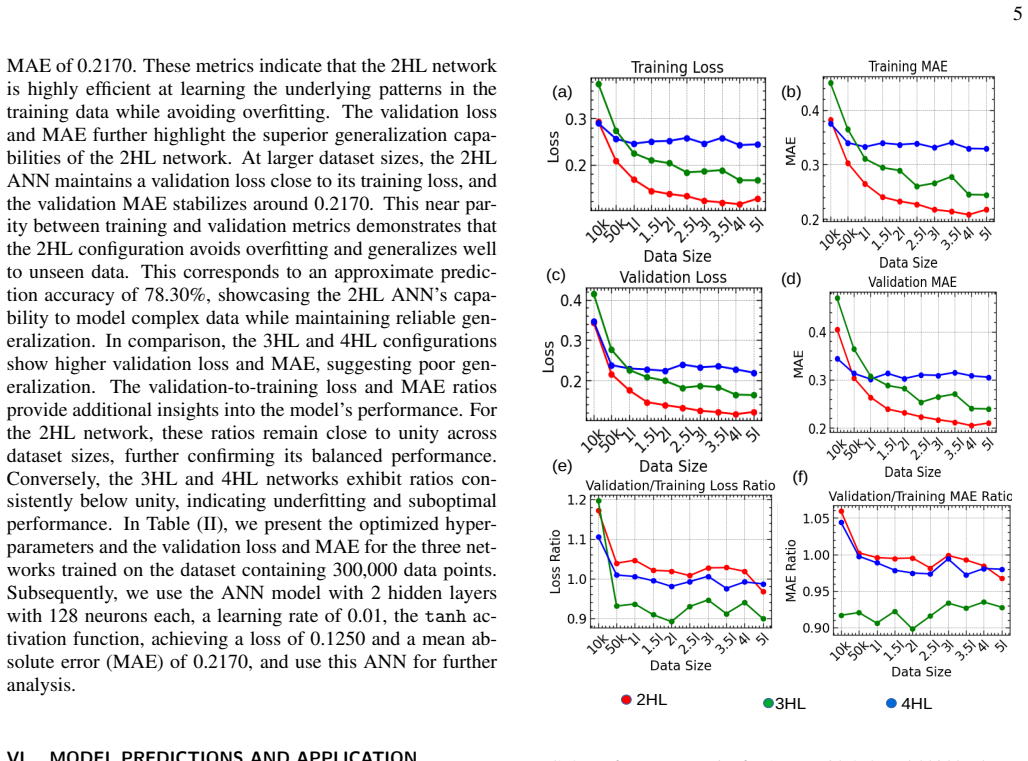
- [Section III and Section VI, ANN mapping f] The ANN input includes T/T0, which is itself calculated from the same theoretical model (Eq. 2) and the same atomic parameters (quantum numbers, ΩC, T0) that are used to generate the output states. Thus the network effectively learns the inverse of the data generator: given a T/T0 value that was produced by known quantum numbers, it recovers those quantum numbers. The reported MAE of 0.217 and '78.30% accuracy' therefore do not demonstrate predictive power for new physics; they only describe how well the network inverts a deterministic map. To support the claim of 'predicting' engine states, the authors should either exclude T/T0 from the inputs, treat it as a design target to be optimized, or validate the model against independent experimental or theoretical data not used in training.
- [Section IV and Section VI, dataset size] The dataset size is reported inconsistently: Section IV states 'we generated 4.6 million data points,' then immediately 'we use the 4.5 million initial dataset,' and Section VI refers to 'the initial dataset consisting of 45 million data points.' These numbers differ by an order of magnitude and are not reconciled. This inconsistency prevents the reader from assessing the training/validation split, the subset sizes, and the reproducibility of the reported learning curves.
- [Section II, Eq. (4)] The ergotropy formula ε = ħω23(ρ33 − ρ22) is introduced without derivation. For a three-level system with energy ordering E1 < E2 < E3, the passive state is obtained by rearranging the populations in descending order on the ascending energy levels. Depending on the relative ordering of ρ11, ρ22, and ρ33, the extracted work involves ħω12, ħω23, or a combination, not generally ħω23(ρ33 − ρ22). The authors should justify Eq. (4) or provide the explicit passive state construction; otherwise the ergotropy values—and the conclusions based on them—are not reliable.
minor comments (4)
- [Figure captions, Figs. 7 and 8] The captions of Figs. 7 and 8 both state 'for low range of T/T0,' but the text describes the mid- and high-output temperature regimes, respectively. Please correct the captions to match the text.
- [Section IV, data generation] The phrase 'we use the 4.5 million initial dataset' appears immediately after 'we generated 4.6 million data points.' This is confusing; clarify whether the full dataset is 4.6M, 4.5M, or 45M, and specify which subset is used for training and validation.
- [Figure captions, Figs. 6-8] The figure captions use inconsistent notation for the reservoir temperature: 'T13 = T32 = T0' appears while the text uses T13 = T23 = T0. Use a single consistent notation throughout.
- [Supplementary Information 3, Fig. 11] The caption for Fig. 11 lists panels (a)-(f) corresponding to n1, l1, j1, n2, l2, j2, but the text says 'n3, l3, j3, and n2, l2, j2.' The panel labels or the text should be corrected.
Circularity Check
Minor self-referential ANN feature: the T/T0 input is computed from the very states the network is trained to output, but the key thermodynamic comparisons are direct model calculations and are not forced by the ANN.
-
self definitional
[Section III, mapping definition; Eq. (2); Supplementary Information 1]
"We then calculate T /T0 using Eq. (2) and aim to establish the following mapping: f : {n1, l1, j1, ΩC, P, T0, T /T0, Z, A} → {n2, l2, j2, n3, l3, j3}"
The input feature T/T0 is not an independently measured quantity: Eq. (2) defines T from B(Δω=0), and B(Δω=0) depends on Θ and the cross sections, which are functions of the transition frequencies, rates, and populations of the target states n2,l2,j2,n3,l3,j3. Thus T/T0 is a deterministic function of the output labels, so the network's task is a learned inverse mapping from a label-derived aggregate to the labels themselves. This makes the phrase 'predict states with elevated T/T0 values' partly self-referential: the user specifies the very quantity that the target states define.
full rationale
The paper's load-bearing thermodynamic content is not generated by the neural network. The steady-state populations, brightness, T/T0, work, and ergotropy are computed from the explicit model in Section II and Supplementary Information 1, which is drawn from the external EIT heat-engine literature (Harris; Zou et al.), not from a self-citation chain. The ANN is used as a supervised inverse mapper: it receives T/T0, which is itself computed from the target quantum numbers via Eq. (2), and outputs those quantum numbers. This is a methodological self-reference rather than a logical derivation of the physics results. The later Cs-versus-Rb comparison and the 'T/T0 alone is insufficient' claim are direct evaluations of Eqs. (1)-(5) for states selected after prediction and would survive even if the ANN were removed. The ergotropy saturation in Eq. (6) is an explicitly fitted exponential curve to model-generated data, so it is a phenomenological fit rather than an independent prediction, but the paper does not disguise it as a derivation. The omission of the spontaneous-emission '+1' term in the rate equations noted by the reader is a correctness concern about the underlying physical model, not a circularity in the derivation chain. Overall, the only circular flavor is the self-referential use of T/T0 as an ANN input, which is minor and does not force the central physical conclusions.
Assumptions & free parameters
free parameters (3)
- a (Eq. 6) =
1.066e12
- b (Eq. 6) =
4.077e-9
- c (Eq. 6) =
3.547e14
assumptions (4)
- ad hoc to paper Steady-state populations satisfy R13ρ33 - R13ρ11 = 0, R23ρ33 - (R23 + ΩC)ρ22 = 0, ... with Rij = Γij \bar n_ij symmetric.
- domain assumption The spectral brightness and output radiation temperature are given by Eq. (1)-(2) from Harris 2016 and Zou et al. 2017.
- domain assumption Work is computed as W = ΔE - TΔS with ΔS = -ħω13/T0 - ħω23/T0 - ħω13/T (Eq. 5), following Refs. 15 and 20.
- domain assumption T13 = T23 = T0, uniform pumping temperature, throughout.
Cite this review
Pith. "Pith review of Predicting Electromagnetically Induced Transparency based Cold Atomic Engines using Deep Learning." pith.science (2026). https://pith.science/paper/ZATAFK3E
@misc{pith2026250103060,
  author       = {Pith},
  title        = {Pith review of: Predicting Electromagnetically Induced Transparency based Cold Atomic Engines using Deep Learning},
  year         = {2026},
  howpublished = {\url{https://pith.science/paper/ZATAFK3E}},
  note         = {Machine review of arXiv:2501.03060}
}
read the original abstract
We develop an artificial neural network model to predict quantum heat engines working within the experimentally realized framework of electromagnetically induced transparency. We specifically focus on {\Lambda}-type alkali-based cold atomic systems. This network allows us to analyze all the alkali atom-based engines' performance. High performance engines are predicted and analyzed based on three figures of merit output, radiation temperature, work and ergotropy. Contrary to traditional notion, the algorithm reveal the limitations of output radiation temperature as a stand alone metric for enhanced engine performance. In high output temperature regime, Cs based engine with a higher output temperature than Rb based engine is characterized by lower work and ergotropy. This is found to be true for different atomic engines with common predicted states in both high and low output temperature regimes. Additionally, the ergotropy is found to exhibit a saturating exponential dependency on the control Rabi frequency.
Figures


Figures from the paper (8 more)


Reference graph
Works this paper leans on
-
[1]
title title Three-level masers as heat engines , \ @noop journal journal Physical Review Letters \ volume 2 ,\ pages 262 ( year 1959 ) NoStop
work page 1959
-
[2]
author author H. E. D. \ Scovil \ and\ author E. O. \ Schulz-DuBois ,\ title title Three-level masers as heat engines , \ 10.1103/PhysRevLett.2.262 journal journal Phys. Rev. Lett. \ volume 2 ,\ pages 262--263 ( year 1959 ) NoStop
-
[3]
author author H. P. \ Goswami \ and\ author U. Harbola ,\ title title Thermodynamics of quantum heat engines , \ 10.1103/PhysRevA.88.013842 journal journal Phys. Rev. A \ volume 88 ,\ pages 013842 ( year 2013 ) NoStop
-
[4]
author author H.-G. \ Xu , author J. Jin , author N. G. \ de Almeida , \ and\ author G. D. d. M. \ Neto ,\ title title Exploring the role of criticality in the quantum otto cycle fueled by the anisotropic quantum rabi-stark model , \ 10.1103/PhysRevB.110.134318 journal journal Phys. Rev. B \ volume 110 ,\ pages 134318 ( year 2024 ) NoStop
-
[5]
author author G. xiang Deng , author Z. He , author Y. Liu , author W. Shao , \ and\ author Z. Cui ,\ https://arxiv.org/abs/2405.17763 title Capturing dynamics and thermodynamics of a three-level quantum heat engine via programmable quantum circuits , \ ( year 2024 ),\ http://arxiv.org/abs/2405.17763 arXiv:2405.17763 [quant-ph] NoStop
work page Pith review arXiv 2024
-
[6]
author author M. Sandilya , author J. Akhtar , author M. J. \ Sarmah , \ and\ author H. P. \ Goswami ,\ title title Cotunneling effects in the geometric statistics of a nonequilibrium spin-resolved junction , \ https://doi.org/10.1002/andp.202400143 journal journal Annalen der Physik \ volume 536 ,\ pages 2400143 ( year 2024 ) NoStop
-
[7]
author author H. Leitch , author N. Piccione , author B. Bellomo , \ and\ author G. De Chiara ,\ title title Driven quantum harmonic oscillators: A working medium for thermal machines , \ 10.1116/5.0072067 journal journal AVS Quantum Science \ volume 4 ,\ pages 012001 ( year 2022 ) ,\ http://arxiv.org/abs/https://pubs.aip.org/avs/aqs/article-pdf/doi/10.11...
-
[8]
author author M. J. \ Sarmah \ and\ author H. P. \ Goswami ,\ title title Efficiency fluctuations of a heat engine with noise-induced quantum coherences , \ 10.1103/PhysRevA.110.052214 journal journal Phys. Rev. A \ volume 110 ,\ pages 052214 ( year 2024 a ) NoStop
Show all 46 references
-
[9]
Hegde , author R
author author A. Hegde , author R. Ott , author A. Xia , author V. Kasper , author J. Berges , \ and\ author F. Jendrzejewski ,\ title title Nonequilibrium dynamics of fluctuations in an ultracold atomic mixture , \ 10.1103/PhysRevA.107.L031302 journal journal Phys. Rev. A \ v...
-
[10]
author author M. J. \ Sarmah \ and\ author H. P. \ Goswami ,\ title title Learning coherences from nonequilibrium fluctuations in a quantum heat engine , \ https://doi.org/10.1016/j.physa.2023.129135 journal journal Physica A: Statistical Mechanics and its Applications \ volum...
2023
-
[12]
Van Horne , author D
author author N. Van Horne , author D. Yum , author T. Dutta , author P. H \"a nggi , author J. Gong , author D. Poletti , \ and\ author M. Mukherjee ,\ title title Single-atom energy-conversion device with a quantum load , \ @noop journal journal npj Quantum Information \ vol...
2020
-
[13]
\ Boller , author A
author author K.-J. \ Boller , author A. Imamo g lu , \ and\ author S. E. \ Harris ,\ title title Observation of electromagnetically induced transparency , \ @noop journal journal Physical Review Letters \ volume 66 ,\ pages 2593 ( year 1991 ) NoStop
1991
-
[14]
author author S. E. \ Harris , author J. Field , \ and\ author A. Imamo g lu ,\ title title Nonlinear optical processes using electromagnetically induced transparency , \ @noop journal journal Physical Review Letters \ volume 64 ,\ pages 1107 ( year 1990 ) NoStop
1990
-
[16]
\ Ma , author H.-Z
author author J.-Y. \ Ma , author H.-Z. \ Shen , author X.-J. \ Zhang , \ and\ author J.-H. \ Wu ,\ title title Single-atom quantum heat engine based on electromagnetically induced transparency , \ 10.1103/PhysRevA.109.012207 journal journal Phys. Rev. A \ volume 109 ,\ pages ...
-
[17]
author author S. E. \ Harris ,\ title title Electromagnetically induced transparency and quantum heat engines , \ 10.1103/PhysRevA.94.053859 journal journal Phys. Rev. A \ volume 94 ,\ pages 053859 ( year 2016 b ) NoStop
2016 doi
-
[18]
author author R. Laskar ,\ title title Proposal for composite quantum electromagnetically induced transparency heat engine coupled by a nanomechanical mirror , \ 10.1088/1361-6455/ad2183 journal journal Journal of Physics B: Atomic, Molecular and Optical Physics \ volume 57 ,\...
-
[19]
Niaz , author Y.-L
author author L. Niaz , author Y.-L. \ Chuang , author F. Badshah , \ and\ author Rahmatullah ,\ title title Gain-assisted quantum heat engine based on electromagnetically induced transparency , \ https://doi.org/10.1016/j.ijleo.2024.171816 journal journal Optik \ volume 306 ,...
-
[20]
Zou , author Y
author author Y. Zou , author Y. Jiang , author Y. Mei , author X. Guo , \ and\ author S. Du ,\ title title Quantum heat engine using electromagnetically induced transparency , \ 10.1103/PhysRevLett.119.050602 journal journal Phys. Rev. Lett. \ volume 119 ,\ pages 050602 ( yea...
-
[21]
author author S. E. \ Harris , author J. E. \ Field , \ and\ author A. Imamo g g lu ,\ title title Nonlinear optical processes using electromagnetically induced transparency , \ 10.1103/PhysRevLett.64.1107 journal journal Phys. Rev. Lett. \ volume 64 ,\ pages 1107--1110 ( year...
-
[22]
Fleischhauer , author A
author author M. Fleischhauer , author A. Imamoglu , \ and\ author J. P. \ Marangos ,\ title title Electromagnetically induced transparency: Optics in coherent media , \ 10.1103/RevModPhys.77.633 journal journal Rev. Mod. Phys. \ volume 77 ,\ pages 633--673 ( year 2005 ) NoStop
-
[23]
Imamolu , author J
author author A. Imamolu , author J. E. \ Field , \ and\ author S. E. \ Harris ,\ title title Lasers without inversion: A closed lifetime broadened system , \ 10.1103/PhysRevLett.66.1154 journal journal Phys. Rev. Lett. \ volume 66 ,\ pages 1154--1156 ( year 1991 ) NoStop
-
[24]
author author J. E. \ Geusic , author E. O. \ Schulz-DuBios , \ and\ author H. E. D. \ Scovil ,\ title title Quantum equivalent of the carnot cycle , \ 10.1103/PhysRev.156.343 journal journal Phys. Rev. \ volume 156 ,\ pages 343--351 ( year 1967 ) NoStop
-
[25]
Mihalas \ and\ author B
author author D. Mihalas \ and\ author B. W. \ Mihalas ,\ @noop title Foundations of Radiation Hydrodynamics \ ( publisher Oxford University Press, New York ,\ year 1984 )\ pp.\ pages xv+718 NoStop
1984
-
[26]
C akmak ,\ title title Ergotropy from coherences in an open quantum system , \ @noop journal journal Physical Review E \ volume 102 ,\ pages 042111 ( year 2020 ) NoStop
author author B. C akmak ,\ title title Ergotropy from coherences in an open quantum system , \ @noop journal journal Physical Review E \ volume 102 ,\ pages 042111 ( year 2020 ) NoStop
2020
-
[27]
Biswas , author M
author author T. Biswas , author M. obejko , author P. Mazurek , author K. Ja owiecki , \ and\ author M. Horodecki ,\ title title Extraction of ergotropy: Free energy bound and application to open cycle engines , \ @noop journal journal Quantum \ volume 6 ,\ pages 841 ( year 2...
2022
-
[28]
author author M. J. \ Sarmah \ and\ author H. P. \ Goswami ,\ title title Noise-induced coherent ergotropy of a quantum heat engine , \ 10.1103/PhysRevA.110.032213 journal journal Phys. Rev. A \ volume 110 ,\ pages 032213 ( year 2024 c ) NoStop
-
[29]
Elouard \ and\ author C
author author C. Elouard \ and\ author C. Lombard Latune ,\ title title Extending the laws of thermodynamics for arbitrary autonomous quantum systems , \ @noop journal journal PRX Quantum \ volume 4 ,\ pages 020309 ( year 2023 ) NoStop
2023
-
[30]
title title Arc: An open-source library for calculating properties of alkali rydberg atoms , \ @noop journal journal Computer Physics Communications \ volume 220 ,\ pages 319--331 ( year 2017 ) NoStop
2017
-
[31]
Lai , author S
author author Z. Lai , author S. Zhang , author Q. Gou , \ and\ author Y. Li ,\ title title Polarizabilities of rydberg states of rb atoms with n up to 140 , \ 10.1103/PhysRevA.98.052503 journal journal Phys. Rev. A \ volume 98 ,\ pages 052503 ( year 2018 ) NoStop
-
[32]
Krug ,\ http://nbn-resolving.de/urn:nbn:de:bvb:19-3362 title Alkali rydberg states in electromagnetic fields , \ ( year 2001 ) NoStop
author author A. Krug ,\ http://nbn-resolving.de/urn:nbn:de:bvb:19-3362 title Alkali rydberg states in electromagnetic fields , \ ( year 2001 ) NoStop
2001
-
[34]
author author A. F. J. \ van Raan , author G. Baum , \ and\ author W. Raith ,\ title title Measurement of the scalar polarizability of very highly excited states of caesium , \ 10.1088/0022-3700/9/12/003 journal journal Journal of Physics B: Atomic and Molecular Physics \ volu...
-
[36]
author author C. E. \ Theodosiou ,\ title title Lifetimes of alkali-metal---atom rydberg states , \ 10.1103/PhysRevA.30.2881 journal journal Phys. Rev. A \ volume 30 ,\ pages 2881--2909 ( year 1984 b ) NoStop
1984 doi
-
[37]
Zhao , author X
author author J. Zhao , author X. Zhu , author L. Zhang , author Z. Feng , author C. Li , \ and\ author S. Jia ,\ title title High sensitivity spectroscopy of cesium rydberg atoms using electromagnetically induced transparency , \ 10.1364/OE.17.015821 journal journal Opt. Expr...
-
[38]
author author M. P. A. \ Jones , author R. M. \ Potvliege , \ and\ author M. Spannowsky ,\ title title Probing new physics using rydberg states of atomic hydrogen , \ 10.1103/PhysRevResearch.2.013244 journal journal Phys. Rev. Res. \ volume 2 ,\ pages 013244 ( year 2020 b ) NoStop
-
[39]
Micha \'n k \'o w , author P
author author J. Micha \'n k \'o w , author P. Sakowski , \ and\ author R. \'S lepaczuk ,\ title title Mean absolute directional loss as a new loss function for machine learning problems in algorithmic investment strategies , \ @noop journal journal Journal of Computational Sc...
2024
-
[40]
Qi , author J
author author J. Qi , author J. Du , author S. M. \ Siniscalchi , author X. Ma , \ and\ author C.-H. \ Lee ,\ title title On mean absolute error for deep neural network based vector-to-vector regression , \ @noop journal journal IEEE Signal Processing Letters \ volume 27 ,\ pa...
2020
-
[41]
Abadi , author A
author author M. Abadi , author A. Agarwal , author P. Barham , author E. Brevdo , author Z. Chen , author C. Citro , author G. S. \ Corrado , author A. Davis , author J. Dean , author M. Devin , author S. Ghemawat , author I. Goodfellow , author A. Harp , author G. Irving , a...
2015
-
[42]
Goodfellow , author Y
author author I. Goodfellow , author Y. Bengio , \ and\ author A. Courville ,\ @noop title Deep Learning \ ( publisher MIT Press ,\ year 2016 )\ note http://www.deeplearningbook.org NoStop
2016
-
[43]
author author E. C. \ Seyrek \ and\ author M. Uysal ,\ title title A comparative analysis of various activation functions and optimizers in a convolutional neural network for hyperspectral image classification , \ 10.1007/s11042-023-17546-5 journal journal Multimedia Tools and...
-
[44]
author author M. J. \ Sarmah ,\ @noop title D L - E nabled- P rediction-of- Q H E s- B ased-on- E I T : D eep L earning- E nabled P rediction of Q uantum H eat E ngines B ased on E lectromagnetically I nduced T ransparency --- github.com , \ howpublished https://github.com/Man...
2024
-
[45]
author author C. E. \ Mungan ,\ title title Radiation thermodynamics with applications to lasing and fluorescent cooling , \ 10.1119/1.1842732 journal journal American Journal of Physics \ volume 73 ,\ pages 315--322 ( year 2005 ) ,\ http://arxiv.org/abs/https://pubs.aip.org/a...
-
[46]
author author X. L. \ Ruan , author S. C. \ Rand , \ and\ author M. Kaviany ,\ title title Entropy and efficiency in laser cooling of solids , \ 10.1103/PhysRevB.75.214304 journal journal Phys. Rev. B \ volume 75 ,\ pages 214304 ( year 2007 ) NoStop
-
[47]
author author S. R. \ Dubey , author S. K. \ Singh , \ and\ author B. B. \ Chaudhuri ,\ title title Activation functions in deep learning: A comprehensive survey and benchmark , \ @noop journal journal Neurocomputing \ volume 503 ,\ pages 92--108 ( year 2022 ) NoStop
2022
-
[48]
author author S. I. \ Serengil ,\ @noop title Hyperbolic tangent as neural network activation function , \ howpublished https://sefiks.com/2017/01/29/hyperbolic-tangent-as-neural-network-activation-function/ ( year 2017 ),\ note [Online; accessed 2024-09-24] NoStop
2017
-
[49]
author author T. Szanda a ,\ title Review and comparison of commonly used activation functions for deep neural networks , \ in\ 10.1007/978-981-15-5495-7_11 booktitle Bio-inspired Neurocomputing ,\ editor edited by\ editor A. K. \ Bhoi , editor P. K. \ Mallick , editor C.-M. \...
-
[50]
Maurya \ and\ author N
author author M. Maurya \ and\ author N. Yadav ,\ title title A comparative analysis of gradient-based optimization methods for machine learning problems , \ in\ @noop booktitle Proceedings on International Conference on Data Analytics and Computing ,\ editor edited by\ editor...
2023
Reviewed August 10, 2026 · model on record in the stance chip above.
Discussion (0). Continue with ORCID to comment.