REVIEW 3 major objections 4 minor 3 cited by
Pulsar timing in the Galactic Center
T0 review · 3 major / 4 minor · reviewed 2026-08-10 · deepseek-v4-flash
Pith's one-line read First-order post-Newtonian timing models fail by seconds for pulsars around supermassive black holes, so fully geodesic photon propagation is needed to keep phase connection.
desk verdict Useful proof-of-concept for fully geodesic GC pulsar timing, but the claim that current codes fail is overreach: the 1PN comparison fixes parameters, never fits, and doesn't test real TEMPO2/PINT implementations. read the letter →
The pith
A machine-rendered reading of the paper's core claim, the machinery that carries it, and where it could break.
The reading
What carries the argument
The load-bearing object is the numerical solution of the emitter-observer problem for null geodesics in a static, spherically symmetric spacetime. For a chosen emission event, the impact parameter b is found by solving the angular integral that links the emitter and observer positions, and the coordinate travel time is the integral of dt/dr along the direct or indirect photon path; the paper composes this with a geodesically integrated pulsar orbit, samples emission times in proper time, computes the relativistic propagation time at each sample, and inverts the interpolated TOA(τ) function to define τ(TOA). This replaces the 1PN delay sum of Eq. (27), whose Rømer and Shapiro terms assume straight-line propagation and whose geometric delay is only a weak-lensing correction.
What would settle it
Take the Toy 0 or S2-like orbit, generate noise-free TOAs from the geodesic pipeline, and fit them with the 1PN timing model of Eq. (27): a residual structure peaking near superior conjunction at the predicted 1-second-to-2-second level would confirm the paper's claim, whereas residuals below 100 microseconds across the full orbit would falsify it.
Extended reading notes
Core claim
The paper's central claim is that the 1PN timing model—straight-line Rømer delay, Shapiro delay, and weak-lensing geometric delay—cannot reproduce the relativistic photon propagation time for a pulsar orbiting a supermassive black hole. For a circular orbit at 100 gravitational radii, the discrepancy reaches about 2 seconds at superior conjunction, and for an S2-like orbit at the same semimajor axis as Sgr A* the discrepancy is about 0.1 seconds, three orders of magnitude above the nominal 100-microsecond sensitivity. The authors build a timing pipeline in which the pulsar orbit is integrated geodesically in Schwarzschild spacetime in harmonic coordinates, the emitter-observer problem is solved numerically for the primary photon image, and the monotonic TOA(τ) map is inverted by spline interpolation to generate phase-connected residuals. They then use this pipeline to show how misestimating intrinsic and orbital parameters imprints detectable, growing residuals, implying that a single pulsar could constrain the black hole mass far better than current stellar-orbit measurements.
Load-bearing premise
The paper's conclusion that current timing codes fail at the Galactic Center rests on the assumption that the simplified 1PN delay formula of Eq. (27), with straight-line Rømer and Shapiro delays plus a weak-lensing geometric term, is what existing timing codes actually implement for a test particle around a point mass; if real codes use more complete post-Keplerian models, the claimed failure is not established.
Editorial extensions
If this is right
- If the central claim is correct, 1PN timing residuals for a pulsar-SMBH system can exceed the pulsar period, so phase connection is lost and standard TOA fitting breaks down.
- For an S2-like orbit around Sgr A*, the 1PN-versus-geodesic discrepancy is about 0.1 seconds, still three orders of magnitude above the 100-microsecond accuracy goal, so even mildly relativistic orbits require geodesic modeling.
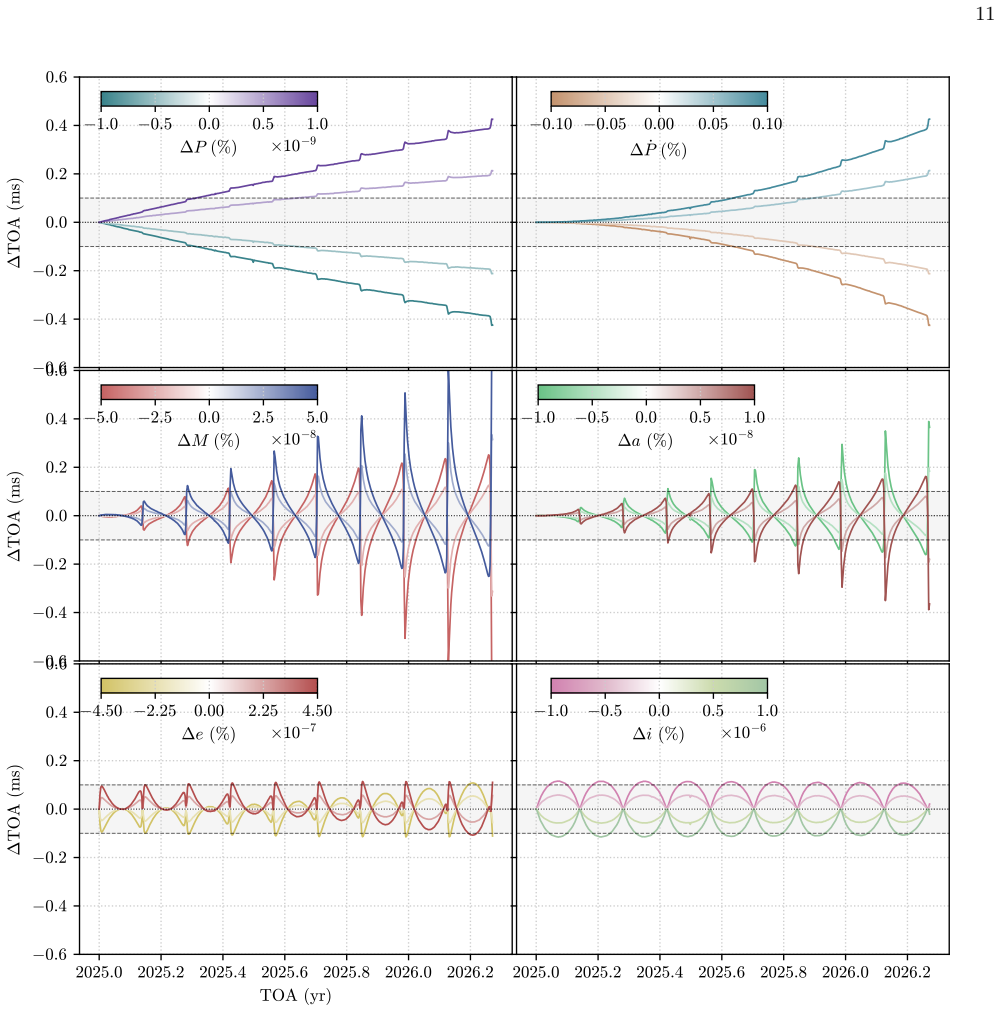
- Misestimating the black hole mass or the semimajor axis by about one part in 10^10 produces residuals above the detection threshold within months to a few years, depending on orbital compactness, which would sharply improve current Sgr A* mass measurements.
- Extending the geodesic timing model to a rotating black hole spacetime is the stated next step, and in spherical symmetry the method already applies to any spacetime, not only Schwarzschild.
- Indirect photon paths that dip toward the photon sphere are included in the propagation-time calculation, so the model captures strong lensing effects that 1PN formulas omit entirely.
Reading between the lines
- Beyond the paper's claims: the same 1PN delay formulas would also corrupt timing of pulsars orbiting intermediate-mass black holes or dense cluster centers, so the geodesic pipeline likely has applications well outside the Galactic Center.
- Beyond the paper's claims: the single-parameter sensitivity study hints at strong degeneracies between orbital parameters and the black hole mass; a full Bayesian fit on simulated TOAs would show how tightly these parameters can actually be separated rather than independently bounded.
- Beyond the paper's claims: the claim that current codes fail depends on Eq. (27) faithfully representing them; testing the same orbit with a complete post-Keplerian timing model would either confirm the failure or localize it to the simplified straight-line delay model the paper adopts.
Editorial analysis
A structured set of objections, weighed in public.
Referee Report
Summary. The paper proposes a fully geodesic timing pipeline for future pulsars orbiting Sgr A*. For a given set of orbital and intrinsic parameters, it integrates the pulsar geodesic, solves the emitter-observer problem for each emitted photon, and inverts the TOA-versus-proper-time relation by spline interpolation to build a timing model. The authors compare this model with a fixed-parameter 1PN delay model composed of Rømer, Shapiro, and geometric delays (Eq. 27), reporting discrepancies of order seconds for a 100M circular orbit and much larger discrepancies for tighter and more eccentric orbits (Figure 6). They also compute residuals caused by one-at-a-time misestimations of parameters such as the pulsar period, spin-down rate, SMBH mass, semi-major axis, eccentricity, and inclination, and use these to argue for extreme future constraining power on the SMBH mass and orbital parameters.
Significance. If the comparison were made against the actual timing models used by TEMPO2/PINT and included a full parameter fit, this would be an important proof-of-concept for strong-field pulsar timing around Sgr A*. The numerical solver is a clear strength: it is validated against the independent Hackmann-Dhani exact solution for a circular-orbit case, and the framework is general enough to be extended beyond Schwarzschild to other spherically symmetric spacetimes. However, the paper's headline claim that 'current timing codes' fail is not yet established, because the 1PN comparison uses a simplified fixed-parameter delay sum rather than a fitted post-Keplerian model, and the sensitivity analysis is based on one-at-a-time parameter offsets rather than a correlated fit. These issues are load-bearing for the abstract and conclusions, so the paper needs a revision that either sharpens the claims or adds the missing comparison.
major comments (3)
- [Section IV B, Eq. (27), Figure 6] The comparison labeled 'current timing codes' tests a fixed-parameter sum ΔtPN = ΔtR + ΔtSh + Δtgeo, not the timing model implemented in TEMPO2/PINT. Standard codes use the Damour-Deruelle post-Keplerian model, which includes relativistic orbital dynamics, the Einstein delay γ sin u, aberration, and a different Shapiro delay parametrization, and they fit all parameters globally to minimize the residuals. A fixed-parameter comparison cannot determine whether a real timing code loses phase connection, because the best-fit mass, semi-major axis, inclination, and pulsar period can absorb part of the delay discrepancy. Please either reframe the claim as applying to the simplified 1PN model only, or generate geodesic TOAs and fit them with TEMPO2/PINT to test the 'current codes fail' conclusion directly.
- [Section IV A, Figure 5, Table II] The claimed constraining power is derived from varying one parameter at a time while keeping all other parameters fixed, and no noise is included in the simulated residuals. In a real fit, parameter covariances and TOA uncertainties strongly affect the posterior, so the percentages reported in Table II should not be presented as projected measurement precisions. Please either run a full correlated fit (e.g., a Fisher-matrix or Markov-chain Monte Carlo forecast) or explicitly label these numbers as qualitative one-parameter sensitivities.
- [Section II, Eq. (20), Figure 2] The text states that the exact Hackmann-Dhani solution is for a non-inclined circular orbit, but Figure 2 describes the toy model as having inclination i = 60°. Please clarify whether Eq. (20) applies to an inclined orbit; if it is restricted to zero inclination, the validation should be repeated for the inclined case or the caption corrected. This is the main external validation of the numerical pipeline, so the configuration must be unambiguous.
minor comments (4)
- [Section IV B] The sentence 'The results of this analysis are shown in Figure ??' contains an unresolved placeholder; the actual figure appears as Figure 6 and should be cited explicitly in the text.
- [Throughout] There are several typographical errors, including 'Galctic' in the introduction to Section III A, 'Earth-bsaed' in the Conclusions, and 'Seciton' in the Conclusions; these should be corrected in a final proofreading pass.
- [Figure 2] The inset axis label '5|Num-Ex| (10^-7 s)' is unclear; please label the quantity explicitly, for example '|Numerical - Exact| (10^-7 s)', and ensure the units are unambiguous.
- [Section III B] The statement that Ndense roughly 50 times Ndata provides a robust reconstruction of TOA(τ) is not accompanied by a quantitative convergence test; the paper notes that increasing Ndense gives improvements below sensitivity, but showing the interpolation error as a function of Ndense would make the choice more defensible.
Circularity Check
No significant circularity: the geodesic-vs-1PN comparison is a direct fixed-parameter computation validated against an independent exact solution, and the sensitivity curves are parametric derivatives rather than fitted predictions.
full rationale
The central derivation is self-contained and does not reduce to its inputs. The paper compares the fully relativistic photon propagation time from Eqs. (10)-(16) with the 1PN delay formula in Eq. (27), using fixed toy-model parameters (Table I) and no fitting to data. The 1PN formula is an independent input taken from the cited timing literature, not derived from the geodesic result, so the large residuals reported in Figure 2 are a computed discrepancy rather than a fitted or assumed one. The numerical emitter-observer solver, which is the one load-bearing element inherited from the authors' prior work [37], is validated in this paper against the independent closed-form solution of Hackmann and Dhani [41]; Figure 2 reports agreement within the adopted numerical tolerance of 10^-6 s. That external exact solution provides an anchor outside the present paper's own pipeline, so the self-citation does not carry the argument by itself. The parameter-sensitivity residuals in Figure 5 and Table II are explicitly qualitative parametric derivatives: they show how the same timing model responds when one parameter is varied while the others are held fixed, which is a Fisher-type sensitivity statement rather than a prediction fitted to observations. No self-definitional reduction, fitted-input-called-prediction, imported uniqueness theorem, or ansatz-smuggled-via-citation pattern is present. One non-circular concern should be noted: Section IV B identifies Eq. (27) with what is 'implemented in all current codes devoted to TOA analysis' [43, 50, 55], whereas standard codes include post-Keplerian orbital dynamics, the Einstein delay, aberration, and parameter fitting; this is a possible overreach in the 'current codes fail' wording, but it concerns the adequacy of the comparison, not the logical circularity of the derivation. Therefore the circularity score is 0.
Assumptions & free parameters
free parameters (6)
- Sgr A* mass M =
4e6 M_sun (assumed standard value)
- Observer distance r_o =
1e9 M
- Pulsar spin period P =
2 s (exemplary value)
- Spin-down rate Pdot =
Assumed small; perturbed by 0.1% in Figure 5
- Toy model orbital parameters =
Table I: a = 1025, 175.4, 43.8, 5 AU; e = 0.88, 0.80, 0.80, 0.786
- TOA accuracy threshold =
100 microseconds
assumptions (5)
- domain assumption The pulsar is a test particle following a timelike geodesic in the Schwarzschild spacetime of the SMBH.
- standard math Photon propagation can be restricted to the equatorial plane without loss of generality.
- domain assumption The Earth-based observer is static at a coordinate distance r_o = 1e9 M and measures coordinate time.
- ad hoc to paper The 1PN photon-delay model of Eq. (27) represents what current pulsar timing codes implement.
- ad hoc to paper Spline interpolation of TOA(tau) with N_dense about 50 times N_data preserves all timing information.
Cite this review
Pith. "Pith review of Pulsar timing in the Galactic Center." pith.science (2026). https://pith.science/paper/IGLOAWZP
@misc{pith2026250103912,
  author       = {Pith},
  title        = {Pith review of: Pulsar timing in the Galactic Center},
  year         = {2026},
  howpublished = {\url{https://pith.science/paper/IGLOAWZP}},
  note         = {Machine review of arXiv:2501.03912}
}
read the original abstract
We propose a novel approach which implements the relativistic calculations of the photon travel time into a robust timing model for pulsars orbiting supermassive black holes. We demonstrate that timing models relying on the lowest-order (1PN) post-Newtonian approximation can produce significant discrepancies in strong-field configurations, affecting the predicted relativistic times of arrival at an Earth-based observatory. We also show how a misestimation of the pulsar parameters can lead to the appearance of phase-dependent residual, which hints at a tremendous constraining power of the binary and intrinsic parameters for timing observations of potential pulsars at the Galactic Center.
Figures


Figures from the paper (3 more)


Forward citations
Cited by 3 Pith papers
-
Probing an Intermediate-Mass Black Hole Companion of Sagittarius A* with Pulsar Timing
A 1PN numerical timing model shows that a pulsar orbiting Sgr A* produces large, distinctive post-fit residuals from an IMBH companion, enabling constraints that fill gaps left by existing S-star and proper-motion bounds.
-
A Realistic Pulsar -- Supermassive Black Hole Timing Model
A 2PN-accurate pulsar timing model for a pulsar orbiting Sgr A* includes proper motion, aberration, and red noise, and forecasts that proper motion will not break the SMBH spin degeneracy for short-period orbits.
-
Time Delay of Pulsar Signals in Astrophysical Black Hole Spacetimes
Pulsar time delays are computed for Kerr, deformed Kerr (Johannsen-Psaltis), and rotating Janis-Newman-Winicour spacetimes, producing model-dependent signatures of up to about 15 seconds.
Reference graph
Works this paper leans on
-
[37]
a methodology for the numerical computation of fully relativistic propagation times for photons emitted in a generic spherically symmetric spacetime was introduced. 1 https://www.skao.int/en 2 http://fast.bao.ac.cn 3 https://public.nrao.edu/ngvla/ 4 https://www.ngeht.org arXiv:2501.03912v1 [gr-qc] 7 Jan 2025 2 This can be applied to estimate the observati...
arXiv 2025
-
[1]
Pulsar Timing and its Application for Navigation and Gravitational Wave Detection
W. Becker, M. Kramer, and A. Sesana, Space Sci. Rev. 214, 30 (2018), arXiv:1705.11022 [astro-ph.IM]
work page Pith review arXiv 2018
-
[2]
I. H. Stairs, Living Reviews in Relativity 6, 5 (2003), arXiv:astro-ph/0307536 [astro-ph]
arXiv 2003
-
[3]
D. R. Lorimer, Living Reviews in Relativity 11, 8 (2008), arXiv:0811.0762 [astro-ph]
arXiv 2008
-
[4]
C. M. Will, Living Reviews in Relativity 17, 4 (2014), arXiv:1403.7377 [gr-qc]
arXiv 2014
-
[5]
R. A. Hulse and J. H. Taylor, ApJ 195, L51 (1975)
work page 1975
-
[6]
Taylor, Joseph H., Reviews of Modern Physics 66, 711 (1994)
J. Taylor, Joseph H., Reviews of Modern Physics 66, 711 (1994)
work page 1994
- [7]
Show all 62 references
- [8]
-
[9]
Johnston, M
S. Johnston, M. A. Walker, M. H. van Kerkwijk, A. G. Lyne, and N. D’Amico, MNRAS 274, L43 (1995)
1995
-
[10]
Johnston, M
S. Johnston, M. Kramer, D. R. Lorimer, A. G. Lyne, M. McLaughlin, B. Klein, and R. N. Manchester, MNRAS 373, L6 (2006), arXiv:astro-ph/0606465 [astro- ph]
2006 arXiv
-
[11]
J. S. Deneva, J. M. Cordes, and T. J. W. Lazio, ApJ 702, L177 (2009), arXiv:0908.1331 [astro-ph.SR]
2009 arXiv
-
[12]
J. S. Deneva, Elusive neutron star populations: Galactic center and intermittent pulsars , Ph.D. thesis, Cornell University, New York (2010)
2010
-
[13]
S. D. Bates, S. Johnston, D. R. Lorimer, M. Kramer, A. Possenti, M. Burgay, B. Stappers, M. J. Keith, A. Lyne, M. Bailes, M. A. McLaughlin, J. T. O’Brien, and G. Hobbs, MNRAS 411, 1575 (2011), arXiv:1009.5873 [astro-ph.SR]
2011 arXiv
-
[14]
J. A. Kennea, D. N. Burrows, C. Kouveliotou, D. M. Palmer, E. G¨ o˘ g¨ u¸ s, Y. Kaneko, P. A. Evans, N. Degenaar, M. T. Reynolds, J. M. Miller, R. Wijnands, K. Mori, and N. Gehrels, ApJ 770, L24 (2013), arXiv:1305.2128 [astro- ph.HE]
2013 arXiv
-
[15]
K. Mori, E. V. Gotthelf, S. Zhang, H. An, F. K. Baganoff, N. M. Barri` ere, A. M. Beloborodov, S. E. Boggs, F. E. Christensen, W. W. Craig, F. Dufour, B. W. Grefen- stette, C. J. Hailey, F. A. Harrison, J. Hong, V. M. Kaspi, J. A. Kennea, K. K. Madsen, C. B. Markwardt, M. Nynk...
2013 arXiv
-
[16]
N. Rea, P. Esposito, J. A. Pons, R. Turolla, D. F. Torres, G. L. Israel, A. Possenti, M. Burgay, D. Vigan` o, A. Papitto, R. Perna, L. Stella, G. Ponti, F. K. Baganoff, D. Haggard, A. Camero-Arranz, S. Zane, A. Minter, S. Mereghetti, A. Tiengo, R. Sch¨ odel, M. Fe- roci, R. Mi...
2013 arXiv
-
[17]
M. E. Lower, S. Dai, and S. Johnston, arXiv e-prints , arXiv:2404.09098 (2024), arXiv:2404.09098 [astro-ph.HE]
2024 arXiv
-
[18]
J. M. Cordes and T. J. W. Lazio, arXiv e-prints , astro- ph/0207156 (2002), arXiv:astro-ph/0207156 [astro-ph]
2002
-
[19]
R. P. Eatough, M. Kramer, B. Klein, R. Karuppusamy, D. J. Champion, P. C. C. Freire, N. Wex, and K. Liu, IAU Symp. 291, 382 (2013), arXiv:1210.3770 [astro- ph.GA]
2013 arXiv
-
[20]
R. S. Wharton, S. Chatterjee, J. M. Cordes, J. S. Deneva, and T. J. W. Lazio, ApJ 753, 108 (2012), arXiv:1111.4216 [astro-ph.HE]
2012 arXiv
-
[21]
Torne, G
P. Torne, G. Desvignes, R. P. Eatough, M. Kramer, R. Karuppusamy, K. Liu, A. Noutsos, R. Whar- ton, C. Kramer, S. Navarro, G. Paubert, S. Sanchez, M. Sanchez-Portal, K. F. Schuster, H. Falcke, and L. Rezzolla, A&A 650, A95 (2021), arXiv:2103.16581 [astro-ph.HE]
2021 arXiv
-
[22]
Torne, K
P. Torne, K. Liu, R. P. Eatough, J. Wongphechaux- sorn, J. M. Cordes, G. Desvignes, M. De Laurentis, M. Kramer, S. M. Ransom, S. Chatterjee, R. Whar- ton, R. Karuppusamy, L. Blackburn, M. Janssen, C.-k. Chan, B. Crew, Geoffrey, L. D. Matthews, C. Goddi, H. Rottmann, J. Wagner,...
2023
-
[23]
D. F. Figer, in Massive Stars: From Pop III and GRBs to the Milky Way. Space Telescope Science Institute Sym- posium Series No. 20. Edited by Mario Livio and Eva Villaver. Cambridge University Press , edited by M. Li- vio and E. Villaver (2009) pp. 40–59
2009
-
[24]
Pfahl and A
E. Pfahl and A. Loeb, ApJ 615, 253 (2004), arXiv:astro- ph/0309744 [astro-ph]
2004
- [25]
-
[26]
K. M. Rajwade, D. R. Lorimer, and L. D. Ander- son, MNRAS 471, 730 (2017), arXiv:1611.06977 [astro- ph.HE]
2017 arXiv
-
[27]
Chennamangalam and D
J. Chennamangalam and D. R. Lorimer, MNRAS 440, L86 (2014), arXiv:1311.4846 [astro-ph.HE]
2014 arXiv
-
[28]
Keane, B
E. Keane, B. Bhattacharyya, M. Kramer, B. Stappers, E. F. Keane, B. Bhattacharyya, M. Kramer, B. W. Stap- pers, S. D. Bates, M. Burgay, S. Chatterjee, D. J. Cham- pion, R. P. Eatough, J. W. T. Hessels, G. Janssen, K. J. Lee, J. van Leeuwen, J. Margueron, M. Oertel, A. Possenti...
2015 arXiv
-
[29]
R. Nan, D. Li, C. Jin, Q. Wang, L. Zhu, W. Zhu, H. Zhang, Y. Yue, and L. Qian, International Journal of Modern Physics D 20, 989 (2011), arXiv:1105.3794 [astro-ph.IM]
2011 arXiv
-
[30]
G. C. Bower, A. Broderick, J. Dexter, S. Doeleman, H. Falcke, V. Fish, M. D. Johnson, D. P. Marrone, J. M. Moran, M. Moscibrodzka, A. Peck, R. L. Plambeck, and R. Rao, ApJ 868, 101 (2018), arXiv:1810.07317 [astro- ph.HE]
2018 arXiv
-
[31]
Akiyama, A
K. Akiyama, A. Alberdi, W. Alef, J. C. Algaba, R. Anan- tua, K. Asada, R. Azulay, U. Bach, A.-K. Baczko, D. Ball, and et al., ApJ 930, L12 (2022)
2022
-
[32]
Wex and S
N. Wex and S. M. Kopeikin, ApJ 514, 388 (1999), arXiv:astro-ph/9811052 [astro-ph]
1999 arXiv
-
[33]
K. Liu, N. Wex, M. Kramer, J. M. Cordes, and T. J. W. Lazio, ApJ 747, 1 (2012), arXiv:1112.2151 [astro-ph.HE]
2012 arXiv
-
[34]
Psaltis, N
D. Psaltis, N. Wex, and M. Kramer, ApJ 818, 121 (2016), arXiv:1510.00394 [astro-ph.HE]
2016 arXiv
-
[35]
Christian, D
P. Christian, D. Psaltis, and A. Loeb, arXiv e-prints , arXiv:1511.01901 (2015), arXiv:1511.01901 [gr-qc]
2015 arXiv
-
[36]
R. N. Izmailov, E. R. Zhdanov, A. Bhadra, and K. K. Nandi, European Physical Journal C 79, 105 (2019)
2019
-
[38]
De Laurentis, I
M. De Laurentis, I. de Martino, and R. Della Mon- ica, Reports on Progress in Physics 86, 104901 (2023), arXiv:2211.07008 [astro-ph.GA]
2023 arXiv
-
[39]
Della Monica, I
R. Della Monica, I. De Martino, and M. De Laurentis, MNRAS 524, 3782 (2023), arXiv:2305.18178 [gr-qc]
2023 arXiv
-
[40]
Damour and N
T. Damour and N. Deruelle, Ann. Inst. Henri Poincar´ e Phys. Th´ eor44, 263 (1986)
1986
-
[41]
Eatough, T
R. Eatough, T. J. W. Lazio, J. Casanellas, S. Chatterjee, J. M. Cordes, P. B. Demorest, M. Kramer, K. J. Lee, K. Liu, S. M. Ransom, and N. Wex, in Advancing As- trophysics with the Square Kilometre Array (AASKA14) (2015) p. 45, arXiv:1501.00281 [astro-ph.IM]
2015 arXiv
-
[42]
Nist digital library of mathematical func- tions,
F. W. J. Olver, A. B. O. Daalhuis, D. W. Lozier, B. I. Schneider, R. F. Boisvert, C. W. Clark, B. V. S. B. R. Mille and, H. S. Cohl, and e. M. A. Mc- Clain, “Nist digital library of mathematical func- tions,” http://dlmf.nist.gov/, Release 1.0.26 of 2020-03- 15 (2020)
2020
-
[43]
Hackmann and A
E. Hackmann and A. Dhani, General Relativity and Gravitation 51, 37 (2019), arXiv:1806.02547 [gr-qc]
2019 arXiv
-
[44]
Lai and R
D. Lai and R. R. Rafikov, ApJ 621, L41 (2005), arXiv:astro-ph/0411726 [astro-ph]
2005 arXiv
-
[45]
R. T. Edwards, G. B. Hobbs, and R. N. Manchester, MNRAS 372, 1549 (2006), arXiv:astro-ph/0607664 [astro-ph]
2006 arXiv
-
[46]
J. H. Taylor and J. M. Weisberg, ApJ 345, 434 (1989)
1989
-
[47]
J. H. Taylor, L. A. Fowler, and P. M. McCulloch, Nature 277, 437 (1979)
1979
-
[48]
V. M. Kaspi, J. H. Taylor, and M. F. Ryba, ApJ 428, 713 (1994)
1994
-
[49]
Wolszczan and D
A. Wolszczan and D. A. Frail, Nature 355, 145 (1992)
1992
-
[50]
G. B. Hobbs, R. T. Edwards, and R. N. Manchester, MNRAS 369, 655 (2006), arXiv:astro-ph/0603381 [astro- ph]
2006 arXiv
-
[51]
R. T. Edwards, W. van Straten, and M. Bailes, ApJ 560, 365 (2001), arXiv:astro-ph/0106353 [astro-ph]
2001 arXiv
-
[52]
Anto- niadis, P
EPTA Collaboration, InPTA Collaboration, J. Anto- niadis, P. Arumugam, S. Arumugam, S. Babak, M. Bag- chi, A. S. Bak Nielsen, C. G. Bassa, A. Bathula, A. Ber- thereau, M. Bonetti, E. Bortolas, P. R. Brook, M. Bur- gay, R. N. Caballero, A. Chalumeau, D. J. Cham- pion, S. Chanla...
2023 arXiv
-
[53]
Agazie, A
G. Agazie, A. Anumarlapudi, A. M. Archibald, Z. Ar- zoumanian, P. T. Baker, B. B´ ecsy, L. Blecha, A. Brazier, P. R. Brook, S. Burke-Spolaor, R. Burnette, R. Case, M. Charisi, S. Chatterjee, K. Chatziioannou, B. D. Cheeseboro, S. Chen, T. Cohen, J. M. Cordes, N. J. 16 Cornish,...
2023 arXiv
-
[54]
H. Xu, S. Chen, Y. Guo, J. Jiang, B. Wang, J. Xu, Z. Xue, R. Nicolas Caballero, J. Yuan, Y. Xu, J. Wang, L. Hao, J. Luo, K. Lee, J. Han, P. Jiang, Z. Shen, M. Wang, N. Wang, R. Xu, X. Wu, R. Manchester, L. Qian, X. Guan, M. Huang, C. Sun, and Y. Zhu, Re- search in Astronomy an...
2023 arXiv
-
[55]
ERDF A way of making Europe
based on the same theoretical principles of TEMPO and TEMPO2, was proposed to offer a modern coding en- vironment that allows also for cross-checking the results obtained across the different implementations. The whole procedure, which finally returns the phys- ical parameters...
2025
-
[56]
D. J. Reardon, A. Zic, R. M. Shannon, G. B. Hobbs, M. Bailes, V. Di Marco, A. Kapur, A. F. Rogers, E. Thrane, J. Askew, N. D. R. Bhat, A. Cameron, M. Cury lo, W. A. Coles, S. Dai, B. Goncharov, M. Kerr, A. Kulkarni, Y. Levin, M. E. Lower, R. N. Manchester, R. Mandow, M. T. Mil...
2023 arXiv
-
[57]
J. Luo, S. Ransom, P. Demorest, P. S. Ray, A. Archibald, M. Kerr, R. J. Jennings, M. Bachetti, R. van Haasteren, C. A. Champagne, J. Colen, C. Phillips, J. Zimmerman, K. Stovall, M. T. Lam, and F. A. Jenet, ApJ 911, 45 (2021), arXiv:2012.00074 [astro-ph.IM]
2021 arXiv
-
[58]
Blandford and S
R. Blandford and S. A. Teukolsky, ApJ 205, 580 (1976)
1976
-
[59]
S. M. Kopeikin, ApJ 439, L5 (1995)
1995
-
[60]
S. M. Kopeikin, ApJ 467, L93 (1996)
1996
-
[61]
Wex, MNRAS 298, 67 (1998), arXiv:astro- ph/9706086 [astro-ph]
N. Wex, MNRAS 298, 67 (1998), arXiv:astro- ph/9706086 [astro-ph]
1998
-
[62]
D. R. Lorimer and M. Kramer, Handbook of Pulsar As- tronomy, Vol. 4 (2004)
2004
Reviewed August 10, 2026 · model on record in the stance chip above.
Discussion (0). Continue with ORCID to comment.