REVIEW 4 major objections 5 minor 94 references
Tracing the Winds: A Uniform Interpretation of Helium Escape in Exoplanets from Archival Spectroscopic Observations
T0 review · 4 major / 5 minor · reviewed 2026-08-10 · deepseek-v4-flash
Pith's one-line read Twelve detected helium outflows in exoplanets follow the energy-limited mass-loss scaling, giving photoevaporative efficiencies of 0.34 and 0.75 depending on outflow hydrogen fraction.
desk verdict A genuinely uniform reanalysis of helium detections gives useful per-planet mass-loss rates, but the 'strong evidence' for energy-limited scaling rests on a detection-only sample; treat the efficiencies as conditional. read the letter →
The pith
A machine-rendered reading of the paper's core claim, the machinery that carries it, and where it could break.
The reading
What carries the argument
The argument is carried by the energy-limited mass-loss identity $\dot{M}=3\varepsilon F_{\rm XUV}/(4G\rho_p)$, which ties the observable mass-loss rate to the ratio of incident XUV flux over planetary density through a single efficiency $\varepsilon$. To measure $\dot{M}$ uniformly, the paper feeds each archival transmission spectrum through one hydrodynamic Parker-wind escape model, treats correlated noise with a Gaussian-process covariance initialized outside the helium line, and searches posteriors with nested sampling. The efficiency is then obtained by fitting the linear relation, and a piecewise version with a break at $F_{\rm XUV}/\rho_p\sim10^4$, to the twelve retrieved rates.
What would settle it
Re-run the population fit including published helium non-detections as upper limits: if the slope of $\dot{M}$ versus $F_{\rm XUV}/\rho_p$ flattens or vanishes once those bounds are added, the claimed trend is a selection artifact rather than a population law.
Extended reading notes
Core claim
The central claim is that the population of detected helium outflows is consistent with energy-limited mass loss. Fitting the relation $\dot{M}=3\varepsilon F_{\rm XUV}/(4G\rho_p)$ to the twelve retrieved mass-loss rates, the authors report a piecewise slope break near $F_{\rm XUV}/\rho_p\sim10^4$; below that threshold the inferred efficiencies are $\varepsilon=0.34\pm0.13$ at H/(H+He)=0.90 and $0.75\pm0.21$ at 0.99, dropping to $0.10\pm0.06$ and $0.57\pm0.19$ beyond it. Bayesian model comparison favors the linear and piecewise energy-limited models over a flat line, which the authors interpret as support for energy-limited escape. They also show that under these efficiencies the mini-Neptunes in the sample can lose a substantial fraction of their atmosphere in a gigayear, whereas hot Jupiters are mostly resilient.
Load-bearing premise
The load-bearing premise is that the detected-only sample, whose XUV fluxes come partly from proxy stars and whose densities come partly from mass-radius relations, preserves the true population-level relation between mass-loss rate and $F_{\rm XUV}/\rho_p$.
Editorial extensions
If this is right
- If energy-limited escape holds, the mass-loss rate of an exoplanet is set mainly by $F_{\rm XUV}/\rho_p$, so planets with the same ratio should lose mass at the same rate.
- The calibrated efficiencies give evolutionary models a concrete input: at solar helium abundance, roughly 34% of XUV energy goes into driving the outflow, while hydrogen-rich outflows convert about 75%.
- The break near $F_{\rm XUV}/\rho_p\sim10^4$ means the simple linear scaling overestimates mass loss for the most strongly irradiated planets.
- Mini-Neptunes in the sample can lose a large fraction of their atmospheres within a gigayear, supporting their evolution into super-Earths, while hot Jupiters mostly retain their atmospheres.
- Because the sample contains only detected outflows, the population trend chiefly applies to planets with substantial mass loss, and the paper calls for publishing non-detections to constrain the rest.
Reading between the lines
- Inference: If the calibration holds, the measured efficiency can be inserted into evolutionary models to predict which sub-Neptunes lose their envelopes and become super-Earths, tying the observed radius gap to a measured number rather than a free parameter.
- Inference: The higher efficiency at H/(H+He)=0.99 suggests that measuring the helium abundance of an outflow, not just the line depth, is what matters most for population-level evolution, since a hydrogen-rich flow can lose mass several times faster at the same irradiation.
- Inference: Because only detections entered the sample, the reported efficiencies are upper-regime values; adding published non-detections as upper limits could lower the population efficiency and sharpen the comparison with the Neptune-desert boundary.
- Inference: The same Gaussian-process plus hydrodynamic-wind pipeline could be applied to Lyman-alpha and Balmer-line escape tracers to test whether the energy-limited efficiency is independent of the observing tracer.
Signed reviews
Editorial analysis
A structured set of objections, weighed in public.
Referee Report
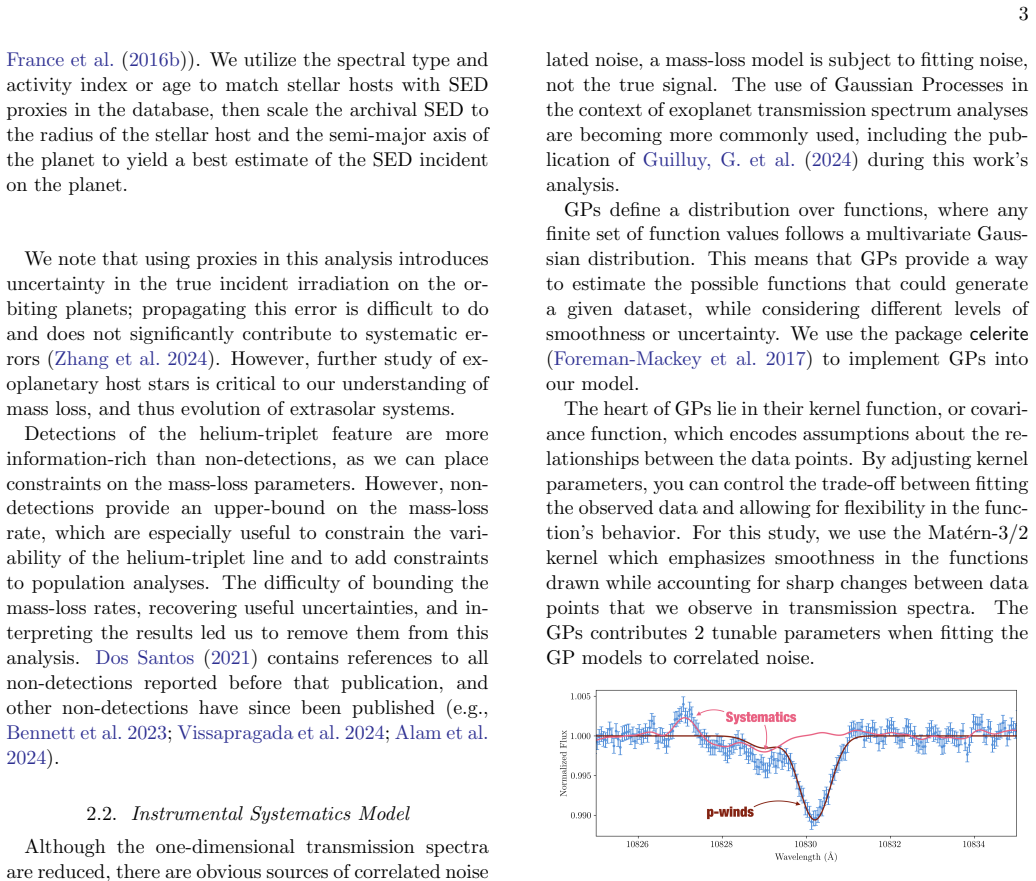
Summary. The paper presents a uniform reanalysis of archival helium-triplet transmission spectra of 12 exoplanets using the p-winds Parker-wind model with Gaussian-process modeling of correlated noise and nested-sampling parameter estimation. For each planet and for two assumed hydrogen fractions (H/(H+He)=0.90 and 0.99), the authors retrieve mass-loss rates, outflow temperatures, and line-of-sight velocities, and then fit these to the energy-limited scaling Mdot = 3 epsilon FXUV/(4 G rho_p). They report population-level efficiencies of epsilon = 0.34 +/- 0.13 and 0.75 +/- 0.21 for the two abundance cases, and conclude from Bayesian model comparison that the data provide "strong evidence supporting energy-limited mass loss." The paper includes individual object discussions, comparisons with previous retrievals, and a brief discussion of evolutionary implications.
Significance. If the population-level efficiencies are robust, this would be a valuable uniform calibration of photoevaporative efficiency across a diverse sample of hot Jupiters, warm Neptunes, and mini-Neptunes, directly informing exoplanet evolution models and the interpretation of the radius gap. The paper's strengths are its homogeneous modeling framework, explicit treatment of correlated noise via Gaussian processes, use of open-source tools (p-winds, dynesty, celerite), and transparent reporting of archival data provenance and per-object posteriors (with appendix figures on Zenodo). The authors are also candid about limitations, including the bias toward large helium signals and the use of proxy SEDs. However, the central population claim currently rests on a detection-only sample and on x-axis quantities (FXUV and rho_p) whose uncertainties are not propagated, so the reported efficiencies and the "strong evidence" statement are not yet population-level robust.
major comments (4)
- [2.1, 6] The population-level conclusion in Section 5.2 and the abstract is based exclusively on the 12 detections; Section 2.1 removes all non-detections even though published upper limits exist, and Section 6 acknowledges the resulting bias toward large helium signatures and higher mass-loss rates. If the detection probability in Mdot is correlated with FXUV/rho, the fitted efficiencies (0.34 +/- 0.13 and 0.75 +/- 0.21) and the log-evidence preference for an energy-limited model (Delta ln Z ~ 5) can be imprinted by this selection. A censored analysis that includes non-detections as upper limits, or at minimum a quantitative demonstration that the selection does not bias the fitted slope, is required before claiming "strong evidence supporting energy-limited mass loss" for the population.
- [2.1, Eq. (1)] For 8 of the 12 stars, the incident FXUV is derived from proxy SEDs (Table 1), and the text states that propagating the proxy uncertainty is difficult and "does not significantly contribute to systematic errors" (citing Zhang et al. 2024). No uncertainty on FXUV appears in Figure 3 or in the fitted efficiencies. Since Eq. (1) is linear in FXUV, a factor-of-two error in the proxy XUV flux translates directly into a factor-of-two error in epsilon, and correlated proxy errors across similar spectral types can systematically tilt the fitted slope. The paper should propagate or marginalize over SED uncertainties, or provide a sensitivity test that varies the assumed proxies.
- [3.3, Eq. (1)] The x-axis of Figure 3 uses rho_p, but the masses of TOI-1430b, TOI-1683b, and TOI-2076b are taken from the Wolfgang et al. (2016) mass-radius relation rather than measured, and Section 3.3 notes that these densities are uncertain. These three mini-Neptunes contribute to the spread in FXUV/rho, so their uncertain x-coordinates can affect the fitted slope and thus the derived efficiencies. At minimum, the fit should be repeated using the full mass-radius posterior or with densities varied within published uncertainties to show that the reported efficiencies are not driven by these assumptions.
- [5.2, Table 4] The headline efficiencies quoted in the abstract and conclusions (0.34 +/- 0.13 and 0.75 +/- 0.21) are the pre-boundary slopes of the piecewise model, but the piecewise model is not significantly preferred over the simple linear model: the log-evidence differences are Delta ln Z = 0.19 for H/(H+He)=0.90 and Delta ln Z = -0.12 for H/(H+He)=0.99, with the latter actually disfavoring the piecewise model. The linear-fit efficiencies are 0.18 +/- 0.04 and 0.67 +/- 0.14. Given this weak or negative evidence for a break, the paper should either quote the linear-model efficiencies as the primary population values or justify why the piecewise pre-boundary value is the appropriate efficiency.
minor comments (5)
- [6] The phrase "strong evidence supporting energy-limited mass loss" is stronger than the model-selection results support; Benneke & Seager (2013) classify Delta ln Z ~ 5 as strong but the comparison is between flat and linear models, not against the piecewise model, and the detection-only sample weakens the inference.
- [References] Several references are duplicated in the bibliography, including Owen & Lai (2018) and Masson et al. (2024), which each appear twice; these should be consolidated.
- [4.5] The sentence "WASP-52b contains large-amplitude correlated noise in its helium transmission spectrum, meaning a comparison with a pure Parker wind model should differ" is unclear; it should specify that the comparison should be interpreted with caution or that the model difference is expected.
- [2.2] The phrase "The GPs contributes 2 tunable parameters" is grammatically incorrect and should read "The GP contributes two tunable parameters."
- [Title] The title in the posted draft reads "T racing the Winds"; this appears to be a typesetting artifact and should be corrected to "Tracing the Winds."
Circularity Check
No significant circularity: the mass-loss rates are retrieved with p-winds independently of the energy-limited scaling, and the efficiencies are explicitly fitted slopes rather than predictions.
full rationale
The paper's derivation chain is not circular. Mass-loss rates are retrieved from helium-triplet transmission spectra using p-winds, which implements an isothermal Parker-wind model and does not use the energy-limited formula as an input. The energy-limited scaling Mdot = 3 epsilon F_XUV / (4 G rho_p) is then tested by fitting linear and piecewise models to the retrieved Mdot values against F_XUV/rho_p; the efficiency epsilon is explicitly a fitted slope, not a predicted output, and the flat-versus-linear model comparison is a standard statistical test on the same data. The use of p-winds, co-developed by one of the authors, is open-source and publicly validated, and it functions as an external retrieval forward model rather than a self-citation that forces the conclusion. The removal of non-detections (Section 2.1) and the use of proxy SEDs are acknowledged limitations that affect sample representativeness and systematic uncertainty, but they do not make any equation equivalent to its own inputs by construction. No specific circular reduction can be exhibited, so the circularity score is 0.
Assumptions & free parameters
free parameters (6)
- Photoevaporative efficiency epsilon =
0.34 +/- 0.13 (H/(H+He)=0.90), 0.75 +/- 0.21 (0.99); linear fits 0.18 +/- 0.04 and 0.67 +/- 0.14
- Hydrogen fraction H/(H+He) =
0.90 and 0.99 (assumed)
- Per-planet mass-loss rate (12 planets) =
Table 4, e.g., GJ-3470b 2.0e11 g/s at 0.99 and 6.6e10 g/s at 0.90
- Per-planet outflow temperature (12 planets) =
Table 4, e.g., HD 189733b 15000 K at 0.99
- Per-planet bulk line-of-sight velocity (12 planets) =
Table 4, roughly -6 to +6 km/s
- Gaussian process kernel hyperparameters (Matern-3/2, two per spectrum) =
Not tabulated
assumptions (6)
- domain assumption Parker-wind, constant-sound-speed isothermal outflow describes escaping exoplanet atmospheres, as implemented in p-winds
- domain assumption Energy-limited mass-loss formula Mdot = 3 epsilon FXUV/(4 G rho_p), from Caldiroli et al. 2022, is the correct relation below FXUV/rho ~ 1e4
- domain assumption SED proxies from MUSCLES or X-exoplanets represent each target star's unobserved high-energy spectrum after scaling by radius and semi-major axis
- domain assumption Gaussian process with Matern-3/2 kernel, initialized outside the helium line, removes correlated noise without removing the planetary signal
- ad hoc to paper Non-detections carry no useful information for this population analysis and can be excluded
- domain assumption All planets in the sample have either H/(H+He)=0.90 or 0.99, and atmospheric metallicity does not materially affect the retrievals
Cite this review
Pith. "Pith review of Tracing the Winds: A Uniform Interpretation of Helium Escape in Exoplanets from Archival Spectroscopic Observations." pith.science (2026). https://pith.science/paper/YQLZDMT4
@misc{pith2026250103998,
  author       = {Pith},
  title        = {Pith review of: Tracing the Winds: A Uniform Interpretation of Helium Escape in Exoplanets from Archival Spectroscopic Observations},
  year         = {2026},
  howpublished = {\url{https://pith.science/paper/YQLZDMT4}},
  note         = {Machine review of arXiv:2501.03998}
}
abstract
Over the past decade, observations of evaporating exoplanets have become increasingly common, driven by the discovery of the near-infrared helium-triplet line as a powerful probe of atmospheric escape. This process significantly influences the evolution of exoplanets, particularly those smaller than Jupiter. Both theoretical and observational studies have aimed to determine how efficiently exoplanets convert their host star's X-ray and ultraviolet (XUV) radiation into atmospheric mass loss. In this study, we employ the open-source atmospheric escape model p-winds to systematically analyze all publicly available helium triplet spectroscopic detections related to exoplanetary atmospheric escape. Our findings indicate that the retrieved outflows strongly depend on the ratio of XUV flux to planetary density ($F_{\text{XUV}}/\rho_p$), supporting the theoretical framework of energy-limited mass loss. We constrain population-level photoevaporative efficiencies to $0.34 \pm 0.13$ and $0.75 \pm 0.21$ for hydrogen-helium fractions of $0.90$ and $0.99$, respectively. These results offer new insights into exoplanetary atmospheric evolution and will aid future studies on exoplanet population demographics.
Figures


Figures from the paper (1 more)

Reference graph
Works this paper leans on
-
[1]
Alam, M. K., Kirk, J., Santos, L. A. D., et al. 2024, The Astronomical Journal, 168, 102, doi: 10.3847/1538-3881/ad50d4
-
[2]
2018, Science, 362, 1384–1387, doi: 10.1126/science.aat5879
Allart, R., Bourrier, V., Lovis, C., et al. 2018, Science, 362, 1384–1387, doi: 10.1126/science.aat5879
-
[3]
2019, A&A, 623, A58, doi: 10.1051/0004-6361/201834917
Allart, R., Bourrier, V., Lovis, C., et al. 2019, A&A, 623, A58, doi: 10.1051/0004-6361/201834917
-
[4]
Allart, R., Lem´ ee-Joliecoeur, P. B., Jaziri, A. Y., et al. 2023, A&A, 677, A164, doi: 10.1051/0004-6361/202245832
-
[5]
Alonso-Floriano, F. J., Snellen, I. A. G., Czesla, S., et al. 2019, A&A, 629, A110, doi: 10.1051/0004-6361/201935979 Astropy Collaboration, Robitaille, T. P., Tollerud, E. J., et al. 2013, A&A, 558, A33, doi: 10.1051/0004-6361/201322068 Astropy Collaboration, Price-Whelan, A. M., Sip˝ ocz, B. M., et al. 2018, AJ, 156, 123, doi: 10.3847/1538-3881/aabc4f As...
-
[6]
Batalha, N. M., Rowe, J. F., Bryson, S. T., et al. 2013, ApJS, 204, 24, doi: 10.1088/0067-0049/204/2/24
-
[7]
R., France, K., Brown, A., et al
Behr, P. R., France, K., Brown, A., et al. 2023, AJ, 166, 35, doi: 10.3847/1538-3881/acdb70
-
[8]
Bello-Arufe, A., Knutson, H. A., Mendon¸ ca, J. M., et al. 2023, AJ, 166, 69, doi: 10.3847/1538-3881/acd935
Show all 94 references
-
[9]
E., Garc ´ ıa Mu˜ noz, A., et al
Ben-Jaffel, L., Ballester, G. E., Garc ´ ıa Mu˜ noz, A., et al. 2022, Nature Astronomy, 6, 141, doi: 10.1038/s41550-021-01505-x
2022 doi
-
[10]
2013, The Astrophysical Journal, 778, 153, doi: 10.1088/0004-637X/778/2/153
Benneke, B., & Seager, S. 2013, The Astrophysical Journal, 778, 153, doi: 10.1088/0004-637X/778/2/153
2013 doi
-
[11]
A., Redfield, S., Oklopˇ ci´ c, A., et al
Bennett, K. A., Redfield, S., Oklopˇ ci´ c, A., et al. 2023, The Astronomical Journal, 165, 264, doi: 10.3847/1538-3881/acd34b
2023 doi
-
[12]
A., & Vidotto, A
Tanaka, Y. A., & Vidotto, A. A. 2016, A&A, 591, A121, doi: 10.1051/0004-6361/201628362
2016 doi
-
[13]
2018, A&A, 620, A147, doi: 10.1051/0004-6361/201833675
Bourrier, V., Lecavelier des Etangs, A., Ehrenreich, D., et al. 2018, A&A, 620, A147, doi: 10.1051/0004-6361/201833675
2018 doi
-
[14]
2015, A&A, 582, A65, doi: 10.1051/0004-6361/201526894
Bourrier, V., Ehrenreich, D., & Lecavelier des Etangs, A. 2015, A&A, 582, A65, doi: 10.1051/0004-6361/201526894
2015 doi
-
[15]
2022, A&A, 663, A122, doi: 10.1051/0004-6361/202142763
Caldiroli, A., Haardt, F., Gallo, E., et al. 2022, A&A, 663, A122, doi: 10.1051/0004-6361/202142763
2022 doi
-
[16]
2021, MNRAS, 500, 3382, doi: 10.1093/mnras/staa3431
Hazra, G. 2021, MNRAS, 500, 3382, doi: 10.1093/mnras/staa3431
2021 doi
-
[18]
2023, AJ, 165, 244, doi: 10.3847/1538-3881/accf10 Dos Santos, L
Vissapragada, S. 2023, AJ, 165, 244, doi: 10.3847/1538-3881/accf10 Dos Santos, L. A., & Vissapragada, S. 2023, p-winds, Zenodo, doi: 10.5281/ZENODO.10419485 Dos Santos, L. A., Ehrenreich, D., Bourrier, V., et al. 2020, A&A, 640, A29, doi: 10.1051/0004-6361/202038802 Dos Santos...
2023 doi
-
[19]
V., Kulikov, Y
Erkaev, N. V., Kulikov, Y. N., Lammer, H., et al. 2007, A&A, 472, 329, doi: 10.1051/0004-6361:20066929
2007 doi
-
[20]
P., & Bridges, M
Feroz, F., Hobson, M. P., & Bridges, M. 2009, MNRAS, 398, 1601, doi: 10.1111/j.1365-2966.2009.14548.x
2009
-
[21]
2016, The Journal of Open Source Software, 1, 24, doi: 10.21105/joss.00024
Foreman-Mackey, D. 2016, The Journal of Open Source Software, 1, 24, doi: 10.21105/joss.00024
2016 doi
-
[22]
2017, ArXiv
Foreman-Mackey, D., Agol, E., Angus, R., & Ambikasaran, S. 2017, ArXiv. https://arxiv.org/abs/1703.09710
2017 arXiv
-
[23]
France, K., Loyd, R. O. P., Youngblood, A., et al. 2016a, ApJ, 820, 89, doi: 10.3847/0004-637X/820/2/89 —. 2016b, ApJ, 820, 89, doi: 10.3847/0004-637X/820/2/89
-
[24]
2024, Nature, 632, 752, doi: 10.1038/s41586-024-07760-y
Fu, G., Welbanks, L., Deming, D., et al. 2024, Nature, 632, 752, doi: 10.1038/s41586-024-07760-y
2024 doi
-
[25]
J., Petigura, E
Fulton, B. J., Petigura, E. A., Howard, A. W., et al. 2017, AJ, 154, 109, doi: 10.3847/1538-3881/aa80eb
2017 doi
-
[26]
1996, ApJL, 459, L35, doi: 10.1086/309935
Saumon, D. 1996, ApJL, 459, L35, doi: 10.1086/309935
1996 doi
-
[27]
2020, A&A, 639, A49, doi: 10.1051/0004-6361/202037644
Guilluy, G., Andretta, V., Borsa, F., et al. 2020, A&A, 639, A49, doi: 10.1051/0004-6361/202037644
2020 doi
-
[28]
2023, A&A, 676, A130, doi: 10.1051/0004-6361/202346419
Guilluy, G., Bourrier, V., Jaziri, Y., et al. 2023, A&A, 676, A130, doi: 10.1051/0004-6361/202346419
2023 doi
-
[29]
C., Bonomo, A
Guilluy, G., D’Arpa, M. C., Bonomo, A. S., et al. 2024, A&A, 686, A83, doi: 10.1051/0004-6361/202348997
2024 doi
-
[30]
R., Millman, K
Harris, C. R., Millman, K. J., van der Walt, S. J., et al. 2020, Nature, 585, 357, doi: 10.1038/s41586-020-2649-2
2020 doi
-
[31]
2019, Statistics and Computing, 29, 891, doi: 10.1007/s11222-018-9844-0
Higson, E., Handley, W., Hobson, M., & Lasenby, A. 2019, Statistics and Computing, 29, 891, doi: 10.1007/s11222-018-9844-0
2019 doi
-
[32]
Hunter, J. D. 2007, Computing in Science and Engineering, 9, 90, doi: 10.1109/MCSE.2007.55
2007 doi
-
[33]
Ih, J., & Kempton, E. M. R. 2021, AJ, 162, 237, doi: 10.3847/1538-3881/ac173b
2021 doi
-
[34]
2001, SciPy: Open Source Scientific Tools for Python
Jones, E., Oliphant, T., & Peterson, P. 2001, SciPy: Open Source Scientific Tools for Python. http://www.scipy.org 16
2001
-
[35]
K., L´ opez-Morales, M., & Zeng, L
Kirk, J., Alam, M. K., L´ opez-Morales, M., & Zeng, L. 2020, The Astronomical Journal, 159, 115, doi: 10.3847/1538-3881/ab6e66
2020 doi
-
[36]
A., L´ opez-Morales, M., et al
Kirk, J., Dos Santos, L. A., L´ opez-Morales, M., et al. 2022, The Astronomical Journal, 164, 24, doi: 10.3847/1538-3881/ac722f
2022 doi
-
[37]
2016, in Positioning and Power in Academic Publishing: Players, Agents and Agendas, ed
Kluyver, T., Ragan-Kelley, B., P´ erez, F., et al. 2016, in Positioning and Power in Academic Publishing: Players, Agents and Agendas, ed. F. Loizides & B. Scmidt (IOS Press), 87–90. https://eprints.soton.ac.uk/403913/
2016
-
[38]
2023, joshspeagle/dynesty: v2.1.3, v2.1.3, Zenodo, doi: 10.5281/zenodo.8408702
Koposov, S., Speagle, J., Barbary, K., et al. 2023, joshspeagle/dynesty: v2.1.3, v2.1.3, Zenodo, doi: 10.5281/zenodo.8408702
2023 doi
-
[39]
F., Fossati, L., Kubyshkina, D., & Lammer, H
Krenn, A. F., Fossati, L., Kubyshkina, D., & Lammer, H. 2021, A&A, 650, A94, doi: 10.1051/0004-6361/202140437
2021 doi
-
[40]
2023, ApJL, 951, L39, doi: 10.3847/2041-8213/acdc26
Krissansen-Totton, J. 2023, ApJL, 951, L39, doi: 10.3847/2041-8213/acdc26
2023 doi
-
[41]
2013, MNRAS, 433, 3239, doi: 10.1093/mnras/stt965
Kurokawa, H., & Kaltenegger, L. 2013, MNRAS, 433, 3239, doi: 10.1093/mnras/stt965
2013 doi
-
[42]
2014, A&A, 562, A80, doi: 10.1051/0004-6361/201322258
Kurosaki, K., Ikoma, M., & Hori, Y. 2014, A&A, 562, A80, doi: 10.1051/0004-6361/201322258
2014 doi
-
[43]
2003, ApJL, 598, L121, doi: 10.1086/380815 Lamp´ on, M., L´ opez-Puertas, M., Lara, L
Lammer, H., Selsis, F., Ribas, I., et al. 2003, ApJL, 598, L121, doi: 10.1086/380815 Lamp´ on, M., L´ opez-Puertas, M., Lara, L. M., et al. 2020, A&A, 636, A13, doi: 10.1051/0004-6361/201937175 Lamp´ on, M., L´ opez-Puertas, M., Sanz-Forcada, J., et al. 2021, A&A, 647, A129, d...
2003 doi
-
[44]
Lazovik, Y. A. 2023, MNRAS, 520, 3749, doi: 10.1093/mnras/stad394 Lecavelier Des Etangs, A. 2007, A&A, 461, 1185, doi: 10.1051/0004-6361:20065014
2023 doi
-
[45]
2024, A&A, 688, A43, doi: 10.1051/0004-6361/202450240
Linssen, D., Shih, J., MacLeod, M., & Oklopˇ ci´ c, A. 2024, A&A, 688, A43, doi: 10.1051/0004-6361/202450240
2024 doi
-
[46]
D., & Fortney, J
Lopez, E. D., & Fortney, J. J. 2014, ApJ, 792, 1, doi: 10.1088/0004-637X/792/1/1
2014 doi
-
[47]
Loyd, R. O. P., France, K., Youngblood, A., et al. 2016, ApJ, 824, 102, doi: 10.3847/0004-637X/824/2/102
2016 doi
-
[48]
S., Kjeldsen, H., Albrecht, S., et al
Lundkvist, M. S., Kjeldsen, H., Albrecht, S., et al. 2016, Nature Communications, 7, 11201, doi: 10.1038/ncomms11201
2016 doi
-
[49]
L., Oklopˇ ci´ c, A., et al
Mansfield, M., Bean, J. L., Oklopˇ ci´ c, A., et al. 2018, ApJL, 868, L34, doi: 10.3847/2041-8213/aaf166
2018 doi
-
[51]
2024, A&A, 688, A179, doi: 10.1051/0004-6361/202449608
Masson, A., Vinatier, S., B´ ezard, B., et al. 2024, A&A, 688, A179, doi: 10.1051/0004-6361/202449608
2024 doi
-
[52]
2025, Appendix Figures for McCreery et al
McCreery, P., dos Santos, L., Espinoza Perez, N., Allart, R., & Kirk, J. 2025, Appendix Figures for McCreery et al. (2025), Zenodo, doi: 10.5281/zenodo.14606920
2025 doi
-
[53]
2020, A&A, 638, A52, doi: 10.1051/0004-6361/201935541
Mordasini, C. 2020, A&A, 638, A52, doi: 10.1051/0004-6361/201935541
2020 doi
-
[54]
2018, Ray: A Distributed Framework for Emerging AI Applications
Moritz, P., Nishihara, R., Wang, S., et al. 2018, Ray: A Distributed Framework for Emerging AI Applications. https://arxiv.org/abs/1712.05889
2018 arXiv
-
[55]
D., Bryson, S
Morton, T. D., Bryson, S. T., Coughlin, J. L., et al. 2016, The Astrophysical Journal, 822, 86, doi: 10.3847/0004-637X/822/2/86
2016 doi
-
[56]
A., Chiang, E
Murray-Clay, R. A., Chiang, E. I., & Murray, N. 2009, ApJ, 693, 23, doi: 10.1088/0004-637X/693/1/23 NASA Exoplanet Archive. 2024, Planetary Systems Composite Parameters, NExScI-Caltech/IPAC, doi: 10.26133/NEA13
2009 doi
-
[57]
P., Stefansson, G., Mahadevan, S., et al
Ninan, J. P., Stefansson, G., Mahadevan, S., et al. 2020, The Astrophysical Journal, 894, 97, doi: 10.3847/1538-4357/ab8559
2020 doi
-
[58]
2018, Science, 362, 1388, doi: 10.1126/science.aat5348 Oklopˇ ci´ c, A., & Hirata, C
Nortmann, L., Pall´ e, E., Salz, M., et al. 2018, Science, 362, 1388, doi: 10.1126/science.aat5348 Oklopˇ ci´ c, A., & Hirata, C. M. 2018, ApJL, 855, L11, doi: 10.3847/2041-8213/aaada9
2018 doi
-
[59]
2022, A&A, 659, A55, doi: 10.1051/0004-6361/202142455
Orell-Miquel, J., Murgas, F., Pall´ e, E., et al. 2022, A&A, 659, A55, doi: 10.1051/0004-6361/202142455
2022 doi
-
[60]
2024, A&A, 689, A179, doi: 10.1051/0004-6361/202449411
Orell-Miquel, J., Murgas, F., Pall´ e, E., et al. 2024, A&A, 689, A179, doi: 10.1051/0004-6361/202449411
2024 doi
-
[62]
E., & Lai, D
Owen, J. E., & Lai, D. 2018, Monthly Notices of the Royal Astronomical Society, 479, 5012, doi: 10.1093/mnras/sty1760
2018 doi
-
[63]
E., & Wu, Y
Owen, J. E., & Wu, Y. 2013, ApJ, 775, 105, doi: 10.1088/0004-637X/775/2/105 —. 2017, ApJ, 847, 29, doi: 10.3847/1538-4357/aa890a
2013 doi
-
[64]
2020, A&A, 638, A61, doi: 10.1051/0004-6361/202037719 pandas development team, T
Palle, E., Nortmann, L., Casasayas-Barris, N., et al. 2020, A&A, 638, A61, doi: 10.1051/0004-6361/202037719 pandas development team, T. 2020, pandas-dev/pandas: Pandas, latest, Zenodo, doi: 10.5281/zenodo.3509134
2020 doi
- [65]
-
[66]
S., Shaikhislamov, I
Rumenskikh, M. S., Shaikhislamov, I. F., Khodachenko, M. L., et al. 2022, ApJ, 927, 238, doi: 10.3847/1538-4357/ac441d
2022 doi
-
[67]
C., & Schmitt, J
Salz, M., Czesla, S., Schneider, P. C., & Schmitt, J. H. M. M. 2016a, A&A, 586, A75, doi: 10.1051/0004-6361/201526109 17
-
[68]
C., Czesla, S., & Schmitt, J
Salz, M., Schneider, P. C., Czesla, S., & Schmitt, J. H. M. M. 2016b, A&A, 585, L2, doi: 10.1051/0004-6361/201527042
-
[69]
C., et al
Salz, M., Czesla, S., Schneider, P. C., et al. 2018, A&A, 620, A97, doi: 10.1051/0004-6361/201833694
2018 doi
-
[70]
2022, Astronomische Nachrichten, 343, e20008, doi: 10.1002/asna.20220008
Sanz-Forcada, J. 2022, Astronomische Nachrichten, 343, e20008, doi: 10.1002/asna.20220008
2022 doi
-
[71]
Seager, S., & Sasselov, D. D. 2000, ApJ, 537, 916, doi: 10.1086/309088
2000 doi
-
[72]
I., Ionov, D
Shematovich, V. I., Ionov, D. E., & Lammer, H. 2014, A&A, 571, A94, doi: 10.1051/0004-6361/201423573
2014 doi
-
[73]
2004, in American Institute of Physics Conference Series, Vol
Skilling, J. 2004, in American Institute of Physics Conference Series, Vol. 735, Bayesian Inference and Maximum Entropy Methods in Science and Engineering: 24th International Workshop on Bayesian Inference and Maximum Entropy Methods in Science and Engineering, ed. R. Fischer,...
2004 doi
-
[74]
2006, Bayesian Analysis, 1, 833 , doi: 10.1214/06-BA127
Skilling, J. 2006, Bayesian Analysis, 1, 833 , doi: 10.1214/06-BA127
2006 doi
-
[75]
J., Oklopˇ ci´ c, A., & Hillenbrand, L
Spake, J. J., Oklopˇ ci´ c, A., & Hillenbrand, L. A. 2021, The Astronomical Journal, 162, 284, doi: 10.3847/1538-3881/ac178a
2021 doi
-
[76]
J., Sing, D
Spake, J. J., Sing, D. K., Evans, T. M., et al. 2018, Nature, 557, 68, doi: 10.1038/s41586-018-0067-5
2018 doi
-
[77]
Speagle, J. S. 2020, MNRAS, 493, 3132, doi: 10.1093/mnras/staa278
2020 doi
-
[78]
E., Morley, C
Teixeira, K. E., Morley, C. V., Foley, B. J., & Unterborn, C. T. 2024, ApJ, 960, 44, doi: 10.3847/1538-4357/ad0cec
2024 doi
-
[79]
D., Anderson, D
Turner, O. D., Anderson, D. R., Barkaoui, K., et al. 2019, MNRAS, 485, 5790, doi: 10.1093/mnras/stz742
2019 doi
-
[80]
A., Oklopˇ ci´ c, A., & David, T
Tyler, D., Petigura, E. A., Oklopˇ ci´ c, A., & David, T. J. 2023, arXiv e-prints, arXiv:2312.02381, doi: 10.48550/arXiv.2312.02381 —. 2024, ApJ, 960, 123, doi: 10.3847/1538-4357/ad11d0 Van Rossum, G. 2020, The Python Library Reference, release 3.8.2 (Python Software Foundation)
-
[81]
A., Jovanovic, N., et al
Vissapragada, S., Knutson, H. A., Jovanovic, N., et al. 2020, AJ, 159, 278, doi: 10.3847/1538-3881/ab8e34
2020 doi
-
[82]
A., Greklek-McKeon, M., et al
Vissapragada, S., Knutson, H. A., Greklek-McKeon, M., et al. 2022, AJ, 164, 234, doi: 10.3847/1538-3881/ac92f2
2022 doi
-
[83]
Vissapragada, S., McCreery, P., Santos, L. A. D., et al. 2024, The Astrophysical Journal Letters, 962, L19, doi: 10.3847/2041-8213/ad23cf
2024 doi
-
[84]
J., Donahue, T
Watson, A. J., Donahue, T. M., & Walker, J. C. G. 1981, Icarus, 48, 150, doi: 10.1016/0019-1035(81)90101-9
1981 doi
-
[85]
J., Froning, C
Wilson, D. J., Froning, C. S., Duvvuri, G. M., et al. 2021, ApJ, 911, 18, doi: 10.3847/1538-4357/abe771
2021 doi
-
[86]
A., & Ford, E
Wolfgang, A., Rogers, L. A., & Ford, E. B. 2016, The Astrophysical Journal, 825, 19, doi: 10.3847/0004-637X/825/1/19
2016 doi
-
[87]
2024, A&A, 686, A208, doi: 10.1051/0004-6361/202348210
Yan, D., Guo, J., Seon, K.-i., et al. 2024, A&A, 686, A208, doi: 10.1051/0004-6361/202348210
2024 doi
-
[88]
Youngblood, A., France, K., Loyd, R. O. P., et al. 2016, ApJ, 824, 101, doi: 10.3847/0004-637X/824/2/101
2016 doi
-
[89]
J., & Catling, D
Zahnle, K. J., & Catling, D. C. 2017, ApJ, 843, 122, doi: 10.3847/1538-4357/aa7846
2017 doi
-
[90]
W., Knutson, H
Zhang, M., Cauley, P. W., Knutson, H. A., et al. 2022a, The Astronomical Journal, 164, 237, doi: 10.3847/1538-3881/ac9675
-
[91]
2023, ApJL, 953, L25, doi: 10.3847/2041-8213/aced51
Rescigno, F. 2023, ApJL, 953, L25, doi: 10.3847/2041-8213/aced51
2023 doi
-
[92]
A., Dai, F., et al
Zhang, M., Knutson, H. A., Dai, F., et al. 2023, The Astronomical Journal, 165, 62, doi: 10.3847/1538-3881/aca75b
2023 doi
-
[93]
A., Wang, L., Dai, F., & Barrag´ an, O
Zhang, M., Knutson, H. A., Wang, L., Dai, F., & Barrag´ an, O. 2022b, The Astronomical Journal, 163, 67, doi: 10.3847/1538-3881/ac3fa7
- [94]
-
[95]
V., Gully-Santiago, M., et al
Zhang, Z., Morley, C. V., Gully-Santiago, M., et al. 2023, Science Advances, 9, eadf8736, doi: 10.1126/sciadv.adf8736
2023 doi
-
[96]
2021, ARA&A, 59, 291, doi: 10.1146/annurev-astro-112420-020055
Zhu, W., & Dong, S. 2021, ARA&A, 59, 291, doi: 10.1146/annurev-astro-112420-020055
2021 doi
-
[97]
2023, Nature, 620, 746, doi: 10.1038/s41586-023-06232-z 18 APPENDIX We present here the model-parameter posteriors as well as the model-fit transmission spectra
Zieba, S., Kreidberg, L., Ducrot, E., et al. 2023, Nature, 620, 746, doi: 10.1038/s41586-023-06232-z 18 APPENDIX We present here the model-parameter posteriors as well as the model-fit transmission spectra. The appendix figure sets are accessible on Zenodo (McCreery et al. 2025)
2023 doi
Reviewed August 10, 2026 · model on record in the stance chip above.
Discussion (0). Continue with ORCID to comment.