REVIEW 5 major objections 6 minor 58 references
Chirpy3D: Part-Aware Multi-View Diffusion for Creative Fine-Grained Object Generation
T0 review · 5 major / 6 minor · reviewed 2026-08-10 · deepseek-v4-flash
Pith's one-line read Chirpy3D generates never-before-seen 3D bird species by sampling and mixing learned part codes from unposed 2D photos.
desk verdict Chirpy3D is a genuine but modest step toward part-aware multi-view 3D generation; its central claim about zero-shot novel species needs stronger evidence than the paper provides. read the letter →
The pith
A machine-rendered reading of the paper's core claim, the machinery that carries it, and where it could break.
The reading
What carries the argument
The load-bearing object is the hierarchical part latent space: each species has an embedding which a small network maps to M part codes; each part code is concatenated with a part-specific positional embedding shared across all species, then projected into the text-embedding space of a pretrained multi-view diffusion model. A Gaussian regularization loss makes the part space continuous, so users can select parts from seen species, interpolate between them, or sample novel parts from the learned distribution. Two auxiliary losses keep the machinery honest: an entropy-based attention loss that forces each part token to attend to its own spatial region, and a feature-consistency loss that minimizes cross-attention feature differences across noise levels, stabilizing denoising for unseen part combinations.
What would settle it
Take a trained Chirpy3D model and draw one random part latent from the Gaussian prior; generate the same unseen hybrid at many camera poses and from multiple seeds. If the species-defining parts (such as beak and wing colors) or the overall silhouette change identity across nearby viewpoints, or if face duplication appears, the central claim of coherent unseen-part generation is refuted. A second check is to compare part-composition success on species pairs far from the training distribution; if the attention loss cannot localize a transferred part, the shared positional-embedding alignment claim fails.
Extended reading notes
Core claim
The central claim is that a multi-view diffusion model can be made part-aware by learning a continuous latent distribution for each object part, regularized toward a standard Gaussian, and conditioning the model on part-level textual embeddings derived from that latent space. This yields, for the first time, a system that generates entirely novel 3D objects with species-specific fine-grained details through flexible part sampling and composition. The model learns the part layout implicitly from off-the-shelf 2D segmentation masks via an attention loss, and a self-supervised feature-consistency loss enforces cross-view structural and semantic coherence even for parts never seen in training. Downstream 3D reconstruction via score distillation is treated as an orthogonal step that consumes the generated multi-view images.
Load-bearing premise
The whole pipeline assumes that the consistency prior learned by the pretrained multi-view diffusion model survives two distortions: being fine-tuned with part-aware prompts, and being asked to generate unseen part combinations that were never in its training distribution; the paper's own limitation section concedes that generalizability is capped by the base model's multi-view consistency, lighting, and pose control.
Editorial extensions
If this is right
- Bird species are a proof of concept: the paper shows the same part-space recipe interpolating and sampling on dog breeds, quadruped categories, and character faces, so the method generalizes to any fine-grained visual category with recurring parts.
- Part-level control becomes a prompt-level operation: swapping a head, wing, or tail is done by swapping the corresponding latent code, giving artists an editing interface that needs no segmentation or 3D tools at inference time.
- Because generated multi-view images are consistent, score-distillation 3D generation can run at lower guidance scales, reducing oversaturation artifacts while keeping the object's identity stable.
- The learned part latent space can also be inverted on an input image, enabling reconstruction and part-level editing of real photographs without part annotations.
Reading between the lines
- A likely near-term application is a data flywheel: because the framework generates coherent multi-view images of novel hybrids without 3D ground truth, those images could serve as pseudo-training data for an image-to-multi-view model, closing the loop the paper notes as future work.
- The Gaussian part prior suggests a principled way to measure part novelty: the distance of a sampled part code from the training distribution could predict when the base model's consistency prior will break, and could be surfaced as a confidence score to users.
- The paper's own caveat that each part code mixes structure and texture means part-level swapping will also mix appearance; separating those two factors would be the natural next axis of control.
Signed reviews
Editorial analysis
A structured set of objections, weighed in public.
Referee Report
Summary. Chirpy3D proposes a part-aware multi-view diffusion framework for fine-grained 3D object generation from unposed 2D images, without 3D supervision or camera poses. The method learns a hierarchical part latent space (species-level embeddings mapped to part embeddings), regularizes the part latents toward a Gaussian, and projects them into textual tokens that condition a fine-tuned MVDream backbone. A self-supervised feature consistency loss L_cl is added to improve coherence for unseen part latents, and downstream 3D generation is performed via SDS with NeRF or 3DGS. Experiments on CUB-200-2011 compare against Textual Inversion and PartCraft using subject fidelity, part composition, diversity, and qualitative 3D results, with an additional user study for L_cl and extensions to dogs, quadrupeds, and faces.
Significance. If the central claims hold, the paper offers a practical recipe for creative fine-grained 3D generation from unposed 2D images, and the combination of a hierarchical part latent space with a pretrained multi-view diffusion model is a sensible and timely idea. The release of code, the inclusion of a user study, and generalization experiments across several categories are strengths. However, the evidence for the key claim of coherent multi-view generation of unseen part combinations is incomplete: no quantitative cross-view consistency metric is reported, the proposed consistency loss as written does not compare features across views, and the quantitative gains over PartCraft are marginal in several tables. The contribution is potentially significant but currently under-supported.
major comments (5)
- [Sec. 4.1, Tables 1–3; Sec. 5, Limitation] The paper claims coherent multi-view and 3D generation for unseen part combinations, but no quantitative cross-view consistency metric is reported. The evaluations measure subject fidelity to real images (Table 1), part composition accuracy (Table 2), and diversity (Table 3); none measures agreement among the four generated views. Given that the Limitation section explicitly concedes generalizability is 'limited by constraints in the base model, particularly in multi-view consistency,' this missing evaluation is load-bearing. The authors should report pairwise view similarity (e.g., DINO/CLIP cosine similarity or LPIPS across generated views) for seen and novel part latents, and compare with the MVDream backbone and PartCraft.
- [Sec. 3.3, Eq. (6), Fig. 3] The self-supervised feature consistency loss L_cl is claimed to enforce 'structural and semantic coherence across views,' but the equation compares cross-attention feature maps F_ϵi and F_ϵj for two different random noise inputs at the same timestep t. This is a single-image denoising-stability term, not a cross-view term; it does not involve features from different camera views. The claim in Sec. 3.3 and the name 'feature consistency loss' are therefore overstated. Either the loss should compare features across the four views in a multi-view batch, or the paper should reframe it as a denoising-stability regularizer whose benefit to SDS comes from reduced variance across noise draws.
- [Sec. 3.2 vs Sec. 3.3, Eq. (1) vs Eq. (5)] The method is described as regularizing part embeddings to a standard Gaussian and enabling 'novel part synthesis via a standard Gaussian prior' (Fig. 2 caption), but the actual sampling distribution in Eq. (5) is N(µ_m, σ^2_m) with per-part empirical mean and variance computed over training species. These are not standard Gaussian, and the L2 penalty in Eq. (1) does not ensure the empirical per-part statistics used at inference. The paper should either sample from the regularized prior (N(0, I)) or justify the empirical distribution and reconcile it with the stated regularization.
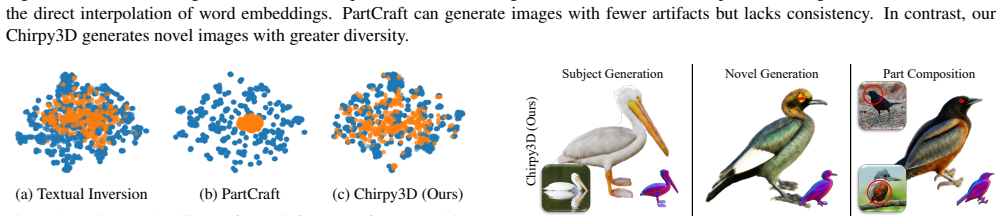
- [Sec. 4.1, Tables 1–2] The quantitative claims of superiority are not supported by the reported numbers. In Table 1, Chirpy3D's FID (43.41) is worse than PartCraft (43.25), and in Table 2 the CoSim gain over PartCraft is 0.002; no error bars or significance tests are provided anywhere. The abstract states that 'Chirpy3D surpasses existing methods in generating creative 3D objects with higher quality and fine-grained details,' but the evidence is marginal for some metrics and absent for 3D quality. The authors should add confidence intervals, significance tests, or at least temper the claims to the specific metrics that show consistent improvement.
- [Sec. 4.2 and Sec. 1] The 'first system capable of generating entirely novel 3D objects' claim is not supported by any comparison against 3D-capable baselines. The only competitors are Textual Inversion and PartCraft, both 2D methods adapted to MVDream; there is no comparison to prior text-to-3D or part-aware 3D generation methods, and the 3D evaluation is purely qualitative (Fig. 10). At minimum, the authors should compare against a text-to-3D baseline (e.g., MVDream SDS with a textual part prompt) and report a quantitative 3D metric or a user study on 3D objects.
minor comments (6)
- [Sec. 4, Implementation; Appendix C] The main text sets the part latent dimension to D_p = 42, while the supplementary (Appendix C, Table 6) states D_l = 4 as the default and shows ablations with D_l ∈ {4, 16, 32, 64}. The notation and actual value are inconsistent; please unify the notation and state which dimension is used in the main experiments.
- [Abstract and Sec. 1] The method is described as 'unsupervised' and 'without manual part annotations,' but the abstract also says it uses 'off-the-shelf 2D part segmentation masks as spatial guidance.' These masks are a form of part-level supervision. Please clarify whether the part decomposition is fully unsupervised or uses pretrained segmentation masks, and adjust the wording in Sec. 1 and Related Work accordingly.
- [Sec. 4.1] The term 'FIDCLIP' appears without definition. Please define how FIDCLIP is computed (presumably FID in a CLIP feature space) in the evaluation section.
- [Table 3] Table 3 reports only PartCraft and Chirpy3D, while the surrounding text discusses Textual Inversion's artifacts. Please include Textual Inversion in the table or explicitly state why it is omitted.
- [Appendix A] In the derivation of Lreg, the text contains a typo, 'bmmu = 0,' which should read 'µ = 0.'
- [Fig. 9 caption] The claim that Chirpy3D produces 'well-clustered DINO feature representations' is supported only by a t-SNE plot; consider reporting a quantitative cluster metric (e.g., silhouette score) if this claim is retained.
Circularity Check
No significant circularity; the central part-sampling contribution is generative and externally evaluated, with only non-load-bearing reuse of the authors' PartCraft components.
full rationale
Walking the derivation chain, the species embeddings s_c are mapped by f to part latents p_c_m, regularized by Eq. (1), projected by g to part-aware text tokens (Eq. 2), and used to condition a fine-tuned MVDream. Every step is an optimization or sampling operation; no predicted quantity is defined as the fitted value it is claimed to predict. The Gaussian prior (Eqs. (1), (5)) is a regularizer and sampling mechanism, not a fitted prediction, and the diversity and quality evaluations are measured against real training images via DINO/CLIP retrieval or user preference, i.e., outside the fitted constants. The paper does reuse the entropy attention loss and segmentation module from the authors' PartCraft [35], and uses PartCraft as a baseline, but this is component reuse and comparison, not load-bearing circularity: the central contribution is the hierarchical part latent space and sampling/interpolation behavior, which does not reduce to PartCraft's loss. Lcl (Eq. 6) is described as enforcing cross-view coherence but as written compares feature maps of different noise inputs at the same timestep, and no direct cross-view consistency metric is reported; this is an evidence and correctness gap, not a circular reduction. The Limitation section candidly attributes generalizability limits to the base model's multi-view consistency. No step meets the quoted-reduction bar, so the paper is not significantly circular.
Assumptions & free parameters
free parameters (3)
- Number of parts M =
5
- Part latent dimension D_p =
42 (main text); supplementary ablation reports D_l=4 as the chosen default for diversity
- Loss weights lambda_attn, lambda_cl, lambda_reg =
0.01, 0.001, 0.0001
assumptions (4)
- domain assumption MVDream's pretrained multi-view consistency transfers to the fine-tuned part-aware prompts and to unseen part combinations
- domain assumption The off-the-shelf part segmentation module from PartCraft gives reliable part masks for the attention loss on unseen images
- ad hoc to paper Part latent codes are well modeled by a standard Gaussian distribution
- domain assumption Cross-attention maps in the U-Net localize the corresponding object parts after fine-tuning
Cite this review
Pith. "Pith review of Chirpy3D: Part-Aware Multi-View Diffusion for Creative Fine-Grained Object Generation." pith.science (2026). https://pith.science/paper/6ZWFJY7P
@misc{pith2026250104144,
  author       = {Pith},
  title        = {Pith review of: Chirpy3D: Part-Aware Multi-View Diffusion for Creative Fine-Grained Object Generation},
  year         = {2026},
  howpublished = {\url{https://pith.science/paper/6ZWFJY7P}},
  note         = {Machine review of arXiv:2501.04144}
}
read the original abstract
Understanding and generating the fine-grained structure of objects -- such as birds with species-specific beaks, wings, and tails -- is a long-standing challenge in computer vision. We propose Chirpy3D, a part-aware multi-view diffusion framework that learns a hierarchical part latent space from unposed 2D images, using only off-the-shelf 2D part segmentation masks as spatial guidance -- without requiring any 3D data, camera poses, or manual part annotations. This latent space enables intuitive part-level swapping, interpolation, and zero-shot composition. A self-supervised feature consistency loss further encourages structural alignment across views, allowing coherent generation even with hybrid or unseen part combinations. Our core contribution is the controllable part-aware latent space and multi-view diffusion model. Downstream 3D generation is supported via any differentiable renderer such as NeRF but is orthogonal to the main framework, making Chirpy3D a flexible foundation for creative object generation in the absence of structured 3D data. Code is released at https://github.com/kamwoh/chirpy3d.
Figures


Figures from the paper (17 more)




Reference graph
Works this paper leans on
-
[1]
Break-a-scene: Ex- tracting multiple concepts from a single image
Omri Avrahami, Kfir Aberman, Ohad Fried, Daniel Cohen-Or, and Dani Lischinski. Break-a-scene: Ex- tracting multiple concepts from a single image. In SIGGRAPH Asia, 2023. 1, 2
work page 2023
-
[2]
Dreamavatar: Text-and-shape guided 3d human avatar generation via diffusion mod- els
Yukang Cao, Yan-Pei Cao, Kai Han, Ying Shan, and Kwan-Yee K Wong. Dreamavatar: Text-and-shape guided 3d human avatar generation via diffusion mod- els. In CVPR, 2024. 1
work page 2024
-
[3]
Emerging properties in self-supervised vision transformers
Mathilde Caron, Hugo Touvron, Ishan Misra, Herv ´e J´egou, Julien Mairal, Piotr Bojanowski, and Armand Joulin. Emerging properties in self-supervised vision transformers. In ICCV, 2021. 5, 6
work page 2021
-
[4]
Shapenet: An information-rich 3d model repos- itory
Angel X Chang, Thomas Funkhouser, Leonidas Guibas, Pat Hanrahan, Qixing Huang, Zimo Li, Sil- vio Savarese, Manolis Savva, Shuran Song, Hao Su, et al. Shapenet: An information-rich 3d model repos- itory. arXiv preprint arXiv:1512.03012, 2015. 2
arXiv 2015
-
[5]
The devil is in the channels: Mutual-channel loss for fine-grained image classifica- tion
Dongliang Chang, Yifeng Ding, Jiyang Xie, Ayan Ku- mar Bhunia, Xiaoxu Li, Zhanyu Ma, Ming Wu, Jun Guo, and Yi-Zhe Song. The devil is in the channels: Mutual-channel loss for fine-grained image classifica- tion. TIP, 2020. 2
work page 2020
-
[6]
Tianyi Chen, Yunfei Zhang, Xiaoyang Huo, Si Wu, Yong Xu, and Hau San Wong. Sphericgan: Semi- supervised hyper-spherical generative adversarial net- works for fine-grained image synthesis. In CVPR,
-
[7]
To- wards creativity characterization of generative models via group-based subset scanning
Celia Cintas, Payel Das, Brian Quanz, Girmaw Abebe Tadesse, Skyler Speakman, and Pin-Yu Chen. To- wards creativity characterization of generative models via group-based subset scanning. In IJCAI, 2022. 2
work page 2022
-
[8]
Toward a neuro-inspired creative de- coder
Payel Das, Brian Quanz, Pin-Yu Chen, Jae-wook Ahn, and Dhruv Shah. Toward a neuro-inspired creative de- coder. In IJCAI, 2020. 2
work page 2020
Show all 58 references
-
[9]
Comgan: unsupervised disentangle- ment and segmentation via image composition
Rui Ding, Kehua Guo, Xiangyuan Zhu, Zheng Wu, and Liwei Wang. Comgan: unsupervised disentangle- ment and segmentation via image composition. 2022. 2
2022
-
[10]
Fine-grained visual classification via progres- sive multi-granularity training of jigsaw patches
Ruoyi Du, Dongliang Chang, Ayan Kumar Bhu- nia, Jiyang Xie, Zhanyu Ma, Yi-Zhe Song, and Jun Guo. Fine-grained visual classification via progres- sive multi-granularity training of jigsaw patches. In ECCV, 2020. 2
2020
-
[11]
Can: Creative adversarial networks generating ”art” by learning about styles and deviating from style norms
Ahmed Elgammal, Bingchen Liu, Mohamed Elho- seiny, and Marian Mazzone. Can: Creative adversarial networks generating ”art” by learning about styles and deviating from style norms. In ICCC, 2017. 2
2017
-
[12]
An image is worth one word: Personal- izing text-to-image generation using textual inversion
Rinon Gal, Yuval Alaluf, Yuval Atzmon, Or Patash- nik, Amit H Bermano, Gal Chechik, and Daniel Cohen-Or. An image is worth one word: Personal- izing text-to-image generation using textual inversion. arXiv preprint arXiv:2208.01618, 2022. 5, 12
2022 arXiv
-
[13]
Get3d: A generative model of high quality 3d textured shapes learned from images
Jun Gao, Tianchang Shen, Zian Wang, Wenzheng Chen, Kangxue Yin, Daiqing Li, Or Litany, Zan Go- jcic, and Sanja Fidler. Get3d: A generative model of high quality 3d textured shapes learned from images. In NeurIPS, 2022. 2
2022
-
[14]
Lawrence Zitnick, and Devi Parikh
Songwei Ge, Vedanuj Goswami, C. Lawrence Zitnick, and Devi Parikh. Creative sketch generation. In ICLR,
-
[15]
Learning shape templates with structured implicit functions
Kyle Genova, Forrester Cole, Daniel Vlasic, Aaron Sarna, William T Freeman, and Thomas Funkhouser. Learning shape templates with structured implicit functions. In ICCV, 2019. 2
2019
-
[16]
Local deep implicit functions for 3d shape
Kyle Genova, Forrester Cole, Avneesh Sud, Aaron Sarna, and Thomas Funkhouser. Local deep implicit functions for 3d shape. In CVPR, 2020. 2
2020
-
[17]
threestudio: A unified framework for 3d content generation
Yuan-Chen Guo, Ying-Tian Liu, Ruizhi Shao, Chris- tian Laforte, Vikram V oleti, Guan Luo, Chia-Hao Chen, Zi-Xin Zou, Chen Wang, Yan-Pei Cao, and Song-Hai Zhang. threestudio: A unified framework for 3d content generation. https://github. com/threestudio-project/threestudio ,
-
[18]
Headsculpt: Crafting 3d head avatars with text
Xiao Han, Yukang Cao, Kai Han, Xiatian Zhu, Jiankang Deng, Yi-Zhe Song, Tao Xiang, and Kwan- Yee K Wong. Headsculpt: Crafting 3d head avatars with text. In Advances in Neural Information Process- ing Systems, 2024. 1
2024
-
[19]
Partimagenet: A large, high-quality dataset of parts
Ju He, Shuo Yang, Shaokang Yang, Adam Ko- rtylewski, Xiaoding Yuan, Jie-Neng Chen, Shuai Liu, Cheng Yang, and Alan Yuille. Partimagenet: A large, high-quality dataset of parts. arXiv preprint arXiv:2112.00933, 2021. 8
2021 arXiv
-
[20]
Spaghetti: Editing implicit shapes through part aware generation
Amir Hertz, Or Perel, Raja Giryes, Olga Sorkine- Hornung, and Daniel Cohen-Or. Spaghetti: Editing implicit shapes through part aware generation. TOG,
-
[21]
LoRA: Low-rank adaptation of large language models
Edward J Hu, Yelong Shen, Phillip Wallis, Zeyuan Allen-Zhu, Yuanzhi Li, Shean Wang, Lu Wang, and Weizhu Chen. LoRA: Low-rank adaptation of large language models. In ICLR, 2022. 5, 12
2022
-
[22]
Dreamtime: An improved optimization strategy for text-to-3d content creation
Yukun Huang, Jianan Wang, Yukai Shi, Xianbiao Qi, Zheng-Jun Zha, and Lei Zhang. Dreamtime: An improved optimization strategy for text-to-3d content creation. arXiv preprint arXiv:2306.12422, 2023. 14
2023 arXiv
-
[23]
Neural template: Topology-aware reconstruction and disentangled generation of 3d meshes
Ka-Hei Hui, Ruihui Li, Jingyu Hu, and Chi-Wing Fu. Neural template: Topology-aware reconstruction and disentangled generation of 3d meshes. InCVPR, 2022. 2
2022
-
[24]
Spad: Spatially aware multi-view dif- fusers
Yash Kant, Aliaksandr Siarohin, Ziyi Wu, Michael Vasilkovsky, Guocheng Qian, Jian Ren, Riza Alp Guler, Bernard Ghanem, Sergey Tulyakov, and Igor Gilitschenski. Spad: Spatially aware multi-view dif- fusers. In CVPR, 2024. 1, 2 9
2024
-
[25]
3d gaussian splatting for real-time radiance field rendering
Bernhard Kerbl, Georgios Kopanas, Thomas Leimk¨uhler, and George Drettakis. 3d gaussian splatting for real-time radiance field rendering. ACM ToG, 2023. 5
2023
-
[26]
Eschernet: A generative model for scalable view synthesis
Xin Kong, Shikun Liu, Xiaoyang Lyu, Marwan Taher, Xiaojuan Qi, and Andrew J Davison. Eschernet: A generative model for scalable view synthesis. In CVPR, 2024. 2
2024
-
[27]
Salad: Part-level latent diffusion for 3d shape generation and manipulation
Juil Koo, Seungwoo Yoo, Minh Hieu Nguyen, and Minhyuk Sung. Salad: Part-level latent diffusion for 3d shape generation and manipulation. InICCV, 2023. 2
2023
-
[28]
Tp2o: Creative text pair-to-object generation using balance swap- sampling
Jun Li, Zedong Zhang, and Jian Yang. Tp2o: Creative text pair-to-object generation using balance swap- sampling. In ECCV, 2024. 1, 2
2024
-
[29]
Mixnmatch: Multifactor disentangle- ment and encoding for conditional image generation
Yuheng Li, Krishna Kumar Singh, Utkarsh Ojha, and Yong Jae Lee. Mixnmatch: Multifactor disentangle- ment and encoding for conditional image generation. In CVPR, 2020. 2
2020
-
[30]
Partgan: Weakly-supervised part de- composition for image generation and segmentation
Yuheng Li, Krishna Kumar Singh, Yang Xue, and Yong Jae Lee. Partgan: Weakly-supervised part de- composition for image generation and segmentation. In BMVC, 2021. 2
2021
-
[31]
Zero-1-to-3: Zero-shot one image to 3d object
Ruoshi Liu, Rundi Wu, Basile Van Hoorick, Pavel Tokmakov, Sergey Zakharov, and Carl V ondrick. Zero-1-to-3: Zero-shot one image to 3d object. In ICCV, 2023. 2
2023
-
[32]
Decoupled weight decay regularization
Ilya Loshchilov and Frank Hutter. Decoupled weight decay regularization. In ICLR, 2018. 12
2018
-
[33]
Nerf: Representing scenes as neural radiance fields for view synthesis
B Mildenhall, PP Srinivasan, M Tancik, JT Barron, R Ramamoorthi, and R Ng. Nerf: Representing scenes as neural radiance fields for view synthesis. In ECCV,
-
[34]
Concepthash: Interpretable fine-grained hashing via concept discovery
Kam Woh Ng, Xiatian Zhu, Yi-Zhe Song, and Tao Xi- ang. Concepthash: Interpretable fine-grained hashing via concept discovery. In CVPRW, 2024. 2
2024
-
[35]
Partcraft: Crafting creative objects by parts
Kam Woh Ng, Xiatian Zhu, Yi-Zhe Song, and Tao Xi- ang. Partcraft: Crafting creative objects by parts. In ECCV, 2024. 1, 2, 3, 4, 5, 7, 12
2024
-
[36]
Creativegan: Editing generative adver- sarial networks for creative design synthesis
Amin Heyrani Nobari, Muhammad Fathy Rashad, and Faez Ahmed. Creativegan: Editing generative adver- sarial networks for creative design synthesis. arXiv preprint arXiv:2103.06242, 2021. 2
2021 arXiv
-
[37]
Deepsdf: Learning continuous signed distance functions for shape representation
Jeong Joon Park, Peter Florence, Julian Straub, Richard Newcombe, and Steven Lovegrove. Deepsdf: Learning continuous signed distance functions for shape representation. In CVPR, 2019. 2
2019
-
[38]
Dreamfusion: Text-to-3d using 2d dif- fusion
Ben Poole, Ajay Jain, Jonathan T Barron, and Ben Mildenhall. Dreamfusion: Text-to-3d using 2d dif- fusion. In ICLR, 2022. 5
2022
-
[39]
Learning transferable visual models from nat- ural language supervision
Alec Radford, Jong Wook Kim, Chris Hallacy, Aditya Ramesh, Gabriel Goh, Sandhini Agarwal, Girish Sas- try, Amanda Askell, Pamela Mishkin, Jack Clark, et al. Learning transferable visual models from nat- ural language supervision. In ICML, 2021. 5
2021
-
[40]
Conceptlab: Creative genera- tion using diffusion prior constraints
Elad Richardson, Kfir Goldberg, Yuval Alaluf, and Daniel Cohen-Or. Conceptlab: Creative genera- tion using diffusion prior constraints. arXiv preprint arXiv:2308.02669, 2023. 1, 2
2023 arXiv
-
[41]
Sims4 faces
Joe Rocca. Sims4 faces. https : / / huggingface . co / datasets / rocca / sims4-faces, 2022. 8
2022
-
[42]
Dreambooth: Fine tuning text-to-image diffusion models for subject-driven generation
Nataniel Ruiz, Yuanzhen Li, Varun Jampani, Yael Pritch, Michael Rubinstein, and Kfir Aberman. Dreambooth: Fine tuning text-to-image diffusion models for subject-driven generation. In CVPR, 2023. 5
2023
-
[43]
Design: Design inspiration from generative networks
Othman Sbai, Mohamed Elhoseiny, Antoine Bordes, Yann LeCun, and Camille Couprie. Design: Design inspiration from generative networks. In ECCVW,
-
[44]
Zero123++: a single image to consistent multi-view diffusion base model, 2023
Ruoxi Shi, Hansheng Chen, Zhuoyang Zhang, Minghua Liu, Chao Xu, Xinyue Wei, Linghao Chen, Chong Zeng, and Hao Su. Zero123++: a single image to consistent multi-view diffusion base model, 2023. 2, 14
2023
-
[45]
Mvdream: Multi-view diffusion for 3d generation
Yichun Shi, Peng Wang, Jianglong Ye, Long Mai, Ke- jie Li, and Xiao Yang. Mvdream: Multi-view diffusion for 3d generation. In ICLR, 2023. 1, 2, 3, 5, 12, 15
2023
-
[46]
Meshgpt: Gener- ating triangle meshes with decoder-only transformers
Yawar Siddiqui, Antonio Alliegro, Alexey Artemov, Tatiana Tommasi, Daniele Sirigatti, Vladislav Rosov, Angela Dai, and Matthias Nießner. Meshgpt: Gener- ating triangle meshes with decoder-only transformers. In CVPR, 2024. 2
2024
-
[47]
Finegan: Unsupervised hierarchical disentangle- ment for fine-grained object generation and discovery
Krishna Kumar Singh, Utkarsh Ojha, and Yong Jae Lee. Finegan: Unsupervised hierarchical disentangle- ment for fine-grained object generation and discovery. In CVPR, pages 6490–6499, 2019. 2
2019
-
[48]
Dreamgaussian: Generative gaussian splatting for efficient 3d content creation
Jiaxiang Tang, Jiawei Ren, Hang Zhou, Ziwei Liu, and Gang Zeng. Dreamgaussian: Generative gaussian splatting for efficient 3d content creation. In ICLR,
-
[49]
Concept decomposition for visual ex- ploration and inspiration
Yael Vinker, Andrey V oynov, Daniel Cohen-Or, and Ariel Shamir. Concept decomposition for visual ex- ploration and inspiration. In SIGGRAPH Asia, 2023. 2
2023
-
[50]
The caltech-ucsd birds- 200-2011 dataset
Catherine Wah, Steve Branson, Peter Welinder, Pietro Perona, and Serge Belongie. The caltech-ucsd birds- 200-2011 dataset. 2011. 5
2011
-
[51]
Fine-grained image analysis with deep learning: A survey
Xiu-Shen Wei, Yi-Zhe Song, Oisin Mac Aodha, Jianxin Wu, Yuxin Peng, Jinhui Tang, Jian Yang, and Serge Belongie. Fine-grained image analysis with deep learning: A survey. TPAMI, 2021. 2
2021
-
[52]
Sagnet: Structure- 10 aware generative network for 3d-shape modeling
Zhijie Wu, Xiang Wang, Di Lin, Dani Lischinski, Daniel Cohen-Or, and Hui Huang. Sagnet: Structure- 10 aware generative network for 3d-shape modeling. TOG, 2019. 2
2019
-
[53]
Instantmesh: Efficient 3d mesh generation from a single image with sparse- view large reconstruction models
Jiale Xu, Weihao Cheng, Yiming Gao, Xintao Wang, Shenghua Gao, and Ying Shan. Instantmesh: Efficient 3d mesh generation from a single image with sparse- view large reconstruction models. arXiv preprint arXiv:2404.07191, 2024. 7, 14
2024 arXiv
-
[54]
Attngan: Fine-grained text to image generation with attentional generative adversarial networks
Tao Xu, Pengchuan Zhang, Qiuyuan Huang, Han Zhang, Zhe Gan, Xiaolei Huang, and Xiaodong He. Attngan: Fine-grained text to image generation with attentional generative adversarial networks. In CVPR,
-
[55]
Sym3d: Learning symmetric triplanes for better 3d-awareness of gans
Jing Yang, Kyle Fogarty, Fangcheng Zhong, and Cen- giz Oztireli. Sym3d: Learning symmetric triplanes for better 3d-awareness of gans. arXiv preprint arXiv:2406.06432, 2024. 2
2024 arXiv
-
[56]
Gaussiandreamer: Fast gener- ation from text to 3d gaussians by bridging 2d and 3d diffusion models
Taoran Yi, Jiemin Fang, Junjie Wang, Guanjun Wu, Lingxi Xie, Xiaopeng Zhang, Wenyu Liu, Qi Tian, and Xinggang Wang. Gaussiandreamer: Fast gener- ation from text to 3d gaussians by bridging 2d and 3d diffusion models. In CVPR, 2024. 1
2024
-
[57]
Entropy_{n}:
Heliang Zheng, Jianlong Fu, Zheng-Jun Zha, and Jiebo Luo. Looking for the devil in the details: Learning trilinear attention sampling network for fine- grained image recognition. In CVPR, 2019. 2 11 A. Derivation We use the symbolx to represent the part latent l for clarity. A...
2019
-
[58]
a [part1] ... [partM ] bird
as our framework andMVDream-threestudio as a plugin. We implement a custom prompt processor to handle the input prompt, as we replace the word embeddings using Eq.2. After tokenization and before passing the word em- beddings, we substitute the placeholder’s word embedding wit...
Reviewed August 10, 2026 · model on record in the stance chip above.
Discussion (0). Continue with ORCID to comment.