REVIEW 3 major objections 5 minor 13 references
ART: Distribution-Free and Model-Agnostic Changepoint Detection with Finite-Sample Guarantees
T0 review · 3 major / 5 minor · reviewed 2026-08-10 · deepseek-v4-flash
Pith's one-line read ART turns any symmetric scoring rule into a changepoint test whose p-value is exactly uniform in finite samples, with no distributional or model assumptions.
desk verdict ART's exact guarantees are real under true permutation symmetry, but the paper ships recommended implementations that likely violate that symmetry, so the headline claim needs qualification. read the letter →
The pith
A machine-rendered reading of the paper's core claim, the machinery that carries it, and where it could break.
The reading
What carries the argument
The load-bearing object is the symmetric transformation $S(z;D)$: a function that returns the same score for an observation regardless of the order of the dataset $D$. Because the scores are exchangeable under $H_0$, their ranks are uniformly distributed over all permutations of $\{1,\dots,n\}$, which alone supplies the exact null distribution for any rank aggregation $A(R_1,\dots,R_n)$, such as a rank CUSUM or nonparametric likelihood statistic. For multi-scale use, the same construction is applied to prespecified intervals, and the identity $R_{i,\ell}=|\{j\in I_\ell: R_j \le R_i\}|$ shows that all local statistics are a single function $G(\pi)$ of one random permutation, giving joint distribution-freeness and pivotalness to changes. A randomized p-value $p_B$ based on $B$ independent permutations plus one uniform tie-breaker converts the permutation null into an exactly valid test.
What would settle it
Take a homogeneous dataset of moderate size, choose a clustering transformation whose implementation consults data order, for example a K-means variant that breaks ties by first appearance, run ART at level 0.1 over many replications, and count rejections. If the empirical size departs from 0.1 beyond Monte Carlo noise, the symmetry condition has been violated and the Theorem 1 guarantee does not apply. Conversely, with an exactly symmetric implementation the empirical size should stay at 0.1 for any continuous error distribution.
Extended reading notes
Core claim
The central discovery is that exact finite-sample changepoint inference can be built only from the exchangeability of ranks of symmetric-transformed scores. For any symmetric transformation $S(z;D)$, under $H_0$ the ranks $(R_1,\dots,R_n)$ are uniform over permutations, so every rank aggregation statistic has a null distribution that depends only on $n$, not on the underlying distribution. Theorem 1 states $p_B \sim U(0,1)$ for any number $B$ of random permutations, giving exact Type-I error control. The multi-scale extension shows that local ranks in prespecified intervals are jointly distribution-free, and that intervals lying inside homogeneous segments have the same joint law whether or not changepoints exist elsewhere, a property the paper calls pivotalness to changes. Theorems 4 and 5 turn this pivotalness into finite-sample guarantees: with probability at least $1-\alpha$, every interval reported by the localization algorithm contains a true changepoint, and the same thresholding bounds the FWER of post-detection tests.
Load-bearing premise
The finite-sample guarantees collapse if the score transformation is not exactly invariant to every permutation of the full dataset, and the paper's exact results require the observations to be independent.
Editorial extensions
If this is right
- A practitioner can test for a changepoint at level $\alpha$ in finite samples using any symmetric score, such as deviance residuals, clustering labels, or learned embeddings, without knowing the data distribution, as long as observations are independent.
- The multi-scale max-statistic test is exactly size-$\alpha$ for any collection of data-independent intervals, so moving-window, seeded, or scan designs all inherit finite-sample validity.
- Localization controls the global false-positive rate: at level $\alpha$, with probability at least $1-\alpha$, no reported interval misses all true changepoints, regardless of model form or dimension.
- Post-detection inference: changepoints found by any algorithm can be retrospectively tested with FWER $\le \alpha$ using the same universal threshold $t_{\alpha,B}$.
- Under a spacing and signal-strength assumption, reported intervals shrink at the rate $O(\log n / Q^2)$, matching known nonparametric localization rates.
Reading between the lines
- Editorial inference: the core mechanism, restore exchangeability under the null by a permutation-invariant transform, is a general recipe that could certify other non-exchangeable problems, such as two-sample testing or graph-structured changepoint detection, whenever such a transform exists.
- Editorial inference: implementations that break exact symmetry, such as stochastic K-means or data-order-dependent tie-breaking, will silently lose the finite-sample guarantee; a diagnostic is to permute a homogeneous dataset many times and check that the rank vector is uniform over permutations.
- Editorial inference: the paper analyzes single transformations, so combining several symmetric scores by taking a maximum or union of p-values is a natural testable extension, but the multiplicity question for such combinations is not addressed.
Editorial analysis
A structured set of objections, weighed in public.
Referee Report
Summary. The paper introduces ART, a changepoint detection framework that transforms independent observations into scores via a symmetric function, ranks the scores, and aggregates the ranks to test for changepoints. The main theoretical claims are exact finite-sample Type-I error control (Theorem 1), joint distribution-freeness and pivotalness of multi-scale local rank statistics (Theorem 2), exact control of the multi-scale testing p-value (Theorem 3), finite-sample global false positive rate control in localization (Theorem 4), and family-wise error rate control in post-detection inference (Theorem 5). The methodology is illustrated through simulations and real-data analyses including well-log and MNIST data. The proofs in the supplementary material follow standard exchangeability and permutation arguments, and the paper makes a useful connection to conformal prediction and to recent changepoint inference tools such as NSP and TUNE.
Significance. If the framework is valid as stated, it would be a valuable contribution: it offers an assumption-lean, exact finite-sample approach to changepoint testing and inference that is applicable to high-dimensional or non-Euclidean data through flexible transformations. The paper explicitly builds on exchangeability rather than asymptotics, and the randomized p-value construction is computationally practical. The multi-scale local ranking idea and the 'pivotalness to changes' property are conceptually clean and could be widely useful. The numerical comparison against DMS, QF-CUSUM, ecp, changeforest, NSP, and TUNE is extensive and generally favorable. However, the exactness of the advertised guarantees rests entirely on the score transformation satisfying exact permutation symmetry (Definition 1), and the paper does not establish that its recommended clustering implementations, especially deep embedded clustering, satisfy this condition. This gap is load-bearing because the MNIST experiments are presented under the banner of exact finite-sample guarantees.
major comments (3)
- [Section 2.2 / Algorithm S.1 (Supplementary S.1.1)] The statement near Algorithm S.1 that the output is 'by construction' invariant to the data order and satisfies Definition 1 is not justified and, as written, is false. Step 1 uses arg min over cluster labels with no tie-breaking rule, and the modified K-means++ initialization described in Remark 2 selects 'the data point achieving the largest D(z)' without specifying how ties are resolved. Different input orderings can therefore produce different label assignments, and even when the partition itself is unique, the numeric labels assigned to clusters are arbitrary up to relabeling, which changes the score vector and hence the ranks. The paper needs to specify an explicitly permutation-invariant version of K-means (including a deterministic tie-breaking rule and a canonical labeling of clusters) and prove that it satisfies Definition 1.
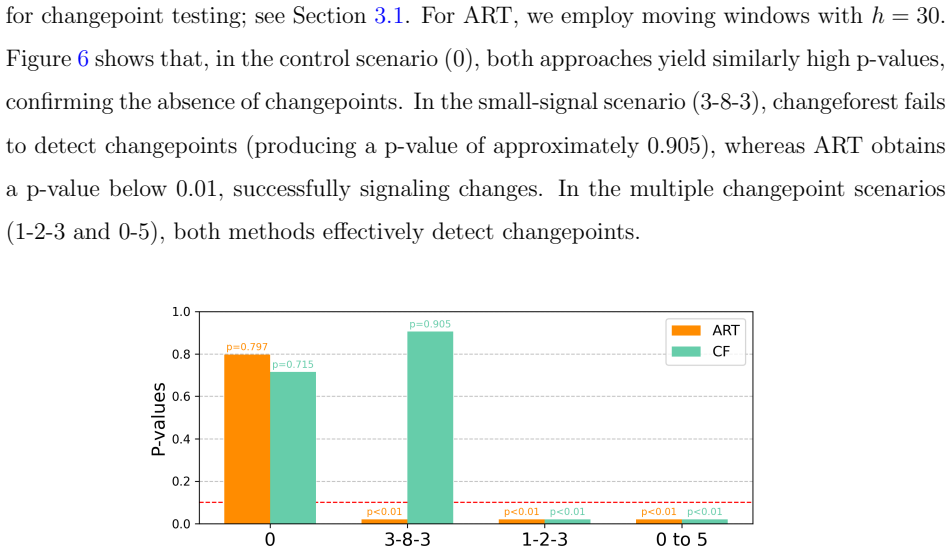
- [Section 2.2 / Algorithm S.2 (Supplementary S.1.2); Section 4.2.2] Deep embedded clustering (Algorithm S.2) is used in the MNIST experiments of Section 4.2.2 and listed in Table 1, but it is not a symmetric transformation in the sense of Definition 1. The algorithm uses random initialization, stochastic gradient descent, and data-dependent minibatch order, all of which depend on the ordering of D, and the output label arg max_j q_{ij} is not invariant under permutations of the input beyond a possible relabeling. Consequently, Theorems 1-5 do not apply to the MNIST results, and the p-values reported in Figure 6 and the FWER/TPP claims in Tables 6-7 are not covered by the paper's finite-sample guarantees. The authors should either provide a permutation-invariant version of deep embedded clustering (e.g., a fully deterministic full-batch variant with canonical label assignment) and prove its symmetry, or explicitly re-label the MNIST analyses as heuristic and outside the exactness guarantees.
- [Section 2.2 and Table 1 (deviance transformation with LASSO)] For the regression examples, the global model bθ_D is defined as an element of arg min of a penalized criterion. Whenever the minimizer is not unique, an unspecified selection rule can depend on the row order of (y_i, x_i), violating Definition 1. The paper should state a deterministic, permutation-invariant tie-breaking rule for all estimated baseline models, or prove uniqueness of the minimizer under the stated conditions; otherwise the exactness claims for the deviance-based ART test are not fully supported.
minor comments (5)
- [Section 4.1] In the sentence 'Let I be the identify matrix', 'identify' should be 'identity'.
- [Section 3.3 (proof sketch of Theorem 5)] In the displayed proof, 'Setp (i)' should be 'Step (i)'.
- [Section 4.1.1] The text 'sutiable randomization' should be 'suitable randomization'.
- [Table 1] The footnote refers to 'deep embedded clustering' via Algorithm S.2, but Algorithm S.2 is only in the supplementary material and is not summarized in the main text; a brief description in the main text would help readers assess the symmetry condition.
- [Section S.3.3 (supplementary)] The subsection 'Departures from independence' presents empirical results under AR(1) errors while the theoretical framework of Section 2.1 assumes independence. The text mentions that this 'merits further theoretical investigation', but it would be clearer to state explicitly that these simulations are outside the scope of the finite-sample guarantees.
Circularity Check
ART's finite-sample guarantees are derived from a stated symmetry condition by direct exchangeability and permutation arguments; self-citations are not load-bearing and no fitted input is relabeled as a prediction.
full rationale
Walking the derivation chain: Definition 1 posits S(z;D)=S(z;D^pi), which is a function-level invariance, not an assumption of exchangeability. Under H0, iid observations plus this invariance give exchangeable scores, hence uniform ranks (Section 2.3). Theorem 1 then follows from the standard randomized-permutation p-value lemma (Lemma S.1, attributed to Vovk et al. 2003), with pB built from independent uniform permutations; no data-dependent constants are fitted. Theorem 2(i) uses the identity R_{i,ℓ} = #{j∈I_ℓ : R_j ≤ R_i}, so the joint statistic vector is a fixed function G(π) of a uniform permutation π; this is a direct distributional reduction, not an identity smuggled through a fitted quantity. Theorem 2(ii) and Lemma S.2 establish segment-rank independence via within-segment exchangeability and then pivotalness, allowing Pr to be replaced by Pr_{H0}; Theorem 4 and Theorem 5 are union-bound and quantile arguments from Corollary 1, whose threshold t_{α,B} (Eq. 1) is a Monte Carlo permutation quantile. Thus the claimed exact Type-I error, joint distribution-freeness, localization false-positive control, and post-detection FWER control all reduce to the stated symmetry premise plus permutation enumeration, not to a fitted parameter or to a self-citation. The same-group citation Jia et al. (2024) (TUNE) appears as an extension target in Section 3.3, and the FWER bound is reproved from the paper's own Corollary 1, so the citation is not load-bearing. Proposition 1 is an asymptotic consistency statement proved with standard VC and U-process inequalities; it is separate from the exact finite-sample testing claims. The only substantive caveat, noted in the supplement's Algorithm S.1 and Algorithm S.2, is that the proposed K-means and deep embedded clustering implementations are asserted to satisfy Definition 1 without a proof of permutation invariance under tie-breaking or stochastic optimization; that is an applicability/completeness gap in the premise, not a circular derivation from the premise. Therefore no circular step is exhibited.
Assumptions & free parameters
free parameters (4)
- Number of clusters K in clustering transformations =
Chosen by BIC over [1, Kbar] in Remark 3; specific simulation values not listed
- Randomization count B for p-values and thresholds =
B=200 default
- Tie-breaking noise scale epsilon =
1e-6 (Section 2.3)
- Interval schedule / window size h =
h=0.1n for multiple testing, h=30 for post-detection, seeded interval counts for localization
assumptions (5)
- domain assumption Observations Z_1,...,Z_n are independent; H0 assumes no changepoints and iid observations (Section 2.1).
- domain assumption The transformation S(z;D) is exactly invariant to any permutation of D (Definition 1).
- domain assumption The intervals I_1,...,I_L are prespecified and data-independent (Section 2.4, Theorems 2-5).
- domain assumption Assumption 1(i)-(iv): baseline fit rate, VC class of indicator kernels, changepoint spacing, and Lipschitz signal smoothness (supplement, before Proposition 1).
- standard math Random tie-breaking noise is independent of the data and continuous (Section 2.3).
Cite this review
Pith. "Pith review of ART: Distribution-Free and Model-Agnostic Changepoint Detection with Finite-Sample Guarantees." pith.science (2026). https://pith.science/paper/3HNVJ7B7
@misc{pith2026250104475,
  author       = {Pith},
  title        = {Pith review of: ART: Distribution-Free and Model-Agnostic Changepoint Detection with Finite-Sample Guarantees},
  year         = {2026},
  howpublished = {\url{https://pith.science/paper/3HNVJ7B7}},
  note         = {Machine review of arXiv:2501.04475}
}
read the original abstract
We introduce ART, a distribution-free and model-agnostic framework for changepoint detection that provides finite-sample guarantees. ART transforms independent observations into real-valued scores via a symmetric function, ensuring exchangeability in the absence of changepoints. These scores are then ranked and aggregated to detect distributional changes. The resulting test offers exact Type-I error control, agnostic to specific distributional or model assumptions. Moreover, ART seamlessly extends to multi-scale settings, enabling robust multiple changepoint estimation and post-detection inference with finite-sample error rate control. By locally ranking the scores and performing aggregations across multiple prespecified intervals, ART identifies changepoint intervals and refines subsequent inference while maintaining its distribution-free and model-agnostic nature. This adaptability makes ART as a reliable and versatile tool for modern changepoint analysis, particularly in high-dimensional data contexts and applications leveraging machine learning methods.
Figures


Figures from the paper (3 more)


Reference graph
Works this paper leans on
-
[1]
Theoretical foundations of conformal prediction,
Angelopoulos, A. N., Barber, R. F., and Bates, S. (2024), “Theoretical foundations of conformal prediction,” arXiv preprint arXiv:2411.11824 . Antoch, J. and Huˇ skov´ a, M. (2001), “Permutation tests in change point analysis,” Statistics & Probability Letters, 53, 37–46. Arlot, S., Celisse, A., and Harchaoui, Z. (2019), “A kernel multiple change-point al...
arXiv 2024
-
[2]
Lemma S.9 (Theorem 2.14.9 in van der Vaart and Wellner (1996))
and w = 163/2. Lemma S.9 (Theorem 2.14.9 in van der Vaart and Wellner (1996)). Suppose F is a VC-class of measurable functions h : X →[0, 1] with parameters a, b >0 and constant envelope. Then for any t >0, Pr n sup h∈F √n 1 n nX i=1 h(Xi) − E[h(X)] > t o ≤ ct√ b b exp −2t2 , where the constant c depends only on a. S.2.6.2 Proof of Lemma S.3 Recall that S...
work page 1996
-
[8]
For any α ∈ (0, 1), it holds that Pr{pB < α} = α
is independent of {Wb}B+1 b=1 . For any α ∈ (0, 1), it holds that Pr{pB < α} = α. The details of this lemma’s proof appear in the proof of Theorem 1 of Vovk et al. (2003). From this lemma, Theorem 1 follows directly. S.2.2 Proof of Theorem 2 Proof of Theorem 2(i) : For any i ∈ Iℓ, we have Ri,ℓ = P j∈Iℓ 1 (Sj ≤ Si) = P j∈Iℓ 1 (Rj ≤ Ri). Then ( Tn,1, Tn,2, ...
work page 2003
-
[9]
S.2.4 Proof of Theorem 3 Under H0, Tn,multi and {∥G(πb)∥∞}B b=1 are iid
− {⌈(1 − α)(B + 1)⌉ + 1} B + 1 ≤ α. S.2.4 Proof of Theorem 3 Under H0, Tn,multi and {∥G(πb)∥∞}B b=1 are iid. By Lemma S.1, the result follows immediately. S.2.5 Proof of Proposition 1 Recall that dk = ⌈c2 log n/{Qk(f0)}2⌉ + 1 for k ∈ [K ∗], with d0 = dK∗+1 = 0, and hf (z1, z2) = 1 (D(z2; f ) ≤ D(z1; f )) − 1/2 for f ∈ F. For k ∈ [K ∗], let Jk = (τ ∗ k − d...
work page 2021
-
[10]
A class of such U -statistics indexed by kernels is called a two- sample U -process
with kernel h is Un,m(h) = (nm)−1 Pn i=1 Pm j=1 h (Xi, Yj). A class of such U -statistics indexed by kernels is called a two- sample U -process. The H´ ajek projection ofUn,m(h) − E[Un,m(h)] is bUn,m(h) = (1/n) nX i=1 h1,0 (Xi) + (1/m) mX j=1 h0,1 (Yj) , where h1,0(x) = EY [h (x, Y)] − E [Un,m(h)] and h0,1(y) = EX [h (X, y)] − E [Un,m(h)] for all (x, y) ∈...
work page 2021
-
[11]
Then for any t >0, Pr {Un,m(h) ≥ t} ≤exp {−nmt2/ (32c2 h)}
with a bounded kernel h such that ch = sup(x,y)∈X ×Y|h(x, y)| < ∞. Then for any t >0, Pr {Un,m(h) ≥ t} ≤exp {−nmt2/ (32c2 h)}. Definition 3 (VC-class). A collection F of measurable functions on a sample space is called a VC-class with parameters a, b >0 and constant envelope F > 0 if for any probability measure Q, N (εF, F , L2(Q)) ≤ a ε b , for any ε ∈ (...
work page 1996
-
[12]
45 Lemma S.7 (Lemma 14 in Cl´ emen¸ con et al
and a = {cν(16e)ν}1/{2(ν−1)}, where c is a universal constant. 45 Lemma S.7 (Lemma 14 in Cl´ emen¸ con et al. (2021)). Suppose F is a VC-class of kernels h : X × Y →R with parameters a, b >0 and constant envelope. Then, the sets {h1,0(x) : h ∈ F }, {h0,1(y) : h ∈ F }, and {h(x, y) − h1,0(x) − h0,1(y) : h ∈ F }are also VC-classes with the same parameters a...
work page 2021
-
[779]
Homogeneity and change-point detec- tion tests for multivariate data using rank statistics,
Lung-Yut-Fong, A., L´ evy-Leduc, C., and Capp´ e, O. (2015), “Homogeneity and change-point detec- tion tests for multivariate data using rank statistics,”Journal de la soci´ et´ e fran¸ caise de statistique, 156, 133–162. Madrid Padilla, O. H., Yu, Y., Wang, D., and Rinaldo, A. (2021), “Optimal nonparametric change point analysis,” Electronic Journal of S...
work page 2015
Show all 13 references
-
[1104]
TUNE: Algorithm-Agnostic Inference after Changepoint Detection,
Jia, Y., Liu, J., Wang, G., Wang, Z., and Zou, C. (2024), “TUNE: Algorithm-Agnostic Inference after Changepoint Detection,” arXiv preprint arXiv:2409.15676 . Jirak, M. (2015), “Uniform change point tests in high dimension,” The Annals of Statistics , 43, 2451–2483. Kaul, A., J...
2024 arXiv
-
[1111]
Computationally efficient change point detection for high- dimensional regression,
35 Leonardi, F. and B¨ uhlmann, P. (2016), “Computationally efficient change point detection for high- dimensional regression,” arXiv preprint arXiv:1601.03704 . Li, J., Fearnhead, P., Fryzlewicz, P., and Wang, T. (2024), “Automatic change-point detection in time series via de...
2016 arXiv
-
[1306]
A non-parametric approach to the change-point problem,
Pettitt, A. N. (1979), “A non-parametric approach to the change-point problem,” Journal of the Royal Statistical Society: Series C (Applied Statistics) , 28, 126–135. Ruanaidh, J. J. ´O. and Fitzgerald, W. J. (1996), Numerical Bayesian methods applied to signal processing, Spr...
1979 arXiv
-
[2016]
Let gθ : Z →Rs (with s ≪ d) be a nonlinear map, often implemented through deep neural networks, that transforms the data into a low-dimensional latent feature space
is a modern approach that simultaneously learns a lower-dimensional feature representation and a clustering objective. Let gθ : Z →Rs (with s ≪ d) be a nonlinear map, often implemented through deep neural networks, that transforms the data into a low-dimensional latent feature...
2016
-
[4717]
A nonparametric method for the a posteriori detection of the “disorder
Cs¨ org¨ o, M. and Horv´ ath, L. (1997),Limit theorems in change-point analysis , Wiley Series in Prob- ability and Statistics, Wiley. Darkhovskh, B. (1976), “A nonparametric method for the a posteriori detection of the “disorder” time of a sequence of independent random varia...
1997
Reviewed August 10, 2026 · model on record in the stance chip above.
Discussion (0). Continue with ORCID to comment.