REVIEW 3 major objections 8 minor 12 references
Choosing the Right Norm for Change Point Detection in Functional Data
T0 review · 3 major / 8 minor · reviewed 2026-08-10 · deepseek-v4-flash
Pith's one-line read This paper claims the L1 norm should be the default for functional change point detection, with tests that keep their nominal level and beat L2 and supremum rivals except on sparse, spiky light-tailed signals.
desk verdict Genuinely new L1 methodology for functional change point detection, but Section 5's power comparison has a load-bearing centering error and the bootstrap null case is unproved. read the letter →
The pith
A machine-rendered reading of the paper's core claim, the machinery that carries it, and where it could break.
The reading
What carries the argument
The central object is the cusum process $U_n(s) = n^{-1}(\sum_{i=1}^{ns} X_i - s\sum_{i=1}^n X_i)$ taking values in $C([0,1],L^1)$, with the test statistic $\hat T_n = \sqrt{n}\sup_{s\in[0,1]}\|U_n(s)\|_1$. The argument is carried by a new strong invariance principle for $L^1$-valued $\beta$-mixing sequences, which uses the cotype-2 property of $L^1$ and projection approximations to embed the partial sums next to an $L^1$-valued Brownian motion. Directional Hadamard differentiability of the supremum-of-$L^1$-norm functional then yields the asymptotic distributions under both null and alternative, and a block multiplier bootstrap provides the quantiles.
What would settle it
Run the L1 block-multiplier bootstrap test under the null on functional data generated as fractional Brownian motion with Hurst exponent close to 1, so the beta-mixing and smoothness assumptions fail, and compare empirical rejection rates to the nominal level; systematic inflation would refute the claimed asymptotic level.
Extended reading notes
Core claim
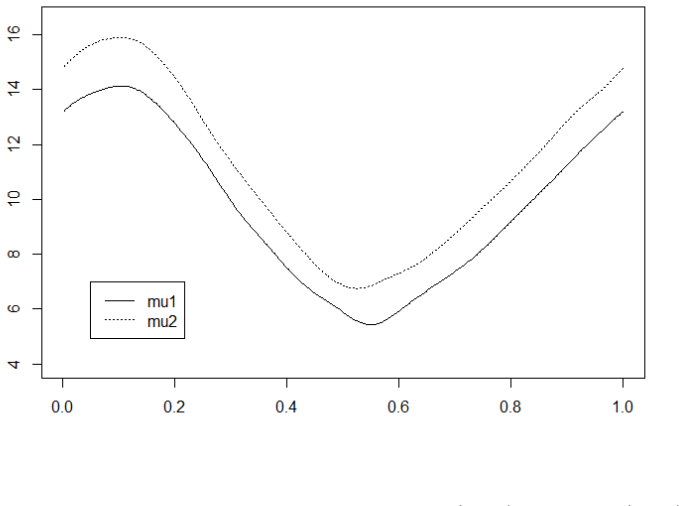
The paper establishes that the L1-norm cusum bootstrap test has asymptotic level alpha under the null and power tending to one under any fixed alternative, and that under a fixed alternative the L1 statistic grows as sqrt(n) times the L1 norm of the mean difference. For dense signals this gives L1 a theoretical advantage over both L2 and supremum norms, while the supremum norm is shown to be better for sufficiently sparse and spiky alternatives. The paper also introduces a power-enhancement term that detects spatially localized changes the plain L1 test misses, at a user-specified cost in size distortion, and validates the whole methodology through simulations and a temperature-curve data example.
Load-bearing premise
The whole construction assumes the noise sequence forgets its past quickly and has a Gaussian counterpart whose L1 distance between shifted versions decays at a polynomial rate; if the data have rough or long-memory noise, neither the limiting null distribution nor the bootstrap's validity is guaranteed.
Editorial extensions
If this is right
- The $L^1$ bootstrap test can serve as a default for retrospective functional change point detection: it keeps the nominal level and detects dense mean shifts without dimension reduction.
- Under a fixed alternative, the $L^1$ statistic separates from its null quantiles at rate $\sqrt{n}$ according to the signal's $L^1$ norm, so power improves as the signal spreads over the domain.
- The power-enhancement component detects spatially concentrated mean shifts that the plain $L^1$ test misses, inflating the asymptotic level only by the user-chosen amount $\alpha_n$.
- For relevant hypotheses with threshold $\Delta$, the bootstrap procedure based on the upper-bound statistic (11) keeps the nominal level in moderate samples and gives an interpretable area-between-curves threshold.
- The strong invariance principle for $L^1$-valued $\beta$-mixing sequences is itself a reusable tool for other inference problems on integrable functional data.
Reading between the lines
- A testable extension is an online monitoring version: the paper only treats retrospective at-most-one-change detection, but the same cusum and bootstrap ingredients are natural candidates for sequential monitoring.
- Because the $L^1$ statistic is a sum of absolute integrated errors, the power comparison may extend to functional data with infinite second moments, where the paper's moment assumptions fail.
- The user-specified tolerated distortion $\alpha_n$ in the power enhancement suggests a data-driven choice of $\alpha_n$ based on estimated signal sparsity, which the paper leaves implicit.
- The paper's analysis of the Gaussian class $\Phi_c(t)=e^{-c(t-0.5)^2}$ predicts a crossover between $L^1$ and supremum power; systematic simulation across covariance operators $C$ could map where that crossover sits.
Signed reviews
Editorial analysis
A structured set of objections, weighed in public.
Referee Report
Summary. This paper develops change point detection for the mean of functional time series taking values in L1[0,1]. The authors prove a strong invariance principle for beta-mixing L1-valued sequences (Theorem 2.2), derive the null limit of the L1 cusum statistic (Corollary 3.1), establish consistency of the change-point estimator (Theorem 3.2), and prove asymptotic level and consistency for a block bootstrap test (Theorem 3.3). Section 4 extends the methodology to relevant hypotheses ||mu(1)-mu(2)||_1 <= Delta, with three bootstrap procedures and limit theorems (Theorems 4.1 and 4.2). Section 5 compares L1-, L2-, and sup-norm tests under fixed alternatives: Theorem 5.1 claims T_n^(i) - sqrt(n) ||Phi||_i converges to a nontrivial limit, Eq. (13) translates this into a power formula, and Corollary 5.2 concludes that L1 is best for dense signals while the supremum norm wins for sparse signals; Theorem 5.3 adds a power enhancement for sparse alternatives. Section 6 provides an extensive simulation comparison under light/heavy tails and independence/dependence, and the methodology is applied to Melbourne daily minimum temperature curves.
Significance. If the validity results hold, the paper makes a useful methodological contribution: it provides the first systematic L1-based cusum theory for functional data, including a new strong invariance principle, a bootstrap test with an explicit block construction, relevant-hypotheses tests with level control at Delta = d1, and a power-enhancement mechanism with a user-specified level distortion. The empirical study is thorough (independent and dependent data, light and heavy tails, five signal shapes, two sample sizes, plus a real-data application) and supports the practical recommendation of L1 as a default norm. I find no circularity: the theoretical derivations involve no fitted constants, the bootstrap quantiles are data-dependent by design, and the tuning parameters (block length l_n, distortion level alpha_n, threshold Delta) are standard. However, the advertised theoretical power comparison (Theorem 5.1, Eq. (13), Corollary 5.2) is invalid as stated, for reasons detailed in major comments M1 and M2; the theoretical validation of the 'L1 best' claim needs substantial rework, although the empirical ranking can stand independently.
major comments (3)
- [Section 5, Theorem 5.1; Section 7.9] The centering in Theorem 5.1 contradicts the paper's own Theorem 4.1. Section 4 derives E[U_n(s)] = (s wedge s* - s s*)(mu(1) - mu(2)), and the deterministic factor is maximized at s = s* with value s*(1-s*). Taking Delta = d1 = ||Phi||_1 in the middle case of Theorem 4.1 yields sqrt(n)(sup_s ||U_n(s)||_1 - s*(1-s*) ||Phi||_1) -> T. The stated convergence sqrt(n)(sup_s ||U_n(s)||_1 - ||Phi||_1) -> A1 = T is therefore false whenever s* in (0,1): the left-hand side equals sqrt(n)(s*(1-s*) - 1)||Phi||_1 + O_P(1), which diverges to -infinity in probability. The same missing factor s*(1-s*) affects the L2 and sup-norm statements, whose deterministic peak is again s*(1-s*)||Phi||_i rather than ||Phi||_i. Theorem 5.1 and its proof (which refers back to Theorem 4.1) must be corrected to the centering sqrt(n) s*(1-s*)||Phi||_i before the claims of Section 5 can be evaluated.
- [Section 5, Eq. (13), Corollary 5.2] The power comparison is not established even after the centering is corrected. (i) Eq. (13) inherits the error of Theorem 5.1: the shift should be sqrt(n) s*(1-s*)||Phi_c||_i, not sqrt(n)||Phi_c||_i. (ii) With any sqrt(n)-order shift, P ow(i,c) -> 1 as n -> infinity for every fixed c with ||Phi_c||_i > 0; the asserted inequalities P ow(1,0) > P ow(2,0) > P ow(infinity,0) compare three sequences that all converge to 1, so a strict asymptotic ranking requires a large-deviation or local-alternative analysis that the paper does not provide. (iii) The monotonicity claims preceding the corollary are false for the stated family Phi_c(t) = exp(-c(t-0.5)^2): for every finite c, Phi_c > 0 on [0,1], so the set N in Theorem 4.1 is empty and A1 = integral_0^1 (W(s*) - s*W(1))(t) dt is independent of c, while for c > 0 the argmax set is E = {0.5}, so A_infinity = W(s*,0.5) - s*W(1,0.5) is also independent of c; the claims that A1 is increasing in c and A_infinity is decreasing in c are therefore false. Corollary 5.2 should be restated with a nondegenerate comparison (e.g., local alternatives or a fixed-n analysis) or downgraded to an empirical conclusion.
- [Section 7.3 (proof of Theorem 3.3)] The bootstrap consistency proof explicitly omits the null-hypothesis case: the text states 'We omit the details as they are not particularly interesting' and only sketches how to find rho with P(||W(s) - sW(1)||_{infinity,1} > a) >= 1 - epsilon and P(max over boundary intervals < a) >= 1 - epsilon. Part 1 of Theorem 3.3, the asymptotic level alpha of the test, is a central validity claim, and the null case is genuinely different from the alternative case because the estimated change point s-hat is not consistent under H0 and the residual correction (mu-hat(2) - mu-hat(1)) is only O_P(n^{-1/2}). The omitted bound for sup_s ||sqrt(n)(S*_n(s) - tilde S*_n(s))||_1 on the event {s-hat in [rho, 1-rho]} must be written out before Theorem 3.3 can be considered proved.
minor comments (8)
- [Introduction, p. 3] The text contains garbled passages ('t m ost o ne c hange', 'The hitherto compiled reference all have on thing in common', 'restrospective'); a careful proofread is needed.
- [Section 7.2, definition of P_N] The indicator in the projection P_N is written as 1{x in [(i-1)/n, i/n)} although the operator is normalized by N on blocks of length 1/N; the second index should be N (blocks [(i-1)/N, i/N)), and as printed the operator is not the intended norm-one projection.
- [Section 5, power enhancement paragraph before Theorem 5.3] The display 'sqrt(n) ||U_n(s-hat,.)||_infinity -> ||W(s*,.)||_infinity := T' cannot hold as stated: under H0 there is no true s* and the limit would involve the random argmax of the limiting L1-cusum process, while under a fixed alternative the left-hand side diverges. Since Theorem 5.3 only requires eta_n = q^J_{1-alpha_n} -> infinity, the display should be corrected or deleted.
- [Section 4, Procedure 3, Eq. (11)] The integrand 'sgn|U*_n(s,t)|' appears to be a typo for '|U*_n(s,t)|'; the sgn symbol is meaningless as written and the integrand should be the pointwise absolute value.
- [Remark 4.3] The displayed formula for Delta-hat_alpha, (d-hat_{infinity,n} - q*_{1-alpha}(n h_n)^{-1/2}) vee 0, does not follow from the definition min{Delta >= 0 | T-hat_{n,Delta} <= q*_{1-alpha}}; solving the inequality gives Delta >= (sup_s ||U_n(s)||_1 - q*_{1-alpha}/sqrt(n)) / (s-hat(1-s-hat)), and the symbols d-hat_{infinity,n} and h_n are not defined at that point.
- [Section 5, Eq. (12)] The quantile ordering q*_{1-alpha,1} < q*_{1-alpha,2} < q*_{1-alpha,infinity} follows from the pointwise norm inequalities ||f||_1 <= ||f||_2 <= ||f||_infinity on [0,1]; attributing it to Jensen's inequality is inaccurate.
- [Section 7.2 (proof of Theorem 2.2)] The proof of Theorem 2.2 is a sketch: the verification of condition (1.19) of Dehling (1983a), in particular the bound E[sup_{|y| <= 2/N} n ||S_n(.) - S_n(.+y)||_1^2] <= N^{-c}, is compressed into a few lines via cotype-2 and Theorem 2.2.4 of van der Vaart and Wellner (1996); since Theorem 2.2 underpins Corollary 3.1 and the proofs of Theorems 3.3 and 4.1, this verification should be written out.
- [Section 6.1, discussion of Table 3] The sentence 'Similar effects ... can be observed when increasing the factor 0.2 and 0.4 in the definitions of the alternatives (20) to (23)' is unclear; the reader needs to know which parameter (kappa, n, or the signal shape) is varied and how it relates to the numbers reported in Table 3.
Circularity Check
No circularity found: the paper's derivation chain is self-contained; the Section 5 centering mismatch is a mathematical error, not a circular step.
full rationale
The paper's central asymptotic statements are derived from external mathematical ingredients rather than from the conclusions they are used to prove. Theorem 2.2 is proved by verifying the conditions of Dehling's invariance principle using results from van der Vaart-Wellner, Yoshihara, and Ledoux-Talagrand; Assumption A4 is an explicit premise, not a disguised form of the target result. Theorem 3.3's bootstrap consistency follows from a newly proved weak invariance principle for the bootstrap process plus the continuous mapping theorem, with change-point estimation handled separately in Theorem 3.2. The relevant-hypotheses results (Theorem 4.1 and the bootstrap procedures (9)-(11)) are derived from Theorem 2.2 and directional Hadamard differentiability (Theorem 7.5), not from any fitted parameter. Section 5's power comparison is built on Theorem 4.1 and standard weak limits; the self-citations (Bastian et al. 2024; Bastian and Dette 2025) appear only in the literature review and as a motivating example, so they are not load-bearing. No step reduces to its input by construction. I also flag, as a correctness issue rather than circularity, that Theorem 5.1 centers with sqrt(n)||Phi||_1, whereas Section 4's calculation E[U_n(s)] = (s and s* - ss*)Phi implies the deterministic maximum is s*(1-s*)||Phi||_1; this undermines the stated power comparison in Corollary 5.2 but does not make the derivation circular.
Assumptions & free parameters
free parameters (3)
- Block length l_n in bootstrap =
l_n approx n^beta with beta in (1/5, 2/7); in simulations selected via Rice-Shang plug-in rule
- Size distortion alpha_n for power enhancement =
alpha_n -> 0, e.g., 0.01 or 1/n in examples
- Relevance threshold Delta =
User-specified, e.g., Delta = d1/2 in simulations; data-driven algorithm in Remark 4.3
assumptions (7)
- domain assumption Assumptions A1-A4: finite (2+delta) moment, beta-mixing with polynomial decay and summability, integrability of sqrt(E[eps(t)^2]), and a Holder modulus bound for the Gaussian process G_eps.
- standard math L1[0,1] has type 1 and cotype 2; cotype-2 bounds and pregaussian covariance criteria from Ledoux and Talagrand (1991).
- standard math Existence of an L1-valued Brownian motion with covariance operator C and continuous distribution of the sup-norm functional.
- standard math Directional Hadamard differentiability of supremum-type functionals (Carcamo et al. 2020) and the delta method for nonsmooth functionals.
- domain assumption In Theorems 5.1 and 5.3, X takes values in C([0,1]) and E[|eps(s)-eps(t)|^2]^(1/2) <= C|s-t|^alpha with alpha > 1/2.
- domain assumption Full trajectories are observed, or a sufficiently dense random grid gives discretization error o(n^{-1/2}).
- standard math Corollary 2 of Hariz et al. (2007) for nonparametric change-point estimator rates.
Cite this review
Pith. "Pith review of Choosing the Right Norm for Change Point Detection in Functional Data." pith.science (2026). https://pith.science/paper/B6ERW4WB
@misc{pith2026250104476,
  author       = {Pith},
  title        = {Pith review of: Choosing the Right Norm for Change Point Detection in Functional Data},
  year         = {2026},
  howpublished = {\url{https://pith.science/paper/B6ERW4WB}},
  note         = {Machine review of arXiv:2501.04476}
}
abstract
We consider the problem of detecting a change point in a sequence of mean functions from a functional time series. We propose an $L^1$ norm based methodology and establish its theoretical validity both for classical and for relevant hypotheses. We compare the proposed method with currently available methodology that is based on the $L^2$ and supremum norms. Additionally we investigate the asymptotic behaviour under the alternative for all three methods and showcase both theoretically and empirically that the $L^1$ norm achieves the best performance in a broad range of scenarios. We also propose a power enhancement component that improves the performance of the $L^1$ test against sparse alternatives. Finally we apply the proposed methodology to both synthetic and real data.
Figures

Reference graph
Works this paper leans on
-
[1]
Aston, J. and Kirch, C. (2012). Detecting and estimating changes in dependent functional data. Journal of Multivariate Analysis ,
work page 2012
-
[12]
Hariz, S. B., Wylie, J. J., and Zhang, Q. (2007). Optimal rate of convergence for nonparametric change-point estimators for nonstationary sequences. The Annals of Statistics , 35(4):1802–1826. Harris, T., Li, B., and Tucker, J. D. (2022). Scalable multiple changepoint detection for functional data sequences. Environmetrics, 33(2):e2710. 43 He, Y., Xu, G.,...
work page 2007
-
[24]
Aue, A., Rice, G., and S¨ onmez, O. (2018). Detecting and dating structural breaks in functional data without dimension reduction. Journal of the Royal Statistical Society Series B: Statistical Methodology , 80(3):509–529. Aue, A. and van Delft, A. (2017). Testing for stationarity of functional time series in the frequency domain. Annals of Statistics ,
work page 2018
-
[48]
Bastian, P., Basu, R., and Dette, H. (2024). Multiple change point detection in functional data with applications to biomechanical fatigue data. The Annals of Applied Statistics, 18(4):3109 –
work page 2024
-
[109]
Aue, A., Gabrys, R., Horv´ ath, L., and Kokoszka, P. (2009). Estimation of a change- point in the mean function of functional data. Journal of Multivariate Analysis , 100(10):2254–2269. Aue, A., Hormann, S., Horvath, L., and Huskova, M. (2014). Dependent functional linear models with applications to monitoring structural change. Statistica Sinica,
work page 2009
-
[181]
Horv´ ath, L. and Kokoszka, P. (2012).Inference for Functional Data with Applications. Springer Series in Statistics. Springer New York. Janson, S. and Kaijser, S. (2012). Higher moments of banach space valued random variables. Memoirs of the American Mathematical Society ,
work page 2012
-
[238]
Kutta, T., Dierickx, G., and Dette, H. (2022). Statistical inference for the slope pa- rameter in functional linear regression. Electronic Journal of Statistics , 16(2):5980 –
work page 2022
-
[259]
Shapiro, A. (1990). On concepts of directional differentiability. Journal of Optimiza- tion Theory and Applications , 66(3):477–487. Shapiro, A. (1991). Asymptotic analysis of stochastic programs. Annals of Operations Research, 30:169–186. Sharipov, O., Tewes, J., and Wendler, M. (2016). Sequential block bootstrap in a hilbert space with application to ch...
work page 1990
Show all 12 references
-
[983]
Fan, J., Liao, Y., and Yao, J. (2015). Power enhancement in high-dimensional cross- sectional tests. Econometrica, 83(4):1497–1541. Fremdt, S., Horv´ ath, L., Kokoszka, P., and Steinebach, J. G. (2014). Functional data analysis with increasing number of projections. Journal of...
2015
-
[1192]
and Kutta, T
Dette, H. and Kutta, T. (2021). Detecting structural breaks in eigensystems of func- tional time series. Electronic Journal of Statistics , 15(1):944 –
2021
-
[3129]
and Dette, H
Bastian, P. and Dette, H. (2025). Gradual changes in functional time series. Journal of Time Series Analysis , n/a(n/a). Berkes, I., Gabrys, R., Horv´ ath, L., and Kokoszka, P. (2009). Detecting changes in the mean of functional observations. Journal of the Royal Statistical S...
2025
-
[6042]
and Talagrand, M
Ledoux, M. and Talagrand, M. (1991). Probability in Banach Spaces: Isoperimetry and Processes. A Series of Modern Surveys in Mathematics Series. Springer. Lu, J., Wu, W., Xiao, Z., and Xu, L. (2022). Almost sure invariance principle of β−mixing time series in hilbert space, ht...
1991 arXiv
Reviewed August 10, 2026 · model on record in the stance chip above.
Discussion (0). Continue with ORCID to comment.