REVIEW 5 major objections 4 minor 48 references
Unified Coding for Both Human Perception and Generalized Machine Analytics with CLIP Supervision
T0 review · 5 major / 4 minor · reviewed 2026-08-10 · deepseek-v4-flash
Pith's one-line read This paper proposes a unified image codec that serves both human perception and unseen machine analytics from a single bitstream, trained without task-specific supervision.
desk verdict A plausible and genuinely novel CLIP-based unified image coding scheme whose reported gains are real but not yet statistically pinned down; deserves a proper referee, not a desk reject. read the letter →
The pith
A machine-rendered reading of the paper's core claim, the machinery that carries it, and where it could break.
The reading
What carries the argument
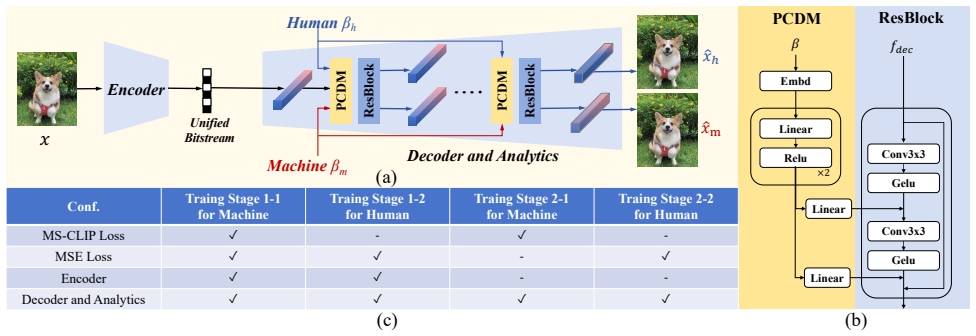
The load-bearing machinery is the Multi-Scale CLIP loss and the Preference Conditional Decoding Module (PCDM). The MS-CLIP loss measures cosine similarity between the original and reconstructed images in the CLIP image-embedding space at three granularities: the full image (global), random local crops (local), and instance crops produced by a segmentation model (instance); summing the three pushes the codec to preserve hierarchical semantics. The PCDM is a lightweight module placed in each decoding block: a two-layer MLP turns the preference indicator beta in {beta_h, beta_m} into a bias feature that is added to the decoder's image features, steering reconstruction toward human or machine utility. A two-stage training schedule alternates human-oriented and machine-oriented objectives so the encoder produces a unified latent and the decoder learns the two branches. Together they make a single bitstream that can be decoded in two different versions without recompression.
What would settle it
Pick an analytics task whose success is known to be poorly captured by CLIP-style global semantics, for instance monocular depth estimation or counting of small objects, and run the machine-preference decode of UG-ICM on it at matched bitrates. If the bpp-analytics gains over the vanilla codec disappear or reverse on that task, the claimed task-agnostic generalization is bounded by CLIP's semantic coverage; if the gains persist, the generalized claim is stronger than the paper's current evaluation shows.
Extended reading notes
Core claim
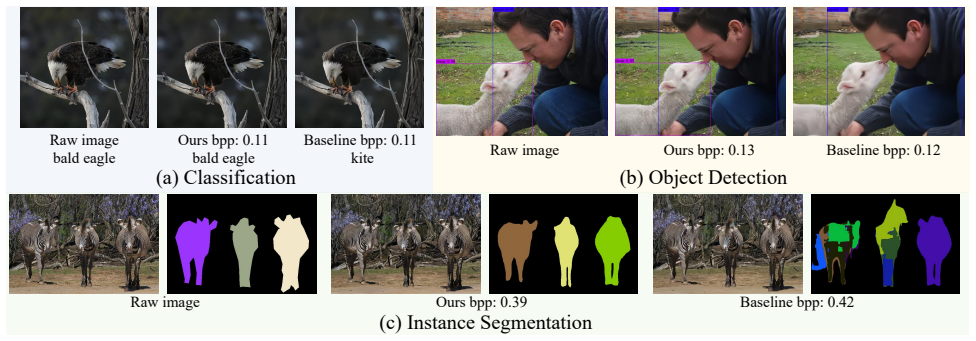
The paper claims that a learned image codec can be made simultaneously human- and machine-friendly, and generalizable to unseen analytics, by two mechanisms. First, it replaces task-specific supervision with multi-scale CLIP-based semantic supervision: a cosine-similarity loss at global, local-crop, and instance-crop levels between the original and reconstructed images, computed in the embedding space of a pre-trained CLIP image encoder. Second, a Preference Conditional Decoding Module injects a preference feature into each decoder block, so the same latent bitstream produces a human-preferred image when the preference parameter is beta_h and a machine-preferred image when it is beta_m. The whole model is trained self-supervised and alternates between rate-perception and rate-analytics objectives; at test time the downstream analytics models are unseen. On the MLIC++ backbone the machine decode gives average bpp-based gains of 2.8% for classification, 3.9% for object detection, 6.0% for semantic segmentation, and 3.2% for instance segmentation over the vanilla codec, with comparable PSNR, SSIM, and LPIPS.
Load-bearing premise
The method assumes that closeness in the CLIP image-embedding space, at global, local, and instance scales, is a faithful proxy for what later, unseen machine analytics tasks need; if that proxy fails for a task, the training signal will not help that task.
Editorial extensions
If this is right
- A single compressed bitstream can be decoded into a human version or a machine version by switching one scalar preference, so separate human and machine streams become unnecessary.
- Because training needs no downstream labels or analytics models, the same recipe can be re-run when new tasks arrive, without retraining the codec for each task.
- The reported gains on unseen classification, detection, and segmentation suggest that semantic preservation in a generic embedding space transfers across task families, not just to tasks used for evaluation.
- The multi-scale variant outperforms global-only CLIP supervision, indicating that small-object and local semantics are material to machine analytics and are worth explicit loss terms.
- The recipe transfers across two learned codec backbones, so it acts as a training-time add-on rather than a redesign of the entropy model or architecture.
Reading between the lines
- Implicit extension: because CLIP embeddings are aligned with text, a language-conditioned variant could steer the machine decode toward a specified task family, such as pedestrians or road markings, without retraining the codec; the paper does not explore this.
- Testable extension: the paper's ablations isolate the joint effect of the three CLIP losses but not their optimal balance; replacing the fixed equal weighting with learned or rate-dependent weights could yield larger gains.
- Boundary inference: the mechanism should help any analytics task whose errors align with CLIP's notion of semantic similarity, such as common recognition tasks, but tasks like geometric measurement or fine-grained counting may see little or no benefit; the paper's task set does not cover those cases.
- Consequence for codec design: if the result holds, learned codecs for machine consumption can drop task-specific heads and instead budget bits toward preserving human-interpretable semantics, making the bitstream a shared resource rather than a task-specific artifact.
Editorial analysis
A structured set of objections, weighed in public.
Referee Report
Summary. The paper proposes UG-ICM, a learned image compression framework that combines a preference-conditional decoder with CLIP-based multi-scale semantic supervision. The encoder and entropy model produce a unified bitstream, and the decoder takes a scalar preference code (human or machine) to produce two reconstructions. The training alternates between rate-perception and rate-analytics objectives, and the CLIP losses are applied at global, random-local, and instance levels (Eqs. 4-7), with instance masks obtained from FreeSOLO. Experiments on two LIC backbones, Bmshj2018 and MLIC++, report bpp-analytics gains of 1.7-6.0% on four downstream tasks, comparable human-perceptual quality, and ablations of the PCDM and multi-scale loss.
Significance. The manuscript addresses a relevant and active topic, and the central idea is plausible: using a frozen multimodal model as task-agnostic supervision and conditioning the decoder on a preference code could provide a practical single-bitstream solution for both human and machine consumption. The paper provides a code link, evaluates on four downstream tasks, and uses two different backbones, which is a reasonable breadth of evidence for a conference submission. The main value is empirical; if the gains are robust, the method would be a useful contribution to the image-coding-for-machines literature. The claims of 'remarkable' and 'unseen' generalization are, however, currently stronger than the evidence supports.
major comments (5)
- [Experimental Results, Figs. 5 and 8] The reported average bpp-analytics gains are not accompanied by any measure of variance, and the phrase 'average bpp-analytics gain' is never defined. The Implementation Details state that models are trained four times with different Lagrange parameters; that is four rate points, not four random seeds. Because learned compression training is sensitive to initialization and the claimed improvements are 1.7-6.0%, the central claim that CLIP supervision improves unseen analytics is not statistically established. Please provide multiple seeds and error bars, and specify how equal-bpp comparisons and the reported averages are computed, including the interpolation rule and bpp anchors.
- [Proposed Method, Eq. (4)] The instance-level CLIP loss pairs a set of masks from the original image with a set of masks from the compressed image, but the paper does not explain how the two sets are matched. FreeSOLO can return different numbers or arrangements of masks for the original and the compressed image; if pairing is only by index, the loss may align unrelated instances. Please describe the mask extraction and matching procedure, including confidence thresholds, maximum number of masks, and whether masks are taken from the machine-preference reconstruction at every training step, or compute the loss using masks transferred from the original image only.
- [Proposed Method, Eq. (5) and Implementation Details] The local-wise CLIP loss is underspecified: the paper does not state the crop size, the number of local crops per image, whether the same spatial coordinates are used for the original and reconstructed crops, or how crops are resized for the CLIP ViT-B/32 input. These choices directly affect the learned representation and the reported gains, so they should be documented to make the MS-CLIP loss reproducible.
- [Comparison to State-of-the-art ICM Methods, Fig. 8] The paper notes that TransTIC requires recompression into another bitstream when adapting to a new task, but it does not state whether the bpp plotted for TransTIC in Fig. 8 includes both the human-oriented and the analytics-oriented bitstreams. If only one bitstream is counted, the comparison is biased in favor of UG-ICM, whose advantage is precisely the use of a single bitstream. Please clarify the bitrate accounting for all anchor methods.
- [Abstract and Benchmark] The statement that instance segmentation is an 'unseen' task is imprecise: the MS-CLIP loss uses FreeSOLO, which is itself an instance segmentation model, to generate the instance-level pairs. The compression model therefore receives instance-level segmentation information during training, even though the evaluation model, Mask R-CNN, and its annotations are not used. Please either weaken the 'unseen task' claim or explain why FreeSOLO's outputs should not be counted as task supervision.
minor comments (4)
- [Throughout] Please fix typos such as 'pretraind', 'tranining', 'Multy-Scale', and 'glocal-local-instance'.
- [Eq. (3)] The cosine term has a mismatched bracket; please correct the notation.
- [Fig. 9] The text 'average gain of3%' and '1dB bpp-PSNR' should be formatted as '3%' and '1 dB', and the terms bpp-mAP and bpp-PSNR should be defined.
- [Implementation Details] Please report the batch size, training image resolution, number of local crops per image, and the preprocessing applied before CLIP feature extraction.
Circularity Check
No significant circularity: CLIP supervision is an external training signal and all reported gains are measured on independent downstream models.
full rationale
The paper's claimed derivation is not circular. The training objective, MS-CLIP loss, is defined as cosine similarity between CLIP features of original and reconstructed images at global, local, and instance levels (Eqs. 4-7), while the reported evaluation metrics are Top-1 accuracy, mAP, mIoU, PSNR, SSIM, and LPIPS computed by external task models (ResNet101, YOLOv3, Mask R-CNN, DeepLabv3+) and standard image quality measures. None of these evaluation quantities appears in the training loss, and the downstream models are not used to construct the training objective, so the reported gains are not forced by construction. The paper does not fit a parameter and then rename it as a prediction; it trains a compression model and measures generalization on held-out tasks. The one overlapping-author citation, Shen et al. 2024, appears only in a related-work survey sentence ('transfer-based methods ... (Shen et al. 2024)') and is not load-bearing for the proposed method or its evaluation. No uniqueness theorem is imported from the authors' prior work, and no ansatz is smuggled in via citation. The absence of error bars or significance tests is a legitimate robustness concern, but it is not a circularity: the empirical comparison is externally grounded. The use of FreeSOLO to generate instance masks for the CLIP instance-level loss does overlap topically with the instance-segmentation evaluation, but the evaluation uses a different, externally trained model (Mask R-CNN) and reports its mAP, not a CLIP similarity score; therefore the reported instance-segmentation improvement is not the training loss by another name. Overall, the derivation chain is self-contained and externally benchmarked, so the circularity score is 0.
Assumptions & free parameters
free parameters (4)
- Lagrange parameter lambda =
four values (not explicitly listed)
- Preference codes beta_h and beta_m =
[0, 1]
- Loss weighting for global, local, instance CLIP losses =
equal weights (implied by Eq. 7)
- Training epochs and learning rates =
200 epochs at 1e-4, then 10 epochs at 1e-5
assumptions (4)
- domain assumption CLIP feature space is a transferable semantic representation for a wide range of unseen machine analytics tasks.
- domain assumption The instance segmentation model FreeSOLO provides consistent and reliable instance masks for both original and compressed images.
- domain assumption L2 reconstruction loss is an adequate proxy for human perceptual quality during training.
- standard math Lagrangian relaxation for rate-distortion optimization is a standard and valid training objective.
Cite this review
Pith. "Pith review of Unified Coding for Both Human Perception and Generalized Machine Analytics with CLIP Supervision." pith.science (2026). https://pith.science/paper/SAG5HWWN
@misc{pith2026250104579,
  author       = {Pith},
  title        = {Pith review of: Unified Coding for Both Human Perception and Generalized Machine Analytics with CLIP Supervision},
  year         = {2026},
  howpublished = {\url{https://pith.science/paper/SAG5HWWN}},
  note         = {Machine review of arXiv:2501.04579}
}
read the original abstract
The image compression model has long struggled with adaptability and generalization, as the decoded bitstream typically serves only human or machine needs and fails to preserve information for unseen visual tasks. Therefore, this paper innovatively introduces supervision obtained from multimodal pre-training models and incorporates adaptive multi-objective optimization tailored to support both human visual perception and machine vision simultaneously with a single bitstream, denoted as Unified and Generalized Image Coding for Machine (UG-ICM). Specifically, to get rid of the reliance between compression models with downstream task supervision, we introduce Contrastive Language-Image Pre-training (CLIP) models into the training constraint for improved generalization. Global-to-instance-wise CLIP supervision is applied to help obtain hierarchical semantics that make models more generalizable for the tasks relying on the information of different granularity. Furthermore, for supporting both human and machine visions with only a unifying bitstream, we incorporate a conditional decoding strategy that takes as conditions human or machine preferences, enabling the bitstream to be decoded into different versions for corresponding preferences. As such, our proposed UG-ICM is fully trained in a self-supervised manner, i.e., without awareness of any specific downstream models and tasks. The extensive experiments have shown that the proposed UG-ICM is capable of achieving remarkable improvements in various unseen machine analytics tasks, while simultaneously providing perceptually satisfying images.
Figures


Figures from the paper (7 more)




Reference graph
Works this paper leans on
-
[1]
Ball \'e , J.; Laparra, V.; and Simoncelli, E. P. 2017. End-to-end optimized image compression. In Proceedings of the International Conference on Learning Representations
work page 2017
-
[2]
Ball \'e , J.; Minnen, D.; Singh, S.; Hwang, S. J.; and Johnston, N. 2018. Variational image compression with a scale hyperprior. In Proceedings of the International Conference on Learning Representations
work page 2018
-
[3]
Bross, B.; Wang, Y.; Ye, Y.; Liu, S.; Chen, J.; Sullivan, G.; and Ohm, J. 2021. Overview of the Versatile Video Coding ( VVC ) Standard and its Applications. IEEE Transactions on Circuits and Systems for Video Technology, 31(10): 3736--3764
work page 2021
-
[4]
D.; Racap \'e , F.; B \'e gaint, J.; Pushparaja, A.; and Feltman, S
Chamain, L. D.; Racap \'e , F.; B \'e gaint, J.; Pushparaja, A.; and Feltman, S. 2021. End-to-end optimized image compression for machines, a study. In Proceedings of the Data Compression Conference, 163--172
work page 2021
-
[5]
Chen, F.; Xu, Y.; and Wang, L. 2022. Two-stage octave residual network for end-to-end image compression. In Proceedings of the AAAI Conference on Artificial Intelligence, volume 36, 3922--3929
work page 2022
-
[6]
Chen, L.-C.; Zhu, Y.; Papandreou, G.; Schroff, F.; and Adam, H. 2018. Encoder-decoder with atrous separable convolution for semantic image segmentation. In Proceedings of the European Conference on Computer Vision, 801--818
2018
-
[7]
Chen, Y.-H.; Weng, Y.-C.; Kao, C.-H.; Chien, C.; Chiu, W.-C.; and Peng, W.-H. 2023. Transtic: Transferring transformer-based image compression from human perception to machine perception. In Proceedings of the IEEE International Conference on Computer Vision, 23297--23307
work page 2023
-
[8]
Chen, Z.; Fan, K.; Wang, S.; Duan, L.; Lin, W.; and Kot, A. 2020. Toward Intelligent Sensing: Intermediate Deep Feature Compression. IEEE Transactions on Image Processing, 29: 2230--2243
work page 2020
Show all 48 references
-
[9]
Chen, Z.; Fan, K.; Wang, S.; Duan, Y.; Lin, W.; and Alex, K. 2019. Lossy intermediate deep learning feature compression and evaluation. In Proceedings of the ACM International Conference on Multimedia, 2414--2422
2019
-
[10]
Choi, H.; and Baji \'c , I. V. 2022. Scalable image coding for humans and machines. IEEE Transactions on Image Processing, 31: 2739--2754
2022
-
[11]
Choi, J.; and Han, B. 2020. Task-aware quantization network for jpeg image compression. In Proceedings of European Conference on Computer Vision, 309--324
2020
-
[12]
Deng, J.; Dong, W.; Socher, R.; Li, L.-J.; Li, K.; and Fei-Fei, L. 2009. Imagenet: A large-scale hierarchical image database. In Proceedings of the IEEE Conference on Computer Vision and Pattern Recognition, 248--255
2009
-
[13]
K.; Winn, J.; and Zisserman, A
Everingham, M.; Van Gool, L.; Williams, C. K.; Winn, J.; and Zisserman, A. 2010. The pascal visual object classes (voc) challenge. International Journal of Computer Vision, 88: 303--338
2010
-
[14]
Gao, Y.; Liu, J.; Xu, Z.; Zhang, J.; Li, K.; Ji, R.; and Shen, C. 2022. Pyramidclip: Hierarchical feature alignment for vision-language model pretraining. Neural Information Processing Systems, 35: 35959--35970
2022
-
[15]
Guo, Z.; Zhang, Z.; Feng, R.; and Chen, Z. 2021. Causal contextual prediction for learned image compression. IEEE Transactions on Circuits and Systems for Video Technology, 32(4): 2329--2341
2021
-
[16]
He, D.; Zheng, Y.; Sun, B.; Wang, Y.; and Qin, H. 2021. Checkerboard context model for efficient learned image compression. In Proceedings of the IEEE Conference on Computer Vision and Pattern Recognition, 14771--14780
2021
-
[17]
He, K.; Gkioxari, G.; Doll \'a r, P.; and Girshick, R. 2017. Mask r-cnn. In Proceedings of the IEEE International Conference on Computer Vision, 2961--2969
2017
-
[18]
He, K.; Zhang, X.; Ren, S.; and Sun, J. 2016. Deep residual learning for image recognition. In Proceedings of the IEEE Conference on Computer Vision and Pattern Recognition, 770--778
2016
-
[19]
Huang, Z.; Jia, C.; Wang, S.; and Ma, S. 2021. Visual analysis motivated rate-distortion model for image coding. In Proceedings of IEEE International Conference on Multimedia and Expo, 1--6
2021
-
[20]
Jiang, W.; and Wang, R. 2023. MLIC++: Linear Complexity Multi-Reference Entropy Modeling for Learned Image Compression. In ICML Workshop Neural Compression: From Information Theory to Applications
2023
-
[21]
Jiang, W.; Yang, J.; Zhai, Y.; Ning, P.; Gao, F.; and Wang, R. 2023. Mlic: Multi-reference entropy model for learned image compression. In Proceedings of the ACM International Conference on Multimedia, 7618--7627
2023
-
[22]
C.; Lo, W.-Y.; et al
Kirillov, A.; Mintun, E.; Ravi, N.; Mao, H.; Rolland, C.; Gustafson, L.; Xiao, T.; Whitehead, S.; Berg, A. C.; Lo, W.-Y.; et al. 2023. Segment anything. In Proceedings of the IEEE/CVF International Conference on Computer Vision, 4015--4026
2023
-
[23]
Le, N.; Zhang, H.; Cricri, F.; Ghaznavi-Youvalari, R.; and Rahtu, E. 2021. Image coding for machines: an end-to-end learned approach. In Proceedings of the IEEE International Conference on Acoustics, Speech and Signal Processing, 1590--1594
2021
-
[24]
Li, B.; Ye, L.; Liang, J.; Wang, Y.; and Han, J. 2022. Region-of-interest and channel attention-based joint optimization of image compression and computer vision. Neurocomputing, 500: 13--25
2022
-
[25]
Lin, T.-Y.; Maire, M.; Belongie, S.; Hays, J.; Perona, P.; Ramanan, D.; Doll \'a r, P.; and Zitnick, C. L. 2014. Microsoft coco: Common objects in context. In Proceedings of the European Conference on Computer Vision, 740--755
2014
-
[26]
Liu, D.; Zhang, H.; and Xiong, Z. 2019. On the classification-distortion-perception tradeoff. In Proceedings of the International Conference on Neural Information Processing Systems, 1206--1215
2019
-
[27]
Liu, J.; Sun, H.; and Katto, J. 2022. Improving multiple machine vision tasks in the compressed domain. In Proceedings of the IEEE International Conference on Pattern Recognition, 331--337
2022
-
[28]
Liu, J.; Sun, H.; and Katto, J. 2023. Learned image compression with mixed transformer-cnn architectures. In Proceedings of the IEEE on Conference on Computer Vision and Pattern Recognition, 14388--14397
2023
-
[29]
Liu, K.; Liu, D.; Li, L.; Yan, N.; and Li, H. 2021. Semantics-to-signal scalable image compression with learned revertible representations. International Journal of Computer Vision, 129(9): 2605--2621
2021
-
[30]
Liu, L.; Hu, Z.; Chen, Z.; and Xu, D. 2023. Icmh-net: Neural image compression towards both machine vision and human vision. In Proceedings of the ACM International Conference on Multimedia, 8047--8056
2023
-
[31]
Minnen, D.; Ball \'e , J.; and Toderici, G. D. 2018. Joint autoregressive and hierarchical priors for learned image compression. Advances in Neural Information Processing Systems, 31
2018
-
[32]
Minnen, D.; and Singh, S. 2020. Channel-wise autoregressive entropy models for learned image compression. In Proceedings of the IEEE International Conference on Image Processing, 3339--3343
2020
-
[33]
W.; Hallacy, C.; Ramesh, A.; Goh, G.; Agarwal, S.; Sastry, G.; Askell, A.; Mishkin, P.; Clark, J.; et al
Radford, A.; Kim, J. W.; Hallacy, C.; Ramesh, A.; Goh, G.; Agarwal, S.; Sastry, G.; Askell, A.; Mishkin, P.; Clark, J.; et al. 2021. Learning transferable visual models from natural language supervision. In Proceedings of the International Conference on Machine Learning, 8748--8763
2021
-
[34]
Redmon, J.; and Farhadi, A. 2018. Yolov3: An incremental improvement. arXiv preprint arXiv:1804.02767
2018 arXiv
-
[35]
Shen, X.; Yin, K.; Wang, X.; He, Y.; Wang, S.; and Yang, W. 2024. Image Coding for Analytics via Adversarially Augmented Adaptation. In Proceedings of the IEEE International Conference on Acoustics, Speech and Signal Processing, 3605--3609
2024
-
[36]
Shindo, T.; Yamada, K.; Watanabe, T.; and Watanabe, H. 2024. Image Coding for Machines with Edge Information Learning Using Segment Anything. arXiv preprint arXiv:2403.04173
2024 arXiv
-
[37]
J.; Ohm, J.-R.; Han, W.-J.; and Wiegand, T
Sullivan, G. J.; Ohm, J.-R.; Han, W.-J.; and Wiegand, T. 2012. Overview of the high efficiency video coding ( HEVC ) standard. IEEE Transactions on Circuits and Systems for Video technology, 22(12): 1649--1668
2012
-
[38]
Torfason, R.; Mentzer, F.; Agustsson, E.; Tschannen, M.; Timofte, R.; and Van Gool, L. 2018. Towards image understanding from deep compression without decoding. arXiv preprint arXiv:1803.06131
2018 arXiv
-
[39]
Wang, S.; Wang, S.; Yang, W.; Zhang, X.; Wang, S.; Ma, S.; and Gao, W. 2021 a . Towards analysis-friendly face representation with scalable feature and texture compression. IEEE Transactions on Multimedia, 24: 3169--3181
2021
-
[40]
Wang, S.; Wang, Z.; Wang, S.; and Ye, Y. 2021 b . End-to-end compression towards machine vision: Network architecture design and optimization. IEEE Open Journal of Circuits and Systems, 2: 675--685
2021
-
[41]
Wang, X.; Yu, Z.; De Mello, S.; Kautz, J.; Anandkumar, A.; Shen, C.; and Alvarez, J. M. 2022. Freesolo: Learning to segment objects without annotations. In Proceedings of the IEEE Conference on Computer Vision and Pattern Recognition, 14176--14186
2022
-
[42]
Xie, Y.; Cheng, K.; and Chen, Q. 2021. Enhanced invertible encoding for learned image compression. In Proceedings of the ACM International Conference on Multimedia, 162--170
2021
-
[43]
Yang, S.; Hu, Y.; Yang, W.; Duan, L.-Y.; and Liu, J. 2021. Towards coding for human and machine vision: Scalable face image coding. IEEE Transactions on Multimedia, 23: 2957--2971
2021
-
[44]
Yang, W.; Huang, H.; Hu, Y.; Duan, L.; and Liu, J. 2024. Video Coding for Machines: Compact Visual Representation Compression for Intelligent Collaborative Analytics. IEEE Transactions on Pattern Analysis amp; Machine Intelligence, 46(07): 5174--5191
2024
-
[45]
A.; Shechtman, E.; and Wang, O
Zhang, R.; Isola, P.; Efros, A. A.; Shechtman, E.; and Wang, O. 2018. The unreasonable effectiveness of deep features as a perceptual metric. In Proceedings of the IEEE Conference on Computer Vision and Pattern Recognition, 586--595
2018
-
[46]
H.; Zhou, L.; Dai, X.; Yuan, L.; Li, Y.; et al
Zhong, Y.; Yang, J.; Zhang, P.; Li, C.; Codella, N.; Li, L. H.; Zhou, L.; Dai, X.; Yuan, L.; Li, Y.; et al. 2022. Regionclip: Region-based language-image pretraining. In Proceedings of the IEEE Conference on Computer Vision and Pattern Recognition, 16793--16803
2022
-
[47]
, " * write output.state after.block = add.period write newline
ENTRY address archivePrefix author booktitle chapter edition editor eid eprint howpublished institution isbn journal key month note number organization pages publisher school series title type volume year label extra.label sort.label short.list INTEGERS output.state before.all...
-
[48]
write newline
" write newline "" before.all 'output.state := FUNCTION n.dashify 't := "" t empty not t #1 #1 substring "-" = t #1 #2 substring "--" = not "--" * t #2 global.max substring 't := t #1 #1 substring "-" = "-" * t #2 global.max substring 't := while if t #1 #1 substring * t #2 gl...
Reviewed August 10, 2026 · model on record in the stance chip above.
Discussion (0). Continue with ORCID to comment.