Giant Kohn anomaly and chiral phonons in the charge density wave phase of 1H-NbSe₂
Pith reviewed 2026-05-23 05:28 UTC · model grok-4.3
The pith
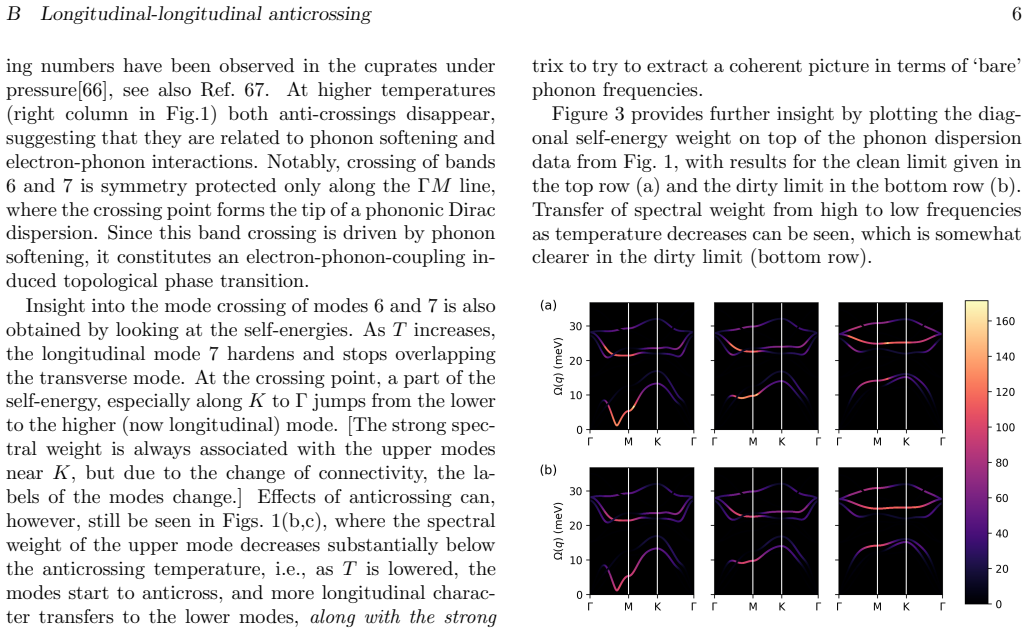
A longitudinal optical phonon softens through a Kohn ladder to drive the charge density wave in monolayer 1H-NbSe2.
A machine-rendered reading of the paper's core claim, the machinery that carries it, and where it could break.
Core claim
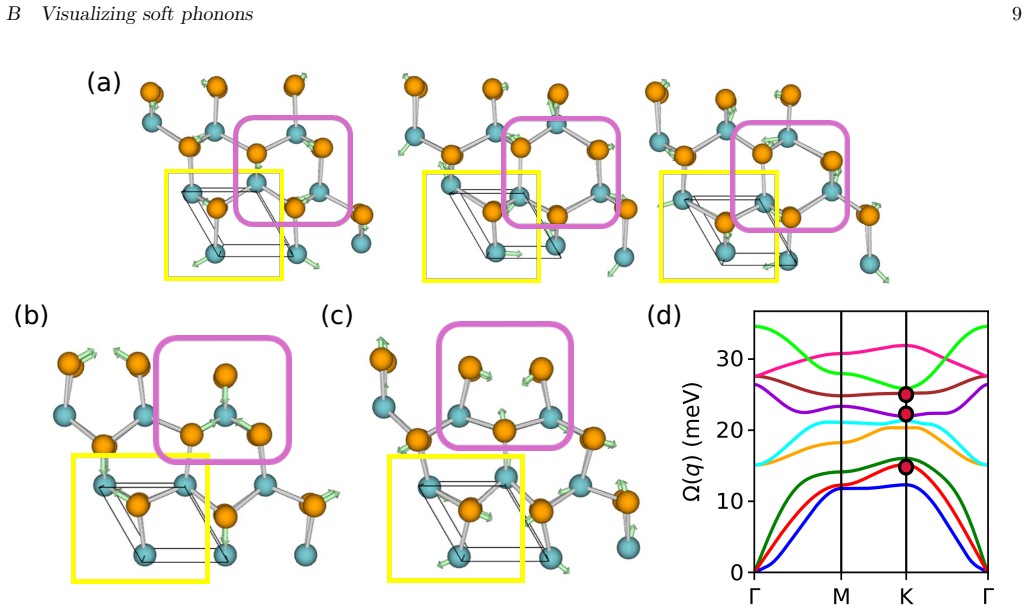
Through an accurate computation of the phonon self-energy, including its off-diagonal components, the relevant mode is a longitudinal optical phonon that softens by anti-crossing several intervening phonon bands, i.e. a Kohn ladder. Q_CDW is fixed by the convolution of the susceptibility and electron-phonon coupling, and the softened phonons are circularly polarized.
What carries the argument
Kohn ladder: the anti-crossing sequence of a longitudinal optical phonon with multiple intervening bands enabled by the full off-diagonal phonon self-energy
If this is right
- The CDW wavevector is fixed by the convolution of susceptibility and electron-phonon coupling rather than Fermi-surface nesting alone.
- The instability involves softening of a longitudinal optical phonon rather than an acoustic mode.
- The softened phonons acquire circular polarization.
- Off-diagonal terms in the phonon self-energy are required to reveal the ladder mechanism.
Where Pith is reading between the lines
- The same ladder process could explain apparent acoustic softening in other CDW materials that actually couple strongly to optical phonons.
- Circular polarization of the soft modes may open new couplings to electronic or magnetic degrees of freedom inside the CDW phase.
- Parallel self-energy calculations on related transition-metal dichalcogenides could test whether the convolution rule for Q_CDW is general.
Load-bearing premise
The phonon self-energy calculation that includes off-diagonal terms is accurate enough to identify the softening mode as longitudinal optical and to establish the convolution origin of Q_CDW.
What would settle it
Measurement of the phonon dispersion near the calculated Q_CDW that either shows or fails to show the predicted sequence of anti-crossings for the longitudinal optical branch together with circular polarization of the eigenvectors.
Figures






read the original abstract
Despite extensive investigations, many aspects of charge density waves (CDWs) remain elusive, especially the relative roles of electron-phonon coupling and Fermi surface nesting as the underlying driving mechanisms responsible for the emergence of the CDW vector $Q_{CDW}$. It is puzzling that even though electrons interact strongly with optical phonons in many correlated systems, the actual mode softening is of an acoustic mode. Here we consider monolayer 1H-NbSe$_2$ as an exemplar system, and through an accurate computation of the phonon self-energy, including its off-diagonal components, we provide compelling evidence that the relevant mode is a longitudinal optical phonon that softens by anti-crossing several intervening phonon bands, i.e. a Kohn ladder which has been only observed previously in high temperature superconductors. We also show that $Q_{CDW}$ is fixed by the convolution of the susceptibility and electron-phonon coupling, and that the softened phonons are circularly polarized.
Editorial analysis
A structured set of objections, weighed in public.
Referee Report
Summary. The paper claims that in monolayer 1H-NbSe₂, an accurate first-principles computation of the phonon self-energy (including off-diagonal components) demonstrates that the CDW instability involves softening of a longitudinal optical phonon via anti-crossing with intervening bands (a 'Kohn ladder'), that Q_CDW is determined by the convolution of the electronic susceptibility and electron-phonon coupling, and that the softened modes are circularly polarized.
Significance. If the computational results hold, the work would resolve the long-standing puzzle of optical versus acoustic phonon softening in CDW systems, provide direct evidence for the convolution mechanism fixing Q_CDW, and establish chiral phonons as a feature of the CDW phase. The explicit inclusion of off-diagonal self-energy terms and the connection to Kohn anomalies in high-Tc superconductors are notable strengths that could influence modeling of CDWs in other 2D materials.
major comments (2)
- [phonon self-energy computation section] The central claims depend on the accuracy and completeness of the phonon self-energy calculation including off-diagonal matrix elements. The manuscript must supply explicit convergence tests with respect to k/q-point sampling, cutoff energies, and smearing parameters, along with quantitative error bars on the mode frequencies and polarization vectors, to substantiate that the longitudinal optical mode is correctly identified as the softening one rather than an acoustic mode.
- [section on Q_CDW determination] The statement that Q_CDW is fixed by the convolution of susceptibility and electron-phonon coupling requires a direct, quantitative demonstration (e.g., a plot or table comparing the convolution peak position to the observed Q_CDW) that isolates this mechanism from possible contributions of Fermi-surface nesting alone or from approximations in the susceptibility.
minor comments (2)
- Clarify the definition and computation of circular polarization for the softened modes, including any phase information or vector decomposition used to establish chirality.
- Add a brief comparison table or discussion contrasting the present results with prior calculations on bulk NbSe₂ or related TMDs to highlight the monolayer-specific findings.
Simulated Author's Rebuttal
We thank the referee for their careful reading of the manuscript and for the constructive comments, which have helped us improve the presentation of our results. We address each major comment below.
read point-by-point responses
-
Referee: The central claims depend on the accuracy and completeness of the phonon self-energy calculation including off-diagonal matrix elements. The manuscript must supply explicit convergence tests with respect to k/q-point sampling, cutoff energies, and smearing parameters, along with quantitative error bars on the mode frequencies and polarization vectors, to substantiate that the longitudinal optical mode is correctly identified as the softening one rather than an acoustic mode.
Authors: We agree that explicit documentation of convergence and error estimates is required to substantiate the identification of the softening mode. In the revised manuscript we have added an appendix containing systematic convergence tests with respect to k- and q-point sampling densities, plane-wave cutoff energies, and smearing parameters. We also report quantitative error bars on the computed phonon frequencies and polarization vectors obtained from these tests, confirming that the longitudinal optical branch is the mode that softens via the Kohn-ladder anti-crossing. revision: yes
-
Referee: The statement that Q_CDW is fixed by the convolution of susceptibility and electron-phonon coupling requires a direct, quantitative demonstration (e.g., a plot or table comparing the convolution peak position to the observed Q_CDW) that isolates this mechanism from possible contributions of Fermi-surface nesting alone or from approximations in the susceptibility.
Authors: We accept that a more direct, side-by-side comparison is needed to isolate the convolution mechanism. The revised manuscript includes a new figure that plots the wave-vector dependence of the susceptibility–electron-phonon-coupling convolution and overlays the experimentally reported Q_CDW. The same figure also shows the susceptibility alone (corresponding to nesting) for direct comparison, demonstrating that the convolution peak coincides with Q_CDW while the nesting peak does not. A brief discussion of the susceptibility approximations and their effect on the peak position has been added to the text. revision: yes
Circularity Check
No significant circularity detected
full rationale
The paper's derivation chain rests on a first-principles computation of the phonon self-energy (including off-diagonal components) within standard many-body perturbation theory for CDW systems. No load-bearing step reduces by construction to a fitted parameter, self-citation chain, or definitional tautology; the mode identification as a longitudinal optical phonon undergoing anti-crossing, the convolution fixing Q_CDW, and the circular polarization are presented as outputs of that computation rather than inputs renamed as predictions. The argument is self-contained against external benchmarks in condensed-matter theory and does not invoke uniqueness theorems or ansatzes from the authors' prior work as load-bearing justification.
Axiom & Free-Parameter Ledger
Lean theorems connected to this paper
-
IndisputableMonolith/Cost/FunctionalEquation.leanwashburn_uniqueness_aczel unclear?
unclearRelation between the paper passage and the cited Recognition theorem.
through an accurate computation of the phonon self-energy, including its off-diagonal components, we provide compelling evidence that the relevant mode is a longitudinal optical phonon that softens by anti-crossing several intervening phonon bands, i.e. a Kohn ladder
-
IndisputableMonolith/Foundation/AlexanderDuality.leanalexander_duality_circle_linking unclear?
unclearRelation between the paper passage and the cited Recognition theorem.
Q_CDW is fixed by the convolution of the susceptibility and electron-phonon coupling
What do these tags mean?
- matches
- The paper's claim is directly supported by a theorem in the formal canon.
- supports
- The theorem supports part of the paper's argument, but the paper may add assumptions or extra steps.
- extends
- The paper goes beyond the formal theorem; the theorem is a base layer rather than the whole result.
- uses
- The paper appears to rely on the theorem as machinery.
- contradicts
- The paper's claim conflicts with a theorem or certificate in the canon.
- unclear
- Pith found a possible connection, but the passage is too broad, indirect, or ambiguous to say the theorem truly supports the claim.
Reference graph
Works this paper leans on
-
[1]
The true soft mode lies near 2/3 of Γ − M
The Kekule state is involved in the softening between modes 6 and 7, but it is not the ground state. The true soft mode lies near 2/3 of Γ − M. At M, all modes are linearly polarized, but as one goes toward Γ, one set of atoms moves in the orthogonal direction to form an elliptical orbit. Notably, in 1H-NbSe 2 an earlier work found two static CDW ground s...
-
[2]
S. Manzeli, D. Ovchinnikov, D. Pasquier, O. V. Yazyev, and A. Kis, 2D transition metal dichalcogenides, Nat Rev Mater 2, 10.1038/natrevmats.2017.33 (2017)
-
[3]
A. B. Kaul, Two-dimensional layered materials: Struc- ture, properties, and prospects for device applications, Journal of Materials Research 29, 348 (2014)
work page 2014
- [4]
-
[5]
K. Cho, M. Ko´ nczykowski, S. Teknowijoyo, M. A. Tanatar, J. Guss, P. B. Gartin, J. M. Wilde, A. Kreyssig, R. J. McQueeney, A. I. Goldman, V. Mishra, P. J. Hirschfeld, and R. Prozorov, Using controlled disorder to probe the interplay between charge order and super- conductivity in NbSe 2, Nature Communications 9, 2796 (2018)
work page 2018
-
[6]
C.-S. Lian, C. Si, and W. Duan, Unveiling charge-density wave, superconductivity, and their competitive nature in two-dimensional NbSe2, Nano Letters 18, 2924 (2018)
work page 2018
-
[7]
F. Zheng and J. Feng, Electron-phonon coupling and the coexistence of superconductivity and charge-density wave in monolayer NbSe2, Phys. Rev. B 99, 161119 (2019)
work page 2019
-
[8]
M. M. Ugeda, A. J. Bradley, S.-F. Shi, F. H. da Jornada, Y. Zhang, D. Y. Qiu, W. Ruan, S.-K. Mo, Z. Hussain, Z.-X. Shen, F. Wang, S. G. Louie, and M. F. Crommie, Characterization of collective ground states in single- layer NbSe2, Nature Physics 12, 92 (2016)
work page 2016
-
[9]
X. Xi, L. Zhao, Z. Wang, H. Berger, L. Forr´ o, J. Shan, and K. F. Mak, Strongly enhanced charge-density-wave order in monolayer NbSe 2, Nature Nanotechnology 10, 765 (2015)
work page 2015
-
[10]
R. Rold´ an, A. Castellanos-Gomez, E. Cappelluti, and F. Guinea, Strain engineering in semiconducting two- dimensional crystals, Journal of Physics: Condensed Matter 27, 313201 (2015)
work page 2015
-
[11]
A. K. Geim and I. V. Grigorieva, Van der Waals het- erostructures, Nature 499, 419 (2013)
work page 2013
-
[12]
B. Amin, N. Singh, and U. Schwingenschl¨ ogl, Het- erostructures of transition metal dichalcogenides, Phys. Rev. B 92, 075439 (2015)
work page 2015
-
[13]
I. Vaskivskyi, J. C. Buttler, D. Chesnel, V. Y. Vorosh- nin, S. Brazovskii, P. Dzemidovich, V. M. Svetin, A. V. Didenko, A. P. Zaykovskiy, and M. Mihailovic, Fast electronic resistance switching involving hidden charge density wave states, Nature Communications 7, 11442 (2016)
work page 2016
-
[14]
D. Akinwande, N. Petrone, and J. Hone, Two- dimensional flexible nanoelectronics, Nature Communi- cations 8, 15295 (2017)
work page 2017
-
[15]
J. Clarke and F. K. Wilhelm, Superconducting quantum bits, Nature 453, 1031 (2008)
work page 2008
- [16]
-
[17]
R. T. Scalettar, N. E. Bickers, and D. J. Scalapino, Com- petition of pairing and peierls–charge-density-wave cor- relations in a two-dimensional electron-phonon model, Phys. Rev. B 40, 197 (1989)
work page 1989
-
[18]
Y.-C. Yam, M. M. Moeller, G. A. Sawatzky, and M. Berciu, Peierls versus holstein models for describing electron-phonon coupling in perovskites, Phys. Rev. B 102, 235145 (2020)
work page 2020
-
[19]
N. F. Mott, Metal-insulator transition, Rev. Mod. Phys. 40, 677 (1968)
work page 1968
-
[20]
A. S. Alexandrov and N. F. Mott, Polarons and Bipo- larons (World Scientific, 1996)
work page 1996
-
[21]
H. Y. Huang, A. Singh, C. Y. Mou, S. Johnston, A. F. Kemper, J. van den Brink, P. J. Chen, T. K. Lee, J. Okamoto, Y. Y. Chu, J. H. Li, S. Komiya, A. C. Ko- marek, A. Fujimori, C. T. Chen, and D. J. Huang, Quan- tum fluctuations of charge order induce phonon softening in a superconducting cuprate, Phys. Rev. X 11, 041038 (2021)
work page 2021
- [22]
- [23]
-
[24]
F. Wu, E. Hwang, and S. D. Sarma, Phonon-induced gi- ant linear-in-T resistivity in magic angle twisted bilayer graphene: Ordinary strangeness and exotic superconduc- tivity, Phys. Rev. B99, 165112 (2019), arXiv:1811.04920 [cond-mat]
work page internal anchor Pith review Pith/arXiv arXiv 2019
-
[25]
Kohn, Image of the fermi surface in the vibration spectrum of a metal, Phys
W. Kohn, Image of the fermi surface in the vibration spectrum of a metal, Phys. Rev. Lett. 2, 393 (1959)
work page 1959
-
[26]
R. S. Markiewicz, G. Seibold, J. Lorenzana, and A. Ban- sil, Gutzwiller charge phase diagram of cuprates, in- cluding electron–phonon coupling effects, New Journal of Physics 17, 023074 (2015)
work page 2015
-
[27]
J. Li, A. Nag, J. Pelliciari, H. Robarts, A. Walters, M. Garcia-Fernandez, H. Eisaki, D. Song, H. Ding, S. Johnston, R. Comin, and K.-J. Zhou, Multiorbital charge-density wave excitations and concomitant phonon anomalies in Bi 2Sr2LaCuO6+δ, Proceedings of the Na- tional Academy of Sciences 117, 16219 (2020)
work page 2020
-
[28]
E. M. Forgan, E. Blackburn, A. T. Holmes, A. K. R. Briffa, J. Chang, L. Bouchenoire, S. D. Brown, R. Liang, D. Bonn, W. N. Hardy, N. B. Christensen, M. V. Zimmermann, M. H¨ ucker, and S. M. Hayden, The mi- croscopic structure of charge density waves in under- doped YBa 2Cu3O6.54 revealed by x-ray diffraction, Na- ture Communications 6, 10064 (2015)
work page 2015
- [29]
- [30]
-
[31]
J. A. Wilson, F. J. Di Salvo, and S. Mahajan, Charge- density waves in metallic, layered, transition-metal dichalcogenides, Advances in Physics 24, 117 (1975)
work page 1975
-
[32]
D. E. Moncton, J. D. Axe, and F. J. DiSalvo, Neutron scattering study of the charge-density wave transitions in 2H-NbSe 2 and 2H-TaSe2, Physical Review B 16, 801 (1977)
work page 1977
- [33]
-
[34]
H. F. Hess, C. A. Murray, and J. V. Waszczak, Scanning- tunneling-microscopy study of distortion and instability of inclined flux-line-lattice structures in the anisotropic superconductor 2H-NbSe 2, Phys. Rev. Lett. 69, 2138 (1992)
work page 1992
-
[35]
A. Soumyanarayanan, M. M. Yee, Y. He, J. van Wezel, D. J. Rahn, K. Rossnagel, E. W. Hudson, M. R. Norman, and J. E. Hoffman, Quantum phase transition from tri- angular to stripe charge order in NbSe 2, Proceedings of the National Academy of Sciences 110, 1623 (2013). 15
work page 2013
-
[36]
X. Xie, D. Lin, L. Zhu, Q. Li, J. Zong, W. Chen, Q. Meng, Q. Tian, S.-C. Li, X. Xi, C. Wang, and Y. Zhang, Charge density wave and electron-phonon interaction in epitax- ial monolayer NbSe 2 films, Chinese Physics Letters 38, 107101 (2021)
work page 2021
-
[37]
H. Lee, M. Garcia, H. McKinzie, and A. Wold, The low- temperature electrical and magnetic properties of tase2 and NbSe 2, Journal of Solid State Chemistry 1, 190 (1970)
work page 1970
-
[38]
Y. Zhou, Z. Wang, P. Yang, X. Zu, L. Yang, X. Sun, and F. Gao, Tensile strain switched ferromagnetism in lay- ered NbS2 and NbSe2, ACS Nano 6, 9727 (2012), pMID: 23057936, https://doi.org/10.1021/nn303198w
-
[39]
M. D. Johannes and I. I. Mazin, Fermi surface nesting and the origin of charge density waves in metals, Physical Review B 77, 165135 (2008)
work page 2008
-
[40]
F. Flicker and J. van Wezel, Charge order in NbSe2, Phys- ical Review B 94, 10.1103/physrevb.94.235135 (2016)
-
[41]
S. V. Borisenko, A. A. Kordyuk, V. B. Zabolotnyy, D. S. Inosov, D. Evtushinsky, B. B¨ uchner, A. N. Yaresko, A. Varykhalov, R. Follath, W. Eberhardt, L. Patthey, and H. Berger, Two Energy Gaps and Fermi-Surface “Arcs” in NbSe 2, Phys. Rev. Lett. 102, 166402 (2009)
work page 2009
- [42]
-
[43]
S. Das, H. Paudyal, E. R. Margine, D. F. Agterberg, and I. I. Mazin, Electron-phonon coupling and spin fluctua- tions in the ising superconductor NbSe 2, npj Computa- tional Materials 9, 66 (2023)
work page 2023
-
[44]
K. Rossnagel, O. Seifarth, L. Kipp, M. Skibowski, D. Voß, P. Kr¨ uger, A. Mazur, and J. Pollmann, Fermi surface of 2H −NbSe2 and its implications on the charge- density-wave mechanism, Phys. Rev. B 64, 235119 (2001)
work page 2001
-
[45]
S. V. Borisenko, A. A. Kordyuk, V. B. Zabolotnyy, D. V. Evtushinsky, B. B¨ uchner, A. N. Yaresko, and R. Fol- lath, Two energy gaps and fermi-surface “arcs” in NbSe2, Physical Review Letters 102, 166402 (2009)
work page 2009
-
[46]
T. Kiss, T. Yokoya, A. Chainani, S. Shin, T. Hanaguri, M. Nohara, and H. Takagi, Charge-order-maximized momentum-dependent superconductivity, Nature Physics 3, 720 (2007)
work page 2007
-
[47]
M. Calandra and F. Mauri, Charge-density wave and su- perconducting dome in tise 2 from electron-phonon inter- action, Physical Review Letters 101, 016404 (2008)
work page 2008
-
[48]
X. Zhu, Y. Cao, J. Zhang, E. W. Plummer, and J. Guo, Classification of charge density waves based on their na- ture, Proceedings of the National Academy of Sciences 112, 2367–2371 (2015)
work page 2015
-
[49]
G. D. Mahan, Many-Particle Physics , 3rd ed. (Springer, 2000)
work page 2000
-
[50]
F. Giustino, Electron-phonon interactions from first prin- ciples, Reviews of Modern Physics 89, 015003 (2017)
work page 2017
-
[51]
A. Marini and R. Del Sole, Possibility of a microscopic description of electron-phonon interaction with density- functional theory, Physical Review Letters 87, 276403 (2001)
work page 2001
-
[52]
R. Heid, K.-P. Bohnen, R. Zeyher, and D. Manske, Mo- mentum dependence of the electron-phonon coupling and self-energy effects in superconducting yba 2cu3o7 within the local-density approximation, Physical Review B 81, 174527 (2010)
work page 2010
-
[53]
V. J. H¨ ark¨ onen, R. van Leeuwen, and E. K. U. Gross, Many-body green’s function theory of electrons and nu- clei beyond the Born-Oppenheimer approximation, Phys- ical Review B 101, 235153 (2020)
work page 2020
-
[54]
P. Giannozzi, S. Baroni, N. Bonini, M. Calandra, R. Car, C. Cavazzoni, D. Ceresoli, G. L. Chiarotti, M. Cococ- cioni, I. Dabo, A. D. Corso, S. de Gironcoli, S. Fabris, G. Fratesi, R. Gebauer, U. Gerstmann, C. Gougoussis, A. Kokalj, M. Lazzeri, L. Martin-Samos, N. Marzari, F. Mauri, R. Mazzarello, S. Paolini, A. Pasquarello, L. Paulatto, C. Sbraccia, S. Sc...
work page 2009
-
[55]
P. Giannozzi, O. Andreussi, T. Brumme, O. Bunau, M. Buongiorno Nardelli, M. Calandra, R. Car, C. Cavaz- zoni, D. Ceresoli, M. Cococcioni, N. Colonna, I. Carn- imeo, A. Dal Corso, S. de Gironcoli, P. Delugas, R. A. DiStasio, A. Ferretti, A. Floris, G. Fratesi, G. Fugallo, R. Gebauer, U. Gerstmann, F. Giustino, T. Gorni, J. Jia, M. Kawamura, H.-Y. Ko, A. Ko...
work page 2017
-
[56]
In the renormalization of phonons by electron-phonon coupling, Quantum Espresso does not consider a full di- agonalization in the multimode phonon subspace which would require mode-mode coupling of the phonons (PHonon User’s Guide). Instead QE considers the renor- malization at a given phonon mode fixed in the absence of the electron-phonon interaction. I...
-
[57]
H. Lee, S. Ponc´ e, K. Bushick, S. Hajinazar, J. Lafuente- Bartolome, J. Leveillee, C. Lian, F. Macheda, H. Paudyal, W. H. Sio, M. Zacharias, X. Zhang, N. Bonini, E. Kioupakis, E. R. Margine, and F. Giustino, Electron-phonon physics from first principles using the epw code (2023), 2302.08085
-
[58]
(https://gitlab.com/susyexists/q-e)
The modified file can be reached from the GitLab repos- itory. (https://gitlab.com/susyexists/q-e)
-
[59]
The scripts for complex self-energy matrix can be reach from the GitHub repository. ( https://github. com/susyexists/typy)
-
[60]
F. Giustino, Electron-phonon interactions from first prin- ciples, Reviews of Modern Physics 89, 10.1103/revmod- phys.89.015003 (2017)
-
[61]
L. Hedin and S. Lundqvist, Effects of electron-electron and electron-phonon interactions on the one-electron states of solids, in Solid State Physics , Vol. 23, edited by F. Seitz, D. Turnbull, and H. Ehrenre- ich (Academic Press, United States, 1969) pp. 1–181, doi:10.1016/S0081-1947(08)60615-3
-
[62]
Gr¨ uner,Density Waves In Solids , Frontiers in physics (Basic Books, 1994)
G. Gr¨ uner,Density Waves In Solids , Frontiers in physics (Basic Books, 1994)
work page 1994
-
[63]
G. Grimvall, The electron-phonon interaction in metals , Series of monographs on selected topics in solid state physics; 16 (North-Holland Pub. Co., 1981)
work page 1981
-
[64]
G. Pizzi, V. Vitale, R. Arita, S. Bl¨ ugel, F. Freimuth, 16 G. G´ eranton, M. Gibertini, D. Gresch, C. Johnson, T. Koretsune, J. Iba˜ nez-Azpiroz, H. Lee, J.-M. Lihm, D. Marchand, A. Marrazzo, Y. Mokrousov, J. I. Mustafa, Y. Nohara, Y. Nomura, L. Paulatto, S. Ponc´ e, T. Pon- weiser, J. Qiao, F. Th¨ ole, S. S. Tsirkin, M. Wierzbowska, N. Marzari, D. Vande...
work page 2020
- [65]
-
[66]
D. C. Mattis and J. Bardeen, Theory of the anomalous skin effect in normal and superconducting metals, Phys. Rev. 111, 412 (1958)
work page 1958
-
[67]
J. Nokelainen, M. E. Matzelle, C. Lane, N. Atlam, R. Zhang, R. S. Markiewicz, B. Barbiellini, J. Sun, and A. Bansil, Second dome of superconductivity in YBa2Cu3O7 at high pressure, (2024), arXiv:2305.05715 [cond-mat.supr-con]
-
[68]
L. Michel and J. Zak, Connectivity of energy bands in crystals, Phys. Rev. B 59, 5998 (1999)
work page 1999
-
[69]
R. Bianco, L. Monacelli, M. Calandra, F. Mauri, and I. Errea, Weak dimensionality dependence and domi- nant role of ionic fluctuations in the charge-density- wave transition of NbSe 2, Physical Review Letters 125, 10.1103/physrevlett.125.106101 (2020)
-
[70]
F. J. Di Salvo, Charge density waves in layered com- pounds, in Electron-Phonon Interactions and Phase Transitions, edited by T. Riste (Springer US, 1977) pp. 107–136
work page 1977
-
[71]
M. Lazzeri and F. Mauri, Nonadiabatic Kohn anomaly in a doped graphene monolayer, Phys. Rev. Lett.97, 266407 (2006)
work page 2006
-
[72]
A. Lunghi and S. Sanvito, How do phonons relax molec- ular spins?, Science Advances 5, 10.1126/sciadv.aax7163 (2019)
-
[73]
T. Nguyen, F. Han, N. Andrejevic, R. Pablo-Pedro, A. Apte, Y. Tsurimaki, Z. Ding, K. Zhang, A. Alatas, E. E. Alp, S. Chi, J. Fernandez-Baca, M. Matsuda, D. A. Tennant, Y. Zhao, Z. Xu, J. W. Lynn, S. Huang, and M. Li, Topological singularity induced chiral Kohn anomaly in a Weyl semimetal, Phys. Rev. Lett. 124, 236401 (2020)
work page 2020
-
[74]
(https://interactivephonon.materialscloud.io/)
Phonon visualizer can be accessed through the webpage. (https://interactivephonon.materialscloud.io/)
-
[75]
A. Bruce and R. Cowley, Structural Phase Transitions , Monographs on Physics: Taylor and Francis (Taylor & Francis, 1981)
work page 1981
-
[76]
Wilczek, Quantum time crystals, Phys
F. Wilczek, Quantum time crystals, Phys. Rev. Lett. 109, 160401 (2012)
work page 2012
-
[77]
K. Sacha and J. Zakrzewski, Time crystals: a review, Reports on Progress in Physics 81, 016401 (2017)
work page 2017
-
[78]
H. C. Longuet-Higgins, U. ¨Opik, M. H. L. Pryce, and R. A. Sack, Studies of the Jahn-Teller effect .ii. the dy- namical problem, Proceedings of the Royal Society of London. Series A. Mathematical and Physical Sciences 244, 1 (1958)
work page 1958
-
[79]
G. Delacr´ etaz, E. R. Grant, R. L. Whetten, L. W¨ oste, and J. W. Zwanziger, Fractional quantization of molec- ular pseudorotation in na 3, Phys. Rev. Lett. 56, 2598 (1986)
work page 1986
-
[80]
L. Pauling, The Nature of the Chemical Bond and the Structure of Molecules and Crystals: An Introduction to Modern Structural Chemistry , George Fisher Baker Non- Resident Lecture Series (Cornell University Press, 1960)
work page 1960
discussion (0)
Sign in with ORCID, Apple, or X to comment. Anyone can read and Pith papers without signing in.