REVIEW 4 major objections 4 minor 1 cited by
Multimodal-to-Text Prompt Engineering in Large Language Models Using Feature Embeddings for GNSS Interference Characterization
T0 review · 4 major / 4 minor · reviewed 2026-08-10 · deepseek-v4-flash
Pith's one-line read A retrieval-augmented LLaVA pipeline classifies GNSS interference types at 96.87% accuracy, surpassing the 96.15% ResNet18 baseline.
desk verdict The 96.87% accuracy claim is undermined by label leakage in the prompts; the application idea is fine but the evaluation is circular. read the letter →
The pith
A machine-rendered reading of the paper's core claim, the machinery that carries it, and where it could break.
The reading
What carries the argument
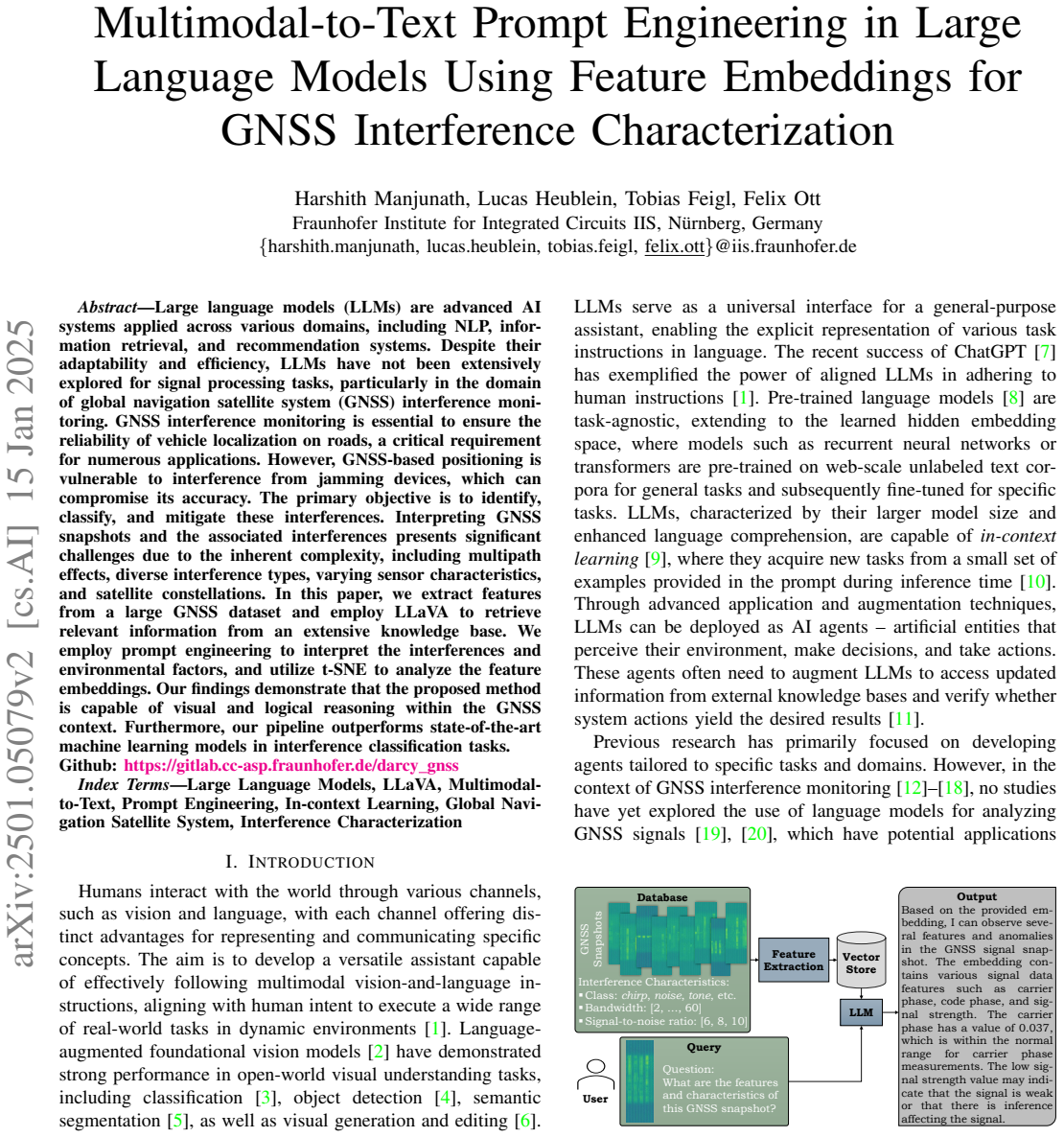
The central mechanism is the retrieval-augmented pipeline: CLIP ViT-L/14 encodes each 1024×34 GNSS snapshot into a 512-dimensional embedding; a FAISS vector store indexes these embeddings and returns the k-nearest neighbors of a query by Euclidean distance; and the LLaVA language model (a Vicuna-based instruction-tuned model) receives the query image, the retrieved context, and a hand-crafted prompt, then generates a textual characterization. Prompt engineering and in-context learning are the connective tissue: task-instruction prompts and the label legend make the model's output more accurate, and in-context examples from the vector store let it generalize. t-SNE is used only to visualize the embedding distribution.
What would settle it
Run the same pipeline with the label legend removed from the query prompt and with the query image excluded from the FAISS vector store, then measure classification accuracy on a held-out set; if accuracy falls to near chance, the original number was measuring label transcription rather than interference classification.
Extended reading notes
Core claim
The paper claims that a pipeline combining a CLIP vision encoder, a FAISS vector store, and the LLaVA language model can both classify and describe GNSS interference. On the 42,592-snapshot dataset, the pipeline reaches 96.87% accuracy on interference-type classification, compared with 96.15% for the ResNet18 model reported by Heublein et al. [27]. The authors also report that adding detailed context and in-context examples to the prompt improves output accuracy and specificity, and that per-snapshot inference runs in under 50 ms. The intended contribution is a system that turns GNSS snapshots into human-readable characterizations—interference class, bandwidth, signal power, and environment—for non-expert decision-makers.
Load-bearing premise
The reported 96.87% accuracy is a true classification result only if the evaluation never lets the model read the answer: the query snapshot must be absent from the vector store, and the ground-truth class, bandwidth, and environment labels must not appear in the prompt or retrieved context.
Editorial extensions
If this is right
- If the accuracy claim holds, LLM-based pipelines become a viable alternative to supervised vision classifiers for GNSS interference monitoring, with the added benefit of explainable output.
- The sub-50 ms per-snapshot inference time suggests the method could run in real-time monitoring stations along highways or for aviation applications.
- Detailed prompt context measurably improves output accuracy, so prompt design is a first-order knob for signal-characterization tasks, not just a convenience.
- The same retrieve-then-prompt recipe could be applied to other sensor modalities whose data can be rendered as images, such as radar or spectrum spectrograms.
- Retrieval-based prompting, the paper's stated future work, would make the context selection itself adaptive, potentially improving both accuracy and interpretability.
Reading between the lines
- A controlled experiment that removes the label legend from the prompt and excludes the query image from the vector store would separate genuine classification from label transcription; without that, the 96.87% figure is uninterpretable as a classification result.
- Because the t-SNE visualization shows heavily overlapping embeddings, the LLM's apparent success likely owes more to the textual context in the prompt than to the visual content, meaning the current system may be a text-reasoning system rather than a visual one.
- The pipeline is a template for sensor-to-text tasks: treating any multivariate signal as an image, embedding it, retrieving similar examples, and asking an LLM to describe it could generalize to other periodic or time-frequency monitoring data.
- Retrieval introduces a new failure mode: if a mislabeled snapshot is among the retrieved neighbors, the LLM may adopt that label; evaluating robustness against poisoned or adversarial entries in the vector store would be a natural stress test.
Editorial analysis
A structured set of objections, weighed in public.
Referee Report
Summary. The paper proposes a multimodal-to-text pipeline for GNSS interference characterization. A CLIP ViT-L/14 encoder embeds GNSS snapshot images into a FAISS vector store, and LLaVA generates textual descriptions conditioned on user prompts and (per the method description) retrieved context. The authors evaluate prompt variants, analyze CLIP embeddings with t-SNE, and claim that the pipeline reaches 96.87% classification accuracy, surpassing a ResNet18 baseline at 96.15%. The dataset comprises 42,592 snapshots with six interference types and multiple multipath scenarios.
Significance. If the 96.87% accuracy claim were supported by a clean, held-out evaluation, the paper would demonstrate a useful application of retrieval-augmented multimodal LLMs to GNSS interference monitoring, with the added benefit of producing human-readable explanations for non-experts. The paper also provides a useful description of a challenging GNSS dataset and is honest about the overlap of CLIP embeddings across classes. However, the central performance claim is not backed by a described evaluation protocol: no test set, no label-free prompts, no conversion of free-text outputs to accuracy, and no common benchmark table for the LLM. The reported example prompts leak ground-truth labels, so the claimed accuracy is more plausibly explained by label transcription than by interference classification.
major comments (4)
- [Section V, Table I] The claimed 96.87% accuracy for the LLaVA pipeline is not presented in Table I, which reports only the vision-model baselines (ResNet18, BEiT, DeiT, Swin, CLIP, ViT). The text gives no description of the test set size, the split between the vector store and the query images, the method used to parse free-text model outputs into class labels, or any error bars or repeated-run statistics. Without these details, the comparison to Heublein et al.'s 96.15% is not a controlled comparison and the central claim cannot be verified.
- [Section III, Prompt Engineering; Figures 9 and 10] The prompts shown in Figures 9 and 10 include the ground-truth labels directly in the user query (e.g., "The associated labels for this image are: Class: 0: None; 1: Noise; 2: Chirp; ..."), and the model output restates exact label values (Class: 2, Subjammer: Chirp, LinearMedium; BW 25, Environment: 1). If the reported 96.87% accuracy was measured under these conditions, the model is performing label transcription from the prompt, not classification from the GNSS snapshot. The paper never states that query snapshots were held out from the vector store or that labels were removed from the retrieved context, so the leakage concern is not addressed.
- [Section VI, Conclusion] The conclusion states, "In future work, we will incorporate retrieval-based prompting" and defines C = R(Sv, t), which directly contradicts Section III's description of the pipeline as using in-context learning with retrieved context from the vector store. As written, the reader cannot determine whether retrieval was actually used in the experiments that produced the reported accuracy. This ambiguity is load-bearing because the paper's title and method center on retrieval-augmented prompting.
- [Section V, Embedding Analysis; Figure 12] The authors state that the CLIP embeddings of the four classes overlap and are hard to distinguish, and Figure 12 visually confirms the absence of distinct clusters. Given this acknowledged difficulty, a 96.87% accuracy without access to the ground-truth labels is implausible unless the evaluation protocol is fundamentally different from what is described. This further supports the need for a label-controlled evaluation protocol.
minor comments (4)
- [Section IV] The sentence "The dataset contains a total of 42,592, of which 576 are free from any interferences" is missing the noun "snapshots."
- [Throughout] There are numerous typos, including "classifation" (Introduction), "leverates" (Related Work), "py parameters" (Dataset), and "top k = 40 value of 40" (Evaluation); these should be corrected in a revision.
- [Section V, Figure 9 output] The model output in Figure 9 contains the typo "the aignals" and inconsistent spacing in list items; the figure captions and quoted outputs should be cleaned up.
- [References] Reference [18] is cited inconsistently as both "Ott et al." (Section IV) and "Heublein et al." (Figure 6 caption); the authors should verify the citation key and author attribution.
Circularity Check
The 96.87% accuracy claim is circular: the evaluation prompts and retrieved context contain ground-truth labels, and the model output restates them, so the reported classification reduces to label transcription.
-
self definitional
[Section V (Prompt Engineering), Figures 9 and 10]
"This image is a snapshot of a GNSS signal. The associated labels for this image are: Class: 0: None; 1: Noise; 2: Chirp; 3: FreqHopper; 4: Modulated; 5: Multitone; 6: Pulsed Amplitude: -10 to 10 Area: 0 to 3 Subjammer: File used for generator, varying in speed, bandwidth, … Environment: 0: None; 1: no obstruction; 2: 2 absorber towards generator; 3: … What are the features and anomalies in this image?"
The user query in Figure 9 provides the complete ground-truth label vocabulary, and the model output shown in the same figure restates exact label values: 'Class: 2, Amplitude: 6, Area: 3, Subjammer: Chirp, LinearMedium; BW 25, Position: 48, Environment: 1'. Figure 10 similarly instructs the model to 'use the retrieved context and analyze the provided image and the labels'. The paper characterizes this output as successful classification, but the labels are present in the input prompt; the model is transcribing them, not deriving them from the GNSS snapshot. Any accuracy computed under this protocol is a measure of label copying by construction, not of interference classification.
-
other
[Section V, Benchmark of Vision Models]
"Heublein et al. [27] achieved an accuracy of 96.15% on the independent single-task test dataset using a ResNet18 model. In comparison, our LLM surpasses the state-of-the-art, attaining an accuracy of 96.87%."
The central numerical claim of the paper is this 96.87% accuracy, but no protocol is given for how it was computed: there is no held-out split, no label-free prompt, no parsing of free-text outputs, and Table I does not include an LLM row. The only concrete evaluation demonstrations in the paper supply ground-truth labels in the prompt and show the model restating them. The asserted superiority over the ResNet18 baseline therefore rests entirely on an unexplained accuracy figure that, on the paper's own evidence, is consistent with label transcription from the prompt or retrieved context rather than independent classification.
1 more flagged steps
-
self definitional
[Fig. 1 caption; Section III (Vector Store and Prompt Engineering)]
"Based on feature embeddings extracted from GNSS snapshots, which include associated interference characteristics, a language model (LLM) generates a description in response to a contextual query provided by a user."
The vector store is described as storing embeddings 'which include associated interference characteristics'—i.e., ground-truth labels are attached to each stored snapshot. The retrieval step (Figure 4) returns the most similar embedding by k-argmin distance, and the LLM is instructed to use the retrieved context. If query snapshots are not explicitly excluded from the vector store, the nearest neighbor of a query can be the query's own labeled embedding, so the 'retrieved context' trivially supplies the ground-truth labels. The paper never states that query images are held out from the store. Thus the retrieval-based classification reduces to looking up the label attached to the query's own or nearest embedding, rather than to visual or logical reasoning about the GNSS signal.
full rationale
The central claim of the paper is that the proposed LLaVA pipeline 'surpasses the state-of-the-art, attaining an accuracy of 96.87%' against a ResNet18 baseline of 96.15%. The only concrete evaluation demonstrations, Figures 9 and 10, place the complete ground-truth label vocabulary, and in the shown outputs the exact label values, directly into the user query; the model output then restates those values. No held-out split, no label-free prompt, and no procedure for computing accuracy from free-text outputs is described, and Table I contains no LLM row. In addition, Figure 1 describes the vector store as holding embeddings 'which include associated interference characteristics', so retrieval can supply ground-truth labels, and the conclusion states that retrieval-based prompting 'will be incorporated' in future work, contradicting the method section's assertion that retrieved context is used. The paper's own evidence therefore shows that the claimed classification result reduces to transcribing labels from the prompt or from the retrieved (self-)nearest embedding. This is central circularity affecting the paper's primary contribution, not a minor self-citation issue.
Assumptions & free parameters
free parameters (2)
- top_k (LLaVA decoding) =
40
- temperature (LLaVA decoding) =
0.6 to 1.0
assumptions (4)
- domain assumption CLIP ViT-L/14 embeddings of GNSS snapshots preserve discriminative information about interference class and parameters.
- domain assumption LLaVA can correctly interpret projected CLIP embeddings and textual context without any GNSS-specific fine-tuning.
- domain assumption The ground-truth labels (class, subjammer, power, bandwidth, environment) in the dataset are accurate.
- domain assumption The vector store retrieval does not supply the query's own label; query snapshots are held out from the stored set.
Cite this review
Pith. "Pith review of Multimodal-to-Text Prompt Engineering in Large Language Models Using Feature Embeddings for GNSS Interference Characterization." pith.science (2026). https://pith.science/paper/24G2GJ53
@misc{pith2026250105079,
  author       = {Pith},
  title        = {Pith review of: Multimodal-to-Text Prompt Engineering in Large Language Models Using Feature Embeddings for GNSS Interference Characterization},
  year         = {2026},
  howpublished = {\url{https://pith.science/paper/24G2GJ53}},
  note         = {Machine review of arXiv:2501.05079}
}
read the original abstract
Large language models (LLMs) are advanced AI systems applied across various domains, including NLP, information retrieval, and recommendation systems. Despite their adaptability and efficiency, LLMs have not been extensively explored for signal processing tasks, particularly in the domain of global navigation satellite system (GNSS) interference monitoring. GNSS interference monitoring is essential to ensure the reliability of vehicle localization on roads, a critical requirement for numerous applications. However, GNSS-based positioning is vulnerable to interference from jamming devices, which can compromise its accuracy. The primary objective is to identify, classify, and mitigate these interferences. Interpreting GNSS snapshots and the associated interferences presents significant challenges due to the inherent complexity, including multipath effects, diverse interference types, varying sensor characteristics, and satellite constellations. In this paper, we extract features from a large GNSS dataset and employ LLaVA to retrieve relevant information from an extensive knowledge base. We employ prompt engineering to interpret the interferences and environmental factors, and utilize t-SNE to analyze the feature embeddings. Our findings demonstrate that the proposed method is capable of visual and logical reasoning within the GNSS context. Furthermore, our pipeline outperforms state-of-the-art machine learning models in interference classification tasks.
Figures


Figures from the paper (4 more)


Forward citations
Cited by 1 Pith paper
-
Position Paper: Rethinking AI/ML for Air Interface in Wireless Networks
A position paper synthesises 3GPP Release 18/19 AI/ML discussions and recommends hybrid, modular machine-learning directions for the 6G air interface.
Reference graph
Works this paper leans on
-
[1]
H. Liu, C. Li, Q. Wu, and Y . J. Lee, “Visual Instruction Tuning,” in NIPS, 2023
work page 2023
-
[2]
ELEV ATOR: A Benchmark and Toolkit for Evaluating Language-Augmented Visual Models,
C. Li, H. Liu, L. Li, P. Zhang, J. Aneja, J. Yang, P. Jin, H. Hu, Z. Liu, Y . J. Lee, and J. Gao, “ELEV ATOR: A Benchmark and Toolkit for Evaluating Language-Augmented Visual Models,” in NIPS, 2022
work page 2022
-
[3]
Florence-2: Advancing a Unified Representation for a Variety of Vision Tasks,
B. Xiao, H. Wu, W. Xu, X. Dai, H. Hu, Y . Lu, M. Zeng, C. Liu, and L. Yuan, “Florence-2: Advancing a Unified Representation for a Variety of Vision Tasks,” in CVPR, Seattle, W A, Nov. 2023
work page 2023
-
[4]
RegionCLIP: Region-based Language-Image Pretraining,
Y . Zhong, J. Yang, P. Zhang, C. Li, N. Codella, L. H. Li, L. Zhou, X. Dai, L. Yuan, Y . Li, and J. Gao, “RegionCLIP: Region-based Language-Image Pretraining,” in CVPR, New Orleands, LA, Jun. 2022
work page 2022
-
[5]
Language-driven Semantic Segmentation,
B. Li, K. Q. Weinberger, S. Belongie, V . Koltun, and R. Ranftl, “Language-driven Semantic Segmentation,” in ICLR, Oct. 2023
work page 2023
-
[6]
High- Resolution Image Synthesis with Latent Diffusion Models,
R. Rombach, A. Blattmann, D. Lorenz, P. Esser, and B. Ommer, “High- Resolution Image Synthesis with Latent Diffusion Models,” in CVPR, New Orleands, LA, Jun. 2022
work page 2022
- [7]
-
[8]
DeBERTa: Decoding-Enhanced BERT with Disentangled Attention,
P. He, X. Liu, J. Gao, and W. Chen, “DeBERTa: Decoding-Enhanced BERT with Disentangled Attention,” in ICLR, 2021
work page 2021
Show all 49 references
-
[9]
Meta-in-Context Learning in Large Language Models,
J. Coda-Forno, M. Binz, Z. Akata, M. Batvinick, J. X. Wang, and E. Schulz, “Meta-in-Context Learning in Large Language Models,” in NIPS, 2023
2023
-
[10]
Improved Baselines with Visual Instruction Tuning,
H. Liu, C. Li, Y . Li, and Y . J. Lee, “Improved Baselines with Visual Instruction Tuning,” in CVPR, 2024, pp. 26 296–26 306
2024
-
[11]
Large Language Models: A Survey,
S. Minaee, T. Mikolov, N. Nikzad, M. Chenaghlu, R. Socher, X. Amatriain, and J. Gao, “Large Language Models: A Survey,” in arXiv:2402.06196, Feb. 2024
2024 arXiv
-
[12]
GNSS Jamming Classification via CNN, Transfer Learning & the Novel Concatenation of Signal Repre- sentations,
C. J. Swinney and J. C. Woods, “GNSS Jamming Classification via CNN, Transfer Learning & the Novel Concatenation of Signal Repre- sentations,” in CyberSA, Dublin, Ireland, Jun. 2021
2021
-
[13]
Jammer Classification in GNSS Bands via Machine Learning Algorithms,
R. M. Ferre, A. de la Fuente, and E. S. Lohan, “Jammer Classification in GNSS Bands via Machine Learning Algorithms,” in MDPI Sensors, vol. 19(22), Nov. 2019
2019
-
[14]
A Real-time Interference Monitoring Technique for GNSS Based on a Twin Support Vector Machine Method,
W. Li, Z. Huang, R. Lang, H. Qin, K. Zhou, and Y . Cao, “A Real-time Interference Monitoring Technique for GNSS Based on a Twin Support Vector Machine Method,” in MDPI Sensors, Mar. 2016
2016
-
[15]
GPS Interference Signal Recognition Based on Machine Learning,
J. Xu, S. Ying, and H. Li, “GPS Interference Signal Recognition Based on Machine Learning,” in Mobile Networks and Applications , vol. 25, Jul. 2020
2020
-
[16]
1 GNSS Interference Identification Beyond Jammer Classification,
Y . Ding and K. Pham, “1 GNSS Interference Identification Beyond Jammer Classification,” in IEEE Aerospace Conf. , Mar. 2023
2023
-
[17]
GNSS Spoofing, Jamming, and Multi- path Interference Classification Using a Maximum-Likelihood Multi-tap Multipath Estimator,
J. N. Gross and T. E. Humphreys, “GNSS Spoofing, Jamming, and Multi- path Interference Classification Using a Maximum-Likelihood Multi-tap Multipath Estimator,” in ION GNSS+, Monterey, CA, Jan. 2017
2017
-
[18]
Evaluating ML Robustness in GNSS Interference Classification, Characterization & Localization,
L. Heublein, T. Feigl, T. Nowak, A. R ¨ugamer, C. Mutschler, and F. Ott, “Evaluating ML Robustness in GNSS Interference Classification, Characterization & Localization,” in arXiv:2409.15114, Sep. 2024
2024 arXiv
-
[19]
NA VISP Asks ChatGPT About the PNT Trends,
E. S. Agency, “NA VISP Asks ChatGPT About the PNT Trends,” in Online, Feb. 2023
2023
-
[20]
LLM + GNSS,
X. Liu, “LLM + GNSS,” in Online, Mar. 2024
2024
-
[21]
Machine Learning- assisted GNSS Interference Monitoring Through Crowdsourcing,
N. L. Raichur, T. Brieger, D. Jdidi, T. Feigl, J. R. van der Merwe, B. Ghimire, F. Ott, A. R ¨ugamer, and W. Felber, “Machine Learning- assisted GNSS Interference Monitoring Through Crowdsourcing,” in ION GNSS+, Denver, CO, Sep. 2022, pp. 1151–1175
2022
-
[22]
Few-Shot Learning with Uncertainty-based Quadruplet Selection for Interference Classification in GNSS Data,
F. Ott, L. Heublein, N. L. Raichur, T. Feigl, J. Hansen, A. R ¨ugamer, and C. Mutschler, “Few-Shot Learning with Uncertainty-based Quadruplet Selection for Interference Classification in GNSS Data,” in ICL-GNSS, Antwerp, Belgium, Jun. 2024
2024
-
[23]
Research Avenues for GNSS Interfer- ence Classification Robustness: Domain Adaptation, Continual Learning & Federated Learning,
F. Ott, L. Heublein, and T. Feigl, “Research Avenues for GNSS Interfer- ence Classification Robustness: Domain Adaptation, Continual Learning & Federated Learning,” in ECML PKDD: Industry Track , Sep. 2024
2024
-
[24]
Robust Design of a Machine Learning-based GNSS NLOS Detector with Multi- Frequency Features,
O. G. Crespillo, J. C. Ruiz-Sicilia, A. Kliman, and J. Marais, “Robust Design of a Machine Learning-based GNSS NLOS Detector with Multi- Frequency Features,” in Front. Robot. AI, vol. 10, Jul. 2023
2023
-
[25]
Low-Cost COTS GNSS Interference Monitoring, Detection, and Classification System,
J. R. van der Merwe, D. C. Franco, J. Hansen, T. Brieger, T. Feigl, F. Ott, D. Jdidi, A. R ¨ugamer, and W. Felber, “Low-Cost COTS GNSS Interference Monitoring, Detection, and Classification System,” in MDPI Sensors, vol. 23(7), 3452, Mar. 2023
2023
-
[26]
Multimodal Learning for Reliable Interference Classification in GNSS Signals,
T. Brieger, N. L. Raichur, D. Jdidi, F. Ott, T. Feigl, J. R. van der Merwe, A. R ¨ugamer, and W. Felber, “Multimodal Learning for Reliable Interference Classification in GNSS Signals,” in ION GNSS+, 2022
2022
-
[27]
Evaluation of (Un-)Supervised Machine Learning Methods for GNSS Interference Classification with Real-World Data Discrepancies,
L. Heublein, N. L. Raichur, T. Feigl, T. Brieger, F. Heuer, L. Asbach, A. R ¨ugamer, and F. Ott, “Evaluation of (Un-)Supervised Machine Learning Methods for GNSS Interference Classification with Real-World Data Discrepancies,” in ION GNSS+, Baltimore, MD, Sep. 2024
2024
-
[28]
GNSS Interference Monitoring and Detection Based on the Swedish CORS Network SWEPOS,
K. E. Abraha, A. Frisk, and P. Wiklund, “GNSS Interference Monitoring and Detection Based on the Swedish CORS Network SWEPOS,” in Journal of Geodetic Science , Feb. 2024
2024
-
[29]
Bayesian Learning-driven Prototypical Contrastive Loss for Class-Incremental Learning,
N. L. Raichur, L. Heublein, T. Feigl, A. R ¨ugamer, C. Mutschler, and F. Ott, “Bayesian Learning-driven Prototypical Contrastive Loss for Class-Incremental Learning,” in arXiv:2405.11067v2, Jul. 2024
2024 arXiv
-
[30]
A Modeling Language to Support the Interoperability of Global Navigation Satellite Systems,
D. Gianni, J. Fuchs, P. D. Simone, and M. Lisi, “A Modeling Language to Support the Interoperability of Global Navigation Satellite Systems,” in GPS Solutions, vol. 17, Jun. 2012, pp. 175–198
2012
-
[31]
Towards Signal Processing in Large Language Models,
P. Verma and M. Pilanci, “Towards Signal Processing in Large Language Models,” in arXiv:2406.10254, Jun. 2024
2024 arXiv
-
[32]
Large Language Models in 6G Security: Challenges and Opportunities,
T. Nguyen, H. Nguyen, S. S. Ahmad Ijaz, A. V . Vasilakos, and P. Kostakos, “Large Language Models in 6G Security: Challenges and Opportunities,” in arXiv:2403.12239, Mar. 2024
2024 arXiv
-
[33]
Pushing Large Language Models to the 6G Edge: Vision, Challenges, and Opportunities,
Z. Lin, G. Qu, Q. Chen, X. Chen, Z. Chen, and K. Huang, “Pushing Large Language Models to the 6G Edge: Vision, Challenges, and Opportunities,” in arXiv:2309.16739, Mar. 2024
2024 arXiv
-
[34]
Zero-Shot ECG Diagnosis with Large Language Models and Retrieval-Augmented Generation,
H. Yu, P. Guo, and A. Sano, “Zero-Shot ECG Diagnosis with Large Language Models and Retrieval-Augmented Generation,” in ML4H, vol. 225, 2023, pp. 650–663
2023
-
[35]
A Systematic Survey of Prompt Engineering on Vision-Language Foundation Models,
J. Gu, Z. Han, S. Chen, A. Beirami, B. He, G. Zhang, R. Liao, Y . Qin, V . Tresp, and P. Torr, “A Systematic Survey of Prompt Engineering on Vision-Language Foundation Models,” in arXiv:2307.12980, Jul. 2023
2023 arXiv
-
[36]
Prompt Engineering a Prompt Engineer,
Q. Ye, M. Axmed, R. Pryzant, and F. Khani, “Prompt Engineering a Prompt Engineer,” in arXiv:2311.05661, Jul. 2024
2024 arXiv
-
[37]
Federated Learning with MMD-based Early Stopping for Adaptive GNSS Interference Classification,
N. S. Gaikwad, L. Heublein, N. L. Raichur, T. Feigl, C. Mutschler, and F. Ott, “Federated Learning with MMD-based Early Stopping for Adaptive GNSS Interference Classification,” in arXiv:2410.15681v2, Dec. 2024
2024 arXiv
-
[38]
Achieving Generaliza- tion in Orchestrating GNSS Interference Monitoring Stations Through Pseudo-Labeling,
L. Heublein, T. Feigl, A. R ¨ugamer, and F. Ott, “Achieving Generaliza- tion in Orchestrating GNSS Interference Monitoring Stations Through Pseudo-Labeling,” in DGON POSNAV, Oct. 2024
2024
-
[39]
Learning Transferable Visual Models From Natural Language Super- vision,
A. Radford, J. W. Kim, C. Hallacy, A. Ramesh, G. Goh, S. Agarwal, G. Sastry, A. Askell, P. Mishkin, J. Clark, G. Krueger, and I. Sutskever, “Learning Transferable Visual Models From Natural Language Super- vision,” in ICML, vol. 139, 2021
2021
-
[40]
The Faiss Library,
M. Douze, A. Guzhva, C. Deng, J. Johnson, G. Szilvasy, P.-E. Mazar ´e, M. Lomeli, L. Hosseini, and H. J ´egou, “The Faiss Library,” in arXiv:2401.08281, Jan. 2024
2024 arXiv
-
[41]
Vi- cuna: An Open-source Chatbot Impressing GPT-4 with 90% ChatGPT Quality,
W.-L. Chiang, Z. Li, Z. Lin, Y . Sheng, Z. Wu, H. Zhang, L. Zheng, S. Zhuang, Y . Zhuang, J. E. Gonzalez, I. Stoica, and E. P. Xing, “Vi- cuna: An Open-source Chatbot Impressing GPT-4 with 90% ChatGPT Quality,” in https://lmsys.org/blog/2023-03-30-vicuna/, Mar. 2023
2023
-
[42]
The Turking Test: Can Language Models Understand Instructions?
A. Efrat and O. Levy, “The Turking Test: Can Language Models Understand Instructions?” in arXiv:2010.11982, Oct. 2020
2010 arXiv
-
[43]
Chain-of-Thought Prompting Elicits Reasoning in Large Language Models,
J. Wei, X. Wang, D. Schuurmans, M. Bosma, B. Ichter, F. Xia, E. H. Chi, Q. V . Le, and D. Zhou, “Chain-of-Thought Prompting Elicits Reasoning in Large Language Models,” in NIPS, Apr. 2024
2024
-
[44]
A Survey on In-Context Learning,
Q. Dong, L. Li, D. Dai, C. Zheng, J. Ma, R. Li, H. Xia, J. Xu, Z. Wu, B. Chang, X. Sun, L. Li, and Z. Sui, “A Survey on In-Context Learning,” in EMNLP, Miami, FL, Jun. 2024, pp. 1107–1128
2024
-
[45]
Visualizing Data Using t-SNE,
L. van der Maaten and G. Hinton, “Visualizing Data Using t-SNE,” in JMLR, vol. 9(86), Nov. 2008, pp. 2579–2605
2008
-
[46]
BEiT: BERT Pre-Training of Image Transformers,
H. Bao, L. Dong, S. Piao, and F. Wei, “BEiT: BERT Pre-Training of Image Transformers,” in ICLR, 2022
2022
-
[47]
Training Data-Efficient Image Transformers & Distillation Through Attention,
H. Touvron, M. Cord, M. Douze, F. Massa, A. Sablayrolles, and H. Jegou, “Training Data-Efficient Image Transformers & Distillation Through Attention,” in ICML, vol. 139, 2021, pp. 10 347–10 357
2021
-
[48]
Swin Transformer: Hierarchical Vision Transformer Using Shifted Windows,
Z. Liu, Y . Lin, Y . Cao, H. Hu, Y . Wei, Z. Zhang, S. Lin, and B. Guo, “Swin Transformer: Hierarchical Vision Transformer Using Shifted Windows,” in arXiv:2103.14030, Mar. 2021
2021 arXiv
-
[49]
An Image is Worth 16×16 Words: Transformers for Image Recognition at Scale,
A. Dosovitskiy, L. Beyer, et al., and N. Houlsby, “An Image is Worth 16×16 Words: Transformers for Image Recognition at Scale,” in ICLR, 2021
2021
Reviewed August 10, 2026 · model on record in the stance chip above.
Discussion (0). Continue with ORCID to comment.