REVIEW 3 major objections 6 minor 56 references
Performance of YOLOv7 in Kitchen Safety While Handling Knife
T0 review · 3 major / 6 minor · reviewed 2026-08-10 · deepseek-v4-flash
Pith's one-line read The paper reports that YOLOv7, trained on 6,004 frames from a single kitchen video, detects two knife-handling hazards with a best mAP50-95 of 0.7879 at epoch 31, while the blade-contact hazard is markedly weaker at 0.290 AP.
desk verdict A small but honest YOLOv7 kitchen-safety study that overclaims in the abstract; the missing test split is the real problem. read the letter →
The pith
A machine-rendered reading of the paper's core claim, the machinery that carries it, and where it could break.
The reading
What carries the argument
The engine of the paper is YOLOv7, a single-stage object detector whose backbone uses Extended Efficient Layer Aggregation Network (E-ELAN) blocks, a Spatial Pyramid Pooling with Cross-Stage Partial Connections (SPPCSPC) neck, multi-scale feature fusion through upsampling and C3 blocks, and a detection head that predicts class probabilities, bounding boxes, and confidence scores. The evaluation pipeline is the second load-bearing piece: 6,004 frames extracted from a 1920×1080 iPhone video, labeled manually in Label Studio into six classes, then augmented with flips, crops, rotations, grayscale, shear, hue, saturation, brightness, exposure, blur, noise, and cutout before 40 epochs of PyTorch training with AdamW. The reported numbers come from the standard COCO-style metrics mAP50 and mAP50-95, which is what the argument rests on.
What would settle it
Evaluate the same trained YOLOv7 weights on a held-out video from a different kitchen, with a different person, different lighting, and a different camera, and compute class-wise AP; if mAP50-95 falls well below 0.7879 or hazard 2 (blade contact) stays at or near 0.29 AP, the claim that YOLOv7 reliably detects knife-handling hazards in real kitchens is not supported.
Extended reading notes
Core claim
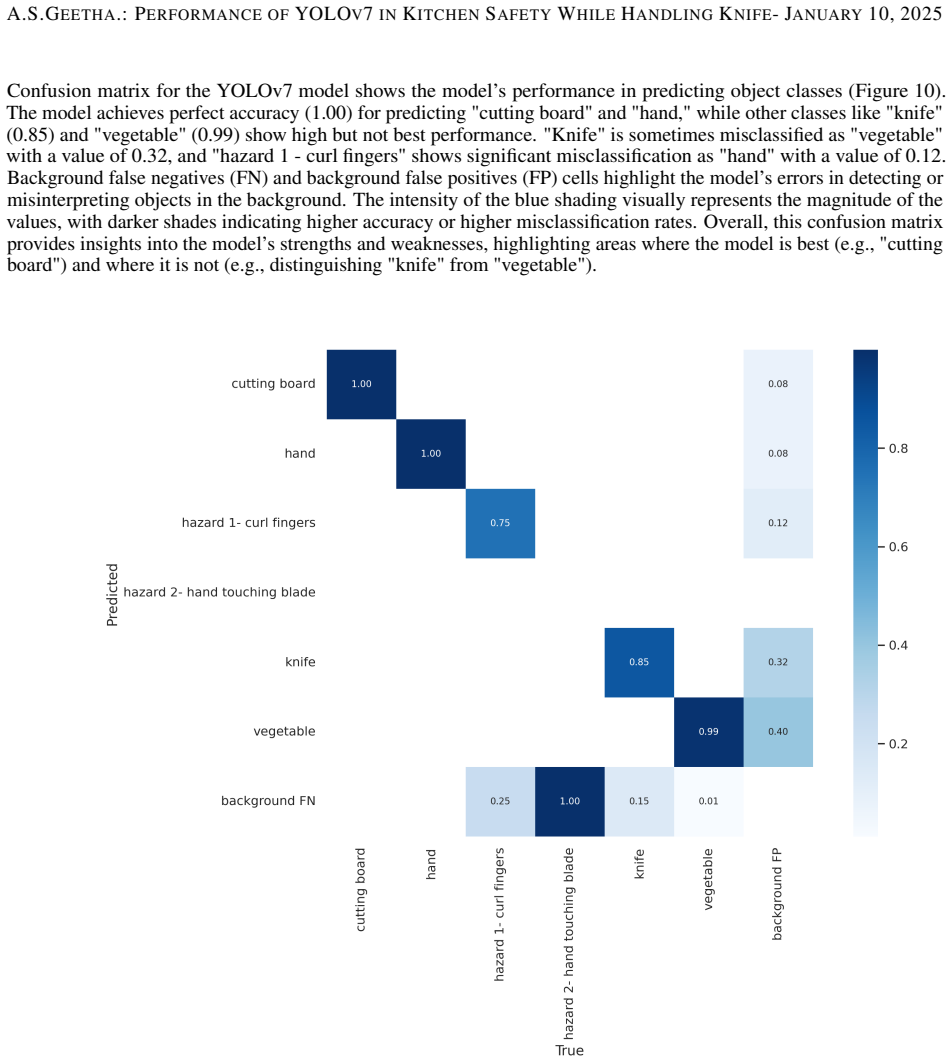
The central claim is that YOLOv7 can learn to localize two knife-safety hazards — hazard 1 (curled versus extended fingers while holding food) and hazard 2 (hand making contact with the blade) — along with four kitchen objects (cutting board, hands, vegetable, knife), from a modest single-video dataset. The best model, at epoch 31, achieves a mean average precision mAP50-95 of 0.7879, precision of 0.9063, recall of 0.7503, and a class-averaged mAP at IoU 0.5 of 0.821. Per class, cutting board (0.995 AP), vegetable (0.978 AP), and hand (0.971 AP) are near-perfect, while the knife is sometimes confused with vegetable in the confusion matrix, hazard 1 is imperfect but workable, and hazard 2 is weak at 0.290 AP. The paper reads this as evidence that YOLOv7 is suitable for real-time kitchen hazard detection once the blade-contact class receives more attention.
Load-bearing premise
The single load-bearing premise is that the 6,004 frames from one iPhone-recorded kitchen video, labeled by one annotator without expert validation, are representative enough that the validation metrics predict how the model would perform in other kitchens, with other people, lighting, and camera angles.
Editorial extensions
If this is right
- At epoch 31 the model reaches mAP50-95 0.7879, precision 0.9063, recall 0.7503, and mAP@0.5 0.821, so the training recipe is a working starting point for a kitchen hazard detector.
- Classes like cutting board, hand, and vegetable are detected at 0.97–0.99 AP, meaning the same model can monitor general kitchen objects while watching for unsafe grips.
- Hazard 2 (hand touching blade) reaches only 0.290 AP, so a practical alert system built from this model would need extra data or a separate detector before it can reliably warn about blade contact.
- The peak F1 of 0.75 at a confidence threshold of 0.102 means an alarm system would operate at a low threshold to catch hazards, accepting more false positives; threshold choice becomes a product decision.
- The author's proposed extensions — larger datasets, more hazard classes, and applications to other domains — follow directly from the same training and evaluation pipeline.
Reading between the lines
- Because all frames come from one iPhone video and one annotator, I would expect the reported mAP to be optimistic; a multi-kitchen, multi-annotator test set is the natural next check and could be assembled cheaply.
- The weak blade-contact results suggest the hazard is visually underspecified or under-represented; adding temporal information (alerts only when blade contact persists across consecutive frames) could reduce false alarms without retraining.
- The author has separately benchmarked YOLOv5, YOLOv8, and YOLOv10 on the same hazard classes; pooling those runs with this YOLOv7 result into one fixed train/test split would give a deployable model-selection comparison.
- A testable extension: retrain with hazard-2 frames oversampled or with a separate binary blade-contact classifier, then check whether hazard-2 AP moves above 0.5 while keeping precision above 0.9.
Editorial analysis
A structured set of objections, weighed in public.
Referee Report
Summary. The paper trains a YOLOv7 object detector on 6,004 frames extracted from a single iPhone-recorded kitchen video, annotated into six classes (cutting board, hand, vegetable, knife, hazard 1 curled fingers, hazard 2 hand touching blade). It describes standard data augmentations, summarizes the YOLOv7 architecture, and reports training/validation curves: precision, recall, mAP50, per-class AP, F1-confidence, and a confusion matrix. The abstract claims best performance at epoch 31 with mAP50-95 of 0.7879, precision of 0.9063, and recall of 0.7503, and concludes that YOLOv7 can accurately detect knife-related hazards.
Significance. If the headline numbers were supported by a properly held-out evaluation, this would be a modest empirical datapoint for YOLOv7 in a niche safety domain, and the paper's transparent reporting of per-class weaknesses (especially hazard 2 AP of 0.290) is a strength. However, as presented, all quantitative claims are derived from validation curves on a single video with no independent test set, so the results do not currently establish generalization to other kitchens, users, or lighting conditions. The significance for real-world deployment therefore remains unsubstantiated, although the underlying idea is worth testing with a more rigorous evaluation protocol.
major comments (3)
- [Abstract and Section 4] The headline metrics in the abstract (mAP50-95=0.7879, precision=0.9063, recall=0.7503 at epoch 31) do not appear anywhere in Section 4; the results section instead reports mAP50=0.821, per-class AP values, and a peak F1 of 0.75. The paper must either add the curves or tables that produce the abstract numbers or correct the abstract. More importantly, no training/validation/test split is described in Section 3.1, and all reported curves appear to be computed on the validation fold used for early stopping and threshold selection. Because the 6,004 frames are consecutive samples from one continuous video, adjacent frames are near-duplicates, so the reported numbers are effectively self-evaluation on the training distribution and do not measure generalization. Please add an explicit data split, ideally with a temporally separated test set or a separate video, and report metrics on that test set, or reframe all claims as validation performance with explicit caveats.
- [Section 4, Figures 7 and 9] Hazard 2 (hand touching blade) achieves an AP of only 0.290 and is described as 'struggling' in the PR and F1 curves, yet the abstract concludes that YOLOv7 can 'accurately detect knife-related hazards.' Since hazard 2 is one of only two safety hazards the paper is designed to detect, this per-class weakness undercuts the headline claim regardless of mean metrics. Please report per-class results in the abstract and conclusion, or adjust the claim to state that only hazard 1 is detected well.
- [Section 3.1] The dataset consists of 6,004 frames from a single iPhone video, labeled by one person without reported expert validation or inter-annotator agreement. This single-annotator, single-video design is the sole source of ground truth, so the model's measured performance is bounded by that annotation and cannot support broad claims about kitchen safety. Please state the annotator's background, provide a labeling protocol or sample annotations, and explicitly discuss how the single-video/single-annotator design limits the conclusions.
minor comments (6)
- [Section 3.2.2] Equation (2) is incomplete: the square bracket is never closed and the right-hand side has no closing bracket; please provide the complete expression and define all variables.
- [Figure 2 caption and Section 3.3] There are typographical errors: 'Grayscle' should be 'Grayscale' in the Figure 2 caption, and 'he architecture' should be 'The architecture' in Section 3.3.
- [Section 4] The text repeatedly refers to 'accuracy improvements' and 'high accuracy,' but no accuracy metric is defined; the reported measures are precision, recall, mAP, and F1. Please use the appropriate terminology.
- [Section 4, Figure 10] In the confusion-matrix description, 'knife' is reported as 0.85 and misclassified as 'vegetable' with 0.32, yet these values do not sum to 1; clarify whether rows are normalized and whether background cells are included in the normalization.
- [References] The reference list contains duplicate entries (for example, refs [9] and [28] are the same paper, and refs [20] and [52] are the same) and mixes peer-reviewed sources with blog posts; please unify and curate the bibliography.
- [Section 3.2] The augmentation section lists many transforms but does not state the actual probabilities or strength values used in the final training pipeline; please report the concrete augmentation configuration used for the reported experiments.
Circularity Check
No significant circularity: the paper reports an empirical YOLOv7 evaluation; self-citations are contextual and the reported metrics are measurements, not derivations from their own inputs.
full rationale
The paper contains no derivation chain that reduces to its inputs. It trains YOLOv7 on a self-collected, manually labeled kitchen-safety dataset and reports validation metrics such as mAP50-95, precision, recall, F1, and a confusion matrix. The ground-truth labels are human annotations, not outputs of the model, so the main quantitative claims are empirical measurements rather than consequences of the model's definition. The choice of YOLOv7 is justified by external architecture literature (ref. [20], Wang et al.), not by the author's own prior work. Self-citations [44]-[47] appear only in the literature review as contextual comparisons of earlier related studies; they are not load-bearing for the reported performance numbers. The only mild methodological concern is that the headline figures appear to be validation metrics at the best-performing epoch, with no described held-out test split, and the F1 threshold is also selected from validation curves. This is an evaluation-protocol weakness that can inflate apparent generalization, but it is not circular in the definitional sense: the metrics are not identical to the training objective by construction, and the paper does not rename a fitted parameter as an independent prediction. Accordingly, no circular step meets the evidentiary bar for flagging, and the appropriate score is 0.
Assumptions & free parameters
free parameters (2)
- best_epoch =
31
- f1_optimizing_confidence_threshold =
0.102
assumptions (4)
- domain assumption The manually labeled ground truth correctly encodes the two hazard definitions.
- domain assumption The 6,004 frames from one iPhone video cover the variability of kitchen knife handling.
- domain assumption The reported metrics are computed on a held-out validation split, not the training set.
- domain assumption YOLOv7's standard architecture and training procedure reproduce the claimed results.
Cite this review
Pith. "Pith review of Performance of YOLOv7 in Kitchen Safety While Handling Knife." pith.science (2026). https://pith.science/paper/WN4OWRYG
@misc{pith2026250105399,
  author       = {Pith},
  title        = {Pith review of: Performance of YOLOv7 in Kitchen Safety While Handling Knife},
  year         = {2026},
  howpublished = {\url{https://pith.science/paper/WN4OWRYG}},
  note         = {Machine review of arXiv:2501.05399}
}
read the original abstract
Safe knife practices in the kitchen significantly reduce the risk of cuts, injuries, and serious accidents during food preparation. Using YOLOv7, an advanced object detection model, this study focuses on identifying safety risks during knife handling, particularly improper finger placement and blade contact with hand. The model's performance was evaluated using metrics such as precision, recall, mAP50, and mAP50-95. The results demonstrate that YOLOv7 achieved its best performance at epoch 31, with a mAP50-95 score of 0.7879, precision of 0.9063, and recall of 0.7503. These findings highlight YOLOv7's potential to accurately detect knife-related hazards, promoting the development of improved kitchen safety.
Figures


Figures from the paper (7 more)


Reference graph
Works this paper leans on
-
[1]
Comparative study of computational time that hog-based features used for vehicle detection
Natthariya Laopracha and Khamron Sunat. Comparative study of computational time that hog-based features used for vehicle detection. In Recent Advances in Information and Communication Technology 2017: Proceedings of the 13th International Conference on Computing and Information Technology (IC2IT), pages 275–284. Springer, 2018
work page 2017
-
[2]
On combining classifiers
J Kittler, M Hatef, Robert PW Duin, and J Matas. On combining classifiers. ieee transaction on pattern analysis and machine intelligence, 1998
1998
-
[3]
Action recognition by dense trajectories
H Wang, A Klaser, C Schmid, and CL Liu. Action recognition by dense trajectories. cvpr’11, washington, dc, usa. IEEE Computer Society, pages 3169–3176, 2011
2011
-
[4]
A database for fine grained activity detection of cooking activities
Marcus Rohrbach, Sikandar Amin, Mykhaylo Andriluka, and Bernt Schiele. A database for fine grained activity detection of cooking activities. In 2012 IEEE conference on computer vision and pattern recognition , pages 1194–1201. IEEE, 2012
2012
-
[5]
Gun and knife detection based on faster r-cnn for video surveillance
M Milagro Fernandez-Carrobles, Oscar Deniz, and Fernando Maroto. Gun and knife detection based on faster r-cnn for video surveillance. In Iberian conference on pattern recognition and image analysis, pages 441–452. Springer, 2019
2019
-
[6]
Deep residual learning for image recognition
Kaiming He, Xiangyu Zhang, Shaoqing Ren, and Jian Sun. Deep residual learning for image recognition. In Proceedings of the IEEE conference on computer vision and pattern recognition, pages 770–778, 2016
2016
-
[7]
Stable and compact design of memristive googlenet neural network
Huanhuan Ran, Shiping Wen, Kaibo Shi, and Tingwen Huang. Stable and compact design of memristive googlenet neural network. Neurocomputing, 441:52–63, 2021. 13 A.S.G EETHA .: P ERFORMANCE OF YOLO V7 IN KITCHEN SAFETY WHILE HANDLING KNIFE - JANUARY 10, 2025
work page 2021
-
[8]
Rich feature hierarchies for accurate object detection and semantic segmentation
Ross Girshick, Jeff Donahue, Trevor Darrell, and Jitendra Malik. Rich feature hierarchies for accurate object detection and semantic segmentation. In Proceedings of the IEEE conference on computer vision and pattern recognition, pages 580–587, 2014
2014
Show all 56 references
-
[10]
Brain tumor detection using mask r-cnn
Mounika Gajja. Brain tumor detection using mask r-cnn. J. Adv. Res. Dyn. Control Syst, 12:101–108, 2020
2020
-
[11]
Pedestrian detection based on faster r-cnn
Shuang Liu, Xing Cui, Jiayi Li, Hui Yang, and Niko Lukaˇc. Pedestrian detection based on faster r-cnn. Interna- tional Journal of Performability Engineering, 15(7):1792, 2019
2019
-
[12]
Classification of picture art style based on vggnet
Zihan Yang. Classification of picture art style based on vggnet. In Journal of Physics: Conference Series, volume 1774, page 012043. IOP Publishing, 2021
2021
-
[13]
Yolo-v5 variant selection algorithm coupled with representative augmentations for modelling production-based variance in automated lightweight pallet racking inspection
Muhammad Hussain. Yolo-v5 variant selection algorithm coupled with representative augmentations for modelling production-based variance in automated lightweight pallet racking inspection. Big Data and Cognitive Computing, 7(2):120, 2023
2023
-
[14]
You only look once: Unified, real-time object detection
Joseph Redmon, Santosh Divvala, Ross Girshick, and Ali Farhadi. You only look once: Unified, real-time object detection. In Proceedings of the IEEE conference on computer vision and pattern recognition, pages 779–788, 2016
2016
-
[15]
Yolo9000: better, faster, stronger
Joseph Redmon and Ali Farhadi. Yolo9000: better, faster, stronger. In Proceedings of the IEEE conference on computer vision and pattern recognition, pages 7263–7271, 2017
2017
-
[16]
Yolov3: An incremental improvement
Joseph Redmon and Ali Farhadi. Yolov3: An incremental improvement. arXiv preprint arXiv:1804.02767, 2018
2018 arXiv
-
[17]
Yolov4: Optimal speed and accuracy of object detection
Alexey Bochkovskiy, Chien-Yao Wang, and Hong-Yuan Mark Liao. Yolov4: Optimal speed and accuracy of object detection. arXiv preprint arXiv:2004.10934, 2020
2004 arXiv
-
[18]
Comprehensive guide to ultralytics yolov5, 2023
Lakshantha Dissanayake, Glenn Jocher, Q Burhan, and Sergiu Waxmann. Comprehensive guide to ultralytics yolov5, 2023
2023
-
[19]
Yolov6: A single-stage object detection framework for industrial applications
Chuyi Li, Lulu Li, Hongliang Jiang, Kaiheng Weng, Yifei Geng, Liang Li, Zaidan Ke, Qingyuan Li, Meng Cheng, Weiqiang Nie, et al. Yolov6: A single-stage object detection framework for industrial applications. arXiv preprint arXiv:2209.02976, 2022
2022 arXiv
-
[21]
Yolo: A brief history, 2023
Glenn Jocher, Muhammad Rizwan Munawar, and Ayush Chaurasia. Yolo: A brief history, 2023
2023
-
[22]
Isolated bangla handwritten character recognition with convolutional neural network
Mujadded Al Rabbani Alif, Sabbir Ahmed, and Muhammad Abul Hasan. Isolated bangla handwritten character recognition with convolutional neural network. In2017 20th International conference of computer and information technology (ICCIT), pages 1–6. IEEE, 2017
2017
-
[23]
Slice&dice: Recognizing food preparation activities using embedded accelerom- eters
Cuong Pham and Patrick Olivier. Slice&dice: Recognizing food preparation activities using embedded accelerom- eters. In European Conference on Ambient Intelligence, pages 34–43. Springer, 2009
2009
-
[24]
Combining embedded accelerometers with computer vision for recognizing food preparation activities
Sebastian Stein and Stephen J McKenna. Combining embedded accelerometers with computer vision for recognizing food preparation activities. In Proceedings of the 2013 ACM international joint conference on Pervasive and ubiquitous computing, pages 729–738, 2013
2013
-
[25]
Knife detection as a subset of object detection approach based on haar cascades
Marek ˙Zywicki, Andrzej Matiola´nski, Tomasz M Orzechowski, and Andrzej Dziech. Knife detection as a subset of object detection approach based on haar cascades. In Proceedings of 11th International Conference “Pattern recognition and information processing, pages 139–142, 2011
2011
-
[26]
Custom lightweight convolutional neural network architecture for automated detection of damaged pallet racking in warehousing & distribution centers
Muhammad Hussain and Richard Hill. Custom lightweight convolutional neural network architecture for automated detection of damaged pallet racking in warehousing & distribution centers. IEEE Access, 11:58879– 58889, 2023
2023
-
[27]
Feature mapping for rice leaf defect detection based on a custom convolutional architecture
Muhammad Hussain, Hussain Al-Aqrabi, Muhammad Munawar, and Richard Hill. Feature mapping for rice leaf defect detection based on a custom convolutional architecture. Foods, 11(23):3914, 2022
2022
-
[28]
Imagenet classification with deep convolutional neural networks
Alex Krizhevsky, Ilya Sutskever, and Geoffrey E Hinton. Imagenet classification with deep convolutional neural networks. Communications of the ACM, 60(6):84–90, 2017
2017
-
[29]
Detection of safety helmet wearing based on improved faster r-cnn
Songbo Chen, Wenhu Tang, Tianyao Ji, Huiling Zhu, Ye Ouyang, and Wenbo Wang. Detection of safety helmet wearing based on improved faster r-cnn. In 2020 International joint conference on neural networks (IJCNN) , pages 1–7. IEEE, 2020
2020
-
[30]
Knife and threat detectors
David A Noever and Sam E Miller Noever. Knife and threat detectors. arXiv preprint arXiv:2004.03366, 2020
2004 arXiv
-
[31]
Using deep convolutional neural network architectures for object classification and detection within x-ray baggage security imagery
Samet Akcay, Mikolaj E Kundegorski, Chris G Willcocks, and Toby P Breckon. Using deep convolutional neural network architectures for object classification and detection within x-ray baggage security imagery. IEEE transactions on information forensics and security, 13(9):2203–2...
2018
-
[32]
A frame-work assisting the visually impaired people: common object detection and pose estimation in surrounding environment
Van-Hung Le, Hai Vu, and Thuy Thi Nguyen. A frame-work assisting the visually impaired people: common object detection and pose estimation in surrounding environment. In 2018 5th NAFOSTED conference on information and computer science (NICS), pages 216–221. IEEE, 2018
2018
-
[33]
An evaluation of yolo-based algorithms for hand detection in the kitchen
Joshua van Staden and Dane Brown. An evaluation of yolo-based algorithms for hand detection in the kitchen. In 2021 International Conference on Artificial Intelligence, Big Data, Computing and Data Communication Systems (icABCD), pages 1–7. IEEE, 2021
2021
-
[34]
Improved yolov4 algorithm for safety management of on-site power system work
Qiang Li, Feng Zhao, Zhongping Xu, Kexin Li, Jing Wang, Haofeng Liu, Liang Qin, and Kaipei Liu. Improved yolov4 algorithm for safety management of on-site power system work. Energy reports, 8:739–746, 2022
2022
-
[35]
Real-time multiple object tracking for safe cooking activities
Hubert Ngankam, Philippe Dion, Hélène Pigot, and Sylvain Giroux. Real-time multiple object tracking for safe cooking activities. In International Conference on Smart Homes and Health Telematics, pages 192–204. Springer, 2023
2023
-
[36]
Realtime mask detection of kitchen staff using yolov5 and edge computing
Yunfan Shi, Zheng Yang, Yifei Bi, Jingcheng Li, Xiaohui Zhu, and Yong Yue. Realtime mask detection of kitchen staff using yolov5 and edge computing. In 2023 3rd International Conference on Computer, Control and Robotics (ICCCR), pages 33–40. IEEE, 2023
2023
-
[37]
Augmented reality based interactive cooking guide
Isaias Majil, Mau-Tsuen Yang, and Sophia Yang. Augmented reality based interactive cooking guide. Sensors, 22(21):8290, 2022
2022
-
[38]
Cooktop sensing based on a yolo object detection algorithm
Iker Azurmendi, Ekaitz Zulueta, Jose Manuel Lopez-Guede, Jon Azkarate, and Manuel González. Cooktop sensing based on a yolo object detection algorithm. Sensors, 23(5):2780, 2023
2023
-
[39]
A yolov6-based improved fire detection approach for smart city environments
Saydirasulov Norkobil Saydirasulovich, Akmalbek Abdusalomov, Muhammad Kafeel Jamil, Rashid Nasimov, Dinara Kozhamzharova, and Young-Im Cho. A yolov6-based improved fire detection approach for smart city environments. Sensors, 23(6):3161, 2023
2023
-
[40]
Detection of guns and knives images based on yolo v7
Yi Yi Aung and Kyi Zar Oo. Detection of guns and knives images based on yolo v7. In 2024 3rd International Conference on Artificial Intelligence For Internet of Things (AIIoT), pages 1–6. IEEE, 2024
2024
-
[41]
Real time object detection with data variation
Maha Mokrani and Zied Hajaiej. Real time object detection with data variation. Przeglad Elektrotechniczny, 2024(5), 2024
2024
-
[42]
An automated alert system for monitoring the hygiene in restaurants using machine vision
Anuja Radhakrishnan, Sumisha Samuel, Sachin Shaju John, Riya Ann Reji, Stephin John, Liya Elizabeth Jacob, and Devi Vinod. An automated alert system for monitoring the hygiene in restaurants using machine vision. In 2024 1st International Conference on Trends in Engineering Sy...
2024
-
[43]
Gc-yolov9: Innovative smart city traffic monitoring solution
R An, X Zhang, M Sun, and G Wang. Gc-yolov9: Innovative smart city traffic monitoring solution. Alexandria Engineering Journal, 106:277–287, 2024
2024
-
[44]
A comparative analysis of yolov5, yolov8, and yolov10 in kitchen safety
Athulya Sundaresan Geetha and Muhammad Hussain. A comparative analysis of yolov5, yolov8, and yolov10 in kitchen safety. arXiv preprint arXiv:2407.20872, 2024
2024 arXiv
-
[45]
Comparative analysis of yolov8 and yolov10 in vehicle detection: Performance metrics and model efficacy.Vehicles, 6(3):1364– 1382, 2024
Athulya Sundaresan Geetha, Mujadded Al Rabbani Alif, Muhammad Hussain, and Paul Allen. Comparative analysis of yolov8 and yolov10 in vehicle detection: Performance metrics and model efficacy.Vehicles, 6(3):1364– 1382, 2024
2024
-
[46]
Comparing yolov5 variants for vehicle detection: A performance analysis
Athulya Sundaresan Geetha. Comparing yolov5 variants for vehicle detection: A performance analysis. arXiv preprint arXiv:2408.12550, 2024
2024 arXiv
-
[47]
What is yolov6? a deep insight into the object detection model
Athulya Sundaresan Geetha. What is yolov6? a deep insight into the object detection model. arXiv preprint arXiv:2412.13006, 2024
2024 arXiv
-
[48]
A gradient guided architecture coupled with filter fused representations for micro-crack detection in photovoltaic cell surfaces
Muhammad Hussain, Tianhua Chen, Sofya Titrenko, Pan Su, and Mufti Mahmud. A gradient guided architecture coupled with filter fused representations for micro-crack detection in photovoltaic cell surfaces. IEEE Access, 10:58950–58964, 2022
2022
-
[49]
Domain modelling for a lightweight convolutional network focused on automated exudate detection in retinal fundus images
Burcu Ataer Aydin, Muhammad Hussain, Richard Hill, and Hussain Al-Aqrabi. Domain modelling for a lightweight convolutional network focused on automated exudate detection in retinal fundus images. In 2023 9th International Conference on Information Technology Trends (ITT), page...
2023
-
[50]
Child emotion recognition via custom lightweight cnn architecture
Muhammad Hussain and Hussain Al-Aqrabi. Child emotion recognition via custom lightweight cnn architecture. In Kids Cybersecurity Using Computational Intelligence Techniques, pages 165–174. Springer, 2023
2023
-
[51]
Yolov1 to yolov10: A comprehensive review of yolo variants and their application in the agricultural domain
Mujadded Al Rabbani Alif and Muhammad Hussain. Yolov1 to yolov10: A comprehensive review of yolo variants and their application in the agricultural domain. arXiv preprint arXiv:2406.10139, 2024
2024 arXiv
-
[52]
Yolov7: Trainable bag-of-freebies sets new state-of-the-art for real-time object detectors
Chien-Yao Wang, Alexey Bochkovskiy, and Hong-Yuan Mark Liao. Yolov7: Trainable bag-of-freebies sets new state-of-the-art for real-time object detectors. In Proceedings of the IEEE/CVF conference on computer vision and pattern recognition, pages 7464–7475, 2023
2023
-
[53]
What is yolov7? a complete guide, 2024
Jacob Solawetz. What is yolov7? a complete guide, 2024
2024
-
[54]
Yolov7 object detection paper explanation & inference, 2022
Kukil and Sovit Rath. Yolov7 object detection paper explanation & inference, 2022. 15 A.S.G EETHA .: P ERFORMANCE OF YOLO V7 IN KITCHEN SAFETY WHILE HANDLING KNIFE - JANUARY 10, 2025
2022
-
[55]
Deployment of ai-based rbf network for photovoltaics fault detection procedure
Muhammad Hussain, Mahmoud Dhimish, Violeta Holmes, and Peter Mather. Deployment of ai-based rbf network for photovoltaics fault detection procedure. AIMS Electronics and Electrical Engineering, 4(1):1–18, 2019
2019
-
[56]
Statistical analysis and development of an ensemble- based machine learning model for photovoltaic fault detection
Muhammad Hussain, Hussain Al-Aqrabi, and Richard Hill. Statistical analysis and development of an ensemble- based machine learning model for photovoltaic fault detection. Energies, 15(15):5492, 2022
2022
-
[57]
Exudate regeneration for automated exudate detection in retinal fundus images
Muhammad Hussain, Hussain Al-Aqrabi, Muhammad Munawar, Richard Hill, and Simon Parkinson. Exudate regeneration for automated exudate detection in retinal fundus images. IEEE access, 11:83934–83945, 2022
2022
-
[58]
A dynamic multi-mobile agent itinerary planning approach in wireless sensor networks via intuitionistic fuzzy set
Tariq Alsboui, Richard Hill, Hussain Al-Aqrabi, Hafiz Muhammad Athar Farid, Muhammad Riaz, Shamaila Iram, Hafiz Muhammad Shakeel, and Muhammad Hussain. A dynamic multi-mobile agent itinerary planning approach in wireless sensor networks via intuitionistic fuzzy set. Sensors, 2...
2022
Reviewed August 10, 2026 · model on record in the stance chip above.
Discussion (0). Continue with ORCID to comment.