REVIEW 4 major objections 4 minor 14 references
Hybrid Weight Window Techniques for Time-Dependent Monte Carlo Neutronics
T0 review · 4 major / 4 minor · reviewed 2026-08-10 · deepseek-v4-flash
Pith's one-line read This paper claims that weight windows generated from a hybrid Monte Carlo–low-order second moment (LOSM) forward solution make the spatial distribution of Monte Carlo particles nearly uniform, improving wavefront resolution and cell-wise…
desk verdict A clean algorithmic extension of LOSM-based weight windows to time-dependent Monte Carlo, undermined by thin numerical validation — send to review, but require error bars and sensitivity studies. read the letter →
The pith
A machine-rendered reading of the paper's core claim, the machinery that carries it, and where it could break.
The reading
What carries the argument
The low-order second moment (LOSM) equations are the first two angular moments of the transport equation, closed by the second-moment functional F(x,t)=∫−11(1/3−μ2)ψdμ, which is estimated by Monte Carlo. The hybrid algorithm solves these one-dimensional equations on a finite volume mesh with Backward Euler or Crank-Nicolson time stepping, using lagged closure data filtered by a moving-average window. The resulting scalar flux profile becomes the weight-window center in each cell, with splitting and rouletting applied as particles cross cell boundaries. The self-adjoint structure of the LOSM operator is the reason the method is proposed as extensible to multidimensional problems.
What would settle it
Run the AZURV1 impulse problem with an ensemble large enough that the Monte Carlo estimates of the second-moment functional and cell-edge currents are statistically indistinguishable from their analytic values; if the LOSM weight windows then do not outperform the lagged previous-timestep windows in wavefront figure of merit, the claimed improvement is an artifact of the noise-filtering procedure.
Extended reading notes
Core claim
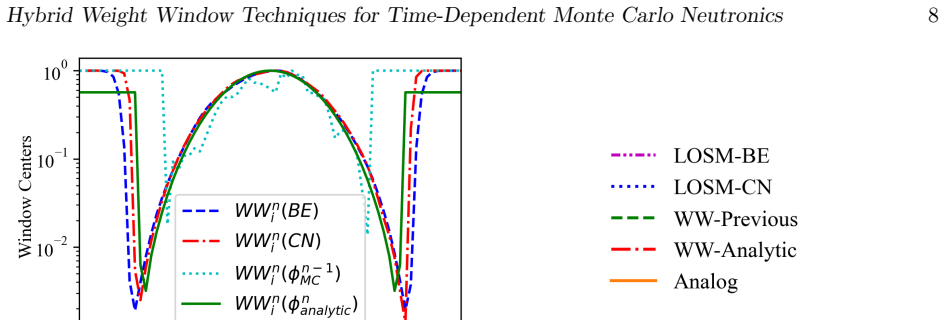
The central claim is that weight window centers defined by the spatially discretized LOSM equations, with the second-moment functional F(x,t)=∫−11(1/3−μ2)ψdμ estimated from Monte Carlo particle locations and filtered with a moving-average filter, make the Monte Carlo particle distribution nearly uniform in space. This uniformity lowers relative variance in low-flux regions and resolves traveling wavefronts more accurately than windows based on the previous timestep's Monte Carlo solution. The paper demonstrates this on the AZURV1 benchmark, comparing LOSM-BE and LOSM-CN windows against WW-Previous and WW-Analytic windows, and shows that the Crank-Nicolson scheme captures the wavefront slope more accurately than Backward Euler due to reduced numerical diffusion.
Load-bearing premise
The load-bearing premise is that the statistically noisy Monte Carlo estimates of the second-moment functional and cell-edge currents, after a simple moving-average filter with k=2, are accurate enough that the resulting weight windows improve rather than distort the Monte Carlo solution.
Editorial extensions
If this is right
- Weight windows from LOSM-CN produce a near-uniform spatial particle distribution, reducing relative standard deviation in low-flux regions.
- Automated windows from the hybrid solution improve wavefront resolution in traveling-wave problems, especially when using the Crank-Nicolson time scheme.
- The hybrid approach computes windows from only half the histories in a timestep, with accuracy comparable to the full-timestep Monte Carlo solution.
- Because the auxiliary solution is used only to set windows, the final Monte Carlo estimate remains unbiased even though the filtered hybrid solution is smoothed.
- LOSM-based windows improve cell-wise figure of merit at the wavefront and outer regions, trading some central precision for more uniform coverage.
Reading between the lines
- Extending beyond the paper: the self-adjointness of the LOSM operator suggests the method may transfer naturally to multidimensional problems, where non-self-adjoint quasi-diffusion equations are harder to discretize; the paper does not demonstrate this extension.
- The success of the method likely depends more on the shape of the filtered auxiliary flux than on its pointwise accuracy, implying that a cheap but qualitatively correct hybrid solution may be sufficient for effective variance reduction.
- A testable extension would replace the fixed moving-average filter (k=2) with an edge-preserving smoother and re-run the AZURV1 benchmark to see whether wavefront figure of merit improves further.
- The mid-timestep update of F_n and the switch from semi-implicit to fully-implicit LOSM solves suggest a lag-vs-noise tradeoff; a multilevel scheme with more frequent updates within a timestep could reduce lag-induced rouletting at the wavefront.
Signed reviews
Editorial analysis
A structured set of objections, weighed in public.
Referee Report
Summary. The paper proposes an automated weight-window method for time-dependent Monte Carlo neutron transport. The weight-window centers are defined by a hybrid forward solution of the discretized low-order second-moment (LOSM) equations, with the second-moment closure terms and initial data computed from Monte Carlo tallies at successive time layers. Two temporal discretizations, Backward Euler and Crank-Nicolson, are derived and compared. The method is implemented in the open-source MC/DC code and tested on the AZURV1 benchmark against weight windows based on the previous timestep's Monte Carlo solution and on the analytic solution. The authors report that the LOSM-CN windows produce a more uniform spatial particle distribution, improve cell-wise figure of merit, and resolve the wavefront more accurately than the lagged-previous-timestep windows.
Significance. If the reported gains are robust, the method is a useful addition to automated variance reduction for time-dependent Monte Carlo, particularly for traveling-wave problems where lagged weight windows misplace particles. The paper's strengths are its systematic derivation of the discretized LOSM equations, the use of an open-source code (MC/DC), and the anchoring of comparisons to the analytic AZURV1 solution, which avoids circularity in evaluating the weight-window effect. A further strength is that the method does not fit free parameters to reproduce the target solution; it changes only particle weights and leaves the tally estimator unchanged. However, the central variance-reduction claim rests on a single Monte Carlo realization and on closure tallies whose accuracy is not demonstrated, so the significance is conditional on additional statistical validation.
major comments (4)
- [Section 3, Figs. 12 and 17] The figure-of-merit comparison is based on a single Monte Carlo run: T is a runtime measurement and sigma_i is estimated from the same run, so the plotted FOM = (sigma^2 T)^{-1} is itself a random variable, yet no error bars, independent repetitions, or confidence intervals are provided. The headline claim that LOSM-CN improves FOM relative to WW-Previous cannot be distinguished from run-to-run fluctuation. Please add repeated-seed studies or another statistically principled comparison, and report the uncertainty in the plotted FOM and relative standard deviation.
- [Section 3, Eqs. (14)-(17)] The numerical setup fixes epsilon_min = epsilon = w_min = 10^{-4} and k = 2, but never states the value of the window width parameter rho used in Eqs. (15)-(16). The wavefront modification in Eq. (17) and the width rho directly control splitting and rouletting intensity and therefore directly affect FOM. Without a sensitivity study (for example varying epsilon and k over at least an order of magnitude, and reporting rho), the reported gains may reflect a favorable tuning of these parameters rather than a robust property of the LOSM-based windows. Please state rho and provide a sensitivity analysis or a justification for the chosen values.
- [Section 2.1] The cell-edge current J^n_{i+1/2} used in the hybrid LOSM problem is obtained by tallying the cell-averaged current at the time layer and linearly interpolating to the edges, while F^n_i comes from census particle locations; no bias or variance estimate is given for either estimator, and no comparison is shown against an independent tally such as a surface-crossing tally for J. Near the wavefront, the solution and its spatial derivative change rapidly, so linear interpolation over a cell and census-based tallies may systematically smooth or bias the closures. Since these closures define the hybrid solution and hence the weight windows, the reported FOM improvement may be sensitive to this unvalidated approximation. Please add a verification study (for example, comparing interpolated edge currents against surface-crossing tallies on a problem with a known solution or with a much larger particle population).
- [Section 2.1, Eq. (13)] The moving-average filter with k = 2 is applied to phi, J, and F before solving the LOSM problem. The paper correctly notes that smoothing may bias the auxiliary solution but argues that the final Monte Carlo estimate remains unbiased; that argument addresses the estimator mean, not the variance-reduction claim. Biased or overly smoothed windows can still degrade FOM or broaden the apparent wavefront, and the paper does not quantify the effect of the filter on the reported improvements. Please include either a numerical sensitivity study in k or a bound on how filter-induced bias in the auxiliary solution propagates to the window centers.
minor comments (4)
- [Eq. (4)] In the boundary condition for J(X,t), the term (1/2) phi(0,t) appears to be a typo; by symmetry with the left boundary it should be (1/2) phi(X,t).
- [Section 3] The value of the window-width parameter rho in Eqs. (15)-(16) is never specified in the numerical setup; please state it explicitly.
- [Throughout] The benchmark is referred to as both "AZUR V1" in the text and "AZURV1" in the title and abstract; please standardize the spelling.
- [Section 1] The sentence introducing hybrid moment equations for weight windows could more explicitly connect the LOSM method to the earlier quasi-diffusion weight-window work in Refs. [3-7]; a sentence noting that the LOSM operator is self-adjoint and what this offers over quasi-diffusion would help the reader.
Circularity Check
No significant circularity: the weight windows are an importance-sampling device driven by an auxiliary LOSM solution, not a fit to the benchmark; the self-citation to MC/DC is implementation-only and not load-bearing.
full rationale
The paper's derivation chain is self-contained: the LOSM equations (Eqs. 2-3) are derived from the transport equation by angular moments, the closure functional F (Eq. 5) is estimated by Monte Carlo tallies, and the resulting hybrid solution only sets weight-window centers (Eqs. 14-16). The target estimator (track-length tallied scalar flux, Figures 9 and 14) is not redefined in terms of the windows; the windows only redistribute particle weights. The numerical evaluation is anchored to the AZURV1 analytic solution (Section 3), and no free parameter is fitted to reproduce that solution. The uniform particle distribution is a direct consequence of the window construction rather than an independent empirical prediction, but the paper presents it as a sanity check of the method, not as a derived physical law. Potential accuracy issues in the census-based current estimate, linear interpolation to cell edges, and the k=2 moving-average filter are correctness risks that could affect the reported FOM gains, but they are not circular: they are unchecked numerical assumptions, not inputs that reappear as outputs by construction. The only self-citation, MC/DC [10], is an open-source implementation reference and does not carry the load-bearing argument; no uniqueness theorem or prior result by the same authors is invoked to force the method.
Assumptions & free parameters
free parameters (5)
- epsilon_min =
1e-4
- epsilon =
1e-4
- w_min =
1e-4
- filter_width_k =
2
- rho
assumptions (4)
- domain assumption The 1D one-group transport equation with isotropic scattering and source (Eq. 1) adequately models the AZURV1 benchmark.
- standard math The second-moment closure F (Eq. 5) together with the boundary conditions (Eq. 4) yields a well-posed low-order system.
- domain assumption Splitting and rouletting with weight windows preserve the unbiasedness of the Monte Carlo estimator.
- domain assumption Monte Carlo tallies at discrete time levels, with linear interpolation for edge currents, provide unbiased estimates of the required functionals.
Cite this review
Pith. "Pith review of Hybrid Weight Window Techniques for Time-Dependent Monte Carlo Neutronics." pith.science (2026). https://pith.science/paper/EBAC5BUH
@misc{pith2026250106144,
  author       = {Pith},
  title        = {Pith review of: Hybrid Weight Window Techniques for Time-Dependent Monte Carlo Neutronics},
  year         = {2026},
  howpublished = {\url{https://pith.science/paper/EBAC5BUH}},
  note         = {Machine review of arXiv:2501.06144}
}
read the original abstract
Efficient variance reduction of Monte Carlo simulations is desirable to avoid wasting computational resources. This paper presents an automated weight window algorithm for solving time-dependent particle transport problems. The weight window centers are defined by a hybrid forward solution of the discretized low-order second moment (LOSM) problem. The second-moment (SM) functionals defining the closure for the LOSM equations are computed by Monte Carlo solution. A filtering algorithm is applied to reduce noise in the SM functionals. The LOSM equations are discretized with first- and second-order time integration methods. We present numerical results of the AZURV1 benchmark. The hybrid weight windows lead to a uniform distribution of Monte Carlo particles in space. This causes a more accurate resolution of wave fronts and regions with relatively low flux.
Figures


Figures from the paper (6 more)


Reference graph
Works this paper leans on
-
[1]
J. C. Wagner, A. Haghighat, Automated variance reduction of Monte Carlo shielding calculations using the discrete ordinates adjoint function, Nuclear Science and Engineering 128 (1998) 186–208
work page 1998
-
[2]
J. C. Wagner, D. E. Peplow, S. W. Mosher, FW-CADIS method for global and regional variance reduction of Monte Carlo radiation transport calculations, Nuclear Science and Engineering 176 (2014) 37–57
work page 2014
-
[3]
M. A. Cooper, E. W. Larsen, Automated weight windows for global Monte Carlo particle transport calculations, Nuclear Science and Engineering 137 (1) (2001) 1–13
work page 2001
-
[4]
M. A. Cooper, An automated variance reduction method for global Monte Carlo neutral particle transport problems, PhD dissertation, University of Michigan, Ann Arbor, MI (1999)
work page 1999
-
[5]
A. B. Wollaber, Advanced Monte Carlo methods for thermal radiation transport, PhD dissertation, University of Michigan, Ann Arbor, MI (2008)
work page 2008
-
[6]
V. Y. Gol’din, A quasi-diffusion method of solving the kinetic equation, USSR Comp. Math. and Math. Phys. 4 (1964) 136–149
work page 1964
-
[7]
L. H. Auer, D. Mihalas, On the use of variable Eddington factors in non-LTE stellar atmospheres computations, Monthly Notices of the Royal Astronomical Society 149 (1970) 65–74
1970
-
[8]
E. E. Lewis, W. F. Miller, Jr, Comparison of P 1 synthetic acceleration techniques, Transactions of the American Nuclear Society 23 (6 1976)
work page 1976
Show all 14 references
-
[9]
G. R. Cefus, E. W. Larsen, Stability analysis of the quasidiffusion and second moment methods for iteratively solving discrete-ordinates problems, Transport Theory and Statistical Physics 18 (5-6) (1989) 493–511
1989
-
[10]
Morgan, I
J. Morgan, I. Variansyah, S. Pasmann, K. Clements, B. Cuneo, A. Mote, C. Goodman, C. Shaw, J. Northrop, R. Pankaj, E.Lame, B. Whewell, R. McClarren, T. Palmer, L. Chen, D. Anistratov, C. Kelley, C. Palmer, K. Niemeyer, Monte Carlo / dynamic code (MC/DC): An accelerated Python ...
2024
-
[11]
R. G. McClarren, T. J. Urbatsch, Temperature-extrapolation method for implicit Monte Carlo - radiation hydrodynamics calculations, in: Proceedings of the International Conference on Mathematics and Computational Methods Applied to Nuclear Science & Engineering (M&C 2013), Amer...
2013
-
[12]
S. W. Smith, The Scientist and Engineer’s Guide to Digital Signal Processing, California Technical Publishing, 1997
1997
-
[13]
J. T. Landman, R. G. McClarren, J. R. Madsen, A. R. Long, Analysis of lagged weight windows for implicit Monte Carlo variance reduction, Transactions of the American Nuclear Society 111 (1) (2014) 648–650
2014
-
[14]
Ganapol, R
B. Ganapol, R. Baker, J. Dahl, R. Alcouffe, Homogeneous infinite media time-dependent analytical benchmarks, Technical Report LA-UR-01-1854, Los Alamos National Laboratory (January 2001)
2001
Reviewed August 10, 2026 · model on record in the stance chip above.
Discussion (0). Continue with ORCID to comment.