REVIEW 3 major objections 5 minor 34 references
Analytic Computation of Vibrational Circular Dichroism Spectra Using Second-Order M{\o}ller-Plesset Perturbation Theory
T0 review · 3 major / 5 minor · reviewed 2026-08-10 · deepseek-v4-flash
Pith's one-line read This paper presents the first analytic-derivative formulation of MP2 vibrational circular dichroism atomic axial tensors, replacing an O(N^11) finite-difference method with an O(N^6) closed-form expression.
desk verdict A genuine first: analytic MP2 AATs for VCD with O(N^6) scaling, but the only validation is same-group internal consistency and the reported spectra lack a stated gauge origin. read the letter →
The pith
A machine-rendered reading of the paper's core claim, the machinery that carries it, and where it could break.
The reading
What carries the argument
The central object is Eq. (31), the fully normalized analytic MP2 AAT expression, which is built from the first-order MP2 wave function with intermediate normalization and then corrected by the derivative of the normalization factor. The required ingredients are first-order CPHF coefficients for nuclear displacements and magnetic-field perturbations, half-derivative overlap integrals, and derivatives of the T2 amplitudes; the derivation uses Wick's theorem with additional contraction rules for the half-derivative overlaps to reduce the many overlap terms to a compact formula. The cancellation structure—several seemingly contributing terms vanish because single-excitation projections cannot fully contract, and paired terms in Eqs. (22)-(23) cancel—leaves the final expression that the implementation evaluates.
What would settle it
Compute the analytic MP2 AAT for a small chiral molecule using an independent implementation with gauge-including atomic orbitals and a different integral package, then compare individual tensor elements to the values reported here; a disagreement beyond about 1e-7 a.u. in any element that cannot be attributed to gauge origin would falsify the working equation or its implementation.
Extended reading notes
Core claim
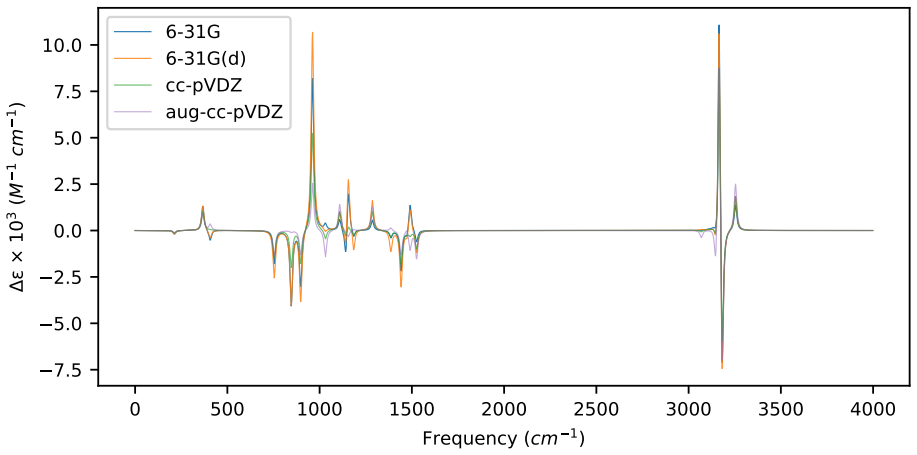
The paper's central discovery is that the MP2 atomic axial tensor—the part of the VCD rotatory strength arising from the magnetic-dipole transition moment—can be evaluated analytically, without complex arithmetic or non-orthonormal molecular orbital overlaps, by differentiating the intermediately normalized MP2 wave function and then restoring full normalization through a closed-form derivative of the normalization factor. The resulting working expression (Eq. 31 of the paper) collects the Hartree-Fock-level AAT term, a pure amplitude-derivative term, and several coupling terms between CPHF coefficients and amplitude derivatives; all other terms cancel by Wick's theorem contractions. The expression agrees with finite-difference AATs to roughly 1e-7 a.u. for (P)-hydrogen peroxide with the 6-31G basis, and the method is validated as far less expensive: a full MP2 AAT that took hours per tensor element numerically takes seconds analytically. Using this method, the paper reports the first fully analytic MP2 VCD spectrum of (S)-methyloxirane for several basis sets.
Load-bearing premise
The validation of the analytic expression rests on agreement with a finite-difference implementation that shares the same integral code and was tested on a single molecule with one basis set; if both routes contain the same systematic error—for example in the magnetic-field response or in the normalization derivative—the close numerical agreement would not expose it.
Editorial extensions
If this is right
- MP2-level VCD spectra can now be computed analytically for molecules and basis sets that were impractical with the previous O(N^11) finite-difference method, which required hours per tensor element.
- The analytic route eliminates complex wave-function arithmetic and non-orthonormal molecular-orbital overlaps, removing a major practical barrier in correlated VCD calculations.
- The same strategy—differentiate the wave function, restore normalization, and contract with Wick's theorem—can be applied to higher correlation methods, which the paper states as future work.
- The computed (S)-methyloxirane rotatory strengths show substantial basis-set dependence, including sign changes for weak modes, so practical MP2 VCD simulations will need carefully chosen basis sets and geometries.
- The analytic method provides a new reference standard for validating cheaper approximations to VCD and for benchmarking finite-difference implementations.
Reading between the lines
- A natural test is whether the analytic and finite-difference routes share a hidden systematic error; comparing the analytic AATs to an independent implementation that uses gauge-including atomic orbitals would separate origin-dependence effects from the response equations themselves.
- The O(N^6) scaling suggests MP2 VCD could be applied to molecules of 20-30 heavy atoms with modest basis sets, a size regime where computed versus measured VCD spectra are often used for assignment; this is a testable prediction about practical applicability.
- The same formal machinery could be transferred to coupled-cluster doubles or other response properties, such as Raman optical activity, where analytically differentiated wave functions would yield similar savings.
- Because the paper's validation used a single molecule and basis set, a broader benchmark across several chiral molecules with different functional groups would firm up the claimed agreement level.
Editorial analysis
A structured set of objections, weighed in public.
Referee Report
Summary. This manuscript derives an analytic-gradient expression for the MP2 atomic axial tensor in Stephens's VCD formulation. Starting from the intermediately normalized MP2 wave function, the authors use second-quantized derivative determinants and Wick's theorem to obtain Eq. (31), implement it in the open-source apyib package, and validate it against their finite-difference MagPy code for (P)-hydrogen peroxide with the 6-31G basis. They report an O(N^6) scaling for the analytic route, several orders of magnitude below the O(N^11) finite-difference route, and present the first fully analytic MP2 VCD spectra for (S)-methyloxirane with four basis sets under two geometry/Hessian protocols.
Significance. If Eq. (31) is correct, this is a significant methodological advance: it removes the numerical-differentiation bottleneck in correlated VCD and greatly extends the size of molecules and basis sets accessible at the MP2 level. The paper's strengths are its self-contained derivation, the explicit treatment of intermediate versus full normalization, and a machine-implemented comparison that reaches roughly 1e-7 a.u. agreement. The main caveats are that the validation is internal to the authors' own code stack and that the reported spectra are origin-dependent with no stated gauge origin. These caveats do not invalidate the derivation, but they do affect how strongly the central claim can be accepted as published.
major comments (3)
- [§4.1, Table 1] The numerical validation is an internal consistency check rather than an independent one: MagPy and apyib are written by the same group and both obtain integrals from Psi4, so the finite-difference and analytic routes share the CPHF response layer, the dependent-pair U treatment mentioned in §3, and the normalization derivative in Eq. (30). The 1e-7 to 1e-9 a.u. agreement therefore does not exclude a systematic error common to both codes. Because Eq. (31) is the central claim, I ask for validation against an independent implementation or, at minimum, additional tabulated cases with different molecule/basis combinations and a demonstration that the magnetic-field CPHF response and normalization derivative are correct in isolation (for example, by comparing the HF limit of the analytic AAT against an independent HF VCD code).
- [§4.2, Tables 2–3; §5] The rotatory strengths and spectra are origin-dependent because GIAOs are not used, as the authors acknowledge in §5, yet no gauge origin is reported for any calculation. Without this information, the numerical values in Tables 2 and 3 and the spectra in Figs. 1 and 2 are not uniquely reproducible, and the physical interpretation of basis-set sign changes is incomplete. Please state the gauge origin used, quantify the origin dependence (for example, by comparing AATs and rotatory strengths at the molecular center of mass and at another origin), or provide an origin-invariant formulation.
- [§3] The text states that 'several small molecular test cases' were compared, but Table 1 reports only (P)-H2O2 with the 6-31G basis. If additional validation data exist, they should be included in the main text or the SI; as written, the reader cannot assess whether the agreement is robust across basis sets and molecules. This is especially important given that the only comparison is to the authors' own finite-difference code.
minor comments (5)
- [§3] The phrase 'hydrogen molecule dimer' is unusual; presumably 'H2 dimer' or 'hydrogen molecule' is intended.
- [§2, Eq. (9)] Operator strings such as 'a†aχaa' are hard to parse; explicit brackets or a short sentence defining the action of the core-derivative creation operators would improve readability.
- [Tables 2–3] Several rotatory strengths contain stray spaces (for example, '2 .495' and '3 .302'); the formatting should be corrected.
- [References] Reference 34 gives the page range as '1–25' and should include the volume and article number or issue information as appropriate for Molecular Physics.
- [Supporting Information] The SI is said to contain only Cartesian coordinates; adding the full set of validation AATs, input keywords, and convergence settings would substantially improve reproducibility.
Circularity Check
No significant circularity: the analytic MP2 AAT derivation is self-contained, and the same-group finite-difference comparison is a validation check rather than a fitted input.
full rationale
The central working equation (31) is obtained by substituting the MP2 ansatz into Stephens's AAT definition, expanding derivative determinants in second quantization, and applying Wick's theorem; no target data enter the derivation. The only same-group elements are refs. 20, 23, 24, and 34 used for comparison and code, and these are not used to derive Eq. (31). The MagPy finite-difference comparison is an internal consistency test of the implementation, not a fit of any parameter to the predicted AATs, so it does not constitute 'fitted input called prediction.' No self-definitional step is present: the AAT is not defined in terms of MP2 amplitudes, and MP2 amplitudes are not defined in terms of the AAT. The canonical-orbital assumption and the absence of GIAOs are limitations affecting transferability and origin dependence, but they are not circular. Therefore the paper's derivation chain is self-contained, and the minor same-group validation dependency is a benchmarking weakness, not circularity.
Assumptions & free parameters
assumptions (6)
- domain assumption Closed-shell HF reference with real, canonical orbitals and MP2 wave function |Psi> approximately N(1+T2)|Phi0>.
- domain assumption Stephens's AAT formula, Eq. (1), gives the electronic contribution to the VCD rotatory strength.
- domain assumption CPHF coefficients U^chi satisfy the derivative orthonormality relation U^chi_pq + U^chi_qp + S^chi_pq = 0 and standard CPHF equations.
- standard math Wick's theorem contraction rules plus half-derivative overlap integral identities, Eqs. (14)-(17), evaluate all overlaps.
- domain assumption Perturbed HF orbitals are assumed canonical, requiring both dependent and independent CPHF coefficients.
- ad hoc to paper No gauge-including atomic orbitals are used; the magnetic-field perturbation acts only through the Hamiltonian, not the basis.
Cite this review
Pith. "Pith review of Analytic Computation of Vibrational Circular Dichroism Spectra Using Second-Order M{\o}ller-Plesset Perturbation Theory." pith.science (2026). https://pith.science/paper/GBSXER6B
@misc{pith2026250106632,
  author       = {Pith},
  title        = {Pith review of: Analytic Computation of Vibrational Circular Dichroism Spectra Using Second-Order M\oller-Plesset Perturbation Theory},
  year         = {2026},
  howpublished = {\url{https://pith.science/paper/GBSXER6B}},
  note         = {Machine review of arXiv:2501.06632}
}
abstract
We present the first analytic-derivative-based formulation of vibrational circular dichroism (VCD) atomic axial tensors for second-order Moller-Plesset (MP2) perturbation theory. We compare our implementation to our recently reported finite-difference approach and find close agreement, thus validating the new formulation. The new approach is dramatically less computationally expensive than the numerical-derivative method with an overall computational scaling of $O(N^6)$. In addition, we report the first fully analytic VCD spectrum for (S)-methyloxirane at the MP2 level of theory.
Figures

Reference graph
Works this paper leans on
-
[1]
Optical activity of vibrational transitions: A coupled oscillator model
Holzwarth, G.; Chabay, I. Optical activity of vibrational transitions: A coupled oscillator model. J. Chem. Phys. 1972, 57, 1632--1635
work page 1972
-
[2]
Schellman, J. A. Vibrational optical activity. J. Chem. Phys. 1973, 58, 2882--2886
work page 1973
-
[3]
Nafie, L. A.; Walnut, T. H. Vibrational circular dichroism theory: A localized molecular orbital model. Chem. Phys. Lett. 1977, 49, 441--446
work page 1977
-
[4]
A charge flow model for vibrational rotational strengths
Abbate, S.; Laux, L.; Overend, J.; Moscowitz, A. A charge flow model for vibrational rotational strengths. J. Chem. Phys. 1981, 75, 3161--3164
work page 1981
-
[5]
Nafie, L. A.; Oboodi, M. R.; Freedman, T. B. Vibrational circular dichroism in amino acids and peptides. 8. A chirality rule for methine C* _ -H stretching modes. J. Am. Chem. Soc. 1983, 105, 7449--7450
work page 1983
-
[6]
Nafie, L. A.; Freedman, T. B. Ring current mechanism of vibrational circular dichroism. J. Phys. Chem. 1986, 90, 763--767
work page 1986
-
[7]
Freedman, T. B.; Nafie, L. A. Vibrational optical activity calculations using infrared and Raman atomic polar tensors. J. Chem. Phys. 1983, 78, 27–31
work page 1983
-
[8]
Polavarapu, P. L. A comparison of bond moment and charge flow models for vibrational circular dichroism intensities. Mol. Phys. 1983, 49, 645--650
work page 1983
Show all 34 references
-
[9]
J.; Drake, A
Barnett, C. J.; Drake, A. F.; Kuroda, R.; Mason, S. A dynamic polarization model for vibrational optical activity and the infrared circular dichroism of a dihydro[5]helicene. Mol. Phys. 1980, 41, 455--468
1980
-
[10]
D.; Buckingham, A
Barron, L. D.; Buckingham, A. D. The inertial contribution to vibrational optical activity in methyl torsion modes. J. Am. Chem. Soc. 1979, 101, 1980--1987
1979
-
[11]
Stephens, P. J. Theory of vibrational circular dichroism. J. Am. Chem. Soc. 1985, 89, 748--752
1985
-
[12]
A.; Segal, G
Lowe, M. A.; Segal, G. A.; Stephens, P. J. The theory of vibrational circular dichroism: trans-1,2-dideuteriocyclopropane. J. Am. Chem. Soc. 1986, 108, 248--256
1986
-
[13]
A.; Stephens, P
Lowe, M. A.; Stephens, P. J.; Segal, G. A. The theory of vibrational circular dichroism: trans -1,2-dideutriocyclobutane and propylene oxide. Chem. Phys. Lett. 1986, 123, 108--116
1986
-
[14]
D.; Handy, N
Amos, R. D.; Handy, N. C.; Jalkanen, K. J.; Stephens, P. Efficient calculation of vibrational magnetic dipole transition moments and rotational strengths. Chem. Phys. Lett. 1987, 133, 21--26
1987
-
[15]
L.; J rgensen, P.; Helgaker, T.; Ruud, K.; Jensen, H
Bak, K. L.; J rgensen, P.; Helgaker, T.; Ruud, K.; Jensen, H. J. A. Gauge-origin independent multiconfigurational self-consistent-field theory for vibrational circular dichroism. J. Chem. Phys. 1993, 98, 8873--8887
1993
-
[16]
J.; Pople, J
Ditchfield, R.; Hehre, W. J.; Pople, J. A. Self-Consistent Molecular-Orbital Methods. IX. An Extended Gaussian-Type Basis for Molecular-Orbital Studies of Organic Molecules. J. Chem. Phys. 1971, 54, 724--728
1971
-
[17]
An electronic Hamiltonian for origin independent calculations of magnetic properties
Helgaker, T.; J rgensen, P. An electronic Hamiltonian for origin independent calculations of magnetic properties. J. Chem. Phys. 1991, 95, 2595--2601
1991
-
[18]
J.; Devlin, F
Stephens, P. J.; Devlin, F. J.; Chabalowski, C. F.; Frisch, M. J. Ab initio Calculation of Vibrational Absorption and Circular Dichroism Spectra Using Density Functional Theory. J. Phys. Chem. 1994, 98, 11623--11627
1994
-
[19]
R.; Frisch, M
Cheeseman, J. R.; Frisch, M. J.; Devlin, F. J.; Stephens, P. J. Ab initio calculation of atomic axial tensors and vibrational rotational strengths using density functional theory. Chem. Phys. Lett. 1996, 252, 211--220
1996
-
[20]
M.; Crawford, T
Shumberger, B. M.; Crawford, T. D. Simulation of Vibrational Circular Dichroism Spectra Using Second-Order M ller-Plesset Perturbation Theory and Configuration Interaction Doubles. J. Chem. Theory Comput. 2024, 20, 7254--7263
2024
-
[21]
D.; Osamura, Y.; Schaefer, H
Yamaguchi, Y.; Goddard, J. D.; Osamura, Y.; Schaefer, H. F. A New Dimension to Quantum Chemistry: Analytic Derivative Methods in Ab Initio Molecular Electronic Structure Theory; Oxford University Press: New York, 1994
1994
-
[22]
D.; Schaefer, H
Crawford, T. D.; Schaefer, H. F. In Reviews in Computational Chemistry; Lipkowitz, K. B., Boyd, D. B., Eds.; VCH Publishers: New York, 2000; Vol. 14; Chapter 2, pp 33--136
2000
-
[23]
Shumberger, B. M. https://github.com/bshumberger/apyib
-
[24]
Crawford, T. D. http://github.com/CrawfordGroup/MagPy
-
[25]
Smith, D. G. A.; Burns, L. A.; Simmonett, A. C.; Parrish, R. M.; Schieber, M. C.; Galvelis, R.; Kraus, P.; Kruse, H.; Remigio, R. D.; Alenaizan, A.; James, A. M.; Lehtola, S.; Misiewicz, J. P.; Scheurer, M.; Shaw, R. A.; Schriber, J. B.; Xie, Y.; Glick, Z. L.; Sirianni, D. A.;...
2020
-
[26]
C.; Amos, R
Handy, N. C.; Amos, R. D.; Gaw, J. F.; Rice, J. E.; Simandiras, E. D. The elimination of singularities in derivative calculations. Chem. Phys. Lett. 1985, 120, 151
1985
-
[27]
J.; Stewart, R
Hehre, W. J.; Stewart, R. F.; Pople, J. A. Self-Consistent Molecular-Orbital Methods. I. Use of Gaussian Expansions of Slater-Type Atomic Orbitals. J. Chem. Phys. 1969, 51, 2657--2664
1969
-
[28]
J.; Ditchfield, R.; Pople, J
Hehre, W. J.; Ditchfield, R.; Pople, J. A. Self-Consistent Molecular Orbital Methods. XII. Further Extensions of Gaussian-Type Basis Sets for Use in Molecular Orbital Studies of Organic Molecules. J. Chem. Phys. 1972, 56, 2257--2261
1972
-
[29]
C.; Pople, J
Hariharan, P. C.; Pople, J. A. The influence of polarization functions on molecular orbital hydrogenation energies. Theor. Chim. Acta 1973, 28, 213--222
1973
-
[30]
Dunning, T. H. Gaussian basis sets for use in correlated molecular calculations. I. The atoms boron through neon and hydrogen. J. Chem. Phys. 1989, 90, 1007--1023
1989
-
[31]
P.; Altarawy, D.; Didier, B.; Gibsom, T
Pritchard, B. P.; Altarawy, D.; Didier, B.; Gibsom, T. D.; Windus, T. L. A New Basis Set Exchange: An Open, Up-to-date Resource for the Molecular Sciences Community. J. Chem. Inf. Model. 2019, 59, 4814--4820
2019
-
[32]
The role of databases in support of computational chemistry calculations
Feller, D. The role of databases in support of computational chemistry calculations. J. Comput. Chem. 1996, 17, 1571--1586
1996
-
[33]
u n. C . Z hang, X . Z heng, and the integral packages MOLECULE ( J . A lml \
Stanton, J. F.; Gauss, J.; Cheng, L.; Harding, M. E.; Matthews, D. A.; Szalay, P. G. CFOUR, Coupled-Cluster techniques for Computational Chemistry, a quantum-chemical program package . W ith contributions from A . A sthana, A . A . A uer, R . J . B artlett, U . B enedikt, C . ...
-
[34]
functional tuning
Shumberger, B. M.; Fink, E. H.; King, R. A.; Crawford, T. D. On the use of property-oriented basis sets for the simulation of vibrational chiroptical spectroscopies. Mol. Phys. 2023, 122, 1--25 mcitethebibliography main.tex0000664000000000000000000000407214740532022011226 0ust...
2023
Reviewed August 10, 2026 · model on record in the stance chip above.
Discussion (0). Continue with ORCID to comment.