REVIEW 3 major objections 4 minor 40 references
VidChain: Chain-of-Tasks with Metric-based Direct Preference Optimization for Dense Video Captioning
T0 review · 3 major / 4 minor · reviewed 2026-08-10 · deepseek-v4-flash
Pith's one-line read VidChain claims that dense video captioning improves when the task is decomposed into a chain of subtasks and each subtask is aligned to the evaluation metric via preference optimization.
desk verdict A solid, honestly-ablated training recipe for dense video captioning; the teacher-forcing gap in M-DPO is real but does not sink the main claim. read the letter →
The pith
A machine-rendered reading of the paper's core claim, the machinery that carries it, and where it could break.
The reading
What carries the argument
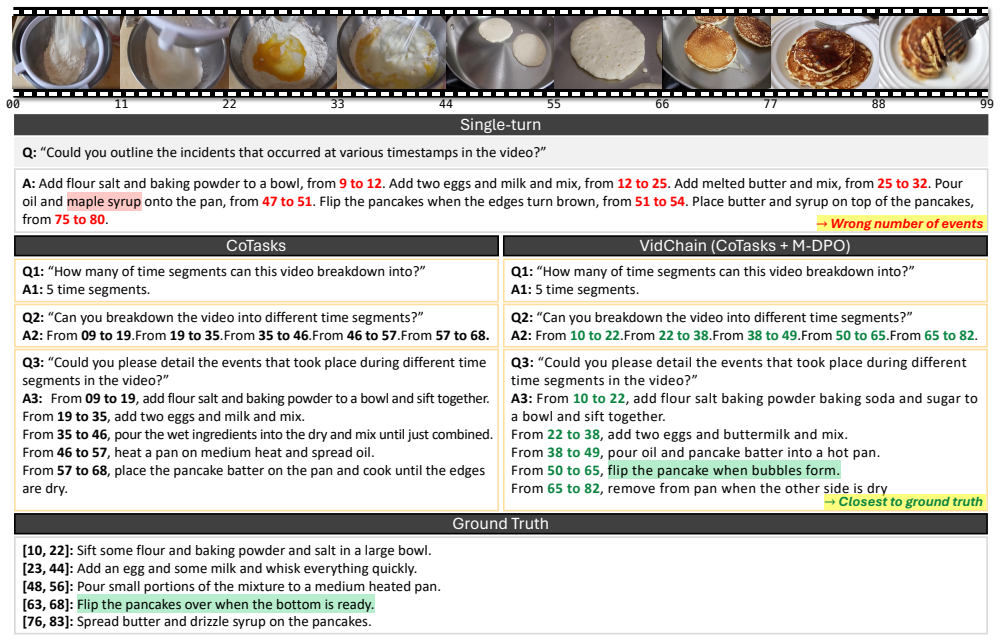
The carrying object is a task decomposition written as a probability factorization, paired with a preference-optimization loss. Chain-of-Tasks (CoTasks) converts DVC into a multi-turn conversation whose two reasoning paths $P_{t\to c}$ and $P_{c\to t}$ factor the joint probability as $p(c|v,n,t)p(t|v,n)p(n|v)$ or $p(t|v,n,c)p(c|v,n)p(n|v)$. M-DPO samples responses from the CoTasks-trained reference model, scores them with metrics ($\text{SODA}_c$, METEOR, IoU), and optimizes $L_{\text{M-DPO}} = -\mathbb{E}\left[\mathbb{1}(m^w_k - m^l_k > \gamma)\, \log \sigma\!\left(\beta r(\hat{y}^w_k) - \beta r(\hat{y}^l_k)\right)\right]$, where $r(\cdot)$ is the log-likelihood ratio between the target and reference policy and the threshold $\gamma$ keeps the model focused on pairs with a meaningful metric gap. This loss is what supplies fine-grained supervision to each subtask rather than only the final response.
What would settle it
Use the paper's generated-history variant of M-DPO (Table 11) on a longer-video or higher-variance benchmark and measure whether the gap to ground-truth-history M-DPO widens enough to erase VidChain's improvement over the base VideoLLM.
Extended reading notes
Core claim
The central discovery is that dense video captioning is better learned as a chain of predictable subunits than as one monolithic generation, and that preference optimization should be driven by the exact metric used at evaluation. Formally, VidChain replaces the single-step objective $p(c,t,n|v)$ with two factorizations, $p(c|v,n,t)p(t|v,n)p(n|v)$ and $p(t|v,n,c)p(c|v,n)p(n|v)$, and implements them as multi-turn QA. M-DPO then samples several responses for each subtask, scores them with the corresponding metric (using SODA as a unified proxy), and applies a DPO-style loss that only trains on pairs whose metric gap exceeds a threshold $\gamma$. The paper reports that on the two VideoLLMs it is applied to, this raises $\text{SODA}_c$ from 7.2 to 8.8 and METEOR from 7.7 to 8.8 on ActivityNet, and raises the YouCook2 $\text{SODA}_c$ by roughly 45 percent relative, while also improving temporal grounding metrics such as R@0.3 and mIoU. The component ablation is the key evidence: CoTasks alone helps, M-DPO adds on top, and supervising intermediate subtasks with metric preferences outperforms final-response-only DPO.
Load-bearing premise
The reported gains rely on the assumption that preference pairs built from ground-truth intermediate answers transfer to inference, where the model sees its own generated intermediate answers; the paper's Table 11 shows this swap already costs 0.4–0.5 SODA_c points.
Editorial extensions
If this is right
- Applied to VTimeLLM at 7B, VidChain matches or exceeds the 13B VTimeLLM baseline on the reported DVC metrics.
- M-DPO's per-subtask preference supervision transfers to temporal video grounding, improving R@0.3 and mIoU even though M-DPO samples were not explicitly built for TVG.
- Including both reasoning paths ($P_{t\to c}$ and $P_{c\to t}$) in the CoTasks training data outperforms either path alone.
- The preference-gap-aware loss (filtering pairs with $m^w_k - m^l_k > \gamma$) yields a larger DPO margin and better final scores than unfiltered DPO.
- At inference, VidChain adds modest cost (about 4% for VTimeLLM and 22% for VideoLLaMA2 in the reported setting) for the reported gains.
Reading between the lines
- A natural next test is to scale M-DPO data construction to model-generated histories with on-policy sampling; the paper's own Table 11 gap suggests this is where the recipe could lose or gain depending on how exposure bias interacts with longer videos.
- The same two-part recipe — factor a composite task into a chain and align with the target metric per link — could transfer to other structured video tasks such as moment retrieval or action segmentation, where the output has a similar count-then-localize-then-describe shape.
- Because metric-based preferences are free to obtain once ground-truth captions exist, the approach could be extended to semi-supervised settings where only a subset of videos have dense annotations, using metric scores on the annotated subset to shape preferences for the unannotated ones.
Editorial analysis
A structured set of objections, weighed in public.
Referee Report
Summary. The paper proposes VidChain, a training framework for dense video captioning (DVC) with VideoLLMs. It decomposes DVC into sequential sub-tasks--event-count prediction followed by timestamps-then-captions or captions-then-timestamps--and introduces M-DPO, a DPO variant in which preference pairs are sampled from the SFT model and labeled by evaluation metrics (SODA, METEOR, IoU) for each sub-task, with a gap threshold gamma. The method is applied to VTimeLLM and VideoLLaMA2 and evaluated on ActivityNet Captions and YouCook2 for DVC, and on ActivityNet Captions for temporal video grounding. The paper reports consistent gains over baselines, extensive ablations, and a code release.
Significance. If the reported results are robust, VidChain is a practically valuable recipe: it improves two different 7B VideoLLMs on DVC and TVG without human preference annotations, and it decomposes DVC into interpretable sub-task losses. The paper is unusually thorough in ablating components (Tables 3, 6, 7, 10), reporting a sensitivity analysis for gamma (Table 8), quantifying inference overhead (Table 12), and even testing generated versus ground-truth conversation history (Table 11). The main caveats are the teacher-forcing gap in M-DPO data construction and the imprecise metric-equivalence claim, both of which concern the method's internal alignment argument rather than its empirical gains.
major comments (3)
- [Appendix F, Table 11, Eq. (4)] The M-DPO objective in Eq. (4) constructs preferences conditioned on ground-truth history h<k, but at inference the model conditions on its own generated history. Table 11 shows that using generated history h_hat<k instead of h<k lowers SODA_c by 0.4-0.5 and TVG R@0.3 by 2.0. Since the M-DPO contribution over CoTasks in Table 3 is about 1.1 points of SODA_c (e.g., 8.8 vs. 7.7 for VideoLLaMA2-Pc->t), the exposure-bias gap is large relative to the claimed marginal gain. Please report M-DPO trained entirely on generated histories, or a curriculum that interpolates between them, and analyze whether the gap grows with video length, event count, or sub-task error. Without this, the 'consistent improvements' attributed to M-DPO are not fully established under the inference-time distribution.
- [Appendix K] The statement that 'using SODA is equivalent to evaluating with METEOR' for comparing two caption outputs at fixed n is not justified. SODA_c is a global assignment cost that combines IoU and METEOR over all predicted and reference captions; for the p(c|v,n) sub-task the timestamps are not yet predicted, so reducing SODA_c to METEOR requires additional assumptions about alignment and timestamp quality. Since M-DPO's central claim is metric-aligned supervision, please state exactly which metric is used to rank each sub-task and provide a derivation, or use METEOR directly for the caption sub-task.
- [Section 4.2, Tables 3, 7, 8, 10, 11] No confidence intervals, standard deviations, or significance tests are reported. Several headline differences are small (e.g., METEOR 8.8 vs. 8.6 in Table 7; YouCook2 METEOR 4.9 vs. 4.5 in Table 3), and the gamma sensitivity in Table 8 varies by 2.2 points in R@0.3 and 0.4 in METEOR. Please report multiple seeds and variance estimates for at least the central comparisons, or explain why the differences are beyond run-to-run noise. This is needed to support the consistency claim across models and benchmarks.
minor comments (4)
- [Table 6] The row labels 'CoTasks-Pt->c' and 'CoTasks-Pc->t' are ambiguous because some rows have checkmarks for both Dt->c and Dc->t; please label each row explicitly, e.g., 'CoTasks-Pt->c (both data types)', or add a separate column for the path label.
- [Table 12] The phrase 'to generate the same number of tokens' is unclear, since CoTasks changes the prompt and decoding structure; please specify whether decoding length or token budget is matched and report the total generated tokens for each configuration.
- [Appendix C, Figure 4] The '6.6 times' margin claim at the end of training would be more informative with training-step markers and with a description of the y-axis units; please also clarify whether the margin is averaged over the evaluation set or the training set.
- [Throughout] Minor wording inconsistencies: Eq. (7) writes the indicator as '1(mw_k - ml_k > gamma)' rather than a properly typeset indicator; Figures 5-7 use 'Progressive Tasks' while the paper's terminology is 'CoTasks'; Appendix A refers to 'Box 1' and 'Box 2' without a visibly numbered box structure in the text.
Circularity Check
No significant circularity: CoTasks is a chain-rule decomposition and M-DPO uses metrics as training preferences, with held-out evaluation; Appendix F discloses a non-circular exposure-bias limitation.
full rationale
VidChain is an empirical method paper; the derivation chain is training and evaluation, not a formal proof. The CoTasks decomposition (Eq. 2-3) is an exact factorization of p(c,t,n|v) by the chain rule, with no circular reduction. M-DPO constructs preference pairs by evaluating sampled responses with SODA/METEOR/IoU against ground-truth responses (Eq. 4 and Sec. 3.3); this is a legitimate reward signal for training, and the reported gains are measured on held-out validation sets with the same metrics. Using the evaluation metric to label training preferences is metric-aligned optimization, not a definitional equivalence: the model must generalize to unseen videos, and the paper's ablations (Tab. 3, 7) show CoTasks alone, without M-DPO, already improves over baselines, so the central claim does not reduce to the training labels. The paper cites Ko et al. 2023a,b from the same group in Related Work as examples of MLLMs, but this citation is not load-bearing; no uniqueness or correctness claim rests on it. Appendix F/Table 11 honestly reports that conditioning M-DPO on ground-truth history h<k instead of generated history ĥ<k gives higher SODAc (8.2 vs 7.8 for Pt→c; 8.8 vs 8.3 for Pc→t) and TVG R@0.3 (63.3 vs 61.3). This is an exposure-bias limitation that may affect transfer, but it is not circular: the ĥ<k rows still outperform the CoTasks-only baselines, and the paper does not redefine the evaluation metrics to match its training objective. No step in the paper reduces to its own inputs by construction.
Assumptions & free parameters
free parameters (4)
- gamma (preference gap threshold) =
5.0 (VTimeLLM ActivityNet), 10.0 (VideoLLaMA2 ActivityNet, both YouCook2)
- beta (DPO temperature) =
0.5
- ns (number of sampled responses) =
3
- LoRA rank r and alpha =
r=64, alpha=128
assumptions (4)
- standard math The joint distribution p(c,t,n|v) factorizes as p(c|v,n,t)p(t|v,n)p(n|v) or p(t|v,n,c)p(c|v,n)p(n|v) (Eq. 2-3).
- domain assumption Ranking sampled responses by evaluation metrics (SODA, METEOR, IoU) on the training set provides a valid preference signal that improves performance on those metrics.
- domain assumption Training with ground-truth intermediate conversation history h<k transfers to inference with model-generated history.
- ad hoc to paper SODA is equivalent to METEOR when comparing captions with a fixed number of segments, and to IoU for timestamp tasks.
Cite this review
Pith. "Pith review of VidChain: Chain-of-Tasks with Metric-based Direct Preference Optimization for Dense Video Captioning." pith.science (2026). https://pith.science/paper/K4BCVBRD
@misc{pith2026250106761,
  author       = {Pith},
  title        = {Pith review of: VidChain: Chain-of-Tasks with Metric-based Direct Preference Optimization for Dense Video Captioning},
  year         = {2026},
  howpublished = {\url{https://pith.science/paper/K4BCVBRD}},
  note         = {Machine review of arXiv:2501.06761}
}
read the original abstract
Despite the advancements of Video Large Language Models (VideoLLMs) in various tasks, they struggle with fine-grained temporal understanding, such as Dense Video Captioning (DVC). DVC is a complicated task of describing all events within a video while also temporally localizing them, which integrates multiple fine-grained tasks, including video segmentation, video captioning, and temporal video grounding. Previous VideoLLMs attempt to solve DVC in a single step, failing to utilize their reasoning capability. Moreover, previous training objectives for VideoLLMs do not fully reflect the evaluation metrics, therefore not providing supervision directly aligned to target tasks. To address such a problem, we propose a novel framework named VidChain comprised of Chain-of-Tasks (CoTasks) and Metric-based Direct Preference Optimization (M-DPO). CoTasks decompose a complex task into a sequence of sub-tasks, allowing VideoLLMs to leverage their reasoning capabilities more effectively. M-DPO aligns a VideoLLM with evaluation metrics, providing fine-grained supervision to each task that is well-aligned with metrics. Applied to two different VideoLLMs, VidChain consistently improves their fine-grained video understanding, thereby outperforming previous VideoLLMs on two different DVC benchmarks and also on the temporal video grounding task. Code is available at \url{https://github.com/mlvlab/VidChain}.
Figures


Figures from the paper (5 more)


Reference graph
Works this paper leans on
-
[1]
Ahn, D.; Choi, Y.; Yu, Y.; Kang, D.; and Choi, J. 2024. Tuning large multimodal models for videos using reinforcement learning from ai feedback. In ACL
work page 2024
-
[2]
Banerjee, S.; and Lavie, A. 2005. METEOR: An automatic metric for MT evaluation with improved correlation with human judgments. In ACL
work page 2005
-
[3]
Chen, Z.; Wu, J.; Wang, W.; Su, W.; Chen, G.; Xing, S.; Zhong, M.; Zhang, Q.; Zhu, X.; Lu, L.; et al. 2024. Internvl: Scaling up vision foundation models and aligning for generic visual-linguistic tasks. In CVPR
2024
-
[4]
Cheng, Z.; Leng, S.; Zhang, H.; Xin, Y.; Li, X.; Chen, G.; Zhu, Y.; Zhang, W.; Luo, Z.; Zhao, D.; et al. 2024. VideoLLaMA 2: Advancing Spatial-Temporal Modeling and Audio Understanding in Video-LLMs. arXiv:2406.07476
arXiv 2024
-
[5]
F.; Leike, J.; Brown, T.; Martic, M.; Legg, S.; and Amodei, D
Christiano, P. F.; Leike, J.; Brown, T.; Martic, M.; Legg, S.; and Amodei, D. 2017. Deep reinforcement learning from human preferences. In NeurIPS
work page 2017
-
[6]
Dai, W.; Li, J.; Li, D.; Tiong, A.; Zhao, J.; Wang, W.; Li, B.; Fung, P.; and Hoi, S. 2023. Instructblip: Towards general-purpose vision-language models with instruction tuning. In NeurIPS
work page 2023
-
[7]
Fujita, S.; Hirao, T.; Kamigaito, H.; Okumura, M.; and Nagata, M. 2020. SODA: Story oriented dense video captioning evaluation framework. In ECCV
work page 2020
-
[8]
Gunjal, A.; Yin, J.; and Bas, E. 2024. Detecting and preventing hallucinations in large vision language models. In AAAI
work page 2024
Show all 40 references
-
[9]
Huang, B.; Wang, X.; Chen, H.; Song, Z.; and Zhu, W. 2024. Vtimellm: Empower llm to grasp video moments. In CVPR
2024
-
[10]
B.; Moon, J.; Choi, J.; and Kim, S
Kim, M.; Kim, H. B.; Moon, J.; Choi, J.; and Kim, S. T. 2024. Do You Remember? Dense Video Captioning with Cross-Modal Memory Retrieval. In CVPR
2024
-
[11]
S.; Choi, M.; Chu, J.; Park, J.; and Kim, H
Ko, D.; Lee, J. S.; Choi, M.; Chu, J.; Park, J.; and Kim, H. J. 2023 a . Open-Vocabulary Video Question Answering: A New Benchmark for Evaluating the Generalizability of Video Question Answering Models. In ICCV
2023
-
[12]
S.; Kang, W.; Roh, B.; and Kim, H
Ko, D.; Lee, J. S.; Kang, W.; Roh, B.; and Kim, H. J. 2023 b . Large language models are temporal and causal reasoners for video question answering. In EMNLP
2023
-
[13]
Krishna, R.; Hata, K.; Ren, F.; Fei-Fei, L.; and Carlos Niebles, J. 2017. Dense-captioning events in videos. In ICCV
2017
-
[14]
Lai, X.; Tian, Z.; Chen, Y.; Yang, S.; Peng, X.; and Jia, J. 2024. Step-DPO: Step-wise Preference Optimization for Long-chain Reasoning of LLMs. arXiv:2406.18629
2024 arXiv
-
[15]
Li, K.; He, Y.; Wang, Y.; Li, Y.; Wang, W.; Luo, P.; Wang, Y.; Wang, L.; and Qiao, Y. 2023. Videochat: Chat-centric video understanding. arXiv:2305.06355
2023 arXiv
-
[16]
Li, K.; Wang, Y.; He, Y.; Li, Y.; Wang, Y.; Liu, Y.; Wang, Z.; Xu, J.; Chen, G.; Luo, P.; et al. 2024. Mvbench: A comprehensive multi-modal video understanding benchmark. In CVPR
2024
-
[17]
Lin, B.; Zhu, B.; Ye, Y.; Ning, M.; Jin, P.; and Yuan, L. 2023. Video-llava: Learning united visual representation by alignment before projection
2023
-
[18]
Liu, H.; Li, C.; Li, Y.; and Lee, Y. J. 2024. Improved baselines with visual instruction tuning. In CVPR
2024
-
[19]
Liu, H.; Li, C.; Wu, Q.; and Lee, Y. J. 2023. Visual instruction tuning. In NeurIPS
2023
-
[20]
Maaz, M.; Rasheed, H.; Khan, S.; and Khan, F. S. 2024. Video-chatgpt: Towards detailed video understanding via large vision and language models. In ACL
2024
-
[21]
Ouyang, L.; Wu, J.; Jiang, X.; Almeida, D.; Wainwright, C.; Mishkin, P.; Zhang, C.; Agarwal, S.; Slama, K.; Ray, A.; et al. 2022. Training language models to follow instructions with human feedback. In NeurIPS
2022
-
[22]
Qian, L.; Li, J.; Wu, Y.; Ye, Y.; Fei, H.; Chua, T.-S.; Zhuang, Y.; and Tang, S. 2024. Momentor: Advancing video large language model with fine-grained temporal reasoning. In ICML
2024
-
[23]
D.; Ermon, S.; and Finn, C
Rafailov, R.; Sharma, A.; Mitchell, E.; Manning, C. D.; Ermon, S.; and Finn, C. 2023. Direct preference optimization: Your language model is secretly a reward model. In NeurIPS
2023
-
[24]
Ren, S.; Yao, L.; Li, S.; Sun, X.; and Hou, L. 2024. Timechat: A time-sensitive multimodal large language model for long video understanding. In CVPR
2024
-
[25]
Song, F.; Yu, B.; Li, M.; Yu, H.; Huang, F.; Li, Y.; and Wang, H. 2024. Preference ranking optimization for human alignment. In AAAI
2024
-
[26]
Vedantam, R.; Lawrence Zitnick, C.; and Parikh, D. 2015. Cider: Consensus-based image description evaluation. In CVPR
2015
-
[27]
Wang, T.; Zhang, R.; Lu, Z.; Zheng, F.; Cheng, R.; and Luo, P. 2021. End-to-end dense video captioning with parallel decoding. In ICCV
2021
-
[28]
Xu, H.; Sharaf, A.; Chen, Y.; Tan, W.; Shen, L.; Van Durme, B.; Murray, K.; and Kim, Y. J. 2024. Contrastive preference optimization: Pushing the boundaries of llm performance in machine translation. In ICML
2024
-
[29]
Yang, A.; Nagrani, A.; Laptev, I.; Sivic, J.; and Schmid, C. 2024. Vidchapters-7m: Video chapters at scale. In NeurIPS
2024
-
[30]
H.; Miech, A.; Pont-Tuset, J.; Laptev, I.; Sivic, J.; and Schmid, C
Yang, A.; Nagrani, A.; Seo, P. H.; Miech, A.; Pont-Tuset, J.; Laptev, I.; Sivic, J.; and Schmid, C. 2023. Vid2seq: Large-scale pretraining of a visual language model for dense video captioning. In CVPR
2023
-
[31]
Ye, Q.; Xu, H.; Ye, J.; Yan, M.; Hu, A.; Liu, H.; Qian, Q.; Zhang, J.; and Huang, F. 2024. mplug-owl2: Revolutionizing multi-modal large language model with modality collaboration. In CVPR
2024
-
[32]
Yu, T.; Yao, Y.; Zhang, H.; He, T.; Han, Y.; Cui, G.; Hu, J.; Liu, Z.; Zheng, H.-T.; Sun, M.; et al. 2024. Rlhf-v: Towards trustworthy mllms via behavior alignment from fine-grained correctional human feedback. In CVPR
2024
-
[33]
Yuan, L.; Cui, G.; Wang, H.; Ding, N.; Wang, X.; Deng, J.; Shan, B.; Chen, H.; Xie, R.; Lin, Y.; et al. 2024. Advancing llm reasoning generalists with preference trees. arXiv:2404.02078
2024 arXiv
-
[34]
Zhang, H.; Li, X.; and Bing, L. 2023. Video-llama: An instruction-tuned audio-visual language model for video understanding. In EMNLP-Demo
2023
-
[35]
Zhou, L.; Xu, C.; and Corso, J. 2018. Towards automatic learning of procedures from web instructional videos. In AAAI
2018
-
[36]
Zhou, X.; Arnab, A.; Buch, S.; Yan, S.; Myers, A.; Xiong, X.; Nagrani, A.; and Schmid, C. 2024. Streaming dense video captioning. In CVPR
2024
-
[37]
Zhu, B.; Lin, B.; Ning, M.; Yan, Y.; Cui, J.; Wang, H.; Pang, Y.; Jiang, W.; Zhang, J.; Li, Z.; et al. 2024. LanguageBind: Extending Video-Language Pretraining to N-modality by Language-based Semantic Alignment. In ICLR
2024
-
[38]
Zhu, X.; Su, W.; Lu, L.; Li, B.; Wang, X.; and Dai, J. 2021. Deformable detr: Deformable transformers for end-to-end object detection. In ICLR
2021
-
[39]
, " * write output.state after.block = add.period write newline
ENTRY address archivePrefix author booktitle chapter edition editor eid eprint howpublished institution isbn journal key month note number organization pages publisher school series title type volume year label extra.label sort.label short.list INTEGERS output.state before.all...
-
[40]
write newline
" write newline "" before.all 'output.state := FUNCTION n.dashify 't := "" t empty not t #1 #1 substring "-" = t #1 #2 substring "--" = not "--" * t #2 global.max substring 't := t #1 #1 substring "-" = "-" * t #2 global.max substring 't := while if t #1 #1 substring * t #2 gl...
Reviewed August 10, 2026 · model on record in the stance chip above.
Discussion (0). Continue with ORCID to comment.