REVIEW 1 major objections 1 minor 1 cited by
Comfortability of quantum walks on embedded graphs on surfaces
T0 review · 1 major / 1 minor · reviewed 2026-08-10 · deepseek-v4-flash
Pith's one-line read Quantum walks can distinguish different surface embeddings of the same graph, and a quantum walker feels more comfortable on embeddings of smaller genus.
desk verdict Factor-2 error in the average comfortability formula and a flawed single-face claim, but the scattering decomposition and embedding-sensitive model are genuinely new and deserve refereeing. read the letter →
The pith
A machine-rendered reading of the paper's core claim, the machinery that carries it, and where it could break.
The reading
What carries the argument
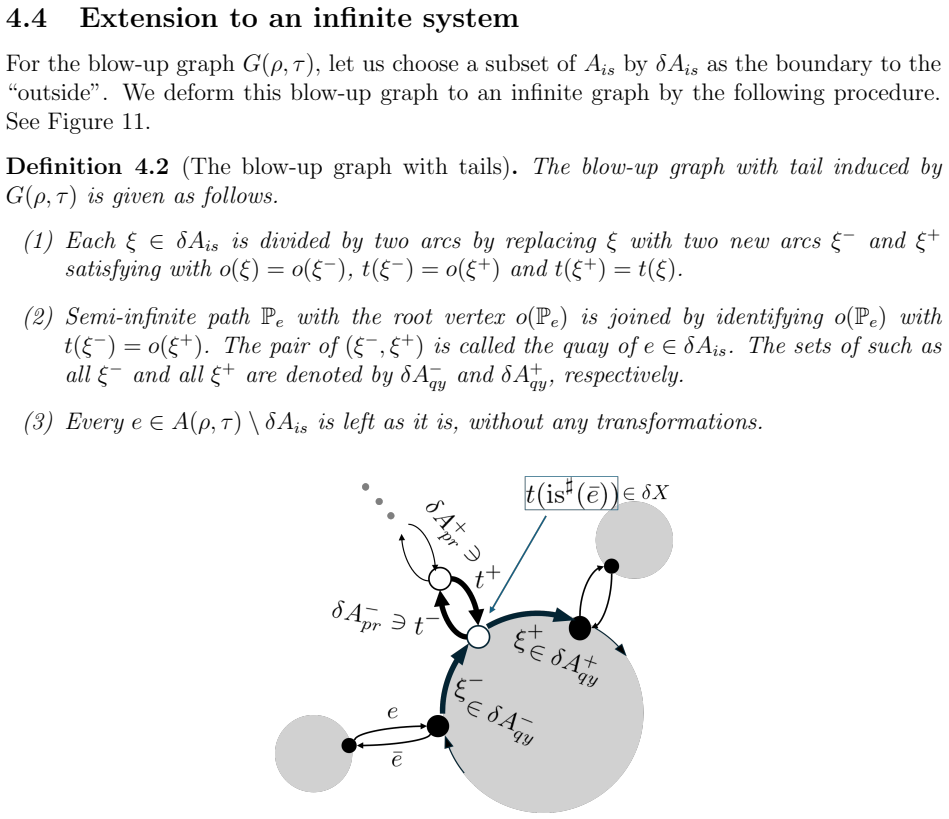
The essential construction is the rotation system $(G,\rho,\tau)$ of the embedding, converted into a degree-2 quantum-walk graph by taking a double cover with front and back sheets, replacing each vertex by a directed cycle called an island, connecting islands by bridges, and attaching semi-infinite tails in the hedgehog assignment. The local time evolution at each degree-2 vertex is governed by a single $2\times 2$ unitary coin $C$. The facial walks $f$ of the rotation system define weighted permutation matrices $P_f$, and these organize the scattering matrix into face blocks and the comfortability sum into face contributions.
What would settle it
Simulate the time evolution numerically for the two K4 embeddings on the torus and the Klein bottle compared in Figure 4, using a = 0.98 and hedgehog tails: the formula predicts the Klein-bottle embedding has the higher average comfortability because its octagonal face has one self-intersection rather than two, so a reversal of that ranking would falsify the face formula.
Extended reading notes
Core claim
The paper claims that the average comfortability of a quantum walker on an embedded graph has a closed form controlled entirely by the embedding's face structure. Under Assumption 1 (hedgehog tails, $d$ real, $a>0$, $\omega=1$), Theorem 1.2 gives $$\mathbb{E}[\mathcal{E}] = \frac{1}{|A|}\frac{2+|b|^2}{|b|^2}\sum_{f\in F}|f|\frac{1+$a^{{|f|}}$}{1-$a^{{|f|}}$} - \frac{1}{|A|}\frac{a}{|b|^2}\sum_{f\in F}\frac{1}{1-$a^{{|f|}}$}\sum_{e\in f\cap \bar f}\left($a^{{\mathrm{dist}}$_f(e,\bar e)}+$a^{{\mathrm{dist}}$_f(\bar e,e)}\right),$$ where $f\cap \bar f$ counts the self-intersections of the facial walk $f$. In the near-staying limit $a=1-\delta$, Corollary 2.1 yields $$\lim_{\delta\downarrow 0}\$delta^{2}$\mathbb{E}[\mathcal{E}_\delta] = \frac{|F|}{|E|}\left(1-\frac{1}{|F|}\sum_{f\in F}\frac{|f\cap \bar f|}{|f|}\right).$$ The same framework proves that the scattering matrix decomposes as $S=\bigoplus_{f\in F}S_f$ with $S_f=bc\omega P_f(I-a\omega P_f)^{-1}+dI_f$, and that the phases of non-zero entries of submatrices of $S$ between islands detect orientability.
Load-bearing premise
The paper relies on an earlier theorem guaranteeing that the walk reaches a unique long-time fixed state and that the scattering matrix is independent of the incoming wave; if that convergence fails for this model, the comfortability formula has no foundation.
Editorial extensions
If this is right
- The scattering matrix $S$ is block-diagonal with one unitary block per face, so outflow data from the tails can be read face by face.
- Orientability of the underlying surface can be decided from the invariance of phases of non-zero scattering entries between two islands, without prior knowledge of the embedding.
- In the $a\to 1$ limit, the average comfortability ranking is governed by $|F|/|E|$ minus the mean self-intersection ratio, so embeddings with more, shorter, and self-intersection-free faces are more comfortable.
- For the complete graph $K_n$, the best and worst embeddings for a quantum walker coincide with the minimal- and maximal-genus embeddings classified by known genus formulas.
- If a triangulation exists among the embeddings of a graph, it is the best embedding.
Reading between the lines
- One could probe individual blocks $S_f$ by feeding tailored inputs that excite a single facial walk, recovering the face length and self-intersection count directly from the response; the paper works only with the averaged uniform-input quantity.
- The divergence of $\mathcal{E}$ as $a\to 1$ suggests that normalizing $\delta^2\mathcal{E}$ extracts a finite per-embedding coefficient; whether that coefficient is a topological invariant under other input ensembles is left open.
- Because $|b|^2=1-a^2$, tuning the coin weights changes the relative size of the face term and the self-intersection penalty, which could amplify one geometric signal over another in an experiment.
Editorial analysis
A structured set of objections, weighed in public.
Referee Report
Summary. The paper constructs a discrete-time quantum walk on the double cover and blow-up of a graph embedded in a closed surface, with semi-infinite tails attached at every island arc (the hedgehog assignment). The time evolution is governed by a local 2x2 unitary coin C, and the scattering matrix S for incoming tail amplitudes is shown to decompose as a direct sum over facial walks of the rotation system. The paper then defines 'comfortability' as half the squared norm of the stationary state restricted to the internal graph, and its main quantitative result, Theorem 1.2, gives the average comfortability over uniformly random single-tail inputs in terms of face lengths and self-intersections. Corollary 2.1 extracts a delta^{-2} coefficient as the coin parameter a approaches 1, yielding genus-based rankings of embeddings, including explicit best and worst embeddings of complete graphs.
Significance. The model construction is original and carefully executed: the blow-up into degree-2 islands and bridges, the hedgehog tail assignment, and the facial-walk factorization of the scattering matrix are appealing and appear to be the correct framework for encoding embedding data in quantum-walk scattering. The orientability detection criterion in Theorem 6.2 is a nice concrete consequence, and the combinatorial corollaries are interesting. However, the central quantitative theorem contains a factor-2 error in its first term, so Theorem 1.2 as stated is incorrect. The qualitative rankings appear to survive because the erroneous factor is common for a fixed graph, but the main formula, the a=0 limit, and Corollary 2.1 need correction.
major comments (1)
- [Section 4.4, Proposition 4.2] The existence and uniqueness of the stationary state Psi_infty and of the scattering matrix S is imported from reference [10] without stating the precise hypotheses. Since the comfortability formula in Theorem 1.2 is computed entirely from Psi_infty, this is a load-bearing point. The authors should state the exact conditions from [10] under which the long-time limit exists for the present infinite graph with hedgehog tails and local coin C, and verify explicitly that those conditions are satisfied here.
minor comments (1)
- [Various] There are several typographical issues: 'eovlution' in Definition 4.3, 'Eular' for Euler, 'orientablility' and 'comfortablity' in the abstract, and 'interactions' instead of 'self-intersections' in the proof of Corollary 2.2. These should be fixed in revision.
Circularity Check
No significant circularity: the comfortability formula is derived from the model and exact scattering identities, with prior work cited as ordinary external support.
full rationale
The paper's derivation chain is self-contained once the model is defined. Comfortability E is introduced as a definition (1/2)||ψ∞|Go||^2, and the main formula (1.1) is not assumed but obtained in Theorem 7.1 from Proposition 7.2, which decomposes E into island and bridge contributions using explicit stationary-state expressions from Proposition 7.1 and the scattering relation. The averaging over uniformly random single-tail inputs is an exact trace computation, not a fit; no parameter is adjusted to reproduce a target comfortability, and no external empirical benchmark is used. Corollary 2.1 follows by Taylor expansion of (1.1) in δ, again without any fitted input. The only external imports are the existence of the long-time limit and of the unitary scattering matrix, quoted from the authors' earlier paper [10], and the orientable-surface model from [12]. These citations are load-bearing in the sense that the analysis assumes the cited convergence results, but they are not equivalent to the claimed conclusion: [10] is a prior general theorem about dynamical systems induced by quantum walks, not a restatement of either Theorem 1.2 or Corollary 2.1. Citing one's own earlier theorems is normal scientific dependence, and the rules require the specific reduction of the target result to its own inputs for circularity; none is present here. The skeptic's concern about a possible factor-2 inconsistency between Theorem 7.1 and Proposition 7.2, if correct, would be an internal algebraic error, not a circularity of the kind analyzed here. Accordingly, the honest finding is no significant circularity, with score 0.
Assumptions & free parameters
free parameters (1)
- a (coin parameter) =
1 - delta (delta to 0)
assumptions (5)
- domain assumption Existence and uniqueness of the stationary state and scattering matrix (Proposition 4.2, based on [10]).
- ad hoc to paper Assumption 1(2): the (2,2) entry d of the coin matrix is real.
- ad hoc to paper Assumption 1(1): hedgehog tail assignment, i.e., every island arc receives a tail.
- standard math The two-cell embedding theorem: every rotation system defines a unique embedding up to equivalence.
- standard math Genus formulas for complete graphs (Ringel-Youngs, Nordhaus-Stewart).
invented entities (2)
-
Comfortability functional E
-
Blow-up graph with tails (G(rho,tau) with hedgehog)
Cite this review
Pith. "Pith review of Comfortability of quantum walks on embedded graphs on surfaces." pith.science (2026). https://pith.science/paper/6F6P3UHV
@misc{pith2026250106765,
  author       = {Pith},
  title        = {Pith review of: Comfortability of quantum walks on embedded graphs on surfaces},
  year         = {2026},
  howpublished = {\url{https://pith.science/paper/6F6P3UHV}},
  note         = {Machine review of arXiv:2501.06765}
}
read the original abstract
The time evolutions of discrete-time quantum walks on graphs are determined by the local adjacency relations of the graphs. In this paper, first, we construct a discrete-time quantum walk model that reflects the embedding on the surface so that an underlying global geometric information is reflected. Second, we consider the scattering problem of this quantum walk model. We obtain the scattering matrix characterized by the faces on the surface and detect the orientablility of the embedding using scattering information. For the stationary state in the scattering problem, the comfortability is defined as the square norm of the stationary state restricted to the internal. This indicates how a quantum walker is stored in the internal under the embedding. Then we find that a quantum walker feels more comfortable on a surface with small genus in some natural setting. We illustrate our results with some interesting examples.
Figures


Figures from the paper (8 more)


Forward citations
Cited by 1 Pith paper
-
Robustness of periodicity in Grover walks under a magnetic vector potential
A small magnetic vector potential on one edge of a periodic Grover walk produces a first-order correction described by a Hermitian matrix H, and the discrete walk converges to a continuous-time quantum walk generated by τH.
Reference graph
Works this paper leans on
-
[10]
Higuchi, Yu. and Segawa, E., Dynamical system induced by quantum walks, Journal of Physics A: Mathematical and Theoretical 52 (2019) 39520
work page 2019
-
[12]
Quantum walks on graphs embedded in orientable surfaces
, Higuchi, Yu. and Segawa, E., Quantum walks on graphs embedded in orientable surfaces, accepted to publication to Annales de l’Institut Henri Poincar´ e D (2025), arXiv:2402.00360
work page Pith review arXiv 2025
-
[1]
and Watrous, J., One-dimensional quantum walks, Proc
Ambainis, A., Bach, E., Nayak, A., Vishwanath, A. and Watrous, J., One-dimensional quantum walks, Proc. 33rd Annual ACM Symp. Theory of Computing, (2001) 37–49
work page 2001
-
[2]
Apers, S. and Sarlette, A., Quantum fast-forwarding; Markov chains and graph property testing, Quantum Information and Computation 19 (2019) 181–213
work page 2019
-
[3]
Ambainis, A., Gily´ en, A., Jeffery, J. and Kokainis, M., Quadratic speedup for finding marked vertices by quantum walks, Proceedings of the 52nd Annual ACM SIGACT Symposium on Theory of Computing 19 (2020) 412–424. 37
work page 2020
-
[4]
Colin de Verdi` ere, Y., Sur un nouvel invariant des graphes et un crit` ere de planarit, Journal of Combinatorial Theory B 50 (1990) 11–21
work page 1990
-
[5]
Feldman, E and Hillery, M., Quantum walks on graphs and quantum scattering theory, Contemporary Mathematics 381 (2005) 71–96
work page 2005
-
[6]
Feldman, E and Hillery, M., Modifying quantum walks: A scattering theory approach, Journal of Physics A: Mathematical and Theoretical 40 (2007) 11319
work page 2007
Show all 24 references
-
[7]
Gross, J. L. and Tucker, W. T., Topological Graph Theory, Dover Pulications, New York (2001)
2001
-
[8]
Higuchi, K., Feynman-type representation of the scattering matrix on the line via a discrete-time quantum walk, Journal of Physics A: Mathematical and Theoretical 54 (2021) 235203
2021
-
[9]
Higuchi, N
Yu. Higuchi, N. Konno, I. Sato and E. Segawa, Quantum graph walks I: mapping to quantum walks, Yokohama Mathematical Journal, 59 (2013) 33—55
2013
-
[11]
and Segawa, E., Circuit equation of Grover walk, Annales Henri Poincar´ e25 (2024) 3739–3777
Higuchi, Yu. and Segawa, E., Circuit equation of Grover walk, Annales Henri Poincar´ e25 (2024) 3739–3777
2024
-
[13]
and Shirai, T., Weak Bloch property for discrete magnetic Schr¨ odinger operators, Nagoya Mathematical Journal 161 (2001) 127–154
, Higuchi, Yu. and Shirai, T., Weak Bloch property for discrete magnetic Schr¨ odinger operators, Nagoya Mathematical Journal 161 (2001) 127–154
2001
-
[14]
Ko, C, K., Konno, N., Yoo, H, J and Segawa, E., How does Grover walk recognize the shape of crystal lattice?, Quantum Information Processing 17 (2017) 167–185
2017
-
[15]
and Segawa, E., Partition-based discrete-time quantum walks, Quantum Information Processing 17 (2018) 1–35
Konno, N., Portugal, R., Sato, I. and Segawa, E., Partition-based discrete-time quantum walks, Quantum Information Processing 17 (2018) 1–35
2018
-
[16]
and Brun, T
Krovi, H. and Brun, T. A., Quantum walks on quotient graphs, Physical Review A 75 (2007) 062332
2007
-
[17]
and Segawa E., Implementation of a discrete-time quantum walk with a circulant matrix on a graph by optical polarizing elements, Physical Review A 106 (2022) 022402
Mizutani, Y., Horikiri, T., Matsuoka, L., Higuchi, Yu. and Segawa E., Implementation of a discrete-time quantum walk with a circulant matrix on a graph by optical polarizing elements, Physical Review A 106 (2022) 022402
2022
-
[18]
and Thomassen, C., Graphs on Surfaces, Johns Hopkins University Press (2001)
Mohar, B. and Thomassen, C., Graphs on Surfaces, Johns Hopkins University Press (2001)
2001
-
[19]
Kyokumenjou no Gurahu Riron
Nakamoto, A. and Ozeki, K., “Kyokumenjou no Gurahu Riron” (Graphs on Surfaces), Saiensu-Sha (2021) (Japanese book) 38
2021
-
[20]
Nordhaus, E. A. and Stewart, B. M., On the Maximum Genus of a Graph, Journal of Combinatorial Theory B 11 (1971) 258–267
1971
-
[21]
Portugal, R., Quantum Walk and Search Algorithm, 2nd Ed., Springer Nature Switzer- land (2018)
2018
-
[22]
and Youngs, J
Ringel, Y. and Youngs, J. W. T., Solution of the Heawood map-coloring problem, Procedings of National Academy of Sciences 60 (1968) 438–445
1968
-
[23]
Tanner, From quantum graphs to quantum random walks, Non-Linear Dynamics and Fundamental Interactions NATO Science Series II: Mathematics, Physics and Chemistry, 213 (2006) 69-87
G. Tanner, From quantum graphs to quantum random walks, Non-Linear Dynamics and Fundamental Interactions NATO Science Series II: Mathematics, Physics and Chemistry, 213 (2006) 69-87
2006
-
[24]
Watrous, J., Quantum simulations of classical random walks and undirected graph connectivity, Journal of Computer and System Sciences 62 (2007) 376–391. 39
2007
Reviewed August 10, 2026 · model on record in the stance chip above.
Discussion (0). Continue with ORCID to comment.