REVIEW 4 major objections 7 minor 53 references
UR2P-Dehaze: Learning a Simple Image Dehaze Enhancer via Unpaired Rich Physical Prior
T0 review · 4 major / 7 minor · reviewed 2026-08-10 · deepseek-v4-flash
Pith's one-line read Shared reflectance prior lifts unpaired dehazing to new SOTA scores.
desk verdict A modest empirical gain on SOTS is real, but the physical prior story doesn't survive contact with the paper's own ASM, and the SOTA claim is overbroad. read the letter →
The pith
A machine-rendered reading of the paper's core claim, the machinery that carries it, and where it could break.
The reading
What carries the argument
The load-bearing identity is the Retinex assumption $I = L \circ R$ (element-wise product), extended to image pairs in Eq. 3: the hazy image and the clear image share one reflectance $R$, differing only in illumination $L$. On this basis the Shared Prior Estimator (SPE) runs three estimators—$\Phi_{Light}$, $\Phi_{Reflect}$, $\Phi_{Color}$—optimized by four losses: a projection loss $L_{project} = \|I_{hazy} - I_{project}\|_2^2$ with an asserted bound $\delta$ in Eq. 5, a reflectance consistency loss $L_{reflect} = \|R_1 - R_2\|_2^2$ that ties the predicted reflectance to a 'rough dehazed image,' a Retinex loss $L_{retinex}$ enforcing $R \circ L \approx I_{project}$ plus an illumination smoothness term, and a color loss $L_{color} = \|C_F - \hat{C}_F\|_1$. Reconstruction uses Dynamic Wavelet Separable Convolution (DWSC), which applies depthwise separable and pointwise convolutions across wavelet subbands (Eqs. 8–11), and an Adaptive Color Corrector (ACC) to align colors. The total loss is $L_{loss} = 50 L_{project} + 0.1 L_{reflect} + 0.1 L_{retinex} + 1 L_{color}$, and the SPE is iteratively trained so that the estimated priors stabilize.
What would settle it
Render a fixed 3D scene under two different synthetic haze densities (varying $\beta$ in $t(x) = e^{-\beta d(x)}$) with known ground-truth reflectance, run the trained shared prior estimator on both hazy images, and check whether the two predicted reflectance maps coincide; if they diverge systematically with $\beta$, the shared-$R$ assumption underlying $L_{reflect}$ is violated.
Extended reading notes
Core claim
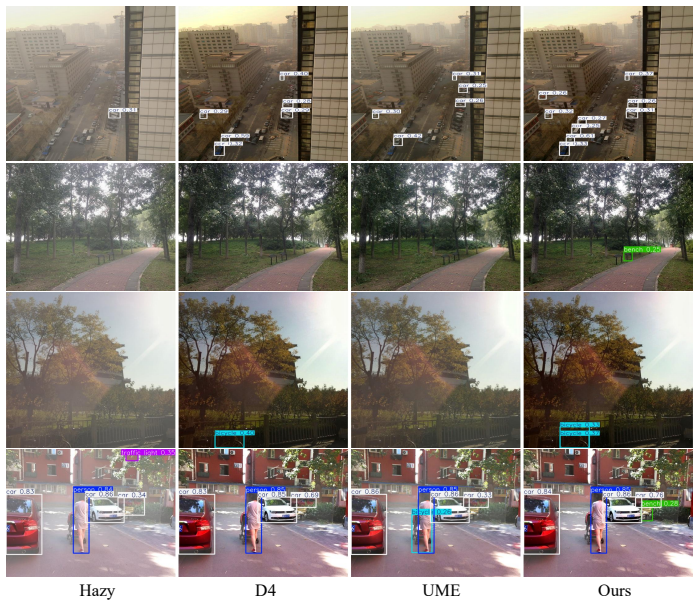
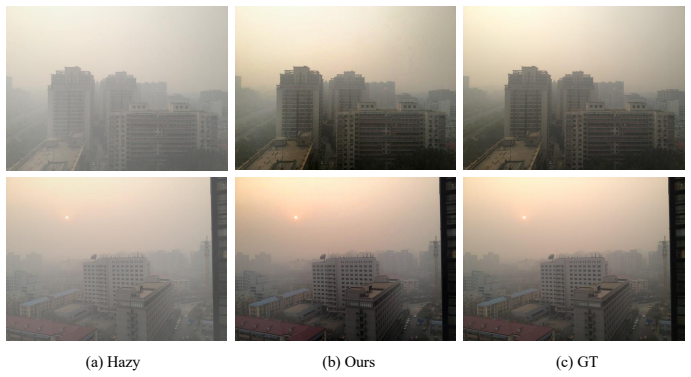
The core claim is that a Retinex decomposition $I_{hazy} = L_{hazy} \circ R$ and $I_{clear} = L_{clear} \circ R$, with a single shared reflectance $R$ for hazy and clear images of the same scene, gives an unpaired network enough structure to outperform all prior unpaired dehazing methods on SOTS-indoor and SOTS-outdoor. The paper reports that the full model reaches 26.82 dB PSNR / 0.948 SSIM indoors and 27.53 dB / 0.967 outdoors, reduces LPIPS, FID, and CIEDE2000 relative to the best unpaired baselines, and brings the RGB histograms of dehazed images measurably closer to the clear reference. It further reports that dehazing with UR2P-Dehaze increases the number of correctly detected objects in hazy images, showing a benefit for downstream vision.
Load-bearing premise
The whole training procedure assumes that a hazy image and its clear counterpart of the same scene differ only in illumination and therefore share one true reflectance map $R$; if haze changes apparent reflectance beyond a pure lighting scaling, the shared-$R$ prior is wrong and the reported gains would not transfer to new scenes.
Editorial extensions
If this is right
- UR2P-Dehaze becomes the new leading unpaired dehazing method on SOTS-indoor and SOTS-outdoor if the reported metrics reproduce, with the largest gains on outdoor scenes.
- The improved CIEDE2000 and histogram alignment indicate that unpaired dehazing can restore color rather than merely increase contrast, making it more suitable for photography and color-sensitive applications.
- Because the method is trained on unpaired RESIDE splits and tested on real I-HAZE and HSTS images, the approach is a practical option when paired clean/hazy data are unavailable.
- The reported downstream detection improvements suggest that dehazing with UR2P-Dehaze can serve as a preprocessing step for object detection and recognition in foggy conditions.
Reading between the lines
- The paper leaves the 'rough dehazed image' that supplies $R_2$ undefined; a concrete next step is to pin down that source, since different choices change the reflectance-consistency loss and could alter the reported gains.
- The projection inequality in Eq. 5 hints at a certification path: if the error $\delta$ can be measured or bounded on a validation set, the method could be extended to output a confidence or failure warning per image.
- The wavelet-domain separable convolution is a generic building block; it could be dropped into other restoration tasks (denoising, super-resolution) where a large receptive field is wanted at low parameter cost, though the paper does not test this.
- The ACC's close histogram match to the reference suggests the module could be used as an automatic color-grading or white-balancing component even when full dehazing is not desired.
Signed reviews
Editorial analysis
A structured set of objections, weighed in public.
Referee Report
Summary. The paper proposes UR2P-Dehaze, an unpaired image dehazing method that combines a Shared Prior Estimator (SPE) based on Retinex decomposition, a Dynamic Wavelet Separable Convolution (DWSC) module, and an Adaptive Color Corrector (ACC). The authors claim state-of-the-art performance on SOTS-indoor, SOTS-outdoor, I-HAZE, and HSTS across PSNR, SSIM, LPIPS, FID, and CIEDE2000. The method is evaluated with several unpaired and paired comparison methods, and ablations are reported for each module. The central technical premise is that hazy and clear images of the same scene share a single reflectance component, enabling a reflectance-consistency loss and a color-correction loss to guide training.
Significance. If the claims were fully supported, the paper would offer a competitive unpaired dehazing method with explicit color and reflectance modeling, and its evaluations on four datasets with multiple metrics would be a useful empirical contribution. The paper also includes ablations for each proposed module and comparisons with many recent methods. However, the central physical prior is internally inconsistent with the atmospheric scattering model stated by the authors themselves, and the stated state-of-the-art claim is contradicted by the paper's own tables on HSTS and I-HAZE. Because these issues affect the core method and the headline result, the contribution as presented is not established.
major comments (4)
- [Abstract, Section 4.2, Tables 3 and 4] The abstract and Section 4.2 claim that UR2P-Dehaze achieves state-of-the-art performance across PSNR, SSIM, LPIPS, FID, and CIEDE2000. This claim is contradicted by the paper's own tables. On HSTS (Table 3), UME-Net achieves a higher PSNR (27.35 vs. 26.71), and on I-HAZE (Table 4), the proposed method's FID of 161.615 is the worst in the table and its SSIM of 0.770 is below RPC-Dehaze's 0.783. In addition, Table 4 labels FID with an up arrow, which is inconsistent with the convention used in Tables 1–3 and with the fact that lower FID is better. The state-of-the-art claim must be substantially revised or removed.
- [Section 3.1, Eq. (1) and Eq. (3)] The shared-reflectance Retinex prior in Eq. (3) is inconsistent with the atmospheric scattering model stated in Eq. (1). If the clear image J satisfies J = L_clear ⊙ R, then Eq. (1) gives I_hazy = (t ⊙ L_clear) ⊙ R + A ⊙ (1 − t). For this to equal L_hazy ⊙ R, one would need [L_hazy − t ⊙ L_clear] ⊙ R = A ⊙ (1 − t), a nontrivial condition that generally cannot hold for spatially varying scene reflectance and airlight. The physical motivation for the shared prior estimator is therefore not justified by the equations in the manuscript. The authors should either reconcile the two models, state the conditions under which Eq. (3) is a valid approximation, or provide empirical evidence that the approximation holds on the datasets used.
- [Section 3.1, Eqs. (5) and (6)] Several key components of the SPE are not formally defined. In Eq. (6), R2 is said to be the reflectance map of the 'rough dehazed image', but this image is never defined. In Eq. (5), δ is introduced as 'the error' but its meaning, range, and estimation are not specified, and the subsequent inequality is not a derivation of the projection loss. The 'self-monitoring mechanism' and the 'redundant feature elimination module' appear only in the Figure 3 caption and are never described in the body of the paper. These undefined entities are load-bearing because the projection loss, reflectance-consistency loss, and the claimed self-monitoring behavior all depend on them.
- [Section 4.3, Tables 5 and 6] The ablation study is difficult to interpret because the 'Baseline' is never defined in relation to the components. The Baseline row in Table 5 has numbers very close to those of D4 in Table 4, suggesting that the baseline may be a reproducing of D4, but this is not stated. Furthermore, the rows 'w SPE' and 'w/o SPE' represent different configurations: 'w SPE' adds SPE to the baseline, while 'w/o SPE' removes SPE from the full model. This dual use makes it unclear what each ablation actually measures. The authors should specify the baseline architecture and each ablation configuration explicitly.
minor comments (7)
- [Section 4.2, Table 4] The FID arrow in Table 4 is reversed; it should be a down arrow because lower FID is better.
- [Throughout] The method name YOLY is written as 'LOLY' in Section 4.2 and Figure 5; please use a consistent name.
- [Figure 4 caption] There is a typo: 'The process oof performing' should be 'The process of performing'.
- [Section 4.2] The text says 'de-ghosting process', which appears to be a typo for 'dehazing process'.
- [Section 1 and Section 3] The paper is described as using unpaired training, but the model is trained on RESIDE (ITS and OTS), which are synthetic paired datasets. Please clarify what 'unpaired' means in this context, e.g., whether the hazy and clear images are used without explicit pair correspondence.
- [Figure 3 and Algorithm 1] The wavelet filter type and number of levels are listed as inputs in Algorithm 1 but are not specified in the implementation details; please report the exact values used.
- [Section 3.3] The color map CF is said to be predicted from the hazy feature image F, but the estimator ΦColor and the features F and F1 are not defined in the text.
Circularity Check
No significant circularity: the reported dehazing gains are empirical results measured against external benchmark datasets and are not forced by the paper's loss definitions or by a self-citation chain.
full rationale
The central claim is a performance claim on SOTS-indoor, SOTS-outdoor, I-HAZE, and HSTS. Those are external test sets, and the reported PSNR/SSIM/LPIPS/FID/CIEDE2000 numbers are measured against held-out reference images, not read off from fitted parameters. The four losses (Lproject, Lreflect, Lretinex, Lcolor) are training regularizers; their effect is separately assessed by ablations. I find no load-bearing self-citation chain: the paper cites standard external sources for Retinex theory and D4, and it does not invoke a self-authored uniqueness theorem to forbid alternatives. The shared-reflectance assumption in Eq. (3) is asserted rather than derived and is in tension with the ASM in Eq. (1); that is a physical-validity and generalization concern, not a circularity, because the benchmark claim does not reduce to that assumption by construction. Several components are under-specified (Eq. (5)'s delta is undefined, the 'rough dehazed image' supplying R2 in Eq. (6) is never defined, and the self-monitoring/redundant-feature-elimination mechanism appears only in a figure caption); these are omissions that prevent one from exhibiting any circular reduction. The ablation 'Baseline' rows coincide numerically with D4's published numbers, which is an attribution/reporting concern rather than a circular derivation. Overall, no step meets the quote-and-reduction bar for circularity, so the appropriate score is 0.
Assumptions & free parameters
free parameters (4)
- loss weights lambda1..lambda4 =
50, 0.1, 0.1, 1
- wavelet filter type and levels =
not stated
- OTS training subset =
18,000 images, random without seed
- SPE iteration count =
not stated
assumptions (5)
- domain assumption Atmospheric scattering model I(x) = J(x)t(x) + A(x)(1 - t(x)), Eq. 1
- ad hoc to paper Retinex decomposition with shared reflectance: Ihazy = Lhazy o R and Iclear = Lclear o R for same-scene image pairs, Eq. 3
- ad hoc to paper Projection removes redundant features with bounded error, Eq. 5
- ad hoc to paper Reflectance R2 of the 'rough dehazed image' is a valid target for R1, Eq. 6
- ad hoc to paper Color map CF predicted from the hazy feature image is a valid pseudo-ground truth for the dehazed image's color, Eq. 12
invented entities (2)
-
I_project (projected image after redundant-feature removal)
-
Self-monitoring mechanism
Cite this review
Pith. "Pith review of UR2P-Dehaze: Learning a Simple Image Dehaze Enhancer via Unpaired Rich Physical Prior." pith.science (2026). https://pith.science/paper/LOSZZJJM
@misc{pith2026250106818,
  author       = {Pith},
  title        = {Pith review of: UR2P-Dehaze: Learning a Simple Image Dehaze Enhancer via Unpaired Rich Physical Prior},
  year         = {2026},
  howpublished = {\url{https://pith.science/paper/LOSZZJJM}},
  note         = {Machine review of arXiv:2501.06818}
}
read the original abstract
Image dehazing techniques aim to enhance contrast and restore details, which are essential for preserving visual information and improving image processing accuracy. Existing methods rely on a single manual prior, which cannot effectively reveal image details. To overcome this limitation, we propose an unpaired image dehazing network, called the Simple Image Dehaze Enhancer via Unpaired Rich Physical Prior (UR2P-Dehaze). First, to accurately estimate the illumination, reflectance, and color information of the hazy image, we design a shared prior estimator (SPE) that is iteratively trained to ensure the consistency of illumination and reflectance, generating clear, high-quality images. Additionally, a self-monitoring mechanism is introduced to eliminate undesirable features, providing reliable priors for image reconstruction. Next, we propose Dynamic Wavelet Separable Convolution (DWSC), which effectively integrates key features across both low and high frequencies, significantly enhancing the preservation of image details and ensuring global consistency. Finally, to effectively restore the color information of the image, we propose an Adaptive Color Corrector that addresses the problem of unclear colors. The PSNR, SSIM, LPIPS, FID and CIEDE2000 metrics on the benchmark dataset show that our method achieves state-of-the-art performance. It also contributes to the performance improvement of downstream tasks. The project code will be available at https://github.com/Fan-pixel/UR2P-Dehaze. \end{abstract}
Figures


Figures from the paper (10 more)


Reference graph
Works this paper leans on
-
[1]
Y . Zhao, W. Lv, S. Xu, J. Wei, G. Wang, Q. Dang, Y . Liu, J. Chen, Detrs beat yolos on real-time object detection, in: Proceedings of the IEEE /CVF Conference on Computer Vision and Pattern Recognition, 2024, pp. 16965–16974
work page 2024
- [2]
- [3]
-
[4]
B. Xie, S. Li, M. Li, C. H. Liu, G. Huang, G. Wang, Sepico: Semantic-guided pixel contrast for domain adaptive semantic segmentation, IEEE Transactions on Pattern Analysis and Machine Intelligence 45 (7) (2023) 9004–9021
work page 2023
-
[5]
S. Gao, X. Liu, B. Zeng, S. Xu, Y . Li, X. Luo, J. Liu, X. Zhen, B. Zhang, Im- plicit diffusion models for continuous super-resolution, in: Proceedings of the IEEE/CVF conference on computer vision and pattern recognition, 2023, pp. 10021–10030
work page 2023
-
[6]
C. Tian, M. Zheng, W. Zuo, B. Zhang, Y . Zhang, D. Zhang, Multi-stage image denoising with the wavelet transform, Pattern Recognition 134 (2023) 109050
2023
-
[7]
S. Panagiotou, A. S. Bosman, Denoising di ffusion post-processing for low-light image enhancement, Pattern Recognition 156 (2024) 110799
work page 2024
-
[8]
J. Liu, Q. Wang, H. Fan, Y . Wang, Y . Tang, L. Qu, Residual denoising diffusion models, in: Proceedings of the IEEE /CVF Conference on Computer Vision and Pattern Recognition, 2024, pp. 2773–2783
work page 2024
Show all 53 references
-
[9]
J. Hou, Z. Zhu, J. Hou, H. Liu, H. Zeng, H. Yuan, Global structure-aware di ffu- sion process for low-light image enhancement, Advances in Neural Information Processing Systems 36 (2024). 28
2024
-
[10]
C. Niu, M. Tao, B.-K. Bao, Semacol: Semantic-enhanced multi-scale approach for text-guided grayscale image colorization, Pattern Recognition 160 (2025) 111203
2025
-
[11]
Y . Yang, C. Wang, R. Liu, L. Zhang, X. Guo, D. Tao, Self-augmented unpaired image dehazing via density and depth decomposition, in: Proceedings of the IEEE/CVF conference on computer vision and pattern recognition, 2022, pp. 2037–2046
2022
-
[12]
K. He, J. Sun, X. Tang, Single image haze removal using dark channel prior, IEEE transactions on pattern analysis and machine intelligence 33 (12) (2010) 2341–2353
2010
-
[13]
Q. Zhu, J. Mai, L. Shao, A fast single image haze removal algorithm using color attenuation prior, IEEE transactions on image processing 24 (11) (2015) 3522– 3533
2015
-
[14]
McCartney, Optics of the atmosphere: scattering by molecules and particles (1976)
E. McCartney, Optics of the atmosphere: scattering by molecules and particles (1976)
1976
-
[15]
Zheng, J
Y . Zheng, J. Zhan, S. He, J. Dong, Y . Du, Curricular contrastive regularization for physics-aware single image dehazing, in: Proceedings of the IEEE /CVF confer- ence on computer vision and pattern recognition, 2023, pp. 5785–5794
2023
-
[16]
Z. Chen, Z. He, Z.-M. Lu, Dea-net: Single image dehazing based on detail- enhanced convolution and content-guided attention, IEEE Transactions on Image Processing (2024)
2024
-
[17]
Y . Cui, Y . Tao, L. Jing, A. Knoll, Strip attention for image restoration, in: Inter- national Joint Conference on Artificial Intelligence, IJCAI, 2023
2023
-
[18]
Berman, S
D. Berman, S. Avidan, et al., Non-local image dehazing, in: Proceedings of the IEEE conference on computer vision and pattern recognition, 2016, pp. 1674– 1682. 29
2016
-
[19]
Mishra, J
P. Mishra, J. Bhattacharya, R. Sharma, G. Ramponi, H2cgan: Manageable ai for scene understanding tasks in hazy/rainy environment, IEEE Access (2024)
2024
-
[20]
B. Li, X. Peng, Z. Wang, J. Xu, D. Feng, Aod-net: All-in-one dehazing network, in: Proceedings of the IEEE international conference on computer vision, 2017, pp. 4770–4778
2017
-
[21]
T. Jia, J. Li, L. Zhuo, T. Yu, Semi-supervised single-image dehazing network via disentangled meta-knowledge, IEEE Transactions on Multimedia (2023)
2023
-
[22]
Z. Sun, Y . Zhang, F. Bao, P. Wang, X. Yao, C. Zhang, Sadnet: Semi-supervised single image dehazing method based on an attention mechanism, ACM Trans- actions on Multimedia Computing, Communications, and Applications (TOMM) 18 (2) (2022) 1–23
2022
-
[23]
S. An, X. Huang, L. Wang, L. Wang, Z. Zheng, Semi-supervised image dehazing network, The Visual Computer 38 (6) (2022) 2041–2055
2022
-
[24]
J. Li, Y . Li, L. Zhuo, L. Kuang, T. Yu, Usid-net: Unsupervised single image dehazing network via disentangled representations, IEEE transactions on multi- media 25 (2022) 3587–3601
2022
-
[25]
H. Sun, Z. Luo, D. Ren, B. Du, L. Chang, J. Wan, Unsupervised multi-branch net- work with high-frequency enhancement for image dehazing, Pattern Recognition 156 (2024) 110763
2024
-
[26]
B. Ding, R. Zhang, L. Xu, G. Liu, S. Yang, Y . Liu, Q. Zhang, U 2 d 2 net: Un- supervised unified image dehazing and denoising network for single hazy image enhancement, IEEE Transactions on Multimedia 26 (2023) 202–217
2023
-
[27]
Engin, A
D. Engin, A. Genc ¸, H. Kemal Ekenel, Cycle-dehaze: Enhanced cyclegan for sin- gle image dehazing, in: Proceedings of the IEEE conference on computer vision and pattern recognition workshops, 2018, pp. 825–833
2018
-
[28]
J.-Y . Zhu, T. Park, P. Isola, A. A. Efros, Unpaired image-to-image translation using cycle-consistent adversarial networks, in: Proceedings of the IEEE interna- tional conference on computer vision, 2017, pp. 2223–2232. 30
2017
-
[29]
Y . Shao, L. Li, W. Ren, C. Gao, N. Sang, Domain adaptation for image dehazing, in: Proceedings of the IEEE /CVF conference on computer vision and pattern recognition, 2020, pp. 2808–2817
2020
-
[30]
Huang, X
Y . Huang, X. Lu, Y . Quan, Y . Xu, H. Ji, Image shadow removal via multi-scale deep retinex decomposition, Pattern Recognition 159 (2025) 111126
2025
-
[31]
X. Yi, H. Xu, H. Zhang, L. Tang, J. Ma, Diff-retinex: Rethinking low-light image enhancement with a generative diffusion model, in: Proceedings of the IEEE/CVF International Conference on Computer Vision, 2023, pp. 12302–12311
2023
-
[32]
Z. Fu, Y . Yang, X. Tu, Y . Huang, X. Ding, K.-K. Ma, Learning a simple low- light image enhancer from paired low-light instances, in: Proceedings of the IEEE/CVF conference on computer vision and pattern recognition, 2023, pp. 22252–22261
2023
-
[33]
J. Gui, X. Cong, L. He, Y . Y . Tang, J. T.-Y . Kwok, Illumination controllable dehazing network based on unsupervised retinex embedding, IEEE Transactions on Multimedia (2023)
2023
-
[34]
P. Li, J. Tian, Y . Tang, G. Wang, C. Wu, Deep retinex network for single image dehazing, IEEE Transactions on Image Processing 30 (2021) 1100–1115. doi: 10.1109/TIP.2020.3040075
2021
-
[35]
E. H. Land, The retinex theory of color vision, Scientific american 237 (6) (1977) 108–129
1977
-
[36]
D. P. Kingma, Adam: A method for stochastic optimization, arXiv preprint arXiv:1412.6980 (2014)
2014 arXiv
-
[37]
B. Li, W. Ren, D. Fu, D. Tao, D. Feng, W. Zeng, Z. Wang, Benchmarking single- image dehazing and beyond, IEEE Transactions on Image Processing 28 (1) (2018) 492–505
2018
-
[38]
Ancuti, C
C. Ancuti, C. O. Ancuti, R. Timofte, C. De Vleeschouwer, I-haze: A dehaz- ing benchmark with real hazy and haze-free indoor images, in: Advanced Con- cepts for Intelligent Vision Systems: 19th International Conference, ACIVS 2018, 31 Poitiers, France, September 24–27, 2018, Pr...
2018
-
[39]
Z. Wang, A. C. Bovik, H. R. Sheikh, E. P. Simoncelli, Image quality assessment: from error visibility to structural similarity, IEEE transactions on image process- ing 13 (4) (2004) 600–612
2004
-
[40]
Sharma, W
G. Sharma, W. Wu, E. N. Dalal, The ciede2000 color-di fference formula: Imple- mentation notes, supplementary test data, and mathematical observations, Color Research & Application: Endorsed by Inter-Society Color Council, The Colour Group (Great Britain), Canadian Society for...
2005
-
[41]
Heusel, H
M. Heusel, H. Ramsauer, T. Unterthiner, B. Nessler, S. Hochreiter, Gans trained by a two time-scale update rule converge to a local nash equilibrium, Advances in neural information processing systems 30 (2017)
2017
-
[42]
Zhang, P
R. Zhang, P. Isola, A. A. Efros, E. Shechtman, O. Wang, The unreasonable ef- fectiveness of deep features as a perceptual metric, in: Proceedings of the IEEE conference on computer vision and pattern recognition, 2018, pp. 586–595
2018
-
[43]
Y . Yang, C. Wang, X. Guo, D. Tao, Robust unpaired image dehazing via den- sity and depth decomposition, International Journal of Computer Vision 132 (5) (2024) 1557–1577
2024
-
[44]
S. Zhao, L. Zhang, Y . Shen, Y . Zhou, Refinednet: A weakly supervised refinement framework for single image dehazing, IEEE Transactions on Image Processing 30 (2021) 3391–3404
2021
-
[45]
B. Li, Y . Gou, S. Gu, J. Z. Liu, J. T. Zhou, X. Peng, You only look yourself: Unsupervised and untrained single image dehazing neural network, International Journal of Computer Vision 129 (2021) 1754–1767. 32
2021
-
[46]
Y . Qu, Y . Chen, J. Huang, Y . Xie, Enhanced pix2pix dehazing network, in: Pro- ceedings of the IEEE /CVF conference on computer vision and pattern recogni- tion, 2019, pp. 8160–8168
2019
-
[47]
X. Qin, Z. Wang, Y . Bai, X. Xie, H. Jia, Ffa-net: Feature fusion attention network for single image dehazing, in: Proceedings of the AAAI conference on artificial intelligence, V ol. 34, 2020, pp. 11908–11915
2020
-
[48]
Y . Qiao, M. Shao, L. Wang, W. Zuo, Learning depth-density priors for fourier- based unpaired image restoration, IEEE Transactions on Circuits and Systems for Video Technology (2023)
2023
-
[49]
H. Wei, Q. Wu, C. Wu, K. N. Ngan, H. Li, F. Meng, H. Qiu, Robust unpaired im- age dehazing via adversarial deformation constraint, IEEE Transactions on Cir- cuits and Systems for Video Technology (2024)
2024
-
[50]
K. Lin, G. Wang, T. Li, Y . Wu, C. Li, Y . Yang, H. T. Shen, Toward generalized and realistic unpaired image dehazing via region-aware physical constraints, IEEE Transactions on Circuits and Systems for Video Technology (2024)
2024
-
[51]
Z. Wang, H. Zhao, J. Peng, L. Yao, K. Zhao, Odcr: Orthogonal decoupling contrastive regularization for unpaired image dehazing, in: Proceedings of the IEEE/CVF Conference on Computer Vision and Pattern Recognition, 2024, pp. 25479–25489
2024
-
[52]
Y . Wang, X. Yan, F. L. Wang, H. Xie, W. Yang, X.-P. Zhang, J. Qin, M. Wei, Ucl- dehaze: Towards real-world image dehazing via unsupervised contrastive learn- ing, IEEE Transactions on Image Processing (2024)
2024
-
[53]
Y . Wang, X. Yan, D. Guan, M. Wei, Y . Chen, X.-P. Zhang, J. Li, Cycle-snspgan: Towards real-world image dehazing via cycle spectral normalized soft likelihood estimation patch gan, IEEE Transactions on Intelligent Transportation Systems 23 (11) (2022) 20368–20382. 33
2022
Reviewed August 10, 2026 · model on record in the stance chip above.
Discussion (0). Continue with ORCID to comment.