REVIEW 4 major objections 5 minor 22 references
SafeSwarm: Decentralized Safe RL for the Swarm of Drones Landing in Dense Crowds
T0 review · 4 major / 5 minor · reviewed 2026-08-10 · deepseek-v4-flash
Pith's one-line read Decentralized reinforcement learning can land a swarm of small drones on moving platforms in cluttered scenes, with 2.25 cm mean error and no collisions in the reported tests.
desk verdict Reported MAPPO landing results are real but the 'safe barrier net' is never specified, and the swarm claim is simulated; the paper is not ready for review. read the letter →
The pith
A machine-rendered reading of the paper's core claim, the machinery that carries it, and where it could break.
The reading
What carries the argument
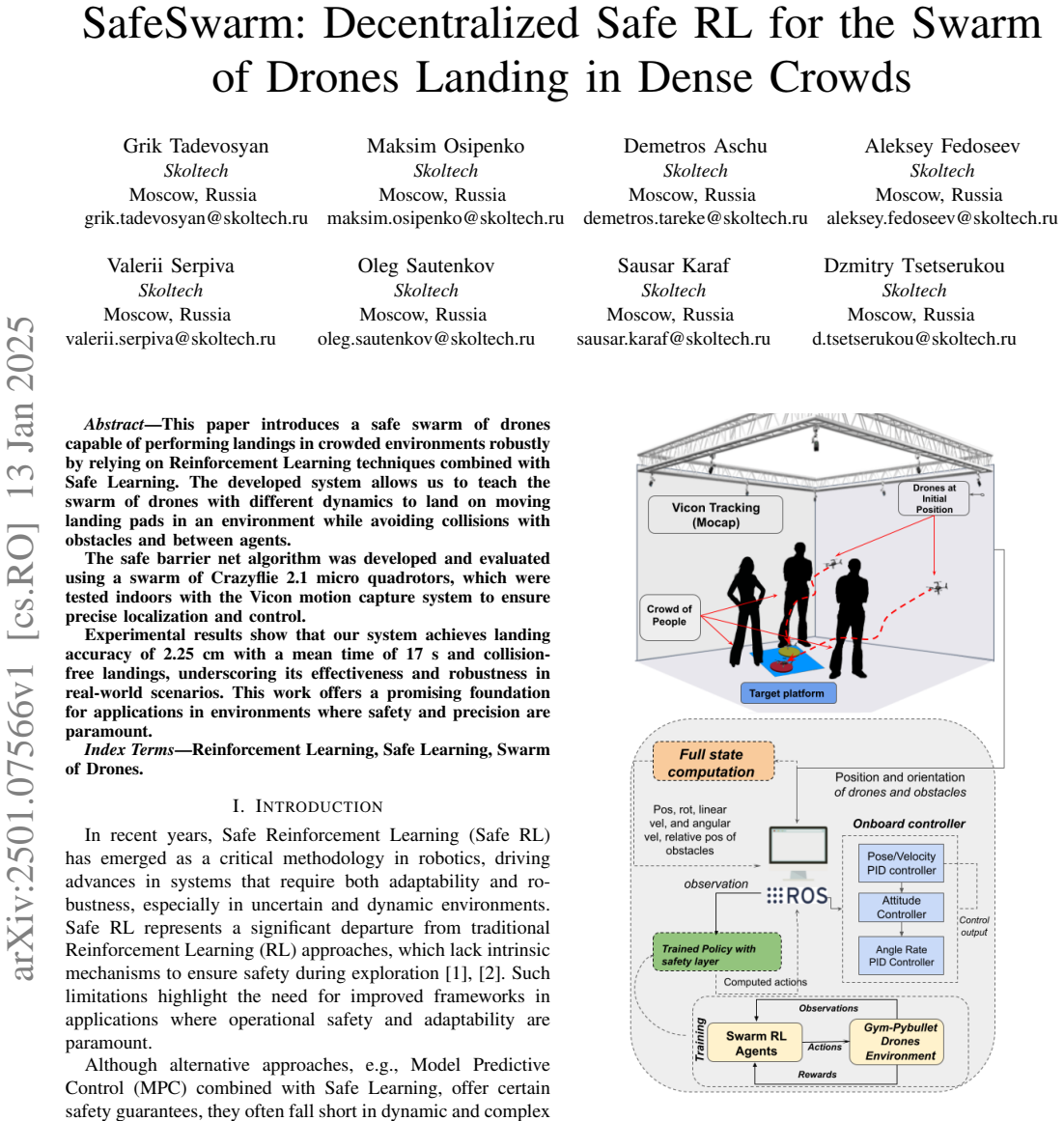
The behavior is carried by the reward function of Eq. (1), with four terms: an encouragement term that pulls the drone toward the target pad, a constant penalty for collision, an edge penalty for being under the pad, and a velocity penalty that couples the drone's speed to its distance from the nearest obstacle and target (Eqs. 2-6). On top of this, the paper names a 'safe barrier net algorithm' as the safety mechanism that produces collision-free landings, although the text gives no formal definition of that barrier. The policy itself is MAPPO with an MLP network, run in a decentralized way so each agent acts on its own observations.
What would settle it
Run the reported landing task with at least two drones flying simultaneous trajectories through the same obstacles in the real indoor setup and record all inter-agent distances; any mid-air collision or a landing error well above 2.25 cm would contradict the collision-free, centimeter-accuracy claim. A second check is to inspect the released code for a barrier layer distinct from the reward function; if no such layer exists, the claimed safety mechanism is not implemented.
Extended reading notes
Core claim
The central claim is that a MAPPO-based decentralized policy, shaped by the reward in Eq. (1), can make a swarm of drones with different dynamics land on moving platforms in cluttered scenes without hitting obstacles or each other. The paper reports simulation success rates of 95% on a static platform and 80% on a moving platform, with higher precision than the compared baseline, and a real-world experiment in which a micro quadrotor landed with 2.25 cm mean error and 80% success in 17 s. The authors attribute these results to their 'safe barrier net algorithm' combined with a reward that encourages approaching the pad, penalizes collisions and under-pad positions, and slows the drone near obstacles and targets.
Load-bearing premise
The central claim rests on the existence and effectiveness of the named 'safe barrier net algorithm', but the paper never specifies how it works; if that net is not actually present, the safety novelty reduces to a standard MAPPO training run with reward shaping.
Editorial extensions
If this is right
- If the reported result transfers to multi-drone flights, a single decentralized policy can coordinate heterogeneous drone teams without inter-agent dynamics models, removing a major scalability bottleneck of model predictive control for landing.
- The 2.25 cm landing error is the same order as motion-capture-based single-drone landers, so obstacle avoidance does not obviously sacrifice touchdown precision.
- Because the policy is trained in simulation and works on hardware in the reported tests, the approach is a candidate for sim-to-real deployment on resource-limited aerial robots.
- Moving-platform tests suggest the method keeps a precision edge over the prior swarm-landing baseline even when the target moves, at the cost of a longer mean landing time (21 s vs 17 s).
- The reward shaping recipe of distance encouragement, collision penalty, under-pad boundary, and proximity-scaled velocity is a reusable pattern for other cluttered-environment landing tasks.
Reading between the lines
- The hardware evidence in the paper is a single-drone flight, so the swarm-level collision-free claim is supported only by simulation; a two-or-more-drone hardware test would be the direct check of that claim.
- Because the safety behavior is attributed to reward heuristics rather than to a formally verified barrier, the 'safe' label would be stronger if a control barrier function with provable invariance were added to the policy.
- If the barrier-net specification is supplied in a later version, the same framework could be adapted to delivery-drone operations or indoor inspection fleets where guarantees about inter-agent clearance matter.
- The velocity penalty mechanism implies a testable prediction: landing accuracy should degrade gradually as localization noise increases, since the policy's obstacle avoidance depends on the quality of relative-position estimates.
Editorial analysis
A structured set of objections, weighed in public.
Referee Report
Summary. The paper proposes SafeSwarm, a decentralized multi-agent reinforcement learning system intended to land swarms of Crazyflie drones on moving landing pads in cluttered environments. The authors introduce a reward function with penalties for distance, collisions, edge proximity, and velocity, and they report a simulation comparison with the MARLander baseline as well as real-world experiments. The abstract and introduction name a 'safe barrier net algorithm' and claim centimeter-level landing accuracy and collision-free landings. However, the manuscript never specifies the barrier-net algorithm, the real-world evaluation uses a single drone rather than a swarm, and no collision metric is reported for the simulation experiments.
Significance. If the claims were fully supported, this work would be a useful application of multi-agent reinforcement learning to safety-critical drone landing, with a concrete quantitative result of 2.25 cm mean landing error and a comparison against a prior MARLander baseline. The paper does report an actual physical experiment and gives numeric landing precision, which is a strength. However, the central novelty named in the title and abstract, the 'safe barrier net algorithm', is not described or evaluated. The swarm-level claim is not tested on hardware, the baseline is from the same group, and no variance or collision statistics are given. As written, the contribution reduces to a reward-shaped MAPPO landing experiment with simulated multi-agent results, so the significance of the stated claims is not established by the presented evidence.
major comments (4)
- [III.A and III.C, Eq. (1)] The manuscript never specifies the 'safe barrier net algorithm' that is named in the Abstract and Introduction. Section III.A only states that PPO and TD3 were used 'with the Control Barrier Net function(CBF)', and Section III.C gives a shaped reward function in Eqs. (1)-(6) that contains distance, collision, edge, and velocity penalties. No barrier function, safety layer, action projection, formal guarantee, or training objective is defined. Since the safety and collision-free claims are the central novelty, this is a load-bearing omission. The authors should either provide the full algorithm and how it constrains actions, or revise the claims to those of a reward-shaped MAPPO policy.
- [IV.B, Fig. 4] The real-world evaluation described in Section IV.B uses one Crazyflie drone, five flights, and Fig. 4 shows a single trajectory, yet the title and abstract claim a swarm of drones with collision-free landings. Thus, swarm-level collision avoidance is not validated on hardware in any way. The 'collision-free landings' claim in the abstract is therefore unsupported by the reported experiments. The authors should either add multi-drone hardware trials with inter-agent collision measurements or explicitly limit the real-world claim to a single-drone landing with the swarm behavior demonstrated only in simulation.
- [IV.A, Tables I and II] The only baseline, MARLander [12], shares authors with this paper, so the comparison is not independent. In addition, the simulation results are reported as point estimates without standard deviations, confidence intervals, or the number of training seeds, despite the claim that the task was run 30 times. Success rate, precision, and time are not sufficient to support the comparative statements without variance information. The authors should add seed-level statistics and at least one independent baseline, such as a vanilla MAPPO without reward shaping or a known safety-layer method, before the relative safety and precision claims can be assessed.
- [IV.A, Tables I and II] No collision metric is reported in the simulation results. 'Collision-free' and 'success rate' are not the same; a landing attempt can be successful while still involving a collision, or a collision can be avoided at the cost of a failed landing. The manuscript should define how collisions with obstacles and between agents are detected in simulation and report the number or rate of collisions per episode. Without such a metric, the safety claim is a qualitative statement rather than a measured result.
minor comments (5)
- [III.C, Eqs. (3)-(6)] The terms αi and βi are called coefficients but are defined as reciprocal-distance factors; please clarify their role and specify the units and ranges of λ, ε, and γ.
- [IV.A] The sentence 'The loss of value function reached 0.01 at the and of training' contains a typo; 'and' should be 'end'.
- [IV.A, Figs. 2 and 3] Figures 2 and 3 do not label their axes or give units, and the mean reward value of -2000 is not contextualized. Adding axis labels and seed variance would make the training curves interpretable.
- [III.A] The phrase 'Control Barrier Net function(CBF)' conflates the Control Barrier Function concept with the BarrierNet architecture; please cite and define the exact formulation used.
- [IV.B] The statement 'accuracy of landing 80%' is ambiguous in relation to the reported 2.25 cm mean error; please define the success threshold used to compute the accuracy.
Circularity Check
No derivation in this paper reduces by construction to its inputs; the named safety algorithm is unspecified and the only overlapping-author baseline is not load-bearing, so circularity is minimal.
full rationale
SafeSwarm presents measured outcomes of a trained MAPPO policy rather than a predictive or first-principles derivation. The reward in Eqs. (1)-(6) shapes behavior directly with distance-to-target, collision, edge, and velocity penalties, so reporting the resulting landing error is a measurement of optimizing that reward, not a fitted input renamed as a prediction. The 'safe barrier net algorithm' is named in the abstract and Section III.A mentions using PPO and TD3 'with the Control Barrier Net function', but no barrier-net architecture, constraint, or training objective is specified; that is an evidentiary gap, not a circular reduction, because no equation defines the claimed safety guarantee in terms of the reward or vice versa. The closest self-citation concern is the MARLander baseline [12], whose authors overlap with this paper, but the comparison tables are direct experimental measurements and are not the sole support for the paper's central accuracy and collision-free claims; hence the self-citation is not load-bearing. The exact duplication of 2.25 cm and 17 s between the simulated SafeSwarm row and the real-world mean is an internal-consistency concern, not a circularity. Under the hard rule requiring a quoted reduction or a fitted-parameter-as-prediction, no circular step can be exhibited, so the appropriate score is 1.
Assumptions & free parameters
free parameters (3)
- lambda (λ)
- epsilon (ε)
- gamma (γ)
assumptions (3)
- domain assumption MAPPO with a shared MLP policy can solve the multi-agent landing task.
- ad hoc to paper The reward function (Eq. 1-6) is a sufficient surrogate for collision-free safety.
- domain assumption Static obstacles approximate dense crowds for real-world applicability.
invented entities (1)
-
Safe Barrier Net algorithm
Cite this review
Pith. "Pith review of SafeSwarm: Decentralized Safe RL for the Swarm of Drones Landing in Dense Crowds." pith.science (2026). https://pith.science/paper/YBT3VASR
@misc{pith2026250107566,
  author       = {Pith},
  title        = {Pith review of: SafeSwarm: Decentralized Safe RL for the Swarm of Drones Landing in Dense Crowds},
  year         = {2026},
  howpublished = {\url{https://pith.science/paper/YBT3VASR}},
  note         = {Machine review of arXiv:2501.07566}
}
read the original abstract
This paper introduces a safe swarm of drones capable of performing landings in crowded environments robustly by relying on Reinforcement Learning techniques combined with Safe Learning. The developed system allows us to teach the swarm of drones with different dynamics to land on moving landing pads in an environment while avoiding collisions with obstacles and between agents. The safe barrier net algorithm was developed and evaluated using a swarm of Crazyflie 2.1 micro quadrotors, which were tested indoors with the Vicon motion capture system to ensure precise localization and control. Experimental results show that our system achieves landing accuracy of 2.25 cm with a mean time of 17 s and collision-free landings, underscoring its effectiveness and robustness in real-world scenarios. This work offers a promising foundation for applications in environments where safety and precision are paramount.
Figures


Figures from the paper (1 more)

Reference graph
Works this paper leans on
-
[12]
MARLander: A Local Path Planning for Drone Swarms using Multiagent Deep Reinforcement Learning
D. Aschu, R. Peter, S. Karaf, A. Fedoseev, and D. Tsetserukou, “Mar- lander: A local path planning for drone swarms using multiagent deep reinforcement learning,” ArXiv, vol. abs/2406.04159, 2024. [Online]. Available: https://api.semanticscholar.org/CorpusID:270286237
work page Pith review arXiv 2024
-
[1]
Abnet: Attention barriernet for safe and scalable robot learning,
W. Xiao, T.-H. Wang, and D. Rus, “Abnet: Attention barriernet for safe and scalable robot learning,” 2024. [Online]. Available: https://arxiv.org/abs/2406.13025
arXiv 2024
-
[2]
Barriernet: Differentiable control barrier functions for learning of safe robot control,
W. Xiao, T.-H. Wang, R. Hasani, M. Chahine, A. Amini, X. Li, and D. Rus, “Barriernet: Differentiable control barrier functions for learning of safe robot control,” IEEE Transactions on Robotics , vol. 39, no. 3, pp. 2289–2307, 2023
2023
-
[3]
A. Hakobyan and I. Yang, “Distributionally robust risk map for learning- based motion planning and control: A semidefinite programming ap- proach,” IEEE Transactions on Robotics , vol. 39, no. 1, pp. 718–737, 2023
work page 2023
-
[4]
Model predictive control for uav automatic landing on moving carrier deck with heave motion,
S. Koo, S. Kim, and J. Suk, “Model predictive control for uav automatic landing on moving carrier deck with heave motion,” IF AC-PapersOnLine, vol. 48, no. 5, pp. 59–64, 2015, 3rd IFAC Workshop on Multivehicle Systems. [Online]. Available: https: //www.sciencedirect.com/science/article/pii/S240589631500703X
work page 2015
-
[5]
Distributionally robust differential dynamic programming with wasserstein distance,
A. Hakobyan and I. Yang, “Distributionally robust differential dynamic programming with wasserstein distance,” IEEE Control Systems Letters , vol. 7, pp. 2329–2334, 2023
work page 2023
-
[6]
Aperiodic communication for mpc in autonomous cooperative landing,
D. Lapandi ´c, L. Persson, D. V . Dimarogonas, and B. Wahlberg, “Aperiodic communication for mpc in autonomous cooperative landing,” IF AC-PapersOnLine, vol. 54, no. 6, pp. 113–118, 2021, 7th IFAC Conference on Nonlinear Model Predictive Control NMPC 2021. [Online]. Available: https://www.sciencedirect.com/science/article/pii/ S2405896321013070
work page 2021
-
[7]
Multi- agent actor-critic for mixed cooperative-competitive environments,
R. Lowe, Y . Wu, A. Tamar, J. Harb, P. Abbeel, and I. Mordatch, “Multi- agent actor-critic for mixed cooperative-competitive environments,” in Proceedings of the 31st International Conference on Neural Information Processing Systems , ser. NIPS’17. Red Hook, NY , USA: Curran Associates Inc., 2017, p. 6382–6393
2017
Show all 22 references
-
[8]
Safe navigation and obstacle avoidance using differ- entiable optimization based control barrier functions,
B. Dai, R. Khorrambakht, P. Krishnamurthy, V . Gonc ¸alves, A. Tzes, and F. Khorrami, “Safe navigation and obstacle avoidance using differ- entiable optimization based control barrier functions,” IEEE Robotics and Automation Letters , vol. 8, no. 9, pp. 5376–5383, 2023
2023
-
[9]
Drone landing and reinforcement learning: State-of-art, challenges and opportunities,
J. Amendola, L. R. Cenkeramaddi, and A. Jha, “Drone landing and reinforcement learning: State-of-art, challenges and opportunities,” IEEE Open Journal of Intelligent Transportation Systems , vol. 5, pp. 520–539, 2024
2024
-
[10]
Lander.ai: Drl-based autonomous drone landing on moving 3d surface in the presence of aerodynamic disturbances,
R. Peter, L. Ratnabala, D. Aschu, A. Fedoseev, and D. Tsetserukou, “Lander.ai: Drl-based autonomous drone landing on moving 3d surface in the presence of aerodynamic disturbances,” in 2024 International Conference on Unmanned Aircraft Systems (ICUAS) , 2024, pp. 295– 300
2024
-
[11]
Autonomous landing on a moving platform using vision-based deep reinforcement learning,
P. Ladosz, M. Mammadov, H. Shin, W. Shin, and H. Oh, “Autonomous landing on a moving platform using vision-based deep reinforcement learning,” IEEE Robotics and Automation Letters , vol. 9, no. 5, pp. 4575–4582, 2024
2024
-
[13]
Learning speed adaptation for flight in clutter,
G. Zhao, T. Wu, Y . Chen, and F. Gao, “Learning speed adaptation for flight in clutter,” IEEE Robotics and Automation Letters , vol. 9, no. 8, pp. 7222–7229, 2024
2024
-
[14]
Vision-based autonomous quadrotor landing on a moving platform,
D. Falanga, A. Zanchettin, A. Simovic, J. Delmerico, and D. Scara- muzza, “Vision-based autonomous quadrotor landing on a moving platform,” in 2017 IEEE International Symposium on Safety, Security and Rescue Robotics (SSRR) , 2017, pp. 200–207
2017
-
[15]
Deep drone racing: From simulation to reality with domain randomization,
A. Loquercio, E. Kaufmann, R. Ranftl, A. Dosovitskiy, V . Koltun, and D. Scaramuzza, “Deep drone racing: From simulation to reality with domain randomization,” IEEE Transactions on Robotics , vol. 36, no. 1, pp. 1–14, 2020
2020
-
[16]
A study of model based and model free offline reinforcement learning,
I. Shukla, H. R. Dozier, and A. C. Henslee, “A study of model based and model free offline reinforcement learning,” in 2022 International Conference on Computational Science and Computational Intelligence (CSCI), 2022, pp. 315–316
2022
-
[17]
V o-safe reinforcement learning for drone navigation,
F. Lin, C. Wei, R. Grech, and Z. Ji, “V o-safe reinforcement learning for drone navigation,” in 2024 IEEE International Conference on Robotics and Automation (ICRA) , 2024, pp. 279–285
2024
-
[18]
Vision-driven uav river following: Benchmarking with safe reinforcement learning,
Z. Wang and N. Mahmoudian, “Vision-driven uav river following: Benchmarking with safe reinforcement learning,” IF AC-PapersOnLine, vol. 58, no. 20, pp. 421–427, 2024, 15th IFAC Conference on Control Applications in Marine Systems, Robotics and Vehicles CAMS 2024. [Online]. Ava...
2024
-
[19]
Morpholander: Reinforcement learning based landing of a group of drones on the adaptive morphogenetic uav,
S. Karaf, A. Fedoseev, M. Martynov, Z. Darush, A. Shcherbak, and D. Tsetserukou, “Morpholander: Reinforcement learning based landing of a group of drones on the adaptive morphogenetic uav,” in 2023 IEEE International Conference on Systems, Man, and Cybernetics (SMC) , 2023, pp...
2023
-
[20]
Safe-control-gym: A unified benchmark suite for safe learning-based control and reinforcement learning in robotics,
Z. Yuan, A. W. Hall, S. Zhou, L. Brunke, M. Greeff, J. Panerati, and A. P. Schoellig, “Safe-control-gym: A unified benchmark suite for safe learning-based control and reinforcement learning in robotics,” IEEE Robotics and Automation Letters , vol. 7, no. 4, pp. 11 142–11 149, 2022
2022
-
[21]
MPCC++: Model Predictive Contouring Control for Time-Optimal Flight with Safety Constraints,
M. Krinner, A. Romero, L. Bauersfeld, M. Zeilinger, A. Carron, and D. Scaramuzza, “MPCC++: Model Predictive Contouring Control for Time-Optimal Flight with Safety Constraints,” in Proceedings of Robotics: Science and Systems , Delft, Netherlands, July 2024
2024
-
[22]
Vision-based autonomous landing using an mpc-controlled micro uav on a moving platform,
A. Mohammadi, Y . Feng, C. Zhang, S. Rawashdeh, and S. Baek, “Vision-based autonomous landing using an mpc-controlled micro uav on a moving platform,” in 2020 International Conference on Unmanned Aircraft Systems (ICUAS) , 2020, pp. 771–780
2020
Reviewed August 10, 2026 · model on record in the stance chip above.
Discussion (0). Continue with ORCID to comment.