REVIEW 2 major objections 5 minor 39 references
Adaptive Collocation Point Strategies For Physics Informed Neural Networks via the QR Discrete Empirical Interpolation Method
T0 review · 2 major / 5 minor · reviewed 2026-08-10 · deepseek-v4-flash
Pith's one-line read The paper claims that adaptive collocation point selection driven by QR-DEIM on residual snapshots consistently lowers PINN errors on wave, convection, Allen-Cahn, and Burgers' equations compared with fixed and existing adaptive sampling…
desk verdict A well-run empirical study of a genuinely new QR-DEIM sampling scheme, but the headline accuracy advantage is not clean because baseline point budgets differ. read the letter →
The pith
A machine-rendered reading of the paper's core claim, the machinery that carries it, and where it could break.
The reading
What carries the argument
The central object is the residual snapshot matrix $R \in \mathbb{R}^{N_{\text{snapshot}} \times P}$, whose columns are pointwise PDE residuals evaluated over a fixed snapshot set during $P$ training iterations. The method computes its SVD $R = V \Sigma W^{\mathsf T}$, keeps the leading $k$ left singular vectors where $k$ satisfies an energy threshold, and applies QR decomposition with column pivoting to $V_k^{\mathsf T}$. The pivot indices select the snapshot points that form the new training points, mirroring how QR-DEIM selects interpolation indices for nonlinear model reduction. The accompanying convergence-degree vector $d = \log_2(\hat{r}_{\text{old}} / \hat{r}_{\text{new}})$ prunes training points whose residuals have decreased most, and QR-DEIM-R replaces the SVD with a randomized SVD and pivoting with a column-norm-weighted random sample, reducing the update complexity.
What would settle it
On a benchmark with a known solution, after training for a fixed number of iterations, compare the QR-DEIM-selected snapshot points against points with the largest pointwise residual magnitudes and against random points; if the QR-DEIM points do not yield a lower validation error when added as collocation points, or if they systematically miss regions where the error is largest, the central claim fails.
Extended reading notes
Core claim
The paper's central claim is that the leading singular vectors of a residual snapshot matrix, combined with QR column pivoting, identify the space-time locations at which a PINN most needs new collocation points, and that acting on this information at regular intervals yields more accurate solutions than either fixed sampling or residual-based adaptive methods that only look at the current residual field. Concretely, after every P training iterations the method evaluates the PDE residual at a separate snapshot set, stacks these evaluations into a matrix, truncates its SVD to the modes capturing a specified energy fraction, and applies pivoted QR to the transposed mode matrix to select the snapshot points whose indices become new training points. It simultaneously removes training points whose residuals have decayed most, keeping the set size fixed. A randomized variant replaces the SVD and pivot selection with randomized linear algebra to cut update costs. Across four benchmark PDEs the method is reported to consistently yield lower mean relative $\ell^2$ errors than uniform, Hammersley, resampling, RAR-G, RAR-D, RAD, R3, and PINNACLE baselines.
Load-bearing premise
The load-bearing premise is that the snapshot points singled out by QR-DEIM's pivoted QR on the residual's dominant modes are the locations where adding collocation points will actually reduce the network's error, a connection the paper verifies only empirically on four one-dimensional benchmarks.
Editorial extensions
If this is right
- PINN users can adopt QR-DEIM or QR-DEIM-R without changing architecture, loss, or optimizer; the sampling strategy is the only modification.
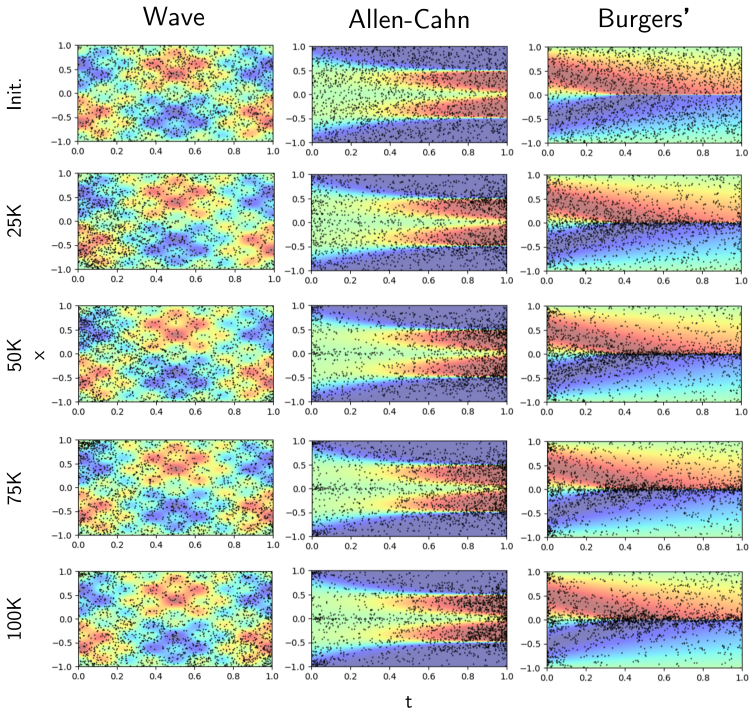
- The methods automatically concentrate points in early-time regions for wave and convection problems and near sharp fronts for Allen-Cahn and Burgers, suggesting they can replace manual time-marching or domain decomposition.
- The randomized variant's lower update cost makes it the scalable choice for larger snapshot sets or higher-dimensional PDEs, while matching the accuracy of the full QR-DEIM on the tested benchmarks.
- Both methods reach lower validation loss in fewer iterations than fixed sampling, so the modest per-iteration overhead can be offset by faster convergence.
- The energy threshold $\varepsilon$ and target rank $k$ have weak influence on accuracy over tested ranges, so default hyperparameters transfer across the four benchmarks.
Reading between the lines
- If the dominant left singular vectors of residual snapshots are indeed a good proxy for where error concentrates, the same snapshot-subspace strategy could be ported to other neural PDE solvers, such as those using different loss weightings or operator learning, with minimal changes.
- The observed early-time concentration for the convection equation resembles the effect of causality-weighted training, but here it arises purely from the sampling rule; an explicit comparison against causal training would reveal whether the two mechanisms are complementary or redundant.
- The method's robustness to $\varepsilon$ and $k$ across 1D benchmarks suggests it may generalize to 2D or 3D problems, but the paper only tests 1D; testing on a 2D problem with a known solution would be the natural next step.
- Since the pruning rule only removes points whose residual has decreased, it cannot detect regions where the residual is stagnating; a stagnation-aware criterion might further improve the update policy.
Editorial analysis
A structured set of objections, weighed in public.
Referee Report
Summary. The paper proposes two adaptive collocation point selection strategies for physics-informed neural networks, based on the QR-DEIM algorithm and a randomized variant. The methods build a residual snapshot matrix over a separate snapshot set during training, use an SVD to identify dominant residual modes, and select new collocation points via QR column pivoting, while pruning converged training points. The authors evaluate the methods on the wave, convection, Allen-Cahn, and Burgers' equations, compare against fixed and adaptive baselines, and report mean relative L2 errors over ten runs, together with ablations on the energy threshold, rank, snapshot count, and snapshot period. The central claim is that the proposed strategies consistently achieve lower errors than existing techniques.
Significance. If the empirical claim holds, the paper makes a useful contribution by importing reduced-order modeling tools into PINN collocation sampling, with a concrete algorithm and extensive ablations. The experimental protocol has strengths: ten runs per configuration, a common test grid, validation-based model selection, and ablations over several hyperparameters. The main limitations are that the comparison does not hold the collocation point budget constant across baselines, that the margins on two of the four benchmarks are small relative to the reported standard deviations, and that the results are restricted to one-dimensional problems with a single optimizer and network architecture. The proposed heuristic is plausible but is not supported by an error bound or convergence analysis; its value rests on the empirical evidence.
major comments (2)
- [Section 2.3, Table 1] The stated goal 'To isolate the effects of the sampling strategies' is not met because the baseline methods are not given the same collocation point budget as the proposed methods. RAR-G and RAR-D begin with 1,000 points and add 10 every 1,000 iterations, so over a 100,000-iteration run they reach 2,000 points only at the final update; PINNACLE starts at 1,000 and adds 100 per update, ending at 11,000 points. The proposed QR-DEIM methods maintain a fixed budget of 2,000 points throughout. The sentence 'We use 2,000 collocation points for all of our benchmark PDEs' is therefore contradicted by Table 1. As a result, the accuracy differences in Table 2 may reflect the number of collocation points rather than the sampling strategy. Please rerun the comparison with matched point budgets, or provide an explicit control showing that the budget difference does not drive the reported improvements.
- [Table 2, Section 4] The central claim that QR-DEIM and QR-DEIM-R 'consistently yield lower errors than existing techniques' is not supported by appropriate statistical evidence. On the Allen-Cahn benchmark, QR-DEIM-R gives 3.85e-03 (1.87e-03) versus RAR-G at 5.14e-03 (9.35e-04); on Burgers' equation, QR-DEIM gives 5.96e-04 (7.07e-05) versus RAR-D at 7.31e-04 (1.78e-04). In both cases the difference is smaller than the combined standard deviation with n=10, so the advantage may not be statistically significant. The paper reports only means and standard deviations and does not perform significance tests or effect-size calculations. Please add such analyses or temper the 'consistently' claim for benchmarks where the improvement is marginal.
minor comments (5)
- [Section 2.2, Eq. (15)] The notation 'min {i = 1,...,P | ...}' should be phrased as 'the smallest i in {1,...,P} such that ...' to avoid ambiguity about whether the set is over i or over a condition.
- [Section 3.5] The statement 'We observe similar patterns of robustness across the other benchmark problems' is not accompanied by tables or figures for the other problems; please provide the data or explicitly label this as a qualitative observation.
- [Section 3.6] The runtime comparison with baseline adaptive methods is informal; reporting measured wall-clock times for each method would make the claim 'roughly in the middle of the spectrum' concrete.
- [Figures 3 and 5] Adding error bars or shaded regions across the ten runs would help the reader assess whether the temporal concentration behavior is consistent.
- [General] The manuscript does not include a reproducibility statement or code release; providing code and random seeds would strengthen the empirical claims.
Circularity Check
No circularity: QR-DEIM sampling is a fixed residual-driven heuristic, and the reported accuracy gains are empirical rather than derived from a fitted input.
full rationale
Walking the derivation chain, QR-DEIM and QR-DEIM-R select collocation points from residual snapshot matrices via SVD and pivoted QR, with pruning based on pointwise residual decrease. None of these quantities is constructed from the test errors or target solutions used in Table 2, and no parameter is fitted to the reported errors; the hyperparameters epsilon, k, and z are fixed defaults with ablation robustness checks. The method borrows QR-DEIM from external reduced-order modeling literature, and the comparison baselines are external published methods, so there is no load-bearing self-citation chain. The central claim is therefore empirical, not circular. One experimental-design concern should be stated separately: Section 2.3 says 'We use 2,000 collocation points for all of our benchmark PDEs,' but Table 1 shows RAR-G and RAR-D start at 1,000 points and add only 10 per update, while PINNACLE grows to 11,000 points, so the baseline point budgets are not controlled throughout training. This undermines the strength of the 'consistently yield lower errors' comparison, but it is a confounding-variable issue, not a reduction of a prediction to its inputs by construction.
Assumptions & free parameters
free parameters (5)
- energy threshold epsilon =
0.005
- target rank k (QR-DEIM-R) =
100
- oversampling parameter z =
50
- number of snapshot points N_snapshot =
1000
- snapshot period P =
1000
assumptions (4)
- domain assumption The dominant left singular vectors of the residual snapshot matrix correspond to regions where the PINN residual is persistently large or dynamically active.
- domain assumption Removing points with high convergence degree (large residual decrease) does not harm final accuracy.
- domain assumption Strong enforcement of initial and boundary conditions via an output transform (Equation 7) is valid for the benchmarks considered.
- standard math SVD, QR with column pivoting, and randomized SVD provide numerically reliable decompositions of the residual matrices.
Cite this review
Pith. "Pith review of Adaptive Collocation Point Strategies For Physics Informed Neural Networks via the QR Discrete Empirical Interpolation Method." pith.science (2026). https://pith.science/paper/OOC3P7I5
@misc{pith2026250107700,
  author       = {Pith},
  title        = {Pith review of: Adaptive Collocation Point Strategies For Physics Informed Neural Networks via the QR Discrete Empirical Interpolation Method},
  year         = {2026},
  howpublished = {\url{https://pith.science/paper/OOC3P7I5}},
  note         = {Machine review of arXiv:2501.07700}
}
read the original abstract
Physics-informed neural networks (PINNs) have gained significant attention for solving forward and inverse problems related to partial differential equations (PDEs). While advancements in loss functions and network architectures have improved PINN accuracy, the impact of collocation point sampling on their performance remains underexplored. Fixed sampling methods, such as uniform random sampling and equispaced grids, can fail to capture critical regions with high solution gradients, limiting their effectiveness for complex PDEs. Adaptive methods, inspired by adaptive mesh refinement from traditional numerical methods, address this by dynamically updating collocation points during training but may overlook residual dynamics between updates, potentially losing valuable information. To overcome this limitation, we propose two adaptive collocation point selection strategies utilizing the QR Discrete Empirical Interpolation Method (QR-DEIM), a reduced-order modeling technique for efficiently approximating nonlinear functions. Our results on benchmark PDEs demonstrate that our QR-DEIM-based approaches improve PINN accuracy compared to existing methods, offering a promising direction for adaptive collocation point strategies.
Figures


Figures from the paper (5 more)



Reference graph
Works this paper leans on
-
[1]
Physics-informed machine learning,
G. E. Karniadakis, I. G. Kevrekidis, L. Lu, P. Perdikaris, S. Wang, and L. Yang, “Physics-informed machine learning,”Nature Reviews Physics, vol. 3, no. 6, pp. 422–440, 2021
2021
-
[2]
DeepXDE: A deep learning library for solving differential equations,
L. Lu, X. Meng, Z. Mao, and G. E. Karniadakis, “DeepXDE: A deep learning library for solving differential equations,”SIAM review, vol. 63, no. 1, pp. 208–228, 2021
work page 2021
-
[3]
M. Raissi, P. Perdikaris, and G. E. Karniadakis, “Physics-informed neu- ral networks: A deep learning framework for solving forward and inverse problems involving nonlinear partial differential equations,”Journal of Computational physics, vol. 378, pp. 686–707, 2019
work page 2019
-
[4]
Physics- informed neural networks (PINNs) for fluid mechanics: A review,
S. Cai, Z. Mao, Z. Wang, M. Yin, and G. E. Karniadakis, “Physics- informed neural networks (PINNs) for fluid mechanics: A review,”Acta Mechanica Sinica, vol. 37, no. 12, pp. 1727–1738, 2021
2021
-
[5]
Multiphysics- informed neural networks for coupled soil hydrothermal modeling,
Y. Wang, L. Shi, X. Hu, W. Song, and L. Wang, “Multiphysics- informed neural networks for coupled soil hydrothermal modeling,” Water Resources Research, vol. 59, no. 1, p. e2022WR031960, 2023
work page 2023
-
[6]
3D multi-physics uncertainty quantification using physics-based machine learning,
D. Degen, M. Cacace, and F. Wellmann, “3D multi-physics uncertainty quantification using physics-based machine learning,”ScientificReports, vol. 12, no. 1, p. 17491, 2022
work page 2022
-
[7]
Systems biology informed deep learning for inferring parameters and hidden dynamics,
A. Yazdani, L. Lu, M. Raissi, and G. E. Karniadakis, “Systems biology informed deep learning for inferring parameters and hidden dynamics,” PLoS computational biology, vol. 16, no. 11, p. e1007575, 2020. 30
work page 2020
-
[8]
C. Wu, M. Zhu, Q. Tan, Y. Kartha, and L. Lu, “A comprehensive study of non-adaptive and residual-based adaptive sampling for physics- informed neural networks,” Computer Methods in Applied Mechanics and Engineering, vol. 403, p. 115671, 2023
work page 2023
Show all 39 references
-
[9]
Meta-learning PINN loss functions,
A. F. Psaros, K. Kawaguchi, and G. E. Karniadakis, “Meta-learning PINN loss functions,” Journal of computational physics, vol. 458, p. 111121, 2022
2022
-
[10]
Gradient-enhanced physics-informed neural networks for forward and inverse PDE prob- lems,
J. Yu, L. Lu, X. Meng, and G. E. Karniadakis, “Gradient-enhanced physics-informed neural networks for forward and inverse PDE prob- lems,” Computer Methods in Applied Mechanics and Engineering, vol. 393, p. 114823, 2022
2022
-
[11]
NAS-PINN: neural architecture search- guided physics-informed neural network for solving PDEs,
Y. Wang and L. Zhong, “NAS-PINN: neural architecture search- guided physics-informed neural network for solving PDEs,”Journal of Computational Physics, vol. 496, p. 112603, 2024
2024
-
[12]
Physics-informed neural networks with hard constraints for inverse de- sign,
L. Lu, R. Pestourie, W. Yao, Z. Wang, F. Verdugo, and S. G. Johnson, “Physics-informed neural networks with hard constraints for inverse de- sign,” SIAM Journal on Scientific Computing, vol. 43, no. 6, pp. B1105– B1132, 2021
2021
-
[13]
fPINNs: Fractional physics- informed neural networks,
G. Pang, L. Lu, and G. E. Karniadakis, “fPINNs: Fractional physics- informed neural networks,” SIAM Journal on Scientific Computing, vol. 41, no. 4, pp. A2603–A2626, 2019
2019
-
[14]
Adaptive deep neural networks methods for high-dimensional partial differential equations,
S. Zeng, Z. Zhang, and Q. Zou, “Adaptive deep neural networks methods for high-dimensional partial differential equations,”Journal of Computational Physics, vol. 463, p. 111232, 2022
2022
-
[15]
Residual-based adaptivity for two-phase flow simulation in porous media using physics-informed neural networks,
J. M. Hanna, J. V. Aguado, S. Comas-Cardona, R. Askri, and D. Borza- cchiello, “Residual-based adaptivity for two-phase flow simulation in porous media using physics-informed neural networks,” Computer Methods in Applied Mechanics and Engineering, vol. 396, p. 115100, 2022
2022
-
[16]
Efficient train- ing of physics-informed neural networks via importance sampling,
M. A. Nabian, R. J. Gladstone, and H. Meidani, “Efficient train- ing of physics-informed neural networks via importance sampling,” Computer-Aided Civil and Infrastructure Engineering, vol. 36, no. 8, pp. 962–977, 2021. 31
2021
-
[17]
Investigating molecular transport in the human brain from MRI with physics-informed neural networks,
B. Zapf, J. Haubner, M. Kuchta, G. Ringstad, P. K. Eide, and K.- A. Mardal, “Investigating molecular transport in the human brain from MRI with physics-informed neural networks,”ScientificReports, vol. 12, no. 1, p. 15475, 2022
2022
-
[18]
Active learning based sampling for high- dimensional nonlinear partial differential equations,
W. Gao and C. Wang, “Active learning based sampling for high- dimensional nonlinear partial differential equations,” Journal of Computational Physics, vol. 475, p. 111848, 2023
2023
-
[19]
Miti- gating propagation failures in physics-informed neural networks us- ing retain-resample-release (R3) sampling,
A. Daw, J. Bu, S. Wang, P. Perdikaris, and A. Karpatne, “Miti- gating propagation failures in physics-informed neural networks us- ing retain-resample-release (R3) sampling,” inProceedings of the 40th International Conference on Machine Learning (A. Krause, E. Brun- skill, K. ...
2023
-
[20]
PIN- NACLE: PINN adaptive collocation and experimental points selection,
G. K. R. Lau, A. Hemachandra, S.-K. Ng, and B. K. H. Low, “PIN- NACLE: PINN adaptive collocation and experimental points selection,” in The Twelfth International Conference on Learning Representations, 2024
2024
-
[21]
Nonlinear model reduc- tion via discrete empirical interpolation,
S. Chaturantabut and D. C. Sorensen, “Nonlinear model reduc- tion via discrete empirical interpolation,” SIAM Journal on Scientific Computing, vol. 32, no. 5, pp. 2737–2764, 2010
2010
-
[22]
A new selection operator for the discrete em- pirical interpolation method—improved a priori error bound and exten- sions,
Z. Drmac and S. Gugercin, “A new selection operator for the discrete em- pirical interpolation method—improved a priori error bound and exten- sions,” SIAM Journal on Scientific Computing, vol. 38, no. 2, pp. A631– A648, 2016
2016
-
[23]
GS- PINN: Greedy sampling for parameter estimation in partial differential equations,
A. Forootani, H. Kapadia, S. Chellappa, P. Goyal, and P. Benner, “GS- PINN: Greedy sampling for parameter estimation in partial differential equations,” arXiv preprint arXiv:2405.08537, 2024
2024 arXiv
-
[24]
Projection methods for reduced order mod- els of compressible flows,
D. J. Lucia and P. S. Beran, “Projection methods for reduced order mod- els of compressible flows,”Journal of Computational Physics, vol. 188, no. 1, pp. 252–280, 2003. 32
2003
-
[25]
Stabilization of projection-based reduced- order models,
D. Amsallem and C. Farhat, “Stabilization of projection-based reduced- order models,” International Journal for Numerical Methods in Engineering, vol. 91, no. 4, pp. 358–377, 2012
2012
-
[26]
On projection- based algorithms for model-order reduction of interconnects,
J. M. Wang, C.-C. Chu, Q. Yu, and E. S. Kuh, “On projection- based algorithms for model-order reduction of interconnects,” IEEE Transactions on Circuits and Systems I: Fundamental Theory and Applications, vol. 49, no. 11, pp. 1563–1585, 2002
2002
-
[27]
Proper orthogonal decomposition extensions for parametric applications in compressible aerodynamics,
T. Bui-Thanh, M. Damodaran, and K. Willcox, “Proper orthogonal decomposition extensions for parametric applications in compressible aerodynamics,” in21st AIAA applied aerodynamics conference, p. 4213, 2003
2003
-
[28]
The proper orthogonal de- composition in the analysis of turbulent flows,
G. Berkooz, P. Holmes, and J. L. Lumley, “The proper orthogonal de- composition in the analysis of turbulent flows,”Annual review of fluid mechanics, vol. 25, no. 1, pp. 539–575, 1993
1993
-
[29]
A reduced-order approach for optimal control of flu- ids using proper orthogonal decomposition,
S. S. Ravindran, “A reduced-order approach for optimal control of flu- ids using proper orthogonal decomposition,” International journal for numerical methods in fluids, vol. 34, no. 5, pp. 425–448, 2000
2000
-
[30]
Proper orthogonal decomposition for linear-quadratic optimal control,
M. Gubisch and S. Volkwein, “Proper orthogonal decomposition for linear-quadratic optimal control,”Model reduction and approximation: theory and algorithms, vol. 15, no. 1, 2017
2017
-
[31]
Nonlinear model order reduction via lifting transformations and proper orthogonal decomposition,
B. Kramer and K. E. Willcox, “Nonlinear model order reduction via lifting transformations and proper orthogonal decomposition,” AIAA Journal, vol. 57, no. 6, pp. 2297–2307, 2019
2019
-
[32]
Discrete empirical interpola- tion for nonlinear model reduction,
S. Chaturantabut and D. C. Sorensen, “Discrete empirical interpola- tion for nonlinear model reduction,” in Proceedings of the 48h IEEE Conference on Decision and Control (CDC) held jointly with 2009 28th Chinese Control Conference, pp. 4316–4321, IEEE, 2009
2009
-
[33]
Finding structure with randomness: Probabilistic algorithms for constructing approximate ma- trix decompositions,
N. Halko, P.-G. Martinsson, and J. A. Tropp, “Finding structure with randomness: Probabilistic algorithms for constructing approximate ma- trix decompositions,” SIAM review, vol. 53, no. 2, pp. 217–288, 2011
2011
-
[34]
Challenges in training pinns: a loss landscape perspective,
P. Rathore, W. Lei, Z. Frangella, L. Lu, and M. Udell, “Challenges in training pinns: a loss landscape perspective,” inProceedings of the 41st 33 International Conference on Machine Learning, ICML’24, JMLR.org, 2024
2024
-
[35]
Characterizing possible failure modes in physics-informed neural net- works,
A. Krishnapriyan, A. Gholami, S. Zhe, R. Kirby, and M. W. Mahoney, “Characterizing possible failure modes in physics-informed neural net- works,” Advances in neural information processing systems, vol. 34, pp. 26548–26560, 2021
2021
-
[36]
Kolmogorov n– width and lagrangian physics-informed neural networks: A causality- conforming manifold for convection-dominated pdes,
R. Mojgani, M. Balajewicz, and P. Hassanzadeh, “Kolmogorov n– width and lagrangian physics-informed neural networks: A causality- conforming manifold for convection-dominated pdes,” Computer Methods in Applied Mechanics and Engineering, vol. 404, p. 115810, 2023
2023
-
[37]
A unified scalable framework for causal sweeping strategies for physics-informed neural networks (pinns) and their temporal decompo- sitions,
M. Penwarden, A. D. Jagtap, S. Zhe, G. E. Karniadakis, and R. M. Kirby, “A unified scalable framework for causal sweeping strategies for physics-informed neural networks (pinns) and their temporal decompo- sitions,” Journal of Computational Physics, vol. 493, p. 112464, 2023
2023
-
[38]
Extended physics-informed neu- ral networks (xpinns): A generalized space-time domain decomposition based deep learning framework for nonlinear partial differential equa- tions,
A. D. Jagtap and G. E. Karniadakis, “Extended physics-informed neu- ral networks (xpinns): A generalized space-time domain decomposition based deep learning framework for nonlinear partial differential equa- tions,” Communications in Computational Physics, vol. 28, no. 5, 2020
2020
-
[39]
Solving Allen-Cahn and Cahn-Hilliard Equations using the Adaptive Physics Informed Neural Networks,
C. L. W. Zhao and Jia, “Solving Allen-Cahn and Cahn-Hilliard Equations using the Adaptive Physics Informed Neural Networks,” Communications in Computational Physics, vol. 29, pp. 930–954, June 2021. 34
2021
Reviewed August 10, 2026 · model on record in the stance chip above.
Discussion (0). Continue with ORCID to comment.