Exact quasi-periodic solutions to the sine(sinh)-Gordon equations: The method for computation and analysis
Pith reviewed 2026-05-23 05:50 UTC · model grok-4.3
The pith
Quasi-periodic solutions to the sine(sinh)-Gordon equations are expressed using the wp_{1,2g-1} function on the spectral curve.
A machine-rendered reading of the paper's core claim, the machinery that carries it, and where it could break.
Core claim
The sine(sinh)-Gordon hierarchy is described in detail with all dynamic variables expressed in terms of the wp-functions uniformizing the spectral curve. Quasi-periodic solutions are obtained in terms of wp_{1,2g-1}, reality conditions are revised, and the method of computation and analysis uses the Hamiltonian technique illustrated in genera one and two.
What carries the argument
The wp_{1,2g-1} function on the hyperelliptic spectral curve, which uniformizes the variables and carries the quasi-periodic solutions.
If this is right
- All dynamic variables of the hierarchy reduce to wp-functions on the curve.
- Reality conditions on the solutions are updated for physical relevance.
- The Hamiltonian technique provides a way to analyze the dynamics of these solutions.
- Explicit computations are feasible for low genera such as one and two.
Where Pith is reading between the lines
- The method could be applied to compute solutions for higher genera using the same uniformization.
- These expressions might connect to other algebro-geometric approaches in integrable systems for verification.
- Revised reality conditions may enable new physical models based on these solutions.
Load-bearing premise
All dynamic variables of the sine(sinh)-Gordon hierarchy can be expressed in terms of the wp-functions that uniformize the associated spectral curve.
What would settle it
Compute the wp_{1,2g-1} expression for genus 2 and check if it satisfies the sine-Gordon equation numerically to within machine precision; mismatch would disprove the claim.
Figures

read the original abstract
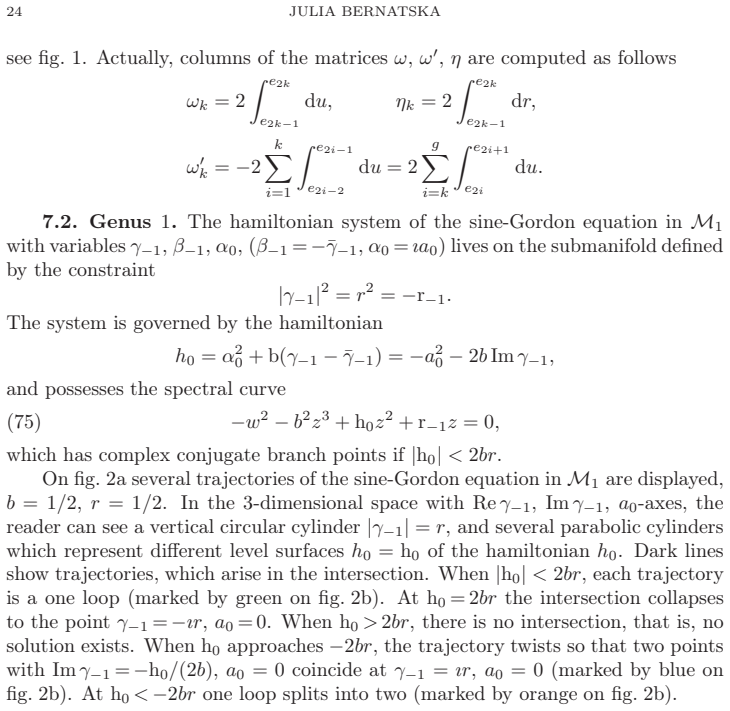
The sine(sinh)-Gordon hierarchy of integrable Hamiltonian systems is described in detail, and all dynamic variables are expressed in terms of the $\wp$-functions that uniformize the associated spectral curve. Quasi-periodic solutions to the sine(sinh)-Gordon equations are obtained in terms of the function $\wp_{1,2g-1}$, reality conditions are revised, and a method of computation and analysis is presented. The proposed method is designed to analyze solutions by means of the Hamiltonian technique, which is illustrated in genera one and two.
Editorial analysis
A structured set of objections, weighed in public.
Referee Report
Summary. The manuscript describes the sine(sinh)-Gordon hierarchy of integrable Hamiltonian systems and claims to express all dynamic variables in terms of the wp-functions that uniformize the associated spectral curve. It obtains quasi-periodic solutions explicitly in terms of the function wp_{1,2g-1}, revises reality conditions, and presents a Hamiltonian technique for computation and analysis, illustrated explicitly in genera one and two.
Significance. If the claimed expressions and uniformization hold, the work supplies explicit algebro-geometric forms for solutions of the sine(sinh)-Gordon hierarchy together with a practical Hamiltonian verification method in low genus; such constructions are useful for analyzing quasi-periodic behavior in integrable systems and for extending the standard theta-function approach.
minor comments (3)
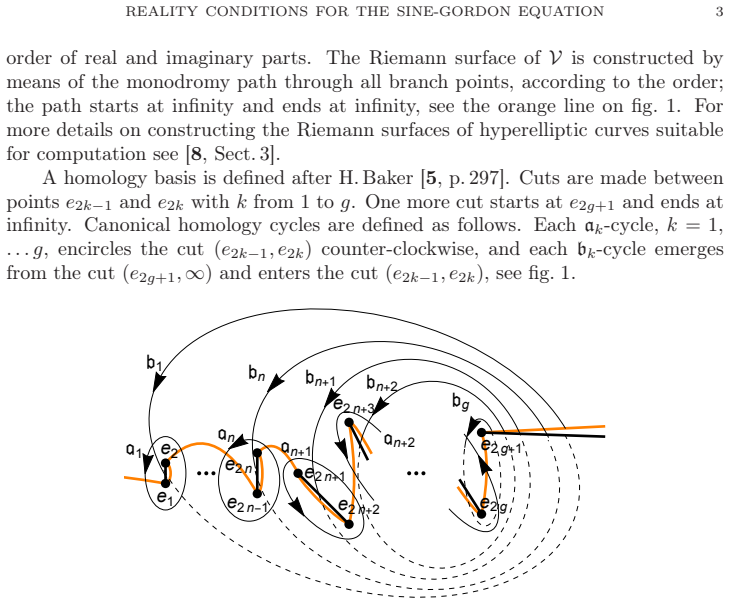
- The abstract states that 'all dynamic variables' are expressed via wp-functions, but the precise mapping from the hierarchy flows to the wp_{1,2g-1} coordinates is not summarized; a short table or diagram in §1 or §2 would clarify the dictionary between the original fields and the wp expressions.
- Reality conditions are said to be 'revised,' yet the manuscript does not indicate which prior statements (e.g., from the literature on the sinh-Gordon case) are being corrected; a brief comparison paragraph would help readers assess the novelty of the revision.
- The Hamiltonian technique is illustrated only for g=1 and g=2; while this is appropriate for exposition, the manuscript should state explicitly whether the same procedure extends without modification to higher genus or whether additional algebraic relations appear.
Simulated Author's Rebuttal
We thank the referee for the positive summary, significance assessment, and recommendation of minor revision. No specific major comments were provided in the report.
Circularity Check
No significant circularity detected
full rationale
The paper applies the standard algebro-geometric construction for integrable hierarchies: dynamic variables of the sine(sinh)-Gordon hierarchy are expressed via wp-functions uniformizing the spectral curve, with explicit quasi-periodic solutions given in terms of wp_{1,2g-1}. This is a direct statement of the uniformization method rather than a self-definitional loop, fitted prediction, or load-bearing self-citation. The Hamiltonian technique illustrated for genera 1 and 2 functions as verification on low-dimensional cases and does not reduce the central claim to its own inputs. No equations or steps in the provided description exhibit the enumerated circularity patterns; the derivation remains self-contained against external benchmarks in integrable systems theory.
Axiom & Free-Parameter Ledger
axioms (1)
- domain assumption All dynamic variables can be expressed in terms of the wp-functions that uniformize the associated spectral curve.
Reference graph
Works this paper leans on
-
[1]
Ablowitz M. J., Kaup D. J., Newell A. C., Segur H., On sympl ectic structures and integrable systems on symmetric spaces, Phys, Rev. Lett. 30:25 (1973) 1262–1264
work page 1973
-
[2]
Adler, M. On a trace functional for formal pseudo-differe ntial operators and the symplectic structure of the Korteweg-devries type equations. Invent. Math. 50, 219–248 (1978)
work page 1978
-
[3]
Completely integrable systems, E uclidean Lie algebras, and curves
Adler, M., Moerbeke P. Completely integrable systems, E uclidean Lie algebras, and curves. Advances in Math., 38:3, 267–317 (1980)
work page 1980
-
[4]
Aktosun T., Demontis F., van der Mee C., Exact solutions t o the sine-Gordon equation, J. Math. Phys. 51 (2010) 123521
work page 2010
-
[5]
Baker H.F., Abelian functions: Abel’s theorem and the al lied theory of theta functions, Cambridge, University press, Cambridge, 1897
-
[6]
Belokolos E. D., Bobenko A. I., Enolski V. Z., Its A. R., Ma tveev. V.B., Algebro-geometric approach to nonlinear integrable equations., Springer-Ve rhag, 1994
work page 1994
-
[7]
Bernatska J., Reality conditions for the KdV equation an d exact quasi-periodic solutions in finite phase spaces, J. Geom. Phys. 206 (2024) 105322
work page 2024
- [8]
-
[9]
Bernatska J., Abelian function fields on Jacobian variet ies, Axioms 14:2 (2025) 90
work page 2025
-
[10]
On Separation of variables for Int egrable equations of soliton type, J
Bernatska J, Holod P. On Separation of variables for Int egrable equations of soliton type, J. Nonlin. Math. Phys. 14:3 (2007) 353–374
work page 2007
-
[11]
Buchstaber V. M., Enolskii V. Z., and Leykin D. V., Hyper elliptic Kleinian functions and applications, preprint ESI 380 (1996), Vienna REALITY CONDITIONS FOR THE SINE-GORDON EQUATION 31
work page 1996
-
[12]
Buchstaber V. M., Leikin D. V., Addition laws on Jacobia n varieties of plane algebraic curves, Nonlinear dynamics, Collected papers, Tr. Mat. Inst. Stekl ova, 251 (2005), pp. 54–126
work page 2005
-
[13]
Dubrovin B. A., Natanzon S. M., Real two-zone solutions of the sine-Gordon equation, Func- tional Analysis and Its Applications, 16 (1982) 21-33
work page 1982
-
[14]
Hirota R., Exact solution of the sine-Gordon equation f or multiple collisions of solitons, J. Phys. Soc. Japan, 33:5 (1972) 1459–1463
work page 1972
-
[15]
Holod P., Hamiltonian systems on the orbits of affine Lie g roups and finite-band integration of nonlinear equation, pp. ˙1361–1367; In Nonlinear and Turbulent Processes in Physi cs: Nonlinear effects in plasma physics, astrophysics, and elem entary particle theory. Ed. Sagdeev R. Z., Harwood Academic Publishers, 1984
work page 1984
-
[16]
Kozel V. A. and Kotlyarov V. P. Explicit almost periodic solutions of the sine-Gordon equation Dokl. Akad. Nauk Ukr. SSR, Ser. A, 10 (1976) 878–881 (in Russian); translation in English in arXiv:1401.4410
work page internal anchor Pith review Pith/arXiv arXiv 1976
-
[17]
Smirnov, A. O., Real elliptic solutions of the sine-Gor don equation, Mathematics of the USSR-Sbornik, 70:1 (1991) 231–240
work page 1991
-
[18]
O., 3-Elliptic solutions of the sine-Gordo n equation MathematicalNotes, 6:3 (1997) 368–376
Smirnov, A. O., 3-Elliptic solutions of the sine-Gordo n equation MathematicalNotes, 6:3 (1997) 368–376
work page 1997
-
[19]
From pendu la and Josephson junctions to gravity and high-energy physics
The sine-Gordon model and its applications. From pendu la and Josephson junctions to gravity and high-energy physics. Eds.: Cuevas-Maraver, J., Kevrek idis, P. G. Williams, F., Springer Cham, New York, 2014 Appendix A. Proof of Lemmas 1 Genus 1. Let an elliptic curve V of the form (3) have branch points located at e2, ¯e2, 0, and ℘ be associated with this...
work page 2014
discussion (0)
Sign in with ORCID, Apple, or X to comment. Anyone can read and Pith papers without signing in.