REVIEW 3 major objections 5 minor 1 cited by
Enhancing Spin Diffusion in GaAs Quantum Wells: The Role of Electron Density and Channel Width
T0 review · 3 major / 5 minor · reviewed 2026-08-10 · deepseek-v4-flash
Pith's one-line read Narrowing a GaAs Hall-bar channel raises the spin diffusion coefficient, by up to 150% when the electron density is lowered by a back-gate voltage.
desk verdict Genuinely new observation that spin diffusion rises in narrow channels and at low density, but the 150% number rests on a strained 1D extraction and a model that fits the data it explains. read the letter →
The pith
A machine-rendered reading of the paper's core claim, the machinery that carries it, and where it could break.
The reading
What carries the argument
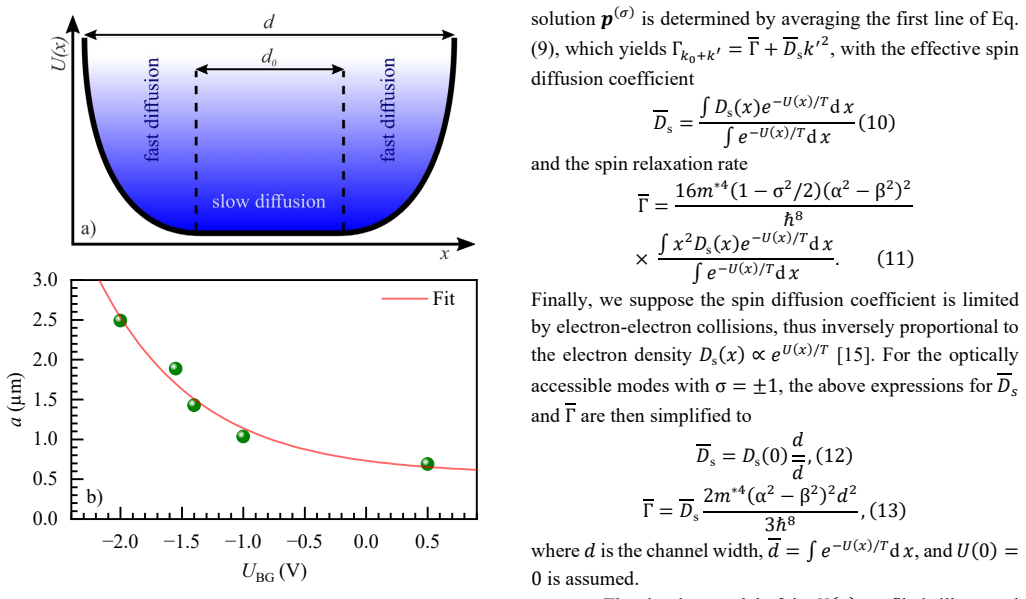
The argument is carried by a spin diffusion equation with a spatially inhomogeneous diffusion coefficient $D_s(x)$, solved in a channel of width $d$ with spin-conserving boundary conditions at the edges. Working near the persistent-spin-helix condition (equal Rashba and Dresselhaus spin-orbit couplings, which create a long-lived helical spin texture) and using perturbation theory in the spin-orbit terms, the authors reduce the problem to an effective one-dimensional diffusion and derive the observed diffusion coefficient as a density-weighted average over the channel. The load-bearing identity is $D_s = D_s(0) d/(d-a)$, where $a$ is a width-independent edge length fixed by the confining potential $U(x)$ through $a = \int (1 - e^{-U/T}) dx$; because $D_s(x)$ is assumed proportional to $e^{U(x)/T}$, the low-density edges contribute disproportionately fast diffusion. The same expansion gives a spin relaxation rate $\Gamma = D_s \frac{2 m^{*4}(\alpha^2-\beta^2)^2 d^2}{3\hbar^8}$, so the diffusion enhancement competes with the known $d^2$ suppression of Dyakonov-Perel relaxation and explains the measured spin diffusion length behavior.
What would settle it
A decisive experiment would repeat the spin-diffusion measurement with a pump spot well below 4 µm and with the region outside the channel borders masked or subtracted; if the extracted $D_s$ no longer rises as the channel narrows, the reported enhancement is an artifact of the one-dimensional fitting assumption rather than an intrinsic diffusion effect.
Extended reading notes
Core claim
The central claim is that the spin diffusion coefficient $D_s$ in a GaAs two-dimensional electron gas is not a fixed bulk property: it grows when the gas is laterally confined to a narrow Hall-bar channel, and grows further when the back-gate voltage lowers the electron density. In the authors' measurements, $D_s$ relative to its value in the 20 µm channel rises steadily as the channel narrows, reaching as much as 150% at the smallest widths and lowest densities, while the spin lifetime remains nearly constant at the voltage where it is already longest and the spin diffusion length $L_s = (D_s \tau_s)^{1/2}$ can nearly double. The proposed mechanism is an edge-density inhomogeneity: the confining potential depletes electrons near the channel edges, and because the spin diffusion coefficient is taken to be inversely proportional to the electron density, the edges diffuse spins faster than the center. Weighting this inhomogeneous profile across the channel gives $D_s = D_s(0) d/(d-a)$, where $a$ is an effective edge width that shrinks as higher electron density screens the confining potential, and this expression reproduces the observed trends with channel width and back-gate voltage. The paper concludes that electron density and channel geometry should be treated together in designing spin transport and coherence in confined two-dimensional electron gases.
Load-bearing premise
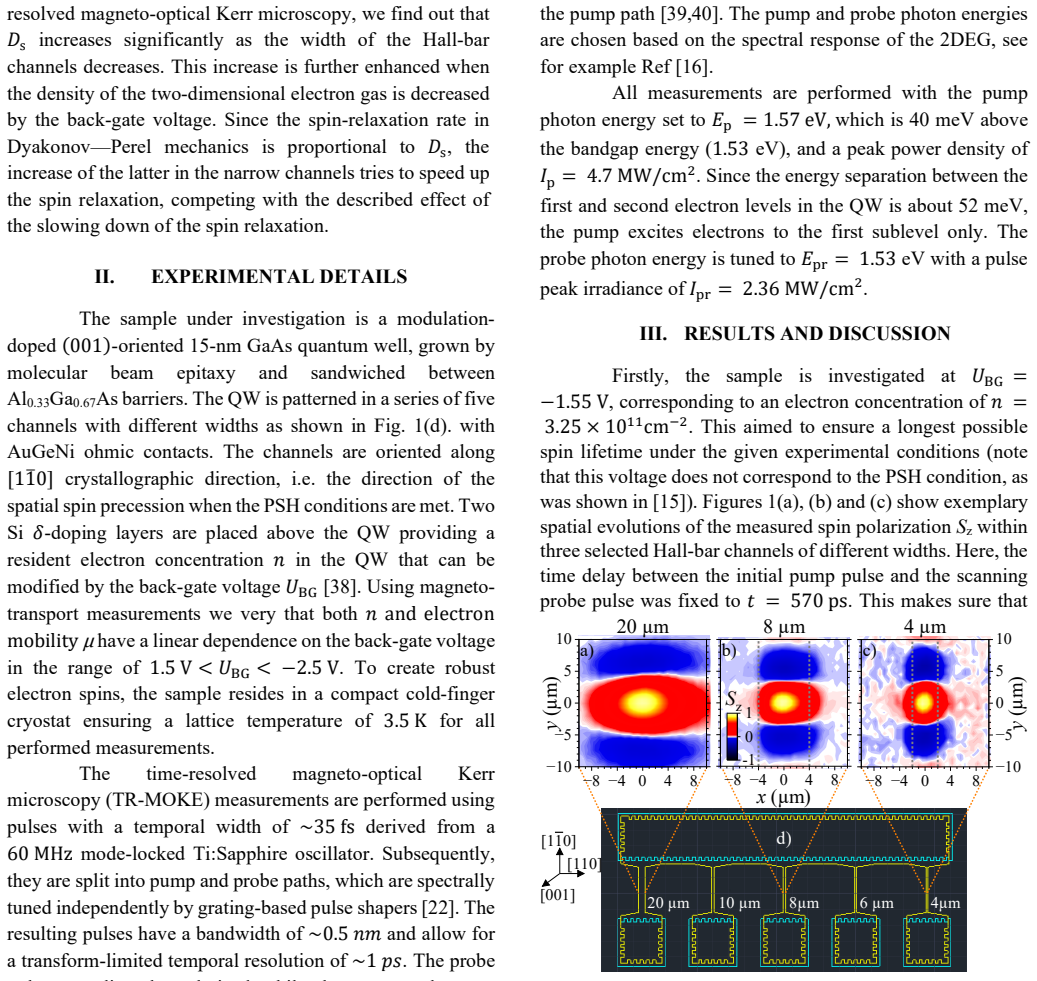
The measured spin signals are analyzed as if the spins diffuse purely along one direction inside the channel, even though the laser spot is nearly as wide as the narrowest channel and some of the signal comes from outside its edges.
Editorial extensions
If this is right
- Narrowing a Hall-bar channel from 20 µm to 4 µm raises the spin diffusion coefficient, and the rise is largest when the back-gate voltage is set to low electron density.
- Lowering the electron density amplifies the confinement-induced enhancement, while higher densities screen the edge potential and reduce it.
- The rise in $D_s$ does not simply shorten spin lifetime: at the voltage where the spin lifetime is longest, $\tau_s$ stays nearly flat, and the spin diffusion length can nearly double in narrow, low-density channels.
- The extracted edge-width parameter $a$ decreases when the back-gate voltage raises the electron density, consistent with screening of the channel-edge potential.
- Because spin relaxation through the Dyakonov-Perel mechanism is proportional to $D_s$, diffusion and relaxation should be evaluated together when designing confined spin-transport devices.
Reading between the lines
- If the edge-density mechanism is correct, deliberately engineering the edge potential—smooth versus abrupt confinement, or gate-defined edges—should change $D_s$ at fixed channel width and density in the way Eq. (15) predicts; this is not tested in the paper.
- The same $d/(d-a)$ enhancement should appear in other quasi-one-dimensional spin conductors with edge depletion, such as etched nanowires or gate-defined channels in two-dimensional materials, whenever spin diffusion is limited by electron-electron scattering.
- A measurement with a pump spot smaller than the narrowest channel and spatially confined detection would directly test whether the enhanced $D_s$ is intrinsic to the channel or partly an artifact of exciting spins outside its borders; the paper reports no such test.
Editorial analysis
A structured set of objections, weighed in public.
Referee Report
Summary. The manuscript reports time-resolved magneto-optical Kerr microscopy measurements of spin diffusion in GaAs quantum well Hall-bar channels of widths 4–20 μm, with back-gate tuning of electron density. The authors extract the spin diffusion coefficient D_s from the time-dependent broadening of Gaussian fits to the spin profile and report that D_s increases as the channel narrows, with the abstract claiming an increase up to 150% for the 4 μm channel at low electron density. They propose a theoretical model in which reduced electron density near the channel edges enhances local spin diffusion, leading to an effective width d−a, and they fit the data with a width-independent edge parameter a. The paper concludes that lateral confinement and density tuning are practical levers for controlling spin transport in two-dimensional electron gases.
Significance. If the reported enhancement is genuine, the result is novel and useful: it identifies a geometry-and-density lever for spin diffusion in 2DEGs, potentially informing spintronic device design. The experimental dataset is fairly comprehensive (five channel widths, five gate voltages), and the theoretical model offers a plausible physical mechanism. The derivation of Eqs. (10)–(16) is transparent, and the paper clearly identifies the regimes where the model is expected to hold. However, the central empirical claim rests on a 1D Gaussian diffusion extraction whose validity is questionable for the narrowest channels, and the model's 'confirmation' is weakened because the free parameter a is fitted to the same data the model then explains. These issues are load-bearing for the quantitative headline claim and need to be addressed before the result can be accepted at face value.
major comments (3)
- [Sec. III, Eq. (2) and Fig. 1]
- [Sec. III, Eq. (15) and Fig. 4]
- [Sec. III, Fig. 3(b) and (c)]
minor comments (5)
- [Sec. III, Eq. (1)]
- [Sec. III, after Eq. (12)]
- [Sec. III, Fig. 3(a)]
- [Conclusion]
- [Sec. III, first paragraph]
Circularity Check
The theoretical model is fitted to the very Ds/D0 data it is said to confirm, with the key Ds proportional to 1/n input imported from the authors' own Ref. [15]; the empirical trend itself is not circular, but the model validation is a fit rather than an independent prediction.
-
fitted input called prediction
[Sec. III, paragraph following Eq. (15); abstract, last sentence]
"We use Eq. (15) to fit the experimental curves in Fig. 3(a) and extract the fit parameter a for different back gate voltages."
The parameter a is extracted by fitting Eq. (15), Ds = Ds(0) d/(d-a), to exactly the Ds/D0 curves shown in Fig. 3(a), which are the same data presented as the main experimental result. The abstract then states: 'The developed theoretical model confirms the spatial inhomogeneities in the spin diffusion.' Because a is not independently predicted from the potential profile U(x) or from any separate measurement, the agreement between Eq. (15) and the data is a consequence of the fit, not an independent confirmation. The enhancement trend is absorbed into the fitted a rather than explained from first principles.
-
self citation load bearing
[Sec. III, between Eqs. (11) and (12)]
"Finally, we suppose the spin diffusion coefficient is limited by electron-electron collisions, thus inversely proportional to the electron density D_s(x) proportional to e^{U(x)/T} [15]."
The closed-form model Ds = Ds(0) d/(d-a) and the subsequent comparison with experiment depend on the assumption Ds(x) proportional to 1/n(x), imported from Ref. [15], a previous paper by several of the same authors (Anghel, Poshakinskiy, Yusa, Betz). The assumption is not re-derived or independently tested in the present paper, so the theoretical mechanism is not self-contained: its key input rests on a same-group citation. This does not make the whole empirical claim circular, but it weakens the paper's assertion that the model independently confirms the measured enhancement.
full rationale
The experimental observation that Ds increases with decreasing channel width and with decreasing electron density is an independent empirical result, obtained from the Gaussian-width analysis of Eq. (2) and plotted in Fig. 3(a); that part is not circular. The circularity arises in the theoretical 'confirmation'. The model's main output, Eq. (15), is fitted to the same Ds/D0 ratios that it is said to confirm, with a as a free parameter adjusted per back-gate voltage. A one-parameter fit can track a monotonic trend without providing independent evidence for the mechanism. Additionally, the simplification Ds(x) proportional to 1/n(x) that converts the general average in Eq. (10) into the closed form is imported from the authors' own Ref. [15] rather than derived or tested here. These two features make the model validation partially circular, though the underlying transport data and the qualitative trend remain meaningful. The score of 5 reflects a central claim that still has independent empirical content but where the theoretical support is substantially weakened by fitting to the data it purports to confirm and by reliance on a load-bearing self-citation.
Assumptions & free parameters
free parameters (1)
- a (edge width parameter) =
roughly 0 to 3 micrometers depending on U_BG (Fig. 4b)
assumptions (5)
- domain assumption Spin diffusion coefficient is inversely proportional to local electron density, D_s(x) proportional to e^{U(x)/T}, because diffusion is limited by electron-electron collisions.
- ad hoc to paper The channel potential is symmetric, flat in a central region of width d0, and rises only near the edges, so the edge parameter a is independent of channel width.
- domain assumption The perturbation parameter norm(Lambda_x w) is much less than 1, meaning small spin precession across the channel, following Ref. [32].
- domain assumption Spin dynamics in the channels are one-dimensional, with spin-conserving boundary conditions at the channel edges.
- domain assumption The electron gas can be treated as non-degenerate with temperature T, or equivalently T is replaced by the Fermi energy E_F(x) for the degenerate 2DEG.
Cite this review
Pith. "Pith review of Enhancing Spin Diffusion in GaAs Quantum Wells: The Role of Electron Density and Channel Width." pith.science (2026). https://pith.science/paper/M7WI73T2
@misc{pith2026250108023,
  author       = {Pith},
  title        = {Pith review of: Enhancing Spin Diffusion in GaAs Quantum Wells: The Role of Electron Density and Channel Width},
  year         = {2026},
  howpublished = {\url{https://pith.science/paper/M7WI73T2}},
  note         = {Machine review of arXiv:2501.08023}
}
read the original abstract
This study explores the relationship between spin diffusion, spin lifetime, electron density and lateral spatial confinement in two-dimensional electron gases hosted in GaAs quantum wells. Using time-resolved magneto-optical Kerr effect microscopy, we analyze how Hall-bar channel width and back-gate voltage modulation influence spin dynamics. The results reveal that the spin diffusion coefficient increases with reduced channel widths, a trend further amplified at lower electron concentrations achieved via back-gate voltages, where it increases up to 150% for the narrowest channels. The developed theoretical model confirms the spatial inhomogeneities in the spin diffusion as arising from electron-density variations within the channels. The results underscore the importance of tuning electron density and spatial geometry to optimize spin transport and coherence, providing valuable design considerations for spintronic devices where efficient spin manipulation is crucial.
Figures


Figures from the paper (1 more)
Forward citations
Cited by 1 Pith paper
-
Persistent spin grids with spin-orbit coupled 2D electron gas
Spin relaxation in a 2D electron gas can be suppressed by confining it to a grid of narrow channels, with a Z2 topological classification of the resulting persistent spin grids.
Reference graph
Works this paper leans on
-
[1]
S. D. Ganichev and L. E. Golub, physica status solidi (b) 251, 1801 (2014)
2014
-
[2]
V. Sih, R. C. Myers, Y. K. Kato, W. H. Lau, A. C. Gossard, and D. D. Awschalom, Nature Physics 1, 31 (2005)
work page 2005
-
[3]
Y. K. Kato, R. C. Myers, A. C. Gossard, and D. D. Awschalom, Science 306, 1910 (2004)
work page 2004
-
[4]
M. P. Walser, C. Reichl, W. Wegscheider, and G. Salis, Nature Physics 8, 757 (2012)
work page 2012
-
[5]
J. D. Koralek, C. P. Weber, J. Orenstein, B. A. Bernevig, S. -C. Zhang, S. Mack, and D. D. Awschalom, Nature 458, 610 (2009)
work page 2009
-
[6]
E. I. Rashba, Sov. Phys. Solid State 2, 1109 (1960)
work page 1960
-
[7]
Dresselhaus, Physical Review 100, 580 (1955)
G. Dresselhaus, Physical Review 100, 580 (1955)
work page 1955
-
[8]
B. A. Bernevig, J. Orenstein, and S. C. Zhang, Phys Rev Lett 97, 236601 (2006)
work page 2006
Show all 40 references
-
[9]
C. P. Weber, J. Orenstein, B. A. Bernevig, S. C. Zhang, J. Stephens, and D. D. Awschalom, Phys Rev Lett 98, 076604 (2007)
2007
-
[10]
Ishihara, T
J. Ishihara, T. Mori, T. Suzuki, S. Sato, K. Morita, M. Kohda, Y. Ohno, and K. Miyajima, Phys Rev Lett 130, 126701 (2023)
2023
-
[11]
Ishihara, T
J. Ishihara, T. Suzuki, G. Kitazawa, T. Mori, Y. Ohno, and K. Miyajima, Physical Review B 105 (2022)
2022
-
[12]
Ishihara, G
J. Ishihara, G. Kitazawa, Y. Furusho, Y. Ohno, H. Ohno, and K. Miyajima, Physical Review B 101 (2020)
2020
-
[13]
Ishihara, Y
J. Ishihara, Y. Ohno, and H. Ohno, Applied Physics Express 7, 013001 (2014)
2014
-
[14]
Ishihara, M
J. Ishihara, M. Ono, Y. Ohno, and H. Ohno, Applied Physics Letters 102 (2013)
2013
-
[15]
Anghel, A
S. Anghel, A. V. Poshakinskiy, K. Schiller, G. Yusa, T. Mano, T. Noda, and M. Betz, Journal of Applied Physics 132, 054301 (2022)
2022
-
[16]
Anghel et al., Physical Review B 103 (2021)
S. Anghel et al., Physical Review B 103 (2021)
2021
-
[17]
Anghel, F
S. Anghel, F. Passmann, K. J. Schiller, J. N. Moore, G. Yusa, T. Mano, T. Noda, M. Betz, and A. D. Bristow, Physical Review B 101 (2020)
2020
-
[18]
Passmann, A
F. Passmann, A. D. Bristow, J. N. Moore, G. Yusa, T. Mano, T. Noda, M. Betz, and S. Anghel, Physical Review B 99, 125404 (2019)
2019
-
[19]
Passmann, S
F. Passmann, S. Anghel, C. Ruppert, A. Bristow, A. Poshakinskiy, S. A. Tarasenko, and M. Betz, Semiconductor Science and Technology 34, 093002 (2019)
2019
-
[20]
Anghel et al
S. Anghel et al. , Physical Review B 97, 125410 (2018)
2018
-
[21]
Passmann, S
F. Passmann, S. Anghel, T. Tischler, A. V. Poshakinskiy, S. A. Tarasenko, G. Karczewski, T. Wojtowicz, A. D. Bristow, and M. Betz, Physical Review B 97, 201413(R) (2018)
2018
-
[22]
Anghel, A
S. Anghel, A. Singh, F. Passmann, H. Iwata, J. N. Moore, G. Yusa, X. Li, and M. Betz, Physical Review B 94, 035303 (2016)
2016
-
[23]
Altmann, F
P . Altmann, F. G. Hernandez, G. J. Ferreira, M. Kohda, C. Reichl, W. Wegscheider, and G. Salis, Phys Rev Lett 116, 196802 (2016)
2016
-
[24]
Altmann, M
P. Altmann, M. Kohda, C. Reichl, W. Wegscheider, and G. Salis, Physical Review B 92 (2015)
2015
-
[25]
Altmann, M
P. Altmann, M. P. Walser, C. Reichl, W. Wegscheider, and G. Salis, Physical Review B 90, 013001 (2014)
2014
-
[26]
Gelfert, C
S. Gelfert, C. Frankerl, C. Reichl, D. Schuh, G. Salis, W. Wegscheider, D. Bougeard, T. Korn, and C. Schüller, Physical Review B 101 (2020)
2020
-
[27]
Schwemmer et al., Applied Physics Letters 109, 4, 172106 (2016)
M. Schwemmer et al., Applied Physics Letters 109, 4, 172106 (2016)
2016
-
[28]
Schönhuber, M
C. Schönhuber, M. P. Walser, G. Salis, C. Reichl, W. Wegscheider, T. Korn, and C. Schüller, Physical Review B 89 (2014)
2014
-
[29]
Studer, G
M. Studer, G. Salis, K. Ensslin, D. C. Driscoll, and A. C. Gossard, Physical Review Letters 103, 027201 (2009)
2009
-
[30]
Studer, M
M. Studer, M. P. Walser, S. Baer, H. Rusterholz, S. Schön, D. Schuh, W. Wegscheider, K. Ensslin, and G. Salis, Physical Review B 82 (2010)
2010
-
[31]
Kunihashi, H
Y. Kunihashi, H. Sanada, Y. Tanaka, H. Gotoh, K. Onomitsu, K. Nakagawara, M. Kohda, J. Nitta, and T. Sogawa, Physical Review Letters 119, 187703 (2017)
2017
-
[32]
A. G. Mal’shukov and K. A. Chao, Physical Review B 61, R2413 (2000)
2000
-
[33]
A. A. Kiselev and K. W. Kim, Physical Review B 61, 13115 (2000)
2000
-
[34]
Chang, J
C.-H. Chang, J. Tsai, H.- F. Lo, and A. G. Mal’shukov, Physical Review B 79, 125310 (2009)
2009
-
[35]
Kunihashi, M
Y. Kunihashi, M. Kohda, and J. Nitta, Physical Review B 85, 035321 (2012)
2012
-
[36]
V. A. Slipko and Y. V. Pershin, Physical Review B 84, 155306 (2011)
2011
-
[37]
Eberle, D
F. Eberle, D. Schuh, D. Bougeard, D. Weiss, and M. Ciorga, Physical Review Applied 16, 014010 (2021)
2021
-
[38]
J. N. Moore, J. Hayakawa, T. Mano, T. Noda, and G. Yusa, Phys Rev Lett 118, 076802 (2017)
2017
-
[39]
T. Henn, T. Kießling, L. W. Molenkamp, D. Reuter, A. D. Wieck, K. Biermann, P. V. Santos, and W. Ossau, physica status solidi (b) 251, 1839 (2014)
2014
-
[40]
T. Henn, T. Kiessling, W. Ossau, L. W. Molenkamp, K. Biermann, and P. V. Santos, Rev. Sci. Instrum. 84, 123903 (2013)
2013
Reviewed August 10, 2026 · model on record in the stance chip above.
Discussion (0). Continue with ORCID to comment.