REVIEW 5 major objections 6 minor 1 cited by
Multimodal Fake News Video Explanation: Dataset, Analysis and Evaluation
T0 review · 5 major / 6 minor · reviewed 2026-08-10 · deepseek-v4-flash
Pith's one-line read This paper introduces fake news video explanation as a new task, with a 2,672-post dataset and a graph-based model that outperforms existing baselines.
desk verdict A useful first dataset and task for explaining fake news videos, but the gold labels inherit veracity from source sets without re-verification; fix that and the access issue before treating it as a benchmark. read the letter →
The pith
A machine-rendered reading of the paper's core claim, the machinery that carries it, and where it could break.
The reading
What carries the argument
The central objects are the FakeVE dataset and the MRGT architecture. The dataset supplies 2,672 posts labeled with one of four falsity aspects and a human reference explanation; the four-aspect taxonomy is the annotation scheme that organizes what counts as an explanation. The MRGT carries the argument: it concatenates title, sampled video frames, and audio transcript tokens, encodes them with a Transformer, builds a multimodal relation graph whose edges link semantically related text tokens, frames matched to title tokens by cosine similarity, and frames to transcripts, then applies a graph convolutional network with a residual connection before a BART decoder generates the explanation autoregressively.
What would settle it
A fact-checking audit of a random sample of FakeVE posts against independent external sources would settle whether the gold explanations are reliable; a human preference study comparing MRGT explanations with GPT-4o's on accuracy and usefulness would settle whether the model's claimed advantage is real.
Extended reading notes
Core claim
The paper's central claim is that the falsity of a multimodal news video can be captured in a short natural language explanation, and that this explanation can be generated automatically from the title, video frames, and audio transcript. This claim rests on FakeVE, which the authors present as the first dataset to definitively explain four real-life fake news video aspects, with 2,672 posts inherited from existing fake news video datasets and explanations written by trained annotators. The paper further claims that MRGT, by representing cross-modal relations as a graph and propagating information through a graph convolutional network before decoding with BART, has a significant advantage in capturing the multimodal feature association of video and generating logically coherent explanatory text, supported by higher BLEU, ROUGE, METEOR and Sentence-BERT scores than all compared baselines and by ablations showing the graph and each modality contribute. It also claims that the human annotations are high quality, with inter-annotator agreement of 0.865 and higher G-Eval scores than GPT-4o and Qwen2-VL on persuasiveness, informativeness, soundness, and readability.
Load-bearing premise
The load-bearing premise is that every one of the 2,672 posts inherited from FMNV and FakeTT is genuinely fake, and that an annotator watching the video and reading the title can identify the falsity without external fact-checking.
Editorial extensions
If this is right
- FNVE becomes an available benchmark task: future work can train and compare explanation generators on FakeVE using standard metrics.
- The four-aspect taxonomy gives content moderation systems a concrete vocabulary for why a video is false, not just that it is false.
- The dataset's explanations can be used as fine-grained evidence chains to train models to recognize specific tampering techniques such as splice tampering and synthetic voiceover.
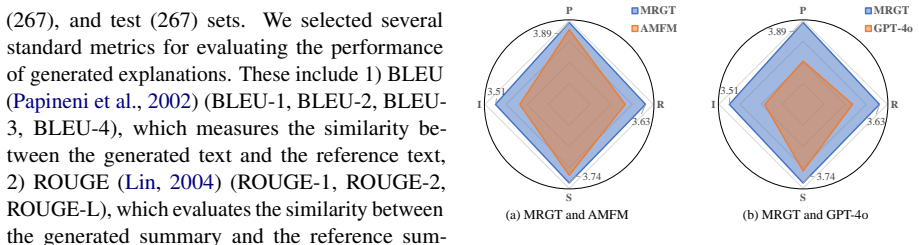
- The reported results imply that combining a relation graph with a pretrained encoder-decoder improves explanation coherence enough to beat strong multimodal language models on this task.
Reading between the lines
- The four-aspect taxonomy could be extended to other languages and platforms, but the annotation protocol would need external fact-checking to verify the source labels.
- The paper's evaluation relies on automatic n-gram metrics and G-Eval; a human preference study on explanation accuracy would test whether MRGT's higher scores correspond to more useful explanations.
- A natural testable extension would be to use the explanations as supervision for detecting the specific manipulation type, not just generating text.
- Because FakeVE inherits its veracity labels from FMNV and FakeTT, the dataset's quality is bounded by the accuracy of those source labels; a fact-check audit could quantify that bound.
Editorial analysis
A structured set of objections, weighed in public.
Referee Report
Summary. The paper introduces the Fake News Video Explanation (FNVE) task, in which a multimodal news post (title, video frames, audio transcript) is used to generate a natural-language explanation of why the news video is false. The authors construct FakeVE, a dataset of 2,672 fake news video posts collected from the existing FMNV and FakeTT datasets, and manually annotate each post with an explanation and one of four error aspects (Contextual Dishonesty, Splice Tampering, Synthetic Voiceover, Contrived Absurdity). They report annotation statistics, analyze aspect distributions, and propose a Multimodal Relation Graph Transformer (MRGT) that combines a Transformer encoder, a graph convolutional network over a multimodal relation graph, and a BART decoder as a benchmark model. Experiments compare MRGT against several MLLM and fine-tuned baselines, with additional ablation studies on modality and graph contributions.
Significance. If the dataset labels are reliable, FakeVE would be a valuable first resource for the new task of natural-language explanation of fake news videos, going beyond binary veracity classification. The paper is clearly useful to the community in proposing a concrete task formulation, a detailed annotation protocol with good inter-annotator agreement (reported Cohen's kappa 0.865), and a reproducible baseline architecture. The exploratory analysis of aspect distribution and the qualitative case studies are helpful for understanding the task. However, the significance is conditional on two load-bearing assumptions: that the inherited veracity labels from FMNV and FakeTT are correct without independent re-verification, and that the LLM-based G-Eval scores used to validate annotation quality are themselves trustworthy. The absence of a dataset release mechanism also limits the community's ability to audit the resource.
major comments (5)
- [Section 3.1] The veracity labels of all 2,672 posts are inherited from FMNV and FakeTT without independent re-verification. The annotation instructions ask annotators to watch the video and check the title, but do not ask them to consult external sources or to independently determine whether the post is actually false. If any source-label false positives exist (e.g., true posts with exaggerated titles, opinion content, or satire), the gold explanations will be invalid, and both the annotation-quality evaluation in Section 3.3 and the supervised training signal for MRGT in Sections 5.3 and 5.4 will be contaminated. Please add a label re-verification step (e.g., fact-checking a random sample against external sources, or a two-stage annotation in which annotators first confirm falsity) and report the resulting agreement or disagreement rates.
- [Section 3.3.1 and Figure 4] The evaluation of annotation quality and of generated explanations relies entirely on G-Eval, an LLM-based referenceless scorer, with no human validation of G-Eval's ratings on this specific domain and no error bars or statistical tests. Figure 4 reports scores such as 4.61 for annotators, but without knowing whether G-Eval agrees with human judgments for this task, the claim that 'manual annotation performs well' is not supported. Similarly, the model comparisons in Section 5.5 use the same unvalidated G-Eval protocol. Please add a human evaluation on a sample of explanations, report inter-judge agreement, and include variance or significance tests for the claim that MRGT has a 'significant advantage.'
- [Section 4.2, Eq. (2)] The construction of the multimodal relation graph is not fully specified. The three rules in Section 4.2 state that 'semantically related text nodes' are linked via dependency tree relations, that edges are added between video frames and title tokens with 'highest modal similarity measured by cosine similarity,' and that 'visual nodes' are linked by adding an edge between video frame and audio transcript. It is unclear which tokens count as nodes, how many edges are added per rule, what threshold is used for cosine similarity, and how dependency relations apply to video-frame nodes. Without an exact adjacency-matrix definition, MRGT is not reproducible, and the source of the improvement attributed to the graph in Table 3 cannot be independently assessed. Please provide the full formal construction of A and include the release of code that implements it.
- [Section 1, Contribution bullet] The paper states 'we release our code and dataset,' but no repository URL, DOI, or other access mechanism is provided anywhere in the manuscript. Since the paper's central contribution is a new dataset, the community cannot audit the inherited labels, the annotation protocol, or the benchmark results without access to the data. Please include a working anonymous link or an availability statement in the camera-ready version.
- [Section 5.2 and Table 2] Table 2 reports single-run scores on a test set of only 267 posts, and the differences between MRGT and the best baseline are small on several metrics (e.g., BLEU-4 8.21 vs. 6.70 for GPT-4o, METEOR 91.62 vs. 86.68 for AMFM). No confidence intervals, multiple seeds, or significance tests are reported. The abstract's claim that MRGT 'has a significant advantage' therefore needs statistical support, especially given that the test set is small and the baselines include zero-shot MLLMs that were not fine-tuned.
minor comments (6)
- [Section 3.1] The paper reports 'Cohen's Kappa coefficient (Fleiss, 1971)' but the Fleiss reference is for Fleiss' kappa for multiple raters; please clarify whether Cohen's kappa or Fleiss' kappa was computed and over how many annotators.
- [Figure 2 and Section 3.2] There are inconsistencies in the abbreviations: Figure 2(a) uses 'CDS' while the text uses 'CD,' and 'the minimum number of cas' should be 'CA.'
- [Sections 5.1 and 5.3] The baseline names are inconsistent: Section 5.3 refers to 'PTSN' while Section 5.1 and Table 2 list 'NCT,' and the model is written as both 'HAA V' and 'HAAV.'
- [Section 4.3] The term 'spurious explanation' appears several times (e.g., 'generate spurious explanations,' 'spurious inference') and should be replaced with 'generated explanation' or 'target explanation.' These appear to be translation artifacts.
- [Section 3.3.2] The prompt template P is described with placeholders but the actual prompt sent to the MLLMs is not shown in full; please provide the complete template and the formatting used for the audio transcript and video frames.
- [Throughout] There are several remaining typos and awkward phrasings, including 'Pering a news video' (Section 3.1), 'utuber' (Section 3.1), and 'violates basic common sense or logical errors' (Section 3.2). A careful proofreading pass is recommended.
Circularity Check
No circularity: the dataset construction and MRGT benchmark are self-contained; inherited veracity labels are a data-quality concern, not a circular reduction.
full rationale
FakeVE is assembled from two existing datasets (FMNV and FakeTT), and the gold explanations are produced by human annotators following instructions; no parameter is fitted to the target explanations and then reported as a prediction. MRGT is trained with cross-entropy on a training split and evaluated on a held-out test split (Section 5.2), and the multimodal graph edges in Eq. (1)-(3) are computed from input modalities (title, frames, transcript), not from the gold explanation Y. The claimed MRGT advantage is supported by BLEU/ROUGE/METEOR/SentBERT comparisons and ablation in Tables 2-3, so the benchmark does not reduce to its inputs. The one same-group citation (FMNV, Wang et al. 2025) supplies 1,500 inherited fake labels and the annotation scheme does not re-verify them against external sources; this is a label-validity limitation of the dataset, but it is not a circular derivation in the sense of Eq. X = Eq. Y or a fitted quantity renamed as a prediction. No uniqueness theorem or ansatz is imported from the authors' prior work.
Assumptions & free parameters
assumptions (4)
- domain assumption The veracity labels in source datasets FMNV and FakeTT are correct.
- domain assumption Annotators can determine why a video is false from the title, video frames, and audio transcript alone.
- ad hoc to paper The four aspects (Contextual Dishonesty, Splice Tampering, Synthetic Voiceover, Contrived Absurdity) are a complete and meaningful taxonomy for fake news video explanations.
- domain assumption G-Eval scores from an LLM reflect the true quality of explanations.
Cite this review
Pith. "Pith review of Multimodal Fake News Video Explanation: Dataset, Analysis and Evaluation." pith.science (2026). https://pith.science/paper/NSOMM6JF
@misc{pith2026250108514,
  author       = {Pith},
  title        = {Pith review of: Multimodal Fake News Video Explanation: Dataset, Analysis and Evaluation},
  year         = {2026},
  howpublished = {\url{https://pith.science/paper/NSOMM6JF}},
  note         = {Machine review of arXiv:2501.08514}
}
read the original abstract
Multimodal fake news videos are difficult to interpret because they require comprehensive consideration of the correlation and consistency between multiple modes. Existing methods deal with fake news videos as a classification problem, but it's not clear why news videos are identified as fake. Without proper explanation, the end user may not understand the underlying meaning of the falsehood. Therefore, we propose a new problem - Fake news video Explanation (FNVE) - given a multimodal news post containing a video and title, our goal is to generate natural language explanations to reveal the falsity of the news video. To that end, we developed FakeVE, a new dataset of 2,672 fake news video posts that can definitively explain four real-life fake news video aspects. In order to understand the characteristics of fake news video explanation, we conducted an exploratory analysis of FakeVE from different perspectives. In addition, we propose a Multimodal Relation Graph Transformer (MRGT) based on the architecture of multimodal Transformer to benchmark FakeVE. The empirical results show that the results of the various benchmarks (adopted by FakeVE) are convincing and provide a detailed analysis of the differences in explanation generation of the benchmark models.
Figures


Figures from the paper (4 more)



Forward citations
Cited by 1 Pith paper
-
A New Dataset and Benchmark for Grounding Multimodal Misinformation
GroundLie360 is a 2,044-video Snopes-derived benchmark with fine-grained annotations localizing six types of multimodal misinformation; the VLM prompting baseline FakeMark shows the task remains difficult.
Reference graph
Works this paper leans on
-
[1]
Combating online misinformation videos: Characterization, detection, and future directions
Yuyan Bu, Qiang Sheng, Juan Cao, Peng Qi, Danding Wang, and Jintao Li. Combating online misinformation videos: Characterization, detection, and future directions. In Proceedings of the 31st ACM International Conference on Multimedia , pages 8770--8780, 2023
work page 2023
-
[2]
Using topic modeling and adversarial neural networks for fake news video detection
Hyewon Choi and Youngjoong Ko. Using topic modeling and adversarial neural networks for fake news video detection. In Proceedings of the 30th ACM international conference on information & knowledge management , pages 2950--2954, 2021
work page 2021
-
[3]
Identifying Misinformation on YouTube through Transcript Contextual Analysis with Transformer Models
Christos Christodoulou, Nikos Salamanos, Pantelitsa Leonidou, Michail Papadakis, and Michael Sirivianos. Identifying misinformation on youtube through transcript contextual analysis with transformer models. arXiv preprint arXiv:2307.12155 , 2023
work page Pith review arXiv 2023
-
[4]
Meteor universal: Language specific translation evaluation for any target language
Michael Denkowski and Alon Lavie. Meteor universal: Language specific translation evaluation for any target language. In Proceedings of the ninth workshop on statistical machine translation , pages 376--380, 2014
work page 2014
-
[5]
Bert: Pre-training of deep bidirectional transformers for language understanding
Jacob Devlin, Ming-Wei Chang, Kenton Lee, and Kristina Toutanova. Bert: Pre-training of deep bidirectional transformers for language understanding. arXiv preprint arXiv:1810.04805 , 2018
arXiv 2018
-
[6]
An image is worth 16x16 words: Transformers for image recognition at scale
Alexey Dosovitskiy, Lucas Beyer, Alexander Kolesnikov, Dirk Weissenborn, Xiaohua Zhai, Thomas Unterthiner, Mostafa Dehghani, Matthias Minderer, Georg Heigold, Sylvain Gelly, et al. An image is worth 16x16 words: Transformers for image recognition at scale. arXiv preprint arXiv:2010.11929 , 2020
arXiv 2010
-
[7]
Market quavers after fake ap tweet says obama was hurt in white house explosions
Dina ElBoghdady. Market quavers after fake ap tweet says obama was hurt in white house explosions. The Washington Post , 23, 2013
work page 2013
-
[8]
Measuring nominal scale agreement among many raters
Joseph L Fleiss. Measuring nominal scale agreement among many raters. Psychological bulletin , 76(5):378, 1971
work page 1971
Show all 42 references
-
[9]
A novel method for detecting misinformation in videos, utilizing reverse image search, semantic analysis, and sentiment comparison of metadata
Dhanvi Ganti. A novel method for detecting misinformation in videos, utilizing reverse image search, semantic analysis, and sentiment comparison of metadata. Utilizing Reverse Image Search, Semantic Analysis, and Sentiment Comparison of Metadata (June 5, 2022) , 2022
2022
-
[10]
Generating visual explanations
Lisa Anne Hendricks, Zeynep Akata, Marcus Rohrbach, Jeff Donahue, Bernt Schiele, and Trevor Darrell. Generating visual explanations. In Computer Vision--ECCV 2016: 14th European Conference, Amsterdam, The Netherlands, October 11--14, 2016, Proceedings, Part IV 14 , pages 3--19...
2016
-
[11]
Towards automatic detection of misinformation in online medical videos
Rui Hou, Ver \'o nica P \'e rez-Rosas, Stacy Loeb, and Rada Mihalcea. Towards automatic detection of misinformation in online medical videos. In 2019 International conference on multimodal interaction , pages 235--243, 2019
2019
-
[12]
Misinformation detection on youtube using video captions
Raj Jagtap, Abhinav Kumar, Rahul Goel, Shakshi Sharma, Rajesh Sharma, and Clint P George. Misinformation detection on youtube using video captions. arXiv preprint arXiv:2107.00941 , 2021
2021 arXiv
-
[13]
e-vil: A dataset and benchmark for natural language explanations in vision-language tasks
Maxime Kayser, Oana-Maria Camburu, Leonard Salewski, Cornelius Emde, Virginie Do, Zeynep Akata, and Thomas Lukasiewicz. e-vil: A dataset and benchmark for natural language explanations in vision-language tasks. In Proceedings of the IEEE/CVF international conference on compute...
2021
-
[14]
Textual explanations for self-driving vehicles
Jinkyu Kim, Anna Rohrbach, Trevor Darrell, John Canny, and Zeynep Akata. Textual explanations for self-driving vehicles. In Proceedings of the European conference on computer vision (ECCV) , pages 563--578, 2018
2018
-
[15]
Richard Landis and Gary G
J. Richard Landis and Gary G. Koch. The measurement of observer agreement for categorical data. Biometrics , page 159, Mar 1977
1977
-
[16]
Bart: Denoising sequence-to-sequence pre-training for natural language generation, translation, and comprehension
Mike Lewis, Yinhan Liu, Naman Goyal, Marjan Ghazvininejad, Abdelrahman Mohamed, Omer Levy, Ves Stoyanov, and Luke Zettlemoyer. Bart: Denoising sequence-to-sequence pre-training for natural language generation, translation, and comprehension. arXiv preprint arXiv:1910.13461 , 2019
1910 arXiv
-
[17]
Rouge: A package for automatic evaluation of summaries
Chin-Yew Lin. Rouge: A package for automatic evaluation of summaries. In Text summarization branches out , pages 74--81, 2004
2004
-
[18]
Covid-vts: Fact extraction and verification on short video platforms
Fuxiao Liu, Yaser Yacoob, and Abhinav Shrivastava. Covid-vts: Fact extraction and verification on short video platforms. arXiv preprint arXiv:2302.07919 , 2023
2023 arXiv
-
[19]
Fixing weight decay regularization in adam
Ilya Loshchilov and Frank Hutter. Fixing weight decay regularization in adam. 2018
2018
-
[20]
Explainable ai approach towards toxic comment classification
Aditya Mahajan, Divyank Shah, and Gibraan Jafar. Explainable ai approach towards toxic comment classification. In Emerging Technologies in Data Mining and Information Security: Proceedings of IEMIS 2020, Volume 2 , pages 849--858. Springer, 2021
2020
-
[21]
Deep multi-task model for sarcasm detection and sentiment analysis in arabic language
Abdelkader El Mahdaouy, Abdellah El Mekki, Kabil Essefar, Nabil El Mamoun, Ismail Berrada, and Ahmed Khoumsi. Deep multi-task model for sarcasm detection and sentiment analysis in arabic language. arXiv preprint arXiv:2106.12488 , 2021
2021 arXiv
-
[22]
Multi-modal semantic inconsistency detection in social media news posts
Scott McCrae, Kehan Wang, and Avideh Zakhor. Multi-modal semantic inconsistency detection in social media news posts. In International Conference on Multimedia Modeling , pages 331--343. Springer, 2022
2022
-
[23]
The covid-19 ‘infodemic’: a new front for information professionals
Salman Bin Naeem and Rubina Bhatti. The covid-19 ‘infodemic’: a new front for information professionals. Health Information & Libraries Journal , 37(3):233--239, 2020
2020
-
[24]
Bleu: a method for automatic evaluation of machine translation
Kishore Papineni, Salim Roukos, Todd Ward, and Wei-Jing Zhu. Bleu: a method for automatic evaluation of machine translation. In Proceedings of the 40th annual meeting of the Association for Computational Linguistics , pages 311--318, 2002
2002
-
[25]
Toward safer highways, application of xgboost and shap for real-time accident detection and feature analysis
Amir Bahador Parsa, Ali Movahedi, Homa Taghipour, Sybil Derrible, and Abolfazl Kouros Mohammadian. Toward safer highways, application of xgboost and shap for real-time accident detection and feature analysis. Accident Analysis & Prevention , 136:105405, 2020
2020
-
[26]
Detecting harmful memes and their targets
Shraman Pramanick, Dimitar Dimitrov, Rituparna Mukherjee, Shivam Sharma, Md Shad Akhtar, Preslav Nakov, and Tanmoy Chakraborty. Detecting harmful memes and their targets. arXiv preprint arXiv:2110.00413 , 2021
2021 arXiv
-
[27]
Fakesv: A multimodal benchmark with rich social context for fake news detection on short video platforms
Peng Qi, Yuyan Bu, Juan Cao, Wei Ji, Ruihao Shui, Junbin Xiao, Danding Wang, and Tat-Seng Chua. Fakesv: A multimodal benchmark with rich social context for fake news detection on short video platforms. In Proceedings of the AAAI Conference on Artificial Intelligence , volume 3...
2023
-
[28]
Hierarchical multi-modal contextual attention network for fake news detection
Shengsheng Qian, Jinguang Wang, Jun Hu, Quan Fang, and Changsheng Xu. Hierarchical multi-modal contextual attention network for fake news detection. In Proceedings of the 44th international ACM SIGIR conference on research and development in information retrieval , pages 153--...
2021
-
[29]
Learning transferable visual models from natural language supervision
Alec Radford, Jong Wook Kim, Chris Hallacy, Aditya Ramesh, Gabriel Goh, Sandhini Agarwal, Girish Sastry, Amanda Askell, Pamela Mishkin, Jack Clark, et al. Learning transferable visual models from natural language supervision. In International conference on machine learning , p...
2021
-
[30]
Faster r-cnn: Towards real-time object detection with region proposal networks
Shaoqing Ren, Kaiming He, Ross Girshick, and Jian Sun. Faster r-cnn: Towards real-time object detection with region proposal networks. Advances in neural information processing systems , 28, 2015
2015
-
[31]
Nlp-based feature extraction for the detection of covid-19 misinformation videos on youtube
Juan Carlos Medina Serrano, Orestis Papakyriakopoulos, and Simon Hegelich. Nlp-based feature extraction for the detection of covid-19 misinformation videos on youtube. In Proceedings of the 1st Workshop on NLP for COVID-19 at ACL 2020 , 2020
2020
-
[32]
A multimodal misinformation detector for covid-19 short videos on tiktok
Lanyu Shang, Ziyi Kou, Yang Zhang, and Dong Wang. A multimodal misinformation detector for covid-19 short videos on tiktok. In 2021 IEEE international conference on big data (big data) , pages 899--908. IEEE, 2021
2021
-
[33]
Seeing is believing: Is video modality more powerful in spreading fake news via online messaging apps? Journal of Computer-Mediated Communication , 26(6):301--319, 2021
S Shyam Sundar, Maria D Molina, and Eugene Cho. Seeing is believing: Is video modality more powerful in spreading fake news via online messaging apps? Journal of Computer-Mediated Communication , 26(6):301--319, 2021
2021
-
[34]
Attention is all you need
Ashish Vaswani, Noam Shazeer, Niki Parmar, Jakob Uszkoreit, Llion Jones, Aidan N Gomez, ukasz Kaiser, and Illia Polosukhin. Attention is all you need. Advances in neural information processing systems , 30, 2017
2017
-
[35]
Cider: Consensus-based image description evaluation
Ramakrishna Vedantam, C Lawrence Zitnick, and Devi Parikh. Cider: Consensus-based image description evaluation. In Proceedings of the IEEE conference on computer vision and pattern recognition , pages 4566--4575, 2015
2015
-
[36]
The challenges of studying misinformation on video-sharing platforms during crises and mass-convergence events
Sukrit Venkatagiri, Joseph S Schafer, and Stephen Prochaska. The challenges of studying misinformation on video-sharing platforms during crises and mass-convergence events. arXiv preprint arXiv:2303.14309 , 2023
2023 arXiv
-
[37]
Zhao, John Canny, and Avideh Zakhor
Kehan Wang, David Chan, Seth Z. Zhao, John Canny, and Avideh Zakhor. Misinformation detection in social media video posts, 2022
2022
-
[38]
Eann: Event adversarial neural networks for multi-modal fake news detection
Yaqing Wang, Fenglong Ma, Zhiwei Jin, Ye Yuan, Guangxu Xun, Kishlay Jha, Lu Su, and Jing Gao. Eann: Event adversarial neural networks for multi-modal fake news detection. In Proceedings of the 24th acm sigkdd international conference on knowledge discovery & data mining , page...
2018
-
[39]
The (minimal) persuasive advantage of political video over text
Chloe Wittenberg, Ben M Tappin, Adam J Berinsky, and David G Rand. The (minimal) persuasive advantage of political video over text. Proceedings of the National Academy of Sciences , 118(47):e2114388118, 2021
2021
-
[40]
Km-bart: Knowledge enhanced multimodal bart for visual commonsense generation
Yiran Xing, Zai Shi, Zhao Meng, Gerhard Lakemeyer, Yunpu Ma, and Roger Wattenhofer. Km-bart: Knowledge enhanced multimodal bart for visual commonsense generation. arXiv preprint arXiv:2101.00419 , 2021
2021 arXiv
-
[41]
Multimodal transformer for multimodal machine translation
Shaowei Yao and Xiaojun Wan. Multimodal transformer for multimodal machine translation. In Proceedings of the 58th annual meeting of the association for computational linguistics , pages 4346--4350, 2020
2020
-
[42]
Multi-modal fake news detection on social media via multi-grained information fusion
Yangming Zhou, Yuzhou Yang, Qichao Ying, Zhenxing Qian, and Xinpeng Zhang. Multi-modal fake news detection on social media via multi-grained information fusion. In Proceedings of the 2023 ACM International Conference on Multimedia Retrieval , pages 343--352, 2023
2023
Reviewed August 10, 2026 · model on record in the stance chip above.
Discussion (0). Continue with ORCID to comment.