REVIEW 4 major objections 4 minor 67 references
Text Semantics to Flexible Design: A Residential Layout Generation Method Based on Stable Diffusion Model
T0 review · 4 major / 4 minor · reviewed 2026-08-10 · deepseek-v4-flash
Pith's one-line read Text-conditioned, boundary-aware Stable Diffusion with LoRA fine-tuning generates residential layouts that satisfy multimodal constraints better than Pix2Pix and HouseDiffusion, even when room-area or connection details are missing.
desk verdict The prompt-template idea is genuinely useful, but the evaluation cannot support the 'better than SOTA' claim; with a corrected protocol and released artifacts this could be a solid application paper. read the letter →
The pith
A machine-rendered reading of the paper's core claim, the machinery that carries it, and where it could break.
The reading
What carries the argument
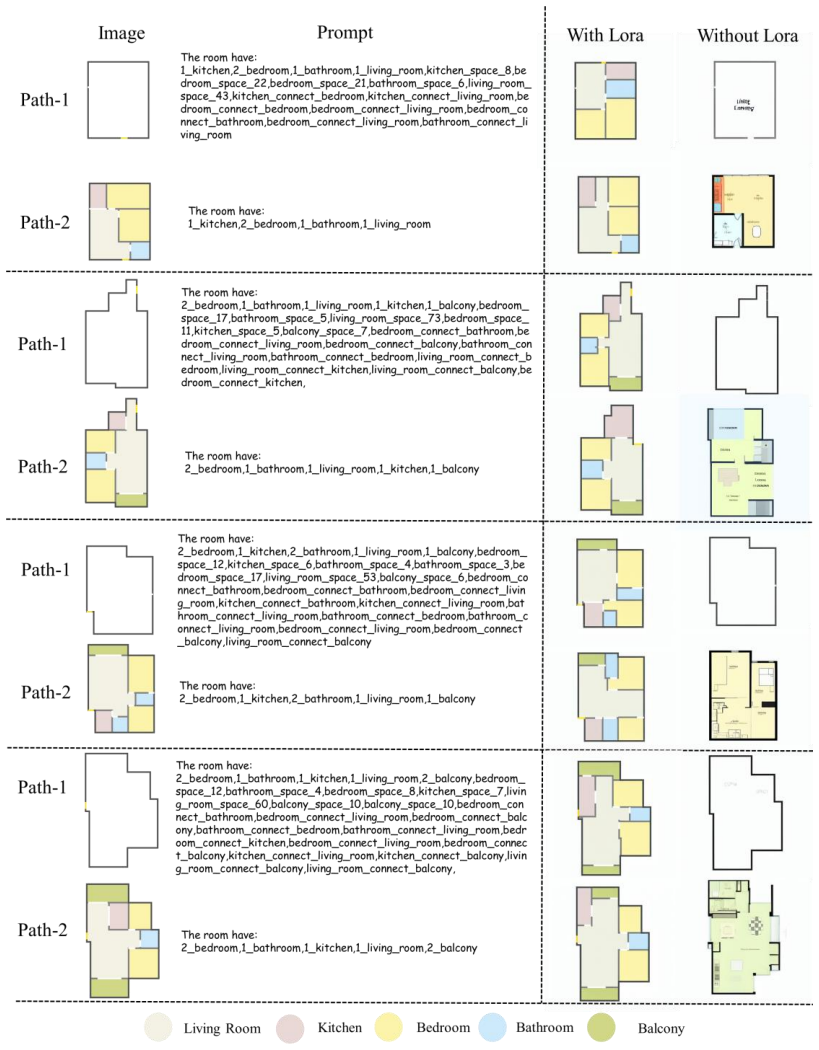
The load-bearing machinery is the pairing of three components. (1) A knowledge-graph-to-text mapping converts each floor plan's room nodes and connectivity edges into a standardized sentence sequence (room types and counts, room areas, then adjacency relations), making design rules available as natural-language conditioning. (2) Low-Rank Adaptation (LoRA) fine-tunes the frozen Stable Diffusion U-Net and text encoder on recolored, upsampled RPLAN data, so the pretrained model learns floor-plan style and rule-following behavior with a small trainable parameter set. (3) ControlNet, conditioned on Canny-edge boundary images, adjusts the U-Net features to keep the generated layout inside the user-supplied boundary, while CLIP embeds the text prompt into the same latent space as the images. The two pathways differ only in the image condition: a full reference layout for Path 1 versus a boundary sketch for Path 2.
What would settle it
Re-run the evaluation with the 8,000 comparison references drawn exclusively from a hold-out subset never used in LoRA fine-tuning, and report the four metrics separately for that unseen subset; if the LoRA-tuned model's advantage over HouseDiffusion and Pix2Pix shrinks substantially or reverses, the flexibility claim is falsified.
Extended reading notes
Core claim
The central claim is that a general-purpose text-to-image diffusion model can be specialized into a cross-modal residential layout generator that is more flexible than prior graph- or boundary-conditioned models. The paper implements this with two generation paths sharing the same text conditioning: Path 1 uses a natural-language prompt plus a reference floor plan image, and Path 2 uses the prompt plus a Canny-detected boundary image fed through ControlNet. Design knowledge is extracted from the RPLAN dataset into a knowledge graph whose nodes carry room type, position, and area and whose edges encode connectivity; this graph is then rendered as structured sentences such as 'bedroom_1 connect bathroom', which form the prompt. The paper reports that the LoRA-tuned model achieves FID of 22.1 (Path 1) and 28.5 (Path 2), versus 32.6 for HouseDiffusion and 142.6 for Pix2Pix, with higher PSNR and SSIM and lower LPIPS on both paths. The ablation experiments are used to argue that omitting room-area or room-connection information degrades strict compliance but leaves the model able to invent plausible layouts, which the paper presents as evidence of flexibility under incomplete semantic information.
Load-bearing premise
The evaluation's validity rests on the assumption that the 8,000 real floor plans used as references were not seen during training and that looking like those drawings is a good proxy for design quality; the paper states only that it randomly selected 8,000 pairs, with no train/test split or pairing protocol.
Editorial extensions
If this is right
- If the method works as reported, a homeowner can state 'three bedrooms, one balcony, living room connects kitchen' and receive a plausible floor plan without preparing bubble diagrams, room masks, or a knowledge graph.
- The shared text conditioning means the same fine-tuned model serves both the reference-image path and the boundary-only path, so a designer can begin with a rough boundary and later supply a preferred precedent layout without retraining.
- The ablation results imply the generator can operate with partial constraints: missing area descriptions or missing connectivity edges lead to diverse completions rather than a refusal, which is useful in early design stages when the program is not fully fixed.
- The reported metric gains would move the practical baseline for floor-plan generation from GAN-based image translation and vector diffusion toward fine-tuned latent diffusion with natural-language control.
Reading between the lines
- Editorial extension: the reported metrics compare generated images to real RPLAN drawings at the pixel and feature level; they do not directly measure whether a generated plan contains exactly the requested number of rooms or the requested adjacencies, so a constraint-satisfaction metric would be a sharper test of the flexibility claim.
- Editorial extension: the knowledge-graph-to-text recipe is specific to residential rules, but the same pipeline—extract a graph, render it as sentences, fine-tune a diffusion model with LoRA—could be ported to other layout problems such as office or hospital planning, provided the rule tables and vocabulary are rebuilt.
- Editorial extension: the ablation figures show the model sometimes repairs missing constraints in plausible but unpredictable ways, such as connecting a balcony to the kitchen when the living-room connection was omitted; a deployed tool would likely pair the generator with a rule checker that flags such violations.
Signed reviews
Editorial analysis
A structured set of objections, weighed in public.
Referee Report
Summary. This paper proposes a residential layout generation method based on a Stable Diffusion model fine-tuned with LoRA, combined with ControlNet for boundary conditioning and a knowledge-graph-to-natural-language scheme for encoding design rules. The method supports two generation pathways: one conditioned on text plus a reference floor-plan image, and one conditioned on text plus a boundary image processed by Canny edge detection. The authors evaluate their method on the RPLAN dataset against a non-fine-tuned SD1.5 baseline, Pix2Pix, and HouseDiffusion using FID, PSNR, SSIM, and LPIPS, and they present ablation experiments in which area, connectivity, or room-count information is omitted. The central claim is that the proposed method provides more flexible and controllable residential layout generation than state-of-the-art models, even when semantic information about room areas or connections is incomplete.
Significance. If the claimed results were supported, the paper would make a useful contribution to AI-based architectural layout design: it addresses a real limitation of prior work by accepting natural-language design constraints, it provides a concrete mapping from a knowledge graph to text prompts, and it demonstrates the feasibility of fine-tuning a large text-to-image model for a structured design task. The work also benefits from using an external public dataset (RPLAN) and from being transparent about failure modes, including the concession in §5.4 that area and connectivity control are still insufficient. The central quantitative claim, however, is not yet established because the evaluation protocol is underspecified and the reported metrics do not measure the claimed constraint-satisfaction and flexibility properties.
major comments (4)
- [§5.2.1, Table 5] The evaluation protocol cannot support the central claim of superiority over state-of-the-art methods. The text states only that "we randomly selected 8,000 pairs of generated and real images to evaluate specific metrics," but it does not state that the real images were held out from training, how pairs were matched, or whether the baselines were trained on the same data with the same prompts and boundary conditions. Because the RPLAN dataset is the training corpus, the high PSNR, SSIM, and LPIPS values in Table 5 could reflect memorization of training images rather than constraint satisfaction. FID is a distribution-level metric and is not defined for paired samples; a low FID could also reflect overlap with the training distribution. The abstract's claim that the method is "better than state-of-the-art models" is therefore not established by Table 5.
- [§5.2.2 and §5.1] The comparison against Pix2Pix and HouseDiffusion is not reproducible because no details are given about how these baselines were configured, trained, or evaluated. It is not stated whether they were retrained on the same RPLAN preprocessing, whether they received the same text and boundary inputs, or whether the same held-out prompts were used. Table 5 also reports single mean values without error bars, confidence intervals, or significance tests, so the statements in §5.2.1 about "minimal fluctuation and high stability" are unsupported. Without a matched evaluation protocol, the numerical gaps in Table 5 cannot be interpreted as evidence of the proposed method's superiority.
- [§5.3 and §5.4] No quantitative metric measures the properties at the core of the paper's claims: room-count accuracy, connectivity correctness, boundary adherence, or constraint satisfaction. The ablation figures themselves show failures, including generation cases with incorrect room connectivity (§5.3.1), balconies connected to the kitchen instead of the living room (§5.3.2), and uncontrolled connections when connection information is missing. Section 5.4 explicitly concedes that "current knowledge representations are still insufficient in terms of area and connectivity control." The qualitative figures cannot substitute for a constraint-satisfaction metric, and the claim that the method is flexible and controllable under incomplete semantic information is not quantitatively supported.
- [§4.2.2, Eq. (4)] The description of ControlNet in Eq. (4) as a dynamic per-layer weight update W' = W + α · ZeroConv(C(B)) does not match the standard ControlNet mechanism, in which a trainable copy of U-Net blocks is injected via zero convolutions and the original weights remain frozen. As written, the equation is not an implementable description of the method and prevents reproducibility. If the authors implemented a different mechanism, Eq. (4) and Fig. 7 must be corrected to state what was actually done; otherwise, the boundary-conditioning pathway is not reproducible.
minor comments (4)
- [§5.2.2] The descriptions of Path 1 and Path 2 in §5.2.2 appear to reverse the definitions given in §4.2: in §4.2 the first path uses text plus a preferred floor-plan image, while the second path uses text plus ControlNet-processed boundaries, but the experimental text says the first path employs a control net and the second path leverages real images. Please reconcile the notation.
- [§5.1, Eq. (8)] The FID formula in Eq. (8) is not written correctly: the first term should be the squared Euclidean norm of the mean difference, and the covariance terms should use the standard FID expression. The variables μ, μw, Σ, and Σw are also not fully defined in the text.
- [§4.2.3, Eq. (5)] In Eq. (5), the roles of r and r' are unclear: if r' denotes the rank of the low-rank matrices, the scaling factor r/r' is not the standard LoRA scaling (which is typically α/r with respect to the rank), so the meaning of each symbol should be clarified.
- [Fig. 10] Fig. 10 is difficult to read in grayscale, and the individual metric distributions are not legible; reporting the standard deviations or interquartile ranges alongside Table 5 would be more informative.
Circularity Check
No derivation-level circularity; the evaluation-protocol concern is a validity issue, not a circular reduction.
full rationale
This paper is an empirical application of Stable Diffusion fine-tuned with LoRA and guided by ControlNet to the RPLAN residential floor-plan dataset. There is no first-principles derivation whose output is equivalent to its input by construction: the generated layouts are not obtained by retrieving the metric reference images, no fitted parameter is relabeled as a prediction, and no uniqueness theorem or ansatz is smuggled in through self-citation. The closest concern is that prompts in Sec. 4.1.4 are generated from a knowledge graph extracted from the same RPLAN images that later serve as real-image references in Sec. 5.2.1, and no train/test split or pairing protocol is described. That is a legitimate external-validity and possible-memorization concern, but it does not make the claimed result equivalent to its inputs; the text conditions specify room counts, areas, and connectivity rather than the reference pixels, and the model still must synthesize a layout. The self-citations [4,19,20] appear only in the literature review and are not load-bearing for the Stable Diffusion pipeline. Accordingly, no circular step can be quoted, and the appropriate circularity score is 0.
Assumptions & free parameters
free parameters (3)
- LoRA rank r' =
32
- Learning rate for U-Net and text encoder =
1e-4 and 1e-5
- Batch size and number of epochs =
14 and 10
assumptions (6)
- standard math Standard diffusion, CLIP, and LoRA formulations (Eqs. 1-3, 5-6) are correct and applicable to floor plan images.
- domain assumption RPLAN images and the simplified 7-room color scheme define the target distribution for residential layouts.
- domain assumption Bounding-box intersection is a valid indicator of room connectivity.
- domain assumption The natural-language prompt template fully conveys the knowledge graph constraints for room count, size, and connectivity.
- domain assumption FID, PSNR, SSIM, and LPIPS can measure residential layout quality and constraint satisfaction.
- domain assumption The 8,000 generated-real image pairs used in evaluation are independent of the training set and are correctly paired for the chosen metrics.
Cite this review
Pith. "Pith review of Text Semantics to Flexible Design: A Residential Layout Generation Method Based on Stable Diffusion Model." pith.science (2026). https://pith.science/paper/GWKWKP7U
@misc{pith2026250109279,
  author       = {Pith},
  title        = {Pith review of: Text Semantics to Flexible Design: A Residential Layout Generation Method Based on Stable Diffusion Model},
  year         = {2026},
  howpublished = {\url{https://pith.science/paper/GWKWKP7U}},
  note         = {Machine review of arXiv:2501.09279}
}
read the original abstract
Flexibility in the AI-based residential layout design remains a significant challenge, as traditional methods like rule-based heuristics and graph-based generation often lack flexibility and require substantial design knowledge from users. To address these limitations, we propose a cross-modal design approach based on the Stable Diffusion model for generating flexible residential layouts. The method offers multiple input types for learning objectives, allowing users to specify both boundaries and layouts. It incorporates natural language as design constraints and introduces ControlNet to enable stable layout generation through two distinct pathways. We also present a scheme that encapsulates design expertise within a knowledge graph and translates it into natural language, providing an interpretable representation of design knowledge. This comprehensibility and diversity of input options enable professionals and non-professionals to directly express design requirements, enhancing flexibility and controllability. Finally, experiments verify the flexibility of the proposed methods under multimodal constraints better than state-of-the-art models, even when specific semantic information about room areas or connections is incomplete.
Figures


Figures from the paper (11 more)




Reference graph
Works this paper leans on
-
[1]
This study defines the mapping scheme between knowledge graphs and natural languages
This study summarizes the design rules characterized by traditional deep model architectures and provides a comprehensive representation of the design rules using natural languages. This study defines the mapping scheme between knowledge graphs and natural languages. This mapping enables the effective use of natural language to describe design requirement...
-
[2]
Literature Review 2.1 Architectural Layout Design Knowledge As urbanization and populations rise, residential design has become increasingly important, blending a mix of taste, quality, and practicality while satisfying various stakeholders. Architectural layout design optimizes the arrangement of spaces to fulfill both function and form, balancing consid...
-
[3]
presuppose predefined rules for automated design and cannot learn and represent design codes and structural constraints outside predefined ones. So, this approach with hard-coded or restricted constraints cannot adequately represent design rules and design constraints. Employing semantic models offers an alternative method for representing and assessing d...
-
[4]
Problem Formulation 3.1 Design Requirements of Residential Layouts In automated design generation, a critical challenge is ensuring that design outcomes adhere to both functional principles and practical architectural requirements. A literature review on automated building solution design, presented in Section 2.1, catego rizes building design considerati...
-
[5]
Methodology This study proposes an innovative approach to automate the design of floor plans for residential layouts. As illustrated in Fig. 3, the methodology comprises two consecutive phases: (1) dataset preparation for residential layouts and (2) development of the residential layout generation model. The first phase involves preparing data by implemen...
-
[6]
GAN+CMP BG Yes (a), (c), (d)-(g) Graph2plan: Learning floor plan generation from layout graphs [38] GNN B + BG Yes (a)-(c), (d)-(g) Automated building layout generation using deep learning and graph algorithms [54] U-net B + BG Yes (a), (c), (d)-(g) Residential floor plans: Multi- conditional automatic generation using diffusion models [55] Diffusion mode...
-
[7]
Experimental Results and Discussions In this study, pre -training for the SD model was done on a personal computer with an NVIDIA RTX A5000. The LoRA network dimension was set to 32, undergoing training across 10 epochs with a batch size of 14. Notably, we opted against employing gradient checkpointing to strike a balance between memory consumption and co...
-
[8]
(8) Here, μ and μw are the means of the respective feature vectors of the original and generated images , respectively ; Σ and Σw are their covariance matrices; and Tr (· ) denotes the matrix trace. A lower FID score suggests a higher similarity between the generated and real images, indicating superior image quality. ⚫ PSNR: PSNR evaluates image fidelity...
Show all 67 references
-
[9]
However, existing model architectures require a single input and lack flexibility in expressing design rules
Conclusion and Future Work There are several research studies on the varied and effective design of residential layouts. However, existing model architectures require a single input and lack flexibility in expressing design rules. To address these challenges, this study propos...
-
[10]
This algorithm helps the SD model to incorporate design principles efficiently, providing a useful method for implementing large models within the construction sector
The research presents a cross-modal generation approach that enhances the training of large SD models with the LoRA technique. This algorithm helps the SD model to incorporate design principles efficiently, providing a useful method for implementing large models within the con...
-
[11]
This study validates the adaptability and flexibility of the generative model under conditions of missing semantic information through ablation experiments. Experiments demonstrate that the model can leverage remaining information to generate diverse new scenarios that meet de...
-
[12]
Grzesiak-Kopeć, B
K. Grzesiak-Kopeć, B. Strug, G. Ślusarczyk, Evolutionary Methods in House Floor Plan Design, Applied Sciences 11 (2021) 8229. https://doi.org/10.3390/app11178229
2021 doi
-
[13]
Li, H.-L
R. Li, H.-L. Chi, Z. Peng, X. Li, A.P.C. Chan, Automatic tower crane layout planning system for high-rise building construction using generative adversarial network, Advanced Engineering Informatics 58 (2023) 102202. https://doi.org/10.1016/j.aei.2023.102202
2023
-
[14]
Aalaei, Architectural layout generation using a graph-constrained conditional Generative Adversarial Network (GAN), Automation in Construction (2023)
M. Aalaei, Architectural layout generation using a graph-constrained conditional Generative Adversarial Network (GAN), Automation in Construction (2023)
2023
-
[15]
J. Liu, Z. Qiu, L. Wang, P. Liu, G. Cheng, Y. Chen, Intelligent floor plan design of modular high-rise residential building based on graph-constrained generative adversarial networks, Automation in Construction 159 (2024) 105264. https://doi.org/10.1016/j.autcon.2023.105264
2024
-
[16]
Nauata, K.-H
N. Nauata, K.-H. Chang, C.-Y. Cheng, G. Mori, Y. Furukawa, House-GAN: Relational Generative Adversarial Networks for Graph-constrained House Layout Generation, (2020). http://arxiv.org/abs/2003.06988 (accessed February 28, 2024)
2020 arXiv
-
[17]
Nauata, S
N. Nauata, S. Hosseini, K.-H. Chang, H. Chu, C.-Y. Cheng, Y. Furukawa, House-GAN++: Generative Adversarial Layout Refinement Network towards Intelligent Computational Agent for Professional Architects, in: 2021 IEEE/CVF Conference on Computer Vision and Pattern Recognition (CV...
2021
-
[18]
Shabani, S
M.A. Shabani, S. Hosseini, Y. Furukawa, HouseDiffusion: Vector Floorplan Generation via a Diffusion Model with Discrete and Continuous Denoising, in: 2023 IEEE/CVF Conference on Computer Vision and Pattern Recognition (CVPR), IEEE, Vancouver, BC, Canada, 2023: pp. 5466–5475. h...
2023
-
[19]
Tokunaga, M
R. Tokunaga, M. Murota, Residential preferences based on life stage groups of residents and factors related to types of intentions to continue living in or relocating from super-high-rise condominiums, Journal of Asian Architecture and Building Engineering 22 (2023) 765–782. h...
2023
-
[20]
Weber, C
R.E. Weber, C. Mueller, C. Reinhart, Automated floorplan generation in architectural design: A review of methods and applications, Automation in Construction 140 (2022) 104385. https://doi.org/10.1016/j.autcon.2022.104385
2022
-
[21]
S. Ji, S. Pan, E. Cambria, P. Marttinen, P.S. Yu, A Survey on Knowledge Graphs: Representation, Acquisition, and Applications, IEEE Transactions on Neural Networks and Learning Systems 33 (2022) 494–514. https://doi.org/10.1109/TNNLS.2021.3070843
2022
-
[22]
Mandow, J.-L
L. Mandow, J.-L. Pé rez-de-la-Cruz, A.B. Rodrí guez-Gavilá n, M. Ruiz-Montiel, Architectural planning with shape grammars and reinforcement learning: Habitability and energy efficiency, Engineering Applications of Artificial Intelligence 96 (2020) 103909. https://doi.org/10.10...
2020
-
[23]
Afzal, Y
M. Afzal, Y. Liu, J.C. Cheng, V.J. Gan, Reinforced concrete structural design optimization: A critical review, Journal of Cleaner Production 260 (2020) 120623. https://doi.org/10.1016/j.jclepro.2020.120623
2020
-
[24]
Gan, C.L
V.J.L. Gan, C.L. Wong, K.T. Tse, J.C.P. Cheng, I.M.C. Lo, C.M. Chan, Parametric modelling and evolutionary optimization for cost-optimal and low-carbon design of high-rise reinforced concrete buildings, Advanced Engineering Informatics 42 (2019) 100962. https://doi.org/10.1016...
2019
-
[25]
Rahbar, M
M. Rahbar, M. Mahdavinejad, A.H.D. Markazi, M. Bemanian, Architectural layout design through deep learning and agent-based modeling: A hybrid approach, Journal of Building Engineering 47 (2022) 103822. https://doi.org/10.1016/j.jobe.2021.103822
2022
-
[26]
C. Zhao, J. Yang, W. Xiong, J. Li, Two Generative Design Methods of Hospital Operating Department Layouts Based on Healthcare Systematic Layout Planning and Generative Adversarial Network, J. Shanghai Jiaotong Univ. (Sci.) 26 (2021) 103–115. https://doi.org/10.1007/s12204-021-2265-9
2021 doi
-
[27]
C.-W. Zhao, J. Yang, J. Li, Generation of hospital emergency department layouts based on generative adversarial networks, Journal of Building Engineering 43 (2021) 102539. https://doi.org/10.1016/j.jobe.2021.102539
2021
-
[28]
B. Xu, Y. Lin, X. Tang, S. Li, L. Shen, N. Sun, D.Z. Pan, WellGAN: Generative-Adversarial- Network-Guided Well Generation for Analog/Mixed-Signal Circuit Layout, in: Proceedings of the 56th Annual Design Automation Conference 2019, Association for Computing Machinery, New York...
2019
-
[29]
Qian, R.K
C. Qian, R.K. Tan, W. Ye, An adaptive artificial neural network-based generative design method for layout designs, International Journal of Heat and Mass Transfer 184 (2022) 122313. https://doi.org/10.1016/j.ijheatmasstransfer.2021.122313
2022
-
[30]
P. Liu, H. Qi, J. Liu, L. Feng, D. Li, J. Guo, Automated clash resolution for reinforcement steel design in precast concrete wall panels via generative adversarial network and reinforcement learning, Advanced Engineering Informatics 58 (2023) 102131. https://doi.org/10.1016/j....
2023
-
[31]
P. Liu, J. Liu, L. Feng, W. Wu, H. Lan, Automated clash free rebar design in precast concrete exterior wall via generative adversarial network and multi-agent reinforcement learning, International Conference on Applied Human Factors and Ergonomics (n.d.) 546–558. https://doi.o...
-
[32]
P. Zhao, Y. Fei, Y. Huang, Y. Feng, W. Liao, X. Lu, Design-condition-informed shear wall layout design based on graph neural networks, Advanced Engineering Informatics 58 (2023) 102190. https://doi.org/10.1016/j.aei.2023.102190
2023
-
[33]
J. Li, W. Zhao, K. Zhang, M. Yu, X. Guo, A space layout design model for concept generation using Function-based spatial planning and structure dynamic deployment, Advanced Engineering Informatics 56 (2023) 101944. https://doi.org/10.1016/j.aei.2023.101944
2023
-
[34]
K. Tang, Y. Zhang, C. Yang, L. He, C. Zhang, W. Zhou, Optimization for multi-resource integrated scheduling in the automated container terminal with a parallel layout considering energy-saving, Advanced Engineering Informatics 62 (2024) 102660. https://doi.org/10.1016/j.aei.20...
2024
-
[35]
Hassanpour, V
S. Hassanpour, V. Gonzalez, J. Liu, Y. Zou, G. Cabrera-Guerrero, A hybrid hierarchical agent- based simulation approach for buildings indoor layout evaluation based on the post-earthquake evacuation, Advanced Engineering Informatics 51 (2022) 101531. https://doi.org/10.1016/j....
2022
-
[36]
R. Li, J. Chen, H.-L. Chi, D. Wang, Y. Fu, Interpretable decision support system for tower crane layout planning: A deep learning-oriented approach, Advanced Engineering Informatics 62 (2024) 102714. https://doi.org/10.1016/j.aei.2024.102714
2024
- [37]
-
[38]
Mountstephens, J
J. Mountstephens, J. Teo, Progress and Challenges in Generative Product Design: A Review of Systems, Computers 9 (2020) 80. https://doi.org/10.3390/computers9040080
2020 doi
-
[39]
J. Liu, P. Liu, L. Feng, W. Wu, D. Li, Y.F. Chen, Automated clash resolution for reinforcement steel design in concrete frames via Q-learning and Building Information Modeling, Automation in Construction 112 (2020) 103062. https://doi.org/10.1016/j.autcon.2019.103062
2020
-
[40]
Hofmeyer, J.M.D
H. Hofmeyer, J.M.D. Delgado, Coevolutionary and genetic algorithm based building spatial and structural design, AI EDAM 29 (2015) 351–370. https://doi.org/10.1017/S0890060415000384
2015 doi
-
[41]
J. de M. Rodríguez, M.E. Villafañe, L. Piškorec, F.S. Caparrini, Generation of geometric interpolations of building types with deep variational autoencoders, Design Science 6 (2020) e34. https://doi.org/10.1017/dsj.2020.31
2020 doi
-
[42]
Arroyo, J
D.M. Arroyo, J. Postels, F. Tombari, Variational Transformer Networks for Layout Generation, in: 2021: pp. 13642–13652. https://openaccess.thecvf.com/content/CVPR2021/html/Arroyo_Variational_Transformer_Netw orks_for_Layout_Generation_CVPR_2021_paper.html (accessed June 17, 2024)
2021
- [43]
-
[44]
P. Zhao, W. Liao, Y. Huang, X. Lu, Intelligent beam layout design for frame structure based on graph neural networks, Journal of Building Engineering 63 (2023) 105499. https://doi.org/10.1016/j.jobe.2022.105499
2023
-
[45]
P. Zhao, W. Liao, Y. Huang, X. Lu, Intelligent design of shear wall layout based on graph neural networks, Advanced Engineering Informatics 55 (2023) 101886. https://doi.org/10.1016/j.aei.2023.101886
2023
-
[46]
Patil, M
A.G. Patil, M. Li, M. Fisher, M. Savva, H. Zhang, LayoutGMN: Neural Graph Matching for Structural Layout Similarity, in: 2021: pp. 11048–11057. https://openaccess.thecvf.com/content/CVPR2021/html/Patil_LayoutGMN_Neural_Graph_Mat ching_for_Structural_Layout_Similarity_CVPR_2021...
2021
-
[47]
Tiezzi, G
M. Tiezzi, G. Ciravegna, M. Gori, Graph Neural Networks for Graph Drawing, IEEE Transactions on Neural Networks and Learning Systems 35 (2024) 4668–4681. https://doi.org/10.1109/TNNLS.2022.3184967
2024
-
[48]
Sö nmez, Architectural Layout Evolution through Similarity-Based Evaluation, International Journal of Architectural Computing 13 (2015) 271–297
N.O. Sö nmez, Architectural Layout Evolution through Similarity-Based Evaluation, International Journal of Architectural Computing 13 (2015) 271–297. https://doi.org/10.1260/1478-0771.13.3-4.271
2015 doi
-
[49]
R. Hu, Z. Huang, Y. Tang, O. Van Kaick, H. Zhang, H. Huang, Graph2Plan: learning floorplan generation from layout graphs, ACM Trans. Graph. 39 (2020). https://doi.org/10.1145/3386569.3392391
2020
-
[50]
Jiang, H
Z. Jiang, H. Wen, F. Han, Y. Tang, Y. Xiong, Data-driven generative design for mass customization: A case study, Advanced Engineering Informatics 54 (2022) 101786. https://doi.org/10.1016/j.aei.2022.101786
2022
-
[51]
Huang, Architectural Drawings Recognition and Generation through Machine Learning, in: ACADIA // 2018: Recalibration
W.Z. Huang, Architectural Drawings Recognition and Generation through Machine Learning, in: ACADIA // 2018: Recalibration. On Imprecisionand Infidelity. [Proceedings of the 38th Annual Conference of the Association for Computer Aided Design in Architecture (ACADIA) ISBN 978-0-...
2018
-
[52]
H. Tang, Z. Zhang, H. Shi, B. Li, L. Shao, N. Sebe, R. Timofte, L. Van Gool, Graph Transformer GANs for Graph-Constrained House Generation, in: 2023: pp. 2173–2182. https://openaccess.thecvf.com/content/CVPR2023/html/Tang_Graph_Transformer_GANs_for_ Graph-Constrained_House_Gen...
2023
-
[53]
S. Wang, W. Zeng, X. Chen, Y. Ye, Y. Qiao, C.-W. Fu, ActFloor-GAN: Activity-Guided Adversarial Networks for Human-Centric Floorplan Design, IEEE Transactions on Visualization and Computer Graphics 29 (2023) 1610–1624. https://doi.org/10.1109/TVCG.2021.3126478
2023
-
[54]
X. Li, Y. Wang, Z. Sha, Deep Learning of Cross-Modal Tasks for Conceptual Design of Engineered Products: A Review, in: n.d. https://doi.org/10.1115/DETC2022-90696
-
[55]
B. Song, R. Zhou, F. Ahmed, Multi-Modal Machine Learning in Engineering Design: A Review and Future Directions, Journal of Computing and Information Science in Engineering 24 (2023). https://doi.org/10.1115/1.4063954
2023 doi
-
[56]
X. Li, Y. Wang, Z. Sha, Deep Learning Methods of Cross-Modal Tasks for Conceptual Design of Product Shapes: A Review, Journal of Mechanical Design 145 (2023). https://doi.org/10.1115/1.4056436
2023 doi
-
[57]
T. Wen, C. Liang, Y.-M. Fu, C.-X. Xiao, H.-M. Xiang, Floor Plan Analysis and Vectorization with Multimodal Information, in: D.-T. Dang-Nguyen, C. Gurrin, M. Larson, A.F. Smeaton, S. Rudinac, M.-S. Dao, C. Trattner, P. Chen (Eds.), MultiMedia Modeling, Springer International Pu...
2023 doi
-
[58]
Sharma, N
D. Sharma, N. Gupta, C. Chattopadhyay, S. Mehta, A novel feature transform framework using deep neural network for multimodal floor plan retrieval, IJDAR 22 (2019) 417–429. https://doi.org/10.1007/s10032-019-00340-1
2019 doi
-
[59]
Z. He, X. Li, P. Wu, L. Fan, H.J. Wang, N. Wang, M. Li, Y. Chen, Generating Architectural Floor Plans Through Conditional Large Diffusion Model, in: C. Stephanidis, M. Antona, S. Ntoa, G. Salvendy (Eds.), HCI International 2024 Posters, Springer Nature Switzerland, Cham, 2024:...
2024 doi
-
[60]
M. Jain, A. Sanyal, S. Goyal, C. Chattopadhyay, G. Bhatnagar, A Framework for the Conversion of Textual BigData into 2D Architectural Floor Plan, in: 2019 IEEE Fifth International Conference on Multimedia Big Data (BigMM), 2019: pp. 404–410. https://doi.org/10.1109/BigMM.2019.00022
2019
-
[61]
Z. Wu, X. Jia, R. Jiang, Y. Ye, H. Qi, C. Xu, CSID-GAN: A Customized Style Interior Floor Plan Design Framework Based on Generative Adversarial Network, IEEE Transactions on Consumer Electronics 70 (2024) 2353–2364. https://doi.org/10.1109/TCE.2024.3376956
2024
-
[62]
X. Jia, R. Jiang, H. Qi, J. Liu, Z. Wu, A Multi-style Interior Floor Plan Design Approach Based on Generative Adversarial Networks, in: H. Zhang, Y. Ke, Z. Wu, T. Hao, Z. Zhang, W. Meng, Y. Mu (Eds.), International Conference on Neural Computing for Advanced Applications, Spri...
2023 doi
-
[63]
Chaillou, ArchiGAN: Artificial Intelligence x Architecture, in: P.F
S. Chaillou, ArchiGAN: Artificial Intelligence x Architecture, in: P.F. Yuan, M. Xie, N. Leach, J. Yao, X. Wang (Eds.), Architectural Intelligence, Springer Nature Singapore, Singapore, 2020: pp. 117–127. https://doi.org/10.1007/978-981-15-6568-7_8
2020 doi
-
[64]
Ghannad, Y.-C
P. Ghannad, Y.-C. Lee, Automated modular housing design using a module configuration algorithm and a coupled generative adversarial network (CoGAN), Automation in Construction 139 (2022) 104234. https://doi.org/10.1016/j.autcon.2022.104234
2022
-
[65]
Wang, Automated building layout generation using deep learning and graph algorithms, Automation in Construction (2023)
L. Wang, Automated building layout generation using deep learning and graph algorithms, Automation in Construction (2023)
2023
-
[66]
P. Zeng, W. Gao, J. Yin, P. Xu, S. Lu, Residential floor plans: Multi-conditional automatic generation using diffusion models, Automation in Construction 162 (2024) 105374. https://doi.org/10.1016/j.autcon.2024.105374
2024
-
[67]
Isola, J.-Y
P. Isola, J.-Y. Zhu, T. Zhou, A.A. Efros, Image-to-Image Translation with Conditional Adversarial Networks, (2018). http://arxiv.org/abs/1611.07004 (accessed October 15, 2024)
2018 arXiv
Reviewed August 10, 2026 · model on record in the stance chip above.
Discussion (0). Continue with ORCID to comment.