REVIEW 3 major objections 5 minor 50 references
Soft ULC Microgels at the Interface Interact and Flow as Hertzian-Like Colloids
T0 review · 3 major / 5 minor · reviewed 2026-08-10 · deepseek-v4-flash
Pith's one-line read This paper claims that ultra-soft microgel monolayers at an oil-water interface interact and flow as Hertzian-like colloids, and that their measured isoelastic points are the experimental manifestation of the predicted reentrant liquid…
desk verdict Valuable data on ultra-soft microgel monolayers, but the reentrant-liquid headline overreaches: the model is tuned to suppress reentrance and the monolayer stays solid at all high densities. read the letter →
The pith
A machine-rendered reading of the paper's core claim, the machinery that carries it, and where it could break.
The reading
What carries the argument
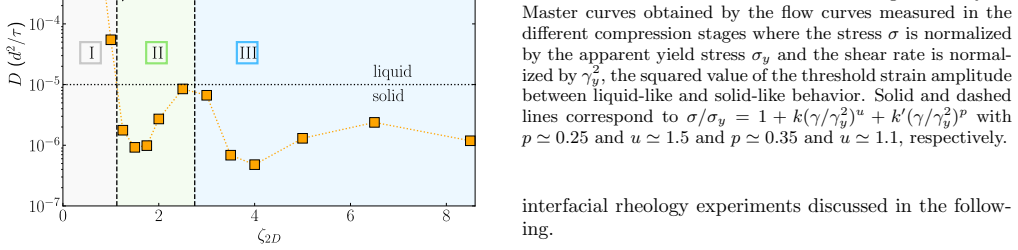
The load-bearing object is the Hertzian pair potential $V_H(r)=\pi Y d^2 (1-r/d)^2/[2\ln(2/(1-r/d))]$ (Eq. 3) and its multi-Hertzian extension $V_{MH}(r)=\sum_i V_H(r,d_i,Y_i)$ (Eq. 4), in which extra Hertzian terms with smaller effective radii and larger Young moduli stand for the effective stiffening of the monolayer at high compression. The pure Hertzian term sets the equilibrium structure and low-density behavior; the additional terms keep the simulated monolayer solid at high $\zeta_{2D}$, allowing the comparison of simulated and experimental flow curves and the reproduction of the non-monotonic elasticity and isoelastic points.
What would settle it
Measure the in-situ structure of the monolayer at the interface (for example with in-situ AFM, confocal microscopy, or grazing-incidence scattering) at the same compressions and compare the radial distribution function and nearest-neighbor distance with the ex-situ AFM data; if the packing or the dilute radius differs beyond error, the $\zeta_{2D}$ assignment and with it the regime boundaries and the location of the isoelastic points would shift. A second check is to measure the storage modulus and yield stress over a wider range of generalized area fractions: if the non-monotonic dip disappears when the microgels are made stiffer, the Hertzian-softness explanation would be in question.
Extended reading notes
Core claim
The central claim is that ULC microgels at an oil-water interface interact as Hertzian-like colloids, with no square-shoulder term required: the measured radial distribution functions and nearest-neighbor spacing $d_{nn}\propto\zeta_{2D}^{-1/2}$ match Brownian dynamics of polydisperse discs with a pure Hertzian potential, and the non-monotonic storage modulus, yield stress, and two flow regimes are reproduced by a multi-Hertzian potential built from added Hertzian terms of increasing stiffness. From the non-monotonic moduli the authors extract isoelastic points, where the monolayer has the same stiffness at very different generalized area fractions, and present these as the experimental manifestation of the reentrant liquid phase that Hertzian-like pair potentials predict at high concentration but that had not previously been observed.
Load-bearing premise
The argument rests on the assumption that the monolayer structure measured by AFM after deposition on a solid substrate is the same as the actual structure at the oil-water interface, so the dilute microgel footprint $R_{2D}$ and every generalized area fraction derived from it are correct.
Editorial extensions
If this is right
- A purely Hertzian pair potential, without a square-shoulder core term, describes the equilibrium structure of ULC microgel monolayers across the full investigated range of generalized area fractions.
- A multi-Hertzian potential reproduces the flow curves, the solid-like oscillatory response, the non-monotonic storage modulus and yield stress, and the isoelastic points in both linear and oscillatory shear.
- The monolayer flows according to two distinct master curves, extending the flow-regime picture previously seen for harder microgels and suggesting the behavior is generic for microgels at interfaces.
- Isoelastic points count as the experimental manifestation of the theoretically predicted reentrant liquid phase for soft pair potentials.
- ULC microgels remain compressible up to the maximum monolayer compression before buckling or multilayer formation, with no onset of an incompressible core.
Reading between the lines
- If the interpretation holds, the reentrant liquid phase does not appear as a full melting of the monolayer but as a measurable softening window in which the glassy monolayer's stiffness and yield stress decrease; the isoelastic construction gives an experimental handle on that window in terms of two concentrations with the same modulus.
- The same non-monotonic elasticity should appear in other ultra-soft two-dimensional colloids without a hard core, such as star polymers, single-chain nanoparticles, or protein glasses; measuring whether their storage modulus crosses at two concentrations would test the generality of the Hertzian picture.
- A direct test would be to derive the multi-Hertzian parameters from monomer-resolved simulations of compressed microgels at the interface, predicting the exact generalized area fractions of the isoelastic points rather than inferring them from fits.
- The authors' suggestion that a multi-Hertzian plus square-shoulder scheme could replace the square-shoulder-Hertzian model for harder microgels implies a unified pair-potential description of microgel monolayers from the softest to the most crosslinked cases.
Editorial analysis
A structured set of objections, weighed in public.
Referee Report
Summary. The paper presents interfacial rheology and AFM structural measurements of ultra-low crosslinked (ULC) microgel monolayers at an oil-water interface, together with Brownian dynamics simulations using Hertzian and multi-Hertzian pair potentials. The authors identify three compression regimes, two distinct flow master curves, and a non-monotonic dependence of the apparent yield stress and plateau elastic modulus on the generalized area fraction. They define 'isoelastic points' where the monolayer has the same stiffness at very different concentrations and claim these are the experimental manifestation of the theoretically predicted reentrant liquid phase for Hertzian-like particles.
Significance. The experimental dataset is carefully collected and the comparison with simulations is detailed; if the reentrant-liquid interpretation were sound, the work would provide the first experimental signature of Hertzian-like reentrant melting in a 2D colloidal monolayer. The identification of two flow regimes and a non-monotonic elastic response for ultra-soft microgels is a useful contribution, and the multi-Hertzian model is a practical tool for reproducing both structure and rheology. However, the central interpretive claim is not supported by the manuscript's own data and modeling choices, and a methodological inconsistency in the synthesis recipe casts doubt on the particle identity. The underlying measurements merit publication after substantial revision of the claims.
major comments (3)
- [Abstract; Section II.A; Section II.C; Fig. 2B; Fig. S3; Fig. 4A] The claim that the observed isoelastic points are 'the experimental manifestation of the predicted reentrant liquid phase' is not supported by the evidence and is contradicted by the manuscript's own modeling strategy. Section II.A states that the multi-Hertzian core parameters (Ycore=270 ε/d², dcore=0.9d) are chosen 'just enough to prevent the onset of a reentrant liquid phase,' and Section II.C states that remaining solid at high ζ2D 'is only achievable due to the use of a multi-Hertzian potential.' Experimentally, all frequency sweeps in Fig. S3 show G′>G″ at all measured frequencies for ζ2D≳1.0, and Fig. 4A shows a finite yield stress throughout region III. The simulated diffusion coefficient in Fig. 2B stays below the glass threshold at high ζ2D and the authors explicitly note the core modulus can be tuned so that D 'never exhibits reentrance to the fluid phase.' A reentrant liquid is a high-density fluid with vanishing yield stress and liquid-like viscoelasticity, neither of which is observed or modeled. The data support a non-monotonic softening of an amorphous solid, not a manifestation of reentrant melting. This is a load-bearing interpretive error that should be corrected by removing or substantially weakening the reentrant-liquid claim in the abstract, introduction, and conclusion.
- [Methods, 'Microgel synthesis'] The synthesis recipe lists 0.6090 g of BIS and 8.4870 g of NIPAM, which corresponds to roughly 5.3 mol% crosslinker, not an ultra-low crosslinked (ULC) microgel. Since the entire premise of the paper—the absence of an incompressible core and the suitability of a purely Hertzian potential—rests on the ULC character of the particles, this inconsistency is load-bearing. The authors state the microgels are 'identical to those described in Refs. [12, 47],' so the recipe may be a typographical error, but as written it conflicts with the claimed ULC identity. Please clarify the actual crosslinker amount and confirm the ULC nature with an appropriate characterization (e.g., swelling ratio or modulus), or revise the interpretation if the particles are not ULC.
- [Section II.A; Eq. (1); Fig. S5] The generalized area fractions ζ2D used throughout the paper depend on the ex situ AFM-derived radius R2D = 323 ± 33 nm transferred to the in situ oil-water interface. The authors justify this via Ref. [33], but the compression isotherms, regime boundaries, g(r) comparisons, and isoelastic-point positions all rest on this transfer. If deposition onto the solid substrate changes the interfacial footprint or the monolayer packing, every ζ2D value and every regime boundary would shift. Please provide in situ evidence for the monolayer structure (e.g., in situ scattering or fluorescence microscopy) or explicitly discuss the uncertainty propagated from the ex situ calibration in the reported ζ2D values.
minor comments (5)
- [Fig. 2B] The empirical glass threshold D < 10^-5 σ²/τ is introduced without derivation or supporting data; please state how this value was estimated and whether the results are sensitive to its precise value.
- [Fig. 4A] The horizontal line marking an isoelastic point is described as 'representative,' but no error bars are shown for σy or Gp; please add uncertainty estimates or explain why they are omitted.
- [Eq. (2) and Fig. S1] The double power-law fits should report confidence intervals for the fit parameters u, p, k, and k′, particularly for the high-ζ2D curves where the authors note difficulty in determining γy.
- [Section I, Introduction] The phrase 'experimental actuation of the reentrant liquid phase' in the conclusion is unclear; consider using 'manifestation' consistently or rephrasing.
- [Methods, 'Microgel synthesis'] The purity specification '≤94%' for decane is ambiguous; should be '≥94%' or a precise grade.
Circularity Check
No significant circularity: the measured isoelastic points and non-monotonic moduli are independent experimental observations; the interpretive link to reentrant melting is an overreach but not a by-construction reduction.
full rationale
The derivation chain is not circular. The experimental elastic moduli, yield stresses, frequency sweeps, and AFM-derived structures are measured independently, and the non-monotonic moduli and isoelastic points are observations, not outputs of a fitted formula. The multi-Hertzian potential parameters (Y = 100 ε/d²; Ycore = 270 ε/d², dcore = 0.9d) are chosen to reproduce the measured g(r)/dnn and to keep the monolayer solid at high ζ2D, and the simulated storage modulus is then compared with experiment rather than derived from the fit. The ex situ/in situ structural equivalence is supported by an external study [33], not by a self-citation. The only potential concern is the statement that isoelastic points are 'the experimental manifestation of the predicted reentrant liquid phase,' since the core term was deliberately tuned to suppress reentrant melting; this makes the interpretation questionable, but it is an over-interpretation of the data, not a circular reduction of a prediction to its input. No equation is defined in terms of the target result, and no fitted parameter is relabeled as a prediction.
Assumptions & free parameters
free parameters (4)
- Hertzian Young modulus Y =
100 ε/d²
- Multi-Hertzian core Young modulus Ycore =
270 ε/d²
- Multi-Hertzian core size dcore =
0.9 d
- Herschel-Bulkley exponents u and p =
u = 1.50, p = 0.25 (regime II); u = 1.10, p = 0.35 (regime III)
assumptions (5)
- domain assumption The 2D Hertzian potential V_H(r) (Eq. 3) describes interactions between ULC microgels at the interface.
- ad hoc to paper The multi-Hertzian sum (Eq. 4) captures many-body effects and internal elasticity gradients through an effective stiff 'core' term.
- domain assumption Ex situ AFM monolayers represent the in situ oil-water structure.
- ad hoc to paper The empirical threshold D < 10^-5 σ²/τ classifies the monolayer as glassy.
- domain assumption The generalized area fraction ζ2D computed from the dilute-state radius R2D is a valid compression coordinate at all densities.
Cite this review
Pith. "Pith review of Soft ULC Microgels at the Interface Interact and Flow as Hertzian-Like Colloids." pith.science (2026). https://pith.science/paper/RIMRPC47
@misc{pith2026250109472,
  author       = {Pith},
  title        = {Pith review of: Soft ULC Microgels at the Interface Interact and Flow as Hertzian-Like Colloids},
  year         = {2026},
  howpublished = {\url{https://pith.science/paper/RIMRPC47}},
  note         = {Machine review of arXiv:2501.09472}
}
read the original abstract
Soft pair potentials predict a reentrant liquid phase for high concentrations, a behavior not observed experimentally. Here, very soft microgels confined at an oil-water interface are used as a model system of particles interacting via a soft potential in 2D. Interfacial rheology measurements demonstrate the existence of different flow regimes that depend on the compression of the monolayer. Such a compression also leads to a non-monotonic variation of the elastic moduli and of the yield stress of the monolayer. These results, together with the equilibrium phase behavior of the monolayer, are reproduced in molecular dynamics simulations of a 2D system of particles interacting with a Hertzian-like potential. Remarkably, due to the non-monotonic variation of the elastic moduli, we observe \textit{isoelastic} points where the monolayer shows the same stiffness at very different concentrations. These points are the experimental manifestation of the predicted reentrant liquid phase.
Figures


Figures from the paper (2 more)


Reference graph
Works this paper leans on
-
[33]
K. Kuk, V. Abgarjan, L. Gregel, Y. Zhou, V. C. Fadanelli, I. Buttinoni, and M. Karg, Soft Matter 19, 175 (2023)
work page 2023
- [1]
- [2]
- [3]
-
[4]
Vlassopoulos and M
D. Vlassopoulos and M. Cloitre, Current opinion in col- loid & interface science 19, 561 (2014)
2014
- [5]
-
[6]
M. M. Schmidt, J. Ruiz-Franco, S. Bochenek, F. Camerin, E. Zaccarelli, and A. Scotti, Physical Re- view Letters 131, 258202 (2023)
work page 2023
-
[7]
B. M. Erwin, M. Cloitre, M. Gauthier, and D. Vlas- sopoulos, Soft Matter 6, 2825 (2010)
work page 2010
Show all 50 references
-
[8]
Borrega, M
R. Borrega, M. Cloitre, I. Betremieux, B. Ernst, and L. Leibler, Europhysics Letters 47, 729 (1999)
1999
-
[9]
Scotti, M
A. Scotti, M. Brugnoni, C. G. Lopez, S. Bochenek, J. J. Crassous, and W. Richtering, Soft Matter 16, 668 (2020)
2020
-
[10]
Gao and B
J. Gao and B. J. Frisken, Langmuir 19, 5212 (2003)
2003
-
[11]
Brugnoni, A
M. Brugnoni, A. C. Nickel, L. C. Kr¨ oger, A. Scotti, A. Pich, K. Leonhard, and W. Richtering, Polymer Chemistry 10, 2397 (2019)
2019
-
[12]
J. E. Houston, L. Fruhner, A. de la Cotte, J. Rojo Gonz´ alez, A. V. Petrunin, U. Gasser, R. Schweins, J. Allgaier, W. Richtering, A. Fernandez- Nieves, et al., Science Advances 8, eabn6129 (2022)
2022
-
[13]
H¨ ofken, U
T. H¨ ofken, U. Gasser, S. Schneider, A. V. Petrunin, and A. Scotti, Macromolecular rapid communications , 2400043 (2024)
2024
-
[14]
Scotti, Soft Matter 17, 5548 (2021)
A. Scotti, Soft Matter 17, 5548 (2021)
2021
-
[15]
P. N. Pusey and W. Van Megen, Nature 320, 340 (1986)
1986
-
[16]
Scotti, S
A. Scotti, S. Bochenek, M. Brugnoni, M.-A. Fernandez- Rodriguez, M. F. Schulte, J. Houston, A. P. Gelissen, I. I. Potemkin, L. Isa, and W. Richtering, Nature Communi- cations 10, 1 (2019)
2019
-
[17]
M. F. Schulte, S. Bochenek, M. Brugnoni, A. Scotti, A. Mourran, and W. Richtering, Angewandte Chemie International Edition 60, 2280 (2021)
2021
-
[18]
M. Rey, J. Kolker, J. A. Richards, I. Malhotra, T. S. Glen, N. D. Li, F. H. Laidlaw, D. Renggli, J. Vermant, A. B. Schofield, et al., Nature Communications 14, 6723 (2023)
2023
-
[19]
Bochenek, F
S. Bochenek, F. Camerin, E. Zaccarelli, A. Maestro, M. M. Schmidt, W. Richtering, and A. Scotti, Nature Communications 13, 3744 (2022)
2022
-
[20]
A. V. Petrunin, S. Bochenek, W. Richtering, and A. Scotti, Physical Chemistry Chemical Physics 25, 2810 (2023)
2023
-
[21]
Gerelli, F
Y. Gerelli, F. Camerin, S. Bochenek, M. M. Schmidt, A. Maestro, W. Richtering, E. Zaccarelli, and A. Scotti, Soft Matter 20, 3653 (2024)
2024
-
[22]
Paloli, P
D. Paloli, P. S. Mohanty, J. J. Crassous, E. Zaccarelli, and P. Schurtenberger, Soft Matter 9, 3000 (2013)
2013
-
[23]
Del Monte and E
G. Del Monte and E. Zaccarelli, Phys. Rev. X 14, 041067 (2024)
2024
-
[24]
M. J. Bergman, N. Gnan, M. Obiols-Rabasa, J.-M. Mei- jer, L. Rovigatti, E. Zaccarelli, and P. Schurtenberger, Nature Communications 9, 5039 (2018)
2018
-
[25]
Stieger, W
M. Stieger, W. Richtering, J. S. Pedersen, and P. Lind- ner, The Journal of chemical physics 120, 6197 (2004)
2004
-
[26]
Hazra, A
N. Hazra, A. Ninarello, A. Scotti, J. E. Houston, P. Mota- Santiago, E. Zaccarelli, and J. J. Crassous, Macro- molecules 57, 339 (2023)
2023
-
[27]
Camerin, N
F. Camerin, N. Gnan, J. Ruiz-Franco, A. Ninarello, L. Rovigatti, and E. Zaccarelli, Physical Review X 10, 031012 (2020)
2020
-
[28]
Berthier, A
L. Berthier, A. J. Moreno, and G. Szamel, Physical Re- view E 82, 060501 (2010)
2010
-
[29]
C. V. Wood, V. I. Razinkov, W. Qi, C. J. Roberts, J. Ver- mant, and E. M. Furst, Langmuir 39, 7775 (2023)
2023
-
[30]
E. M. Freer, K. S. Yim, G. G. Fuller, and C. J. Radke, The Journal of Physical Chemistry B 108, 3835 (2004)
2004
-
[31]
M. A. Bos and T. Van Vliet, Advances in colloid and interface science 91, 437 (2001)
2001
-
[32]
Bochenek, A
S. Bochenek, A. A. Rudov, T. Sassmann, I. I. Potemkin, and W. Richtering, Langmuir 39, 18354 (2023)
2023
-
[34]
M. Rey, M. ´A. Fern´ andez-Rodr ´ ıguez, M. Steinacher, L. Scheidegger, K. Geisel, W. Richtering, T. M. Squires, and L. Isa, Soft Matter 12, 3545 (2016)
2016
-
[35]
Geisel, L
K. Geisel, L. Isa, and W. Richtering, Angewandte Chemie 126, 5005 (2014)
2014
-
[36]
Bochenek, A
S. Bochenek, A. Scotti, and W. Richtering, Soft Matter 17, 976 (2021)
2021
-
[37]
J. C. P` amies, A. Cacciuto, and D. Frenkel, The Journal of chemical physics 131 (2009)
2009
-
[38]
Pellet and M
C. Pellet and M. Cloitre, Soft Matter 12, 3710 (2016)
2016
-
[39]
Tatry, E
M.-C. Tatry, E. Laurichesse, J. Vermant, V. Ravaine, and V. Schmitt, Journal of Colloid and Interface Science 629, 288 (2023)
2023
-
[40]
G. M. Conley, C. Zhang, P. Aebischer, J. L. Harden, and F. Scheffold, Nature Communications 10, 2436 (2019)
2019
-
[41]
Bergman, Y
M. Bergman, Y. Xu, J. Mu˜ n´ eton D ´ ıaz, C. Zhang, T. G. Mason, and F. Scheffold, Langmuir (2025)
2025
-
[42]
Zaccarelli, G
E. Zaccarelli, G. Foffi, K. Dawson, F. Sciortino, and P. Tartaglia, Physical Review E 63, 031501 (2001)
2001
-
[43]
K. Pham, G. Petekidis, D. Vlassopoulos, S. Egelhaaf, W. Poon, and P. Pusey, Journal of Rheology 52, 649 (2008)
2008
-
[44]
Q. Zou, Y. Ruan, R. Zhang, and G. Liu, Macromolecules 57, 777 (2024)
2024
-
[45]
P.-H. Wu, D. R.-B. Aroush, A. Asnacios, W.-C. Chen, M. E. Dokukin, B. L. Doss, P. Durand-Smet, A. Ekpeny- ong, J. Guck, N. V. Guz, et al., Nature methods 15, 491 (2018)
2018
-
[46]
Komaragiri, R
Y. Komaragiri, R. H. Pires, S. Spiegler, H. T. Dau, D. Biedenweg, C. O. Salas, M. F. Hossain, B. Fregin, S. Gross, M. Gellert, et al., Communications Physics 7, 252 (2024)
2024
-
[47]
Scotti, A
A. Scotti, A. R. Denton, M. Brugnoni, J. E. Houston, R. Schweins, I. I. Potemkin, and W. Richtering, Macro- molecules 52, 3995 (2019)
2019
-
[48]
Pelton and P
R. Pelton and P. Chibante, Colloids and Surfaces 20, 247 (1986)
1986
-
[49]
Vandebril, A
S. Vandebril, A. Franck, G. G. Fuller, P. Moldenaers, and J. Vermant, Rheologica Acta 49, 131 (2010)
2010
-
[50]
Functional microgels and microgel systems
A. P. Thompson, H. M. Aktulga, R. Berger, D. S. Bolin- tineanu, W. M. Brown, P. S. Crozier, P. J. in ’t Veld, 12 A. Kohlmeyer, S. G. Moore, T. D. Nguyen, R. Shan, M. J. Stevens, J. Tranchida, C. Trott, and S. J. Plimp- ton, Comp. Phys. Comm. 271, 108171 (2022). Acknowledgement...
2022
Reviewed August 10, 2026 · model on record in the stance chip above.
Discussion (0). Continue with ORCID to comment.