REVIEW 2 major objections 6 minor 28 references
Electronic Health Records: Towards Digital Twins in Healthcare
T0 review · 2 major / 6 minor · reviewed 2026-08-10 · deepseek-v4-flash
Pith's one-line read This chapter argues that MIMIC-III made critical-care data broadly accessible, and that the database's identifier structure means query choices materially change research results.
desk verdict Useful MIMIC-III tutorial for newcomers, but the central counting error needs fixing before I'd trust it with students. read the letter →
The pith
A machine-rendered reading of the paper's core claim, the machinery that carries it, and where it could break.
The reading
What carries the argument
The carrying mechanism is the MIMIC-III relational schema, centered on three identifiers: `subject_id` for a unique patient, `hadm_id` for a unique hospital admission, and `icustay_id` for a unique ICU stay. The chapter's argument is that these identifiers sit at different levels of granularity—one patient can have several admissions, and one admission can have several ICU stays—so counts and outcome measures computed from one identifier do not automatically transfer to another. Around this core sit the `patients`, `admissions`, and `icustays` tables, with dictionary tables that decode chart, input, output, and lab events, and with the ICD-9 code tables that attach diagnoses to admissions.
What would settle it
Re-run the chapter's counting queries on the same MIMIC-III release by selecting distinct values from `subject_id`, `hadm_id`, and `icustay_id` respectively; if the three counts match, the chapter's central warning about query-sensitive results is empty rather than instructive, and if the age-filtered admission count in Section 3.3 exceeds the total in Figure 9, that specific statistic is false.
Extended reading notes
Core claim
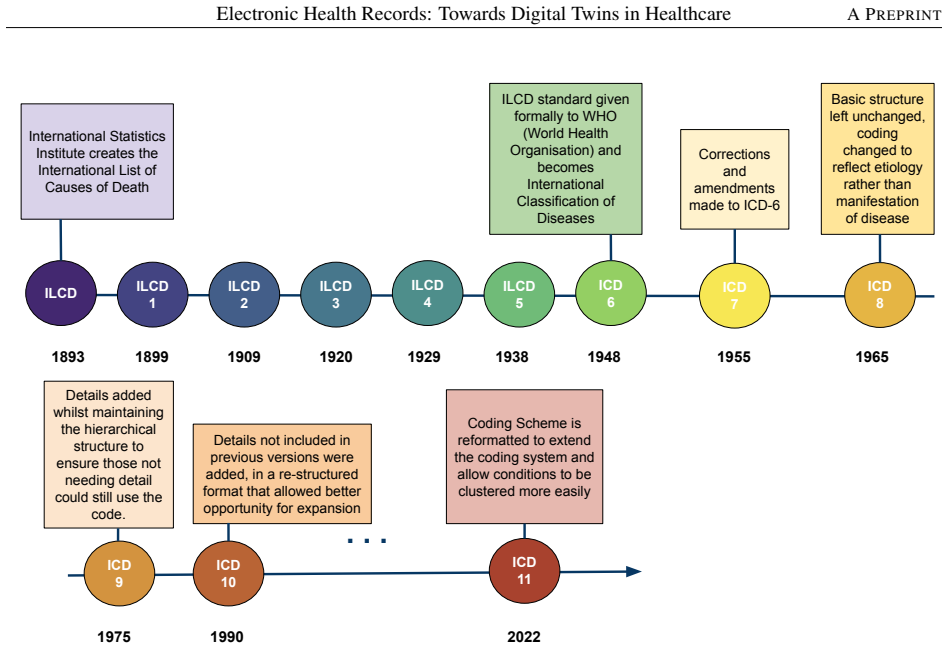
The central claim is that MIMIC-III has opened up access to high-quality critical-care data, and that this access comes with a catch: the database's architecture determines the answer. Counting distinct patients, distinct hospital admissions, and distinct ICU stays yields different totals, and mortality estimates differ depending on whether death is measured in the ICU, in the hospital, or over a longer window after admission. The chapter shows these differences with reproducible queries and charts, presenting the MIMIC-III schema as the key instrument that links raw clinical events to research-grade conclusions. Along the way it treats ICD-9 codes as the clinical vocabulary that lets researchers group patients by disease, and it presents the progression from descriptive statistics through predictive models to digital twins as the direction in which EHR research is moving.
Load-bearing premise
The chapter's usefulness rests on the factual accuracy of its MIMIC-III statistics, and that accuracy is internally inconsistent: Section 3.3 reports over 53,000 hospital admissions for patients aged 60 and above, while Figures 9 and 10 report 49,785 hospital admissions and 53,423 ICU stays.
Editorial extensions
If this is right
- Researchers should report which identifier they counted and which mortality window they used whenever they publish MIMIC-III results, because the same database can support multiple defensible answers.
- Reproducible cohort definitions, like the catheterization study's stepwise SQL pipeline, become as important as statistical models for making EHR research trustworthy.
- Mortality and length-of-stay models built on MIMIC-III should be evaluated against the specific outcome definition they target, since ICU, hospital, and longer-term mortality behave differently.
- The path to predictive analytics and digital twins in healthcare depends on solving the data-linkage and schema-understanding problems demonstrated here, not just on adding more data.
Reading between the lines
- The same identifier-hierarchy problem is likely present in other large EHR databases, so the chapter's tutorial could be read as a general checklist for schema-aware reporting rather than a MIMIC-III-specific guide.
- If published MIMIC-III studies rarely specify their counting semantics, a portion of apparent disagreements in the literature may be artifacts of query choice rather than genuine clinical differences.
- A simple testable extension would be a benchmark task where researchers are given the chapter's clinical questions and asked to report their query definitions; the spread of answers would quantify how much architecture literacy matters.
- The chapter's own statistical inconsistency (Section 3.3 versus Figures 9 and 10) illustrates the same point it argues: numbers from EHR databases need to be traced back to the exact query that produced them.
Signed reviews
Editorial analysis
A structured set of objections, weighed in public.
Referee Report
Summary. This preprint is an expository chapter on electronic health records and digital twins, with a detailed tutorial on the MIMIC-III critical care database. It reviews the transition to EHRs in the UK and USA, the ICD-9/ICD-10 coding systems, MIMIC-III's relational schema, descriptive statistics queries, mortality and length-of-stay outcomes, vital sign extraction, ICD-9 code distribution, clinical concepts, and a catheterization mortality case study, before discussing the path from descriptive to prescriptive analytics and digital twins. The central pedagogical claim is that correct analysis of MIMIC-III requires understanding the schema because different identifiers (patients, hospital admissions, ICU stays) yield different counts.
Significance. If the factual issues are corrected, this chapter would be a useful pedagogical resource for researchers entering critical-care data analytics. Its strengths are the clear entity-relationship exposition, the emphasis on identifier semantics and the consequences of query choices, the practical SQL query examples (presented as figures), and the accessible treatment of ICD coding and clinical concepts. The chapter does not present a new method or derivation, and it does not ship code or machine-checked proofs; its value is tutorial rather than research.
major comments (2)
- [3.3] The sentence 'The MIMIC-III database contains over 53,000 distinct hospital admissions for patients aged 60 years and above' is internally inconsistent with the chapter's own Figures 9 and 10, which report 49,785 hospital admissions and 53,423 ICU stays, and it conflicts with published MIMIC-III v1.4 counts. The number 53,423 is the total count of ICU stays, not hospital admissions, and the age restriction is unsupported by the cited figures. Because the chapter's central lesson is that conflating hospital admission and ICU stay identifiers produces different results, this error reproduces the very mistake the text warns against and should be corrected (e.g., to 'the database contains 49,785 hospital admissions and 53,423 ICU stays; the later case studies often restrict to patients aged 60 and above').
- [3.5.1] The ICU mortality paragraph states that the query 'focuses on patients older than 60 years' but then reports 'total ICU mortality is about 8.5%, corresponding to approximately 4,565 patients.' Since 8.5% of 53,423 is about 4,541, the reported mortality count matches the all-adult ICU population rather than a >60-year-old subset. The authors should either provide the cohort size for the age-restricted query or clarify that the 8.5% figure is for all adults; as written, the age filter and the reported numbers are inconsistent and undermine the schema-semantics lesson of the chapter.
minor comments (6)
- [2.3.1] The statement that the ICD-9 coding system 'consists of a five-digit structure' is an oversimplification; ICD-9-CM codes have 3 to 5 digits, and the text should acknowledge this variability.
- [3.2] The citation 'cite [Moody, 2009]' appears as a raw LaTeX command; it should be formatted as a proper citation.
- [Figure 3] The figure contains typos: 'HIPPA' should be 'HIPAA' and 'MyHeathED' should be 'MyHealthED'.
- [References] The reference list contains 'V oigt' (with a space) for 'Voigt'; this should be corrected.
- [3.3] The phrase 'The MIMIC-III is a relational database comprises 26 tables' is ungrammatical; it should be 'The MIMIC-III relational database comprises 26 tables'.
- [3.4] The table name 'Patients' is sometimes written as 'Patient' (e.g., 'the Patient and Icustays tables'); for consistency, use 'patients' throughout.
Circularity Check
No circularity: the chapter is expository and contains no derivation or prediction that reduces to its inputs.
full rationale
This manuscript is a survey/tutorial chapter. It does not derive a new result, fit a model, or make a prediction that is then compared with data. Its central claims are descriptive: that EHR systems evolved, that ICD coding changed from ICD-9 to ICD-10, that MIMIC-III is a valuable public database, and that querying it requires understanding its schema. None of these claims is established by a derivation chain from assumptions, and none is justified by a self-citation that carries the argument. The chapter's factual account of MIMIC-III can be checked against the database itself and against publicly documented counts, and the apparent mismatch between the Section 3.3 statement about 'over 53,000 distinct hospital admissions for patients aged 60 years and above' and the chapter's own Figures 9 and 10 (49,785 hospital admissions and 53,423 ICU stays) is a factual consistency issue, not a circularity issue. A factual error does not make an argument circular because there is no argument that reduces to its own conclusion. The chapter also relies on external sources for historical facts and for the MIMIC-III study example, but those citations are ordinary scholarly references rather than load-bearing self-citations that define the outcome. Therefore the circularity burden is not applicable and the appropriate score is 0.
Assumptions & free parameters
assumptions (3)
- domain assumption MIMIC-III is the most comprehensive critical care database freely available to researchers worldwide.
- domain assumption The database statistics reported in the chapter are accurate, including the claim in Section 3.3 of over 53,000 distinct hospital admissions for patients aged 60 and above.
- domain assumption The SQL queries shown in Figures 23 to 30 faithfully reproduce the patient selection pipeline of Hsu et al. 2015.
Cite this review
Pith. "Pith review of Electronic Health Records: Towards Digital Twins in Healthcare." pith.science (2026). https://pith.science/paper/IZTC4BFW
@misc{pith2026250109640,
  author       = {Pith},
  title        = {Pith review of: Electronic Health Records: Towards Digital Twins in Healthcare},
  year         = {2026},
  howpublished = {\url{https://pith.science/paper/IZTC4BFW}},
  note         = {Machine review of arXiv:2501.09640}
}
read the original abstract
The pivotal shift from traditional paper-based records to sophisticated Electronic Health Records (EHR), enabled systematic collection and analysis of patient data through descriptive statistics, providing insight into patterns and trends across patient populations. This evolution continued toward predictive analytics, allowing healthcare providers to anticipate patient outcomes and potential complications before they occur. This progression from basic digital record-keeping to sophisticated predictive modelling and digital twins reflects healthcare's broader evolution toward more integrated, patient-centred approaches that combine data-driven insights with personalized care delivery. This chapter explores the evolution and significance of healthcare information systems, beginning with an examination of the implementation of EHR in the UK and the USA. It provides a comprehensive overview of the International Classification of Diseases (ICD) system, tracing its development from ICD-9 to ICD-10. Central to this discussion is the MIMIC-III database, a landmark achievement in healthcare data sharing and arguably the most comprehensive critical care database freely available to researchers worldwide. MIMIC-III has democratized access to high-quality healthcare data, enabling unprecedented opportunities for research and analysis. The chapter examines its structure, clinical outcome analysis capabilities, and practical applications through case studies, with a particular focus on mortality and length of stay metrics, vital signs extraction, and ICD coding. Through detailed entity-relationship diagrams and practical examples, the text illustrates MIMIC's complex data structure and demonstrates how different querying approaches can lead to subtly different results, emphasizing the critical importance of understanding the database's architecture for accurate data extraction.
Figures


Figures from the paper (31 more)


Reference graph
Works this paper leans on
-
[1]
Karen Wilson and Lara Khansa. Migrating to electronic health record systems: a comparative study between the united states and the united kingdom. Health Policy, 122 0 (11): 0 1232--1239, 2018
work page 2018
-
[2]
Ethical issues in electronic health records: A general overview
Fouzia F Ozair, Nayer Jamshed, Amit Sharma, and Praveen Aggarwal. Ethical issues in electronic health records: A general overview. Perspectives in clinical research, 6 0 (2): 0 73--76, 2015
work page 2015
-
[3]
Standardized electronic health record data modeling and persistence: A comparative review
Aya Gamal, Sherif Barakat, and Amira Rezk. Standardized electronic health record data modeling and persistence: A comparative review. Journal of biomedical informatics, 114: 0 103670, 2021
work page 2021
-
[4]
ET Vander Velde, JWJ Vriend, MMAM Mannens, CSPM Uiterwaal, R Brand, and Barbara JM Mulder. Concor, an initiative towards a national registry and dna-bank of patients with congenital heart disease in the netherlands: rationale, design, and first results. European journal of epidemiology, 20: 0 549--557, 2005
work page 2005
-
[5]
Amanda Bodell, Gudrun Bj \"o rkhem, Ulf Thil \'e n, and Estelle Naumburg. National quality register of congenital heart diseases--can we trust the data? Journal of Congenital Cardiology, 1: 0 1--8, 2017
work page 2017
-
[6]
Fouke Ombelet, Eva Goossens, Ruben Willems, Lieven Annemans, Werner Budts, Julie De Backer, Katya De Groote, St \'e phane Moniotte, Liesbet Van Bulck, Ariane Marelli, et al. Creating the belgian congenital heart disease database combining administrative and clinical data (belcodac): rationale, design and methodology. International journal of cardiology, 3...
work page 2020
-
[7]
Terminologies in the world health organisation family of international classifications (who-fic)
Nicholas R Hardiker, Ann-Helene Almborg, Lynn Bracewell, Christopher Chute, Coen van Gool, and Cassandra Linton. Terminologies in the world health organisation family of international classifications (who-fic)
-
[8]
Classification of diseases, functioning, and disability, 2024
Centers for Disease Control and Prevention . Classification of diseases, functioning, and disability, 2024. URL https://www.cdc.gov/nchs/icd/index.html. [Online; accessed 9-September-2024]
work page 2024
Show all 28 references
-
[9]
International classification of diseases
Sudha R Raminani. International classification of diseases. Encyclopaedia Britannica, 2015
2015
-
[10]
Bills of mortality: tracking disease in early modern london
Niall Boyce. Bills of mortality: tracking disease in early modern london. The Lancet, 395 0 (10231): 0 1186--1187, 2020
2020
-
[11]
History of the statistical classification of diseases and causes of death
Iwao Milton Moriyama, Ruth M Loy, Alastair Hamish Tearloch Robb-Smith, Harry Michael Rosenberg, and Donna L Hoyert. History of the statistical classification of diseases and causes of death. 2011
2011
-
[12]
Icd-11, 2019
The Lancet. Icd-11, 2019
2019
-
[13]
International Statistical Classification of Diseases and related health problems: Alphabetical index, volume 3
World Health Organization. International Statistical Classification of Diseases and related health problems: Alphabetical index, volume 3. World Health Organization, 2004
2004
-
[14]
The mimic code repository: enabling reproducibility in critical care research
Alistair EW Johnson, David J Stone, Leo A Celi, and Tom J Pollard. The mimic code repository: enabling reproducibility in critical care research. Journal of the American Medical Informatics Association, 25 0 (1): 0 32--39, 2018
2018
-
[15]
big data
Lucas Bulgarelli, Rodrigo Oct \'a vio Deliberato, and Alistair EW Johnson. Prediction on critically ill patients: the role of “big data”. Journal of critical care, 60: 0 64--68, 2020
2020
-
[16]
Mortality prediction and acuity assessment in critical care
A Johnson. Mortality prediction and acuity assessment in critical care. PhD thesis, University of Oxford, 2014
2014
-
[17]
Mimic ii: a massive temporal icu patient database to support research in intelligent patient monitoring
Mohammed Saeed, Christine Lieu, Greg Raber, and Roger G Mark. Mimic ii: a massive temporal icu patient database to support research in intelligent patient monitoring. In Computers in cardiology, pages 641--644. IEEE, 2002
2002
-
[18]
Multiparameter intelligent monitoring in intensive care ii: a public-access intensive care unit database
Mohammed Saeed, Mauricio Villarroel, Andrew T Reisner, Gari Clifford, Li-Wei Lehman, George Moody, Thomas Heldt, Tin H Kyaw, Benjamin Moody, and Roger G Mark. Multiparameter intelligent monitoring in intensive care ii: a public-access intensive care unit database. Critical car...
2011
-
[19]
Mimic-iii, a freely accessible critical care database
Alistair EW Johnson, Tom J Pollard, Lu Shen, Li-wei H Lehman, Mengling Feng, Mohammad Ghassemi, Benjamin Moody, Peter Szolovits, Leo Anthony Celi, and Roger G Mark. Mimic-iii, a freely accessible critical care database. Scientific data, 3 0 (1): 0 1--9, 2016
2016
-
[20]
Physionet: Research resource for complex physiologic signals
George B Moody. Physionet: Research resource for complex physiologic signals. Jpn. J. Electrocardiol, 29: 0 1--3, 2009
2009
-
[21]
The association between indwelling arterial catheters and mortality in hemodynamically stable patients with respiratory failure: a propensity score analysis
Douglas J Hsu, Mengling Feng, Rishi Kothari, Hufeng Zhou, Kenneth P Chen, and Leo A Celi. The association between indwelling arterial catheters and mortality in hemodynamically stable patients with respiratory failure: a propensity score analysis. Chest, 148 0 (6): 0 1470--1476, 2015
2015
-
[22]
Machine learning and ai for healthcare: Big data for improved health outcomes
Panesar Arjun. Machine learning and ai for healthcare: Big data for improved health outcomes. Apress: London, UK, 2019
2019
-
[23]
Digital twin: Values, challenges and enablers
Adil Rasheed, Omer San, and Trond Kvamsdal. Digital twin: Values, challenges and enablers. arXiv preprint arXiv:1910.01719, 2019
1910 arXiv
-
[24]
Make more digital twins
Fei Tao and Qinglin Qi. Make more digital twins. Nature, 573 0 (7775): 0 490--491, 2019
2019
-
[25]
Digital twin driven prognostics and health management for complex equipment
Fei Tao, Meng Zhang, Yushan Liu, and Andrew YC Nee. Digital twin driven prognostics and health management for complex equipment. Cirp Annals, 67 0 (1): 0 169--172, 2018
2018
-
[26]
Digital twins for multiple sclerosis
Isabel Voigt, Hernan Inojosa, Anja Dillenseger, Rocco Haase, Katja Akg \"u n, and Tjalf Ziemssen. Digital twins for multiple sclerosis. Frontiers in immunology, 12: 0 669811, 2021
2021
-
[27]
Home monitoring in asthma: towards digital twins
David Drummond, Jolt Roukema, and Mari \"e lle Pijnenburg. Home monitoring in asthma: towards digital twins. Current Opinion in Pulmonary Medicine, 29 0 (4): 0 270--276, 2023
2023
-
[28]
Towards a digital twin in human brain: Brain tumor detection using k-means
Anastasios Loukas Sarris, Efstathios Sidiropoulos, Evangelos Paraskevopoulos, and Panagiotis Bamidis. Towards a digital twin in human brain: Brain tumor detection using k-means. In Caring is Sharing--Exploiting the Value in Data for Health and Innovation, pages 1052--1056. IOS...
2023
Reviewed August 10, 2026 · model on record in the stance chip above.
Discussion (0). Continue with ORCID to comment.