REVIEW 4 major objections 4 minor 46 references
pFedWN: A Personalized Federated Learning Framework for D2D Wireless Networks with Heterogeneous Data
T0 review · 4 major / 4 minor · reviewed 2026-08-10 · deepseek-v4-flash
Pith's one-line read The paper claims pFedWN, a server-free personalized federated learning method for device-to-device wireless networks, improves a target client's model by selecting neighbors with low transmission error and weighting their updates by…
desk verdict New combo of channel-aware neighbor selection and FedEM-style weighting, but the optimality claim and the convergence proof don't hold up, so it needs major rework before the results can be trusted. read the letter →
The pith
A machine-rendered reading of the paper's core claim, the machinery that carries it, and where it could break.
The reading
What carries the argument
The load-bearing mechanism is the combination of a channel-aware neighbor selection rule and an EM-based weight assignment. Neighbor selection uses the probability of transmission error $P_{\mathrm{err}}^s(\hat{h}^f)$, computed from an SINR threshold $\gamma_{\mathrm{th}}$, Rayleigh fading, path loss, and a log-normal interference model, selecting neighbors for which $P_{\mathrm{err}} < \epsilon$. Weight assignment treats the target client's data distribution as a mixture of selected neighbors' distributions, with a latent variable $z_n$, and iterates an E-step computing posterior probabilities $\lambda_{nm}^{(t+1)}$ proportional to $\pi_{nm}^{(t)}\exp[-l(h_{\omega_{nm}^{(t)}}(x_i), y_i)]$ and an M-step updating $\pi_{nm}^{(t+1)}$ as the average posterior over the target client's local samples, then aggregates the target model as $\omega_n^{(t+1)} = \alpha\omega_n^{(t)} + (1-\alpha)\sum_{m\in M_n}\pi_{nm}\omega_m^{(t)}$.
What would settle it
Run pFedWN on a CIFAR-10 setting in which the target client's local dataset contains a label class that appears in none of the selected neighbors' datasets, with the channel selection fixed; if the target client's accuracy does not beat local-only training, or if the EM-assigned weight to the neighbor with the most dissimilar distribution is not the lowest, the central personalization claim fails.
Extended reading notes
Core claim
On the paper's own terms, the central claim is that pFedWN achieves efficient and personalized learning with non-IID and unbalanced datasets, and outperforms existing FL and PFL baselines in learning efficacy and robustness under dynamic and unpredictable wireless channel conditions. The mechanism is a two-step decomposition: first select neighbors whose packet error probability, derived from SINR, Rayleigh fading, path loss, and a log-normal interference model in unlicensed bands, falls below a threshold; then run an EM procedure, initialized with the assumption that the target client's data distribution is a mixture of the selected neighbors' distributions, to estimate posterior weights and aggregate neighbor models into the target client's update. The paper further claims the EM weights converge, and that the overall update converges at rate $O(\gamma^T)$ for strongly convex losses and $O(1/T)$ plus a constant for non-convex losses under Lipschitz, bounded-variance, and bounded-model assumptions.
Load-bearing premise
The EM weight assignment assumes the target client's data distribution is exactly a mixture of the selected neighbors' distributions; if the target client has classes or modes that none of its selected neighbors possess, the estimated weights stop being a measure of data similarity and the claimed optimal aggregation loses its justification.
Editorial extensions
If this is right
- Target clients can improve accuracy over local-only training by collaborating only with neighbors whose channels are reliable, even when local data are non-IID and unbalanced.
- Tighter SINR thresholds, larger error thresholds, and higher interference or network density shrink the selected neighbor set, which reduces communication overhead but also limits collaboration opportunities.
- EM weight assignment tilts aggregation toward neighbors with similar label distributions, and the weights converge over EM iterations, as shown for one CIFAR-10 case.
- In larger networks with sparser per-client data, pFedWN can still match or beat FedAMP on harder tasks like CIFAR-100, though FedAMP wins on MNIST and CIFAR-10 in the 20-neighbor scenario.
- Under the stated assumptions, the target client update converges at rate $O(\gamma^T)$ for strongly convex losses and $O(1/T)$ plus a constant for non-convex losses.
Reading between the lines
- If the mixture assumption fails, say a target client has a class no selected neighbor possesses, the EM posteriors will not measure true data similarity, so the 'optimal' weights are optimal for the mixture model, not for the personalized learning objective; a testable consequence is that pFedWN could underperform local training on such target clients.
- The channel-aware selection step filters neighbors before similarity weighting, so a neighbor with very similar data but a bad channel is excluded; this implies channel reliability is valued over data similarity in selecting collaborators, which could be tested by comparing against a selection rule based on data similarity first.
- A natural extension is to make the selection threshold $\epsilon$ itself depend on the EM-estimated similarity, so that neighbor selection and weight assignment are solved jointly rather than sequentially.
- Benchmarking pFedWN against a variant that uses the same neighbor selection but uniform or distance-based weights would isolate how much of the gain comes from EM weighting versus channel-aware selection.
Editorial analysis
A structured set of objections, weighed in public.
Referee Report
Summary. The paper proposes pFedWN, a server-free personalized federated learning framework for D2D wireless networks. The method decomposes the problem into two steps: channel-aware neighbor selection based on a transmission-error probability derived from SINR and interference models, and EM-based assignment of aggregation weights intended to reflect data similarity between a target client and its selected neighbors. The target client then blends its local model with neighbor models using these weights. The paper reports numerical results on MNIST, CIFAR-10, and CIFAR-100 for 10-neighbor and 20-neighbor networks, comparing pFedWN with FedAvg, FedProx, Per-FedAvg, FedAMP, and local training, and it provides convergence analyses for strongly convex and non-convex losses in Appendices C-E.
Significance. If the central claims held, pFedWN would address a realistic and under-explored problem: personalized FL under unreliable D2D wireless channels, with channel-aware neighbor selection and data-similarity weighting. The paper does include a detailed wireless channel model and an explicit two-stage algorithmic design, which are useful components. However, the central optimality claim for the EM weights is not supported by the algorithm as written, the convergence proofs contain concrete mathematical errors, and the empirical evaluation lacks error bars and contains an inconsistent baseline description. The favorable results in the tables are therefore not enough to establish the paper's main assertion that pFedWN outperforms existing FL and PFL methods.
major comments (4)
- [Section IV-B, Eqs. (9)-(11); Algorithms 1 and 2] The EM procedure in Algorithm 1 computes weights by maximizing an evidence lower bound for a generative model in which each component model ω_nm is refit to the target client's data D_n in Eq. (11). Algorithm 2, however, aggregates the models ω_m that neighbors train locally on their own data D_m (Algorithm 2, line 3) using the fixed weights π* (Algorithm 2, line 11). Nothing identifies the EM component models ω_nm with the transmitted neighbor models ω_m, and no step of Algorithm 2 corresponds to Eq. (11). Consequently, π* is not shown to be optimal for the aggregation objective in Eq. (1); it is optimal for a different objective involving refit components. Since the abstract and Section I present EM-based optimal weighting as the key enabler of pFedWN, this gap is load-bearing.
- [Appendix E, Theorem 2 and definition of C'] The proof of Theorem 2 contains a concrete algebraic error. After summing over t, the terms proportional to T should be divided by T to give a constant B/γ; instead, the paper defines C' to include the factors T explicitly. As written, C' grows linearly with T, so the claimed bound 1/T Σ E[||∇f_n(ω_t)||²] ≤ O(1/T) + C' does not establish convergence. Additionally, the quantity γ = αηE/2 − (1−α)/(2αηE) is negative when α is small, and the theorem does not state the condition needed to ensure γ > 0. These issues invalidate the stated non-convex convergence result.
- [Section V, Tables II-III and baseline protocol] The empirical support for the central claim is weaker than the abstract states. In Table III, pFedWN is not the best method: FedAMP achieves 92.1% versus 90.0% on MNIST and 58.1% versus 56.5% on CIFAR-10. In Table II, pFedWN ties or nearly ties FedAMP in several rows. The paper also describes the baseline protocol inconsistently: Section V-A says 'For all baseline methods, only neighbors selected based on the communication selection method join the training process,' while Section V-C.1 says 'For other FL baseline methods, the same clients in the coverage area join the learning process for those methods.' No error bars, confidence intervals, or numbers of random seeds are reported, so the claimed improvements over baselines cannot be assessed statistically.
- [Appendix C, Theorem 1] The proof of Theorem 1 introduces a residual term A and then assumes that the neighbor clients' models converge and their variances are bounded so that 'A is a bounded term or decaying over time.' This is an additional assumption not listed among Assumptions 1-3, and without a proof of this assumption the O(γ^T) convergence claim is unsupported. Moreover, the stated condition α²(2−α)(1−ηµ)^E ≤ 1 is automatically satisfied for α∈[0,1] and ηµ≥0, so it imposes no meaningful restriction on the learning rate.
minor comments (4)
- [Table II, Case 1 row 'Local'] The Local row for Case 1 reports 98.3 for both MNIST and CIFAR-10; this repetition is likely a typo and should be corrected, especially because the CIFAR-10 local dataset is highly imbalanced.
- [Section V-C.2] The phrase 'lower-completely tasks' appears to be a typo; it should likely read 'lower-complexity tasks.'
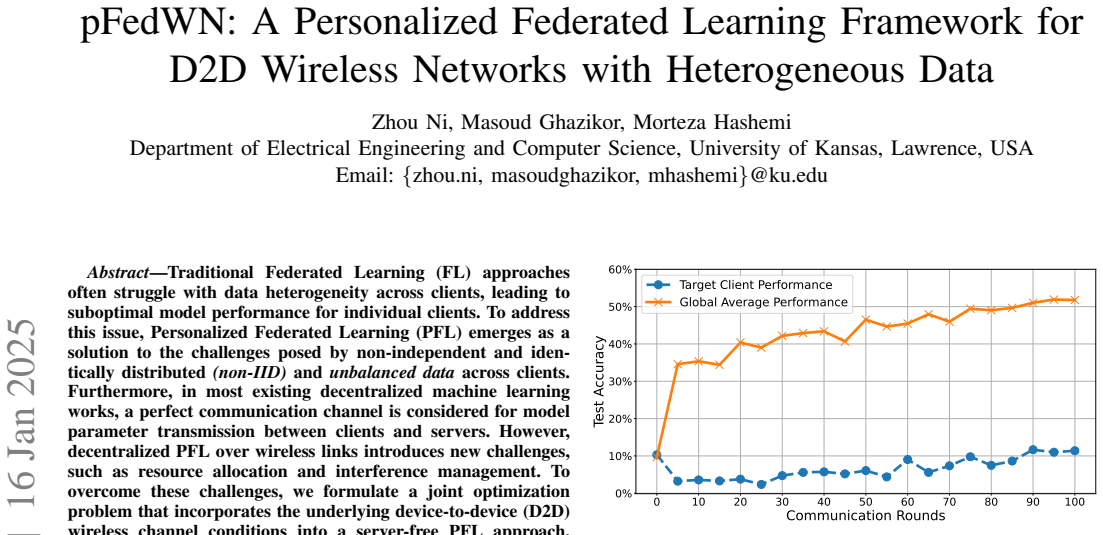
- [Figure 1] Figure 1 does not specify the non-IID split, number of clients, or hyperparameters used to produce the FedAvg comparison; adding this information would make the motivating example reproducible.
- [Section III-B] The channel model derivation would benefit from a short discussion of the regime in which the log-normal interference approximation is valid, since Eq. (6) is a modeling approximation that is used directly in the neighbor-selection rule.
Circularity Check
No significant circularity: the derivation chain is either externally sourced or self-contained, and the same-author citations are background only.
full rationale
The paper's central claims are not forced by definition or by a fitted parameter. The EM-based weight assignment is explicitly adapted from the external work [37] ('We follow the derivation and proof provided in [37] and adapt it to our setting'), and its convergence is cited to [37], [38]; the transmission-error model is taken from [35], [36]. The convergence theorems for pFedWN are argued in Appendices C-E from stated assumptions (L-smoothness, bounded variance, strong convexity or bounded model/neighbor discrepancy), and they do not invoke the paper's own empirical results as premises. The only same-author references ([15], [19], [34]) are used as background and for a standard single-slope path-loss formula; none is the load-bearing justification for the claimed personalized-learning performance. There is a real gap: Algorithm 1's EM component models omega_nm are refit to the target data (Eq. (11)), while Algorithm 2 aggregates the neighbors' own locally-trained models omega_m with the resulting pi*, so the 'optimal' label for Eq. (1) is not proven; however, that is an unproven optimality transfer, not a circular reduction, because pi* is not defined as the minimizer of Eq. (1). The empirical accuracy comparisons are measured outcomes, not quantities forced by the EM fit. Accordingly, no circular step is present.
Assumptions & free parameters
free parameters (4)
- alpha (blending coefficient in Eq. (1)) =
not reported
- epsilon (transmission error threshold) =
0.05 in Fig. 6; varied implicitly elsewhere
- gamma_th (SINR threshold) =
5, 10, 15 across the three cases
- beta (channel fading threshold) =
2 (Table I)
assumptions (4)
- domain assumption The target client's data distribution is a mixture of the selected neighbors' distributions
- standard math L-Lipschitz gradients, bounded stochastic gradient variance (Assumptions 1 and 2), bounded expected distance between neighbor and target models (Assumption 4), and bounded gradient norms (Assumption 5)
- ad hoc to paper Neighbor local models are bounded and converge to their own optima, and the residual term A is bounded or decays over time
- domain assumption Interference is log-normally distributed and channel fading is Rayleigh
Cite this review
Pith. "Pith review of pFedWN: A Personalized Federated Learning Framework for D2D Wireless Networks with Heterogeneous Data." pith.science (2026). https://pith.science/paper/ZZALKAGK
@misc{pith2026250109822,
  author       = {Pith},
  title        = {Pith review of: pFedWN: A Personalized Federated Learning Framework for D2D Wireless Networks with Heterogeneous Data},
  year         = {2026},
  howpublished = {\url{https://pith.science/paper/ZZALKAGK}},
  note         = {Machine review of arXiv:2501.09822}
}
read the original abstract
Traditional Federated Learning (FL) approaches often struggle with data heterogeneity across clients, leading to suboptimal model performance for individual clients. To address this issue, Personalized Federated Learning (PFL) emerges as a solution to the challenges posed by non-independent and identically distributed (non-IID) and unbalanced data across clients. Furthermore, in most existing decentralized machine learning works, a perfect communication channel is considered for model parameter transmission between clients and servers. However, decentralized PFL over wireless links introduces new challenges, such as resource allocation and interference management. To overcome these challenges, we formulate a joint optimization problem that incorporates the underlying device-to-device (D2D) wireless channel conditions into a server-free PFL approach. The proposed method, dubbed pFedWN, optimizes the learning performance for each client while accounting for the variability in D2D wireless channels. To tackle the formulated problem, we divide it into two sub-problems: PFL neighbor selection and PFL weight assignment. The PFL neighbor selection is addressed through channel-aware neighbor selection within unlicensed spectrum bands such as ISM bands. Next, to assign PFL weights, we utilize the Expectation-Maximization (EM) method to evaluate the similarity between clients' data and obtain optimal weight distribution among the chosen PFL neighbors. Empirical results show that pFedWN provides efficient and personalized learning performance with non-IID and unbalanced datasets. Furthermore, it outperforms the existing FL and PFL methods in terms of learning efficacy and robustness, particularly under dynamic and unpredictable wireless channel conditions.
Figures


Figures from the paper (6 more)


Reference graph
Works this paper leans on
-
[37]
Federated multi-task learning under a mixture of distributions,
O. Marfoq, G. Neglia, A. Bellet, L. Kameni, and R. Vidal, “Federated multi-task learning under a mixture of distributions,” Advances in Neural Information Processing Systems , 2021
work page 2021
-
[38]
Find your friends: Personalized federated learning with the right collaborators,
Y . Sui, J. Wen, Y . Lau, B. L. Ross, and J. C. Cresswell, “Find your friends: Personalized federated learning with the right collaborators,” arXiv:2210.06597, 2022
arXiv 2022
-
[1]
Communication-efficient learning of deep networks from decentralized data,
B. McMahan, E. Moore, D. Ramage, S. Hampson, and B. A. y Arcas, “Communication-efficient learning of deep networks from decentralized data,” in PMLR: Artificial intelligence and statistics , 2017
work page 2017
-
[2]
Personalized federated learning: A meta-learning approach,
A. Fallah, A. Mokhtari, and A. Ozdaglar, “Personalized federated learning: A meta-learning approach,” arXiv:2002.07948, 2020. 15
arXiv 2002
-
[3]
Adaptive personalized federated learning,
Y . Deng, M. M. Kamani, and M. Mahdavi, “Adaptive personalized federated learning,” arXiv:2003.13461, 2020
arXiv 2003
-
[4]
Optimality and stability in federated learning: A game-theoretic approach,
K. Donahue and J. Kleinberg, “Optimality and stability in federated learning: A game-theoretic approach,” Advances in Neural Information Processing Systems, 2021
work page 2021
-
[5]
An efficient frame- work for clustered federated learning,
A. Ghosh, J. Chung, D. Yin, and K. Ramchandran, “An efficient frame- work for clustered federated learning,” Advances in Neural Information Processing Systems, 2020
work page 2020
-
[6]
Towards provably personalized federated learning via threshold-clustering of similar clients,
M. Werner, L. He, S. P. Karimireddy, M. Jordan, and M. Jaggi, “Towards provably personalized federated learning via threshold-clustering of similar clients,” in Workshop on Federated Learning: Recent Advances and New Challenges (in Conjunction with NeurIPS 2022) , 2022
work page 2022
Show all 46 references
-
[7]
How to collaborate: Towards maximizing the generalization performance in cross-silo federated learn- ing,
Y . Sun, M. Kountouris, and J. Zhang, “How to collaborate: Towards maximizing the generalization performance in cross-silo federated learn- ing,” arXiv:2401.13236, 2024
2024 arXiv
-
[8]
Wireless communications for collaborative federated learning,
M. Chen, H. V . Poor, W. Saad, and S. Cui, “Wireless communications for collaborative federated learning,” IEEE Communications Magazine , 2020
2020
-
[9]
Federated learning over wireless fading channels,
M. M. Amiri and D. G ¨und¨uz, “Federated learning over wireless fading channels,” IEEE Transactions on Wireless Communications , 2020
2020
-
[10]
A joint learning and communications framework for federated learning over wireless networks,
M. Chen, Z. Yang, W. Saad, C. Yin, H. V . Poor, and S. Cui, “A joint learning and communications framework for federated learning over wireless networks,” IEEE Transactions on Wireless Communications , 2020
2020
-
[11]
Interference management for over-the-air federated learning in multi-cell wireless networks,
Z. Wang, Y . Zhou, Y . Shi, and W. Zhuang, “Interference management for over-the-air federated learning in multi-cell wireless networks,”IEEE Journal on Selected Areas in Communications , 2022
2022
-
[12]
Performance optimization for variable bitwidth federated learning in wireless networks,
S. Wang, M. Chen, C. G. Brinton, C. Yin, W. Saad, and S. Cui, “Performance optimization for variable bitwidth federated learning in wireless networks,” IEEE Transactions on Wireless Communications , 2023
2023
-
[13]
Performance analysis for resource constrained decen- tralized federated learning over wireless networks,
Z. Yan and D. Li, “Performance analysis for resource constrained decen- tralized federated learning over wireless networks,” IEEE Transactions on Communications, 2024
2024
-
[14]
Robust federated learning for unreliable and resource-limited wireless networks,
Z. Chen, W. Yi, Y . Liu, and A. Nallanathan, “Robust federated learning for unreliable and resource-limited wireless networks,” IEEE Transac- tions on Wireless Communications , 2024
2024
-
[15]
Optimizing NOMA transmissions to advance federated learning in vehicular networks,
Z. Chen, Z. Ni, P. Guan, L. Wang, L. X. Cai, M. Hashemi, and Z. Li, “Optimizing NOMA transmissions to advance federated learning in vehicular networks,” arXiv preprint arXiv:2408.03446 , 2024
2024 arXiv
-
[16]
Personalized federated learning with moreau envelopes,
C. T Dinh, N. Tran, and J. Nguyen, “Personalized federated learning with moreau envelopes,” Advances in Neural Information Processing Systems, 2020
2020
-
[17]
Federated multi-task learning,
V . Smith, C.-K. Chiang, M. Sanjabi, and A. S. Talwalkar, “Federated multi-task learning,” Advances in neural information processing systems, 2017
2017
-
[18]
Dynamic personalized federated learn- ing with adaptive differential privacy,
X. Yang, W. Huang, and M. Ye, “Dynamic personalized federated learn- ing with adaptive differential privacy,” Advances in Neural Information Processing Systems, 2023
2023
-
[19]
Efficient cluster selection for personalized federated learning: A multi-armed bandit approach,
Z. Ni and M. Hashemi, “Efficient cluster selection for personalized federated learning: A multi-armed bandit approach,” 2023 IEEE Virtual Conference on Communications (VCC) , 2023
2023
-
[20]
Joint device schedul- ing and resource allocation for latency constrained wireless federated learning,
W. Shi, S. Zhou, Z. Niu, M. Jiang, and L. Geng, “Joint device schedul- ing and resource allocation for latency constrained wireless federated learning,” IEEE Transactions on Wireless Communications , 2020
2020
-
[21]
Federated learning over wireless networks: Convergence analysis and resource allocation,
C. T. Dinh, N. H. Tran, M. N. Nguyen, C. S. Hong, W. Bao, A. Y . Zomaya, and V . Gramoli, “Federated learning over wireless networks: Convergence analysis and resource allocation,” IEEE/ACM Transactions on Networking, 2020
2020
-
[22]
Client selection and bandwidth allocation in wireless federated learning networks: A long-term perspective,
J. Xu and H. Wang, “Client selection and bandwidth allocation in wireless federated learning networks: A long-term perspective,” IEEE Transactions on Wireless Communications , 2020
2020
-
[23]
Energy-efficient federated learning with resource allocation for green iot edge intelligence in b5g,
A. Salh, R. Ngah, L. Audah, K. S. Kim, Q. Abdullah, Y . M. Al-Moliki, K. A. Aljaloud, and H. N. Talib, “Energy-efficient federated learning with resource allocation for green iot edge intelligence in b5g,” IEEE Access, 2023
2023
-
[24]
Resource allocation of federated learning for the metaverse with mobile augmented reality,
X. Zhou, C. Liu, and J. Zhao, “Resource allocation of federated learning for the metaverse with mobile augmented reality,” IEEE Transactions on Wireless Communications, 2023
2023
-
[25]
Energy efficient federated learning over wireless communication networks,
Z. Yang, M. Chen, W. Saad, C. S. Hong, and M. Shikh-Bahaei, “Energy efficient federated learning over wireless communication networks,” IEEE Transactions on Wireless Communications , 2020
2020
-
[26]
Edge-native intelligence for 6g communications driven by federated learning: A survey of trends and challenges,
M. Al-Quraan, L. Mohjazi, L. Bariah, A. Centeno, A. Zoha, K. Arshad, K. Assaleh, S. Muhaidat, M. Debbah, and M. A. Imran, “Edge-native intelligence for 6g communications driven by federated learning: A survey of trends and challenges,” IEEE Transactions on Emerging Topics in C...
2023
-
[27]
Federated learning encounters 6G wireless communication in the scenario of internet of things,
J. Pei, S. Li, Z. Yu, L. Ho, W. Liu, and L. Wang, “Federated learning encounters 6G wireless communication in the scenario of internet of things,” IEEE Communications Standards Magazine , 2023
2023
-
[28]
De- centralized aggregation for energy-efficient federated learning via d2d communications,
M. S. Al-Abiad, M. Obeed, M. J. Hossain, and A. Chaaban, “De- centralized aggregation for energy-efficient federated learning via d2d communications,” IEEE Transactions on Communications , 2023
2023
-
[29]
Connectivity-aware semi-decentralized federated learning over time- varying D2D networks,
R. Parasnis, S. Hosseinalipour, Y .-W. Chu, M. Chiang, and C. G. Brinton, “Connectivity-aware semi-decentralized federated learning over time- varying D2D networks,” in Proceedings of the Twenty-fourth Interna- tional Symposium on Theory, Algorithmic Foundations, and Protocol ...
2023
-
[30]
Client selection in federated learning: Principles, challenges, and opportunities,
L. Fu, H. Zhang, G. Gao, M. Zhang, and X. Liu, “Client selection in federated learning: Principles, challenges, and opportunities,” IEEE Internet of Things Journal , 2023
2023
-
[31]
Energy or accuracy? near-optimal user selection and aggregator placement for federated learning in MEC,
Z. Xu, D. Li, W. Liang, W. Xu, Q. Xia, P. Zhou, O. F. Rana, and H. Li, “Energy or accuracy? near-optimal user selection and aggregator placement for federated learning in MEC,” IEEE Transactions on Mobile Computing, 2023
2023
-
[32]
TFL-DT: A trust evaluation scheme for federated learning in digital twin for mobile networks,
J. Guo, Z. Liu, S. Tian, F. Huang, J. Li, X. Li, K. K. Igorevich, and J. Ma, “TFL-DT: A trust evaluation scheme for federated learning in digital twin for mobile networks,” IEEE Journal on Selected Areas in Communications, 2023
2023
-
[33]
Convergence time minimiza- tion of federated learning over wireless networks,
M. Chen, H. V . Poor, W. Saad, and S. Cui, “Convergence time minimiza- tion of federated learning over wireless networks,” in ICC 2020-2020 IEEE International Conference on Communications (ICC) , 2020
2020
-
[34]
Channel-aware distributed transmission control and video streaming in UA V networks,
M. Ghazikor, K. Roach, K. Cheung, and M. Hashemi, “Channel-aware distributed transmission control and video streaming in UA V networks,” arXiv:2408.01885, 2024
2024 arXiv
-
[35]
To transmit or not to transmit? distributed queueing games in infrastructureless wireless networks,
Z. Guan, T. Melodia, and G. Scutari, “To transmit or not to transmit? distributed queueing games in infrastructureless wireless networks,” IEEE/ACM Transactions on Networking , 2016
2016
-
[36]
Interference-aware cross-layer design for distributed video transmission in wireless networks,
J. Tian, H. Zhang, D. Wu, and D. Yuan, “Interference-aware cross-layer design for distributed video transmission in wireless networks,” IEEE Transactions on Circuits and Systems for Video Technology , 2016
2016
-
[39]
Learning multiple layers of features from tiny images,
K. Alex, “Learning multiple layers of features from tiny images,” https://www. cs. toronto. edu/kriz/learning-features-2009-TR. pdf , 2009
2009
-
[40]
EMNIST: Ex- tending MNIST to handwritten letters,
G. Cohen, S. Afshar, J. Tapson, and A. Van Schaik, “EMNIST: Ex- tending MNIST to handwritten letters,” in 2017 international joint conference on neural networks (IJCNN) , 2017
2017
-
[41]
Ensemble distillation for robust model fusion in federated learning,
T. Lin, L. Kong, S. U. Stich, and M. Jaggi, “Ensemble distillation for robust model fusion in federated learning,” Advances in Neural Information Processing Systems , 2020
2020
-
[42]
PFLlib: Personalized federated learning algorithm library,
J. Zhang, Y . Liu, Y . Hua, H. Wang, T. Song, Z. Xue, R. Ma, and J. Cao, “PFLlib: Personalized federated learning algorithm library,” arXiv preprint arXiv:2312.04992 , 2023
2023 arXiv
-
[43]
Tackling the ob- jective inconsistency problem in heterogeneous federated optimization,
J. Wang, Q. Liu, H. Liang, G. Joshi, and H. V . Poor, “Tackling the ob- jective inconsistency problem in heterogeneous federated optimization,” Advances in neural information processing systems , 2020
2020
-
[44]
Per- sonalized cross-silo federated learning on non-IID data,
Y . Huang, L. Chu, Z. Zhou, L. Wang, J. Liu, J. Pei, and Y . Zhang, “Per- sonalized cross-silo federated learning on non-IID data,” in Proceedings of the AAAI conference on artificial intelligence , 2021
2021
-
[45]
On the convergence of FedAvg on non-IID data,
X. Li, K. Huang, W. Yang, S. Wang, and Z. Zhang, “On the convergence of FedAvg on non-IID data,” arXiv preprint arXiv:1907.02189 , 2019
1907 arXiv
-
[46]
Federated multi- objective learning,
H. Yang, Z. Liu, J. Liu, C. Dong, and M. Momma, “Federated multi- objective learning,” Advances in Neural Information Processing Systems, 2024. 16
2024
Reviewed August 10, 2026 · model on record in the stance chip above.
Discussion (0). Continue with ORCID to comment.