REVIEW 3 major objections 6 minor 86 references
Giant topological Hall effect in epitaxial Ni$_{80}$Fe$_{20}$/La$_{0.65}$Sr$_{0.35}$MnO$_3$ thin film heterostructures
T0 review · 3 major / 6 minor · reviewed 2026-08-10 · deepseek-v4-flash
Pith's one-line read The paper reports a room-temperature topological Hall resistivity of about 2.8 µΩ·cm in epitaxial permalloy/La0.65Sr0.35MnO3 heterostructures, about five times larger than in single-layer permalloy, and attributes the enhancement to…
desk verdict New heterostructure with clean growth, but the 2.8 µΩcm topological Hall peak likely arises from a single-coefficient AHE subtraction across two magnetic phases; worth refereeing, not citing. read the letter →
The pith
A machine-rendered reading of the paper's core claim, the machinery that carries it, and where it could break.
The reading
What carries the argument
The machinery is a two-step Hall-resistivity decomposition plus a Rashba-skyrmion tight-binding model. The total Hall resistivity is written as $\rho_{xy} = R_0 H + R_s M + \rho^T_{xy}$; the ordinary Hall term $R_0 H$ is obtained by a linear fit at high fields, and the anomalous Hall term is taken proportional to the total magnetization $M$ with a single coefficient $R_s$ fixed by the saturated high-field data, so the remaining field-dependent hump is assigned to the topological Hall effect. The theoretical engine is a tight-binding model of a square-lattice skyrmion crystal with nearest-neighbor hopping $t$, Hund's coupling $J_H/t = 100$, and a Rashba term $H_R = \alpha[\sigma_x \sin(k_y a) - \sigma_y \sin(k_x a)]$; the topological Hall conductivity is computed via the Kubo formula from the Berry curvature. This model shows the Rashba interaction can modulate the topological Hall conductivity and reverse its response with the sign of $\alpha$, giving a route to electrically control the effect.
What would settle it
Measure the Hall resistivity versus field of single-layer Py and single-layer LSMO films of identical thickness and growth conditions, compute their conductivity-weighted sum, and compare with the measured Py/LSMO bilayer: if the weighted sum reproduces the hump without any added term, the topological interpretation is not needed. A complementary decisive check is Lorentz transmission electron microscopy on the same stack, looking for skyrmion winding at the fields where the hump appears; absence of such contrast would refute the claim.
Extended reading notes
Core claim
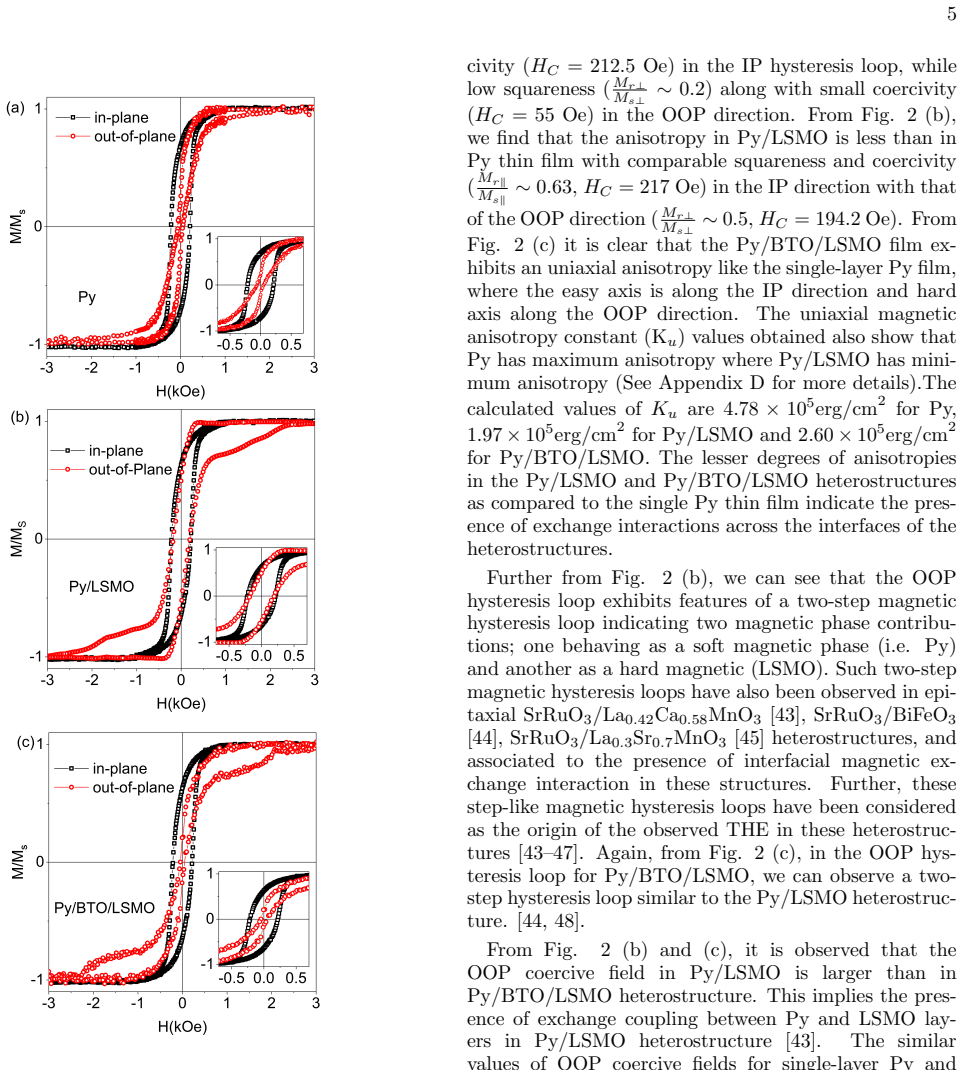
On the paper's own terms, the central discovery is that a large topological Hall effect can be generated at a simple ferromagnet/oxide interface: epitaxial Ni80Fe20 grown on La0.65Sr0.35MnO3 shows a topological Hall resistivity of about $2.8\,\mu\Omega\,\text{cm}$ at room temperature, about five times the value in single-layer permalloy, and the effect survives up to 375 K and leaves a remanent signal at zero field. The authors attribute this to non-coplanar, skyrmion-like spin textures at the Py/LSMO interface, stabilized by interfacial Rashba spin-orbit coupling (from broken inversion symmetry and a built-in electric field caused by charge transfer) together with magnetic exchange coupling between the two layers. Magnetic force microscopy reveals skyrmion-like features whose average size is largest in the Py/LSMO stack, consistent with the largest topological Hall signal. Tight-binding calculations for a Néel skyrmion lattice show that adding a Rashba term changes the magnitude and sign of the topological Hall conductivity, providing a plausible microscopic account of the observed enhancement. The paper explicitly notes that non-topological chiral textures or inhomogeneous electronic structure could also mimic the anomaly, and that direct real-space imaging by Lorentz transmission electron microscopy is needed to confirm topological spin texture.
Load-bearing premise
The entire topological Hall signal rests on the assumption that the anomalous Hall effect of the two-magnetic-phase stack can be represented by one coefficient times the total magnetization; if permalloy and LSMO contribute separate anomalous Hall terms with different field dependencies, the subtraction creates a spurious topological hump.
Editorial extensions
If this is right
- The room-temperature value ($2.8\,\mu\Omega\,\text{cm}$) is among the largest reported for epitaxial thin films, and the effect persists from 250 K to 375 K, which would make the material usable in temperature-tolerant spintronic devices if the interpretation holds.
- The zero-field remanent topological Hall resistivity of $1.55\,\mu\Omega\,\text{cm}$ in Py/LSMO implies stable skyrmion-like states without an applied field, a requirement for low-power memory and logic.
- The BTO sandwich shows that a ferroelectric layer can substitute for magnetic exchange coupling in producing enhanced topological Hall effect, pointing to a materials-design knob (ferroelectric polarization) separate from interface exchange.
- The model predicts the topological Hall conductivity changes sign with the sign of the Rashba coefficient, suggesting that an external gate voltage could switch the effect on and off in these heterostructures.
- The paper itself cautions that non-topological chiral textures or inhomogeneous electronic structure can mimic a topological Hall anomaly, so Lorentz transmission electron microscopy is required to verify the skyrmion interpretation.
Reading between the lines
- If Py and LSMO have independent anomalous Hall coefficients with different field dependences, the single-$R_s$ subtraction used here could create a hump that looks topological; a two-channel model of the Hall response or a variable-thickness paramagnetic spacer experiment would test this directly.
- The model computes a periodic skyrmion lattice while MFM shows isolated, irregular objects; bridging this gap (for example, by simulating isolated skyrmions in a disordered landscape) would test whether the calculated $\sigma_{xy}^{THC}$ can quantitatively reproduce the measured resistivity.
- The single-layer Py reference already shows a topological Hall signal of $0.56\,\mu\Omega\,\text{cm}$ attributed to strain-induced tetragonal distortion; growing Py on a lattice-matched buffer to remove strain would isolate the interfacial contribution from the bulklike strain contribution.
- Comparing the same Py/LSMO stack with varying LSMO thickness or with a heavy-metal cap would clarify whether the enhancement scales with interfacial Rashba strength or with the half-metallic character of LSMO.
Signed reviews
Editorial analysis
A structured set of objections, weighed in public.
Referee Report
Summary. The manuscript reports the observation of a topological Hall effect in epitaxial Py/LSMO and Py/BTO/LSMO heterostructures grown on MgO(100), with a maximum topological Hall resistivity of about 2.8 µΩcm at room temperature in Py/LSMO, compared with 0.56 µΩcm in single-layer Py. The authors attribute the enhancement to interfacial Rashba interaction and skyrmion-like spin textures, supported by field-dependent MFM imaging and by a tight-binding model of a skyrmion lattice with Rashba coupling. The paper includes structural, magnetic, transport, and spectroscopic characterization of the heterostructures.
Significance. If the Hall decomposition is correct, the reported room-temperature topological Hall resistivity of 2.83 µΩcm in Py/LSMO is among the largest reported in epitaxial heterostructures and would be of considerable interest for spintronics. The paper combines careful epitaxial growth characterization (XRD RSM, rocking curves, XPS), field- and temperature-dependent transport, and MFM imaging, and it includes a model calculation with a well-defined Kubo-formula prescription. These strengths make the claim potentially important. However, the extraction of rho_T depends on a single-coefficient AHE subtraction that conflicts with the explicitly observed two-phase magnetization loop, and the supporting MFM and model evidence are not yet decisive.
major comments (3)
- [Appendix E (Eq. E1), Fig. 2] The decomposition in Eq. (E1) subtracts a single anomalous Hall term Rs M(H) from the measured total Hall resistivity, with Rs extracted at saturation (Appendix E). However, Section III B and Fig. 2(b) show that the out-of-plane M(H) loop of Py/LSMO is a two-step loop with soft (Py) and hard (LSMO) magnetic phases. In a parallel-conduction stack, the anomalous Hall effect is a weighted sum of different Rs_i M_i(H) for each layer, and a single Rs cannot describe the field-dependent AHE of the bilayer. The residual obtained by subtracting Rs M_total(H) will be largest near the switching fields of the two phases, exactly where the claimed topological Hall peak occurs (about 0.05 T, Table III) and where a remanent hump remains at H=0. The same objection applies to Py/BTO/LSMO, since the BTO interlayer does not remove the conducting LSMO channel. The authors cite Kimbell et al. [76] on nontopological mimics of the THE, but the two-channel AHE scenario is not excluded. The reported 2.83 micro-ohm-cm THE can therefore be an artifact of the subtraction. Please re-analyze with a two-channel model (or single-layer controls) and show the residual persists.
- [Section III B, Fig. 4] The MFM images in Fig. 4 show irregular, skyrmion-like features at 0.2 T, but MFM senses stray-field gradients and cannot by itself establish a nonzero topological charge; similar contrast can arise from magnetic bubbles, stripe-domain fragments, or tip-induced effects. The manuscript itself acknowledges in Section III C that Lorentz TEM is needed for decisive confirmation. Given that the Hall-subtraction issue in Major Comment 1 undermines the primary evidence, the MFM images as presented do not provide independent support for the topological origin. Please add size/field statistics and a quantitative comparison with the expected stray-field contrast, or obtain complementary imaging.
- [Section III C, Eqs. (1)-(4), Fig. 5] The tight-binding calculation in Section III C demonstrates that for a prescribed skyrmion lattice the computed topological Hall conductivity changes when a Rashba term is added. However, the model does not reproduce the experimental magnitude, sign, or field dependence: no experimental parameter (carrier density, skyrmion size, Rashba coefficient) is used to set the scale, and no conversion from sigma_xy to rho_xy is provided. The statement that the Rashba interaction 'can account for the observed changes' is therefore not quantitatively supported. Please either fit the model to the measured parameters and compare magnitudes, or restrict the claim to 'is consistent with'.
minor comments (6)
- [Section I] Typo: 'Rasba effect' should be 'Rashba effect' in the introduction.
- [Table III] In the FeGe row, 'Symerion' should be 'Skyrmion'.
- [Appendix G, Fig. 10 caption] The caption states 'represents 11 µm', which is likely a typo for 1 µm; the scale bar in Fig. 4 is 1 µm.
- [Table II and Section III B] The units of the uniaxial anisotropy constant are inconsistent: the text gives erg/cm^2 while Table II lists erg/cm^3; please harmonize.
- [Fig. 3] The Hall resistivity curves are plotted without error bars or an explicit measurement precision; please state the experimental uncertainty.
- [Reference [69]] Reference [69] is cited as an arXiv preprint; please cite the published version if available.
Circularity Check
No significant circularity: the experimental THE is a standard residual and the model calculation is independent of the measured values.
full rationale
The central experimental claim is obtained by a standard Hall decomposition, with the total Hall resistivity written as rho_xy = R0H + RsM + rho_T (Appendix E, Eq. E1). Rs is fixed from the saturated stack and rho_T is the field-dependent residual; this is the operational definition of a topological Hall signal, not a prediction forced by a fitted parameter. The theoretical section independently computes the Berry-curvature topological Hall conductivity (Eqs. 3-4) of a skyrmion lattice with and without Rashba coupling; no experimental value of rho_T, no fitted film parameter, and no measured magnetization enters the model calculation. The self-citations (Refs. 4 and 34, by co-author S. Bhowal) are to standard Rashba and skyrmion tight-binding forms and are not load-bearing: the Rashba term is a textbook form and the THC is evaluated in the present paper rather than imported from the cited works. The paper itself cites Kimbell et al. [76] and explicitly states that non-topological chiral spin textures and inhomogeneous electronic structures can mimic AHE anomalies, which is a limitation/correctness caveat rather than a circular step. The skeptic's concern that a single-coefficient AHE subtraction may create a spurious hump in a two-magnetic-phase stack is a substantive validity risk, but it is not a case of the paper's result being equivalent to its own inputs by construction.
Assumptions & free parameters
free parameters (5)
- Ordinary Hall coefficient R0 =
not given numerically; extracted from high-field linear fit
- Anomalous Hall coefficient Rs =
derived from rho_A+T_xy(sat)/M(sat)
- Rashba coefficient alpha in tight-binding model =
alpha/t = 0, +-0.5
- Hund's coupling JH/t =
JH/t = 100
- Skyrmion size lambda in model =
not specified in units
assumptions (5)
- domain assumption The Hall data can be decomposed as rho_xy = R0*H + Rs*M + rho_T_xy with a single Rs for the whole stack.
- domain assumption The spin texture in the samples is a Neel-type skyrmion lattice with m=1, gamma=0 and theta = pi(1-r/lambda).
- domain assumption The electrons are in the adiabatic limit JH >> t so that spins follow the local magnetization.
- ad hoc to paper The Rashba coupling has the form HR = alpha[sigma_x sin(k_y a) - sigma_y sin(k_x a)] with a single alpha for all bands.
- standard math The Kubo formula gives the topological Hall conductivity.
Cite this review
Pith. "Pith review of Giant topological Hall effect in epitaxial Ni$_{80}$Fe$_{20}$/La$_{0.65}$Sr$_{0.35}$MnO$_3$ thin film heterostructures." pith.science (2026). https://pith.science/paper/PBH2Q25Z
@misc{pith2026250109969,
  author       = {Pith},
  title        = {Pith review of: Giant topological Hall effect in epitaxial Ni$_80$Fe$_20$/La$_0.65$Sr$_0.35$MnO$_3$ thin film heterostructures},
  year         = {2026},
  howpublished = {\url{https://pith.science/paper/PBH2Q25Z}},
  note         = {Machine review of arXiv:2501.09969}
}
abstract
The emergence of new physical properties at the interfaces between complex oxides has always been of both fundamental and practical importance. Here, we report the observation of a giant topological Hall resistivity of $\sim 2.8 \mu \Omega$ \text{cm} at room temperature in an epitaxial thin-film heterostructure of permalloy (Py, Ni$_{80}$Fe$_{20}$) and the half-metallic ferromagnet La$_{0.65}$Sr$_{0.35}$MnO$_3$ (LSMO). This large magnitude of the topological Hall effect in the Py/LSMO heterostructure, compared to a single-layer Py thin film, is attributed to the optimized combination of ferromagnetism in LSMO and the strong spin-orbit-coupling-driven Rashba interaction at the interface. The introduction of a ferroelectric BaTiO$_3$ (BTO) sandwich layer in the Py/LSMO heterostructure also leads to an enhanced topological Hall resistivity compared to the single-layer Py thin film. Interestingly, magnetic force microscopy measurements reveal skyrmion-like features, suggesting the origin of the topological Hall effect. Our theoretical model calculations for the skyrmion lattice further indicate that the Rashba interaction, driven by the broken inversion symmetry in the Py/LSMO films, can account for the observed changes in the topological Hall effect at the interface. Our work opens the door for the potential use of Py/LSMO thin films in spintronic applications.
Figures


Figures from the paper (6 more)


Reference graph
Works this paper leans on
-
[76]
G. Kimbell, C. Kim, W. Wu, M. Cuoco, and J. W. A. Robinson, Communications Materials 3, 19 (2022), URL https://doi.org/10.1038/s43246-022-00238-2
-
[1]
H. Y. Hwang, Y. Iwasa, M. Kawasaki, B. Keimer, N. Na- gaosa, and Y. Tokura, Nature Materials 11, 103 (2012), URL https://doi.org/10.1038/nmat3223
doi:10.1038/nmat3223 2012
-
[2]
K. S. Takahashi, M. Kawasaki, and Y. Tokura, Applied Physics Letters 79, 1324 (2001), ISSN 0003-6951, https://pubs.aip.org/aip/apl/article- pdf/79/9/1324/18559896/1324 1 online.pdf, URL https://doi.org/10.1063/1.1398331
-
[3]
J. Nichols, X. Gao, S. Lee, T. L. Meyer, J. W. Freeland, V. Lauter, D. Yi, J. Liu, D. Haskel, J. R. Petrie, et al., Nature Communications 7, 12721 (2016), URL https: //doi.org/10.1038/ncomms12721
-
[4]
Bhowal and S
S. Bhowal and S. Satpathy, Phys. Rev. B 99, 245145 (2019), URL https://link.aps.org/doi/10. 1103/PhysRevB.99.245145
2019
-
[5]
Bhowal and S
S. Bhowal and S. Satpathy, npj Computational Ma- terials 5, 61 (2019), URL https://doi.org/10.1038/ s41524-019-0198-8
2019
-
[6]
A. Ohtomo and H. Y. Hwang, Nature 427, 423 (2004), URL https://doi.org/10.1038/nature02308
-
[7]
K. D. Belashchenko, Phys. Rev. Lett. 105, 147204 (2010), URL https://link.aps.org/doi/10.1103/ PhysRevLett.105.147204
2010
Show all 86 references
-
[8]
S. F. Weber, A. Urru, S. Bhowal, C. Ederer, and N. A. Spaldin, Phys. Rev. X 14, 021033 (2024), URL https: //link.aps.org/doi/10.1103/PhysRevX.14.021033
2024 doi
-
[9]
Bhowal, A
S. Bhowal, A. Urru, S. F. Weber, and N. A. Spaldin, Emergent surface multiferroicity (2024), 2411.12434, URL https://arxiv.org/abs/2411.12434
2024 arXiv
-
[10]
Matsuno, N
J. Matsuno, N. Ogawa, K. Yasuda, F. Kagawa, W. Koshibae, N. Nagaosa, Y. Tokura, and M. Kawasaki, Sci. Adv 2, e1600304 (2016), URL https://www. science.org/doi/abs/10.1126/sciadv.1600304
2016 doi
-
[11]
Ohuchi, J
Y. Ohuchi, J. Matsuno, N. Ogawa, Y. Kozuka, M. Uchida, Y. Tokura, and M. Kawasaki, Nature Com- munications 9, 213 (2018), URL https://doi.org/10. 1038/s41467-017-02629-3
2018
-
[12]
Soumyanarayanan, N
A. Soumyanarayanan, N. Reyren, A. Fert, and C. Panagopoulos, Nature 539, 509 (2016), URL https: //doi.org/10.1038/nature19820. 15
2016 doi
-
[13]
Vistoli, W
L. Vistoli, W. Wang, A. Sander, Q. Zhu, B. Casals, R. Ci- chelero, A. Barth´ el´ emy, S. Fusil, G. Herranz, S. Valen- cia, et al., Nature Physics 15, 67 (2019), URL https: //doi.org/10.1038/s41567-018-0307-5
2019 doi
-
[14]
Skoropata, J
E. Skoropata, J. Nichols, J. M. Ok, R. V. Chopdekar, E. S. Choi, A. Rastogi, C. Sohn, X. Gao, S. Yoon, T. Farmer, et al., Science Advances 6, eaaz3902 (2020), https://www.science.org/doi/pdf/10.1126/ sci- adv.aaz3902, URL https://www.science.org/doi/abs/ 10.1126/sciadv.aaz3902
2020 doi
-
[15]
M.-W. Yoo, J. Tornos, A. Sander, L.-F. Lin, N. Mohanta, A. Peralta, D. Sanchez-Manzano, F. Gallego, D. Haskel, J. W. Freeland, et al., Nature Communications (2021), URL https://doi.org/10.1038/s41467-021-23489-y
2021 doi
-
[16]
C. H. Ahn, A. Bhattacharya, M. Di Ventra, J. N. Eck- stein, C. D. Frisbie, M. E. Gershenson, A. M. Gold- man, I. H. Inoue, J. Mannhart, A. J. Millis, et al., Rev. Mod. Phys. 78, 1185 (2006), URL https://link.aps. org/doi/10.1103/RevModPhys.78.1185
2006 doi
-
[17]
Middey, P
S. Middey, P. Rivero, D. Meyers, M. Kareev, X. Liu, Y. Cao, J. W. Freeland, S. Barraza-Lopez, and J. Chakhalian, Scientific Reports 4, 6819 (2014), URL https://doi.org/10.1038/srep06819
2014 doi
-
[18]
Okamoto, J
S. Okamoto, J. Nichols, C. Sohn, S. Y. Kim, T. W. Noh, and H. N. Lee, Nano Letters 17, 2126 (2017), URL https://doi.org/10.1021/acs.nanolett.6b04107
2017 doi
-
[19]
Belabbes, G
A. Belabbes, G. Bihlmayer, S. Bl¨ ugel, and A. Manchon, Scientific Reports 6, 24634 (2016), URL https://doi. org/10.1038/srep24634
2016 doi
-
[20]
D. Xiao, W. Zhu, Y. Ran, N. Nagaosa, and S. Okamoto, Nature Communications 2, 596 (2011), URL https:// doi.org/10.1038/ncomms1602
2011 doi
-
[21]
MATSUNO, Hyomen Kagaku 38, 614 (2017)
J. MATSUNO, Hyomen Kagaku 38, 614 (2017)
2017
-
[22]
Huang, Y.-C
Y.-H. Huang, Y.-C. Weng, C.-T. Liang, and J. G. Lin, AIP Advances 10, 015041 (2020), ISSN 2158-3226, https://pubs.aip.org/aip/adv/article- pdf/doi/10.1063/1.5129445/12999765/015041 1 online. pdf, URL https://doi.org/10.1063/1.5129445
2020 doi
-
[23]
H. D. Arnold and G. W. Elmen, The Bell System Tech- nical Journal 2, 101 (1923)
1923
-
[24]
Zhang, F
S. Zhang, F. Kronast, G. van der Laan, and T. Hesjedal, Nano Letters 18, 1057 (2018), URL https://doi.org/ 10.1021/acs.nanolett.7b04537
2018 doi
-
[25]
Tokura and Y
Y. Tokura and Y. Tomioka, Journal of Magnetism and Magnetic Materials 200, 1 (1999), ISSN 0304- 8853, URL https://www.sciencedirect.com/science/ article/pii/S0304885399003522
1999
-
[26]
M. V. J. M. D. Coey and S. von Moln´ ar, Advances in Physics 48, 167 (1999), https://doi.org/10.1080/000187399243455, URL https://doi.org/10.1080/000187399243455
1999 doi
-
[27]
Y. Li, L. Zhang, Q. Zhang, C. Li, T. Yang, Y. Deng, L. Gu, and D. Wu, ACS Applied Materials & Inter- faces 11, 21268 (2019), URL https://doi.org/10.1021/ acsami.9b05562
2019
-
[28]
Y. zhao, F. Liu, and C. Jiang, Journal of Magnetism and Magnetic Materials 570, 170529 (2023), ISSN 0304- 8853, URL https://www.sciencedirect.com/science/ article/pii/S0304885323001786
2023
-
[29]
Bergenti, P
I. Bergenti, P. K. Manna, C.-H. Lin, P. Graziosi, X. Liu, G. L. Causer, F. Liscio, A. Ruotolo, V. A. Dediu, J. van Lierop, et al., Journal of Applied Physics 124, 183903 (2018), ISSN 0021-8979, https://pubs.aip.org/aip/jap/article- pdf/doi/10.1063/1.5049235/15218206/183903 1 o...
2018 doi
-
[30]
Ruotolo, A
A. Ruotolo, A. Oropallo, F. Miletto Granozio, G. P. Pepe, P. Perna, and U. Scotti di Uccio, Applied Physics Letters 88, 252504 (2006), ISSN 0003-6951, https://pubs.aip.org/aip/apl/article- pdf/doi/10.1063/1.2216891/14351874/252504 1 online. pdf, URL https://doi.org/10.1063/1.2216891
2006 doi
-
[31]
Mondal, A
N. Mondal, A. Barman, S. Chatterjee, and D. Mukher- jee, Journal of Magnetism and Magnetic Mate- rials 564, 170118 (2022), ISSN 0304-8853, URL https://www.sciencedirect.com/science/article/ pii/S0304885322010034
2022
-
[32]
H. I, F. R, G.-R. JM, C. J, G.-H. J, and B. AM, The Review of scientific instruments 78(1), 013705 (2007)
2007
-
[33]
Hamamoto, M
K. Hamamoto, M. Ezawa, and N. Nagaosa, Phys. Rev. B 92, 115417 (2015), URL https://link.aps.org/doi/ 10.1103/PhysRevB.92.115417
2015 doi
-
[34]
Bhowal and N
S. Bhowal and N. A. Spaldin, Phys. Rev. Lett. 128, 227204 (2022), URL https://link.aps.org/doi/10. 1103/PhysRevLett.128.227204
2022
-
[35]
Nagaosa and Y
N. Nagaosa and Y. Tokura, Nat. Nanotechnol. 8, 899 (2013), URL https://doi.org/10.1038/nnano.2013. 243
2013 doi
-
[36]
Kawano and C
M. Kawano and C. Hotta, Phys. Rev. B 107, 045123 (2023), URL https://link.aps.org/doi/10. 1103/PhysRevB.107.045123
2023
-
[37]
Pekar and ´E
S. Pekar and ´E. I. Rashba, Zh. Eksp. Teor. Fiz. 47, 1927 (1964), [Sov. Phys. JETP 20 (5), 1295- 1298 (1965)], URL http://www.jetp.ras.ru/cgi-bin/ e/index/r/47/5/p1927?a=list
1964
-
[38]
Rashba, Sov
E. Rashba, Sov. Phys.-Solid State 2, 1109 (1960), URL https://cir.nii.ac.jp/crid/1571698600346713472
1960
-
[39]
Y. A. Bychkov and E. I. Rashba, J. Solid State Phys. 17, 6039 (1984), URL https://dx.doi.org/10.1088/ 0022-3719/17/33/015
1984
-
[40]
K. V. Shanavas and S. Satpathy, Phys. Rev. Lett. 112, 086802 (2014), URL https://link.aps.org/doi/ 10.1103/PhysRevLett.112.086802
2014 doi
-
[41]
Jiang, X
J. Jiang, X. Sun, X. Chen, B. Wang, Z. Chen, Y. Hu, Y. Guo, L. Zhang, M. Yuan, L. Gao, et al., Nature Com- munications 10 (2019)
2019
-
[42]
Chatterjee, K
S. Chatterjee, K. Yadav, N. Mondal, G. S. Kumar, D. Bhattacharya, and D. Mukherjee, Journal of Applied Physics 135 (2024)
2024
-
[43]
P. Roy, D. Zhang, A. R. Mazza, N. Cucciniello, S. Kun- war, H. Zeng, A. Chen, and Q. Jia, Nanoscale 15, 17589 (2023), URL http://dx.doi.org/10.1039/D3NR02407E
2023 doi
-
[44]
X. Yao, C. Wang, E.-J. Guo, X. Wang, X. Li, L. Liao, Y. Zhou, S. Lin, Q. Jin, C. Ge, et al., ACS Applied Ma- terials & Interfaces 14, 6194 (2022), pMID: 35072446, https://doi.org/10.1021/acsami.1c21703, URL https:// doi.org/10.1021/acsami.1c21703
2022 doi
-
[45]
R. Rana, P. Pandey, R. P. Singh, and D. S.Rana, Scien- tific Reports 4, 4138 (2014), URL https://doi.org/10. 1038/srep04138
2014
-
[46]
N. Li, R. Sun, Y. Li, L. Su, Z.-Z. Gong, X.-Q. Zhang, W. He, and Z.-H. Cheng, Physics Let- ters A 401, 127329 (2021), ISSN 0375-9601, URL https://www.sciencedirect.com/science/article/ pii/S0375960121001936
2021
-
[47]
Y. He, S. Schneider, T. Helm, J. Gayles, D. Wolf, I. Soldatov, H. Borrmann, W. Schnelle, R. Schaefer, 16 G. H. Fecher, et al., Acta Materialia 226, 117619 (2022), ISSN 1359-6454, URL https://www.sciencedirect. com/science/article/pii/S1359645422000039
2022
-
[48]
Ziese and I
M. Ziese and I. Lindfors-Vrejoiu, Journal of Applied Physics 124, 163905 (2018), ISSN 0021-8979, https://pubs.aip.org/aip/jap/article- pdf/doi/10.1063/1.5051812/15219613/163905 1 online. pdf, URL https://doi.org/10.1063/1.5051812
2018 doi
-
[49]
S. K. Chaluvadi, V. Polewczyk, A. Y. Petrov, G. Vinai, L. Braglia, J. M. Diez, V. Pierron, P. Perna, L. Mechin, P. Torelli, et al., ACS Omega 7, 14571 (2022), https://doi.org/10.1021/acsomega.1c06529, URL https: //doi.org/10.1021/acsomega.1c06529
2022 doi
-
[50]
Mukherjee, M
D. Mukherjee, M. Hordagoda, P. Lampen, M.-H. Phan, H. Srikanth, S. Witanachchi, and P. Mukherjee, Phys. Rev. B 91, 054419 (2015), URL https://link.aps.org/ doi/10.1103/PhysRevB.91.054419
2015 doi
-
[51]
Chen, T.-H
Y.-C. Chen, T.-H. Hong, Z.-X. Jiang, and Q.-R. Lin, Journal of Applied Physics 103, 07E305 (2008), ISSN 0021-8979, URL https://doi.org/10.1063/1.2836801
2008 doi
-
[52]
Kanazawa, Y
N. Kanazawa, Y. Onose, T. Arima, D. Okuyama, K. Ohoyama, S. Wakimoto, K. Kakurai, S. Ishi- wata, and Y. Tokura, Phys. Rev. Lett. 106, 156603 (2011), URL https://link.aps.org/doi/10. 1103/PhysRevLett.106.156603
2011
-
[53]
Z. Liu, A. Burigu, Y. Zhang, H. M. Jafri, X. Ma, E. Liu, W. Wang, and G. Wu, Scripta Mate- rialia 143, 122 (2018), ISSN 1359-6462, URL https://www.sciencedirect.com/science/article/ pii/S1359646217305365
2018
-
[54]
Roychowdhury, K
S. Roychowdhury, K. Samanta, P. Yanda, B. Mala- man, M. Yao, W. Schnelle, E. Guilmeau, P. Con- stantinou, S. Chandra, H. Borrmann, et al., Journal of the American Chemical Society 145, 12920 (2023), pMID: 37267070, https://doi.org/10.1021/jacs.3c04249, URL https://doi.org/10.1...
2023 doi
-
[55]
Roychowdhury, S
S. Roychowdhury, S. Singh, S. N. Guin, N. Kumar, T. Chakraborty, W. Schnelle, H. Borrmann, C. Shekhar, and C. Felser, Chemistry of Materials 33, 8343 (2021), https://doi.org/10.1021/acs.chemmater.1c02625, URL https://doi.org/10.1021/acs.chemmater.1c02625
2021 doi
-
[56]
Y. Xu, W. Ren, S. Ma, C. Chen, C. Fang, X. Luo, and Z. Mo, Applied Physics Letters 123, 072402 (2023), ISSN 0003-6951, https://pubs.aip.org/aip/apl/article- pdf/doi/10.1063/5.0160745/18084495/072402 1 5.0160745. pdf, URL https://doi.org/10.1063/5.0160745
2023 doi
-
[57]
W. Wang, Y. Zhang, G. Xu, L. Peng, B. Ding, Y. Wang, Z. Hou, X. Zhang, X. Li, E. Liu, et al., Advanced Materials 28, 6887 (2016), https://onlinelibrary.wiley.com/doi/pdf/10.1002/ adma.201600889, URL https://onlinelibrary. wiley.com/doi/abs/10.1002/adma.201600889
2016 doi
-
[58]
M. R. U. Nabi, A. Wegner, F. Wang, Y. Zhu, Y. Guan, A. Fereidouni, K. Pandey, R. Basnet, G. Acharya, H. O. H. Churchill, et al., Phys. Rev. B 104, 174419 (2021), URL https://link.aps.org/doi/10. 1103/PhysRevB.104.174419
2021
-
[59]
A. S. Ahmed, J. Rowland, B. D. Esser, S. R. Dunsiger, D. W. McComb, M. Randeria, and R. K. Kawakami, Phys. Rev. Mater. 2, 041401 (2018), URL https://link. aps.org/doi/10.1103/PhysRevMaterials.2.041401
2018 doi
-
[60]
J. C. Gallagher, K. Y. Meng, J. T. Brangham, H. L. Wang, B. D. Esser, D. W. McComb, and F. Y. Yang, Phys. Rev. Lett. 118, 027201 (2017), URL https:// link.aps.org/doi/10.1103/PhysRevLett.118.027201
2017 doi
-
[61]
Budhathoki, A
S. Budhathoki, A. Sapkota, K. M. Law, S. Ranjit, B. Nepal, B. D. Hoskins, A. S. Thind, A. Y. Borise- vich, M. E. Jamer, T. J. Anderson, et al., Phys. Rev. B 101, 220405 (2020), URL https://link.aps.org/doi/ 10.1103/PhysRevB.101.220405
2020 doi
-
[62]
M. He, G. Li, Z. Zhu, Y. Zhang, L. Peng, R. Li, J. Li, H. Wei, T. Zhao, X.-G. Zhang, et al., Phys. Rev. B 97, 174419 (2018), URL https://link.aps.org/doi/ 10.1103/PhysRevB.97.174419
2018 doi
-
[63]
Ohuchi, Y
Y. Ohuchi, Y. Kozuka, M. Uchida, K. Ueno, A. Tsukazaki, and M. Kawasaki, Phys. Rev. B 91, 245115 (2015), URL https://link.aps.org/doi/10. 1103/PhysRevB.91.245115
2015
-
[64]
Y. Chen, Y. Zhu, R. Lin, W. Niu, R. Liu, W. Zhuang, X. Zhang, J. Liang, W. Sun, Z. Chen, et al., Ad- vanced Functional Materials 33, 2302984 (2023), https://onlinelibrary.wiley.com/doi/pdf/10.1002/ adfm.202302984, URL https://onlinelibrary.wiley. com/doi/abs/10.1002/adfm.202302984
2023 doi
-
[65]
Lone, Aijaz H.and Zou, D
X. Lone, Aijaz H.and Zou, D. Das, X. Fong, G. Setti, and H. Fariborzi, npj Spintronics (2024), URL https: //doi.org/10.1038/s44306-023-00006-z
2024 doi
-
[66]
L. Ma, Y. Li, H. R. Fu, N. Tian, and C. Y. You, Applied Physics Letters 121, 192405 (2022), ISSN 0003-6951, https://pubs.aip.org/aip/apl/article- pdf/doi/10.1063/5.0127474/16486989/192405 1 online. pdf, URL https://doi.org/10.1063/5.0127474
2022 doi
-
[67]
Sugimoto, Y
S. Sugimoto, Y. K. Takahashi, and S. Kasai, Ap- plied Physics Letters 121, 182404 (2022), ISSN 0003-6951, https://pubs.aip.org/aip/apl/article- pdf/doi/10.1063/5.0128572/16487044/182404 1 online. pdf, URL https://doi.org/10.1063/5.0128572
2022 doi
-
[68]
P. Chen, C. Zhang, Y. Wang, B. Lv, P. Liu, Y. Tian, J. Ran, C. Gao, Q. Liu, and D. Xue, Phys. Rev. B 104, 064409 (2021), URL https://link.aps.org/doi/ 10.1103/PhysRevB.104.064409
2021 doi
-
[69]
N. A. Porter, P. Sinha, M. B. Ward, A. N. Dobrynin, R. M. D. Brydson, T. R. Charlton, C. J. Kinane, M. D. Robertson, S. Langridge, and C. H. Marrows, Giant topological hall effect in strained Fe 0.7Co0.3Si epilayers (2013), 1312.1722, URL https://arxiv.org/abs/1312. 1722
2013 arXiv
-
[70]
J. Yu, Y. Liu, Y. Ke, J. Su, J. Cao, Z. Li, B. Sun, H. Bai, and W. Wang, Advanced Materials 36, 2308415 (2024), https://onlinelibrary.wiley.com/doi/pdf/10.1002/ adma.202308415, URL https://onlinelibrary. wiley.com/doi/abs/10.1002/adma.202308415
2024 doi
-
[71]
S. Hu, E. Liu, Y. Bai, M. Zhuang, W. Liu, M. Lei, Y. Zhang, G. Xu, F. Xu, and S. Mangin, Phys. Rev. B 109, 224407 (2024), URL https://link.aps.org/doi/ 10.1103/PhysRevB.109.224407
2024 doi
-
[72]
Allenspach, A
R. Allenspach, A. Bischof, B. Boehm, U. Drechsler, O. Reich, M. Sousa, S. Tacchi, and G. Carlotti, Phys. Rev. B 110, 014402 (2024), URL https://link.aps. org/doi/10.1103/PhysRevB.110.014402
2024 doi
-
[73]
Curcic, B
M. Curcic, B. Van Waeyenberge, A. Vansteenkiste, M. Weigand, V. Sackmann, H. Stoll, M. F¨ ahnle, T. Tyliszczak, G. Woltersdorf, C. H. Back, et al., Phys. Rev. Lett. 101, 197204 (2008), URL https://link.aps. org/doi/10.1103/PhysRevLett.101.197204
2008 doi
-
[74]
P. Roy, A. Carr, T. Zhou, B. Paudel, X. Wang, D. Chen, K. T. Kang, A. Pateras, Z. Corey, S. Lin, et al., Advanced Electronic Materials 9, 2300020 (2023), 17 https://onlinelibrary.wiley.com/doi/pdf/10.1002/ aelm.202300020, URL https://onlinelibrary.wiley. com/doi/abs/10.1002/ae...
2023 doi
-
[75]
Galitski and I
V. Galitski and I. B. Spielman, NATURE 494, 49 (2013), ISSN 0028-0836
2013
-
[77]
X. Zhao, C. Jin, C. Wang, H. Du, J. Zang, M. Tian, R. Che, and Y. Zhang, Proceedings of the Na- tional Academy of Sciences 113, 4918 (2016), https://www.pnas.org/doi/pdf/10.1073/pnas.1600197113, URL https://www.pnas.org/doi/abs/10.1073/pnas. 1600197113
2016 doi
-
[78]
J. Tang, L. Kong, W. Wang, H. Du, and M. Tian, Chi- nese Physics B 28, 087503 (2019), URL https://dx. doi.org/10.1088/1674-1056/28/8/087503
2019 doi
-
[79]
M. T. Birch, D. Cort´ es-Ortu˜ no, L. A. Turnbull, M. N. Wilson, F. Groß, N. Tr¨ ager, A. Laurenson, N. Bukin, S. H. Moody, M. Weigand, et al., Nature Communica- tions 11, 1726 (2020), URL https://doi.org/10.1038/ s41467-020-15474-8
2020
-
[80]
P. Sahu, B. R. K. Nanda, and S. Satpathy, Phys. Rev. B 106, 224403 (2022), URL https://link.aps.org/doi/ 10.1103/PhysRevB.106.224403
2022 doi
-
[81]
Feng, X.-Y
Y. Feng, X.-Y. Yu, and U. Paik, Scientific Reports (2016), URL https://doi.org/10.1038/srep34004
2016 doi
-
[82]
M. B. Islam, M. Yanagida, Y. Shirai, Y. Nabetani, and K. Miyano, ACS Omega 2, 2291 (2017), pMID: 31457579, https://doi.org/10.1021/acsomega.7b00538, URL https://doi.org/10.1021/acsomega.7b00538
2017 doi
-
[83]
Salou, B
M. Salou, B. Lescop, S. Rioual, A. Lebon, J. B. Youssef, and B. Rouvellou, Surface Science 602, 2901 (2008), ISSN 0039-6028, URL https://www.sciencedirect. com/science/article/pii/S0039602808004792
2008
-
[84]
Cheng, H
M. Cheng, H. Fan, Y. Song, Y. Cui, and R. Wang, Dalton Trans. 46, 9201 (2017), URL http://dx.doi.org/10. 1039/C7DT01289F
2017
-
[85]
Medvedeva, E
A. Medvedeva, E. Makhonina, L. Pechen, Y. Poli- tov, A. Rumyantsev, Y. Koshtyal, A. Goloveshkin, K. Maslakov, and I. Eremenko, Materials 15 (2022), ISSN 1996-1944, URL https://www.mdpi. com/1996-1944/15/22/8225
2022
-
[86]
Yamashita and P
T. Yamashita and P. Hayes, Applied Surface Sci- ence 254, 2441 (2008), ISSN 0169-4332, URL https://www.sciencedirect.com/science/article/ pii/S0169433207013748
2008
Reviewed August 10, 2026 · model on record in the stance chip above.
Discussion (0). Continue with ORCID to comment.