REVIEW 5 major objections 9 minor 73 references
Topology-Driven Attribute Recovery for Attribute Missing Graph Learning in Social Internet of Things
T0 review · 5 major / 9 minor · reviewed 2026-08-10 · deepseek-v4-flash
Pith's one-line read TDAR, a topology-driven framework, recovers missing node attributes in graphs by pre-filling with edge-based propagation and regularizing embeddings, and reports state-of-the-art results on reconstruction, classification, and clustering…
desk verdict Solid incremental integration of known ideas with consistent benchmark gains, but the SIoT robustness claim needs a heterophilous test. read the letter →
The pith
A machine-rendered reading of the paper's core claim, the machinery that carries it, and where it could break.
The reading
What carries the argument
The load-bearing identity is the Dirichlet energy $E(X)=X^T L X$ of the graph Laplacian, whose minimizer yields the feature-propagation update $X_u = -L_{uu}^{-1} L_{uk} X_k$. TDAR's key mechanism is a modification of the iterative feature-propagation loop (Eqs. 7–8) that injects a small global average of known attributes and lets known attributes participate in updates with a reset term, cutting the required iterations from roughly 40 to at most 10 and reducing oversmoothing. On top of that, ESPC computes a per-node confidence weight from two distance functions—shortest path from unknown nodes to known nodes, and known nodes' count of unknown neighbors—and applies it to a correlation-corrected embedding to re-weight the loss; NHS and NLSC then add cosine-similarity losses over connected and disconnected node pairs.
What would settle it
On a heterophilous graph (edges mostly between dissimilar nodes) with 50% masked attributes, compare TDAR's reconstruction RMSE with a plain MLP autoencoder that ignores graph structure; if the MLP is more accurate, topology-driven pre-fill and homophily regularizers are actively harmful in that regime.
Extended reading notes
Core claim
On its own terms, TDAR establishes that the central difficulty of learning from attribute-missing graphs is not encoding capacity but initialization and supervision: how the missing attributes are filled before network training, and how the embedding space is constrained. The paper's discovery is that a cheap, parameter-free pre-fill step—feature propagation with a small global-mean term and a known-reset mechanism—already outperforms the standard FP pre-fill, and that combining it with position-aware embedding weights (ESPC) and two similarity-based regularizers (NHS and NLSC) yields the best reported results on all benchmark datasets. The authors argue that this shows topology should be treated as the primary signal for attribute recovery, with generative refinements playing a secondary role.
Load-bearing premise
The whole pipeline assumes homophily—that connected nodes have similar attributes—so feature propagation along edges and the NHS regularizer improve recovery; on graphs where edges connect dissimilar nodes or are noisy, these steps spread incorrect attributes and can hurt reconstruction.
Editorial extensions
If this is right
- Graphs with missing attributes can be handled with a deterministic, parameter-free pre-fill plus regularized GAE training, avoiding GAN and variational inference overhead.
- The improvements hold across missing rates from 0.2 to 0.8, so topology-driven recovery remains useful even under extreme missingness.
- Better reconstruction transfers to downstream tasks: node classification accuracy improves by up to 9.5 points and clustering accuracy by up to 35 points on the tested benchmarks.
- The overall complexity stays $O(N^2)$, dominated by the non-link similarity calibration, keeping TDAR competitive in runtime with prior state-of-the-art methods.
- The framework's modular design means each component (pre-fill, weighting, regularizers) can be lifted into other AMG pipelines as an initialization or loss term.
Reading between the lines
- If the homophily assumption is the real source of gains, TDAR should degrade on heterophilous graphs (e.g., protein interaction or transaction networks); a direct test on such data would mark the boundary of the method.
- The NHS loss pushes every connected pair toward similarity, which may over-constrain hubs and noisy-edge graphs; a degree-normalized or attention-weighted variant of NHS could preserve the benefit while avoiding collapse.
- The global-mean term in TAAP injects a dataset-wide average into every unknown node; on highly imbalanced label distributions this could bias recovery toward majority classes, and ablating α's value at larger sizes would reveal whether this matters.
- The reported clustering gains on Amap are much larger than on Cora; investigating whether this comes from the graph's dense structure or from the pre-fill would tell practitioners which datasets most benefit from TDAR.
Editorial analysis
A structured set of objections, weighed in public.
Referee Report
Summary. The paper proposes TDAR, a framework for learning from graphs with missing node attributes (AMGs). TDAR combines a topology-aware attribute propagation pre-filling step (TAAP) with embedding-space confidence weighting (ESPC) and two regularization terms (NHS and NLSC) inside a graph autoencoder, and is motivated by attribute-missing graphs in the Social Internet of Things. Experiments on six standard citation and co-purchase datasets report improvements over existing AMG baselines in attribute reconstruction, node classification, and clustering, along with ablations, hyperparameter studies, and qualitative visualizations. The authors provide a link to the code.
Significance. If validated, TDAR would offer a useful end-to-end method for attribute-missing graph learning, and the idea of combining pre-filling with topology-aware weighting and homophily regularizers is reasonable. The paper's strengths are its broad comparison with many baselines, the ablation of each component, the hyperparameter sensitivity analysis, and the release of code. However, the current evidence is weakened by the absence of any statistical variability analysis (all runs use a single fixed seed), by internal inconsistencies in the equations that define the core mechanisms, and by an experimental scope that excludes the heterophilous or SIoT-style graphs that the paper itself identifies as the motivating application domain. The improvements are consistent in direction but the claimed 'significance' is not established.
major comments (5)
- [§V.C, Tables II–V] All reported results come from a single fixed random seed (72), with no error bars, multiple runs, or significance tests. Since many reported gains over the strongest baselines are small (1–4% on reconstruction and classification), the claim in the abstract and Section VI that TDAR 'significantly outperforms' state-of-the-art methods is not statistically supported. Please report results over multiple seeds with mean and standard deviation, perform significance tests where appropriate, or explicitly temper the strength of the claims.
- [§IV.C and §V.A/V.G] The three core mechanisms—TAAP (Eq. 8), NHS (Eq. 18), and NLSC (Eq. 19)—explicitly encode a homophily and smoothness prior: features are propagated along edges, connected nodes are pushed to have similar embeddings, and non-connected nodes with similar embeddings are penalized. The experimental evaluation, however, is restricted to homophilous citation graphs (Cora, Citeseer, PubMed) and co-purchase graphs (Amac, Amap, CS), with no heterophilous dataset and no SIoT dataset. Section V.G measures homogeneity as a desirable outcome rather than testing robustness to heterophily. Given the paper's SIoT motivation and its claim of 'a robust solution' (abstract, Section VI), the evidence does not support the robustness claim for the motivating domain. Please add experiments on heterophilous or SIoT-style graphs, or restrict the conclusion to homophilous AMGs.
- [§IV.B, Eq. (11)] The confidence weight matrix W in Eq. (11) is not well-defined. The formula 'W = α F_{k2u}^T + (1 − α F_{u2k}^T)' mixes matrices of incompatible dimensions (F_{k2u} and F_{u2k} are introduced as N×D expansions, so their transposes are D×N), and the second term is ambiguous. Moreover, the described monotonicity is contradicted: the text says unknown-node weights should decrease with distance to known nodes, but the formula uses a positive multiple of distance, and the known-node term '1 − α F_{u2k}^T' would decrease (and possibly become negative) as the number of unknown neighbors grows, contrary to the statement that it should increase. Because the ESPC module is a central contribution, this formula must be corrected and clarified before the method can be reproduced or fairly evaluated.
- [§IV.A, Eqs. (7)–(8)] The TAAP update is internally inconsistent. Eq. (7) writes the update as a propagation matrix plus a vector [α X_k^{(l)}; (1−β)X_k^{(0)}], but Eq. (8) updates unknown nodes with an added term α X_k^{(l)} (a mean feature vector) and updates known nodes through the two-step form X_k^{(l+1)} = \hat{A}_{ku}X_u^{(l)} + \hat{A}_{kk}X_k^{(l)}, \tilde{X}_k^{(l+1)} = X_k^{(0)} + β X_k^{(l+1)}. These expressions do not match algebraically, and the second block of the added vector in Eq. (7) appears to have length k rather than the required unknown-node count. The actual algorithm implemented is therefore ambiguous, which is a serious reproducibility problem for the pre-filling step that the paper identifies as a key contribution.
- [Table IV] ITR and MATE are reported as out-of-memory on PubMed and CS, which removes two of the strongest baselines from the node classification comparison on the two largest datasets. The very large claimed improvements on those datasets (e.g., 32.1% on PubMed and 9.5% on CS) are therefore not established against the full set of competing state-of-the-art methods. Please provide results for memory-efficient runs of these baselines, or clearly discuss the missing comparisons and their effect on the 'consistently outperforms' conclusion.
minor comments (9)
- [Table III] The baseline row labeled 'GGN' appears to be a typo for GCN; please correct it. Also, 'GNN*' is used as a single aggregated row in Tables II, IV, and V, but GCN, GraphSAGE, and GAT are listed as separate rows in Table III; please unify the presentation.
- [§V.C] 'Amcp' is a typo for 'Amap', and the phrase 'binary-tier GCN-MLP' is unclear; please specify the exact encoder/decoder architecture.
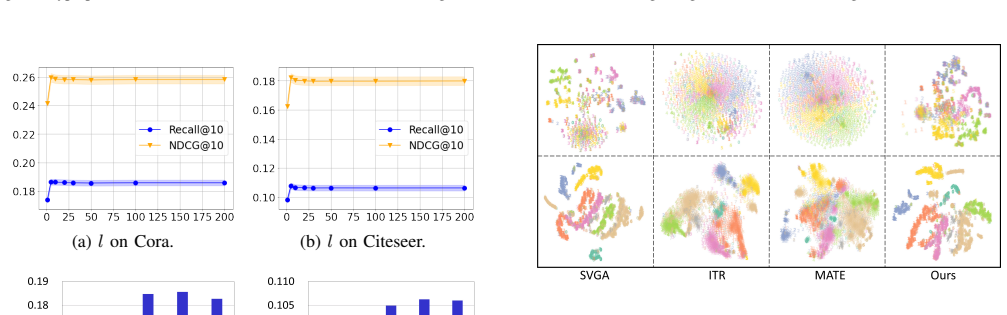
- [Figure 4 text] The metric name 'nDGC@k' in the description of Figure 4 should be 'nDCG@k'.
- [§IV.A and §IV.B] The symbol α is used for two different hyperparameters: the TAAP global propagation coefficient (Section IV.A, set to 0.05) and the ESPC distance attenuation factor (Section IV.B, later set to 0.9 in §V.C). Please use distinct symbols to avoid ambiguity and to make the hyperparameter reporting unambiguous.
- [Reference [49]] Reference [49] cites Shannon's 'A Mathematical Theory of Communication' as the basis for Dirichlet energy minimization in graphs; this appears to be a mis-citation. Please replace it with an appropriate graph Laplacian or harmonic function reference, e.g., Zhu et al. (ICML 2003).
- [§V.D.2] The sentence 'TDAR method consistently outperforms the other methods across all four datasets' does not match Table IV, which contains six datasets; please correct the count.
- [§IV.E] The complexity summary says the total complexity 'simplifies to O(N^2)', but the NLSC term is already O(N^2) (more precisely O(N^2 D) for pairwise cosine similarities over non-edges), so this is not a simplification but the dominant term. Please state the dependence on D explicitly and clarify the O(N log N) estimate for NHS, which neglects the per-edge inner product cost.
- [Eq. (12)] In the correlation matrix C, the indices i and j are used for feature dimensions while v is used for nodes, but \bar{Z}_i and \bar{Z}_j are not explicitly defined as means over nodes; please clarify the notation.
- [Eq. (17)] The reconstruction loss L_TAAP supervises against \tilde{X}_k, the TAAP-refined known attributes, rather than the original X_k. Since TAAP modifies known attributes with a β-weighted propagation term, the loss does not directly enforce fidelity to the original known values; please justify this design choice.
Circularity Check
No significant circularity: TDAR is a benchmark-evaluated method whose components (TAAP, ESPC, NHS, NLSC) are self-contained extensions of externally cited feature-propagation and GAE building blocks, and no reported result is a fitted constant or a self-citation-dependent derivation.
full rationale
The paper's derivation chain is self-contained and does not reduce any reported result to its own inputs. TAAP is explicitly grounded in external Feature Propagation work (Rossi et al. [15]; Um et al. [50]) through the Dirichlet-energy minimization update in Eqs. (1)-(3), and the paper's contribution is a stated modification: adding a global average term and a known-reset term in Eqs. (7)-(8). The pre-filled features are then fed into a standard GAE encoder/decoder (Eqs. (4)-(5)), and the reconstruction loss (Eq. (17)) is computed against known attributes. ESPC (Eqs. (9)-(14)) is a weighting transform of encoder outputs, and NHS/NLSC (Eqs. (15)-(19)) are regularizers on the embedding; none of these is defined in terms of the benchmark metrics being reported. The empirical claims are evaluation scores on public datasets with masked attributes, not fitted constants renamed as predictions, and hyperparameters (lambda1, lambda2, l, epsilon, alpha) are tuned on validation as described in Section V-H. The self-citations (CSAT [31], AmGCL [32], and the authors' earlier graph/hypergraph papers [4,5,12,13]) appear only in related-work discussion and are not load-bearing: no uniqueness theorem, no ansatz, and no central premise is justified solely by these citations. The paper itself acknowledges scope limitations in Section VI, noting that adapting to heterogeneous/dynamic graphs and addressing heterogeneity and distributional bias remain future work; this is an external-validity concern about the SIoT motivation, not circularity. Overall, the derivation and evaluation are independent of the paper's own conclusions, so no circular step is present.
Assumptions & free parameters
free parameters (7)
- alpha_TAAP =
0.05
- beta =
0.1
- alpha_ESPC =
0.9
- epsilon =
0.01
- tau =
0.2
- lambda_1/lambda_2 =
0.1 default; per dataset/task values in Fig. 6
- l =
10
assumptions (3)
- domain assumption Node attributes vary smoothly along graph edges (homophily).
- domain assumption Random attribute masking in the benchmark protocol represents real missingness in AMGs.
- standard math Dirichlet energy minimization is a valid criterion for reconstructing node attributes.
Cite this review
Pith. "Pith review of Topology-Driven Attribute Recovery for Attribute Missing Graph Learning in Social Internet of Things." pith.science (2026). https://pith.science/paper/4VBPAM6S
@misc{pith2026250110151,
  author       = {Pith},
  title        = {Pith review of: Topology-Driven Attribute Recovery for Attribute Missing Graph Learning in Social Internet of Things},
  year         = {2026},
  howpublished = {\url{https://pith.science/paper/4VBPAM6S}},
  note         = {Machine review of arXiv:2501.10151}
}
read the original abstract
With the advancement of information technology, the Social Internet of Things (SIoT) has fostered the integration of physical devices and social networks, deepening the study of complex interaction patterns. Text Attribute Graphs (TAGs) capture both topological structures and semantic attributes, enhancing the analysis of complex interactions within the SIoT. However, existing graph learning methods are typically designed for complete attributed graphs, and the common issue of missing attributes in Attribute Missing Graphs (AMGs) increases the difficulty of analysis tasks. To address this, we propose the Topology-Driven Attribute Recovery (TDAR) framework, which leverages topological data for AMG learning. TDAR introduces an improved pre-filling method for initial attribute recovery using native graph topology. Additionally, it dynamically adjusts propagation weights and incorporates homogeneity strategies within the embedding space to suit AMGs' unique topological structures, effectively reducing noise during information propagation. Extensive experiments on public datasets demonstrate that TDAR significantly outperforms state-of-the-art methods in attribute reconstruction and downstream tasks, offering a robust solution to the challenges posed by AMGs. The code is available at https://github.com/limengran98/TDAR.
Figures


Figures from the paper (7 more)




Reference graph
Works this paper leans on
-
[1]
Zero-shot text classi- fication via knowledge graph embedding for social media data,
Q. Chen, W. Wang, K. Huang, and F. Coenen, “Zero-shot text classi- fication via knowledge graph embedding for social media data,” IEEE Internet of Things Journal , vol. 9, no. 12, pp. 9205–9213, 2021
work page 2021
-
[2]
B. Li, J. Wu, D. Pi, and Y . Lin, “Dual mutual robust graph convolutional network for weakly supervised node classification in social networks of internet of people,” IEEE Internet of Things Journal , vol. 10, no. 16, pp. 14 798–14 809, 2021
work page 2021
-
[3]
K. Wang, J. An, M. Zhou, Z. Shi, X. Shi, and Q. Kang, “Minority- weighted graph neural network for imbalanced node classification in social networks of internet of people,” IEEE Internet of Things Journal , vol. 10, no. 1, pp. 330–340, 2022
work page 2022
-
[4]
Multi-view hypergraph neu- ral networks for student academic performance prediction,
M. Li, Y . Zhang, X. Li, L. Cai, and B. Yin, “Multi-view hypergraph neu- ral networks for student academic performance prediction,” Engineering Applications of Artificial Intelligence , vol. 114, p. 105174, 2022
work page 2022
-
[5]
Hypergraph transformer neural networks,
M. Li, Y . Zhang, X. Li, Y . Zhang, and B. Yin, “Hypergraph transformer neural networks,” ACM Transactions on Knowledge Discovery from Data, vol. 17, no. 5, pp. 1–22, 2023
work page 2023
-
[6]
X. Zuo, L. Li, S. Luo, H. Peng, Y . Yang, and L. Gong, “Privacy- preserving verifiable graph intersection scheme with cryptographic ac- cumulators in social networks,” IEEE Internet of Things Journal , vol. 8, no. 6, pp. 4590–4603, 2020
work page 2020
-
[7]
Achieving graph clustering privacy preservation based on structure entropy in social iot,
Y . Tian, Z. Zhang, J. Xiong, L. Chen, J. Ma, and C. Peng, “Achieving graph clustering privacy preservation based on structure entropy in social iot,” IEEE Internet of Things Journal, vol. 9, no. 4, pp. 2761–2777, 2021
work page 2021
-
[8]
B. Wu, L. Zhong, L. Yao, and Y . Ye, “Eagcn: An efficient adaptive graph convolutional network for item recommendation in social internet of things,” IEEE internet of things journal , vol. 9, no. 17, pp. 16 386– 16 401, 2022
work page 2022
Show all 73 references
-
[9]
Dual preference perception network for fashion recommendation in the social internet of things,
P. Jing, K. Zhang, X. Liu, Y . Li, Y . Liu, and Y . Su, “Dual preference perception network for fashion recommendation in the social internet of things,” IEEE Internet of Things Journal , vol. 11, no. 5, pp. 7893–7903, 2024
2024
-
[10]
Graph-based semi-supervised learning: A comprehensive review,
Z. Song, X. Yang, Z. Xu, and I. King, “Graph-based semi-supervised learning: A comprehensive review,” IEEE Transactions on Neural Net- works and Learning Systems , vol. 34, no. 11, pp. 8174–8194, 2023
2023
-
[11]
Graph neural networks: Taxonomy, advances, and trends,
Y . Zhou, H. Zheng, X. Huang, S. Hao, D. Li, and J. Zhao, “Graph neural networks: Taxonomy, advances, and trends,” ACM Transactions on Intelligent Systems and Technology , vol. 13, no. 1, pp. 1–54, 2022
2022
-
[12]
Self-supervised nodes-hyperedges embedding for heterogeneous information network learning,
M. Li, Y . Zhang, W. Zhang, Y . Chu, Y . Hu, and B. Yin, “Self-supervised nodes-hyperedges embedding for heterogeneous information network learning,” IEEE Transactions on Big Data, vol. 9, no. 4, pp. 1210–1224, 2023
2023
-
[13]
Redundancy is not what you need: An embedding fusion graph auto-encoder for self-supervised graph representation learning,
M. Li, Y . Zhang, S. Wang, Y . Hu, and B. Yin, “Redundancy is not what you need: An embedding fusion graph auto-encoder for self-supervised graph representation learning,” IEEE Transactions on Neural Networks and Learning Systems , 2024
2024
-
[14]
Handling missing data with graph representation learning,
J. You, X. Ma, D. Y . Ding, M. Kochenderfer, and J. Leskovec, “Handling missing data with graph representation learning,” in Proceedings of the International Conference on Neural Information Processing Systems , 2020, pp. 19 075–19 087
2020
-
[15]
On the unreasonable effectiveness of feature propagation in learning on graphs with missing node features,
E. Rossi, H. Kenlay, M. I. Gorinova, B. P. Chamberlain, X. Dong, and M. M. Bronstein, “On the unreasonable effectiveness of feature propagation in learning on graphs with missing node features,” in Learning on Graphs Conference . PMLR, 2022, pp. 11–1
2022
-
[16]
Fair attribute completion on graph with missing attributes,
D. Guo, Z. Chu, and S. Li, “Fair attribute completion on graph with missing attributes,” arXiv preprint arXiv:2302.12977 , 2023
2023 arXiv
-
[17]
Single im- putation with multilayer perceptron and multiple imputation combining multilayer perceptron and k-nearest neighbours for monotone patterns,
E.-L. Silva-Ram ´ırez, R. Pino-Mej´ıas, and M. L ´opez-Coello, “Single im- putation with multilayer perceptron and multiple imputation combining multilayer perceptron and k-nearest neighbours for monotone patterns,” Applied Soft Computing , vol. 29, pp. 65–74, 2015
2015
-
[18]
Adjusted weight voting algorithm for random forests in handling missing values,
J. Xia, S. Zhang, G. Cai, L. Li, Q. Pan, J. Yan, and G. Ning, “Adjusted weight voting algorithm for random forests in handling missing values,” Pattern Recognition, vol. 69, pp. 52–60, 2017
2017
-
[19]
A singular value thresholding al- gorithm for matrix completion,
J.-F. Cai, E. J. Cand `es, and Z. Shen, “A singular value thresholding al- gorithm for matrix completion,” SIAM Journal on optimization , vol. 20, no. 4, pp. 1956–1982, 2010
1956
-
[20]
Exact matrix completion via convex opti- mization,
E. Candes and B. Recht, “Exact matrix completion via convex opti- mization,” Communications of the ACM , vol. 55, no. 6, pp. 111–119, 2012
2012
-
[21]
Semi-supervised classification with graph convolutional networks,
T. N. Kipf and M. Welling, “Semi-supervised classification with graph convolutional networks,” arXiv preprint arXiv:1609.02907 , 2016
2016 arXiv
-
[22]
Graph attention networks,
P. Veli ˇckovi´c, G. Cucurull, A. Casanova, A. Romero, P. Lio, and Y . Ben- gio, “Graph attention networks,” arXiv preprint arXiv:1710.10903, 2017. 15
2017 arXiv
-
[23]
Inductive representation learning on large graphs,
W. L. Hamilton, R. Ying, and J. Leskovec, “Inductive representation learning on large graphs,” inProceedings of the International Conference on Neural Information Processing Systems , 2017, pp. 1025–1035
2017
-
[24]
Auto-encoding variational bayes,
D. P. Kingma and M. Welling, “Auto-encoding variational bayes,” arXiv preprint arXiv:1312.6114, 2013
2013 arXiv
-
[25]
Variational graph auto-encoders,
T. N. Kipf and M. Welling, “Variational graph auto-encoders,” arXiv preprint arXiv:1611.07308, 2016
2016 arXiv
-
[26]
Generative adversarial networks,
I. Goodfellow, J. Pouget-Abadie, M. Mirza, B. Xu, D. Warde-Farley, S. Ozair, A. Courville, and Y . Bengio, “Generative adversarial networks,” Communications of the ACM , vol. 63, no. 11, pp. 139–144, 2020
2020
-
[27]
Learning on attribute-missing graphs,
X. Chen, S. Chen, J. Yao, H. Zheng, Y . Zhang, and I. W. Tsang, “Learning on attribute-missing graphs,” IEEE Transactions on Pattern Analysis and Machine Intelligence , vol. 44, no. 2, pp. 740–757, 2022
2022
-
[28]
Amer: A new attribute-missing network embedding approach,
D. Jin, R. Wang, T. Wang, D. He, W. Ding, Y . Huang, L. Wang, and W. Pedrycz, “Amer: A new attribute-missing network embedding approach,” IEEE Transactions on Cybernetics, vol. 53, no. 7, pp. 4306– 4319, 2022
2022
-
[29]
Accurate node feature estimation with structured variational graph autoencoder,
J. Yoo, H. Jeon, J. Jung, and U. Kang, “Accurate node feature estimation with structured variational graph autoencoder,” in Proceedings of the ACM SIGKDD Conference on Knowledge Discovery and Data Mining , 2022, pp. 2336–2346
2022
-
[30]
Local computations with prob- abilities on graphical structures and their application to expert systems,
S. L. Lauritzen and D. J. Spiegelhalter, “Local computations with prob- abilities on graphical structures and their application to expert systems,” Journal of the Royal Statistical Society: Series B (Methodological) , vol. 50, no. 2, pp. 157–194, 1988
1988
-
[31]
Csat: Contrastive sampling-aggregating transformer for community detection in attribute-missing networks,
M. Li, Y . Zhang, W. Zhang, S. Zhao, X. Piao, and B. Yin, “Csat: Contrastive sampling-aggregating transformer for community detection in attribute-missing networks,” IEEE Transactions on Computational Social Systems, vol. 11, no. 2, pp. 2277–2290, 2024
2024
-
[32]
Amgcl: Feature imputation of attribute missing graph via self-supervised contrastive learning,
X. Zhang, M. Li, Y . Wang, and H. Fei, “Amgcl: Feature imputation of attribute missing graph via self-supervised contrastive learning,” arXiv preprint arXiv:2305.03741, 2023
2023 arXiv
-
[33]
Initializing then refining: A simple graph attribute imputation network,
W. Tu, S. Zhou, X. Liu, Y . Liu, Z. Cai, E. Zhu, Z. Changwang, and J. Cheng, “Initializing then refining: A simple graph attribute imputation network,” in Proceedings of the International Joint Conference on Artificial Intelligence, 2022, pp. 3494–3500
2022
-
[34]
Multi-view graph imputation network,
X. Peng, J. Cheng, X. Tang, B. Zhang, and W. Tu, “Multi-view graph imputation network,” Information Fusion, p. 102024, 2023
2023
-
[35]
Attribute imputation autoencoders for attribute-missing graphs,
R. Xia, C. Zhang, A. Li, X. Liu, and B. Yang, “Attribute imputation autoencoders for attribute-missing graphs,” Knowledge-Based Systems , vol. 291, p. 111583, 2024
2024
-
[36]
A new model for learning in graph domains,
M. Gori, G. Monfardini, and F. Scarselli, “A new model for learning in graph domains,” in Proceedings of the International Joint Conference on Neural Networks , vol. 2, 2005, pp. 729–734
2005
-
[37]
The graph neural network model,
F. Scarselli, M. Gori, A. C. Tsoi, M. Hagenbuchner, and G. Monfardini, “The graph neural network model,” IEEE Transactions on Neural Networks and Learning Systems , vol. 20, no. 1, pp. 61–80, 2008
2008
-
[38]
Masked label prediction: Unified message passing model for semi-supervised classification,
Y . Shi, Z. Huang, S. Feng, H. Zhong, W. Wang, and Y . Sun, “Masked label prediction: Unified message passing model for semi-supervised classification,” arXiv preprint arXiv:2009.03509 , 2020
2009 arXiv
-
[39]
Recipe for a general, powerful, scalable graph transformer,
L. Ramp ´aˇsek, M. Galkin, V . P. Dwivedi, A. T. Luu, G. Wolf, and D. Beaini, “Recipe for a general, powerful, scalable graph transformer,” in Proceedings of the Neural Information Processing Systems , vol. 35, 2022, pp. 14 501–14 515
2022
-
[40]
Navigating networks by using homophily and degree,
¨O. S ¸ims ¸ek and D. Jensen, “Navigating networks by using homophily and degree,” Proceedings of the National Academy of Sciences , vol. 105, no. 35, pp. 12 758–12 762, 2008
2008
-
[41]
Graph recurrent networks with attributed random walks,
X. Huang, Q. Song, Y . Li, and X. Hu, “Graph recurrent networks with attributed random walks,” in Proceedings of the ACM SIGKDD International Conference on Knowledge Discovery & Data Mining , 2019, pp. 732–740
2019
-
[42]
Attributed random walk as matrix factorization,
L. Chen, J. Bruna, and M. Bronstein, “Attributed random walk as matrix factorization,” in Proceedings of the International Conference on Neural Information Processing Systems, Graph Representation Learning Workshop, 2019
2019
-
[43]
Gain: Missing data imputation using generative adversarial nets,
J. Yoon, J. Jordon, and M. Schaar, “Gain: Missing data imputation using generative adversarial nets,” in Proceedings of the International Conference on Machine Learning . PMLR, 2018, pp. 5689–5698
2018
-
[44]
Stacked denoising autoencoders: Learning useful represen- tations in a deep network with a local denoising criterion
P. Vincent, H. Larochelle, I. Lajoie, Y . Bengio, P.-A. Manzagol, and L. Bottou, “Stacked denoising autoencoders: Learning useful represen- tations in a deep network with a local denoising criterion.” Journal of Machine Learning Research , vol. 11, no. 12, 2010
2010
-
[45]
Missing data imputation with adversarially-trained graph convolutional networks,
I. Spinelli, S. Scardapane, and A. Uncini, “Missing data imputation with adversarially-trained graph convolutional networks,” Neural Networks , vol. 129, pp. 249–260, 2020
2020
-
[46]
Graph convolutional networks for graphs containing missing features,
H. Taguchi, X. Liu, and T. Murata, “Graph convolutional networks for graphs containing missing features,” Future Generation Computer Systems, vol. 117, pp. 155–168, 2021
2021
-
[47]
T2-gnn: Graph neural networks for graphs with incomplete features and structure via teacher-student distillation,
C. Huo, D. Jin, Y . Li, D. He, Y .-B. Yang, and L. Wu, “T2-gnn: Graph neural networks for graphs with incomplete features and structure via teacher-student distillation,” in Proceedings of the AAAI Conference on Artificial Intelligence, vol. 37, no. 4, 2023, pp. 4339–4346
2023
-
[48]
Recov- ering missing node features with local structure-based embeddings,
V . M. Tenorio, M. Navarro, S. Segarra, and A. G. Marques, “Recov- ering missing node features with local structure-based embeddings,” in ICASSP IEEE International Conference on Acoustics, Speech and Signal Processing (ICASSP). IEEE, 2024, pp. 9931–9935
2024
-
[49]
A mathematical theory of communication,
C. E. Shannon, “A mathematical theory of communication,” ACM SIGMOBILE Mobile Computing and Communications Review , vol. 5, no. 1, pp. 3–55, 2001
2001
-
[50]
Confidence-based feature imputation for graphs with partially known features,
D. Um, J. Park, S. Park, and J. Y . Choi, “Confidence-based feature imputation for graphs with partially known features,” arXiv preprint arXiv:2305.16618, 2023
2023 arXiv
-
[51]
Social internet of things: vision, challenges, and trends,
M. Malekshahi Rad, A. M. Rahmani, A. Sahafi, and N. Nasih Qader, “Social internet of things: vision, challenges, and trends,”Human-centric Computing and Information Sciences , vol. 10, no. 1, p. 52, 2020
2020
-
[52]
Quantitative computation of social strength in social internet of things,
J. Jung, S. Chun, X. Jin, and K.-H. Lee, “Quantitative computation of social strength in social internet of things,” IEEE Internet of Things Journal, vol. 5, no. 5, pp. 4066–4075, 2018
2018
-
[53]
A social-relationships-based service recommendation system for siot devices,
A. Khelloufi, H. Ning, S. Dhelim, T. Qiu, J. Ma, R. Huang, and L. Atzori, “A social-relationships-based service recommendation system for siot devices,” IEEE Internet of Things Journal , vol. 8, no. 3, pp. 1859–1870, 2020
2020
-
[54]
Deep learning- embedded social internet of things for ambiguity-aware social recom- mendations,
Z. Guo, K. Yu, Y . Li, G. Srivastava, and J. C.-W. Lin, “Deep learning- embedded social internet of things for ambiguity-aware social recom- mendations,” IEEE Transactions on Network Science and Engineering , vol. 9, no. 3, pp. 1067–1081, 2021
2021
-
[55]
An integrated pca-daegcn model for movie recommendation in the social internet of things,
W. Sun, J. Jiang, Y . Huang, J. Li, and M. Zhang, “An integrated pca-daegcn model for movie recommendation in the social internet of things,” IEEE Internet of Things Journal , vol. 9, no. 12, pp. 9410–9418, 2021
2021
-
[56]
Learning to solve task-optimized group search for social internet of things,
C.-H. Yang, H.-H. Shuai, C.-Y . Shen, and M.-S. Chen, “Learning to solve task-optimized group search for social internet of things,” IEEE Transactions on Knowledge and Data Engineering , vol. 34, no. 11, pp. 5429–5445, 2021
2021
-
[57]
Ccnsim: An artificial intelligence enabled classification, clustering and navigation simulator for social internet of things,
S. Mohana, S. S. Prakash, and K. Krinkin, “Ccnsim: An artificial intelligence enabled classification, clustering and navigation simulator for social internet of things,” Engineering Applications of Artificial Intelligence, vol. 119, p. 105745, 2023
2023
-
[58]
Tfd: Trust-based fraud detection in siot with graph convolutional networks,
N. Jiang, W. Gu, L. Li, F. Zhou, S. Qiu, T. Zhou, and H. Chen, “Tfd: Trust-based fraud detection in siot with graph convolutional networks,” IEEE Transactions on Consumer Electronics , 2024
2024
-
[59]
Graph neural networks exponentially lose expressive power for node classification,
K. Oono and T. Suzuki, “Graph neural networks exponentially lose expressive power for node classification,” arXiv preprint arXiv:1905.10947, 2019
1905 arXiv
-
[60]
The anatomy of a large-scale hypertextual web search engine,
S. Brin and L. Page, “The anatomy of a large-scale hypertextual web search engine,” Computer Networks and ISDN Systems , vol. 30, no. 1-7, pp. 107–117, 1998
1998
-
[61]
Link prediction based on graph neural networks,
M. Zhang and Y . Chen, “Link prediction based on graph neural networks,” in Proceedings of the International Conference on Neural Information Processing Systems , 2018, pp. 5171–5181
2018
-
[62]
Distance encoding: de- sign provably more powerful neural networks for graph representation learning,
P. Li, Y . Wang, H. Wang, and J. Leskovec, “Distance encoding: de- sign provably more powerful neural networks for graph representation learning,” in Proceedings of the International Conference on Neural Information Processing Systems , 2020, pp. 4465–4478
2020
-
[63]
Beyond homophily in graph neural networks: Current limitations and effective designs,
J. Zhu, Y . Yan, L. Zhao, M. Heimann, L. Akoglu, and D. Koutra, “Beyond homophily in graph neural networks: Current limitations and effective designs,” in Proceedings of the Neural Information Processing Systems, vol. 33, 2020, pp. 7793–7804
2020
-
[64]
Geom-gcn: Geo- metric graph convolutional networks,
H. Pei, B. Wei, K. C.-C. Chang, Y . Lei, and B. Yang, “Geom-gcn: Geo- metric graph convolutional networks,” arXiv preprint arXiv:2002.05287, 2020
2002 arXiv
-
[65]
Large scale learning on non-homophilous graphs: New benchmarks and strong simple methods,
D. Lim, F. Hohne, X. Li, S. L. Huang, V . Gupta, O. Bhalerao, and S. N. Lim, “Large scale learning on non-homophilous graphs: New benchmarks and strong simple methods,” in Proceedings of the Neural Information Processing Systems , vol. 34, 2021, pp. 20 887–20 902
2021
-
[66]
Revisiting semi-supervised learning with graph embeddings,
Z. Yang, W. Cohen, and R. Salakhudinov, “Revisiting semi-supervised learning with graph embeddings,” in Proceedings of the International Conference on Machine Learning . PMLR, 2016, pp. 40–48
2016
-
[67]
Pitfalls of graph neural network evaluation,
O. Shchur, M. Mumme, A. Bojchevski, and S. G ¨unnemann, “Pitfalls of graph neural network evaluation,” arXiv preprint arXiv:1811.05868 , 2018. 16
2018 arXiv
-
[68]
Attribute-missing graph clustering network,
W. Tu, R. Guan, S. Zhou, C. Ma, X. Peng, Z. Cai, Z. Liu, J. Cheng, and X. Liu, “Attribute-missing graph clustering network,” in Proceedings of the AAAI Conference on Artificial Intelligence , vol. 38, no. 14, 2024, pp. 15 392–15 401
2024
-
[69]
Adam: A method for stochastic optimization,
D. P. Kingma and J. Ba, “Adam: A method for stochastic optimization,” arXiv preprint arXiv:1412.6980 , 2014
2014 arXiv
-
[70]
Least squares quantization in pcm,
S. Lloyd, “Least squares quantization in pcm,” IEEE Transactions on Information Theory, vol. 28, no. 2, pp. 129–137, 1982
1982
-
[71]
Knn model-based approach in classification,
G. Guo, H. Wang, D. Bell, Y . Bi, and K. Greer, “Knn model-based approach in classification,” in OTM Confederated International Confer- ences on the Move to Meaningful Internet Systems , 2003, pp. 986–996
2003
-
[72]
Visualizing data using t-sne
L. Van der Maaten and G. Hinton, “Visualizing data using t-sne.” Journal of Machine Learning Research , vol. 9, no. 11, 2008. Mengran Li is currently pursuing a Ph.D. degree at the Guangdong Key Laboratory of Intelligent Transportation Systems, School of Intelligent Sys- tems ...
2008
-
[2009]
After finishing his post-doctoral research work at INRIA, Paris, France, in February 2011, he is cur- rently an Associate Professor with Guangdong Key Laboratory of Intelligent Transportation System, School of Intelligent Systems Engineering, Shenzhen Campus of Sun Yat-sen Uni...
2011
Reviewed August 10, 2026 · model on record in the stance chip above.
Discussion (0). Continue with ORCID to comment.