REVIEW 4 major objections 4 minor 1 cited by
Multi-scale Optimal Transport for Complete Collider Events
T0 review · 4 major / 4 minor · reviewed 2026-08-10 · deepseek-v4-flash
Pith's one-line read This paper proposes a nested two-level optimal-transport distance for complete collider events—each event a distribution over jets, each jet a distribution over calorimeter cells—and reports that it classifies boosted top-antitop and BSM…
desk verdict A sound and genuinely new nested W2-on-W2 metric for complete events, with plausible gains over single-scale OT; the unvalidated LinW2 substitution and missing reference-event details are the main reasons it needs revision rather than acceptance as-is. read the letter →
The pith
A machine-rendered reading of the paper's core claim, the machinery that carries it, and where it could break.
The reading
What carries the argument
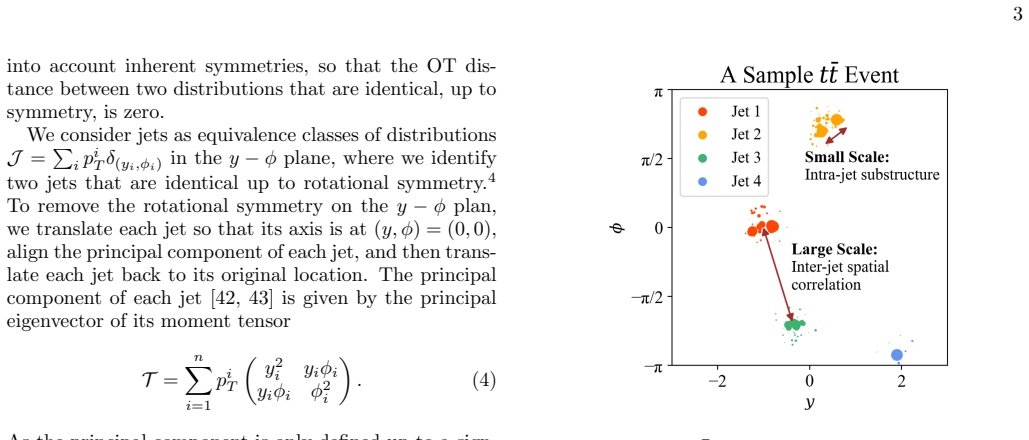
The central object is the two-level Wasserstein distance of Eqs. (5) and (6): an event is a distribution over the jets found by anti-kT clustering, and each jet is a distribution of transverse momentum in the rapidity-azimuth plane. The ground metric $d_{jet}$ is built from an intra-jet part, the 2-Wasserstein distance between jet shapes after recentering, and an inter-jet part, the Euclidean distance between jet positions, with coefficients $c_{intra}$ and $c_{inter}$ that set the relative physical scale. The event-level distance is then another 2-Wasserstein distance under $d_{jet}$. Since exact jet-level 2-Wasserstein distances are computationally heavy, the implementation replaces the inner distance by the linearized tangent-plane approximation LinW2, whose reference-event construction is required to satisfy the convergence condition that makes it a metric.
What would settle it
Compute the same event distances with the exact 2-Wasserstein jet distance instead of LinW2 on a few thousand events and check whether the kNN AUCs or nearest-neighbor rankings change; if they do, the linearization is carrying the result. Independently, recompute $d_{jet}$ using true jet centers of mass rather than anti-kT axes and see whether the classification gain survives.
Extended reading notes
Core claim
The paper's central claim is that a complete collider event should be compared to another as a distribution over jets, not directly as a distribution over calorimeter cells. It defines the event-level distance $W_{2,event}$ by a 2-Wasserstein optimization whose ground cost $d_{jet}$ combines two terms: the 2-Wasserstein distance between the two jets after translating each to zero center of mass, scaled by $c_{intra}$, and the Euclidean distance between the jets' centers in the rapidity-azimuth plane, scaled by $c_{inter}$. With $c_{intra}$ and $c_{inter}$ positive, $d_{jet}$ is a metric, so $W_{2,event}$ is a genuine metric on complete events. The paper argues that this nested structure separates the substructure scale inside a jet from the inter-jet scale of the whole event, and that this separation is why the distance outperforms single-scale optimal transport and transverse thrust in boosted top-antitop versus QCD and BSM dijet versus QCD classification.
Load-bearing premise
The central assumption is that the linearized LinW2 jet distance and the anti-kT jet axis are faithful stand-ins for the true jet-shape distance and jet center, so that the measured classification gain comes from the two-scale metric rather than from the approximations.
Editorial extensions
If this is right
- The multi-scale distance improves over single-scale optimal transport and transverse thrust for almost all coefficient choices and jet radii in both benchmarks, so the nested representation itself, not the specific classifier, is the source of the gain.
- The relative weight $c_{intra} : c_{inter}$ is tunable: for boosted top-antitop versus QCD the best performance is obtained when substructure dominates, while for resolved BSM dijets the optimal balance shifts toward inter-jet geometry.
- Weighting jets by transverse momentum and weighting them uniformly perform similarly, and both beat a version that compares only the hardest jet, except when large-radius jets collect the full decay products.
- When $c_{intra}=c_{inter}$, the ground metric reduces to the ordinary 2-Wasserstein distance between jets, so the framework continuously interpolates between single-scale and multi-scale comparisons.
- Because the event-level distance is a metric, any distance-based machine learning method, not only k-nearest neighbors, can consume it directly for classification or anomaly detection.
Reading between the lines
- Because $c_{intra}$ and $c_{inter}$ are free weights, the reported $(10,1)$ default is not special; a per-task scan over the ratio should be seen as part of the method, and the paper's own curves show the optimum moves with jet radius.
- The anti-kT axis proxy is a testable threat: replacing it with a true center of mass would isolate whether the multi-scale geometry or the preprocessing details produce the gains.
- The W2-on-W2 construction is really a recipe for any nested point cloud, so the same distance could be applied to trackers, calorimeter layers, or other hierarchical detector data without changing the formalism.
- Extending the event-level distance to an unbalanced Hellinger-Kantorovich distance would restore information lost when each event is normalized to unit total transverse momentum or unit jet count, making the metric sensitive to overall event activity as well as shape and layout.
Editorial analysis
A structured set of objections, weighed in public.
Referee Report
Summary. The paper proposes a hierarchical optimal-transport distance for complete collider events. Section II defines a 'W2-on-W2' construction: an event is represented as a distribution over its anti-kT jets, each jet is itself a distribution on the rapidity-azimuth plane, and the ground distance djet in Eq. (6) combines a weighted intra-jet W2 term between centered jets with a weighted inter-jet center-of-mass term. The authors state that djet is a metric for exact W2,jet and hence W2,event is a metric on events. In practice, W2,jet is replaced by the linearized LinW2 of Eq. (3), the anti-kT axis is used as a proxy for the jet center of mass, and each event is normalized to unit total mass, the latter detail appearing only in the conclusions. Section III applies the distance with a kNN classifier to t-tbar vs. QCD and BSM paired-dijet vs. QCD classification at jet radii R=0.3, 0.5, 1.0, reporting AUC curves as functions of cintra:cinter and comparing with single-scale OT and transverse thrust. The authors find that multi-scale OT generally outperforms the two benchmarks and interpret this as evidence that the nested metric captures both intra-jet substructure and inter-jet spatial correlations.
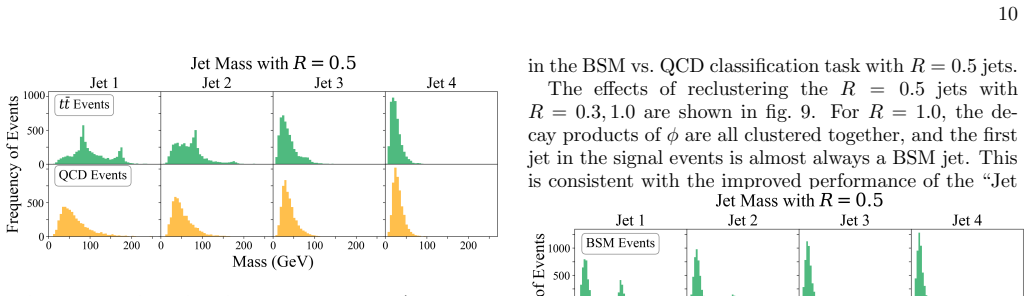
Significance. If validated, the construction gives LHC analyses a principled two-scale metric for complete events, with a tunable balance between jet-substructure information and jet-location information. The metric definition is mathematically standard for exact W2,jet, and the toy example plus two classification benchmarks are appropriate demonstrations of the intended behavior. The paper also provides useful appendices relating jet-mass distributions to the classification results. However, the numerical claims currently rest on unquantified substitutions: LinW2 instead of exact W2,jet, an unspecified reference event in the linearization, and the anti-kT axis instead of the jet center of mass. These choices could affect the reported AUC differences, so the empirical contribution is not yet fully supported as written.
major comments (4)
- [II C, Eq. (6)] The numerical experiments replace W2,jet in Eq. (6) with the linearized LinW2 of Eq. (3), but the reference event R used for the projection is never described; the statement that the conditions of [12, Proposition 1] are 'explicitly enforced' is not verifiable without specifying R. Because LinW2 is not a metric and its deviation from W2,jet is unquantified, the AUC gains in Figs. 3 and 4 could be an artifact of the linearization rather than evidence for the multi-scale metric. Please specify the construction of R and report a comparison between LinW2 and exact W2,jet on representative jet pairs, including the error as a function of jet multiplicity and substructure.
- [II C, Eq. (6)] Eq. (6) defines the inter-jet term using the jet center of mass, but the implementation uses the anti-kT jet axis as a proxy. For asymmetric jets, the axis and the center of mass differ by O(R), which is comparable to the intra-jet scale O(0.1) quoted in Section II C; this can change the effective cintra:cinter balance. The paper should quantify the axis-vs-center-of-mass offset, for example by reporting its distribution or by rerunning one benchmark with true centers of mass, before the optimal ratios in Section III can be interpreted.
- [III, Figs. 3 and 4] The paper states that the kNN hyperparameter k is selected on the validation set, but it does not state whether the coefficient pair (cintra,cinter) is also selected on validation. The narrative 'highest AUC is achieved around (10,1)' suggests the pair may have been chosen from the test-set curves; if so, the reported best AUCs are optimistically biased. Please clarify the selection protocol and, if the pair is scanned, select it on validation and report the test AUC at that selected point.
- [IV, Conclusions] The statement that each event is normalized to unit total mass before computing Eq. (6) appears only in the conclusions, not in Section II C where the jet weights Js are defined. This normalization determines the balanced optimal transport problem and is essential for reproducibility; it should be stated explicitly in the method section and its effect on both weighting schemes should be discussed.
minor comments (4)
- [II A, Eq. (2)] The text says 'To remove the rotational symmetry on the y−phi plane, we translate each jet...'; the symmetry being removed by translation is translational symmetry in the plane, so the terminology should be clarified.
- [III A] The sentence 'pp → jjjj, where a jet j is originated by either a gluon or u, d, c, squarks' appears to contain a typo; 'squarks' should probably read 'quarks'.
- [II C] The passage 'C ∼ O(5) is the diameter of the detector and M ∼ O(5), leading to an O(1) length scale' uses M without a definition; if M denotes the number of jets or something else, please clarify.
- [References, [54]] Reference [54] is the present paper itself; citing it in the conclusions for the Hellinger-Kantorovich extension does not supply the claimed content and should be replaced by an appropriate external reference.
Circularity Check
No significant circularity: the multi-scale OT distance is defined ex ante, its coefficients are scanned rather than fitted, and the reported AUCs are held-out evaluations.
full rationale
The central claim is that the multi-scale distance in Eqs. (5) and (6) improves event classification. The distance is constructed directly from the 2-Wasserstein distance and the weights cintra, cinter; these weights are scanned over a fixed grid, k is selected on a validation split, and the final AUC is evaluated on a held-out test set (Sec. III). No parameter is fitted to test labels, so no reported number reduces to a fit. The LinW2 substitution for W2,jet in Eq. (6) is an approximation whose error is not quantified, and the anti-kT jet axis is used as a proxy for the jet center of mass; these are correctness and reproducibility concerns, not circularity, because the distance is not defined in terms of the classifier output or any fitted value. The one self-referential passage is the future-direction sentence in Sec. IV citing [54] (the present paper) alongside [34] as having used the Hellinger-Kantorovich extension; this citation is erroneous but not load-bearing, since it occurs in a forward-looking remark and the external Hellinger-Kantorovich reference [34] is co-cited. The invocation of [12, Proposition 1] to justify LinW2 convergence to a metric is a self-citation of a formal theorem with stated assumptions, not an input to the classification benchmark; the reference-event construction is not described, which is a missing-support issue rather than circular derivation. Overall, the derivation chain is self-contained: the metric is defined ex ante and tested on external simulation benchmarks.
Assumptions & free parameters
free parameters (4)
- cintra and cinter =
scanned values including (1,0), (10,1), (5,1), (0,1), and others
- k in kNN classifier =
selected from 10 to 200 in steps of 10 on the validation set
- jet radius R =
0.3, 0.5, 1.0
- LinW2 reference event =
not specified
assumptions (5)
- standard math The 2-Wasserstein distance is a metric, and the Wasserstein space over a metric space is itself a metric space.
- domain assumption Anti-kT clustering with a fixed radius partitions the event into jets that faithfully represent the relevant physical scales.
- domain assumption Rotational alignment of jets via principal component analysis removes only symmetry and preserves classification-relevant information.
- ad hoc to paper The reference event used for LinW2 satisfies the conditions in [12, Proposition 1], so LinW2 approximates a metric.
- domain assumption Monte Carlo samples generated with MadGraph and Pythia represent the relevant LHC event distributions.
Cite this review
Pith. "Pith review of Multi-scale Optimal Transport for Complete Collider Events." pith.science (2026). https://pith.science/paper/NZJYO7A4
@misc{pith2026250110681,
  author       = {Pith},
  title        = {Pith review of: Multi-scale Optimal Transport for Complete Collider Events},
  year         = {2026},
  howpublished = {\url{https://pith.science/paper/NZJYO7A4}},
  note         = {Machine review of arXiv:2501.10681}
}
read the original abstract
Building upon the success of optimal transport metrics defined for single collinear jets, we develop a multi-scale framework that models entire collider events as distributions on the manifold of their constituent jets, which are themselves distributions on the ground space of the calorimeter. This hierarchical structure of optimal transport effectively captures relevant physics at different scales. We demonstrate the versatility of our method in two event classification tasks, which respectively emphasize intra-jet substructure and inter-jet spatial correlations. Our results highlight the relevance of a nested structure of manifolds in the treatment of full collider events, broadening the applicability of optimal transport methods in collider analyses.
Figures


Figures from the paper (4 more)



Forward citations
Cited by 1 Pith paper
-
Optimal Transport Event Representation for Anomaly Detection
Adding a few optimal-transport-based features to standard jet observables nearly doubles anomaly-detection significance at 0.5% signal injection on LHC Olympics benchmarks.
Reference graph
Works this paper leans on
-
[54]
M. Cacciari, G. P. Salam, and G. Soyez, Fast- jet user manual, The European Physical Jour- nal C 72, 10.1140/epjc/s10052-012-1896-2 (2012), arXiv:1111.6097
arXiv 2012
-
[34]
J. H. Collins, An exploration of learnt representations of w jets (2022), arXiv:2109.10919 [hep-ph]
arXiv 2022
-
[1]
A. J. Larkoski, I. Moult, and B. Nachman, Jet substruc- ture at the large hadron collider: A review of recent ad- vances in theory and machine learning, Physics Reports 841, 1–63 (2020). 11
work page 2020
- [2]
-
[3]
K. Albertsson and et al., Machine learning in high energy physics community white paper (2019), arXiv:1807.02876 [physics.comp-ph]
arXiv 2019
-
[4]
have a threshold of pT > 150 GeV. In cases where more than four jets are identified in an event, we only keep the first four jets with the largest pT and discard the rest. These four jets define an event in our dataset. In order to study the effect of varying jet radius, we fur- ther create two more datasets based on the above dataset. For each event in t...
-
[5]
A. Radovic, M. Williams, D. Rousseau, M. Kagan, D. Bonacorsi, A. Himmel, A. Aurisano, K. Terao, and T. Wongjirad, Machine learning at the energy and inten- sity frontiers of particle physics, Nature 560, 41 (2018), epub 2018 Aug 1
work page 2018
-
[6]
G. Carleo, I. Cirac, K. Cranmer, L. Daudet, M. Schuld, N. Tishby, L. Vogt-Maranto, and L. Zdeborov´ a, Machine learning and the physical sciences, Reviews of Modern Physics 91, 10.1103/revmodphys.91.045002 (2019)
Show all 56 references
-
[7]
Bourilkov, Machine and deep learning applications in particle physics, International Journal of Modern Physics A 34, 1930019 (2019)
D. Bourilkov, Machine and deep learning applications in particle physics, International Journal of Modern Physics A 34, 1930019 (2019)
2019
-
[8]
M. D. Schwartz, Modern machine learning and particle physics, Harvard Data Science Review 10.1162/99608f92.beeb1183 (2021)
2021 doi
-
[9]
Karagiorgi, G
G. Karagiorgi, G. Kasieczka, S. Kravitz, B. Nachman, and D. Shih, Machine learning in the search for new fun- damental physics (2021), arXiv:2112.03769 [hep-ph]
2021 arXiv
-
[10]
Shanahan, K
P. Shanahan, K. Terao, and D. Whiteson, Snow- mass 2021 computational frontier compf03 topical group report: Machine learning (2022), arXiv:2209.07559 [physics.comp-ph]
2022 arXiv
-
[11]
P. T. Komiske, E. M. Metodiev, and J. Thaler, Metric Space of Collider Events, Phys. Rev. Lett. 123, 041801 (2019), arXiv:1902.02346 [hep-ph]
2019 arXiv
-
[12]
P. T. Komiske, E. M. Metodiev, and J. Thaler, The hidden geometry of particle collisions, Journal of High Energy Physics 2020, 10.1007/jhep07(2020)006 (2020), arXiv:2004.04159
2020 arXiv
-
[13]
T. Cai, J. Cheng, N. Craig, and K. Craig, Linearized optimal transport for collider events, Physical Review D 102, 10.1103/physrevd.102.116019 (2020)
2020 doi
-
[14]
T. Cai, J. Cheng, K. Craig, and N. Craig, Which metric on the space of collider events?, Phys. Rev. D105, 076003 (2022)
2022
-
[15]
P. T. Komiske, R. Mastandrea, E. M. Metodiev, P. Naik, and J. Thaler, Exploring the Space of Jets with CMS Open Data, Phys. Rev. D 101, 034009 (2020), arXiv:1908.08542 [hep-ph]
2020 arXiv
-
[16]
Cesarotti and J
C. Cesarotti and J. Thaler, A Robust Measure of Event Isotropy at Colliders, JHEP 08, 084, arXiv:2004.06125 [hep-ph]
2004 arXiv
-
[17]
Cesarotti, M
C. Cesarotti, M. Reece, and M. J. Strassler, The efficacy of event isotropy as an event shape observable, Journal of High Energy Physics 2021, 10.1007/jhep07(2021)215 (2021)
2021 doi
-
[18]
Cheng, J.-F
T. Cheng, J.-F. Arguin, J. Leissner-Martin, J. Pilette, and T. Golling, Variational autoencoders for anoma- lous jet tagging, Physical Review D 107, 10.1103/phys- revd.107.016002 (2023)
2023 doi
-
[19]
Crispim Rom˜ ao, N
M. Crispim Rom˜ ao, N. F. Castro, J. G. Milhano, R. Pe- dro, and T. Vale, Use of a generalized energy mover’s dis- tance in the search for rare phenomena at colliders, The European Physical Journal C 81, 10.1140/epjc/s10052- 021-08891-6 (2021)
2021 doi
-
[20]
T. A. collaboration, G. Aad, B. Abbott, et al., Measure- ments of multijet event isotropies using optimal transport with the atlas detector, Journal of High Energy Physics 2023 (2023)
2023
-
[21]
Craig, J
N. Craig, J. N. Howard, and H. Li, Exploring optimal transport for event-level anomaly detection at the large hadron collider (2024), arXiv:2401.15542 [hep-ph]
2024 arXiv
-
[22]
Gouskos, F
L. Gouskos, F. Iemmi, S. Liechti, B. Maier, V. Mikuni, and H. Qu, Optimal transport for a novel event de- scription at hadron colliders, Physical Review D 108, 10.1103/physrevd.108.096003 (2023)
2023 doi
-
[23]
Cesarotti and M
C. Cesarotti and M. LeBlanc, A Field Guide to Event- Shape Observables Using Optimal Transport, (2024), arXiv:2409.13150 [hep-ph]
2024
-
[24]
Gambhir, A
R. Gambhir, A. J. Larkoski, and J. Thaler, SPECTER: efficient evaluation of the spectral EMD, JHEP 12, 219, arXiv:2410.05379 [hep-ph]
-
[25]
D. Ba, A. S. Dogra, R. Gambhir, A. Tasissa, and J. Thaler, SHAPER: can you hear the shape of a jet?, JHEP 06, 195, arXiv:2302.12266 [hep-ph]
-
[26]
Cai, Optimal Transport for High Energy Physics , Ph.D
T. Cai, Optimal Transport for High Energy Physics , Ph.D. thesis, UC, Santa Barbara (main) (2023), url: https://escholarship.org/uc/item/93n2s2ff
2023
-
[27]
Mullin, S
A. Mullin, S. Nicholls, H. Pacey, M. Parker, M. White, and S. Williams, Does susy have friends? a new approach for lhc event analysis (2021), arXiv:1912.10625 [hep-ph]
2021 arXiv
-
[28]
T. Cai, J. Cheng, N. Craig, G. Koszegi, and A. J. Larkoski, The phase space distance between collider events (2024), arXiv:2405.16698 [hep-ph]
2024 arXiv
-
[29]
Stein, U
G. Stein, U. Seljak, and B. Dai, Unsupervised in- distribution anomaly detection of new physics through conditional density estimation (2020), arXiv:2012.11638 [cs.LG]
2020 arXiv
-
[30]
Kasieczka and et al., The lhc olympics 2020 a com- munity challenge for anomaly detection in high energy physics, Reports on Progress in Physics 84, 124201 (2021)
G. Kasieczka and et al., The lhc olympics 2020 a com- munity challenge for anomaly detection in high energy physics, Reports on Progress in Physics 84, 124201 (2021)
2021
-
[31]
J. N. Howard, S. Mandt, D. Whiteson, and Y. Yang, Learning to simulate high energy particle collisions from unlabeled data, Scientific Reports 12, 10.1038/s41598- 022-10966-7 (2022)
2022 doi
-
[32]
G. D. Guglielmo, F. Fahim, C. Herwig, M. B. Valentin, J. Duarte, C. Gingu, P. Harris, J. Hirschauer, M. Kwok, V. Loncar, Y. Luo, L. Miranda, J. Ngadiuba, D. Noonan, S. Ogrenci-Memik, M. Pierini, S. Summers, and N. Tran, A reconfigurable neural network asic for detector front- ...
2021
-
[33]
Kansal, J
R. Kansal, J. Duarte, H. Su, B. Orzari, T. Tomei, M. Pierini, M. Touranakou, J.-R. Vlimant, and D. Gunopulos, Particle cloud generation with mes- sage passing generative adversarial networks (2022), arXiv:2106.11535 [cs.LG]
2022 arXiv
-
[35]
T. Cai, J. Cheng, B. Schmitzer, and M. Thorpe, The linearized hellinger–kantorovich distance, SIAM Journal on Imaging Sciences 15, 45 (2022), arXiv:https://doi.org/10.1137/21M1400080
2022 doi
-
[36]
Lott, Some geometric calculations on wasserstein space (2007), url: https://arxiv.org/abs/math/0612562, arXiv:math/0612562 [math.DG]
J. Lott, Some geometric calculations on wasserstein space (2007), url: https://arxiv.org/abs/math/0612562, arXiv:math/0612562 [math.DG]
2007 arXiv
-
[37]
Ambrosio, N
L. Ambrosio, N. Gigli, and G. Savar´ e, Gradient flows: in metric spaces and in the space of probability measures (Springer Science & Business Media, 2008)
2008
-
[38]
Otto, The geometry of dissipative evolution equations: the porous medium equation, Comm
F. Otto, The geometry of dissipative evolution equations: the porous medium equation, Comm. Partial Differential 12 Equations 26, 101 (2001)
2001
-
[39]
Bertsekas, The auction algorithm: A distributed re- laxation method for the assignment problem, Annals of Operations Research 14, 105 (1988), url: https://doi
D. Bertsekas, The auction algorithm: A distributed re- laxation method for the assignment problem, Annals of Operations Research 14, 105 (1988), url: https://doi. org/10.1007/BF02186476
1988 doi
-
[40]
Altschuler, J
J. Altschuler, J. Weed, and P. Rigollet, Near-linear time approximation algorithms for optimal transport via sinkhorn iteration, Advances in Neural Information Processing Systems 30, 1961 (2018), arXiv:1705.09634 [cs.DS]
2018 arXiv
-
[41]
M. Cuturi, Sinkhorn distances: Lightspeed computa- tion of optimal transportation distances, Advances in Neural Information Processing Systems 26, 2292 (2013), arXiv:1306.0895 [stat.ML]
2013 arXiv
-
[42]
W. Wang, D. Slepˇ cev, S. Basu, J. A. Ozolek, and G. K. Rohde, A linear optimal transportation framework for quantifying and visualizing variations in sets of im- ages, International Journal of Computer Vision 101, 254 (2013)
2013
-
[43]
Gur-Ari, M
G. Gur-Ari, M. Papucci, and G. Perez, Classification of energy flow observables in narrow jets, (2011), arXiv:1101.2905 [hep-ph]
2011 arXiv
-
[44]
Gallicchio and M
J. Gallicchio and M. D. Schwartz, Quark and gluon jet substructure, Journal of High Energy Physics 2013, 10.1007/jhep04(2013)090 (2013), arXiv:1211.7038
2013 arXiv
-
[45]
Cacciari, G
M. Cacciari, G. P. Salam, and G. Soyez, The anti-kt jet clustering algorithm, Journal of High Energy Physics 2008, 063–063 (2008)
2008
-
[46]
Ambrosio and N
L. Ambrosio and N. Gigli, A user’s guide to optimal transport, in Modelling and Optimisation of Flows on Networks: Cetraro, Italy 2009, Editors: Benedetto Pic- coli, Michel Rascle (Springer Berlin Heidelberg, Berlin, Heidelberg, 2013) pp. 1–155
2009
-
[47]
Cuesta-Albertos, C
J. Cuesta-Albertos, C. Matr´ an, and J. Rodr ´ ıguez- Rodr ´ ıguez, Approximation to probabilities through uni- form laws on convex sets, Journal of Theoretical Proba- bility 16, 363 (2003)
2003
-
[48]
T. M. Cover and P. E. Hart, Nearest neighbor pattern classification, IEEE Trans. Inf. Theory 13, 21 (1967), url: https://doi.org/10.1109/TIT.1967.1053964
1967
-
[49]
I. A. Bertram (D0), Jet results at the D0 experiment, Acta Phys. Polon. B 33, 3141 (2002), url: https://www. actaphys.uj.edu.pl/R/33/10/3141/pdf
2002
-
[50]
Z. Nagy, Next-to-leading order calculation of three-jet observables in hadron-hadron collisions, Physical Review D 68, 10.1103/physrevd.68.094002 (2003), url: http:// dx.doi.org/10.1103/PhysRevD.68.094002
2003 doi
-
[51]
Banfi, G
A. Banfi, G. P. Salam, and G. Zanderighi, Resummed event shapes at hadron-hadron colliders, Journal of High Energy Physics 2004, 062–062 (2004), url: http://dx. doi.org/10.1088/1126-6708/2004/08/062
2004 doi
-
[52]
Alwall, R
J. Alwall, R. Frederix, S. Frixione, V. Hirschi, F. Maltoni, O. Mattelaer, H.-S. Shao, T. Stelzer, P. Torrielli, and M. Zaro, The automated computation of tree-level and next-to-leading order differential cross sections, and their matching to parton shower simulations, Journal...
2014 arXiv
-
[53]
Bierlich, S
C. Bierlich, S. Chakraborty, N. Desai, L. Gellersen, I. He- lenius, P. Ilten, L. L¨ onnblad, S. Mrenna, S. Prestel, C. T. Preuss, T. Sj¨ ostrand, P. Skands, M. Utheim, and R. Ver- heyen, A comprehensive guide to the physics and usage of pythia 8.3, (2022), arXiv:2203.11601 [hep-ph]
2022 arXiv
-
[55]
T. Cai, N. Craig, K. Craig, and X. Lin, Multi-scale opti- mal transport for complete collider events, arXiv preprint arXiv:2501.10681 (2025)
2025 arXiv
-
[56]
Manole, P
T. Manole, P. Bryant, J. Alison, M. Kuusela, and L. Wasserman, Background modeling for double higgs boson production: Density ratios and optimal transport (2024), arXiv:2208.02807 [stat.AP]
2024 arXiv
Reviewed August 10, 2026 · model on record in the stance chip above.
Discussion (0). Continue with ORCID to comment.