REVIEW 3 major objections 6 minor 53 references
A Semantic Approach to Successive Interference Cancellation for Multiple Access Networks
T0 review · 3 major / 6 minor · reviewed 2026-08-10 · deepseek-v4-flash
Pith's one-line read Successive interference cancellation for multi-user channels can be moved from the digital symbol domain into the semantic word-embedding domain, where decoded text from one user helps decode the next.
desk verdict Real extension of DeepSC to the MAC with semantic side-information SIC, but the side-information gain is only shown on deliberately correlated SNLI texts, and the traditional baselines lack SIC. read the letter →
The pith
A machine-rendered reading of the paper's core claim, the machinery that carries it, and where it could break.
The reading
What carries the argument
The load-bearing mechanism is a neural module called the integrated feature generator (IFG). For user $i$'s sentence, it takes the current compressed word-semantic vector $\hat{r}^i_j$ together with the recovered compressed vectors of previously decoded users $\tilde{r}^1_j, \ldots, \tilde{r}^{i-1}_j$ and produces $g^i_j = \text{ReLU}(\theta_i(\pi_i(\hat{r}^i_j), \Omega^i_1(\tilde{r}^1_j), \ldots, \Omega^{i-1}_i(\tilde{r}^{i-1}_j)) + \hat{r}^i_j)$, which the autoencoder decoder converts into the word-semantic vector used to generate the next text. This fusion is what changes SIC from a pure subtraction operation into a side-information operation. Around this, the training scheme uses a joint cross-entropy loss, a per-user pretraining stage, and a partial retraining algorithm that freezes the existing users' encoders and decoders when new users join, so only the new users' networks and the shared decoder are updated.
What would settle it
Run the same system on a MAC whose users transmit semantically unrelated texts, for example sentences sampled independently from different topics so there is no entailment-style pairing between users, and compare the with-side-information and without-side-information variants under BERT similarity and BLEU. If the side-information variants do not beat the no-side-information baselines, the claimed benefit rests entirely on the dataset's inter-sentence correlations and does not hold for general user traffic.
Extended reading notes
Core claim
The paper's central claim is that SIC for a multiple access channel can be performed in the semantic domain rather than only in the digital symbol domain. After the strongest user's text is recovered, the usual SIC step is kept, namely reconstructing and subtracting that user's symbols from the received signal, but the recovered text itself is not discarded. Its compressed word-semantic vectors are passed through an integrated feature generator together with the next user's noisy features, and the combined feature is decoded into the next text. The paper argues that because natural-language messages from different users are often semantically related, this side information improves semantic similarity and BLEU scores, and that a partial retraining scheme which freezes old users' networks and trains only the new users' networks preserves most of the benefit while reducing per-iteration training time by more than 30 percent.
Load-bearing premise
The gain from side information depends on users' texts being semantically related, so a decoded sentence from one user genuinely narrows the possibilities for another user's sentence; without that correlation the side information may add nothing or even hurt.
Editorial extensions
If this is right
- In a K-user MAC, decoding can proceed in order of descending received power, and each successfully decoded text is fed into the decoding of the next text rather than discarded.
- Adding a new user to a trained MAC can be handled by partial retraining that keeps existing encoders and decoders fixed, reducing per-iteration training time by more than 30 percent relative to full retraining with side information.
- The reported results imply side information is most valuable in low-SINR and fading conditions, where partial retraining with side information outperforms full retraining without it.
- Because the method is built on SIC, the same semantic-side-information idea can be carried to broadcast and interference channels whenever SIC applies, although capacity achievability is not guaranteed there.
Reading between the lines
- A testable extension is to modulate the side-information branch of the IFG by an estimated inter-user semantic correlation, letting the network ignore side information when users' messages are unrelated; this would reveal how much of the reported gain is dataset-specific.
- The subtract-then-reuse-recovered-content recipe should transfer to image or audio semantic MACs, replacing BERT/BLEU with SSIM or SDR, which the authors themselves list as future work.
- Freezing old users' networks during partial retraining implies an incremental onboarding protocol for IoT devices that speak semantic protocols: new devices can enter the MAC without reconfiguring existing ones, which is a deployment property beyond the tested performance metrics.
- If semantic SIC holds up, the effective multiuser limit of such systems depends on inter-user semantic redundancy as much as on power and bandwidth, suggesting a semantic capacity region notion that the paper does not formalize.
Signed reviews
Editorial analysis
A structured set of objections, weighed in public.
Referee Report
Summary. This paper proposes a deep learning-enabled semantic communication system for uplink multiple access channels (MAC), extending the single-user DeepSC framework to K users. The approach applies successive interference cancellation (SIC) in the semantic domain: after decoding each user's text, the decoded text is re-encoded and its signal is removed from the received mixture; in addition, an integrated feature generator (IFG) uses previously decoded texts as side information to improve decoding of subsequent users. To handle dynamic user addition, the paper also proposes a pretraining scheme and a partial retraining scheme that updates only the newly added users' networks while reusing existing users' encoders/decoders. Experiments on the SNLI corpus compare the proposed methods with ablated baselines (with/without side information, full/partial retraining) and with traditional Huffman+LDPC and Huffman+Polar schemes, reporting semantic similarity and BLEU scores across several channel conditions.
Significance. If the claims hold, the paper provides a meaningful extension of semantic communication to multi-user networks and introduces a practical retraining mechanism for dynamic user sets. The internal ablations show consistent gains from side information and reduced training time from partial retraining, and the open-source code is a plus. However, the significance is somewhat limited by the evaluation: the traditional baselines do not use any interference cancellation, so the comparison does not isolate the value of the semantic SIC; and the side-information benefit is demonstrated only on SNLI, which was selected for its strong inter-sentential correlations, leaving the behavior on uncorrelated sources untested.
major comments (3)
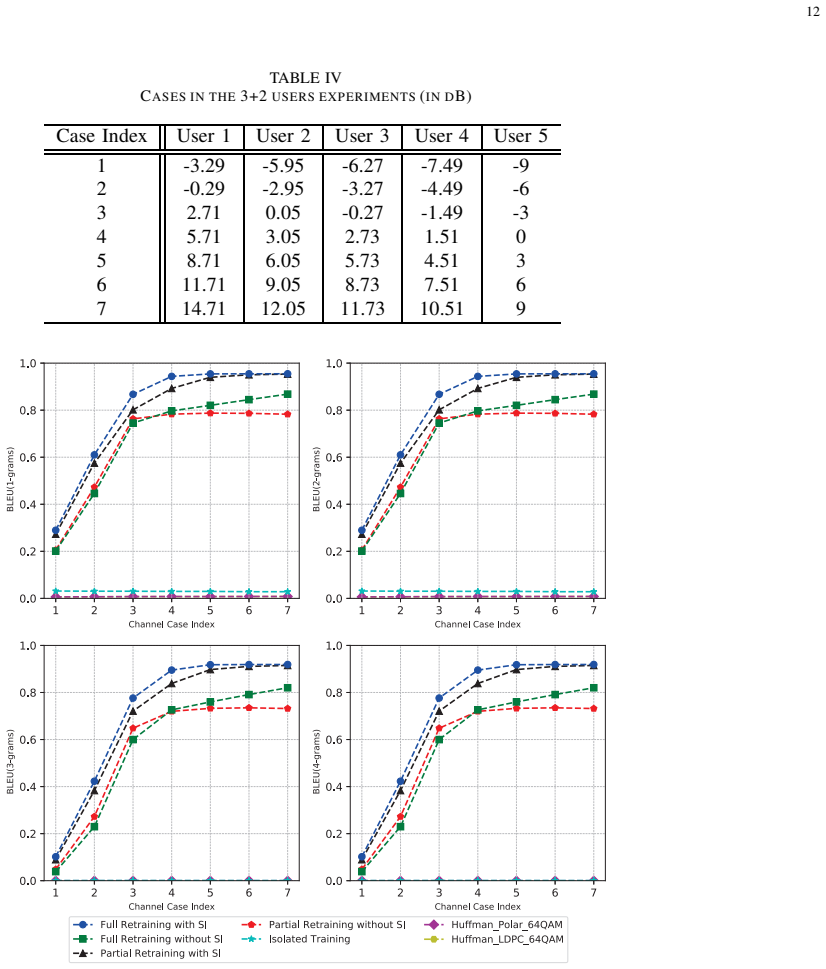
- [Section VI-A] The traditional baselines (Huffman+LDPC and Huffman+Polar with 64-QAM) are described without any interference cancellation or multi-user detection, whereas the proposed method relies on successive interference cancellation. As a result, the performance differences in Figs. 9–12 could be attributed to SIC itself rather than its semantic aspect. Please include a baseline that performs conventional symbol-level SIC with the same channel coding, or justify why the current comparison is appropriate for the claimed advantage over existing benchmark methods.
- [Section VI-A] The side-information benefit is evaluated only on the SNLI dataset, which the authors selected because it exhibits much stronger inter-sentential connections than other corpora. The mechanism in Eqs. (34)–(35) is thus tested exclusively in a high-correlation regime. No experiment varies the degree of semantic correlation between user texts (e.g., using random sentence pairings or a corpus such as Europarl). Without such an experiment, it is unclear whether the 'semantic SIC' advantage persists when users transmit unrelated content, which is a common scenario in multiple access networks. Please add such experiments or explicitly qualify the claims to correlated sources.
- [Section V-C, Eq. (39) and Algorithm 2] The tradeoff factors τ_i in the loss function (39) are not specified; it is unclear how they are set or whether they are tuned. Since the partial retraining performance is a central contribution, please provide the values used or a sensitivity analysis to show that the results are not sensitive to these factors.
minor comments (6)
- [Section III, Eq. (19)] The zero-padding procedure in Eq. (19) pads each sentence to a fixed length N; however, the paper does not specify what happens when a sentence exceeds N words (truncation?) or how the positional encoding handles the padded dummy words. Clarify this in the text.
- [Section V-C and Algorithm 4] The description of the partial retraining decoding order is inconsistent: Section V-C states that after recovering the new user's message, the old users in group G2 are decoded 'as if the new user does not exist', but Algorithm 4 decodes all old users in a single step after canceling the new users' signals. Please reconcile the algorithm with the narrative.
- [Section VI-A] The statement 'we allocate 18 symbols for each word' is not connected to the encoding parameters: in the system model, each word is compressed to a c-dimensional vector and then mapped to c/2 complex symbols. Please explain how 18 symbols per word relates to c and the total block length M.
- [Section IV-B] The paper calls the method 'semantic SIC', but the actual interference cancellation in Eqs. (30) and (32) is performed in the complex symbol domain after re-encoding; only the side-information generation (Eq. (35)) is in the semantic embedding domain. Consider clarifying this terminology.
- [Section VI-B, Fig. 11] The text contains a typo: 'acheive' should be 'achieve' in the description of the Rayleigh fading BLEU results.
- [References] Reference [47] (SNLI) lists the arXiv identifier 2201.01389, which duplicates reference [13]; the correct identifier for the SNLI corpus is 1508.05326. Please correct this citation.
Circularity Check
No significant circularity: the semantic-SIC claims are supported by independent training and evaluation, not by self-citation or construction.
full rationale
The paper's derivation chain is empirical and self-contained. The semantic encoding and decoding modules follow the DeepSC framework, which is cited as prior work rather than derived from the paper's own claims. The central contribution, semantic SIC with side information, is implemented through the IFG mechanism in Eqs. (34)-(35), and its benefit is evaluated by comparing full and partial retraining with side information against the same procedures without side information, as well as against traditional Huffman+LDPC and Huffman+Polar baselines. The loss functions Ljoint (Eq. 38) and LFP (Eq. 39) are standard supervised objectives; no trained parameter is relabeled as a prediction, and no target quantity is defined in terms of the method's output. The choice of the SNLI dataset because of strong inter-sentential connections is a scope limitation: it means the side-information gain may not generalize to uncorrelated user texts, but it does not make the comparison circular. Citations to the authors' own prior work are peripheral and not load-bearing, and no uniqueness theorem or ansatz is imported from self-citations. The inserted revision remarks in the manuscript are descriptive and do not assert a circular step or omitted proof. Overall, the central empirical claims rest on independent benchmarks and held-out test evaluation, so the paper exhibits no significant circularity.
Assumptions & free parameters
free parameters (5)
- compression dimension c =
not explicitly stated; 18 channel symbols per word implies c=36
- embedding dimension d =
128
- max sentence length N =
not explicitly stated; preprocessing limits sentences to 4 to 20 words
- number of Transformer layers =
4
- tradeoff factor tau_i in loss (39) =
not specified
assumptions (5)
- domain assumption Channel model: y_m = sum_i h_i x^i_m + z_m with i.i.d. Gaussian noise (Eq. 4)
- domain assumption Power constraint on each user's transmit sequence (Eq. 3)
- domain assumption Decoding order is fixed by decreasing received power (Eq. 1)
- standard math The Transformer, BERT embeddings, and autoencoders are trainable with standard backpropagation and Adam
- ad hoc to paper Semantic correlation between users' texts is present and exploitable
invented entities (1)
-
Integrated Feature Generator (IFG) network
Cite this review
Pith. "Pith review of A Semantic Approach to Successive Interference Cancellation for Multiple Access Networks." pith.science (2026). https://pith.science/paper/ANKCUHTI
@misc{pith2026250110926,
  author       = {Pith},
  title        = {Pith review of: A Semantic Approach to Successive Interference Cancellation for Multiple Access Networks},
  year         = {2026},
  howpublished = {\url{https://pith.science/paper/ANKCUHTI}},
  note         = {Machine review of arXiv:2501.10926}
}
read the original abstract
Differing from the conventional communication system paradigm that models information source as a sequence of (i.i.d. or stationary) random variables, the semantic approach aims at extracting and sending the high-level features of the content deeply contained in the source, thereby breaking the performance limits from the statistical information theory. As a pioneering work in this area, the deep learning-enabled semantic communication (DeepSC) constitutes a novel algorithmic framework based on the transformer--which is a deep learning tool widely used to process text numerically. The main goal of this work is to extend the DeepSC approach from the point-to-point link to the multi-user multiple access channel (MAC). The inter-user interference has long been identified as the bottleneck of the MAC. In the classic information theory, the successive interference cancellation (SIC) scheme is a common way to mitigate interference and achieve the channel capacity. Our main contribution is to incorporate the SIC scheme into the DeepSC. As opposed to the traditional SIC that removes interference in the digital symbol domain, the proposed semantic SIC works in the domain of the semantic word embedding vectors. Furthermore, to enhance the training efficiency, we propose a pretraining scheme and a partial retraining scheme that quickly adjust the neural network parameters when new users are added to the MAC. We also modify the existing loss function to facilitate training. Finally, we present numerical experiments to demonstrate the advantage of the proposed semantic approach as compared to the existing benchmark methods.
Figures


Figures from the paper (9 more)



Reference graph
Works this paper leans on
-
[1]
A mathematical theory of communication,
C. E. Shannon, “A mathematical theory of communication, ” Bell Syst. Tech. J., vol. 27, no. 3, pp. 379–423, Mar, 1948
work page 1948
-
[2]
Nine challenges in artificial intell igence and wireless communications for 6G,
W. Tong and G. Y . Li, “Nine challenges in artificial intell igence and wireless communications for 6G,” IEEE Wireless Commun. , vol. 29, no. 4, pp. 140–145, 2022
work page 2022
-
[3]
Semantics-empowered communications: A tutorial-cum-su rvey,
Z. Lu, R. Li, K. Lu, X. Chen, E. Hossain, Z. Zhao, and H. Zhan g, “Semantics-empowered communications: A tutorial-cum-su rvey,” IEEE Commun. Surveys Tuts. , 2023
work page 2023
-
[4]
On the road to 6G: Visions, requirements, key technologies, and testbeds,
C.-X. Wang, X. Y ou, X. Gao, X. Zhu, Z. Li, C. Zhang, H. Wang, Y . Huang, Y . Chen, H. Haas et al. , “On the road to 6G: Visions, requirements, key technologies, and testbeds,” IEEE Commun. Surveys Tuts., vol. 25, no. 2, pp. 905–974, 2023
work page 2023
-
[5]
Semantic communication systems for s peech transmission,
Z. Weng and Z. Qin, “Semantic communication systems for s peech transmission,” IEEE J. Sel. Areas Commun. , vol. 39, no. 8, pp. 2434– 2444, 2021
2021
-
[6]
Autoencoder- based semantic communication systems with relay channels,
X. Luo, B. Yin, Z. Chen, B. Xia, and J. Wang, “Autoencoder- based semantic communication systems with relay channels,” in Proc. IEEE Int. Conf. Commun. W orkshops (ICC W orkshops) , 2022, pp. 711–716
work page 2022
-
[7]
Preserving qual ity of information by using semantic relationships,
P . Basu, J. Bao, M. Dean, and J. Hendler, “Preserving qual ity of information by using semantic relationships,” Pervasive Mobile Comput., vol. 11, pp. 188–202, April, 2014
work page 2014
-
[8]
Le ss data, more knowledge: Building next generation semantic communi cation networks,
C. Chaccour, W. Saad, M. Debbah, Z. Han, and H. V . Poor, “Le ss data, more knowledge: Building next generation semantic communi cation networks,” IEEE Commun. Surveys Tuts. , 2024
work page 2024
Show all 53 references
-
[9]
Energy efficient semantic communication over wireless networks with rate splitting,
Z. Y ang, M. Chen, Z. Zhang, and C. Huang, “Energy efficient semantic communication over wireless networks with rate splitting, ” IEEE J. Sel. Areas Commun. , vol. 41, no. 5, pp. 1484–1495, 2023
2023
-
[10]
DR L-driven dynamic resource allocation for task-oriented semantic co mmunication,
H. Zhang, H. Wang, Y . Li, K. Long, and A. Nallanathan, “DR L-driven dynamic resource allocation for task-oriented semantic co mmunication,” IEEE Trans. Wireless Commun. , vol. 71, no. 7, pp. 3992–4004, 2023
2023
-
[11]
Multimodal se mantic communication accelerated bidirectional caching for 6G ME C,
C. Wang, X. Y u, L. Xu, Z. Wang, and W. Wang, “Multimodal se mantic communication accelerated bidirectional caching for 6G ME C,” Future Gener . Comput. Syst., vol. 140, pp. 225–237, 2023
2023
-
[12]
Crossword: A semantic approach to text compression via masking,
M. Li, R. Jin, L. Xiang, K. Shen, and S. Cui, “Crossword: A semantic approach to text compression via masking,” in Proc. IEEE Int. Conf. Acoust. Speech Signal Process. (ICASSP) , April 2024, pp. 9171–9175
2024
-
[14]
Deep learning e nabled semantic communication systems,
H. Xie, Z. Qin, G. Y . Li, and B.-H. Juang, “Deep learning e nabled semantic communication systems,” IEEE Trans. Signal Process., vol. 69, pp. 2663–2675, 2021
2021
-
[15]
Robust semantic communications against semantic noise,
Q. Hu, G. Zhang, Z. Qin, Y . Cai, G. Y u, and G. Y . Li, “Robust semantic communications against semantic noise,” in 2022 IEEE 96th V eh. Technol. Conf. (VTC Fall), Sep, 2022
2022
-
[16]
Wireless deep video semantic transmission,
S. Wang, J. Dai, Z. Liang, K. Niu, Z. Si, C. Dong, X. Qin, an d P . Zhang, “Wireless deep video semantic transmission,” IEEE J. Select. Areas Commun., vol. 41, no. 1, pp. 214 – 229, Jan 2022
2022
-
[17]
YOLO-based semantic communication with generative AI-ai ded re- source allocation for digital twins construction,
B. Du, H. Du, H. Liu, D. Niyato, P . Xin, J. Y u, M. Qi, and Y . T ang, “YOLO-based semantic communication with generative AI-ai ded re- source allocation for digital twins construction,” IEEE Internet Things J., 2023
2023
-
[18]
Netwo rking architecture and key supporting technologies for human dig ital twin in personalized healthcare: a comprehensive survey,
J. Chen, C. Yi, S. D. Okegbile, J. Cai, and X. Shen, “Netwo rking architecture and key supporting technologies for human dig ital twin in personalized healthcare: a comprehensive survey,” IEEE Commun. Surveys Tuts., vol. 26, no. 1, pp. 706–746, 2023
2023
-
[19]
Metaverse commu- nications, networking, security, and applications: Resea rch issues, state- of-the-art, and future directions,
M. Ali, F. Naeem, G. Kaddoum, and E. Hossain, “Metaverse commu- nications, networking, security, and applications: Resea rch issues, state- of-the-art, and future directions,” IEEE Commun. Surveys Tuts. , 2023
2023
-
[20]
S emantic- aware sensing information transmission for metaverse: A co ntest the- oretic approach,
J. Wang, H. Du, Z. Tian, D. Niyato, J. Kang, and X. Shen, “S emantic- aware sensing information transmission for metaverse: A co ntest the- oretic approach,” IEEE Trans. Wireless Commun. , vol. 22, no. 8, pp. 5214–5228, 2023
2023
-
[21]
Semantic communications for wireless sensing: RIS-aided encoding and self-supervised decoding,
H. Du, J. Wang, D. Niyato, J. Kang, Z. Xiong, J. Zhang, and X. Shen, “Semantic communications for wireless sensing: RIS-aided encoding and self-supervised decoding,” IEEE J. Sel. Areas Commun. , vol. 41, no. 8, pp. 2547–2562, 2023
2023
-
[22]
Deep learnin g enabled semantic-secure communication with shuffling,
F. Chen, L. Xiang, H. V . Cheng, and K. Shen, “Deep learnin g enabled semantic-secure communication with shuffling,” in IEEE Global Com- mun. Conf. (GLOBECOM) , 2023, pp. 6338–6343
2023
-
[23]
Task-oriented multi-user semantic communications,
H. Xie, Z. Qin, X. Tao, and K. B. Letaief, “Task-oriented multi-user semantic communications,” IEEE J. Sel. Areas Commun. , vol. 40, no. 9, pp. 2584–2597, 2022
2022
-
[24]
C hannel- transferable semantic communications for multi-user OFDM -NOMA systems,
L. Lin, W. Xu, F. Wang, Y . Zhang, W. Zhang, and P . Zhang, “C hannel- transferable semantic communications for multi-user OFDM -NOMA systems,” IEEE Wireless Commun. Lett. , 2023
2023
-
[25]
Semantic feature division multiple access for mul ti-user digital interference networks,
S. Ma, C. Zhang, B. Shen, Y . Wu, H. Li, S. Li, G. Shi, and N. A l- Dhahir, “Semantic feature division multiple access for mul ti-user digital interference networks,” IEEE Trans. Wireless Commun. , 2024
2024
-
[26]
Flag vect or assisted multi-user semantic communications for downlink text tran smission,
W. Huang, J. Wang, X. Chen, Q. Peng, and Y . Zhu, “Flag vect or assisted multi-user semantic communications for downlink text tran smission,” IEEE Commun. Lett. , 2024
2024
-
[27]
Exploiting semantic communication fo r non- orthogonal multiple access,
X. Mu and Y . Liu, “Exploiting semantic communication fo r non- orthogonal multiple access,” IEEE J. Sel. Areas Commun. , vol. 41, no. 8, pp. 2563–2576, 2023. 14
2023
-
[28]
Fusion-base d multi-user semantic communications for wireless image transmission o ver degraded broadcast channels,
T. Wu, Z. Chen, M. Tao, B. Xia, and W. Zhang, “Fusion-base d multi-user semantic communications for wireless image transmission o ver degraded broadcast channels,” in IEEE Global Commun. Conf. (GLOBECOM) , 2023, pp. 7623–7628
2023
-
[29]
Deep joint source-channel coding for adaptive image transmissi on over MIMO channels,
H. Wu, Y . Shao, C. Bian, K. Mikolajczyk, and D. G¨ und¨ uz, “Deep joint source-channel coding for adaptive image transmissi on over MIMO channels,” IEEE Trans. Wireless Commun. , 2024
2024
-
[30]
Attention is all you need,
A. V aswani, N. Shazeer, N. Parmar, J. Uszkoreit, L. Jone s, A. N. Gomez, Ł. Kaiser, and I. Polosukhin, “Attention is all you need,” in Neural Info. Process. Syst. (NeurIPS) , vol. 30, 2017
2017
-
[31]
A sp atial- temporal transformer network for city-level cellular traf fic analysis and prediction,
B. Gu, J. Zhan, S. Gong, W. Liu, Z. Su, and M. Guizani, “A sp atial- temporal transformer network for city-level cellular traf fic analysis and prediction,” IEEE Trans. Wireless Commun. , vol. 22, no. 12, pp. 9412– 9423, 2023
2023
-
[32]
Fedfor mer: Frequency enhanced decomposed transformer for long-term s eries fore- casting,
T. Zhou, Z. Ma, Q. Wen, X. Wang, L. Sun, and R. Jin, “Fedfor mer: Frequency enhanced decomposed transformer for long-term s eries fore- casting,” in Int’l Conf. Machine Learning (ICML) , 2022, pp. 27 268– 27 286
2022
-
[33]
Transformer-aided wireless image transmission with chan nel feedback,
H. Wu, Y . Shao, E. Ozfatura, K. Mikolajczyk, and D. G¨ und ¨ uz, “Transformer-aided wireless image transmission with chan nel feedback,” IEEE Trans. Wireless Commun. , 2024
2024
-
[34]
Quan-transfo rmer based channel feedback for RIS-aided wireless communication sys tems,
W. Xie, J. Zou, J. Xiao, M. Li, and X. Peng, “Quan-transfo rmer based channel feedback for RIS-aided wireless communication sys tems,” IEEE Commun. Lett. , vol. 26, no. 11, pp. 2631–2635, 2022
2022
-
[35]
A robust deep learning enabled semantic communication syste m for text,
X. Peng, Z. Qin, D. Huang, X. Tao, J. Lu, G. Liu, and C. Pan, “A robust deep learning enabled semantic communication syste m for text,” in IEEE Global Commun. Conf. (GLOBECOM) , 2022, pp. 2704–2709
2022
-
[36]
Semantic communication wit h memory,
H. Xie, Z. Qin, and G. Y . Li, “Semantic communication wit h memory,” IEEE J. Sel. Areas Commun. , vol. 41, no. 8, pp. 2658–2669, 2023
2023
-
[37]
A lite distributed semantic communic ation system for internet of things,
H. Xie and Z. Qin, “A lite distributed semantic communic ation system for internet of things,” IEEE J. Sel. Areas Commun. , vol. 39, no. 1, pp. 142–153, 2020
2020
-
[38]
Semantic impo rtance- aware based for multi-user communication over MIMO fading c han- nels,
H. Liang, Z. Bao, W. An, C. Dong, and X. Xu, “Semantic impo rtance- aware based for multi-user communication over MIMO fading c han- nels,” arXiv preprint arXiv:2312.16057 , 2023
2023 arXiv
-
[39]
Sentence-BERT: Sentence e mbed- dings using Siamese BERT-networks,
N. Reimers and I. Gurevych, “Sentence-BERT: Sentence e mbed- dings using Siamese BERT-networks,” 2019, [Online]. Avail able: https://arxiv.org/abs/1908.10084
2019 arXiv
-
[40]
Semantic cosine simi- larity,
F. Rahutomo, T. Kitasuka, M. Aritsugi et al. , “Semantic cosine simi- larity,” in Proc. 7th Int. Student Conf Adv. Sci. Technol. , vol. 4, no. 1. University of Seoul South Korea, 2012
2012
-
[41]
BLEU: A m ethod for automatic evaluation of machine translation,
K. Papineni, S. Roukos, T. Ward, and W.-J. Zhu, “BLEU: A m ethod for automatic evaluation of machine translation,” in Proc. Annual Meeting Assoc. Comput. Linguistics (ACL’02) , 2002, p. 311–318
2002
-
[42]
Cider : Consensus- based image description evaluation,
R. V edantam, C. Lawrence Zitnick, and D. Parikh, “Cider : Consensus- based image description evaluation,” in in Proc. IEEE Conf. Comput. Vis. Pattern Recognit. , 2015, pp. 4566–4575
2015
-
[43]
GPT-4 technical report,
J. Achiam, S. Adler, S. Agarwal, L. Ahmad, I. Akkaya, F. L . Aleman, D. Almeida, J. Altenschmidt, S. Altman, S. Anadkat et al. , “GPT-4 technical report,” arXiv preprint arXiv:2303.08774 , 2023
2023 arXiv
-
[44]
Deep joint source chann el coding for wireless image transmission with OFDM,
M. Y ang, C. Bian, and H.-S. Kim, “Deep joint source chann el coding for wireless image transmission with OFDM,” in Proc. IEEE Int. Conf. Commun. (ICC), , 2021, pp. 1–6
2021
-
[45]
End-to-en d optimized image compression,
J. Ball´ e, V . Laparra, and E. P . Simoncelli, “End-to-en d optimized image compression,” in 5th Proc. Int. Conf. Learn. Represent. (ICLR) , 2017
2017
-
[46]
Adam: A method for stochastic opt imization,
D. P . Kingma and J. Ba, “Adam: A method for stochastic opt imization,” 2014, [Online]. Available: https://arxiv.org/abs/1412. 6980
2014
-
[47]
A la rge an- notated corpus for learning natural language inference,
S. R. Bowman, G. Angeli, C. Potts, and C. D. Manning, “A la rge an- notated corpus for learning natural language inference,” 2 015, [Online]. Available: https://arxiv.org/abs/2201.01389
-
[48]
Europarl: A parallel corpus for statistical machine transla- tion,
P . Koehn, “Europarl: A parallel corpus for statistical machine transla- tion,” in Proc. MT Summit , Sep, 2005, pp. 79–86
2005
-
[49]
S eq2Seq-SC: End-to-end semantic communication systems with pre-train ed language model,
J.-H. Lee, D.-H. Lee, E. Sheen, T. Choi, and J. Pujara, “S eq2Seq-SC: End-to-end semantic communication systems with pre-train ed language model,” in Proc. IEEE 57th Asilomar Conf. Signals, Syst. Comput. , 2023, pp. 260–264
2023
-
[50]
Usin g Siamese BiLSTM models for identifying text semantic similarity,
G. Fradelos, I. Perikos, and I. Hatzilygeroudis, “Usin g Siamese BiLSTM models for identifying text semantic similarity,” in IFIP AIAI WG 12.5 International W orkshops, 2023, pp. 381–392
2023
-
[51]
Training for d iversity in image paragraph captioning,
L. Melas-Kyriazi, A. M. Rush, and G. Han, “Training for d iversity in image paragraph captioning,” in Proc. Conf. Empir . Methods Natural Lang. Process. , 2018, pp. 757–761
2018
-
[52]
A method for the construction of minimum -redundancy codes,
D. A. Huffman, “A method for the construction of minimum -redundancy codes,” Proc. Inst. Radio Eng. , vol. 40, no. 9, pp. 1098–1101, Sep, 1952
1952
-
[53]
An introduction to LDPC codes,
W. E. Ryan et al. , “An introduction to LDPC codes,” CRC Handbook for Coding and Signal Processing for Recording Systems , vol. 5, no. 2, pp. 1–23, 2004
2004
-
[54]
Design of polar codes in 5G new radio,
V . Bioglio, C. Condo, and I. Land, “Design of polar codes in 5G new radio,” IEEE Commun. Surveys Tuts. , vol. 23, no. 1, pp. 29–40, 2020. Mingxiao Li (Graduate Student Member, IEEE) received the B.E. degree from Beijing University of Posts and Telecommunications, B eijing, Ch...
2020
Reviewed August 10, 2026 · model on record in the stance chip above.
Discussion (0). Continue with ORCID to comment.