REVIEW 6 major objections 4 minor 12 references
Multivariate Wireless Link Quality Prediction Based on Pre-trained Large Language Models
T0 review · 6 major / 4 minor · reviewed 2026-08-10 · deepseek-v4-flash
Pith's one-line read A graph attention layer over link parameters lets a fine-tuned GPT-2 predict wireless link quality more accurately than the LLM alone.
desk verdict Plausible GAT+GPT-2 hybrid for wireless link quality prediction, but the reported results are unverifiable because the train/test split and normalization fit are never specified. read the letter →
The pith
A machine-rendered reading of the paper's core claim, the machinery that carries it, and where it could break.
The reading
What carries the argument
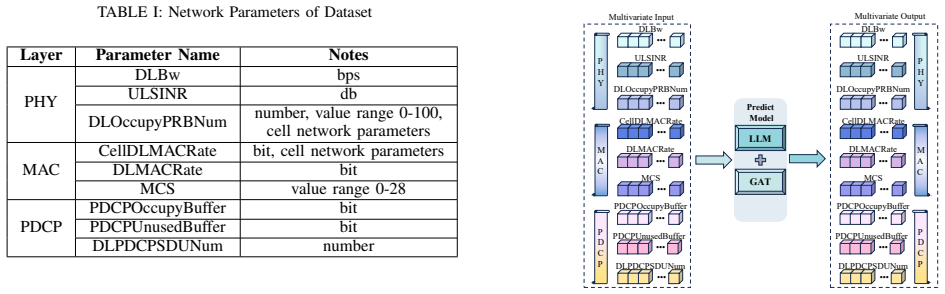
The load-bearing mechanism is a graph attention layer across variables: nine protocol-layer parameters become nodes, a learnable matrix transforms their features, and a multi-head attention coefficient $\alpha_{jk}$ aggregates neighbor information before a linear layer turns the enriched vectors into GPT-2 tokens with positional encoding. This is what lets a one-dimensional-sequence LLM see multivariate structure; the paper's argument is that this cross-variable exchange is the reason GAT-LLM beats GPT-2 alone, while the pretrained transformer supplies temporal pattern recognition.
What would settle it
Compute the same five-model comparison with a strictly chronological split and with normalization fitted only on the training portion; if GAT-LLM no longer beats GPT-2 alone and GAT-Transformer on most variables, or if its multi-step margins shrink to noise, the paper's central performance claim would be falsified.
Extended reading notes
Core claim
The core discovery the paper asserts is that the bottleneck for LLM-based link quality prediction is not the LLM's temporal modeling but its blindness to interdependencies among simultaneously measured variables, and that a graph attention layer placed before the LLM removes that bottleneck. Concretely, GAT-LLM constructs one graph per time step with nine nodes (DLBw, ULSINR, DLOccupyPRBNum, CellDLMACRate, DLMACRate, MCS, PDCPOccupyBuffer, PDCPUnusedBuffer, DLPDCPSDUNum), computes multi-head attention coefficients between nodes, aggregates neighbor features, linearly projects the result into LLM tokens, and fine-tunes all GPT-2 parameters on the prediction task. The experiments report lower MAE and RMSE than the four baselines for one-step forecasts across most variables and for all four reported parameters over ten steps, and the multi-step comparison shows the margin grows with horizon, which the paper attributes to GAT's cross-variable information feeding the autoregressive loop.
Load-bearing premise
The performance comparison rests on the assumption that the min-max normalization bounds and the train/test split respect temporal order and use only training data; the paper does not state either, so if normalization spans the full 22,661-sample series, test information leaks into training and the reported MAE/RMSE margins would be optimistic.
Editorial extensions
If this is right
- With GAT-LLM, a base station could turn nine 1 ms link metrics into 10 ms look-ahead forecasts of downlink bandwidth, user rate, MCS, and uplink SINR, providing a short prediction window for scheduling and link adaptation.
- The GAT layer removes the need to hand-engineer cross-layer features: the model learns which protocol-layer variables matter to each other directly from data.
- The reported multi-step margin over univariate prediction implies that correlated variables contribute most at longer horizons, exactly where autoregressive error accumulation normally worsens forecasts.
- The paper's configuration shows a pretrained transformer can be fine-tuned on a relatively small domain dataset (22,661 samples) rather than retrained, which the paper argues is a practical route to LLM-based prediction at the base station.
Reading between the lines
- If the reported gains survive a clean chronological split, the same graph-over-variables design could transfer to other multivariate radio-management tasks, such as handover timing or energy-efficiency control, because the GAT layer is agnostic to which protocol parameters form the nodes.
- The paper does not run an ablation that fixes GPT-2 and toggles the GAT layer on and off, so the reader cannot yet tell how much of the improvement is due to cross-variable graph attention and how much to fine-tuning the LLM itself; that ablation would be a direct test of the paper's explanatory story.
- Because all experiments use one 22,661-sample trace from a single operator at 1 ms resolution, the paper's robustness claim remains a single-dataset observation; validating it on other operators, mobility regimes, and radio environments would show whether the architecture generalizes or overfits to this trace.
Signed reviews
Editorial analysis
A structured set of objections, weighed in public.
Referee Report
Summary. The manuscript proposes GAT-LLM, a model that uses a graph attention network over nine cross-layer wireless link quality variables and feeds the resulting embeddings into a fine-tuned GPT-2 to produce one-step and autoregressive multi-step predictions. The authors evaluate on a public 22,661-sample China Mobile dataset and compare against GPT-2, GAT-Transformer, Conv-LSTM, and VARIMA using MAE and RMSE. The central claim is that GAT-LLM outperforms all baselines across most variables and improves robustness, especially in multi-step prediction scenarios.
Significance. The combination of GAT with a pretrained LLM for multivariate wireless link quality prediction is a timely and plausible idea, and the use of a public dataset plus several baselines is a strength. If the performance advantage were established under a sound evaluation protocol, the paper would make a useful contribution to LLM-based time series forecasting in wireless networks. However, the current experimental description omits essential details about data splitting and normalization, and no uncertainty quantification is provided, so the empirical central claim is not yet supported.
major comments (6)
- [IV-A, Table II] The experimental setup never states how the 22,661-sample series is divided into training and test sets. With the stride-1 sliding windows defined in Eq. (2), a random split would place 19 of every 20 time steps of a test window in the training set, making the reported one-step MAE/RMSE values in Table III uninformative about generalization. Please specify a temporal split (e.g., first 80% train, last 20% test), state the split ratio, and confirm that no test-window time steps appear in training.
- [III-C] The preprocessing section says only that min-max normalization scales all parameters linearly to [0,1]; it does not state whether the minimum and maximum are computed on the training portion or on the entire series. If the latter, future test statistics enter the trained model through the input embedding, which would inflate the reported performance. Please state that normalization parameters are fitted on the training set only and applied to validation and test sets.
- [IV-B, Table III] The text says GAT-LLM is better 'with two exceptions: DLOccupyPRBNum, which performs worse than the GPT-2 scheme in terms of RMSE,' but only one exception is identified; moreover, Table III shows DLOccupyPRBNum RMSE=0.0154 for GAT-LLM versus 0.0130 for GPT-2. Please correct the count and give a per-variable summary of wins and losses for both MAE and RMSE, since the central outperformance claim is qualified.
- [IV-A, Table III, Fig. 3] All results appear to come from a single run; no standard deviations, confidence intervals, or multiple-seed experiments are reported. Given that the model fine-tunes all GPT-2 parameters for 500 epochs on 22,661 samples, the observed gaps may be within run-to-run variance. Please report mean plus/minus standard deviation over at least 3 to 5 seeds and, if possible, a paired significance test across variables.
- [II-B, Fig. 3] The multi-step evaluation protocol is underspecified. Eq. (3) is applied autoregressively, but it is not stated whether the model consumes its own previous predictions or ground-truth values at each step, and the y-axis label in Fig. 3 is 'MAE(dB)' even though several variables (DLMACRate, MCS) are not measured in dB. Please describe the recursive evaluation procedure and use consistent units.
- [Abstract, V] The abstract and conclusion claim improved 'robustness,' but no experiment measures robustness to noise, missing values, or distribution shift; the multi-step curves only show error growth over the horizon. Please either add a robustness evaluation or soften the claim so it matches the experiments actually reported.
minor comments (4)
- [I] There are typos such as 'Exising' in the Introduction and 'Bandwith' in Section II-A; please proofread the manuscript.
- [II-B, Eq. (1)] Eq. (1) writes X_t as a subset of R^{T x N}, but a single multivariate observation should be a vector in R^N; the notation should be corrected. Eq. (2) defines A but never uses it afterward.
- [Table II] The entries 'Training step length 19' and 'Step size for predicting (l) 10' are not defined in the text; please clarify what these parameters mean.
- [References] Reference [6] is cited as both 'One fits all' and as the source of GPT-2; the GPT-2 model should be cited to its original authors, not to Zhou et al.
Circularity Check
No circularity: GAT-LLM is an empirical architecture comparison; its equations define a standard preprocessing/GAT/LLM pipeline, and no predicted quantity reduces to a fitted input or self-citation.
full rationale
The paper is an empirical benchmarking study rather than a derivation from first principles. It proposes GAT-LLM by combining a graph attention network with a fine-tuned GPT-2 backbone; Eqs. (1)-(4) formulate sliding-window multivariate time series inputs and outputs, Eqs. (5)-(7) define the standard GAT attention and multi-head aggregation, and Eqs. (8)-(9) define MAE and RMSE. None of these definitions equates a predicted quantity with an input by construction. The central claim in Section IV-B is that GAT-LLM outperforms GPT-2, GAT-Transformer, Conv-LSTM, and VARIMA on the reported dataset; this is an empirical comparison against external baselines, not a fitted parameter renamed as a prediction. The paper invokes no uniqueness theorem, and no load-bearing premise is justified solely by a self-citation: none of the cited works [1]-[12] is authored by the present paper's authors. The only concerns raised by the manuscript text are that Section IV-A does not specify a train/test split and Section III-C does not state whether min-max normalization bounds are fitted on the training set only. Those are reproducibility and potential test-leakage/soundness risks, not circularity, because the manuscript does not demonstrate by construction that the reported errors are computed on training data. Hence no circular step is exhibited and the circularity score is 0.
Assumptions & free parameters
free parameters (6)
- learning_rate =
0.001
- fixed_window_size tau =
20
- GAT hidden dimension =
1024
- GAT attention heads =
16
- training epochs =
500
- min-max normalization bounds =
unspecified
assumptions (4)
- domain assumption The nine dataset parameters provide sufficient and unbiased information about link quality.
- ad hoc to paper GPT-2's pretrained representations transfer to wireless time series after fine-tuning.
- domain assumption Lagrange interpolation reconstructs missing samples without distorting the temporal structure.
- domain assumption Min-max normalization is applied without test-set leakage.
Cite this review
Pith. "Pith review of Multivariate Wireless Link Quality Prediction Based on Pre-trained Large Language Models." pith.science (2026). https://pith.science/paper/OCRY6G7I
@misc{pith2026250111247,
  author       = {Pith},
  title        = {Pith review of: Multivariate Wireless Link Quality Prediction Based on Pre-trained Large Language Models},
  year         = {2026},
  howpublished = {\url{https://pith.science/paper/OCRY6G7I}},
  note         = {Machine review of arXiv:2501.11247}
}
read the original abstract
Accurate and reliable link quality prediction (LQP) is crucial for optimizing network performance, ensuring communication stability, and enhancing user experience in wireless communications. However, LQP faces significant challenges due to the dynamic and lossy nature of wireless links, which are influenced by interference, multipath effects, fading, and blockage. In this paper, we propose GAT-LLM, a novel multivariate wireless link quality prediction model that combines Large Language Models (LLMs) with Graph Attention Networks (GAT) to enable accurate and reliable multivariate LQP of wireless communications. By framing LQP as a time series prediction task and appropriately preprocessing the input data, we leverage LLMs to improve the accuracy of link quality prediction. To address the limitations of LLMs in multivariate prediction due to typically handling one-dimensional data, we integrate GAT to model interdependencies among multiple variables across different protocol layers, enhancing the model's ability to handle complex dependencies. Experimental results demonstrate that GAT-LLM significantly improves the accuracy and robustness of link quality prediction, particularly in multi-step prediction scenarios.
Figures


Figures from the paper (1 more)

Reference graph
Works this paper leans on
-
[1]
Machine Learning for Wireless Link Quality Estimation: A Survey,
G. Cerar, H. Yetgin, M. Mohor ˇciˇc, and C. Fortuna, “Machine Learning for Wireless Link Quality Estimation: A Survey,” IEEE Communications Surveys & Tutorials , vol. 23, no. 2, pp. 696–728, 2021
work page 2021
-
[2]
Long-term application-level wireless link quality prediction,
Z. Sayeed, E. Grinshpun, D. Faucher, and S. Sharma, “Long-term application-level wireless link quality prediction,” in 2015 36th IEEE Sarnoff Symposium , 2015, pp. 40–45
work page 2015
-
[3]
Point Cloud- Based Proactive Link Quality Prediction for Millimeter-Wave Commu- nications,
S. Ohta, T. Nishio, R. Kudo, K. Takahashi, and H. Nagata, “Point Cloud- Based Proactive Link Quality Prediction for Millimeter-Wave Commu- nications,” IEEE Transactions on Machine Learning in Communications and Networking , vol. 1, pp. 258–276, 2023
work page 2023
-
[4]
Wireless link quality prediction based on temporal convolutional networks and self-attention fusion,
Y . Wang and L. Liu, “Wireless link quality prediction based on temporal convolutional networks and self-attention fusion,” in Proceedings of the 2024 5th International Conference on Computing, Networks and Internet of Things , 2024, pp. 448–453
work page 2024
-
[5]
A survey of large language models,
W. X. Zhao, K. Zhou, J. Li, T. Tang, X. Wang, Y . Hou, Y . Min, B. Zhang, J. Zhang, Z. Dong et al. , “A survey of large language models,” arXiv preprint arXiv:2303.18223, 2023
arXiv 2023
-
[6]
One fits all: Power general time series analysis by pretrained lm,
T. Zhou, P. Niu, L. Sun, R. Jin et al. , “One fits all: Power general time series analysis by pretrained lm,” Advances in neural information processing systems, vol. 36, pp. 43 322–43 355, 2023
2023
-
[7]
Time-LLM: Time Series Forecasting by Reprogramming Large Language Models,
M. Jin, S. Wang, L. Ma, Z. Chu, J. Y . Zhang, X. Shi, P.-Y . Chen, Y . Liang, Y .-F. Li, S. Pan, and Q. Wen, “Time-LLM: Time Series Forecasting by Reprogramming Large Language Models,” inThe Twelfth International Conference on Learning Representations , 2024
work page 2024
-
[8]
Large Language Model (LLM) for Telecommunications: A Comprehensive Survey on Principles, Key Techniques, and Opportunities,
H. Zhou, C. Hu, Y . Yuan, Y . Cui, Y . Jin, C. Chen, H. Wu, D. Yuan, L. Jiang, D. Wu, X. Liu, C. Zhang, X. Wang, and J. Liu, “Large Language Model (LLM) for Telecommunications: A Comprehensive Survey on Principles, Key Techniques, and Opportunities,” IEEE Com- munications Surveys & Tutorials , pp. 1–1, 2024
2024
Show all 12 references
-
[9]
MultiCast: Zero- Shot Multivariate Time Series Forecasting Using LLMs,
G. Chatzigeorgakidis, K. Lentzos, and D. Skoutas, “MultiCast: Zero- Shot Multivariate Time Series Forecasting Using LLMs,” in 2024 IEEE 40th International Conference on Data Engineering Workshops (ICDEW), 2024, pp. 119–127
2024
-
[10]
Using Pre- trained LLMs for Multivariate Time Series Forecasting,
M. L. Wolff, S. Yang, K. Torkkola, and M. W. Mahoney, “Using Pre- trained LLMs for Multivariate Time Series Forecasting,” arXiv preprint arXiv:2501.06386, 2025
2025 arXiv
-
[11]
Large Language Model (LLM)-enabled Graphs in Dynamic Networking,
G. Sun, Y . Wang, D. Niyato, J. Wang, X. Wang, H. V . Poor, and K. B. Letaief, “Large Language Model (LLM)-enabled Graphs in Dynamic Networking,” IEEE Network , pp. 1–1, 2024
2024
-
[12]
Vehicular Crowdsensing Inference and Prediction With Multi Training Graph Transformer Networks,
J. Huo, L. Wang, Z. Lu, and X. Wen, “Vehicular Crowdsensing Inference and Prediction With Multi Training Graph Transformer Networks,”IEEE Internet of Things Journal , vol. 11, no. 1, pp. 217–227, 2024
2024
Reviewed August 10, 2026 · model on record in the stance chip above.
Discussion (0). Continue with ORCID to comment.