REVIEW 4 major objections 5 minor 17 references
Can MLLMs Generalize to Multi-Party dialog? Exploring Multilingual Response Generation in Complex Scenarios
T0 review · 4 major / 5 minor · reviewed 2026-08-10 · deepseek-v4-flash
Pith's one-line read This paper claims that multilingual LLMs fail to generalize to multi-party dialogue, and that fine-tuning on a new six-language dataset of 312k podcast conversations gives only marginal gains while mixing languages during training usually…
desk verdict XMP is a genuinely new dataset, but the headline negative claims about fine-tuning and cross-lingual mixing are confounded and need controlled re-runs before they can be believed. read the letter →
The pith
A machine-rendered reading of the paper's core claim, the machinery that carries it, and where it could break.
The reading
What carries the argument
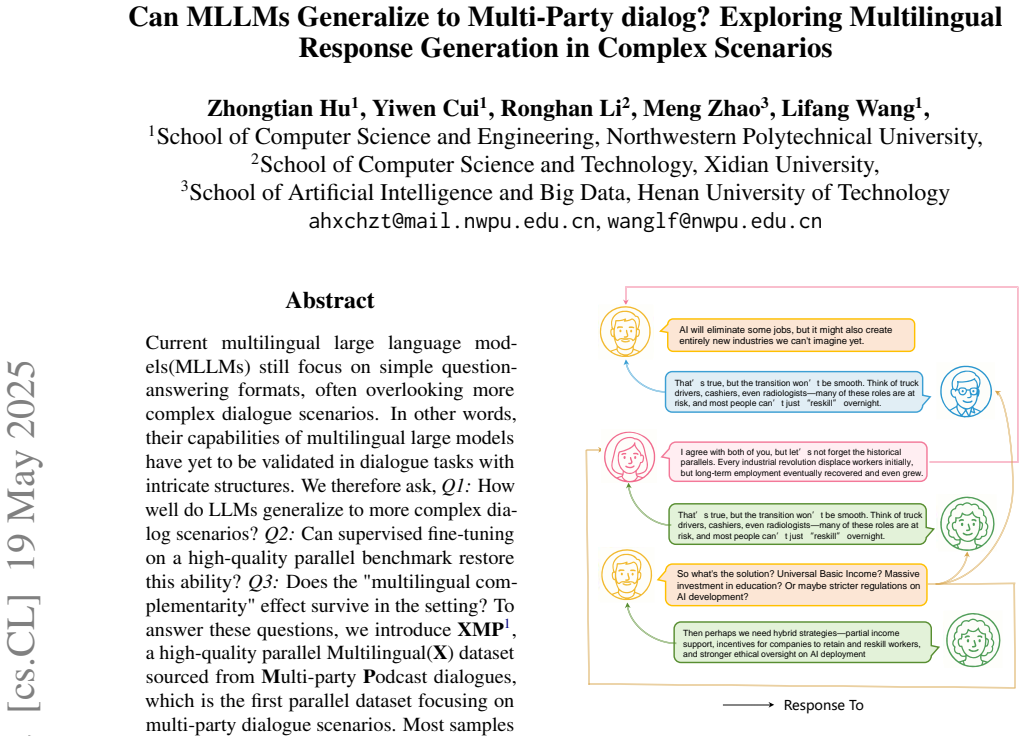
The load-bearing object is XMP, a parallel multilingual dataset for multi-party dialogue built from public podcast transcripts, with each English dialogue translated into Chinese, Japanese, German, French, and Italian, yielding 312k conversations averaging 3.64 speakers and 8.47 turns. The paper also relies on the notion of 'multilingual complementarity' — the claimed ability of a model to use training data from several languages to improve on one target language — and on a low-rank-adaptation fine-tuning setup using LLaMA 3.1 8B/70B and Qwen 2.5 7B. The dataset supplies the missing testbed: a complex, multi-speaker generation task where prior multilingual benchmarks (structured tasks or two-party dialogue) cannot reveal whether model abilities generalize.
What would settle it
Run the mixed-language condition with the same total number of training examples and the same number of target-language examples as the single-language condition (for example, subsample each language to match the single-language size and train for the same number of steps). If the performance drop disappears or reverses, the paper's R3 claim about cross-lingual interference is not supported; if the drop persists under matched data, the claim survives.
Extended reading notes
Core claim
On the paper's own terms, the central discovery is that the capabilities of multilingual LLMs do not transfer to multi-party dialogue: the models cannot reliably track who is speaking, what the topic is, or what a given speaker would naturally say next. Fine-tuning on XMP, a purpose-built parallel multilingual dataset of 312k podcast conversations in English, Chinese, Japanese, German, French, and Italian, recovers only a small fraction of this ability; the 70B LLaMA model's advantage over the 8B model stays within about one absolute point on most metrics. The multilingual complementarity effect, previously observed in structured tasks where training on multiple languages improves a target language, largely diminishes or reverses in this setting: mixing English with another language during supervised fine-tuning usually degrades the target language, with only isolated and marginal gains in the 70B model. The authors interpret the failure as a genuine limitation of conversational understanding rather than an artifact of the test: context-removal experiments show performance depends mostly on the last two turns, and case studies show the model losing track of speakers and producing generic, content-free replies.
Load-bearing premise
The comparison between single-language and mixed-language fine-tuning assumes that only the language mixture changes, but the paper does not state whether total training data size or the proportion of target-language examples is held constant, and the training commands concatenate dataset splits, so mixed runs may train on roughly twice as many examples.
Editorial extensions
If this is right
- Multilingual LLMs should not be assumed to handle multi-party dialogue; at minimum, benchmarks should include multi-speaker settings before claiming general multilingual chat ability.
- Fine-tuning on a high-quality parallel dataset does not automatically restore this ability, and scale alone (70B vs 8B) offers only marginal gains of about one absolute point.
- Training on multiple languages during supervised fine-tuning is usually detrimental in this setting, so multilingual complementarity is not a universal property of LLM training.
- Models generate responses mostly from the last few turns, not the full dialogue history, so improving multi-party performance requires better long-range conversational modeling.
- High n-gram scores for Japanese and Chinese do not reflect semantic quality; BERTScore shows Chinese lagging, so token-based metrics can mislead in multilingual dialogue evaluation.
Reading between the lines
- Extension: if the single- versus mixed-language runs are not matched for total training data or target-language proportion, the observed 'detrimental' effect of mixing may be an artifact of doubled data or diluted target examples; a matched-data experiment would settle this.
- Extension: the context-removal result suggests a testable fix — explicitly encoding speaker identities and turn structure (for example, role embeddings or graph attention over speakers) might recover the multi-party ability that plain sequence fine-tuning misses.
- Extension: since the dataset is machine-translated via Google Translate, some of the cross-lingual differences could reflect translationese rather than model limitations; a human-translated subset would be a sharper test.
- Extension: the paper's negative results imply that dialog systems for real group settings (meetings, multiplayer games) may need dedicated multi-party training objectives rather than relying on scale or cross-lingual transfer.
Signed reviews
Editorial analysis
A structured set of objections, weighed in public.
Referee Report
Summary. The paper introduces XMP, a parallel multilingual multi-party dialogue dataset built by translating English podcast transcripts into Chinese, Japanese, German, French, and Italian, with about 312k conversations. It evaluates Qwen-2.5 7B and LLaMA-3.1 8B/70B on a response-generation task and claims three findings: R1, that MLLMs fail to generalize to multi-party dialogue; R2, that fine-tuning on XMP improves performance only marginally, with the 70B model gaining at most 1% absolute over the 8B model; and R3, that multilingual complementarity is inconsistent or even detrimental in this setting. The paper also reports translation-quality checks, dataset statistics, and case studies of model errors.
Significance. If the negative findings were rigorously established, they would be noteworthy because they would challenge the expectation that cross-lingual fine-tuning benefits transfer to complex generation tasks. The dataset itself is a potentially useful resource: it is large, covers six languages, and the authors report human and automatic translation-quality checks. The empirical claims, however, are not currently supported at the level needed for the paper's central conclusions, and one quantitative claim is contradicted by the paper's own table.
major comments (4)
- [§6.3, Table 5; Appendix E] The single-language versus mixed-language fine-tuning comparison does not control the training budget. Appendix E documents only the train_en command with num_train_epochs=2.0; no commands or dataset-composition details are given for the mixed runs such as 'DE, FR'. If mixed training concatenates the two single-language splits and keeps epochs fixed, the mixed model is trained on roughly twice as many examples and twice as many optimizer steps with a different cosine schedule; if optimizer steps are instead held fixed, the target language contributes only half the examples per epoch. Both scenarios confound language mixing with training-data exposure and optimization length. Under this design, the consistent degradation of the 8B model in Table 5 is equally compatible with underfitting or data imbalance as with cross-lingual interference, and the scattered 70B deltas, mostly below 0.5 points, are within plausible seed-to-seed noise that the paper never reports. R3 is therefore not established by the reported experiments.
- [§6.1, Table 3; Abstract R2] R2 as stated is not supported. First, Table 3 reports only the fine-tuned models; there is no zero-shot or in-context-learning baseline under the same evaluation protocol, so the paper cannot claim that fine-tuning 'improves only marginally.' The abstract's wording conflates the effect of fine-tuning with the effect of model scale. Second, the quantitative gloss 'at most a 1% absolute gain' is contradicted by the table: LLaMA-3.1 70B exceeds LLaMA-3.1 8B by 1.31 F1 on English (21.23 vs. 19.92). The claim should either be revised to 'typically within 1% on most metrics' and then verified, or the table and claim must be reconciled.
- [§3, Appendix A, Figure 5; R1] R1, that MLLMs fail to generalize to multi-party dialogue, is supported only by flat or declining in-context-learning curves on roughly 1,000 samples and by low absolute n-gram scores. These observations do not distinguish 'the model cannot handle multi-party structure' from 'n-gram metrics are insensitive for open-ended generation with many valid continuations' or 'ICL is not the right regime for this task.' No human-performance baseline, chance-level reference, or zero-shot baseline under the final evaluation setup is provided, and no significance test accompanies the differences in Figure 5. The claim should be reworded or supplemented with a controlled comparison, such as human judgments or a simple template-based baseline.
- [Tables 3 and 5; §6.3] No measure of variance is reported for any result. The headline deltas in Table 5 are as small as +0.04 or -0.00 F1, and several 70B improvements, such as DE+FR on FR with +0.66 F1, could plausibly flip sign under a different random seed. Without multiple seeds, confidence intervals, or significance tests, qualitative conclusions such as 'detrimental,' 'marginal,' or 'inconsistent' are not supported by these point estimates.
minor comments (5)
- [§5.2, Eq. (1)] The sentence describing the cross-entropy loss is incomplete: 'the cross-entropy loss is computed between and the ground truth' should identify the model output R_hat as the first argument.
- [Abstract and Introduction] The acronym MLLM is used for 'multilingual large language model,' but MLLM more commonly denotes 'multimodal large language model'; please define and disambiguate at first use.
- [Table 3 caption] The caption says that differences are 'highlighted,' but no highlighting is visible in the submitted text; please indicate explicitly that the superscript numbers are deltas relative to LLaMA-3.1 70B.
- [Figure 5] The three template types are distinguished only by color or line style; in grayscale the Type 1, Type 2, and Type 3 curves are difficult to separate. Adding markers would improve readability.
- [§6.2, Table 4] BERTScore is reported only for LLaMA-3.1 8B, but the surrounding discussion generalizes to 'the models'; please clarify that the semantic-divergence observation is currently demonstrated for one model only.
Circularity Check
No circularity: R1–R3 are direct empirical measurements on a held-out test split; no parameter is fitted to the target quantities and no load-bearing self-citation appears.
full rationale
The paper's three claims are empirical measurements, not derived quantities. R1 (MLLMs fail to generalize to multi-party dialogue) follows from ICL and SFT evaluations on the new XMP benchmark, where scores are computed on a 90/10 train/test split with no fitted parameter re-labeled as a prediction. R2 (marginal 70B-over-8B gains) is likewise a direct comparison of test-set metrics. R3 (multilingual complementarity diminishes) operationalizes the term the authors themselves define ('a model's capacity to effectively leverage information from multiple languages during training to enhance performance on specific target languages,' Sec. 6.3) as a controlled single-language vs. mixed-language SFT comparison; the definition and the dependent variable are independent, and the finding is an outcome of the experiment rather than an input to it. No self-citation is load-bearing: the reference list contains none of the present authors' prior work, and the cited cross-lingual effects (Mulcaire et al. 2019; Conneau et al. 2020b; Whitehouse et al. 2023; Choenni et al. 2023) are used only as external framing for the research question. No uniqueness theorem is invoked, and no ansatz is smuggled in via citation. The skeptical concern about R3 — that mixed-training data size, optimizer steps, and target-language exposure are not reported as matched (Appendix E documents only single-language train_en commands) — is a genuine internal-validity threat to the causal attribution, not a circular step, since the measured deltas are not forced by construction. Similarly, the use of BLEU/ROUGE/BERTScore on machine-translated references may compress absolute scores, affecting external validity, but it does not make any result equivalent to its inputs. Self-contained benchmark evaluation therefore warrants score 0.
Assumptions & free parameters
assumptions (5)
- domain assumption NPR podcast transcripts are representative of multi-party dialogue and preserve the complexity being tested
- domain assumption Google Translate preserves speaker roles, dialogue structure, and cultural fidelity well enough that the translated test sets measure the same underlying task
- domain assumption The prompt 'What will Speaker-x say next?' with concatenated history is a valid operationalization of multi-party response generation
- domain assumption BLEU, ROUGE, F1, and BERTScore are adequate measures of response quality for drawing conclusions about model ability
- domain assumption The three tested models (LLaMA-3.1 8B, LLaMA-3.1 70B, Qwen-2.5 7B) are representative of current multilingual LLMs
Cite this review
Pith. "Pith review of Can MLLMs Generalize to Multi-Party dialog? Exploring Multilingual Response Generation in Complex Scenarios." pith.science (2026). https://pith.science/paper/RAQYF7GD
@misc{pith2026250111269,
  author       = {Pith},
  title        = {Pith review of: Can MLLMs Generalize to Multi-Party dialog? Exploring Multilingual Response Generation in Complex Scenarios},
  year         = {2026},
  howpublished = {\url{https://pith.science/paper/RAQYF7GD}},
  note         = {Machine review of arXiv:2501.11269}
}
read the original abstract
Current multilingual large language models(MLLMs) still focus on simple question-answering formats, often overlooking more complex dialogue scenarios. In other words, their capabilities of multilingual large models have yet to be validated in dialogue tasks with intricate structures. We therefore ask, Q1: How well do LLMs generalize to more complex dialog scenarios? Q2: Can supervised fine-tuning on a high-quality parallel benchmark restore this ability? Q3: Does the "multilingual complementarity" effect survive in the setting? To answer these questions, we introduce XMP, a high-quality parallel Multilingual dataset sourced from Multi-party Podcast dialogues, which is the first parallel dataset focusing on multi-party dialogue scenarios. Most samples in the dataset feature three or more participants, discussing a wide range of topics. Through extensive experiments, we find that, R1: MLLMs fail to generalize to multi-party setting, R2 Fine-tuning on XMP improves only marginally, with the 70B model achieving at most a 1% absolute gain over its 8B counterpart; R3: Mixing languages during SFT is usually detrimental, with any benefits being marginal and limited to isolated cases in the 70B model.
Figures


Figures from the paper (2 more)


Reference graph
Works this paper leans on
-
[1]
description Using English templates and En- glish examples. In this setting, the model learns and infers based on English examples, effectively leveraging the provided data
-
[2]
For example, when test- ing with Chinese data, we employ Chinese templates and Chinese examples
Using target language templates and target language examples. For example, when test- ing with Chinese data, we employ Chinese templates and Chinese examples
-
[3]
Information Pro- cessing & Management, 60(3):103250
Zero-shot cross-lingual transfer language se- lection using linguistic similarity. Information Pro- cessing & Management, 60(3):103250. Edward J. Hu, Yelong Shen, Phillip Wallis, Zeyuan Allen-Zhu, Yuanzhi Li, Shean Wang, Lu Wang, and Weizhu Chen. 2021. Lora: Low-rank adaptation of large language models. Preprint, arXiv:2106.09685. Wenpeng Hu, Zhangming Ch...
arXiv 2021
-
[4]
A regular expression r’(\w[\w\s,]*) :\s*([ˆ:]*?)(?=\w[\w\s,]*:|$)’was ap- plied to separate "Speaker: Utterance" pairs, aligning speakers with their corresponding ut- terances. B.2 Data Filtering Post extraction, a set of filtering rules was applied to eliminate noise from the data:
-
[5]
et al., we applied different templates com- bined with ICL for further validation. Specially, we designed three different experimental methods to validate the model’s performance variations:
-
[8]
Using English templates and target language examples. We also experimented with various template for- mats, but the results were largely similar across different configurations. As a result, we selected one template format that was used in the final ex- periments, which is illustrated in the Figure 4. Ad- ditionally, we tested the model’s performance with...
-
[9]
The HTML structure was parsed to extract the page titles
-
[10]
The <div> sections containing transcription text were identified and processed
Show all 17 references
-
[11]
Extraneous content, such as timestamps and bracketed text, was removed or converted into readable text
-
[13]
Copyright,
Platform Labels: Phrases such as “Copyright,” “(Laughter),” “(SOUNDBITE OF TV SHOW, THE TONIGHT SHOW),” and “HOST, BY- LINE” were removed
-
[14]
B.3 Data Segmentation Podcast episodes typically range from 80 to 100 utterances, making segmentation essential to gener- ate manageable samples
URLs: Any URL strings within the text were removed. B.3 Data Segmentation Podcast episodes typically range from 80 to 100 utterances, making segmentation essential to gener- ate manageable samples. The following rules were used:
-
[15]
Segment Length: Long conversations were split into shorter segments, ensuring each con- tained 7 to 15 utterances
-
[16]
Speaker Presence: The speaker generating the response must appear in the prior dialogue history to ensure coherence
-
[17]
Yeah, wel
Response Quality: Segments with overly short or long responses, or responses deemed mean- ingless (e.g., “Yeah, wel” or “Alright”), were excluded. C Comparison of Translate Method C.1 Human Evaluation for Different Translation Methods For human evaluation, we began by selectin...
2024
-
[2021]
arXiv preprint arXiv:2107.00676
A primer on pretrained multilingual language models. arXiv preprint arXiv:2107.00676. Juuso Eronen, Michal Ptaszynski, and Fumito Masui
-
[2023]
In Proceedings of the 2023 Conference on Empiri- cal Methods in Natural Language Processing, pages 13244–13257, Singapore
How do languages influence each other? study- ing cross-lingual data sharing during LM fine-tuning. In Proceedings of the 2023 Conference on Empiri- cal Methods in Natural Language Processing, pages 13244–13257, Singapore. Association for Computa- tional Linguistics. Alexis Co...
2023
-
[2024]
In Proceedings of the 28th Conference on Computational Natural Language Learning, pages 400–418
Translating across cultures: Llms for intralin- gual cultural adaptation. In Proceedings of the 28th Conference on Computational Natural Language Learning, pages 400–418. Hugo Touvron, Thibaut Lavril, Gautier Izacard, Xavier Martinet, Marie-Anne Lachaux, Timothée Lacroix, Bapt...
2023 arXiv
Reviewed August 10, 2026 · model on record in the stance chip above.
Discussion (0). Continue with ORCID to comment.