REVIEW 4 major objections 5 minor 116 references
Double-tough ceramics: Optimization-supported multiscale computational design
T0 review · 4 major / 5 minor · reviewed 2026-08-10 · deepseek-v4-flash
Pith's one-line read A multiscale design couples zirconia's phase transformation with a brick-and-mortar alumina structure to reach 12.99 MPa√m in simulated fracture toughness.
desk verdict First credible computational study combining transformation toughening and brick-and-mortar toughening in one ceramic; the design trends are probably right, but the absolute KI numbers are not yet backed up. read the letter →
The pith
A machine-rendered reading of the paper's core claim, the machinery that carries it, and where it could break.
The reading
What carries the argument
The load-bearing machinery is the pseudoelastic constitutive law of the zirconia mortar, produced by a nanoscale phase-field model of the tetragonal-to-monoclinic transformation, feeding a microscale stress-based phase-field fracture model of the brick-and-mortar composite. The transformation is described by a phase-field kinetic equation for an order parameter $\eta$ (0 tetragonal, 1 monoclinic), with only the volumetric transformation strain retained and the shear component assumed to be compensated by twinning. The microscale fracture model uses a crack phase field $\phi$ driven by the principal-tensile-stress criterion $D_d = \left\langle \sum_i \langle\sigma_i\rangle^2/\sigma_c^2 - 1\right\rangle$, which makes the crack-driving force independent of the length scale. The mortar curve fixes the transformation activation stress (259 MPa in the reference nanoscale setup) and the transformation-induced inelastic strain (0.0098), and the brick-and-mortar geometry's role is to give the crack a long, deflected path through that transforming mortar. The optimization layer then closes the loop: particle swarm optimization updates brick length, brick width, mortar thickness, and the two strengths to maximize the fracture toughness extracted from the force-displacement curve.
What would settle it
Fabricate a double-tough ceramic with the optimized geometry and strengths, measure crack-initiation toughness in bending, and compare the transformed zone ahead of the crack with the model's predictions; alternatively, measure the stress-strain response of a zirconia mortar layer constrained between alumina bricks under multiaxial loading and feed that curve into the model. A large discrepancy in activation stress or toughness would falsify the transfer from the uniaxial nanoscale curve to the constrained crack-tip state.
Extended reading notes
Core claim
On its own terms, the paper claims that transformation toughening and structural toughening can be combined in a single all-ceramic material and that the combination is synergistic: the phase transformation raises the resistance force along the crack path while the brick-and-mortar layout lengthens that path, so more energy is dissipated before failure than either mechanism alone provides. The demonstration is carried by a two-scale simulation: at the nanoscale, a 400 nm ceria-stabilized zirconia polycrystal is loaded in uniaxial tension, and a phase-field model with a relaxation kinetic equation produces the stress-strain curve that is then assigned to the mortar; at the microscale, a stress-based phase-field fracture model propagates a crack through a 30 µm × 5 µm brick-and-mortar domain with alumina bricks and that zirconia mortar. The paper's peak reported number is $K_I = 12.99$ MPa$\sqrt{\mathrm{m}}$, obtained by particle swarm optimization at $(l, w, t) = (12, 0.12, 0.04)$ µm with zirconia strength $\sigma_{fZ} = 2$ GPa and alumina strength $\sigma_{fA} \ge 24.58$ GPa, compared with $6.00$ MPa$\sqrt{\mathrm{m}}$ for the initial geometry with both mechanisms active. The paper presents this as evidence that the two mechanisms are compatible and mutually reinforcing rather than competing.
Load-bearing premise
The load-bearing premise is that the mortar's stress-strain curve measured in a free-standing zirconia film under uniaxial tension also describes the mortar in the composite, where it is squeezed between stiff alumina bricks and sits in the crack-tip stress field; if the transformation activates at a different stress or produces a different inelastic strain there, the predicted toughness and the optimized design change.
Editorial extensions
If this is right
- Fracture toughness rises with brick aspect ratio: the optimized design sits at the highest explored aspect ratio, $l/w = 100$, with the thinnest considered mortar layer, $t = 0.04$ µm.
- A minimum alumina strength (about 24.58 GPa for the optimum) is needed to keep the crack in the transforming zirconia mortar; below that, the crack cuts through the alumina bricks and toughness drops sharply.
- Softer grain boundaries raise the stress required to trigger the transformation (from 143 to 259 MPa across the explored range), so sintering conditions that change grain-boundary stiffness offer a processing handle on transformation activity.
- Grain orientation texture changes both the transformation patterns and the triggering stress, which means textured microstructures can be used as an additional design degree of freedom.
- Coupling both mechanisms gives crack-initiation toughness of $6.00$ MPa$\sqrt{\mathrm{m}}$ for the experimental reference geometry and $12.99$ MPa$\sqrt{\mathrm{m}}$ after optimization, values the paper treats as achievable in a flaw-free, all-ceramic composite.
Reading between the lines
- Editorial extension: the predicted optimum depends on the assumption that the mortar's uniaxial pseudoelastic response survives in the constrained, multiaxial crack-tip state; inserting a measured constrained constitutive law would be the natural next test of the design ranking.
- Editorial extension: because the model assumes a flawless material, the $12.99$ MPa$\sqrt{\mathrm{m}}$ figure is an ideal ceiling; with realistic defects and microcracks the absolute values would drop, so the primary message is the ranking of designs and the existence of a strength window rather than the exact number.
- Editorial extension: the same two-scale recipe could transfer to other transformation-toughened oxides in the mortar or other strong brick materials, since the approach only requires a pseudoelastic mortar curve and bricks strong enough to deflect the crack.
- Editorial extension: the finding that a non-periodic layout outperforms highly periodic ones suggests that layer-by-layer control of overlap, accessible by additive manufacturing, may be a practical lever beyond the optimized uniform geometry.
Signed reviews
Editorial analysis
A structured set of objections, weighed in public.
Referee Report
Summary. The manuscript presents a two-scale computational framework for designing alumina/zirconia brick-and-mortar ceramics in which the zirconia mortar is transformation-toughened. At the nanoscale, a phase-field model simulates the tetragonal-to-monoclinic transformation in a 400 nm polycrystalline zirconia domain and extracts stress-strain curves; at the microscale, a phase-field fracture model simulates crack propagation in a 30 x 5 µm brick-and-mortar domain using a pseudoelastic mortar law derived from the nanoscale response. Particle swarm optimization is then applied to maximize fracture toughness over geometric and material parameters. The authors report a best fracture toughness of KI = 12.99 MPa sqrt(m) for (l, w, t) = (12, 0.12, 0.04) µm with sigma_fZ = 2 GPa and sigma_fA in [24.58, 30] GPa.
Significance. The paper addresses a timely and relevant problem: combining transformation toughening and brick-and-mortar architecture in an all-ceramic material. The qualitative trends reported---longer/thinner bricks, thinner mortar layers, and higher constituent strengths improve toughness---are plausible and potentially useful for guiding experimental designs. The systematic sensitivity studies on grain-boundary properties, grain orientations, kinetic coefficient, and brick/mortar geometry are clearly presented, and the coupling of nanoscale transformation data into a microscale fracture model is a novel methodological contribution. However, the quantitative claims currently rest on an incompletely specified toughness extraction formula and on an unvalidated transfer of a uniaxial nanoscale constitutive law to a constrained multiaxial mortar phase. The level of certainty in the reported KI values is therefore moderate, and the central quantitative result should be treated as provisional pending clarification and validation.
major comments (4)
- [Sec. 3.2.1 and Table 4] The fracture toughness KI is repeatedly reported (e.g., 6.00 MPa sqrt(m) in Sec. 3.2.1, 8.12 MPa sqrt(m) in Sec. 3.2.3, 12.99 MPa sqrt(m) in Sec. 3.3), but the extraction formula is never given. The text only states that the value is 'calculated based on the dissipation energy, crack length, and elastic properties.' Without an explicit equation relating KI to the force-displacement curves, the reported values cannot be reproduced or independently assessed. This is a load-bearing issue because every quantitative conclusion in the paper depends on this metric.
- [Sec. 3.1.1 vs. Sec. 3.2] There is an internal inconsistency in the grain-boundary property selection. Section 3.1.1 states that 'in the following phase transformation analyses, we set the GB properties to 25% of those of the grains,' and the 25% case gives an activation stress of 176 MPa. However, Section 3.2 states that the mortar constitutive law is derived from the nanoscale model 'with grain boundary properties set as 5% of the bulk ones,' which gives an activation stress of 259 MPa. The microscale model therefore uses a different mortar response than the one selected in the nanoscale analysis, and this discrepancy affects all subsequent force-displacement curves and KI values.
- [Sec. 2.2 and Sec. 3.2] The microscale mortar behavior is represented by a pseudoelastic law characterized only by a 259 MPa activation stress and an inelastic strain of 0.0098, obtained from a free-standing 400 nm polycrystal under uniaxial traction with only the volumetric transformation strain retained. In the brick-and-mortar model, the mortar is a thin layer constrained between stiff alumina bricks and experiences a strongly multiaxial, confined stress state ahead of the crack. The manuscript does not specify a multiaxial transformation criterion, a stress-triaxiality dependence, or an unloading/reloading law. Because every reported KI value and the optimized design are computed from this law, the central quantitative claim rests on an unvalidated transfer from uniaxial to multiaxial conditions.
- [Sec. 3.1 and Sec. 3.2] No mesh- or length-scale convergence study is reported for either the nanoscale or the microscale models. The nanoscale model uses a maximum mesh size h = 2 nm, and the microscale model uses h = 10 nm with a phase-field length scale l0 = 20 nm. Phase-field fracture results, including crack paths and dissipated energy, generally depend on the length-scale parameter and mesh resolution, even when a stress-based driving force is used. Without a convergence check, the quantitative KI values in Table 4 and Section 3.3 are not yet shown to be numerically converged.
minor comments (5)
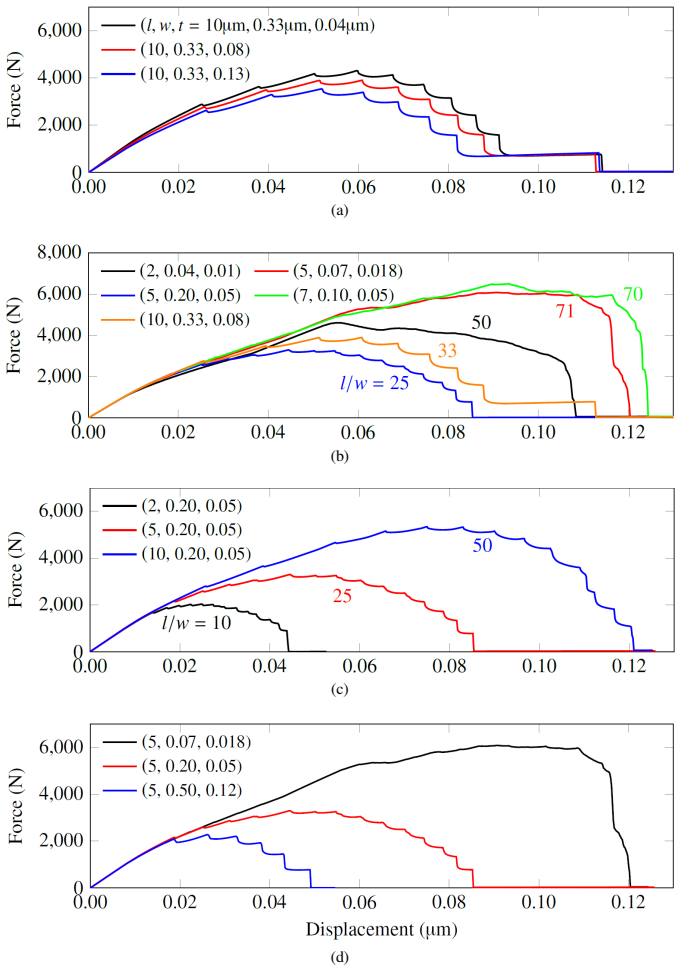
- [Fig. 9 caption and Sec. 3.2.3] The notation '(5, 007, 0.018)' appears where '(5, 0.07, 0.018)' is intended; the zero is misplaced.
- [Sec. 3.2.3] The sentence 'The model with the smallest brick width, w = 0.018' should read w = 0.07 µm, since the widths compared in that paragraph are 0.07, 0.20, and 0.50 µm.
- [Sec. 1] The phrase 'dislocation dymanics' contains a typo and should read 'dislocation dynamics.'
- [Table A.6] The formatting of the final rows is inconsistent: entries such as '12 0.12 0.04 25.05 2 24.58 12.99' lack explicit iteration numbers, and the repeated candidates for the optimum are not clearly separated from the iteration column.
- [Sec. 3.3] The particle swarm optimization is run for a maximum of 10 iterations with 4 or 6 candidates per iteration, but no termination tolerance or repeated-run variability is reported; the global optimality of the identified design is therefore not fully established.
Circularity Check
No circular reduction was found: the nanoscale mortar law is a model output, not a fit to KI, and the self-cited experiment supplies motivation but no fitted constants.
full rationale
Walking the derivation chain: the nanoscale stress-strain response is an output of the phase-field/elastostatics system (Eqs. 16-28 plus parameters in Table 2), not a fit to the microscale fracture toughness; the microscale phase-field fracture problem (Eqs. 6-15) is then solved with that curve as a material law, and KI values are computed from the resulting force-displacement curves. No parameter is calibrated against any KI value, and no reported KI enters the nanoscale model. The self-cited experimental companion [8] supplies motivation and the baseline brick dimensions (l=10 µm, w=0.33 µm, t=0.04 µm), but it contributes no fitted constants and is externally falsifiable experimental evidence, so it does not make the derivation circular. The notable weakness is an internal inconsistency: §3.1.1 states subsequent analyses use 25% GB properties, while §3.2 adopts the 5%-GB nanoscale curve (259 MPa activation). That is a reproducibility/validity concern rather than a circular step, because the 259 MPa curve is itself an independent simulation output, not the target of the microscale prediction. The optimization merely selects parameters at the boundary of the sampled design space; it does not rename an input as an output. No load-bearing self-definitional, fitted-input, or imported-uniqueness reduction was found.
Assumptions & free parameters
free parameters (5)
- Grain boundary elastic property scale =
25% selected in Section 3.1.1; 5% actually used in Section 3.2
- Kinetic coefficient L =
2 m3/J/s
- Grain orientation realization (Group 1) =
Random seed producing Group 1
- Initial phase variable distribution =
mean 1e-4, std 1e-5
- Phase-field length scale l0 and mesh size =
l0=20 nm, h=10 nm
assumptions (7)
- domain assumption The shear component of the transformation-induced strain is compensated by twinning, so only volumetric transformation strain is modeled.
- domain assumption The nanoscale stress-strain curve under uniaxial tension can serve as the microscale mortar constitutive law under arbitrary crack-tip stress states.
- domain assumption The material is flawless and free of initial defects.
- domain assumption The brick-and-mortar structure is perfectly periodic and uniform in 2D.
- standard math Standard phase-field fracture and Ginzburg-Landau phase transformation equations are accepted as valid models.
- standard math Stress-based phase-field driving force Dd uses principal tensile stresses with Macaulay brackets.
- ad hoc to paper Grain boundary elastic constants are represented as uniform percentages of bulk values, with 25% selected for later analysis and 5% actually used in Section 3.2.
Cite this review
Pith. "Pith review of Double-tough ceramics: Optimization-supported multiscale computational design." pith.science (2026). https://pith.science/paper/WAG2INYT
@misc{pith2026250111728,
  author       = {Pith},
  title        = {Pith review of: Double-tough ceramics: Optimization-supported multiscale computational design},
  year         = {2026},
  howpublished = {\url{https://pith.science/paper/WAG2INYT}},
  note         = {Machine review of arXiv:2501.11728}
}
read the original abstract
To overcome the brittleness limitation of ceramics, various toughening mechanisms have been proposed. Some of the most remarkable, especially for oxides, include the tetragonal-to-monoclinic phase transformation leading to crack shielding in zirconia, and bioinspired brick-and-mortar microstructures fostering crack deflection. It has, however, proven challenging to incorporate both these mechanisms into a single all-ceramic material. In this work, we propose a computational methodology for the design of a material that combines these two toughening strategies, using a multiscale modeling approach that captures both their individual contributions and the overall fracture performance. This is achieved by developing an all-ceramic composite with a brick-and-mortar microstructure, in which the nanocrystalline mortar is transformation-toughened. Key factors influencing phase transformation, such as grain boundary properties, grain orientations, and kinetic coefficients, are analyzed, and the resulting transformation stress-strain behavior is incorporated into the microscale mortar constitutive model. We demonstrate that the synergistic effect of the two toughening mechanisms is achievable, and that it is an extremely effective strategy to boost fracture performance. The influence of brick size, mortar thickness, and properties of the constituent materials is then systematically investigated. Finally, a gradient-free optimization algorithm is employed to identify optimal geometric and material parameters, revealing that longer, thinner bricks with minimal mortar thickness provide the best fracture resistance. Optimal combinations of material properties are identified for given brick sizes and mortar thicknesses.
Figures


Figures from the paper (13 more)




Reference graph
Works this paper leans on
-
[1]
Shape memory and superelastic ceramics at small scales
Alan Lai, Zehui Du, Chee Lip Gan, and Christopher A Schuh. Shape memory and superelastic ceramics at small scales. Science, 341(6153):1505–1508, 2013
2013
-
[2]
X.Q. Cao, R. Vassen, and D. Stoever. Ceramic materials for thermal barrier coatings. Journal of the European Ceramic Society, 24(1):1–10, 2004
2004
-
[3]
Thermal barrier coatings technology: critical review, progress update, remaining challenges and prospects
R Darolia. Thermal barrier coatings technology: critical review, progress update, remaining challenges and prospects. International Materials Reviews, 58(6):315–348, 2013
2013
-
[4]
Piconi and G
C. Piconi and G. Maccauro. Zirconia as a ceramic biomaterial. Biomaterials, 20(1):1–25, 1999
1999
-
[5]
Low-temperature degradation of zirconia and impli- cations for biomedical implants
J ´erˆome Chevalier, Laurent Gremillard, and Sylvain Deville. Low-temperature degradation of zirconia and impli- cations for biomedical implants. Annual Review of Materials Research, 37(1):1–32, 2007
2007
-
[6]
Robert Kelly
Isabelle Denry and J. Robert Kelly. State of the art of zirconia for dental applications. Dental Materials , 24(3):299–307, 2008
2008
-
[7]
Muley, and Ruchika
Hitesh Bhakuni, A.V . Muley, and Ruchika. Fabrication, testing & analysis of particulate ceramic matrix composite for automotive brake pad application. Materials Today: Proceedings, 2023
2023
-
[8]
Francesco Aiello, Jian Zhang, Johannes C Brouwer, Mauro Salazar, and Diletta Giuntini. Double-tough and ultra- strong ceramics: leveraging multiscale toughening mechanisms through bayesian optimization. arXiv preprint arXiv:2406.14423, 2024. 29
work page Pith review arXiv 2024
Show all 116 references
-
[9]
Ceramic steel? In Sintering Key Papers, pages 253–257
Ronald C Garvie, RH Hannink, and RT Pascoe. Ceramic steel? In Sintering Key Papers, pages 253–257. Springer, 1990
1990
-
[10]
Microcrack and transformation toughening of zirconia-containing alumina
Manfred R ¨uhle. Microcrack and transformation toughening of zirconia-containing alumina. Materials Science and Engineering: A, 105-106:77–82, 1988
1988
-
[11]
Becher and Michael V
Paul F. Becher and Michael V . Swain. Grain-size-dependent transformation behavior in polycrystalline tetragonal zirconia. Journal of the American Ceramic Society, 75(3):493–502, 1992
1992
-
[12]
Tetragonal-to-monoclinic phase transformation in ceo2-stabilized zirconia under multiaxial loading
G Rauchs, T Fett, D Munz, and R Oberacker. Tetragonal-to-monoclinic phase transformation in ceo2-stabilized zirconia under multiaxial loading. Journal of the European Ceramic Society, 22(6):841–849, 2002
2002
-
[13]
M ¨uller, Giovanni Bruno, Sven Schomer, Tobias F ¨urderer, Erik Adolfsson, Nicolas Courtois, Michael Swain, and J´erˆome Chevalier
Al ´eth´ea Liens, Helen Reveron, Thierry Douillard, Nicholas Blanchard, Vanni Lughi, Valter Sergo, Ren ´e Laquai, Bernd R. M ¨uller, Giovanni Bruno, Sven Schomer, Tobias F ¨urderer, Erik Adolfsson, Nicolas Courtois, Michael Swain, and J´erˆome Chevalier. Phase transformation i...
2020
-
[14]
Transformation-toughening in partially-stabilized zirconia (psz)
DL Porter, AG Evans, and AH Heuer. Transformation-toughening in partially-stabilized zirconia (psz). Acta metallurgica, 27(10):1649–1654, 1979
1979
-
[15]
Transformation toughening in ceramics: Martensitic transformations in crack-tip stress fields
AG Evans and AH Heuer. Transformation toughening in ceramics: Martensitic transformations in crack-tip stress fields. Journal of the American Ceramic Society, 63(5-6):241–248, 1980
1980
-
[16]
Transformation toughening in ceramics
DB Marshall, AG Evans, and M Drory. Transformation toughening in ceramics. Fracture Mechanics of Ceramics, 6:289–307, 1983
1983
-
[17]
Mechanics of transformation-toughening in brittle materials
RM McMeeking and AG Evans. Mechanics of transformation-toughening in brittle materials. Journal of the American Ceramic Society, 65(5):242–246, 1982
1982
-
[18]
Budiansky, J.W
B. Budiansky, J.W. Hutchinson, and J.C. Lambropoulos. Continuum theory of dilatant transformation toughening in ceramics. International Journal of Solids and Structures, 19(4):337–355, 1983
1983
-
[19]
Richard H. J. Hannink, Patrick M. Kelly, and Barry C. Muddle. Transformation toughening in zirconia-containing ceramics. Journal of the American Ceramic Society, 83(3):461–487, 2000
2000
-
[20]
The martensitic transformation in ceramics—its role in transformation toughening
Patrick M Kelly and LR Francis Rose. The martensitic transformation in ceramics—its role in transformation toughening. Progress in Materials Science, 47(5):463–557, 2002
2002
-
[21]
Toughening of yttria-stabilised tetragonal zirconia ceramics
B Basu. Toughening of yttria-stabilised tetragonal zirconia ceramics. International Materials Reviews, 50(4):239– 256, 2005
2005
-
[22]
Virkar, and David R
J ´erˆome Chevalier, Laurent Gremillard, Anil V . Virkar, and David R. Clarke. The tetragonal-monoclinic transfor- mation in zirconia: Lessons learned and future trends. Journal of the American Ceramic Society , 92(9):1901– 1920, 2009
1901
-
[23]
Phase transformation in TZP-ZrO2 under local stress and numerical simulation
Xin Wang. Phase transformation in TZP-ZrO2 under local stress and numerical simulation. PhD thesis, Univer- sit¨at T¨ubingen, 2010
2010
-
[24]
Platt, P
P. Platt, P. Frankel, M. Gass, R. Howells, and M. Preuss. Finite element analysis of the tetragonal to monoclinic phase transformation during oxidation of zirconium alloys. Journal of Nuclear Materials, 454(1):290–297, 2014
2014
-
[25]
Wang, X.Y
X.Z. Wang, X.Y . Liu, A. Javed, C. Zhu, and G.Y . Liang. Phase transition behavior of yttria-stabilized zirconia from tetragonal to monoclinic in the lanthanum zirconate /yttria-stabilized zirconia coupled-system using molecular dynamics simulation. Journal of Molecular Liquid...
2015
-
[26]
Harris, and Charlene M
Binghui Deng, Jian Luo, Jason T. Harris, and Charlene M. Smith. Critical stress map for zro2 tetragonal to monoclinic phase transformation in zro2-toughened glass-ceramics. Materialia, 9:100548, 2020
2020
-
[27]
Platt, R
P. Platt, R. Mella, W. DeMaio, M. Preuss, and M.R. Wenman. Peridynamic simulations of the tetragonal to monoclinic phase transformation in zirconium dioxide. Computational Materials Science, 140:322–333, 2017
2017
-
[28]
A review on phase field modeling of marten- sitic phase transformation
Mahmood Mamivand, Mohsen Asle Zaeem, and Haitham El Kadiri. A review on phase field modeling of marten- sitic phase transformation. Computational Materials Science, 77:304–311, 2013
2013
-
[29]
Abba Abdulhamid Abubakar, Syed Sohail Akhtar, and Abul Fazal M. Arif. Phase field modeling of v2o5 hot corrosion kinetics in thermal barrier coatings. Computational Materials Science, 99:105–116, 2015
2015
-
[30]
Numerical simulation of intergranular and transgranular crack propagation in ferroelectric polycrystals
Amir Abdollahi and Irene Arias. Numerical simulation of intergranular and transgranular crack propagation in ferroelectric polycrystals. International journal of fracture, 174:3–15, 2012
2012
-
[31]
Clayton and J
J.D. Clayton and J. Knap. Phase field modeling of directional fracture in anisotropic polycrystals. Computational Materials Science, 98:158–169, 2015
2015
-
[32]
Phase-field modelling of interface failure in brittle materials
Arne Claus Hansen-D ¨orr, Ren´e de Borst, Paul Hennig, and Markus K ¨astner. Phase-field modelling of interface failure in brittle materials. Computer Methods in Applied Mechanics and Engineering, 346:25–42, 2019
2019
-
[33]
W. J. Boettinger, J. A. Warren, C. Beckermann, and A. Karma. Phase-field simulation of solidification. Annual Review of Materials Research, 32(1):163–194, 2002
2002
-
[34]
Mul- tiscale modeling of solidification: phase-field methods to adaptive mesh refinement
Nikolas Provatas, Michael Greenwood, Badrinarayan Athreya, Nigel Goldenfeld, and Jonathan Dantzig. Mul- tiscale modeling of solidification: phase-field methods to adaptive mesh refinement. International Journal of Modern Physics B, 19(31):4525–4565, 2005
2005
-
[35]
Phase-field models for microstructure evolution
Long-Qing Chen. Phase-field models for microstructure evolution. Annual Review of Materials Research , 32(1):113–140, 2002. 30
2002
-
[36]
Advanced phase-field approach to dislocation evolution
Valery I Levitas and Mahdi Javanbakht. Advanced phase-field approach to dislocation evolution. Physical Review B, 86(14):140101, 2012
2012
-
[37]
Mahdi Javanbakht and Valery I. Levitas. Phase field approach to dislocation evolution at large strains: Computa- tional aspects. International Journal of Solids and Structures, 82:95–110, 2016
2016
-
[38]
Steinbach and M
I. Steinbach and M. Apel. Multi phase field model for solid state transformation with elastic strain. Physica D: Nonlinear Phenomena, 217(2):153–160, 2006
2006
-
[39]
Ap- plication of phase-field modeling in solid-state phase transformation of steels
Shao-jie Lv, Shui-ze Wang, Gui-lin Wu, Jun-heng Gao, Xu-sheng Yang, Hong-hui Wu, and Xin-ping Mao. Ap- plication of phase-field modeling in solid-state phase transformation of steels. Journal of Iron and Steel Research International, 29(6):867–880, 2022
2022
-
[40]
Landau theory and martensitic phase transitions
Fritz Falk. Landau theory and martensitic phase transitions. Le Journal de Physique Colloques , 43(C4):C4–3, 1982
1982
-
[41]
Theory of macroscopic periodicity for a phase transition in the solid state
AG Khachaturyan and GA Shatalov. Theory of macroscopic periodicity for a phase transition in the solid state. Soviet Phys. JETP, 29(3):557–561, 1969
1969
-
[42]
Artemev, Y
A. Artemev, Y . Jin, and A.G. Khachaturyan. Three-dimensional phase field model of proper martensitic transfor- mation. Acta Materialia, 49(7):1165–1177, 2001
2001
-
[43]
Phase field modeling of the tetragonal-to-monoclinic phase transformation in zirconia
Mahmood Mamivand, Mohsen Asle Zaeem, Haitham El Kadiri, and Long-Qing Chen. Phase field modeling of the tetragonal-to-monoclinic phase transformation in zirconia. Acta Materialia, 61(14):5223–5235, 2013
2013
-
[44]
E ffect of variant strain accommodation on the three-dimensional microstructure formation during martensitic transformation: Application to zirconia
Mahmood Mamivand, Mohsen Asle Zaeem, and Haitham El Kadiri. E ffect of variant strain accommodation on the three-dimensional microstructure formation during martensitic transformation: Application to zirconia. Acta Materialia, 87:45–55, 2015
2015
-
[47]
A phase-field model for non-isothermal phase transformation and plas- ticity in polycrystalline yttria-stabilized tetragonal zirconia
Cheikh Ciss ´e and Mohsen Asle Zaeem. A phase-field model for non-isothermal phase transformation and plas- ticity in polycrystalline yttria-stabilized tetragonal zirconia. Acta Materialia, 191:111–123, 2020
2020
-
[48]
Aschroft, and Sav- vas P
Adrian Egger, Udit Pillai, Konstantinos Agathos, Emmanouil Kakouris, Eleni Chatzi, Ian A. Aschroft, and Sav- vas P. Triantafyllou. Discrete and phase field methods for linear elastic fracture mechanics: A comparative study and state-of-the-art review. Applied Sciences, 9(12), 2019
2019
-
[49]
Dennis M. Tracey. Finite elements for determination of crack tip elastic stress intensity factors. Engineering Fracture Mechanics, 3(3):255–265, 1971
1971
-
[50]
Roshdy S. Barsoum. On the use of isoparametric finite elements in linear fracture mechanics. International Journal for Numerical Methods in Engineering, 10(1):25–37, 1976
1976
-
[51]
Oden, C.A.M
J.T. Oden, C.A.M. Duarte, and O.C. Zienkiewicz. A new cloud-based hp finite element method. Computer Methods in Applied Mechanics and Engineering, 153(1):117–126, 1998
1998
-
[52]
A finite element method for crack growth without remeshing
Nicolas Mo ¨es, John Dolbow, and Ted Belytschko. A finite element method for crack growth without remeshing. International Journal for Numerical Methods in Engineering, 46(1):131–150, 1999
1999
-
[53]
The extended /generalized finite element method: An overview of the method and its applications
Thomas-Peter Fries and Ted Belytschko. The extended /generalized finite element method: An overview of the method and its applications. International Journal for Numerical Methods in Engineering, 84(3):253–304, 2010
2010
-
[54]
Arag ´on and Angelo Simone
Alejandro M. Arag ´on and Angelo Simone. The discontinuity-enriched finite element method. International Journal for Numerical Methods in Engineering, 112(11):1589–1613, 2017
2017
-
[55]
van den Boom, Fred van Keulen, and Alejandro M
Jian Zhang, Sanne J. van den Boom, Fred van Keulen, and Alejandro M. Arag ´on. A stable discontinuity-enriched finite element method for 3-d problems containing weak and strong discontinuities.Computer Methods in Applied Mechanics and Engineering, 355:1097–1123, 2019
2019
-
[56]
van den Boom, Dongyu Liu, and Alejandro M
Jian Zhang, Elena Zhebel, Sanne J. van den Boom, Dongyu Liu, and Alejandro M. Arag ´on. An object-oriented geometric engine design for discontinuities in unfitted /immersed/enriched finite element methods. International Journal for Numerical Methods in Engineering, 123(21):512...
2022
-
[57]
Pereira, C
Kyoungsoo Park, Jeronymo P. Pereira, C. Armando Duarte, and Glaucio H. Paulino. Integration of singular enrich- ment functions in the generalized/extended finite element method for three-dimensional problems. International Journal for Numerical Methods in Engineering, 78(10):1...
2009
-
[58]
Francfort and J.-J
G.A. Francfort and J.-J. Marigo. Revisiting brittle fracture as an energy minimization problem. Journal of the Mechanics and Physics of Solids, 46(8):1319–1342, 1998
1998
-
[59]
The variational approach to fracture
Blaise Bourdin, Gilles A Francfort, and Jean-Jacques Marigo. The variational approach to fracture. Journal of elasticity, 91:5–148, 2008
2008
-
[60]
A review on phase-field models of brittle fracture and a new fast hybrid formulation
Marreddy Ambati, Tymofiy Gerasimov, and Laura De Lorenzis. A review on phase-field models of brittle fracture and a new fast hybrid formulation. Computational Mechanics, 55:383–405, 2015
2015
-
[61]
Phase- 31 field modeling of fracture
Jian-Ying Wu, Vinh Phu Nguyen, Chi Thanh Nguyen, Danas Sutula, Sina Sinaie, and St´ephane PA Bordas. Phase- 31 field modeling of fracture. Advances in applied mechanics, 53:1–183, 2020
2020
-
[62]
Study of crack propagation behavior in single crystalline tetragonal zirconia with the phase field method
Tiankai Zhao, Jingming Zhu, and Jun Luo. Study of crack propagation behavior in single crystalline tetragonal zirconia with the phase field method. Engineering Fracture Mechanics, 159:155–173, 2016
2016
-
[63]
Study of transformation induced intergranular microcracking in tetragonal zirconia polycrystals with the phase field method
Jingming Zhu and Jun Luo. Study of transformation induced intergranular microcracking in tetragonal zirconia polycrystals with the phase field method. Materials Science and Engineering: A, 701:69–84, 2017
2017
-
[64]
Study of the fracture behavior of tetragonal zirconia polycrystal with a modified phase field model
Jingming Zhu, Jun Luo, and Yuanzun Sun. Study of the fracture behavior of tetragonal zirconia polycrystal with a modified phase field model. Materials, 13(19):4430, 2020
2020
-
[65]
Phase field modeling of crack propagation in shape memory ceramics – application to zirconia
Ehsan Moshkelgosha and Mahmood Mamivand. Phase field modeling of crack propagation in shape memory ceramics – application to zirconia. Computational Materials Science, 174:109509, 2020
2020
-
[66]
Three-dimensional phase field modeling of fracture in shape memory ceramics
Ehsan Moshkelgosha and Mahmood Mamivand. Three-dimensional phase field modeling of fracture in shape memory ceramics. International Journal of Mechanical Sciences, 204:106550, 2021
2021
-
[67]
Concurrent modeling of martensitic transformation and crack growth in polycrystalline shape memory ceramics
Ehsan Moshkelgosha and Mahmood Mamivand. Concurrent modeling of martensitic transformation and crack growth in polycrystalline shape memory ceramics. Engineering Fracture Mechanics, 241:107403, 2021
2021
-
[68]
Mechanical properties of mother of pearl in tension
John Donald Currey. Mechanical properties of mother of pearl in tension. Proceedings of the Royal society of London. Series B. Biological sciences, 196(1125):443–463, 1977
1977
-
[69]
U. G. K. Wegst and M. F. Ashby. The mechanical e fficiency of natural materials. Philosophical Magazine, 84(21):2167–2186, 2004
2004
-
[70]
The mechanical design of nacre
AP Jackson, Julian FV Vincent, and RM Turner. The mechanical design of nacre. Proceedings of the Royal society of London. Series B. Biological sciences, 234(1277):415–440, 1988
1988
-
[71]
Deformation mechanisms in nacre
RZ Wang, Z Suo, AG Evans, N Yao, and Ilhan A Aksay. Deformation mechanisms in nacre. Journal of Materials Research, 16(9):2485–2493, 2001
2001
-
[72]
Biological materials: Structure and mechanical properties
Marc Andr ´e Meyers, Po-Yu Chen, Albert Yu-Min Lin, and Yasuaki Seki. Biological materials: Structure and mechanical properties. Progress in Materials Science, 53(1):1–206, 2008
2008
-
[73]
Nacre from mollusk shells: a model for high-performance structural materials
Francois Barthelat. Nacre from mollusk shells: a model for high-performance structural materials. Bioinspiration & biomimetics, 5(3):035001, 2010
2010
-
[74]
Multiscale mechanics and optimization of gastro- pod shells
Mostafa Yourdkhani, Damiano Pasini, and Francois Barthelat. Multiscale mechanics and optimization of gastro- pod shells. Journal of Bionic Engineering, 8(4):357–368, 2011
2011
-
[75]
Song, A.K
F. Song, A.K. Soh, and Y .L. Bai. Structural and mechanical properties of the organic matrix layers of nacre. Biomaterials, 24(20):3623–3631, 2003
2003
-
[76]
Mechanical strength of abalone nacre: Role of the soft organic layer
Marc Andr ´e Meyers, Albert Yu-Min Lin, Po-Yu Chen, and Julie Muyco. Mechanical strength of abalone nacre: Role of the soft organic layer. Journal of the Mechanical Behavior of Biomedical Materials, 1(1):76–85, 2008
2008
-
[77]
Model for the robust mechanical behavior of nacre
AG Evans, Z Suo, RZ Wang, Ilhan A Aksay, MY He, and JW Hutchinson. Model for the robust mechanical behavior of nacre. Journal of Materials Research, 16(9):2475–2484, 2001
2001
-
[78]
Modeling the organic-inorganic interfacial nanoasperities in a model bio-nanocomposite, nacre
Dinesh R Katti, Shashindra Man Pradhan, and Kalpana S Katti. Modeling the organic-inorganic interfacial nanoasperities in a model bio-nanocomposite, nacre. Reviews on Advanced Materials Science , 6(2):162–168, 2004
2004
-
[79]
Platelet interlocks are the key to toughness and strength in nacre
Kalpana S Katti, Dinesh R Katti, Shashindra M Pradhan, and Arundhati Bhosle. Platelet interlocks are the key to toughness and strength in nacre. Journal of Materials Research, 20(5):1097–1100, 2005
2005
-
[80]
Observations of damage morphologies in nacre during deformation and fracture
RZ Wang, HB Wen, FZ Cui, HB Zhang, and HD Li. Observations of damage morphologies in nacre during deformation and fracture. Journal of materials science, 30:2299–2304, 1995
1995
-
[81]
Interfacial shear strength in abalone nacre.Journal of the Mechanical Behavior of Biomedical Materials, 2(6):607–612, 2009
Albert Yu-Min Lin and Marc Andr´e Meyers. Interfacial shear strength in abalone nacre.Journal of the Mechanical Behavior of Biomedical Materials, 2(6):607–612, 2009. Biological Materials Science
2009
-
[82]
Mechanical property-microstructural relationships in abalone shell
M Sarikaya, KE Gunnison, M Yasrebi, and IA Aksay. Mechanical property-microstructural relationships in abalone shell. MRS Online Proceedings Library, 174:109–116, 1989
1989
-
[83]
Rigid biological systems as models for synthetic composites
George Mayer. Rigid biological systems as models for synthetic composites. Science, 310(5751):1144–1147, 2005
2005
-
[84]
Application of fracture mechanics concepts to hierarchical biomechanics of bone and bone-like materials
Huajian Gao. Application of fracture mechanics concepts to hierarchical biomechanics of bone and bone-like materials. International Journal of fracture, 138:101–137, 2006
2006
-
[85]
Nacre’s brick–mortar structure suppresses the adverse effect of microstructural randomness
Yi Yan, Zi-Long Zhao, Xi-Qiao Feng, and Huajian Gao. Nacre’s brick–mortar structure suppresses the adverse effect of microstructural randomness. Journal of the Mechanics and Physics of Solids, 159:104769, 2022
2022
-
[86]
Micromechanical model of nacre tested in tension
SP Kotha, Y Li, and N Guzelsu. Micromechanical model of nacre tested in tension. Journal of materials science, 36:2001–2007, 2001
2001
-
[87]
Structural motifs and elastic properties of hierarchical biological tissues – a review
Benny Bar-On and H.Daniel Wagner. Structural motifs and elastic properties of hierarchical biological tissues – a review. Journal of Structural Biology, 183(2):149–164, 2013. Special Issue in Recognition of Dr. Steve Weiner’s Scientific Accomplishments
2013
-
[88]
Why is nacre strong? elastic theory and fracture mechanics for biocomposites with stratified structures
Ko Okumura and P-G De Gennes. Why is nacre strong? elastic theory and fracture mechanics for biocomposites with stratified structures. The European Physical Journal E, 4:121–127, 2001
2001
-
[89]
Discontinuous crack-bridging model for fracture toughness analysis of nacre
Yue Shao, Hong-Ping Zhao, Xi-Qiao Feng, and Huajian Gao. Discontinuous crack-bridging model for fracture toughness analysis of nacre. Journal of the Mechanics and Physics of Solids, 60(8):1400–1419, 2012. 32
2012
-
[90]
Fracture toughness analysis of interlocked brick and mortar structure considering the anisotropic behavior
Yunqing Nie, Dongxu Li, and Qing Luo. Fracture toughness analysis of interlocked brick and mortar structure considering the anisotropic behavior. Archive of Applied Mechanics, 93(6):2389–2409, 2023
2023
-
[91]
Nanoscale toughening mechanism of nacre tablet
Ning Zhang, Shengfeng Yang, Liming Xiong, Yu Hong, and Youping Chen. Nanoscale toughening mechanism of nacre tablet. Journal of the mechanical behavior of biomedical materials, 53:200–209, 2016
2016
-
[92]
S. Anup. Influence of initial flaws on the mechanical properties of nacre. Journal of the Mechanical Behavior of Biomedical Materials, 46:168–175, 2015
2015
-
[93]
Structural hierarchies define toughness and defect-tolerance despite simple and mechanically inferior brittle building blocks
Dipanjan Sen and Markus J Buehler. Structural hierarchies define toughness and defect-tolerance despite simple and mechanically inferior brittle building blocks. Scientific reports, 1(1):35, 2011
2011
-
[94]
Dimas, Graham H
Leon S. Dimas, Graham H. Bratzel, Ido Eylon, and Markus J. Buehler. Tough composites inspired by mineralized natural materials: Computation, 3d printing, and testing. Advanced Functional Materials , 23(36):4629–4638, 2013
2013
-
[95]
Modeling microarchitecture and mechanical behavior of nacre using 3d finite element techniques part i elastic properties
Dinesh R Katti and Kalpana S Katti. Modeling microarchitecture and mechanical behavior of nacre using 3d finite element techniques part i elastic properties. Journal of Materials Science, 36:1411–1417, 2001
2001
-
[96]
Tomsia, and Robert O
Martin Genet, Guillaume Cou ´egnat, Antoni P. Tomsia, and Robert O. Ritchie. Scaling strength distributions in quasi-brittle materials from micro- to macro-scales: A computational approach to modeling nature-inspired structural ceramics. Journal of the Mechanics and Physics of...
2014
-
[97]
Enhanced mechanical performance of bio- inspired hybrid structures utilising topological interlocking geometry
Lee Djumas, Andrey Molotnikov, George P Simon, and Yuri Estrin. Enhanced mechanical performance of bio- inspired hybrid structures utilising topological interlocking geometry. Scientific reports, 6(1):26706, 2016
2016
-
[98]
Discrete-element modeling of nacre-like materials: Effects of random microstructures on strain localization and mechanical performance
Najmul Abid, Mohammad Mirkhalaf, and Francois Barthelat. Discrete-element modeling of nacre-like materials: Effects of random microstructures on strain localization and mechanical performance. Journal of the Mechanics and Physics of Solids, 112:385–402, 2018
2018
-
[99]
Kaoutar Radi, David Jau ffres, Sylvain Deville, and Christophe L. Martin. Strength and toughness trade-o ff opti- mization of nacre-like ceramic composites. Composites Part B: Engineering, 183:107699, 2020
2020
-
[100]
Crack deflection and flaw tolerance in” brick-and-mortar” structured composites
Zhaoqian Xie and Haimin Yao. Crack deflection and flaw tolerance in” brick-and-mortar” structured composites. International Journal of Applied Mechanics, 6(02):1450017, 2014
2014
-
[101]
Niebel, Florian Bouville, Dimitri Kokkinis, and Andr ´e R
Tobias P. Niebel, Florian Bouville, Dimitri Kokkinis, and Andr ´e R. Studart. Role of the polymer phase in the mechanics of nacre-like composites. Journal of the Mechanics and Physics of Solids, 96:133–146, 2016
2016
-
[102]
Mirkhalaf and F
M. Mirkhalaf and F. Barthelat. Nacre-like materials using a simple doctor blading technique: Fabrication, testing and modeling. Journal of the Mechanical Behavior of Biomedical Materials, 56:23–33, 2016
2016
-
[103]
Toughening mechanisms in bioinspired multilayered materials
Sina Askarinejad and Nima Rahbar. Toughening mechanisms in bioinspired multilayered materials. Journal of The Royal Society Interface, 12(102):20140855, 2015
2015
-
[104]
Multi-objective bayesian optimization for the design of nacre-inspired composites: optimizing and understanding biomimetics through ai
Kundo Park, Chihyeon Song, Jinkyoo Park, and Seunghwa Ryu. Multi-objective bayesian optimization for the design of nacre-inspired composites: optimizing and understanding biomimetics through ai. Materials Horizons, 10(10):4329–4343, 2023
2023
-
[105]
A length scale insensitive phase field model for brittle fracture of hyperelastic solids
Tushar Kanti Mandal, Abhinav Gupta, Vinh Phu Nguyen, Rajib Chowdhury, and Alban de Vaucorbeil. A length scale insensitive phase field model for brittle fracture of hyperelastic solids. Engineering Fracture Mechanics, 236:107196, 2020
2020
-
[106]
Chapter 2 a handbook of γ-convergence
Andrea Braides. Chapter 2 a handbook of γ-convergence. In M. Chipot and P. Quittner, editors, Handbook of Differential Equations: Stationary Partial Di fferential Equations, volume 3, pages 101–213. North-Holland, 2006
2006
-
[107]
Christian Miehe, Fabian Welschinger, and Martina Hofacker. Thermodynamically consistent phase-field models of fracture: Variational principles and multi-field fe implementations.International journal for numerical methods in engineering, 83(10):1273–1311, 2010
2010
-
[108]
Collected papers of LD Landau
Lev Davidovich Landau. Collected papers of LD Landau. Pergamon, 1965
1965
-
[109]
Wang and A.G
Y . Wang and A.G. Khachaturyan. Three-dimensional field model and computer modeling of martensitic transfor- mations. Acta Materialia, 45(2):759–773, 1997
1997
-
[110]
Levitas and Dean L
Valery I. Levitas and Dean L. Preston. Three-dimensional landau theory for multivariant stress-induced marten- sitic phase transformations. i. austenite↔martensite. Phys. Rev. B, 66:134206, Oct 2002
2002
-
[111]
Phase field modeling of stress-induced tetragonal-to-monoclinic transformation in zirconia and its effect on transformation toughening
Mahmood Mamivand, Mohsen Asle Zaeem, and Haitham El Kadiri. Phase field modeling of stress-induced tetragonal-to-monoclinic transformation in zirconia and its effect on transformation toughening. Acta Materialia, 64:208–219, 2014
2014
-
[112]
Shape memory e ffect and pseudoelasticity behavior in tetragonal zirconia polycrystals: A phase field study
Mahmood Mamivand, Mohsen Asle Zaeem, and Haitham El Kadiri. Shape memory e ffect and pseudoelasticity behavior in tetragonal zirconia polycrystals: A phase field study. International Journal of Plasticity , 60:71–86, 2014
2014
-
[113]
Thermodynamic analysis of the tetragonal to monoclinic transformation in a constrained zir- conia microcrystal: Part 2 in the presence of an applied stress
Ronald C Garvie. Thermodynamic analysis of the tetragonal to monoclinic transformation in a constrained zir- conia microcrystal: Part 2 in the presence of an applied stress. Journal of materials science , 20:3479–3486, 1985
1985
-
[114]
Elastic properties of cubic, tetragonal and mono- clinic zro2 from first-principles calculations
Xu-Shan Zhao, Shun-Li Shang, Zi-Kui Liu, and Jian-Yun Shen. Elastic properties of cubic, tetragonal and mono- clinic zro2 from first-principles calculations. Journal of Nuclear Materials, 415(1):13–17, 2011. 33
2011
-
[115]
Zhang, X.J
Y .L. Zhang, X.J. Jin, and T.Y . Hsu(Xu Zuyao). Thermodynamic calculation of ms in zro2–ceo2–y2o3 system. Journal of the European Ceramic Society, 23(5):685–690, 2003
2003
-
[116]
Wei Ji, Jinyong Zhang, Weimin Wang, Zhengyi Fu, and Richard I. Todd. The microstructural origin of rapid densification in 3ysz during ultra-fast firing with or without an electric field. Journal of the European Ceramic Society, 40(15):5829–5836, 2020
2020
-
[117]
El Attaoui, M
H. El Attaoui, M. Sa ˆadaoui, J. Chevalier, and G. Fantozzi. Static and cyclic crack propagation in ce-tzp ceramics with different amounts of transformation toughening. Journal of the European Ceramic Society, 27(2):483–486, 2007
2007
-
[118]
Mechanical prop- erties of single and polycrystalline α-al2o3 coatings grown by chemical vapor deposition
Fabian Konstantiniuk, Michael Tkadletz, Christina Kainz, Christoph Czettl, and Nina Schalk. Mechanical prop- erties of single and polycrystalline α-al2o3 coatings grown by chemical vapor deposition. Surface and Coatings Technology, 410:126959, 2021. 34
2021
Reviewed August 10, 2026 · model on record in the stance chip above.
Discussion (0). Continue with ORCID to comment.