REVIEW 3 major objections 5 minor 46 references
Generating visual explanations from deep networks using implicit neural representations
T0 review · 3 major / 5 minor · reviewed 2026-08-10 · deepseek-v4-flash
Pith's one-line read This paper argues that implicit neural representations — coordinate-based networks that map pixel positions and an area condition to a mask value — make attribution masks smoothly queryable by area and allow several non-overlapping…
desk verdict A solid, clearly written method paper that makes a real contribution by adapting INRs to attribution masks, but the advertised area-continuity advantage is asserted more than demonstrated. read the letter →
The pith
A machine-rendered reading of the paper's core claim, the machinery that carries it, and where it could break.
The reading
What carries the argument
The load-bearing mechanism is the conditioned implicit neural representation of the attribution mask: an MLP whose input is the pair of pixel coordinates and a scalar area value, with a Fourier feature encoding of both, and whose output is filtered through a radial-basis-function smoothing step. The area conditioning ties coordinates and area together so the network must interpolate masks across the whole area range. A soft Dice loss is added for the multi-mask variant, enforcing that newly generated masks avoid already explained regions.
What would settle it
Train the INR as described, then evaluate the mask at a dense grid of area parameters such as 0.025, 0.04, 0.06, 0.08, 0.1, 0.15, 0.2 and compute both the true mask area and the pairwise overlap of consecutive masks. If the true area does not rise monotonically with the requested area, or if adjacent masks differ discontinuously by swapping to a different image region, the central continuity claim is disproved. A direct test of generalization is to train on a few discrete area values only and evaluate at held-out values in between.
Extended reading notes
Core claim
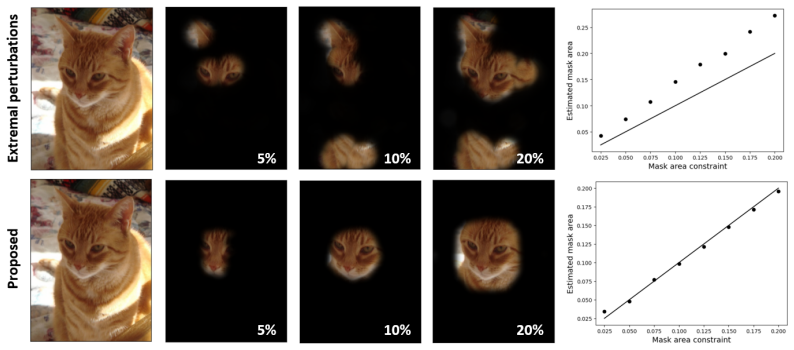
The central discovery is that a mask over the input image can be represented as an implicit function of pixel coordinates and an area. A multilayer perceptron with Fourier feature encoding takes $(x, a)$ and outputs a scalar mask value, which is then smoothed; during training $a$ is sampled uniformly, so the result is a continuum of masks rather than a set of discrete solutions. The same implicit function, retrained with a soft Dice penalty against previous masks, yields non-overlapping explanations. On ImageNet-S the method reaches a mean precision of 0.68 and a hit rate of 0.73; on PASCAL VOC it is statistically tied with extremal perturbations, and the iterative procedure shows that later masks drift outside the object while the best of the first three iterations reaches 0.73 precision.
Load-bearing premise
The method's claimed advantage depends on a single INR, trained with area values sampled uniformly, generalizing smoothly and monotonically between those values; if the network merely memorizes the sampled areas, the masks will not be well-behaved for unseen area queries.
Editorial extensions
If this is right
- A single trained INR per image can be queried at any mask area without retraining, making area sweeps and interactive explanation tools practical.
- The iterative Dice-loss procedure provides a concrete way to surface contextual biases: masks outside the reference segmentation reveal what scene elements, such as sky and water for boats, the classifier uses.
- Reported ImageNet-S precision of 0.68 and a combined first-three-iterations maximum of 0.73 suggest the method can recover the object region while also mapping the object's surroundings.
- Because the same network architecture handles both single and multiple masks by changing only the loss, the approach slots into existing INR toolchains for joint tasks like segmentation.
Reading between the lines
- Beyond the paper's experiments, the area-conditioned INR could power a real-time 'explanation slider' for debugging interfaces, since the same weights answer arbitrary area queries without re-optimization.
- The non-overlap mechanism could be turned into a quantitative bias score by measuring how much of each successive mask falls outside the reference segmentation, giving a per-class context-dependence measure.
- If the continuity claim holds at higher resolutions, combining the INR with a learned initialization could bring per-case training time down enough for clinical or interactive use.
- The same mask representation already uses a segmentation-style Dice loss, so attribution and semantic segmentation could plausibly be optimized jointly in one implicit network.
Editorial analysis
A structured set of objections, weighed in public.
Referee Report
Summary. The manuscript proposes using implicit neural representations (INRs) to generate attribution masks for deep image classifiers. The first contribution reformulates extremal perturbations: a coordinate-based MLP, conditioned on an area parameter a uniformly sampled from [0,1], is trained against the post-softmax probability with an area-sorting regularizer (Eqs. 2–4), yielding masks that the authors claim are smooth and continuous in a. The second contribution is an iterative procedure that adds a Dice-based penalty to the loss (Eq. 6) to generate multiple non-overlapping attribution masks for the same image (Algorithm 1). Experiments use pretrained ResNet50 models on 752 ImageNet-S validation images and 2230 PASCAL VOC 2007 test images; the method is compared with extremal perturbations, RISE, and GradCAM using precision and hit rate. The reported numbers are a mean precision of 0.68 on ImageNet (vs. 0.63 for extremal perturbations) and 0.44 on VOC (vs. 0.46, asserted not statistically significant), with successive explanations on ImageNet degrading in precision from 0.68 to 0.30.
Significance. If the empirical claims are substantiated, the paper would make a useful contribution to explainable AI: a single INR conditioned on an area parameter is a practical way to query attribution masks at arbitrary areas without retraining, and the iterative non-overlap procedure can reveal that a classifier uses contextual regions (e.g., water and sky for 'boat') rather than only the object itself. The authors release code and evaluate on two datasets with a standard pretrained architecture, which is commendable. The main weaknesses are that the paper's headline advantage—area-continuity and monotonicity—is not measured quantitatively, and the statistical reporting is incomplete (no variances despite five training runs per image, and an unspecified t-test). These gaps are load-bearing for the central claims, but they are addressable with additional analysis rather than being fundamental flaws.
major comments (3)
- [Abstract, Section 4.1, Section 3.4] The abstract and Section 1 advertise 'well-behaved' attribution masks with respect to the area constraint, and Section 4.1 claims 'better monotonic correspondence between the area constraint and the actual calculated mask area.' This is a principal claimed advantage over extremal perturbations, yet the training procedure in Section 3.4 supervises each sampled area independently through Eq. (2) and Eq. (3); nothing in the loss explicitly enforces continuity or monotonicity across neighboring area values. Figure 1 is qualitative, and Section 4.1 reports no quantitative metric for continuity or monotonicity. Since the evaluation only uses a in {0.025, 0.05, 0.1, 0.2}, the behavior at interpolated areas is not demonstrated. Please define and report a quantitative measure, for example the mean absolute deviation of the computed mask area from the target a, or the average per-pixel overlap between masks at adjacent area values, including areas not used in the evaluation; alternatively, temper the continuity claims to what the experiments actually support.
- [Section 3.3.1, Table 1] The text states that the implicit network was trained five times per input image to evaluate variability with respect to weight initialization, but Table 1 reports only mean precision and hit rate values, with no standard deviations, confidence intervals, or per-image distributions. The claim that the VOC difference between the proposed method (0.44) and extremal perturbations (0.46) is 'not statistically significant' cannot be checked without these details, and the t-test setup (paired or unpaired, per-image or per-mask, correction for multiple comparisons) is not described. Please report variance statistics and a precise statistical protocol, or move the significance statement to results that include them.
- [Algorithm 1, line 2] In Algorithm 1, the baseline mask is computed as M^b = sum_{i=0}^n M_i before M_n has been generated; for n=1 this includes the undefined mask M_1. This contradicts the accompanying text, which says previously computed masks are combined, and an implementation following the pseudocode literally would not impose the intended non-overlap penalty. The sum should run over i=0,...,n-1 (or, equivalently, over the masks output before iteration n). This is a small but load-bearing correction for the reproducibility of the multiple-explanation method.
minor comments (5)
- [Section 3.1] The notation 'x ∈ R2 → [0,1]^2' is garbled; it should state that pixel coordinates are x ∈ [0,1]^2 (after normalization).
- [Equation (4)] The network is defined as f_l(x,c) with a conditioning variable c, but the surrounding text only introduces the coordinates x and the area parameter a; please define c or replace it with a consistently.
- [Section 3.4] The binarization procedure is specified only for GradCAM and RISE saliency maps. Since the precision metric in Eq. (7) applies to binary masks, the authors should state explicitly how the soft masks produced by the proposed method and by extremal perturbations are converted to binary masks (e.g., threshold at 0.5 or another value).
- [Table 2] The 'Combination, max' row is ambiguous: it should state that the maximum precision is taken over the three iterations for each image and then averaged across images, rather than being a single global maximum.
- [Section 4.1] The phrase 'actual calculated mask area' is not defined. It should be clarified whether this is the sum of soft mask values, the area after binarization at a fixed threshold, or another quantity.
Circularity Check
No circularity: the attribution masks are optimized against the explained model and evaluated against external segmentations, so the central claims are not equivalent to their inputs.
full rationale
The paper's derivation chain is self-contained. Masks are obtained by optimizing the post-softmax probability of the explained model under the area regularization of Eq. (2)-(3), and the evaluated quantities (precision against ImageNet-S segmentations and PASCAL VOC bounding boxes, hit rates, iteration-wise precision) are external benchmarks, not quantities fitted into the method. The area-conditioned INR is trained with a uniformly sampled area parameter and evaluated at fixed areas {0.025, 0.05, 0.1, 0.2}; the claimed smoothness and monotonicity are empirical properties of the learned mapping, not identities enforced by the loss. The only author self-citation ([5]) concerns a prior INR application to gene-expression images and is not load-bearing for the attribution claims. The paper honestly lists limitations, including that the explaining network is itself a black box and that convergence may be harder at high resolution; these are evidence-quality caveats, not circular steps. The skeptics' concern that area-continuity is only shown qualitatively is a missing-evidence issue rather than a circularity issue: no equation or fitted parameter is reused to define the evaluated result. The off-by-one point in Algorithm 1 line 2 is a pseudocode correctness concern, not a circular-derivation concern.
Assumptions & free parameters
free parameters (4)
- lambda_r =
1
- lambda_d =
1
- Fourier encoding configuration =
6 frequencies, 128 components
- Baseline binarization thresholds =
0.2 (ImageNet), 0.5 (PASCAL VOC)
assumptions (4)
- domain assumption Gradient-based training of Eq. 2 converges to a locally meaningful attribution mask for each area parameter.
- domain assumption The Gaussian-blur perturbation I' and the RBF filter preserve the model's decision semantics, so preserving the output probability while removing other information isolates true causes.
- ad hoc to paper A single INR with the area parameter as conditioning can represent a family of masks across a in [0,1] with smooth interpolation.
- standard math The soft Dice loss L_dice approximates zero overlap when masks are disjoint and one when identical, making non-overlap optimization tractable.
Cite this review
Pith. "Pith review of Generating visual explanations from deep networks using implicit neural representations." pith.science (2026). https://pith.science/paper/KJ4B4AN6
@misc{pith2026250111784,
  author       = {Pith},
  title        = {Pith review of: Generating visual explanations from deep networks using implicit neural representations},
  year         = {2026},
  howpublished = {\url{https://pith.science/paper/KJ4B4AN6}},
  note         = {Machine review of arXiv:2501.11784}
}
read the original abstract
Explaining deep learning models in a way that humans can easily understand is essential for responsible artificial intelligence applications. Attribution methods constitute an important area of explainable deep learning. The attribution problem involves finding parts of the network's input that are the most responsible for the model's output. In this work, we demonstrate that implicit neural representations (INRs) constitute a good framework for generating visual explanations. Firstly, we utilize coordinate-based implicit networks to reformulate and extend the extremal perturbations technique and generate attribution masks. Experimental results confirm the usefulness of our method. For instance, by proper conditioning of the implicit network, we obtain attribution masks that are well-behaved with respect to the imposed area constraints. Secondly, we present an iterative INR-based method that can be used to generate multiple non-overlapping attribution masks for the same image. We depict that a deep learning model may associate the image label with both the appearance of the object of interest as well as with areas and textures usually accompanying the object. Our study demonstrates that implicit networks are well-suited for the generation of attribution masks and can provide interesting insights about the performance of deep learning models.
Figures


Figures from the paper (3 more)


Reference graph
Works this paper leans on
-
[1]
Going off-grid: continuous implicit neural representations for 3d vascular modeling
Dieuwertje Alblas, Christoph Brune, Kak Khee Yeung, and Jelmer M Wolterink. Going off-grid: continuous implicit neural representations for 3d vascular modeling. In Inter- national Workshop on Statistical Atlases and Computational Models of the Heart, pages 79–90. Springer, 2022. 3
work page 2022
-
[2]
Sajid Ali, Tamer Abuhmed, Shaker El-Sappagh, Khan Muhammad, Jose M Alonso-Moral, Roberto Confalonieri, Riccardo Guidotti, Javier Del Ser, Natalia Díaz-Rodríguez, and Francisco Herrera. Explainable artificial intelligence (xai): What we know and what is left to attain trustworthy artificial intelligence. Information fusion, 99:101805, 2023. 2
work page 2023
-
[3]
Sebastian Bach, Alexander Binder, Grégoire Montavon, Frederick Klauschen, Klaus-Robert Müller, and Wojciech Samek. On pixel-wise explanations for non-linear classi- fier decisions by layer-wise relevance propagation.PloS one, 10(7):e0130140, 2015. 3
work page 2015
-
[4]
Seeing implicit neural representations as fourier series
Nuri Benbarka, Timon Höfer, Andreas Zell, et al. Seeing implicit neural representations as fourier series. In Proceed- ings of the IEEE/CVF Winter Conference on Applications of Computer Vision, pages 2041–2050, 2022. 3
work page 2022
-
[5]
Michal Byra, Charissa Poon, Tomomi Shimogori, and Hen- rik Skibbe. Implicit neural representations for joint decom- position and registration of gene expression images in the marmoset brain. In International Conference on Medical Im- age Computing and Computer-Assisted Intervention , pages 645–654. Springer, 2023. 3
work page 2023
-
[6]
Grad-cam++: General- ized gradient-based visual explanations for deep convolu- tional networks
Aditya Chattopadhay, Anirban Sarkar, Prantik Howlader, and Vineeth N Balasubramanian. Grad-cam++: General- ized gradient-based visual explanations for deep convolu- tional networks. In 2018 IEEE winter conference on appli- cations of computer vision (WACV) , pages 839–847. IEEE,
2018
-
[7]
Real time image saliency for black box classifiers
Piotr Dabkowski and Yarin Gal. Real time image saliency for black box classifiers. Advances in neural information processing systems, 30, 2017. 2
work page 2017
-
[8]
The pascal visual object classes challenge: A retrospective
Mark Everingham, SM Ali Eslami, Luc Van Gool, Christo- pher KI Williams, John Winn, and Andrew Zisserman. The pascal visual object classes challenge: A retrospective. In- ternational journal of computer vision , 111:98–136, 2015. 5
work page 2015
Show all 46 references
-
[9]
Unified implicit neural styliza- tion
Zhiwen Fan, Yifan Jiang, Peihao Wang, Xinyu Gong, Dejia Xu, and Zhangyang Wang. Unified implicit neural styliza- tion. In European Conference on Computer Vision , pages 636–654. Springer, 2022. 3
2022
-
[10]
Un- derstanding deep networks via extremal perturbations and smooth masks
Ruth Fong, Mandela Patrick, and Andrea Vedaldi. Un- derstanding deep networks via extremal perturbations and smooth masks. In Proceedings of the IEEE/CVF interna- tional conference on computer vision , pages 2950–2958,
-
[11]
Interpretable explana- tions of black boxes by meaningful perturbation
Ruth C Fong and Andrea Vedaldi. Interpretable explana- tions of black boxes by meaningful perturbation. In Pro- ceedings of the IEEE international conference on computer vision, pages 3429–3437, 2017. 2
2017
-
[12]
Large-scale unsu- pervised semantic segmentation
Shanghua Gao, Zhong-Yu Li, Ming-Hsuan Yang, Ming- Ming Cheng, Junwei Han, and Philip Torr. Large-scale unsu- pervised semantic segmentation. IEEE transactions on pat- tern analysis and machine intelligence, 2022. 5
2022
-
[13]
Neu- ral tangent kernel: Convergence and generalization in neural networks
Arthur Jacot, Franck Gabriel, and Clément Hongler. Neu- ral tangent kernel: Convergence and generalization in neural networks. Advances in neural information processing sys- tems, 31, 2018. 3
2018
-
[14]
Cameras: Enhanced reso- lution and sanity preserving class activation mapping for im- age saliency
Mohammad AAK Jalwana, Naveed Akhtar, Mohammed Bennamoun, and Ajmal Mian. Cameras: Enhanced reso- lution and sanity preserving class activation mapping for im- age saliency. In Proceedings of the IEEE/CVF Conference on Computer Vision and Pattern Recognition, pages 16327– 16336...
2021
-
[15]
Adam: A method for stochastic optimization
Diederik P Kingma and Jimmy Ba. Adam: A method for stochastic optimization. arXiv preprint arXiv:1412.6980 ,
-
[16]
Nerf: Representing scenes as neural radiance fields for view syn- thesis
Ben Mildenhall, Pratul P Srinivasan, Matthew Tancik, Jonathan T Barron, Ravi Ramamoorthi, and Ren Ng. Nerf: Representing scenes as neural radiance fields for view syn- thesis. Communications of the ACM , 65(1):99–106, 2021. 3
2021
-
[17]
V-net: Fully convolutional neural networks for volumetric medical image segmentation
Fausto Milletari, Nassir Navab, and Seyed-Ahmad Ahmadi. V-net: Fully convolutional neural networks for volumetric medical image segmentation. In 2016 fourth international conference on 3D vision (3DV), pages 565–571. IEEE, 2016. 5
2016
-
[18]
Implicit neural representation in medical imaging: A comparative survey
Amirali Molaei, Amirhossein Aminimehr, Armin Tavakoli, Amirhossein Kazerouni, Bobby Azad, Reza Azad, and Dorit Merhof. Implicit neural representation in medical imaging: A comparative survey. In Proceedings of the IEEE/CVF International Conference on Computer Vision, pages 238...
2023
-
[19]
Neural image representations for multi-image fusion and layer separation
Seonghyeon Nam, Marcus A Brubaker, and Michael S Brown. Neural image representations for multi-image fusion and layer separation. In European conference on computer vision, pages 216–232. Springer, 2022. 2
2022
-
[20]
Deepsdf: Learning con- tinuous signed distance functions for shape representation
Jeong Joon Park, Peter Florence, Julian Straub, Richard Newcombe, and Steven Lovegrove. Deepsdf: Learning con- tinuous signed distance functions for shape representation. In Proceedings of the IEEE/CVF conference on computer vi- sion and pattern recognition, pages 165–174, 2019. 2
2019
-
[21]
Pytorch: An imperative style, high-performance deep learning library
Adam Paszke, Sam Gross, Francisco Massa, Adam Lerer, James Bradbury, Gregory Chanan, Trevor Killeen, Zem- ing Lin, Natalia Gimelshein, Luca Antiga, Alban Desmai- son, Andreas Kopf, Edward Yang, Zachary DeVito, Mar- tin Raison, Alykhan Tejani, Sasank Chilamkurthy, Benoit Steine...
2019
-
[22]
Rise: Random- ized input sampling for explanation of black-box models
Vitali Petsiuk, Abir Das, and Kate Saenko. Rise: Random- ized input sampling for explanation of black-box models. In Proceedings of the British Machine Vision Conference (BMVC), 2018. 2, 5
2018
-
[23]
H2o: Heatmap by hierarchical occlusion
Luc-Etienne Pommé, Romain Bourqui, and Romain Giot. H2o: Heatmap by hierarchical occlusion. In Proceedings of the 20th International Conference on Content-based Mul- timedia Indexing, pages 111–118, 2023. 1, 4
2023
-
[24]
Ablation-cam: Visual explanations for deep convolutional network via gradient- free localization
Harish Guruprasad Ramaswamy et al. Ablation-cam: Visual explanations for deep convolutional network via gradient- free localization. In proceedings of the IEEE/CVF winter conference on applications of computer vision , pages 983– 991, 2020. 2
2020
-
[25]
A systematic review of ex- plainable artificial intelligence models and applications: Re- cent developments and future trends
A Saranya and R Subhashini. A systematic review of ex- plainable artificial intelligence models and applications: Re- cent developments and future trends. Decision analytics journal, page 100230, 2023. 2
2023
-
[26]
Grad-cam: Visual explanations from deep networks via gradient-based localization
Ramprasaath R Selvaraju, Michael Cogswell, Abhishek Das, Ramakrishna Vedantam, Devi Parikh, and Dhruv Batra. Grad-cam: Visual explanations from deep networks via gradient-based localization. In Proceedings of the IEEE in- ternational conference on computer vision , pages 618–626,
-
[27]
One explanation is not enough: structured attention graphs for image classification.Advances in Neural Information Processing Systems, 34:11352–11363, 2021
Vivswan Shitole, Fuxin Li, Minsuk Kahng, Prasad Tadepalli, and Alan Fern. One explanation is not enough: structured attention graphs for image classification.Advances in Neural Information Processing Systems, 34:11352–11363, 2021. 1, 4
2021
-
[28]
Deep inside convolutional networks: Visualising image classification models and saliency maps
Karen Simonyan, Andrea Vedaldi, and Andrew Zisserman. Deep inside convolutional networks: Visualising image classification models and saliency maps. arXiv preprint arXiv:1312.6034, 2013. 2
2013 arXiv
-
[29]
Poly- nomial implicit neural representations for large diverse datasets
Rajhans Singh, Ankita Shukla, and Pavan Turaga. Poly- nomial implicit neural representations for large diverse datasets. In Proceedings of the IEEE/CVF Conference on Computer Vision and Pattern Recognition , pages 2041– 2051, 2023. 3
2023
-
[30]
Metasdf: Meta-learning signed distance functions
Vincent Sitzmann, Eric Chan, Richard Tucker, Noah Snavely, and Gordon Wetzstein. Metasdf: Meta-learning signed distance functions. Advances in Neural Information Processing Systems, 33:10136–10147, 2020. 8
2020
-
[31]
Implicit neural representa- tions with periodic activation functions
Vincent Sitzmann, Julien Martel, Alexander Bergman, David Lindell, and Gordon Wetzstein. Implicit neural representa- tions with periodic activation functions. Advances in neural information processing systems, 33:7462–7473, 2020. 2, 3
2020
-
[32]
Smoothgrad: removing noise by adding noise
Daniel Smilkov, Nikhil Thorat, Been Kim, Fernanda Viégas, and Martin Wattenberg. Smoothgrad: removing noise by adding noise. arXiv preprint arXiv:1706.03825, 2017. 3
2017 arXiv
-
[33]
Striving for simplicity: The all convolutional net
Jost Tobias Springenberg, Alexey Dosovitskiy, Thomas Brox, and Martin Riedmiller. Striving for simplicity: The all convolutional net. arXiv preprint arXiv:1412.6806, 2014. 3
2014 arXiv
-
[34]
Nisf: Neural implicit segmen- tation functions
Nil Stolt-Ansó, Julian McGinnis, Jiazhen Pan, Kerstin Ham- mernik, and Daniel Rueckert. Nisf: Neural implicit segmen- tation functions. In International Conference on Medical Im- age Computing and Computer-Assisted Intervention , pages 734–744. Springer, 2023. 3
2023
-
[35]
Ground truth based comparison of saliency maps algorithms
Karolina Szczepankiewicz, Adam Popowicz, Kamil Charkiewicz, Katarzyna Nał˛ ecz-Charkiewicz, Michał Szczepankiewicz, Sławomir Lasota, Paweł Zawistowski, and Krystian Radlak. Ground truth based comparison of saliency maps algorithms. Scientific Reports, 13(1):16887,
-
[36]
Learned initializations for optimizing coordinate-based neural representations
Matthew Tancik, Ben Mildenhall, Terrance Wang, Divi Schmidt, Pratul P Srinivasan, Jonathan T Barron, and Ren Ng. Learned initializations for optimizing coordinate-based neural representations. In Proceedings of the IEEE/CVF Conference on Computer Vision and Pattern Recognition...
2021
-
[37]
Fourier features let networks learn high frequency functions in low dimen- sional domains
Matthew Tancik, Pratul Srinivasan, Ben Mildenhall, Sara Fridovich-Keil, Nithin Raghavan, Utkarsh Singhal, Ravi Ra- mamoorthi, Jonathan Barron, and Ren Ng. Fourier features let networks learn high frequency functions in low dimen- sional domains. Advances in Neural Information ...
2020
-
[38]
A survey on explainable artificial intelligence (xai): Toward medical xai
Erico Tjoa and Cuntai Guan. A survey on explainable artificial intelligence (xai): Toward medical xai. IEEE transactions on neural networks and learning systems , 32(11):4793–4813, 2020. 1
2020
-
[39]
Score-cam: Score-weighted visual explanations for convolutional neural networks
Haofan Wang, Zifan Wang, Mengnan Du, Fan Yang, Zijian Zhang, Sirui Ding, Piotr Mardziel, and Xia Hu. Score-cam: Score-weighted visual explanations for convolutional neural networks. In Proceedings of the IEEE/CVF conference on computer vision and pattern recognition workshops ...
2020
-
[40]
Implicit neural representations for deformable image registration
Jelmer M Wolterink, Jesse C Zwienenberg, and Christoph Brune. Implicit neural representations for deformable image registration. In International Conference on Medical Imag- ing with Deep Learning, pages 1349–1359. PMLR, 2022. 3
2022
-
[41]
Neural fields in visual computing and beyond
Yiheng Xie, Towaki Takikawa, Shunsuke Saito, Or Litany, Shiqin Yan, Numair Khan, Federico Tombari, James Tomp- kin, Vincent Sitzmann, and Srinath Sridhar. Neural fields in visual computing and beyond. InComputer Graphics Forum, volume 41, pages 641–676. Wiley Online Library, 2022. 3
2022
-
[42]
Signal processing for implicit neural rep- resentations
Dejia Xu, Peihao Wang, Yifan Jiang, Zhiwen Fan, and Zhangyang Wang. Signal processing for implicit neural rep- resentations. Advances in Neural Information Processing Systems, 35:13404–13418, 2022. 3
2022
-
[43]
Geometry processing with neural fields
Guandao Yang, Serge Belongie, Bharath Hariharan, and Vladlen Koltun. Geometry processing with neural fields. Advances in Neural Information Processing Systems, 34:22483–22497, 2021. 3
2021
-
[44]
A structured dictionary perspective on implicit neural representations
Gizem Yüce, Guillermo Ortiz-Jiménez, Beril Besbinar, and Pascal Frossard. A structured dictionary perspective on implicit neural representations. In Proceedings of the IEEE/CVF Conference on Computer Vision and Pattern Recognition, pages 19228–19238, 2022. 3
2022
-
[45]
Opti-cam: Optimizing saliency maps for interpretability
Hanwei Zhang, Felipe Torres, Ronan Sicre, Yannis Avrithis, and Stephane Ayache. Opti-cam: Optimizing saliency maps for interpretability. arXiv preprint arXiv:2301.07002, 2023. 2
2023 arXiv
-
[46]
Learning deep features for discrimina- tive localization
Bolei Zhou, Aditya Khosla, Agata Lapedriza, Aude Oliva, and Antonio Torralba. Learning deep features for discrimina- tive localization. In Proceedings of the IEEE conference on computer vision and pattern recognition, pages 2921–2929,
Reviewed August 10, 2026 · model on record in the stance chip above.
Discussion (0). Continue with ORCID to comment.