REVIEW 4 major objections 5 minor 85 references
Large Amplitude Oscillatory Extension (LAOE) of dilute polymer solutions
T0 review · 4 major / 5 minor · reviewed 2026-08-10 · deepseek-v4-flash
Pith's one-line read Dilute polymer solutions under oscillatory stretching show a sharp transition to nonlinearity, and this paper reports the first experimental stress measurements of that transition.
desk verdict A genuinely useful new experimental platform for LAOE of dilute polymer solutions, with a solid qualitative core but a quantitative onset law that is fit, not prediction, and an excess-pressure interpretation that outruns the homogeneity evidence. read the letter →
The pith
A machine-rendered reading of the paper's core claim, the machinery that carries it, and where it could break.
The reading
What carries the argument
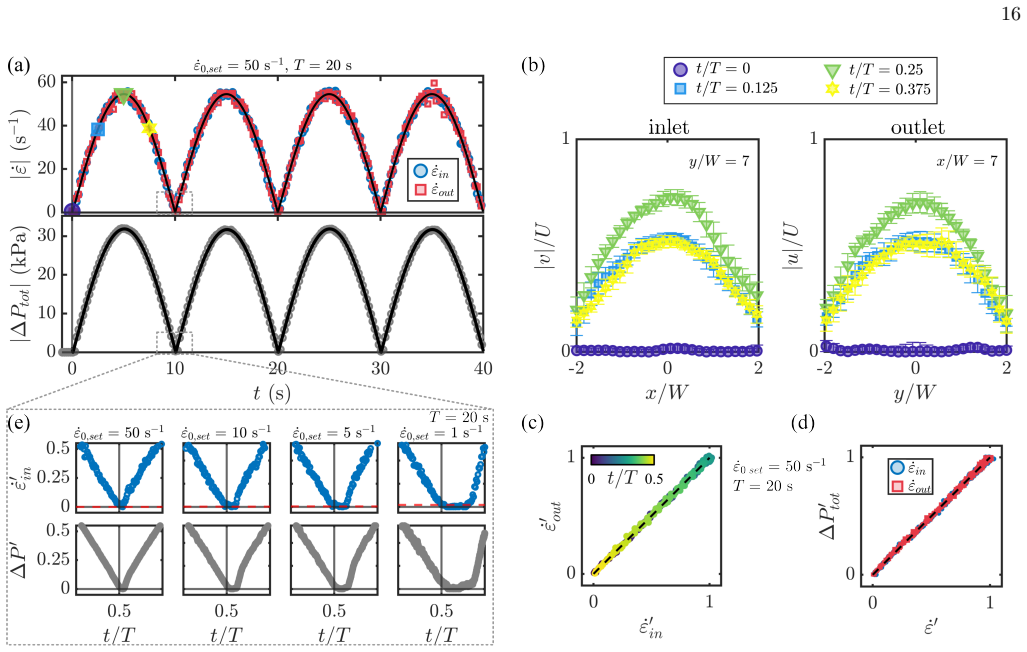
The load-bearing element is the optimized shape cross-slot extensional rheometer (OSCER), a microfluidic device producing a nearly homogeneous planar extensional flow at a stagnation point. The measured total and shear pressure drops are combined into an excess pressure drop $\Delta P_{\rm ex} = \Delta P_{\rm tot} - \Delta P_{\rm sh}$, which is treated as a proxy for the first normal stress difference $N_1$ of the homogeneous extensional flow. The onset of nonlinearity is organized by the effective Weissenberg number $Wi_{\rm eff} = Wi_{\max}/(k\,De+1)$ with $k=3$, and by the strain-hardening index $I = 1 - \dot{\varepsilon}'_{\rm out}/\dot{\varepsilon}'_{\rm in}$, which is zero for a Newtonian fluid and positive when the extension axis strain rate lags the compression axis. These quantities are compared against FENE-P and Giesekus constitutive models.
What would settle it
A spatial simulation of the real device geometry that fails to reproduce the measured pressure drop, or a local stress measurement showing the velocity distortion changes the excess pressure by more than the noise, would falsify the homogeneous-flow interpretation.
Extended reading notes
Core claim
The central claim is that dilute polymer solutions under large amplitude oscillatory extension show a well-defined transition from linear to nonlinear response, and the paper provides the first experimental measurement of the associated stress response. Above a critical Weissenberg number $Wi_c \approx 1$, the average strain rate along the stretching axis falls below that along the compression axis, an effect quantified by a strain-hardening index, and the excess pressure drop develops characteristic Lissajous curves. The critical onset across frequencies obeys $Wi_c^{\rm LAOE} = Wi_c(k\,De+1)$ with $k = 3$, showing that more rapid oscillation delays the onset to higher flow strengths. Numerical solutions of the FENE-P and Giesekus models under a homogeneous planar extensional flow reproduce the qualitative shape and cycle-dependence of the measured stress response, with the Giesekus model capturing the full concave-to-linear-to-convex transition in the Lissajous curves.
Load-bearing premise
The load-bearing premise is that the measured excess pressure drop faithfully represents the elastic stress of a simple uniform stretching flow, even though the polymer's own stretching visibly distorts the flow.
Editorial extensions
If this is right
- If the excess pressure drop indeed tracks the first normal stress difference, LAOE in the OSCER gives a quantitative, time-resolved measure of extensional stress in dilute polymer solutions, a quantity previously accessible only under steady or uniaxial conditions.
- The critical condition $Wi_c^{\rm LAOE} = Wi_c(k\,De+1)$ with $k=3$ provides a predictive rule for when a given polymer solution will show nonlinear extensional response at a given oscillation frequency.
- Pulsatile and oscillatory driving produce equivalent Lissajous curves at matching $De$ and $Wi_{\max}$, so the experimentally simpler pulsatile mode can be used to study the nonlinear stress response.
- The comparison of FENE-P and Giesekus shows the latter captures the full shape transition of the Lissajous curves, offering an experimental fingerprint for distinguishing constitutive models under oscillatory extension.
- The method's demonstrated linearity for Newtonian fluids across amplitudes and frequencies validates the microfluidic platform as a controlled nonlinear rheometer for low-viscosity fluids.
Reading between the lines
- If the effective-Weissenberg collapse is universal rather than specific to this PAA system, the same $k \approx 3$ might appear for other dilute polymer solutions; a test across different molecular weights and concentrations would show whether $k$ depends on extensibility $L$.
- The measured onset corresponds to accumulated strains of $\varepsilon_c \approx 2$-$6$, which brackets the coil-stretch transition of long chains; combining LAOE with single-molecule DNA imaging in the same geometry could directly connect the bulk stress proxy to molecular extension.
- The homogeneous-flow assumption in the simulations is put in question by the visible modification of the outlet velocity profile; a fully spatial CFD simulation of the same OSCER geometry could determine whether the quantitative agreement in Sec. III F is fortuitous.
- Because the excess pressure drop is a proxy for $N_1$, converting it to a stress-versus-strain curve (rather than stress-versus-strain-rate) and integrating over a cycle would yield a measure of dissipated energy in oscillatory extension, analogous to LAOS.
Editorial analysis
A structured set of objections, weighed in public.
Referee Report
Summary. This manuscript reports an experimental protocol for large-amplitude oscillatory extension (LAOE) of dilute polyacrylamide solutions in an optimized cross-slot microfluidic rheometer (OSCER). The authors impose pulsatile and oscillatory sinusoidal flow with programmable syringe pumps, measure the velocity field by micro-PIV and simultaneous pressure drops, and analyze normalized Lissajous curves of inlet/outlet strain rates and excess pressure drop. Newtonian controls remain linear, whereas the polymer solutions show the outlet strain rate falling below the inlet strain rate and an excess pressure drop arising once the temporal Weissenberg number exceeds about unity; an empirical onset criterion WicLAOE = Wic(k De + 1) with k = 3 is proposed. Homogeneous-flow FENE-P and Giesekus simulations are compared with the normalized excess pressure data.
Significance. The experimental core—Newtonian linearity, concentration-dependent deviation of the outlet strain rate, emergence of excess pressure near Wi approximately 1, and systematic dependence on De and Wimax—is well documented and constitutes a useful advance for probing extensional rheology under transient flow. Strengths include the use of PIV-measured rather than set strain rates, the broad parameter sweep, the comparison of pulsatile and oscillatory modes, the explicit frequency-response characterization of the pumping system, and the inclusion of the full ODE system in Appendix A. However, the manuscript's headline claim of a first quantitative measurement of the stress response under LAOE is not secured: the excess pressure is not demonstrated to equal the first normal stress difference of a homogeneous flow, and the central onset law contains a fitted constant. With re-scoping and additional validation, the approach could become a valuable tool for the community.
major comments (4)
- [Sec. II E and Sec. III F] The identification of the excess pressure drop ΔPex = ΔPtot − ΔPsh with the first normal stress difference N1 of a homogeneous planar extensional flow is load-bearing and is not supported by the data. In the very regime where ΔPex is significant, the PIV measurements show a flattening and eventually a local minimum of the outlet velocity profile (Figs. 4d, 6b, 10b), so the flow is not the homogeneous planar extension of Eq. (4). The comparison in Fig. 15 is made with normalized N1 and normalized ΔPex, so only the shape and phase of the signals are compared; no absolute stress values or extensional viscosities are reported. The authors should either provide absolute excess pressure data converted to stress through a validated relation, perform full CFD simulations that include the flow modification, or re-scope the claims to 'excess pressure drop' rather than 'stress response'.
- [Sec. III E, Eq. (5) and Fig. 14] The criterion WicLAOE = Wic(k De + 1) with k = 3 is not a prediction but a fit: the same onset data used to draw the red line in Fig. 14 are used to determine k, and the shaded region 1 ≤ k ≤ 5 shows a large uncertainty at larger De. The manuscript should state explicitly that this is an empirical fit, give the uncertainty in k, and ideally validate the scaling on an independent data subset or against a constitutive model before presenting it as a critical condition.
- [Sec. II E] The subtraction procedure assumes that the shear-dominated pressure drop ΔPsh measured with flow in only two channels (around a corner) equals the shear and entrance contribution in the four-channel flow used for ΔPtot. This equality is plausible for Newtonian fluids but not guaranteed for viscoelastic solutions, because polymer stretch history and stress distribution differ between the two configurations. The authors should justify this assumption, for example by testing whether ΔPex is zero at Wi < 1 in the polymer solutions or by estimating the magnitude of the configuration-dependent error.
- [Sec. II H and Sec. III F] The comparison with FENE-P and Giesekus models is under-constrained. The manuscript does not report the solvent viscosity ratio β used in Eq. (3), nor does it report absolute model predictions; the normalization Δσ′ = N1/N1,max removes any magnitude information. Consequently the agreement in Fig. 15 does not validate the microfluidic measurement quantitatively. Please report the model parameters and the absolute predicted and measured pressure or stress levels, or soften the conclusion that the simulations validate the experimental approach.
minor comments (5)
- [Fig. 2(b) caption] The phrase 'Qf lowflow' appears to be a typo for 'Qflow' or 'Qflow directions'.
- [References] References [23] and [25] are duplicates of the same paper by Rogers (2012); one of them should be removed.
- [Sec. III C 1] The text contains 'oscillatory LOAE', which should read 'LAOE'.
- [Sec. II G] The normalization of pressure by its maximum value is not meaningful when the signal crosses zero, as ΔPex does in Figs. 8(a) and 12(a); the definition of ΔPex,max and the noise floor threshold should be stated explicitly.
- [Eq. (5) and surrounding text] There are spacing artifacts such as 'Wief f' and 'Wi LAOE c'; please fix the formatting throughout.
Circularity Check
No significant circularity: the effective-Weissenberg critical line is an explicitly labeled one-parameter fit, and the central stress comparisons use independent rheological inputs.
full rationale
The manuscript's claimed derivation chain is: (i) PIV measures inlet and outlet strain rates; (ii) excess pressure drop is defined as ΔPex = ΔPtot − ΔPsh from two pressure configurations; (iii) FENE-P and Giesekus ODEs (Eqs. 2–4 and Appendix A) are solved using λ from CaBER measurements and L=143 from prior work; (iv) the onset of nonlinearity is characterized by an effective Weissenberg number (Eq. 5). The only apparent fit-to-data issue is the constant k=3 in Wi_LAOE_c = Wic(k De + 1). The paper explicitly states 'The red line in Fig. 14 represents this relation, using a prefactor of k = 3, which provides a reasonable fit to the experimental data' and describes k as 'a prefactor, previously used to align data from Hookean dumbbell models and numerical simulations.' Thus the critical line is presented as an empirical fit, not as a first-principles prediction or as a test of an independently derived constant. The steady anchor Wic ≈ 1 (Fig. 4g) and the LAOE onset classifications (Figs. 6d, 10c, 14) are independent PIV measurements, so the scaling is a transparent collapse rather than a hidden reuse of the target data. The FENE-P/Giesekus comparison uses relaxation times measured by CaBER and extensibility from prior experimental characterizations (Refs. 48 and 49), which are external to the present fitted values; the authors also acknowledge that the model assumes homogeneous flow and does not capture the observed flow modification, which is a validity limitation rather than a circularity. Self-citations to the OSCER geometry and prior extensional rheometry are background methodology, not a load-bearing uniqueness argument. No step reduces by construction to its own input.
Assumptions & free parameters
free parameters (2)
- k =
3
- lambda_CaBER =
0.25, 0.34, 0.58 s (200, 400, 800 ppm PAA)
assumptions (6)
- domain assumption OSCER central region approximates homogeneous planar extensional flow
- domain assumption dPex = dPtot - dPsh isolates elongational stress
- domain assumption CaBER lambda is the single-mode relaxation time relevant for Wi and De
- domain assumption FENE-P and Giesekus describe the dilute PAA solutions
- standard math Incompressibility gives du/dx + dv/dy = 0
- ad hoc to paper Effective Weissenberg number form Wieff = Wimax/(k De + 1)
Cite this review
Pith. "Pith review of Large Amplitude Oscillatory Extension (LAOE) of dilute polymer solutions." pith.science (2026). https://pith.science/paper/DMTAVEF3
@misc{pith2026250111950,
  author       = {Pith},
  title        = {Pith review of: Large Amplitude Oscillatory Extension (LAOE) of dilute polymer solutions},
  year         = {2026},
  howpublished = {\url{https://pith.science/paper/DMTAVEF3}},
  note         = {Machine review of arXiv:2501.11950}
}
read the original abstract
This study presents an experimental framework for large amplitude oscillatory extension (LAOE) to investigate nonlinear material properties of complex fluids. Using a microfluidic optimized shape cross-slot extensional rheometer, we generate approximately homogeneous planar extensional flows driven by programmable syringe pumps operating in oscillatory or pulsatile sinusoidal modes. Micro-particle image velocimetry and simultaneous pressure drop measurements are employed to analyze the time-dependent flow field and elastic stress response. For Newtonian fluids, a linear relationship between the applied strain rate and pressure drop is observed across a wide range of oscillation amplitudes and frequencies. In contrast, dilute polymer solutions exhibit significant deviations, with excess pressure drops and divergence between average strain rates along extension and compression axes during the LAOE cycle. By spanning a broad range of Weissenberg and Deborah numbers, we identify unique Lissajous curves and critical conditions for the onset of nonlinearities under oscillatory extension. Numerical simulations, assuming homogeneous flow, underpin the experimental findings, validating the robustness of our microfluidic approach. This study demonstrates the utility of oscillatory extensional flows for probing the nonlinear rheological behavior of soft materials, offering quantitative insights into their extensional properties under nonlinear flow conditions.
Figures


Figures from the paper (12 more)




Reference graph
Works this paper leans on
-
[1]
Newtonian fluid Figure 9 summarizes the flow behavior of the New- tonian reference fluid under oscillatory LAOE. Similar to pulsatile LAOE, we observe ˙ εout(t) = − ˙εin(t) for the Newtonian fluid, with both strain rates and the pres- sure signal following the magnitude of the imposed si- nusoidal signal, as shown in Fig. 9(a). Throughout the cycle, the v...
-
[2]
Flow field characterization We proceed to exam- ine the flow field of the viscoelastic PAA solutions under pulsatile LAOE
Polymer solution a. Flow field characterization We proceed to exam- ine the flow field of the viscoelastic PAA solutions under pulsatile LAOE. Figure 6(a) shows a representative mea- surement of the modulus of the average extension rates ˙εin and ˙εout, as well as the total pressure drop ∆ Ptot for the 800 ppm PAA sample at ˙ ε0,set = 5 s−1 and T = 10 s (...
-
[3]
Polymer solution a. Flow field characterization Figure 10(a) presents a representative measurement of the average extension rates ˙εin and ˙εout along with the total pressure drop ∆Ptot for the 800 ppm PAA sample at ˙ ε0,set = 5 s−1 and T = 10 s over two oscillation cycles. Similar to the Newtonian case, we observe that both the inlet strain rate and the ...
-
[4]
J. D. Ferry, W. M. Sawyer, J. N. Ashworth, Behavior of concentrated polymer solutions under periodic stresses, Journal of Polymer Science 2 (6) (1947) 593–611. doi: https://doi.org/10.1002/pol.1947.120020604. URL https://onlinelibrary.wiley.com/doi/abs/10. 1002/pol.1947.120020604
-
[5]
J. D. Ferry, Viscoelastic Properties of Polymers, Vol. 264, Wiley, 1980
1980
-
[6]
R. B. Bird, R. C. Armstrong, O. Hassager, Dynamics of polymeric liquids. Vol. 1, 2nd Ed. : Fluid mechanics, Vol. 1, Wiley, 1987
1987
-
[7]
N. W. Tschoegl, The Phenomenological The- ory of Linear Viscoelastic Behavior, Springer Berlin Heidelberg, Berlin, Heidelberg, 1989. doi:10.1007/978-3-642-73602-5 . URL http://link.springer.com/10.1007/ 978-3-642-73602-5
-
[8]
W. P. Fletcher, A. N. Gent, Nonlinearity in the dy- namic properties of vulcanized rubber compounds, Rub- ber Chemistry and Technology 27 (1) (1954) 209–222. doi:10.5254/1.3543472. URL https://doi.org/10.5254/1.3543472
Show all 85 references
-
[9]
K. Hyun, S. H. Kim, K. H. Ahn, S. J. Lee, Large amplitude oscillatory shear as a way to classify the complex fluids, J. Nonnewton. Fluid Mech. 107 (1-3) (2002) 51–65. doi:10.1016/S0377-0257(02)00141-6 . URL https://linkinghub.elsevier.com/retrieve/ pii/S0377025702001416
2002 doi
-
[10]
Wilhelm, Fourier-Transform Rheology, Macro- mol
M. Wilhelm, Fourier-Transform Rheology, Macro- mol. Mater. Eng. 287 (2) (2002) 83–105. doi:10.1002/1439-2054(20020201)287:2<83:: AID-MAME83>3.0.CO;2-B . URL https://onlinelibrary.wiley.com/doi/ 10.1002/1439-2054(20020201)287:2{%}3C83:: AID-MAME83{%}3E3.0.CO;2-B
2002 doi
-
[11]
K. Hyun, M. Wilhelm, C. O. Klein, K. S. Cho, J. G. Nam, K. H. Ahn, S. J. Lee, R. H. Ewoldt, G. H. McKinley, A review of nonlinear oscillatory shear tests: Analysis and application of large amplitude oscillatory shear (LAOS), Prog. Polym. Sci. 36 (12) (2011) 1697–
2011
-
[12]
Jones, S
S. Jones, S. VandenHeuvel, A. Luengo Martinez, R. Birur, E. Burgeson, I. Gilbert, A. Baker, M. Wolf, S. A. Raghavan, S. Rogers, E. Cosgriff-Hernandez, Suspension electrospinning of decellularized extra- cellular matrix: A new method to preserve bioac- tivity, Bioact. Mater. 41...
2024 doi
-
[13]
Giacomin, R
A. Giacomin, R. Bird, L. Johnson, A. Mix, Large- amplitude oscillatory shear flow from the corotational Maxwell model, J. Nonnewton. Fluid Mech. 166 (19-20) (2011) 1081–1099. doi:10.1016/j.jnnfm.2011.04.002. URL http://dx.doi.org/10.1016/j.jnnfm.2011.04. 002
2011 doi
-
[14]
Kamkar, R
M. Kamkar, R. Salehiyan, T. B. Goudoulas, M. Abbasi, C. Saengow, E. Erfanian, S. Sadeghi, G. Natale, S. A. Rogers, A. J. Giacomin, U. Sundararaj, Large amplitude oscillatory shear flow: Microstructural assessment of polymeric systems, Prog. Polym. Sci. 132 (2022) 101580. doi:1...
2022
-
[15]
Y. Wang, C. Selomulya, Food rheology applications of large amplitude oscillation shear (LAOS), Trends Food Sci. Technol. 127 (May) (2022) 221–244. doi:10.1016/ j.tifs.2022.05.018. URL https://doi.org/10.1016/j.tifs.2022.05.018 25
2022 doi
-
[16]
Wilhelm, D
M. Wilhelm, D. Maring, H.-W. Spiess, Fourier- transform rheology, Rheol. Acta 37 (4) (1998) 399–405. doi:10.1007/s003970050126. URL http://link.springer.com/10.1007/ s003970050126
1998 doi
-
[17]
Armstrong, A
M. Armstrong, A. Pincot, S. Rogers, T. Knight, D. Bailey, Recent Advances in Biofluid Mechanics and Bio- and Hemorheology Collating Recent Advances in Predicting Complex Behavior of Human Blood With Thixo-Elasto-Visco-Plastic Models and Sequence of Physical Process, Front. Phy...
2022
-
[18]
Philippoff, Vibrational Measurements with Large Amplitudes, Trans
W. Philippoff, Vibrational Measurements with Large Amplitudes, Trans. Soc. Rheol. 10 (1) (1966) 317–334. doi:10.1122/1.549049. URL https://pubs.aip.org/ jor/article/10/1/317/417208/ Vibrational-Measurements-with-Large-Amplitudes
1966 doi
-
[19]
Harris, K
J. Harris, K. Bogie, The experimental analysis of non- linear waves in mechanical systems, Rheol. Acta 6 (1) (1967) 3–5. doi:10.1007/BF01968375. URL http://link.springer.com/10.1007/BF01968375
1967 doi
-
[20]
Klein, P
C. Klein, P. Venema, L. Sagis, E. van der Linden, Rheological discrimination and characterization of carrageenans and starches by Fourier transform- rheology in the non-linear viscous regime, J. Non- newton. Fluid Mech. 151 (1-3) (2008) 145–150. doi:10.1016/j.jnnfm.2008.01.001...
2008 doi
-
[21]
Wilhelm, P
M. Wilhelm, P. Reinheimer, M. Ortseifer, High sensi- tivity Fourier-transform rheology, Rheol. Acta 38 (4) (1999) 349–356. doi:10.1007/s003970050185. URL http://link.springer.com/10.1007/ s003970050185
1999 doi
-
[22]
K. S. Cho, K. Hyun, K. H. Ahn, S. J. Lee, A geomet- rical interpretation of large amplitude oscillatory shear response, J. Rheol. (N. Y. N. Y). 49 (3) (2005) 747–758. doi:10.1122/1.1895801. URL https://pubs.aip.org/sor/jor/article/49/3/ 747-758/239982
2005 doi
-
[23]
C. O. Klein, H. W. Spiess, A. Calin, C. Balan, M. Wil- helm, Separation of the Nonlinear Oscillatory Response into a Superposition of Linear, Strain Hardening, Strain Softening, and Wall Slip Response, Macromolecules 40 (12) (2007) 4250–4259. doi:10.1021/ma062441u. URL https:/...
2007 doi
-
[24]
S. A. Rogers, In search of physical meaning: defining transient parameters for nonlinear vis- coelasticity, Rheol. Acta 56 (5) (2017) 501–525. doi:10.1007/s00397-017-1008-1 . URL http://link.springer.com/10.1007/ s00397-017-1008-1
2017 doi
-
[25]
R. H. Ewoldt, A. E. Hosoi, G. H. McKinley, New mea- sures for characterizing nonlinear viscoelasticity in large amplitude oscillatory shear, J. Rheol. (N. Y. N. Y). 52 (6) (2008) 1427–1458. doi:10.1122/1.2970095. URL https://pubs.aip.org/sor/jor/article/52/6/ 1427-1458/240149
2008 doi
-
[26]
R. H. Ewoldt, Defining nonlinear rheological material functions for oscillatory shear, J. Rheol. (N. Y. N. Y). 57 (1) (2013) 177–195. doi:10.1122/1.4764498. URL https://pubs.aip.org/sor/jor/article/57/1/ 177-195/240953
2013 doi
-
[28]
Oswald, N
W. Oswald, N. Willenbacher, Controlling the elonga- tional flow behavior of complex shear-thinning fluids without affecting shear viscosity, Rheol. Acta 58 (10) (2019) 687–698. doi:10.1007/s00397-019-01170-y . URL http://link.springer.com/10.1007/ s00397-019-01170-y
2019 doi
-
[29]
S. A. Rogers, A sequence of physical processes deter- mined and quantified in LAOS: An instantaneous local 2D/3D approach, J. Rheol. (N. Y. N. Y). 56 (5) (2012) 1129–1151. doi:10.1122/1.4726083. URL https://pubs.aip.org/sor/jor/article/56/5/ 1129-1151/240871
2012 doi
-
[30]
J. Choi, F. Nettesheim, S. A. Rogers, The unification of disparate rheological measures in oscillatory shearing, Phys. Fluids 31 (7) (jul 2019). doi:10.1063/1.5106378. URL https://doi.org/10.1063/1.5106378
2019 doi
-
[31]
J. C.-W. Lee, K. M. Weigandt, E. G. Kelley, S. A. Rogers, Structure-Property Relationships via Recov- ery Rheology in Viscoelastic Materials, Phys. Rev. Lett. 122 (24) (2019) 248003. arXiv:1905.07849, doi:10.1103/PhysRevLett.122.248003. URL https://link.aps.org/doi/10.1103/ Ph...
2019 arXiv
-
[32]
Jiang, Modeling nonlinear viscoelastic behavior under large deformations, Rubber Chemistry and Technology 88 (1) (2015) 28–39
B. Jiang, Modeling nonlinear viscoelastic behavior under large deformations, Rubber Chemistry and Technology 88 (1) (2015) 28–39. doi:10.5254/rct.14.86927. URL https://doi.org/10.5254/rct.14.86927
2015 doi
-
[33]
M. S. Abdelgawad, S. J. Haward, A. Q. Shen, M. E. Rosti, From yield stress to elastic in- stabilities: tuning the extensional behavior of elastoviscoplastic fluids, PNAS Nexus (2024) 1– 10doi:10.1093/pnasnexus/pgae227/7688418. URL https://academic.oup.com/pnasnexus/ advance-ar...
2024 doi
-
[34]
H. K. Rasmussen, P. Laill´ e, K. Yu, Large amplitude oscillatory elongation flow, Rheol. Acta 47 (1) (2008) 97–103. doi:10.1007/s00397-007-0216-5 . URL http://link.springer.com/10.1007/ s00397-007-0216-5
2008 doi
-
[35]
A. G. Bejenariu, H. K. Rasmussen, A. L. Skov, O. Has- sager, S. M. Frankaer, Large amplitude oscillatory extension of soft polymeric networks, Rheol. Acta 49 (8) (2010) 807–814. doi:10.1007/s00397-010-0464-7 . URL http://link.springer.com/10.1007/ s00397-010-0464-7
2010 doi
-
[36]
S. L. Anna, G. H. McKinley, D. a. Nguyen, T. Sridhar, S. J. Muller, J. Huang, D. F. James, An interlaboratory comparison of measurements from filament-stretching rheometers using common test fluids, J. Rheol. (N. Y. N. Y). 45 (1) (2001) 83–114. doi:10.1122/1.1332388. URL http:...
2001 doi
-
[37]
Dessi, D
C. Dessi, D. Vlassopoulos, A. J. Giacomin, C. Saengow, 26 Elastomers in large-amplitude oscillatory uniax- ial extension, Rheol. Acta 56 (12) (2017) 955–970. doi:10.1007/s00397-017-1046-8 . URL http://link.springer.com/10.1007/ s00397-017-1046-8
2017 doi
-
[38]
Staropoli, D
M. Staropoli, D. Gerstner, B. Duez, M. Sztucki, G. Vehres, A. Radulescu, J.-S. Thomann, S. West- ermann, W. Pyckhout-Hintzen, A spatio-temporal in-situ investigation of the Payne effect in silica- filled rubbers in Large Amplitude Oscillatory Exten- sion, Polymer (Guildf). 251...
2022
-
[39]
S. Liu, Y. Jiang, B. Xu, S. Jiang, Insight of the non-linear viscoelasticity of noodle dough using large amplitude oscillatory extension tests and the correlation with noodle quality, J. Food Eng. 341 (October 2022) (2023) 111320. doi:10.1016/j.jfoodeng.2022.111320. URL https:...
2023
-
[40]
S. J. Haward, V. Sharma, J. A. Odell, Extensional opto- rheometry with biofluids and ultra-dilute polymer solu- tions, Soft Matter 7 (21) (2011) 9908. doi:10.1039/ c1sm05493g. URL http://xlink.rsc.org/?DOI=c1sm05493g
2011
-
[41]
G. H. McKinley, T. Sridhar, Filament-stretching rheom- etry of complex fluid, Annu. Rev. Fluid Mech. 34 (1) (2002) 375–415. doi:10.1146/annurev.fluid.34. 083001.125207. URL http://www.annualreviews.org/doi/10.1146/ annurev.fluid.34.083001.125207
2002
-
[42]
Odell, S
J. Odell, S. Carrington, Extensional flow oscillatory rheometry, J. Nonnewton. Fluid Mech. 137 (1-3) (2006) 110–120. doi:10.1016/j.jnnfm.2006.03.010. URL https://linkinghub.elsevier.com/retrieve/ pii/S0377025706000760
2006 doi
-
[43]
S. J. Haward, J. A. Odell, Z. Li, X.-F. Yuan, Extensional rheology of dilute polymer solutions in oscillatory cross-slot flow: the transient behaviour of birefrin- gent strands, Rheol. Acta 49 (6) (2010) 633–645. doi:10.1007/s00397-009-0420-6 . URL http://link.springer.com/10....
2010 doi
-
[44]
Y. Zhou, C. M. Schroeder, Transient and Average Un- steady Dynamics of Single Polymers in Large-Amplitude Oscillatory Extension, Macromolecules 49 (20) (2016) 8018–8030. doi:10.1021/acs.macromol.6b01606. URL https://pubs.acs.org/doi/10.1021/acs. macromol.6b01606
2016 doi
-
[45]
S. H. Bryngelson, J. B. Freund, Non-modal Floquet sta- bility of capsules in large-amplitude oscillatory exten- sional flow, Eur. J. Mech. - B/Fluids 77 (2019) 171–176. doi:10.1016/j.euromechflu.2019.04.012. URL https://doi.org/10.1016/j.euromechflu.2019. 04.012
2019 doi
-
[46]
C. Lin, D. Kumar, C. M. Richter, S. Wang, C. M. Schroeder, V. Narsimhan, Vesicle dynamics in large amplitude oscillatory extensional flow, J. Fluid Mech. 929 (2021) A43. arXiv:2102.09097, doi:10.1017/jfm.2021.885. URL https://www.cambridge.org/core/ product/identifier/S0022112...
2021 arXiv
-
[47]
Y. Zhou, C. M. Schroeder, Single polymer dy- namics under large amplitude oscillatory exten- sion, Phys. Rev. Fluids 1 (5) (2016) 053301. doi:10.1103/PhysRevFluids.1.053301. URL https://link.aps.org/doi/10.1103/ PhysRevFluids.1.053301
2016 doi
-
[48]
S. J. Haward, S. Varchanis, G. H. McKinley, M. A. Alves, A. Q. Shen, Extensional rheometry of mobile fluids. Part II: Comparison between the uniaxial, planar, and biaxial extensional rheology of dilute polymer solutions using numerically optimized stagnation point microfluidic...
2023 arXiv
-
[49]
M. A. Alves, A. Co, G. L. Leal, R. H. Colby, A. J. Gia- comin, Design of a Cross-Slot Flow Channel for Exten- sional Viscosity Measurements, in: AIP Conf. Proc., Vol. 1027, AIP, 2008, pp. 240–242. doi:10.1063/1.2964648. URL https://pubs.aip.org/aip/acp/article/1027/ 1/240-242/628891
2008 doi
-
[50]
S. J. Haward, G. H. McKinley, A. Q. Shen, Elastic in- stabilities in planar elongational flow of monodisperse polymer solutions, Sci. Rep. 6 (1) (2016) 33029. doi: 10.1038/srep33029. URL https://www.nature.com/articles/srep33029
2016 doi
-
[51]
S. M. Recktenwald, S. J. Haward, A. Q. Shen, N. Willenbacher, Heterogeneous flow inside threads of low viscosity fluids leads to anomalous long filament lifetimes, Sci. Rep. 9 (1) (2019) 7110. doi:10.1038/s41598-019-43590-z . URL http://www.nature.com/articles/ s41598-019-43590-z
2019 doi
-
[52]
S. J. Haward, M. S. N. Oliveira, M. A. Alves, G. H. McKinley, Optimized Cross-Slot Flow Ge- ometry for Microfluidic Extensional Rheome- 27 try, Phys. Rev. Lett. 109 (12) (2012) 128301. doi:10.1103/PhysRevLett.109.128301. URL https://link.aps.org/doi/10.1103/ PhysRevLett.109.128301
2012 doi
-
[53]
D. W. Carlson, A. Q. Shen, S. J. Haward, Explor- ing multi-stability in three-dimensional viscoelastic flow around a free stagnation point, J. Nonnewton. Fluid Mech. 323 (December 2023) (2024) 105169. doi:10. 1016/j.jnnfm.2023.105169. URL https://doi.org/10.1016/j.jnnfm.2023.105169
2024
-
[54]
S. L. Anna, G. H. McKinley, Elasto-capillary thinning and breakup of model elastic liquids, J. Rheol. (N. Y. N. Y). 45 (1) (2001) 115–138. doi:10.1122/1.1332389. URL https://pubs.aip.org/sor/jor/article/45/1/ 115-138/239558
2001 doi
-
[55]
S. J. Haward, F. Pimenta, S. Varchanis, D. W. Carlson, K. Toda-Peters, M. A. Alves, A. Q. Shen, Extensional rheometry of mobile fluids. Part I: OUBER, an optimized uniaxial and biaxial extensional rheometer, J. Rheol. (N. Y. N. Y). 67 (5) (2023) 995–1009. arXiv:2302.10401, doi...
2023 arXiv
-
[56]
Wereley, C
S. Wereley, C. Meinhart, Micron-Resolution Particle Image Velocimetry, in: Microscale Diagnostic Tech., Springer-Verlag, 2019, pp. 51–112. doi:10.1007/ 3-540-26449-3_2 . URL https://doi.org/10.1007/3-540-26449-3_2
2019 doi
-
[57]
F. J. Galindo-Rosales, M. S. N. Oliveira, M. A. Alves, Optimized cross-slot microdevices for homogeneous ex- tension, RSC Adv. 4 (15) (2014) 7799. doi:10.1039/ c3ra47230b. URL http://dx.doi.org/10.1039/C3RA47230B
2014 doi
-
[58]
S. J. Haward, Microfluidic extensional rheometry using stagnation point flow, Biomicrofluidics 10 (4) (jul 2016). doi:10.1063/1.4945604. URL http://dx.doi.org/10.1063/1.4945604
2016 doi
-
[59]
S. T. Wereley, C. D. Meinhart, Recent Advances in Micro-Particle Image Velocimetry, Annu. Rev. Fluid Mech. 42 (1) (2010) 557–576. doi:10.1146/ annurev-fluid-121108-145427 . URL https://www.annualreviews.org/doi/10.1146/ annurev-fluid-121108-145427
2010
-
[60]
Y.-J. Li, T. Cao, K.-R. Qin, Transmission of dynamic biochemical signals in the shallow microfluidic chan- nel: nonlinear modulation of the pulsatile flow, Mi- crofluid. Nanofluidics 22 (8) (2018) 81. doi:10.1007/ s10404-018-2097-6 . URL http://dx.doi.org/10.1007/s10404-018-2097-6
2018 doi
-
[61]
C. D. Meinhart, S. T. Wereley, M. H. B. Gray, Vol- ume illumination for two-dimensional particle image velocimetry, Meas. Sci. Technol. 11 (6) (2000) 809–814. doi:10.1088/0957-0233/11/6/326. URL http://stacks.iop.org/ 0957-0233/11/i=6/a=326?key=crossref. 60effff1c17e24778a16ac...
2000 doi
-
[62]
S. J. Haward, T. J. Ober, M. S. Oliveira, M. a. Alves, G. H. McKinley, Extensional rheology and elastic in- stabilities of a wormlike micellar solution in a microflu- idic cross-slot device, Soft Matter 8 (2) (2012) 536–555. doi:10.1039/C1SM06494K. URL http://xlink.rsc.org/?DO...
2012 doi
-
[63]
R. C. van der Burgt, P. D. Anderson, J. M. den Toonder, F. N. van de Vosse, A microscale pulsatile flow device for dynamic cross-slot rheometry, Sensors Actuators A Phys. 220 (2014) 221–229. doi:10.1016/j.sna.2014.09.019. URL http://dx.doi.org/10.1016/j.sna.2014.09.019
2014 doi
-
[64]
Poole, On the use of the Astarita flow field for viscoelastic fluids to develop a generalised Newtonian fluid model incorporating flow type (GNFFTy), J
R. Poole, On the use of the Astarita flow field for viscoelastic fluids to develop a generalised Newtonian fluid model incorporating flow type (GNFFTy), J. Fluid Mech. 987 (2024) A2. doi:10.1017/jfm.2024.344. URL https://www.cambridge.org/core/ product/identifier/S002211202400...
2024 doi
-
[65]
S. M. Recktenwald, C. Wagner, T. John, Optimizing pressure-driven pulsatile flows in microfluidic devices, Lab Chip 21 (13) (2021) 2605–2613. doi:10.1039/ D0LC01297A. URL https://doi.org/10.1039/D0LC01297A
2021 doi
-
[66]
Poole, The Deborah and Weissenberg numbers, Br
R. Poole, The Deborah and Weissenberg numbers, Br. Soc. Rheol. Rheol. Bull. 53 (2) (2012) 32–39. URL http://www.smp.uq.edu.au/pitch
2012
-
[67]
H. Giesekus, A simple constitutive equation for poly- mer fluids based on the concept of deformation- dependent tensorial mobility, Journal of Non- Newtonian Fluid Mechanics 11 (1-2) (1982) 69–109. doi:10.1016/0377-0257(82)85016-7 . URL https://doi.org/10.1016/0377-0257(82) 85016-7
1982 doi
-
[68]
Gardner, E
K. Gardner, E. Pike, M. Miles, A. Keller, K. Tanaka, Photon-correlation velocimetry of polystyrene solutions in extensional flow fields, Polymer (Guildf). 23 (10) (1982) 1435–1442. doi:10.1016/0032-3861(82)90240-3 . URL https://linkinghub.elsevier.com/retrieve/ pii/0032386182902403
1982
-
[69]
P. E. Arratia, C. C. Thomas, J. Diorio, J. P. Gollub, Elastic Instabilities of Polymer Solutions in Cross- Channel Flow, Phys. Rev. Lett. 96 (14) (2006) 144502. arXiv:0703262, doi:10.1103/PhysRevLett.96.144502. URL https://link.aps.org/doi/10.1103/ PhysRevLett.96.144502
2006 doi
-
[70]
R. J. Poole, M. A. Alves, P. J. Oliveira, Purely Elastic Flow Asymmetries, Phys. Rev. Lett. 99 (16) (2007) 164503. doi:10.1103/PhysRevLett.99.164503. URL https://link.aps.org/doi/10.1103/ PhysRevLett.99.164503
2007 doi
-
[72]
S. J. Haward, G. H. McKinley, Instabilities in stagna- tion point flows of polymer solutions, Phys. Fluids 25 (8) (2013). doi:10.1063/1.4818151
2013 doi
-
[73]
Pakdel, G
P. Pakdel, G. H. McKinley, Elastic Instability and Curved Streamlines, Phys. Rev. Lett. 77 (12) (1996) 2459–2462. doi:10.1103/PhysRevLett.77.2459. URL https://link.aps.org/doi/10.1103/ PhysRevLett.77.2459
1996 doi
-
[74]
G. N. Rocha, R. J. Poole, M. A. Alves, P. J. Oliveira, On extensibility effects in the cross-slot flow bifurcation, J. Nonnewton. Fluid Mech. 156 (1-2) (2009) 58–69. doi:10.1016/j.jnnfm.2008.06.008. URL https://linkinghub.elsevier.com/retrieve/ pii/S0377025708001286
2009 doi
-
[75]
S. J. Haward, G. H. McKinley, Stagnation point flow of wormlike micellar solutions in a microfluidic cross-slot device: Effects of surfactant concentration and ionic en- vironment, Phys. Rev. E 85 (3) (2012) 031502. doi: 10.1103/PhysRevE.85.031502. URL https://link.aps.org/doi...
2012 doi
-
[76]
S. J. Haward, J. A. Odell, Z. Li, X.-F. Yuan, The rheology of polymer solution elastic strands in ex- tensional flow, Rheol. Acta 49 (7) (2010) 781–788. doi:10.1007/s00397-010-0453-x . URL http://link.springer.com/10.1007/ s00397-010-0453-x
2010 doi
-
[77]
Lyazid, O
A. Lyazid, O. Scrivener, R. Teitgen, Velocity Field in an Elongational Polymer Solution Flow, in: Rhe- ology, Springer US, Boston, MA, 1980, pp. 141–148. doi:10.1007/978-1-4684-3743-0_29 . URL http://link.springer.com/10.1007/ 978-1-4684-3743-0{_}29
1980 doi
-
[78]
P. N. Dunlap, L. G. Leal, Dilute polystyrene solutions in extensional flows: Birefringence and flow modification, J. Nonnewton. Fluid Mech. 23 (C) (1987) 5–48. doi: 10.1016/0377-0257(87)80009-5
1987 doi
-
[79]
Harlen, J
O. Harlen, J. Rallison, M. Chilcott, High-Deborah- number flows of dilute polymer solutions, J. Nonnewton. Fluid Mech. 34 (3) (1990) 319–349. doi:10.1016/0377-0257(90)80027-W . 28 URL https://linkinghub.elsevier.com/retrieve/ pii/037702579080027W
1990
-
[80]
Sharma, S
V. Sharma, S. J. Haward, J. Serdy, B. Keshavarz, A. Soderlund, P. Threlfall-Holmes, G. H. McKinley, The rheology of aqueous solutions of ethyl hydroxy-ethyl cel- lulose (EHEC) and its hydrophobically modified ana- logue (hmEHEC): extensional flow response in capillary break-up...
2015 doi
-
[81]
Keller, J
A. Keller, J. A. Odell, The extensibility of macro- molecules in solution; A new focus for macromolecu- lar science, Colloid Polym. Sci. 263 (3) (1985) 181–201. doi:10.1007/BF01415506. URL http://link.springer.com/10.1007/BF01415506
1985 doi
-
[82]
Becherer, A
P. Becherer, A. N. Morozov, W. van Saarloos, Scaling of singular structures in extensional flow of dilute polymer solutions, J. Nonnewton. Fluid Mech. 153 (2-3) (2008) 183–190. doi:10.1016/j.jnnfm.2007.12.009. URL https://linkinghub.elsevier.com/retrieve/ pii/S0377025707002947
2008 doi
-
[83]
Becherer, W
P. Becherer, W. van Saarloos, A. N. Morozov, Stress singularities and the formation of birefringent strands in stagnation flows of dilute polymer solutions, J. Nonnewton. Fluid Mech. 157 (1-2) (2009) 126–132. doi:10.1016/j.jnnfm.2008.09.001. URL https://linkinghub.elsevier.com...
2009 doi
-
[85]
R. H. Ewoldt, P. Winter, J. Maxey, G. H. McKinley, Large amplitude oscillatory shear of pseudoplastic and elastoviscoplastic materials, Rheol. Acta 49 (2) (2010) 191–212. doi:10.1007/s00397-009-0403-7 . URL http://link.springer.com/10.1007/ s00397-009-0403-7
2010 doi
-
[86]
Calabrese, A
V. Calabrese, A. Q. Shen, S. J. Haward, Naturally derived colloidal rods in microfluidic flows, Biomicroflu- idics 17 (2) (mar 2023). doi:10.1063/5.0142867. URL https://pubs.aip.org/bmf/ article/17/2/021301/2878742/ Naturally-derived-colloidal-rods-in-microfluidic
2023 doi
-
[87]
Calabrese, T
V. Calabrese, T. Porto Santos, C. G. Lopez, M. P. Lettinga, S. J. Haward, A. Q. Shen, Extensibility governs the flow-induced alignment of polymers and rod-like colloids, Phys. Rev. Res. 6 (1) (2024) L012042. doi:10.1103/PhysRevResearch.6.L012042. URL https://link.aps.org/doi/1...
2024 doi
-
[1753]
URL https://linkinghub.elsevier.com/retrieve/ pii/S0079670011000281
doi:10.1016/j.progpolymsci.2011.02.002. URL https://linkinghub.elsevier.com/retrieve/ pii/S0079670011000281
2011 doi
Reviewed August 10, 2026 · model on record in the stance chip above.
Discussion (0). Continue with ORCID to comment.