REVIEW 4 major objections 6 minor 4 cited by
Black hole in the Dekel-Zhao dark matter profile
T0 review · 4 major / 6 minor · reviewed 2026-08-10 · deepseek-v4-flash
Pith's one-line read A black hole embedded in a Dekel-Zhao dark matter halo acquires a modified metric whose shadow grows with the hole's mass but shrinks as the halo's central density rises.
desk verdict The new metric is a routine Einstein-cluster application, but the shadow analysis is built on a photon-sphere radius that doesn't follow from the paper's own mass profile. read the letter →
The pith
A machine-rendered reading of the paper's core claim, the machinery that carries it, and where it could break.
The reading
What carries the argument
The central machinery is the Einstein-cluster construction, which represents the dark halo as a stationary, collisionless collection of particles on circular geodesics with zero radial pressure. This yields the coupled equations $m'(r)=4\pi r^2 \rho(r)$, $f'(r)/f(r) = 2m(r)/[r(r-2m(r))]$, and $P(r)=m(r)\rho(r)/[2(r-2m(r))]$, so that a chosen density profile fixes the mass profile and then the lapse function by integration. The Dekel-Zhao profile $\rho(r) = \rho_{\rm ch} x^{-a} (1+x^{1/2})^{-2(3.5-a)}$ with $x=r/r_c$ supplies the specific halo. The photon-sphere analysis is carried by the effective potential $V_{\rm eff}=f(r)/r^2$ and the condition $r_{\rm ph} f'(r_{\rm ph}) - 2 f(r_{\rm ph}) = 0$, together with the shadow formula $R_{\rm sh} = r_{\rm ph}/\sqrt{f(r_{\rm ph})}$.
What would settle it
Compute the exact mass profile by numerically integrating $m'(r)=4\pi r^2 \rho(r)$ with the full Dekel-Zhao density (without the $r\ll r_c$ cut), solve for the photon sphere using the exact lapse function, and compare the resulting shadow radius with Eq. (28) at the Figure 3 parameter values ($a=0.1$, $r_c=0.1$, $\rho_{\rm ch}=1$, $M_{\rm BH}=0.15$). If the exact shadow differs substantially, the small-radius approximation is not valid at the photon sphere and the paper's shadow predictions would need revision.
Extended reading notes
Core claim
The central discovery is the lapse function for a Schwarzschild black hole embedded in a Dekel-Zhao dark matter profile. In the inner regime $r \ll r_c$, the metric is $f(r) = \left(1 - \frac{2M_{\rm BH}}{r}\right) \exp\left[\frac{2M_{\rm BH}}{r} + \frac{8\pi \rho_{\rm ch} r^{2-a}}{(3-a)(2-a) r_c^{a-3}}\right]$, while in the outer regime $r \gg r_c$ the exponential correction decays and the solution reduces to Schwarzschild. The photon sphere lies at $r_{\rm ph} = \left(\frac{3-a}{12\pi \rho_{\rm ch}}\right)^{1/(5-2a)}$, and the shadow radius is $R_{\rm sh} = r_{\rm ph}/\sqrt{f(r_{\rm ph})}$. The paper shows numerically that $R_{\rm sh}$ increases with $M_{\rm BH}$ and decreases with $\rho_{\rm ch}$, and that the deflection angle increases as the characteristic radius $r_c$ shrinks. The outer-regime approximation yields a negative mass profile, so no light ring exists there under that approximation.
Load-bearing premise
The shadow calculation assumes the short-distance approximation of the metric is valid at the photon sphere, but for the parameter values shown in the paper's Figure 3 the photon-sphere radius lies beyond the halo's characteristic radius, so the approximation may not hold where it is used.
Editorial extensions
If this is right
- For fixed halo parameters, the shadow radius increases monotonically with black hole mass, so heavier black holes present larger apparent shadows to a distant observer.
- Higher central dark-matter density $\rho_{\rm ch}$ produces a smaller shadow radius, meaning dense halos compress the photon sphere and shrink the observed shadow.
- The deflection angle of light is larger for smaller characteristic radius $r_c$, so compact halos bend light more strongly.
- In the large-distance regime the metric reduces to the Schwarzschild metric, so the halo's influence is confined to the inner region and vacuum general relativity is recovered.
- The outer-regime mass profile becomes negative under the approximation, which implies no photon ring exists far from the hole.
Reading between the lines
- The paper never checks whether its inner-region approximation $r\ll r_c$ actually holds at the photon sphere for the parameters plotted in Figure 3; a direct numerical integration of the exact field equations with the full Dekel-Zhao profile would show whether the predicted shadow radius survives without the approximation.
- The same Einstein-cluster machinery could be applied to other double power-law halos to see whether the qualitative shadow behavior — larger $M_{\rm BH}$ enlarging the shadow, higher $\rho_{\rm ch}$ shrinking it — is universal across halo shapes.
- Because the shadow depends on the halo's central density and characteristic radius, precision shadow measurements of supermassive black holes in dense galactic centers could in principle constrain the Dekel-Zhao profile parameters, turning the shadow into a dark-matter probe.
- The monotonic decrease of the shadow with $\rho_{\rm ch}$ offers a sharp, testable signature that distinguishes this halo model from a vacuum Schwarzschild black hole at the same mass.
Editorial analysis
A structured set of objections, weighed in public.
Referee Report
Summary. The manuscript uses the Einstein-cluster method of Cardoso et al. to construct a spherically symmetric black-hole metric whose surrounding matter follows the Dekel-Zhao density profile. It presents separate small-r and large-r approximations for the mass and lapse functions, derives the photon sphere and shadow radius in the small-r regime, and computes a weak-field deflection angle. The paper claims that the shadow radius increases with the black-hole mass M_BH, decreases with the central density rho_ch, and that the deflection angle increases as the characteristic radius r_c decreases.
Significance. The motivation is timely and the Einstein-cluster construction is an appropriate way to model a dark-matter environment around a black hole. The paper gives explicit analytic expressions, discusses asymptotic Schwarzschild recovery, and connects the observables to EHT-type tests, which would be a useful contribution if the derivation were internally consistent. The construction is not circular: the metric is derived from a specified density profile and the observables are consequences. However, the central shadow and lensing results currently rest on a mass-profile formula that does not follow from the density profile, so the claimed predictions are not yet supported.
major comments (4)
- [II, Eq. (10)] For r<<r_c, Eq. (3) reduces to rho(r)=rho_ch (r/r_c)^{-a}; integrating Eq. (7) gives m(r)=4*pi*rho_ch*r_c^a*r^{3-a}/(3-a). Equation (10) instead has m(r)=4*pi*rho_ch*r^{3-a}/[(3-a)*r_c^{a-3}] = 4*pi*rho_ch*r_c^{3-a}*r^{3-a}/(3-a), which is dimensionally inconsistent in geometrized units (it has length dimension L^{4-2a} rather than L) and does not follow from the stated density profile. Because this mass profile enters Eq. (8), the error propagates into Y(r) in Eq. (12), the lapse functions in Eqs. (14)-(15), and all subsequent observables.
- [III, Eq. (27)] The photon-sphere formula does not follow from either the correct small-r mass or the paper's Eq. (10). Using the correct mass m(r)=4*pi*rho_ch*r_c^a*r^{3-a}/(3-a), the condition r=3m(r) gives r_ph=[(3-a)/(12*pi*rho_ch*r_c^a)]^{1/(2-a)}, which depends on r_c and has exponent 1/(2-a); using Eq. (10) verbatim gives r_ph=[(3-a)*r_c^{a-3}/(12*pi*rho_ch)]^{1/(2-a)}. Neither expression equals Eq. (27), which has no r_c dependence and an exponent of 1/(5-2a). Consequently Eq. (28), Fig. 3, and the claimed monotonic trends of R_sh with M_BH and rho_ch are not consequences of the derived metric.
- [II, Eq. (11); III, no-light-ring claim] For r>>r_c, the Dekel-Zhao density behaves as rho(r) about rho_ch*r_c^{3.5}*r^{-3.5}; integrating Eq. (7) gives m(r)=C-8*pi*rho_ch*r_c^{3.5}*r^{-0.5}. The integration constant C is fixed by the central mass and by matching to the inner solution, not by the indefinite integral. Setting C=0, as Eq. (11) implicitly does, produces a negative enclosed mass, so the subsequent statement in Section III that r=3m(r) has no real root in the outer regime is an artifact of that choice and cannot be used to argue that no light ring exists.
- [III, Fig. 3] Even accepting Eq. (27), the parameter values used in Fig. 3 (a=0.1, r_c=0.1, rho_ch=1) give r_ph about 0.59, which is larger than r_c=0.1; the small-r metric, Eq. (14), is therefore not valid at the photon sphere. The paper never states or checks the condition r_ph<<r_c, so the plotted shadow radii are outside the regime in which the lapse function was derived.
minor comments (6)
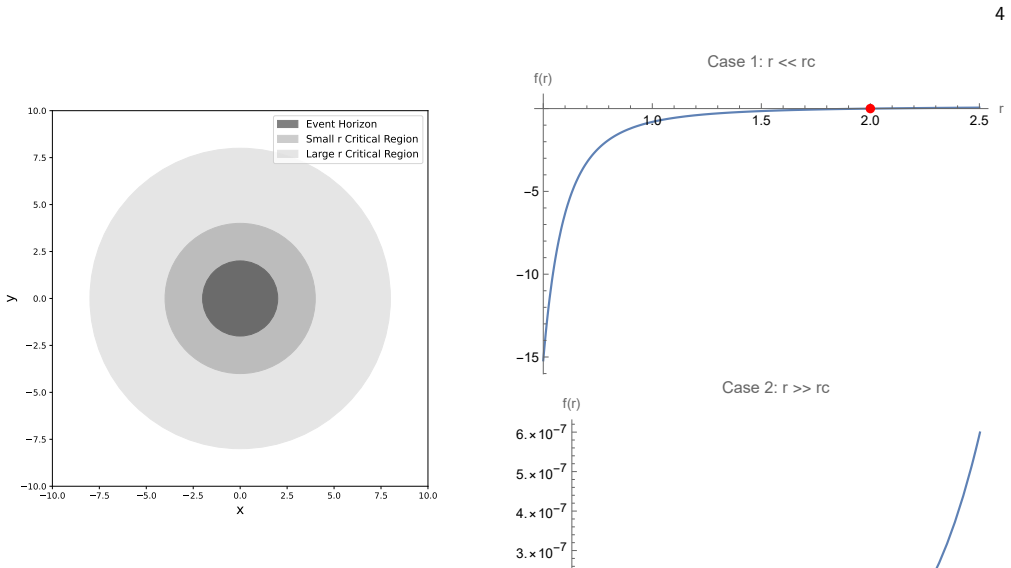
- [Fig. 2 caption] The caption appears to swap the two regimes: the in-figure labels say 'Case 1: r<<r_c' for the top panel and 'Case 2: r>>r_c' for the bottom panel, while the caption describes the top as r>>r_c and the bottom as r<<r_c; the caption and figure should be reconciled.
- [II, text after Eq. (22)] The statement that the tangential pressure equals rho/2 'for any mass function' is inconsistent with Eq. (9), which gives P_t=m*rho/[2(r-2m)]; the equality holds only at r=3m, not generally.
- [II, derivation paragraph] The sentence 'we use this approach approach to derive new black hole solutions' contains a duplicated word and should be edited.
- [III, shadow derivation] The phrase 'The radius of shadow to be equal to,' is grammatically incomplete; use 'The shadow radius is'.
- [V, Acknowledgments] The phrase 'multi-messenger appronkh' appears to be a typo and should be corrected.
- [III, Fig. 4] The deflection-angle section should state which metric regime, Eq. (14) or Eq. (15), is used in the numerical integration, and should confirm that the plotted impact parameters lie in that regime for each r_c value shown.
Circularity Check
No circularity: the metric, shadow, and deflection angle follow from an explicit density-profile ansatz, and the self-citations are non-load-bearing.
full rationale
The paper's derivation chain is not circular. The metric is obtained by integrating the Einstein field equations for a specified Dekel-Zhao density profile, giving the mass profile m(r), the lapse function f(r), and the tangential pressure. The shadow and deflection angle are then computed from the resulting f(r) using standard photon-sphere formulas. No observable is used to set the model parameters, and no fitted quantity is renamed as a prediction. The self-citations to the authors' earlier work (refs. [30]-[32]) appear only in a general list of prior studies on black-hole-shadow and dark-matter research; they are not used to fix a constant, to justify a uniqueness claim, or to supply the central derivation. The method is attributed to Cardoso et al., not to the present authors. A possible concern is that the photon-sphere formula in Eq. (27) appears inconsistent with the mass profile in Eq. (10), but that is a correctness or internal-consistency issue, not circularity: Eq. (27) is not constructed from the shadow output and then used to predict that same output. Hence no circular step can be exhibited, and the appropriate finding is no significant circularity.
Assumptions & free parameters
free parameters (4)
- a (Dekel-Zhao inner slope) =
0.1 (used in figures)
- rc (characteristic radius) =
0.1, 5, 10, 15, 20 in figures
- ρ_ch (characteristic density) =
1 in figures
- M_BH (black hole mass) =
0.15, 2 in figures
assumptions (4)
- domain assumption Dark matter is modeled as an Einstein cluster: collisionless particles on circular geodesics, stress-energy diag(-ρ,0,Pt,Pt), Pr=0.
- standard math The metric is static, spherically symmetric, with ds² = -f(r)dt² + dr²/(1-2m(r)/r) + r²dΩ².
- domain assumption The Dekel-Zhao profile with b=2 and g=3.5 (Eq (3)) describes the dark matter halo.
- ad hoc to paper The mass and lapse function can be obtained by patching asymptotic solutions for r << rc and r >> rc.
Cite this review
Pith. "Pith review of Black hole in the Dekel-Zhao dark matter profile." pith.science (2026). https://pith.science/paper/RD52A7NY
@misc{pith2026250112559,
  author       = {Pith},
  title        = {Pith review of: Black hole in the Dekel-Zhao dark matter profile},
  year         = {2026},
  howpublished = {\url{https://pith.science/paper/RD52A7NY}},
  note         = {Machine review of arXiv:2501.12559}
}
abstract
Motivated by the work of Cardoso et al. [Phys. Rev. D 105 (2022) 6, L061501, https://doi.org/10.1103/PhysRevD.105.L061501] on black holes in galaxies, we derive a new black hole solution surrounded by a Dekel-Zhao (DZ) dark matter profile. The derived metric, influenced by DZ profile parameters, exhibits two distinct regimes: for $r \ll r_{\rm c}$ (\textcolor{black}{$r_{\rm c}$ is a characteristic radius}), exponential corrections dominate, producing significant deviations from the Schwarzschild solution near dense cores, while for $r \gg r_{\rm c}$, these corrections vanish, restoring the Schwarzschild metric at large distances. These findings ensure consistency with general relativity in vacuum. \textcolor{black}{The black hole shadow and deflection angle are analyzed, demonstrating that the shadow radius increases with black hole mass ($M_{\rm BH}$), while higher central densities ($\rho_{\rm ch}$) result in smaller shadows, reflecting the environmental impact of dense dark matter halos.} Photon dynamics reveal how DZ profiles modify critical impact parameters and effective potentials, with gravitational lensing effects highly sensitive to the characteristic radius ($r_{\rm c}$). Smaller $r_{\rm c}$ values lead to larger deflection angles due to stronger gravitational effects near compact cores. This work highlights the significance dark matter profiles in shaping black hole observables, providing a theoretical foundation for future observational studies and advancing the understanding of dark matter-black hole interactions in astrophysical and cosmological contexts.
Figures


Forward citations
Cited by 4 Pith papers
-
Geometric properties of slowly rotating black holes embedded in matter environments
The rotation of a surrounding dark-matter halo shifts the light ring, ISCO, epicyclic frequencies, and resonance locations of a slowly spinning black hole in a way that depends on the halo's angular velocity.
-
Schwarzschild-like Black Holes Submerged in an Exponential Density Dark Matter Profile
An analytic Schwarzschild-like metric with an exponential dark matter halo is constructed and its shadows, quasi-normal modes, and greybody bounds are computed, though several derived expressions have sign errors.
-
Ringdown of a black hole sourced by a Burkert-density effective anisotropic source
The Burkert-halo black hole metric and its quasinormal-mode shifts are computed, but the model's source is not Burkert and the axial gravitational potential is incorrect.
-
Shadow and Quasi-Normal Modes of Schwarzschild-Hernquist Black Hole
For black holes embedded in Hernquist dark matter halos, the shadow radius and quasinormal mode frequencies are redshifted by a factor 1 - C + C^2/6 in the halo compactness C, with EHT observations implying C <= 0.092.
Reference graph
Works this paper leans on
- [1]
-
[2]
D. J. E. Marsh, D. Ellis, and V. M. Mehta, Dark Mat- ter: Evidence, Theory, and Constraints , Princeton Series in Astrophysics (Princeton University Press, 2024)
work page 2024
-
[3]
The Theory of Direct Dark Matter Detection: A Guide to Computations,
E. Del Nobile, “The Theory of Direct Dark Matter Detection: A Guide to Computations,” (2021), arXiv:2104.12785 [hep- ph]
arXiv 2021
-
[4]
First model independent results from DAMA/LIBRA-phase2
R. Bernabei et al., Nucl. Phys. Atom. Energy 19, 307 (2018), arXiv:1805.10486 [hep-ex]
work page Pith review arXiv 2018
-
[5]
C. Amole et al. (PICO), Phys. Rev. Lett. 118, 251301 (2017), arXiv:1702.07666 [astro-ph.CO]
arXiv 2017
-
[6]
G. Angloher et al. (CRESST), Eur. Phys. J. C 76, 25 (2016), arXiv:1509.01515 [astro-ph.CO]
arXiv 2016
-
[7]
R. Bernabei et al. , Eur. Phys. J. C 73, 2648 (2013), arXiv:1308.5109 [astro-ph.GA]. 7
arXiv 2013
-
[8]
R. Bernabei et al. (DAMA), Eur. Phys. J. C 56, 333 (2008), arXiv:0804.2741 [astro-ph]
arXiv 2008
Show all 67 references
-
[9]
Aalbers et al
J. Aalbers et al. (LZ), Phys. Rev. Lett. 131, 041002 (2023), arXiv:2207.03764 [hep-ex]
2023 arXiv
-
[10]
Abdallah et al
J. Abdallah et al. , Phys. Dark Univ. 9-10, 8 (2015), arXiv:1506.03116 [hep-ph]
2015 arXiv
-
[11]
Askew, S
A. Askew, S. Chauhan, B. Penning, W. Shepherd, and M. Tripathi, Int. J. Mod. Phys. A 29, 1430041 (2014), arXiv:1406.5662 [hep-ph]
2014 arXiv
-
[12]
S. Baum, A. K. Drukier, K. Freese, M. G´ orski, and P. Sten- gel, Phys. Lett. B 803, 135325 (2020), arXiv:1806.05991 [astro-ph.CO]
2020 arXiv
-
[13]
Z. Xu, X. Hou, X. Gong, and J. Wang, JCAP 09, 038 (2018), arXiv:1803.00767 [gr-qc]
2018 arXiv
-
[14]
R. A. Konoplya and A. Zhidenko, Astrophys. J. 933, 166 (2022), arXiv:2202.02205 [gr-qc]
2022 arXiv
-
[15]
Cardoso, K
V. Cardoso, K. Destounis, F. Duque, R. P. Macedo, and A. Maselli, Phys. Rev. D 105, L061501 (2022), arXiv:2109.00005 [gr-qc]
2022 arXiv
-
[16]
Constraining Self-interacting Scalar Field Dark Matter From the Black Hole Shadow of the Event Horizon Telescope,
G. G´ omez and P. Valageas, “Constraining Self-interacting Scalar Field Dark Matter From the Black Hole Shadow of the Event Horizon Telescope,” (2024), arXiv:2403.08988 [astro-ph.CO]
2024 arXiv
-
[17]
Einstein Cluster as Central Spiky Distribution of Galactic Dark Matter,
K.-i. Maeda, V. Cardoso, and A. Wang, “Einstein Cluster as Central Spiky Distribution of Galactic Dark Matter,” (2024), arXiv:2410.04175 [gr-qc]
2024 arXiv
-
[18]
A Class of Analytical Models for Black holes Surrounded by Dark Matter Halos,
Z. Shen, A. Wang, and S. Yin, “A Class of Analytical Models for Black holes Surrounded by Dark Matter Halos,” (2024), arXiv:2408.05417 [gr-qc]
2024 arXiv
-
[19]
Qiao and P
C.-K. Qiao and P. Su, Eur. Phys. J. C 84, 1032 (2024), arXiv:2403.05682 [gr-qc]
2024 arXiv
-
[20]
S. R. Wu, B. Q. Wang, Z. W. Long, and H. Chen, Phys. Dark Univ. 44, 101455 (2024)
2024
-
[21]
Testing bumblebee gravity with global monopoles in a dark matter spike by EHT observations from M87 and Sgr A,
S. Capozziello, S. Zare, and H. Hassanabadi, “Testing bumblebee gravity with global monopoles in a dark matter spike by EHT observations from M87 and Sgr A,” (2023), arXiv:2311.12896 [gr-qc]
2023
-
[22]
Dark matter spike around Bumblebee black holes,
S. Capozziello, S. Zare, D. F. Mota, and H. Hassanabadi, “Dark matter spike around Bumblebee black holes,” (2023), arXiv:2303.13554 [gr-qc]
2023 arXiv
-
[23]
Liu, C.-K
Y.-G. Liu, C.-K. Qiao, and J. Tao, JCAP 10, 075 (2024), arXiv:2312.15760 [gr-qc]
2024 arXiv
-
[24]
Z. Xu, J. Wang, and M. Tang, JCAP 09, 007 (2021), arXiv:2104.13158 [gr-qc]
2021 arXiv
-
[25]
Z. Xu, X. Gong, and S.-N. Zhang, Phys. Rev. D 101, 024029 (2020)
2020
-
[26]
Jusufi, M
K. Jusufi, M. Jamil, and T. Zhu, Eur. Phys. J. C 80, 354 (2020), arXiv:2005.05299 [gr-qc]
2020 arXiv
-
[27]
Haroon, M
S. Haroon, M. Jamil, K. Jusufi, K. Lin, and R. B. Mann, Phys. Rev. D 99, 044015 (2019), arXiv:1810.04103 [gr-qc]
2019 arXiv
-
[28]
X. Hou, Z. Xu, M. Zhou, and J. Wang, JCAP 07, 015 (2018), arXiv:1804.08110 [gr-qc]
2018 arXiv
-
[29]
X. Hou, Z. Xu, and J. Wang, JCAP 12, 040 (2018), arXiv:1810.06381 [gr-qc]
2018 arXiv
-
[30]
R. C. Pantig, Phys. Dark Univ. 45, 101550 (2024), arXiv:2405.07531 [gr-qc]
2024 arXiv
-
[31]
¨Ovg¨ un, L
A. ¨Ovg¨ un, L. J. F. Sese, and R. C. Pantig, Annalen Phys. 2023, 2300390 (2023), arXiv:2309.07442 [gr-qc]
2023 arXiv
-
[32]
R. C. Pantig and A. ¨Ovg¨ un, Fortsch. Phys.2022, 2200164 (2022), arXiv:2210.00523 [gr-qc]
2022 arXiv
-
[33]
Biswas, C
S. Biswas, C. Singha, and S. Chakraborty, Phys. Rev. D 109, 064043 (2024), arXiv:2307.04836 [gr-qc]
2024 arXiv
-
[34]
J. C. Feng, S. Chakraborty, and V. Cardoso, Phys. Rev. D 107, 044050 (2023), arXiv:2211.05261 [gr-qc]
2023 arXiv
-
[35]
Chakraborty, G
S. Chakraborty, G. Comp` ere, and L. Machet, (2024), arXiv:2412.14831 [gr-qc]
2024 arXiv
-
[36]
Rahman, S
M. Rahman, S. Kumar, and A. Bhattacharyya, JCAP 01, 035 (2024), arXiv:2306.14971 [gr-qc]
2024 arXiv
- [37]
- [38]
-
[39]
Xamidov, U
T. Xamidov, U. Uktamov, S. Shaymatov, and B. Ahmedov, Phys. Dark Univ. 47, 101805 (2025)
2025
-
[40]
R.-Y. Chen, F. Javed, D. G. Mustafa, S. K. Maurya, and S. Ray, JHEAp 44, 172 (2024)
2024
-
[41]
M. M. Gohain, P. Phukon, and K. Bhuyan, Phys. Dark Univ. 46, 101683 (2024), arXiv:2407.02872 [gr-qc]
2024 arXiv
-
[42]
C. F. B. Macedo, J. a. L. Rosa, and D. Rubiera-Garcia, JCAP 07, 046 (2024), arXiv:2402.13047 [gr-qc]
2024 arXiv
-
[43]
Montalvo, A
D. Montalvo, A. Smith-Orlik, S. Rastgoo, L. Sagunski, N. Becker, and H. Khan, Universe 10, 427 (2024), arXiv:2401.06084 [gr-qc]
2024 arXiv
- [44]
-
[45]
Pezzella, K
L. Pezzella, K. Destounis, A. Maselli, and V. Cardoso, (2024), arXiv:2412.18651 [gr-qc]
2024 arXiv
-
[46]
Mollicone and K
A. Mollicone and K. Destounis, Phys. Rev. D 111, 024017 (2025), arXiv:2410.11952 [gr-qc]
2025 arXiv
-
[47]
Destounis, A
K. Destounis, A. Kulathingal, K. D. Kokkotas, and G. O. Papadopoulos, Phys. Rev. D 107, 084027 (2023), arXiv:2210.09357 [gr-qc]
2023 arXiv
-
[48]
Figueiredo, A
E. Figueiredo, A. Maselli, and V. Cardoso, Phys. Rev. D 107, 104033 (2023), arXiv:2303.08183 [gr-qc]
2023 arXiv
-
[49]
Speeney, E
N. Speeney, E. Berti, V. Cardoso, and A. Maselli, Phys. Rev. D 109, 084068 (2024), arXiv:2401.00932 [gr-qc]
2024 arXiv
-
[50]
Polcar, G
L. Polcar, G. Lukes-Gerakopoulos, and V. Witzany, Phys. Rev. D 106, 044069 (2022), arXiv:2205.08516 [gr-qc]
2022 arXiv
-
[51]
Chen and P
C.-Y. Chen and P. Kotlaˇ r ´ ık, Phys. Rev. D 108, 064052 (2023), arXiv:2307.07360 [gr-qc]
2023 arXiv
-
[52]
R. G. Daghigh and G. Kunstatter, Phys. Rev. D 109, 083004 (2024), arXiv:2308.15682 [gr-qc]
2024 arXiv
-
[53]
Z. Shen, A. Wang, Y. Gong, and S. Yin, Phys. Lett. B 855, 138797 (2024), arXiv:2311.12259 [gr-qc]
2024 arXiv
-
[54]
Freundlich, F
J. Freundlich, F. Jiang, A. Dekel, N. Cornuault, O. Ginzburg, R. Koskas, S. Lapiner, A. Dutton, and A. V. Macci, Monthly Notices of the Royal Astronomical Society 499, 29122933 (2020)
2020
-
[55]
Einstein, Annals Math
A. Einstein, Annals Math. 40, 922 (1939)
1939
-
[56]
Cardoso, K
V. Cardoso, K. Destounis, F. Duque, R. Panosso Macedo, and A. Maselli, Phys. Rev. Lett. 129, 241103 (2022), arXiv:2210.01133 [gr-qc]
2022 arXiv
-
[57]
Hernquist, Astrophys
L. Hernquist, Astrophys. J. 356, 359 (1990)
1990
-
[58]
Vagnozzi and L
S. Vagnozzi and L. Visinelli, Phys. Rev. D 100, 024020 (2019), arXiv:1905.12421 [gr-qc]
2019 arXiv
-
[59]
Allahyari, M
A. Allahyari, M. Khodadi, S. Vagnozzi, and D. F. Mota, JCAP 02, 003 (2020), arXiv:1912.08231 [gr-qc]
2020 arXiv
-
[60]
R. Roy, S. Vagnozzi, and L. Visinelli, Phys. Rev. D 105, 083002 (2022), arXiv:2112.06932 [astro-ph.HE]
2022 arXiv
-
[61]
Afrin, S
M. Afrin, S. Vagnozzi, and S. G. Ghosh, Astrophys. J. 944, 149 (2023), arXiv:2209.12584 [gr-qc]
2023 arXiv
-
[62]
Vagnozzi et al., Class
S. Vagnozzi et al., Class. Quant. Grav. 40, 165007 (2023), arXiv:2205.07787 [gr-qc]
2023 arXiv
-
[63]
Paithankar and S
K. Paithankar and S. Kolekar, Phys. Rev. D 108, 104042 (2023), arXiv:2305.07444 [gr-qc]. 8
2023 arXiv
-
[64]
Claudel, K
C.-M. Claudel, K. S. Virbhadra, and G. F. R. Ellis, J. Math. Phys. 42, 818 (2001), arXiv:gr-qc/0005050
2001 arXiv
-
[65]
Cardoso, A
V. Cardoso, A. S. Miranda, E. Berti, H. Witek, and V. T. Zanchin, Phys. Rev. D 79, 064016 (2009), arXiv:0812.1806 [hep-th]
2009 arXiv
-
[66]
K. S. Virbhadra, D. Narasimha, and S. M. Chitre, Astron. Astrophys. 337, 1 (1998), arXiv:astro-ph/9801174
1998 arXiv
-
[67]
K. S. Virbhadra and G. F. R. Ellis, Phys. Rev. D 62, 084003 (2000), arXiv:astro-ph/9904193
2000 arXiv
Reviewed August 10, 2026 · model on record in the stance chip above.
Discussion (0). Continue with ORCID to comment.