REVIEW 3 major objections 6 minor 41 references
Information Design for Adaptive Organizations
T0 review · 3 major / 6 minor · reviewed 2026-08-10 · deepseek-v4-flash
Pith's one-line read For networked organizations, the optimal public signal is a spectral threshold rule: always include the average state, then add Laplacian eigenvector statistics whose coordination cost is low enough.
desk verdict A clean and useful spectral characterization of optimal public signals in network organizations, but the core theorem is borrowed without proof, making the main results conditional. read the letter →
The pith
A machine-rendered reading of the paper's core claim, the machinery that carries it, and where it could break.
The reading
What carries the argument
The engine of the paper is the matrix $V = B'(I_n - 2\beta(\tilde{L} - L))B$, with $B = (I_n + \beta L)^{-1}$: its nonnegative-eigenvalue eigenvectors are, by the cited quadratic Gaussian persuasion theorem, exactly the linear statistics an optimal public signal discloses. In the uniform-synergy case $\tilde{G} = K_n$, this matrix is diagonal in the Laplacian eigenbasis of the incentive graph, giving the explicit eigenvalue $\omega_j = (1 + \beta\lambda_j)^{-2}(1 - 2\beta(n - \lambda_j))$ for each Laplacian eigenvector $q_j$. The sign of $\omega_j$ is the disclosure rule: $q_j' x$ is revealed exactly when $\beta^{-1} \geq 2(n - \lambda_j)$, with the average statistic $q_1' x$ always included. This spectral machinery converts the information-design problem into a one-dimensional threshold comparison per eigenvector.
What would settle it
For a small fixed $n$, enumerate all incentive graphs $G$ with $\tilde{G} = K_n$, compute $V$ at several values of $\beta$, and check whether the set of nonnegative-eigenvalue statistics of $V$ equals the set $\{j : \beta^{-1} \geq 2(n - \lambda_j)\}$; a single mismatch for any graph would falsify Proposition 6.
Extended reading notes
Core claim
The central claim is that, in a quadratic network organization, information design reduces to eigenvalue selection. Starting from the equilibrium action profile $a^* = (I_n + \beta L)^{-1}\hat{x}$, where $L$ is the Laplacian of the incentive graph and $\hat{x}$ is the public posterior expectation of the state, the principal's payoff is $E[\hat{x}' V \hat{x}]$ with $V = B'(I_n - 2\beta(\tilde{L} - L))B$ and $B = (I_n + \beta L)^{-1}$. Taking the quadratic Gaussian persuasion characterization as given, the optimal signal is the set of linear statistics $m_j^* = z_j' x$ formed from the eigenvectors $z_j$ of $V$ with nonnegative eigenvalues. The paper shows that $\mathbf{1}_n$ is always such an eigenvector with eigenvalue $1$, so the average state is always disclosed. When the synergy graph is complete, $V$ is simultaneously diagonalized by the Laplacian eigenvectors of $G$: $V q_j = (1 + \beta\lambda_j)^{-2}(1 - 2\beta(n - \lambda_j)) q_j$, so the threshold $\beta^{-1} \geq 2(n - \lambda_j)$ decides exactly which statistics are disclosed. Consequently the second-smallest Laplacian eigenvalue (algebraic connectivity) sets the cutoff for full revelation, and the largest Laplacian eigenvalue (spectral radius) sets the high-$\beta$ condition for minimum transparency.
Load-bearing premise
The entire analysis rests on the cited theorem, taken without proof in this paper, that in a quadratic Gaussian persuasion problem the optimal public signal consists exactly of the linear statistics given by the nonnegative eigenvectors of $V$; if that theorem fails, the Laplacian threshold rule and all propositions built on it collapse.
Editorial extensions
If this is right
- The average local state is always disclosed, so the principal always anchors agents on the organizational goal even when coordination incentives are misaligned.
- When the synergy graph is complete, the optimal signal is read directly from the incentive graph's Laplacian spectrum: statistic $q_j' x$ is disclosed exactly when $\beta^{-1} \geq 2(n - \lambda_j)$.
- Full transparency is optimal exactly for $\beta \leq 1/(2(n - \lambda_2))$; with high $\beta$ and a connected complement of the incentive graph, the optimal signal shrinks to the average alone.
- Adding a coordination link to the incentive graph weakly increases the number of disclosed statistics, and a higher coordination weight $\beta$ weakly decreases it.
- The signal's precision about agent $i$ is the sum of squared Laplacian eigenvector components of the disclosed statistics, so central agents receive more precise information about their local state.
Reading between the lines
- Editorial extension: the threshold rule suggests an operational policy heuristic: use spectral clustering projections to choose which agent states to disclose when full network knowledge is unavailable.
- Editorial extension: because the main theorem presumes Gaussian states, the threshold rule may not survive non-Gaussian or heavy-tailed environments; numerical persuasion experiments with non-Gaussian priors would test this.
- Editorial extension: the maximum-degree approximation connects to a cheap data requirement: large organizations can approximate the minimum-transparency regime from the maximum degree alone, without computing the full Laplacian spectrum.
Editorial analysis
A structured set of objections, weighed in public.
Referee Report
Summary. This paper studies optimal public information design in a quadratic adaptation-coordination model with n agents. The equilibrium action profile is a* = (I + beta L)^{-1} x_hat, and the principal's payoff reduces to E[x_hat' V x_hat] with V = (I + beta L)^{-1}(I - 2 beta (eL - L))(I + beta L)^{-1}, where L and eL are the Laplacians of the incentive and synergy graphs. The paper invokes a theorem from Tamura (2018) to assert that the optimal signal discloses exactly the linear statistics z_j' x associated with the nonnegative eigenvectors of V. From this it derives that the average state is always disclosed, two sufficient conditions for full revelation, monotonicity of signal dimension in G and beta, and, for complete synergy graphs, the explicit threshold rule m*_j in I(phi*) iff beta^{-1} >= 2(n - lambda_j). It applies the rule to stars, rings, disjoint cliques, paths, and complete bipartite graphs, and reports numerical simulations for ER and BA random graphs.
Significance. If Theorem 1 is accepted, the paper gives a sharp, parameter-free connection between graph spectra and the optimal public signal. Proposition 6's threshold rule and Corollary 2's full-revelation cutoff are concrete and falsifiable, and the spectral computations for the worked examples are accurate. The extensions to correlated states and asymmetric coordination weights broaden the result's applicability. The main limitation is that the persuasion-theoretic core comes from an unproved, self-cited SSRN working paper; until that theorem is supplied, the new propositions are conditional. The paper is nevertheless a useful synthesis and contributes a clear Laplacian-eigenvector interpretation to organizational information design.
major comments (3)
- [3.3, Theorem 1 (and Theorem 2, 6.1)] The paper's central characterization, that the optimal public signal consists exactly of the statistics z_j' x for the nonnegative eigenvectors of V, is quoted from Tamura (2018) and is not proved or independently verified in this manuscript. Since Proposition 6's threshold rule, Corollary 2's cutoff, and the examples in Section 5.2 are all obtained by applying this theorem to the eigenvectors of V, a failure of Theorem 1 would invalidate the paper's main claims. Please include a self-contained proof of Theorem 1 and its correlated-state version, Theorem 2, or cite a published proof; the current dependence on an SSRN working paper is too heavy for the results to be evaluated unconditionally.
- [4.3, Proof of Proposition 4 (Appendix C)] The displayed equality V_{G'} = V + 2 beta B'(L_{G'} - L_G)B does not hold as written, because the equilibrium matrix B = (I + beta L)^{-1} changes when G is replaced by G'; the B appearing in V_{G'} is (I + beta L_{G'})^{-1}, not the B used in V_G. Proposition 4's statement can be obtained by Sylvester's law of inertia on V = B'(I - 2 beta (eL - L))B and Weyl's monotonicity for I - 2 beta eL + 2 beta L, but the proof in the Appendix needs to be rewritten with the correct argument.
- [5.2.3, clique example] The four-phase description is inconsistent with Proposition 6. For G = K_m union K_{n-m} with m <= n-m, the relevant thresholds are b_beta(n-m) = 1/(2m), b_beta(m) = 1/[2(n-m)], and b_beta(0) = 1/(2n), which satisfy b_beta(n-m) >= b_beta(m) >= b_beta(0). Thus as beta increases from zero the optimal signal moves from full revelation (beta <= 1/(2n)) to partial disclosure to minimum transparency (beta > 1/(2m)), the opposite of the ordering stated in Phases 1-4. As written, Phase 3's interval [b_beta(m), b_beta(0)) is empty when m < n-m. Please correct the phase order and the interval endpoints.
minor comments (6)
- [Appendix C, Proof of Proposition 8, Eq. (36)] The expression mu' V' mu should be mu' V mu (or E[x]' V E[x]); the prime on V appears to be a typo.
- [5.2.2, ring graphs] After Eq. (13), for even n the text says k(n) = k/2; the right-hand side is undefined and should presumably be n/2.
- [5.4, Proposition 11] In the statement of Proposition 11, 'taret' should be 'target'.
- [5.3, Eq. (14)] The matrix bar Q is written as [q1 qn ... qr], which mixes fixed and variable indices; please relabel the retained eigenvectors as q_{j_1}, ..., q_{j_r} so that the formula is unambiguous.
- [6.1, Theorem 2 and Proposition 12] Theorem 2's signal uses Z'_+ Sigma^{-1/2} x, while Proposition 12's discussion uses q'_j Sigma^{1/2} x; for symmetric Sigma these differ by positive scalar factors and carry the same information, but the inconsistency should be flagged so readers do not think the two formulas are identical.
- [7, numerical analysis] Figures 1-4 report simulation results based on random graph generation, but no code, seeds, or data are provided; a brief reproducibility note would strengthen the numerical section.
Circularity Check
The Laplacian threshold rule is conditional on the author's unproved Theorem 1; aside from that load-bearing self-citation, the derivation is self-contained.
-
self citation load bearing
[Section 3.3, Theorem 1; Section 5.1, Proposition 6; Appendix C proof of Proposition 6.]
"Theorem 1 (Tamura, 2018) Suppose that each xi is independent and identically distributed according to a normal distribution. Let ωj denote an eigenvalue of V and let zj denote the corresponding eigenvector. Assume that V has r nonnegative eigenvalues and n − r negative eigenvalues. Then, the optimal public signal consists of r statistics m = {m∗j}, where each statistic m∗j is a linear combination of the state, given by m∗j = z′jx for j such that ωj ≥ 0."
Proposition 6 is derived by combining an in-paper spectral computation (V qj = ωj qj, ωj = (1+βλj)^{-2}(1−2β(n−λj))) with the assertion that the optimal signal is exactly the set of nonnegative-eigenvector statistics. The latter assertion is not proved or reproved here; it is imported from the author's SSRN working paper. The in-paper computation alone establishes only the eigenstructure of V, not the persuasion-theoretic characterization of the optimal signal. Thus the central condition m*_j ∈ I(φ*) ⇔ β^{-1} ≥ 2(n−λ_j), Corollary 2, and related results are contingent on an unverified self-citation rather than on a derivation contained in this manuscript. No fitted parameter or definitional identity is involved, so the circularity is limited to this load-bearing dependency.
full rationale
Aside from the reliance on Theorem 1 (and Theorem 2 in the correlated-state extension), the paper's derivations are self-contained: equilibrium actions, the objective V, the eigenvector/eigenvalue identities, and the spectral bounds are all computed from the model. No constant is fitted to target results, and Propositions 2-5, 9, 10, 11, 15, 16 are derived from the model's equations plus standard spectral facts. The main concern is that the characterization of the optimal signal as the full set of nonnegative-eigenvector statistics is borrowed from the author's prior working paper and is load-bearing for the headline Laplacian threshold results. This is a genuine external dependency, but it is not a construction-level equivalence or a fitted-input prediction, so a moderate score is appropriate.
Assumptions & free parameters
assumptions (5)
- domain assumption Theorem 1 (Tamura 2018): for a quadratic Gaussian Bayesian persuasion problem with matrix V, the optimal public signal reveals exactly the linear statistics z'_j x for eigenvectors with nonnegative eigenvalues of V.
- standard math Laplacian spectral facts: Laplacian eigenvalues satisfy 0 = lambda_1 <= ... <= lambda_n <= n; lambda_2 = 0 iff G is disconnected; lambda_n = n iff the complement of G is disconnected.
- domain assumption Quadratic payoffs and Gaussian iid states: agents' payoffs are given by (1) and states are N(mu 1, sigma^2 I).
- domain assumption The principal can commit ex ante to a public signal and cannot send private signals.
- domain assumption In Section 5, the synergy graph is complete (eG = Kn), so the principal benefits equally from coordination of every pair.
Cite this review
Pith. "Pith review of Information Design for Adaptive Organizations." pith.science (2026). https://pith.science/paper/4G5Y5QLL
@misc{pith2026250112669,
  author       = {Pith},
  title        = {Pith review of: Information Design for Adaptive Organizations},
  year         = {2026},
  howpublished = {\url{https://pith.science/paper/4G5Y5QLL}},
  note         = {Machine review of arXiv:2501.12669}
}
read the original abstract
This paper examines the optimal design of information sharing in organizations. Organizational performance depends on agents adapting to uncertain external environments while coordinating their actions, where coordination incentives and synergies are modeled as graphs (networks). The equilibrium strategies and the principal's objective function are summarized using Laplacian matrices of these graphs. I formulate a Bayesian persuasion problem to determine the optimal public signal and show that it comprises a set of statistics on local states, necessarily including their average, which serves as the organizational goal. When the principal benefits equally from the coordination of any two agents, the choice of disclosed statistics is based on the Laplacian eigenvectors and eigenvalues of the incentive graph. The algebraic connectivity (the second smallest Laplacian eigenvalue) determines the condition for full revelation, while the Laplacian spectral radius (the largest Laplacian eigenvalue) establishes the condition for minimum transparency, where only the average state is disclosed.
Figures
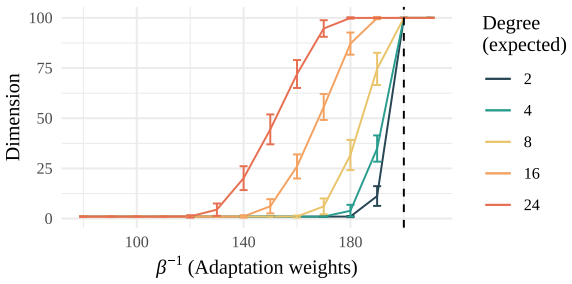


Figures from the paper (1 more)

Reference graph
Works this paper leans on
-
[1]
, " * write output.state after.block = add.period write newline
ENTRY address author booktitle chapter edition editor eid howpublished institution journal key month note number organization pages publisher school series title type volume year label extra.label sort.label short.list INTEGERS output.state before.all mid.sentence after.sentence after.block FUNCTION init.state.consts #0 'before.all := #1 'mid.sentence := ...
-
[2]
" write newline "" before.all 'output.state := FUNCTION n.dashify 't := "" t empty not t #1 #1 substring "-" = t #1 #2 substring "--" = not "--" * t #2 global.max substring 't := t #1 #1 substring "-" = "-" * t #2 global.max substring 't := while if t #1 #1 substring * t #2 global.max substring 't := if while FUNCTION word.in bbl.in capitalize " " * FUNCT...
-
[3]
Alonso, R. , Dessein, W. and Matouschek, N. (2008). When does coordination require centralization? American Economic Review, 98 (1), 145--179
work page 2008
-
[4]
Anderson Jr, W. N. and Morley, T. D. (1985). Eigenvalues of the L aplacian of a graph. Linear and Multilinear Algebra, 18 (2), 141--145
work page 1985
-
[5]
Ballester, C. , Calv \'o -Armengol, A. and Zenou, Y. (2006). Who's who in networks. wanted: The key player. Econometrica, 74 (5), 1403--1417
work page 2006
-
[6]
Bloch, F. and Qu \'e rou, N. (2013). Pricing in social networks. Games and Economic Behavior, 80, 243--261
work page 2013
-
[7]
Bolton, P. , Brunnermeier, M. K. and Veldkamp, L. (2013). Leadership, coordination, and corporate culture. Review of Economic Studies, 80 (2), 512--537
work page 2013
-
[8]
Brouwer, A. E. and Haemers, W. H. (2012). Spectra of Graphs. Springer
work page 2012
Show all 41 references
-
[9]
and de Mart \' , J
Calv \'o -Armengol, A. and de Mart \' , J. (2009). Information gathering in organizations: Equilibrium, welfare, and optimal network structure. Journal of the European Economic Association, 7 (1), 116--161
2009
-
[10]
--- , --- and Prat, A. (2015). Communication and influence. Theoretical Economics, 10 (2), 649--690
2015
-
[11]
Candogan, O. (2022). Persuasion in networks: Public signals and cores. Operations Research, 70 (4), 2264--2298
2022
-
[12]
and Ozdaglar, A
--- , Bimpikis, K. and Ozdaglar, A. (2012). Optimal pricing in networks with externalities. Operations Research, 60 (4), 883--905
2012
-
[13]
and Xu, H
--- , Guo, Y. and Xu, H. (2020). On information design with spillovers. Available at SSRN 3537289
2020
-
[14]
and Qi, X
Chen, C. and Qi, X. (2024). Optimality of public persuasion in job seeking. Available at SSRN 4879213
2024
-
[15]
and Santos, T
Dessein, W. and Santos, T. (2006). Adaptive organizations. Journal of Political Economy, 114 (5), 956--995
2006
-
[16]
Managerial style and attention
--- and --- (2021). Managerial style and attention. American Economic Journal: Microeconomics, 13 (3), 372--403
2021
-
[17]
and Sonin, K
Egorov, G. and Sonin, K. (2020). Persuasion on networks. Tech. rep., National Bureau of Economic Research
2020
-
[18]
, Ghiglino, C
Galeotti, A. , Ghiglino, C. and Squintani, F. (2013). Strategic information transmission networks. Journal of Economic Theory, 148 (5), 1751--1769
2013
-
[19]
and Goyal, S
--- , Golub, B. and Goyal, S. (2020). Targeting interventions in networks. Econometrica, 88 (6), 2445--2471
2020
-
[20]
and Perego, J
Galperti, S. and Perego, J. (2023). Games with information constraints: Seeds and spillovers. Available at SSRN 3340090
2023
-
[21]
and Merris, R
Grone, R. and Merris, R. (1994). The L aplacian spectrum of a graph II . SIAM Journal on Discrete Mathematics, 7 (2), 221--229
1994
-
[22]
and Koessler, F
Hagenbach, J. and Koessler, F. (2016). Full disclosure in decentralized organizations. Economics Letters, 139, 5--7
2016
-
[23]
, Qiao, M
Haghtalab, N. , Qiao, M. and Yang, K. (2024). Leakage-robust B ayesian persuasion. arXiv preprint arXiv:2411.16624
2024 arXiv
-
[24]
and Ramos, J
Herskovic, B. and Ramos, J. (2020). Acquiring information through peers. American Economic Review, 110 (7), 2128--2152
2020
-
[25]
Ivanov, M. (2010). Informational control and organizational design. Journal of Economic Theory, 145 (2), 721--751
2010
-
[26]
, Sheikholeslami, S
Jahanbani, A. , Sheikholeslami, S. M. and Khoeilar, R. (2021). On the spectrum of L aplacian matrix. Mathematical Problems in Engineering, 2021 (1), 8096874
2021
-
[27]
Jehiel, P. (2015). On transparency in organizations. Review of Economic Studies, 82 (2), 736--761
2015
-
[28]
and Gentzkow, M
Kamenica, E. and Gentzkow, M. (2011). Bayesian persuasion. American Economic Review, 101 (6), 2590--2615
2011
-
[29]
Kerman, T. T. and Tenev, A. P. (2023). Pitfalls of information spillovers in persuasion. Available at SSRN 4641522
2023
-
[30]
and Motter, A
Kim, D.-H. and Motter, A. E. (2007). Ensemble averageability in network spectra. Physical Review Letters, 98 (24), 248701
2007
-
[31]
, Shiu, W
Li, J. , Shiu, W. C. and Chang, A. (2010). The L aplacian spectral radius of graphs. Czechoslovak Mathematical Journal, 60 (3), 835--847
2010
-
[32]
Liu, H. , Lu, M. and Tian, F. (2004). On the L aplacian spectral radius of a graph. Linear Algebra and its Applications, 376, 135--141
2004
-
[33]
and Ui, T
Miyashita, M. and Ui, T. (2024). LQG information design. arXiv preprint arXiv:2312.09479
2024 arXiv
-
[34]
Mohar, B. (1991). The L aplacian spectrum of graphs. In Graph Theory, Combinatorics, and Applications, vol. 2, New York: Wiley, pp. 871--898
1991
-
[35]
Rantakari, H. (2008). Governing adaptation. Review of Economic Studies, 75 (4), 1257--1285
2008
-
[36]
and Segal, I
Rayo, L. and Segal, I. R. (2010). Optimal information disclosure. Journal of Political Economy, 118 (5), 949--987
2010
-
[37]
Shi, L. (2007). Bounds on the ( L aplacian) spectral radius of graphs. Linear Algebra and its Applications, 422 (2-3), 755--770
2007
-
[38]
The spectral radius of irregular graphs
--- (2009). The spectral radius of irregular graphs. Linear Algebra and its Applications, 431 (1-2), 189--196
2009
-
[39]
and Tamura, W
Shimono, K. and Tamura, W. (2025). Laplacian eigenvector centrality. arXiv preprint arXiv:2501.11024
2025 arXiv
-
[40]
Tamura, W. (2018). Bayesian persuasion with quadratic preferences. Available at SSRN 1987877
2018
-
[41]
Von Luxburg, U. (2007). A tutorial on spectral clustering. Statistics and Computing, 17, 395--416
2007
Reviewed August 10, 2026 · model on record in the stance chip above.
Discussion (0). Continue with ORCID to comment.