REVIEW 4 major objections 5 minor 33 references
Can masking background and object reduce static bias for zero-shot action recognition?
T0 review · 4 major / 5 minor · reviewed 2026-08-10 · deepseek-v4-flash
Pith's one-line read CLIP-based zero-shot action recognition models lean on background and object appearance, and color-masked training can push them back to the actor.
desk verdict Solid extension of masking to zero-shot CLIP action recognition; the P-top1 metric is confounded, but the Mimetics results carry the paper. read the letter →
The pith
A machine-rendered reading of the paper's core claim, the machinery that carries it, and where it could break.
The reading
What carries the argument
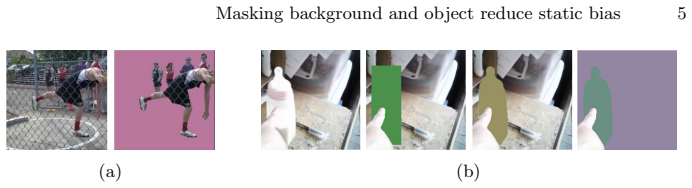
The machinery is a set of masking operations defined by Eq. (1)-(5): each frame is blended with a randomly sampled color $c$ over the regions to be suppressed, using binary masks produced by GroundingDINO and SAM. Background masking keeps only the person; object masking removes object texture, bounding boxes, or both object and background while preserving object shape. The evaluation uses two new metrics: P-top1 (accuracy when background is masked, so only the person is visible) and B-top1 (accuracy when the person is masked, so only the background is visible). These metrics separate where the model is looking, letting the authors attribute accuracy changes to background or object bias.
What would settle it
A concrete falsifier: compute P-top1 and B-top1 after replacing masked regions with randomly sampled patches from other videos instead of uniform colors. If P-top1 gains vanish and B-top1 no longer drops, the reported effect is an artifact of color masking rather than a genuine reduction in static bias.
Extended reading notes
Core claim
The central discovery is that static bias exists in zero-shot CLIP-based action recognizers and can be counteracted with simple color-masking augmentation. Using GroundingDINO and SAM to segment persons, objects, and backgrounds, the authors mask each region with randomly sampled colors during training. This consistently raises P-top1, a metric that measures accuracy when only the person is visible, while lowering B-top1, the metric for background-only predictions. On Mimetics, background masking improves overall top-1 accuracy by up to 3.47% for ActionCLIP in the cross-dataset zero-shot setting. On SSv2, masking background and object with different colors improves seen-category top-1 from 12.89% to 13.93% for ViFi-CLIP. The authors interpret this as evidence that masking prevents over-reliance on static bias and focuses the model on human action.
Load-bearing premise
The whole argument rests on the assumption that the segmentation masks (from GroundingDINO and SAM) correctly separate person, object, and background in every frame, so that masking removes static cues without also destroying the evidence the action actually needs.
Editorial extensions
If this is right
- Masking background during training can be adopted as a cheap data-augmentation drop-in for CLIP-based zero-shot action recognition, with no new architecture required.
- On datasets with weak background bias, such as Mimetics, background masking improves overall top-1 accuracy, not just person-focused accuracy.
- For object-biased benchmarks like SSv2, masking both background and object in different colors is the most effective recipe, preserving object shape while removing texture.
- P-top1 and B-top1 provide a low-cost diagnostic for static bias, simpler than background-swapping evaluation protocols.
- The optimal masking ratio and masking type differ between models and between seen versus unseen categories, so the augmentation should be tuned per architecture.
Reading between the lines
- Beyond the paper, the same masking recipe could serve as a cheap diagnostic for any video-language model: a large gap between P-top1 and B-top1 quantifies static-bias strength without needing background-swap datasets.
- A natural next experiment, not run here, is to vary the masking color distribution; the paper samples colors from a standard normal, and one could test whether adversarial or scene-matched colors change the amount of residual bias.
- The results suggest a regularization objective: penalize agreement between masked-background and masked-person predictions during fine-tuning, which the paper does not propose but its metrics make straightforward.
Editorial analysis
A structured set of objections, weighed in public.
Referee Report
Summary. The paper studies static bias in zero-shot action recognition for CLIP-based video models. It proposes data-augmentation masking of background regions, object regions, or both during training, and introduces two evaluation metrics, P-top1 and B-top1, computed by masking the background or the person bounding box on validation videos. Experiments with ViFi-CLIP and ActionCLIP on Kinetics400, Mimetics, and SSv2 show that background masking raises P-top1 and lowers B-top1, that masking helps on Mimetics where background bias is weak, and that masking background and objects in different colors can improve SSv2 performance. The paper concludes that masking backgrounds or objects during training reduces reliance on static bias and shifts predictions toward the person.
Significance. If the central claim holds, the paper would provide useful, previously missing evidence about static bias in zero-shot action recognition with vision-language models, and would suggest a cheap, practical augmentation-based mitigation. The paper has concrete strengths: it tests two model architectures and three datasets spanning different bias regimes, introduces interpretable P-top1/B-top1 metrics, and includes a comparison with S3Aug. However, the current experiments do not fully separate the effect of reduced static bias from the effect of training/evaluation augmentation alignment, and one abstract-level claim is contradicted by the paper's own table. With additional controls and more careful statistical reporting, the contribution could become solid; as it stands, the evidence is suggestive rather than conclusive.
major comments (4)
- [§4.2, Eq. (2); §3.3] The P-top1 evaluation uses the same background-masking operation that is used as a training augmentation, so the reported P-top1 gains over the unmasked baseline are confounded by train/eval distribution matching rather than by a measured reduction in static bias. A model trained with masked backgrounds sees color-filled backgrounds at evaluation and is therefore evaluated in-distribution, whereas the unmasked baseline sees an unusual corruption. To support the central claim, the authors should add a control that varies the masking style at evaluation (e.g., fixed gray, noise, random patches, or background swapping) and show that P-top1 improvements persist across unseen masking styles, or provide attribution evidence on original unmasked videos showing decisions become more person-centric.
- [Table 4 and Abstract] The abstract states that masking both background and objects in different colors improves performance for SSv2, but Table 4 shows this is not true for ViFi-CLIP on unseen categories: the novel (unseen) top1 drops from 9.62 at the 1.0:0.0:0.0:0.0 baseline to 9.13 at the 0.5:0.0:0.0:0.5 ratio, a decrease of 0.49. Only ActionCLIP shows a clear unseen-category gain (5.80 to 8.06). The conclusion and abstract should be qualified to state that the benefit is model- and split-dependent, or the claim should be restricted to the seen categories where the evidence is more consistent.
- [Tables 1–4, §4.1] All tables report single runs without error bars or significance tests, and the best masking ratio is selected per model and per dataset after inspecting the results. This makes it difficult to distinguish genuine effects from noise and risks post-hoc selection bias, especially on Mimetics where the validation set has only 713 videos and differences of 1–3 top1 points are reported. The authors should report means and standard deviations over at least three seeds (or over the three base-to-novel splits), and either pre-register the masking ratios or choose them on a separate validation split before reporting final test numbers.
- [§4.1, Masking; Eqs. (2)–(5)] The entire method and both evaluation metrics depend on GroundingDINO and SAM masks correctly separating persons, objects, and backgrounds frame by frame, yet the paper provides no quantitative or qualitative validation of segmentation quality. If object detectors miss objects or segment hands incorrectly, P-top1 and B-top1 could measure masking artifacts rather than static bias. The authors should report segmentation accuracy or at least show representative success and failure cases across all three datasets, and discuss how mask errors affect the main conclusions.
minor comments (5)
- [Eq. (5)] In Eq. (5), the complement/overline notation appears to be missing: as printed, the two color terms are multiplied by the same mask, so it is impossible to tell whether the background and objects actually receive different colors. Please rewrite the equation with explicit masks for background and object regions.
- [References] The S3Aug reference appears twice as [28] and [29]; please merge the duplicate and renumber subsequent references.
- [§4.3] There is a typo in 'backgrond bias' in the first paragraph of Section 4.3.
- [§4.4] The paragraphs following Table 4 (e.g., 'masking the object bounding box and the object shape', 'a combination of masking') read like bullet fragments; they should be integrated into coherent prose.
- [§4.3] The phrase 'P-top1 was significantly lower than B-top1' uses 'significantly' in a colloquial sense; since no statistical test is reported, please rephrase or add the appropriate test.
Circularity Check
P-top1 is computed with the same masking operation used as training augmentation, so part of the reported gain reflects train/eval distribution match; independent Mimetics and SSv2 results keep the central claim from being entirely circular.
-
other
[Sections 3.3 and 4.2, Eqs. (2), (5), and the definition of P-top1]
"'Masking background' is the same with Eq.(2) for background bias and Eq.(5) for object bias. We use the masked validation videos to compute the top1 performance, which we refer to as Person top1 or simply P-top1. ... For each sample pair of video frames Vi and category text T, we randomly apply one of the masking types with a predefined ratio."
P-top1 is defined by applying the exact background-masking transformation (Eq. 2 or Eq. 5) that was used as a training augmentation in Section 3.3. A model trained with masking therefore encounters its own training distribution during P-top1 evaluation, while the no-masking baseline is evaluated on a corruption it never saw. The reported P-top1 gains can thus partly measure robustness to this specific color-fill augmentation, not a general reduction of static bias. The conclusion that masking 'prevents models from overly depending on static bias' leans on this metric. However, the paper also reports top1 improvements on unmasked Mimetics and SSv2 videos, which are independent of this alignment, so the central claim is not fully circular.
full rationale
There is no equation-level circularity: the paper makes no formal derivation, and the masking equations are not claimed to imply the results by algebra. The main circularity concern is that P-top1, the primary evidence for 'focusing on the person', is evaluated with the same masking operator used as a training-time augmentation. This is a specific, quotable reduction: Section 4.2 states that P-top1 uses the same Eq.(2)/(5) masks, while Section 3.3 trains with those same masks. This confound inflates P-top1 improvement for masked models relative to the unmasked baseline. The B-top1 metric is less affected because person-bbox masking is not used in training. Self-citations (refs. 9 and 28) are used only for context and comparison, not as load-bearing uniqueness or ansatz arguments. Because the paper also reports gains on unmasked Mimetics and SSv2 evaluations, the core empirical claim retains independent support. Score 3 reflects one partial circularity in the main evidence, not a wholesale collapse of the paper's argument.
Assumptions & free parameters
free parameters (4)
- background masking ratio =
varies: 0.5:0.5, 0.33:0.67, 0:1
- object and background masking ratio =
varies: 0.5:0.5:0:0, 0.5:0:0.5:0, 0.5:0:0:0.5, 0.33:0:0.33:0.33
- masking color distribution =
c ~ N(0,I) per video
- segmentation prompts =
'person', 'hand', and SSv2 object names
assumptions (4)
- domain assumption CLIP embedding space supports zero-shot transfer to action categories after fine-tuning.
- domain assumption GroundingDINO and SAM segmentations are accurate enough for masking persons, objects, and backgrounds.
- domain assumption Action-relevant information survives in person regions and object shape, while background texture and object texture are mostly bias.
- domain assumption Base-to-novel and cross-dataset splits approximate true zero-shot evaluation.
Cite this review
Pith. "Pith review of Can masking background and object reduce static bias for zero-shot action recognition?." pith.science (2026). https://pith.science/paper/EJR3UXNL
@misc{pith2026250112681,
  author       = {Pith},
  title        = {Pith review of: Can masking background and object reduce static bias for zero-shot action recognition?},
  year         = {2026},
  howpublished = {\url{https://pith.science/paper/EJR3UXNL}},
  note         = {Machine review of arXiv:2501.12681}
}
read the original abstract
In this paper, we address the issue of static bias in zero-shot action recognition. Action recognition models need to represent the action itself, not the appearance. However, some fully-supervised works show that models often rely on static appearances, such as the background and objects, rather than human actions. This issue, known as static bias, has not been investigated for zero-shot. Although CLIP-based zero-shot models are now common, it remains unclear if they sufficiently focus on human actions, as CLIP primarily captures appearance features related to languages. In this paper, we investigate the influence of static bias in zero-shot action recognition with CLIP-based models. Our approach involves masking backgrounds, objects, and people differently during training and validation. Experiments with masking background show that models depend on background bias as their performance decreases for Kinetics400. However, for Mimetics, which has a weak background bias, masking the background leads to improved performance even if the background is masked during validation. Furthermore, masking both the background and objects in different colors improves performance for SSv2, which has a strong object bias. These results suggest that masking the background or objects during training prevents models from overly depending on static bias and makes them focus more on human action.
Figures


Reference graph
Works this paper leans on
-
[1]
In: Proceedings of the IEEE/CVF International Confer- ence on Computer Vision (ICCV)
Arnab, A., Dehghani, M., Heigold, G., Sun, C., Luˇ ci´ c, M., Schmid, C.: Vivit: A video vision transformer. In: Proceedings of the IEEE/CVF International Confer- ence on Computer Vision (ICCV). pp. 6836–6846 (October 2021)
work page 2021
-
[2]
Carreira, J., Zisserman, A.: Quo vadis, action recognition? a new model and the kinetics dataset. In: Proceedings of the IEEE Conference on Computer Vision and Pattern Recognition (CVPR) (July 2017) Masking background and object reduce static bias 13
work page 2017
-
[3]
In: Advances in Neural Infor- mation Processing Systems
Choi, J., Gao, C., Messou, J.C.E., Huang, J.B.: Why can 't i dance in the mall? learning to mitigate scene bias in action recognition. In: Advances in Neural Infor- mation Processing Systems. vol. 32. Curran Associates, Inc. (2019)
work page 2019
-
[4]
Chung, J., Wu, Y., Russakovsky, O.: Enabling detailed action recognition evalua- tion through video dataset augmentation. In: Thirty-sixth Conference on Neural Information Processing Systems Datasets and Benchmarks Track (2022)
work page 2022
-
[5]
Neurocomputing 439, 159–175 (2021)
Estevam, V., Pedrini, H., Menotti, D.: Zero-shot action recognition in videos: A survey. Neurocomputing 439, 159–175 (2021)
work page 2021
-
[6]
Feichtenhofer, C.: X3d: Expanding architectures for efficient video recognition. In: Proceedings of the IEEE/CVF Conference on Computer Vision and Pattern Recognition (CVPR) (June 2020)
work page 2020
-
[7]
In: Proceedings of the IEEE International Conference on Computer Vision (ICCV) (Oct 2017)
Goyal, R., Ebrahimi Kahou, S., Michalski, V., Materzynska, J., Westphal, S., Kim, H., Haenel, V., Fruend, I., Yianilos, P., Mueller-Freitag, M., Hoppe, F., Thurau, C., Bax, I., Memisevic, R.: The ”something something” video database for learning and evaluating visual common sense. In: Proceedings of the IEEE International Conference on Computer Vision (IC...
work page 2017
-
[8]
Hara, K.: Recent advances in video action recognition with 3d convolutions. IE- ICE Transactions on Fundamentals of Electronics, Communications and Computer Sciences E104.A(6), 846–856 (2021)
work page 2021
Show all 33 references
-
[9]
In: Proceedings of the IEEE/CVF Con- ference on Computer Vision and Pattern Recognition (CVPR) Workshops
Hara, K., Ishikawa, Y., Kataoka, H.: Rethinking training data for mitigating rep- resentation biases in action recognition. In: Proceedings of the IEEE/CVF Con- ference on Computer Vision and Pattern Recognition (CVPR) Workshops. pp. 3349–3353 (June 2021)
2021
-
[10]
In: Hua, G., J´ egou, H
He, Y., Shirakabe, S., Satoh, Y., Kataoka, H.: Human action recognition without human. In: Hua, G., J´ egou, H. (eds.) ECCV2016. pp. 11–17 (2016)
2016
-
[11]
CoRR abs/1705.06950 (2017)
Kay, W., Carreira, J., Simonyan, K., Zhang, B., Hillier, C., Vijayanarasimhan, S., Viola, F., Green, T., Back, T., Natsev, P., Suleyman, M., Zisserman, A.: The kinetics human action video dataset. CoRR abs/1705.06950 (2017)
2017 arXiv
-
[12]
In: Proceedings of the 4th ACM Interna- tional Conference on Multimedia in Asia
Kimata, J., Nitta, T., Tamaki, T.: Objectmix: Data augmentation by copy-pasting objects in videos for action recognition. In: Proceedings of the 4th ACM Interna- tional Conference on Multimedia in Asia. MMAsia ’22, Association for Computing Machinery, New York, NY, USA (2022)
2022
-
[13]
In: Proceedings of the IEEE/CVF International Conference on Computer Vision (ICCV)
Kirillov, A., Mintun, E., Ravi, N., Mao, H., Rolland, C., Gustafson, L., Xiao, T., Whitehead, S., Berg, A.C., Lo, W.Y., Dollar, P., Girshick, R.: Segment anything. In: Proceedings of the IEEE/CVF International Conference on Computer Vision (ICCV). pp. 4015–4026 (October 2023)
2023
-
[14]
Kong, Y., Fu, Y.: Human action recognition and prediction: A survey. Int. J. Comput. Vis. 130(5), 1366–1401 (2022)
2022
-
[15]
In: Metaxas, D.N., Quan, L., Sanfeliu, A., Gool, L.V
Kuehne, H., Jhuang, H., Garrote, E., Poggio, T.A., Serre, T.: HMDB: A large video database for human motion recognition. In: Metaxas, D.N., Quan, L., Sanfeliu, A., Gool, L.V. (eds.) IEEE International Conference on Computer Vision, ICCV 2011, Barcelona, Spain, November 6-13, 2...
2011
-
[16]
In: Proceedings of the European Conference on Computer Vision (ECCV) (September 2018)
Li, Y., Li, Y., Vasconcelos, N.: Resound: Towards action recognition without rep- resentation bias. In: Proceedings of the European Conference on Computer Vision (ECCV) (September 2018)
2018
-
[17]
In: Proceedings of the IEEE/CVF International Conference on Computer Vision (ICCV)
Lin, W., Karlinsky, L., Shvetsova, N., Possegger, H., Kozinski, M., Panda, R., Feris, R., Kuehne, H., Bischof, H.: Match, expand and improve: Unsupervised finetuning for zero-shot action recognition with language knowledge. In: Proceedings of the IEEE/CVF International Confere...
2023
-
[18]
arXiv preprint arXiv:2303.05499 (2023)
Liu, S., Zeng, Z., Ren, T., Li, F., Zhang, H., Yang, J., Li, C., Yang, J., Su, H., Zhu, J., et al.: Grounding dino: Marrying dino with grounded pre-training for open-set object detection. arXiv preprint arXiv:2303.05499 (2023)
2023 arXiv
-
[19]
In: International Conference on Learning Representations (2019)
Loshchilov, I., Hutter, F.: Decoupled weight decay regularization. In: International Conference on Learning Representations (2019)
2019
-
[20]
In: Proceedings of the 2022 Conference of the North American Chapter of the Association for Computational Linguistics: Human Language Technologies (Jul 2022)
Luo, Z., Ghosh, S., Guillory, D., Kato, K., Darrell, T., Xu, H.: Disentangled action recognition with knowledge bases. In: Proceedings of the 2022 Conference of the North American Chapter of the Association for Computational Linguistics: Human Language Technologies (Jul 2022)
2022
-
[21]
arXiv preprint arXiv:2207.07285 (2022)
Ma, Y., Xu, G., Sun, X., Yan, M., Zhang, J., Ji, R.: X-CLIP: End-to- end multi-grained contrastive learning for video-text retrieval. arXiv preprint arXiv:2207.07285 (2022)
2022 arXiv
-
[22]
CoRR abs/1807.03748 (2018)
van den Oord, A., Li, Y., Vinyals, O.: Representation learning with contrastive predictive coding. CoRR abs/1807.03748 (2018)
2018 arXiv
-
[23]
CoRR abs/2103.00020 (2021)
Radford, A., Kim, J.W., Hallacy, C., Ramesh, A., Goh, G., Agarwal, S., Sastry, G., Askell, A., Mishkin, P., Clark, J., Krueger, G., Sutskever, I.: Learning transferable visual models from natural language supervision. CoRR abs/2103.00020 (2021)
2021 arXiv
-
[24]
In: The IEEE/CVF Conference on Computer Vision and Pattern Recognition (2023)
Rasheed, H., khattak, M.U., Maaz, M., Khan, S., Khan, F.S.: Finetuned clip models are efficient video learners. In: The IEEE/CVF Conference on Computer Vision and Pattern Recognition (2023)
2023
-
[25]
CoRR abs/2201.05991 (2022)
Selva, J., Johansen, A.S., Escalera, S., Nasrollahi, K., Moeslund, T.B., Clap´ es, A.: Video transformers: A survey. CoRR abs/2201.05991 (2022)
2022 arXiv
-
[26]
In: Ghahramani, Z., Welling, M., Cortes, C., Lawrence, N., Wein- berger, K
Simonyan, K., Zisserman, A.: Two-stream convolutional networks for action recog- nition in videos. In: Ghahramani, Z., Welling, M., Cortes, C., Lawrence, N., Wein- berger, K. (eds.) Advances in Neural Information Processing Systems. vol. 27. Curran Associates, Inc. (2014)
2014
-
[27]
CoRR abs/1212.0402 (2012)
Soomro, K., Zamir, A.R., Shah, M.: UCF101: A dataset of 101 human actions classes from videos in the wild. CoRR abs/1212.0402 (2012)
2012 arXiv
-
[29]
In: Proceedings of the 19th International Joint Conference on Computer Vision, Imaging and Computer Graphics Theory and Applications - Volume 2: VISAPP
Sugiura, T., Tamaki, T.: S3aug: Segmentation, sampling, and shift for action recog- nition. In: Proceedings of the 19th International Joint Conference on Computer Vision, Imaging and Computer Graphics Theory and Applications - Volume 2: VISAPP. pp. 71–79. INSTICC, SciTePress (2024)
2024
-
[30]
CoRR abs/2209.05700 (2022)
Ulhaq, A., Akhtar, N., Pogrebna, G., Mian, A.: Vision transformers for action recognition: A survey. CoRR abs/2209.05700 (2022)
2022 arXiv
-
[31]
CoRR abs/2109.08472 (2021)
Wang, M., Xing, J., Liu, Y.: Actionclip: A new paradigm for video action recogni- tion. CoRR abs/2109.08472 (2021)
2021 arXiv
-
[32]
International Journal of Computer Vision 129(5), 1675–1690 (2021)
Weinzaepfel, P., Rogez, G.: Mimetics: Towards understanding human actions out of context. International Journal of Computer Vision 129(5), 1675–1690 (2021)
2021
-
[33]
In: Proceedings of the IEEE/CVF Conference on Computer Vi- sion and Pattern Recognition (CVPR)
Wu, W., Wang, X., Luo, H., Wang, J., Yang, Y., Ouyang, W.: Bidirectional cross-modal knowledge exploration for video recognition with pre-trained vision- language models. In: Proceedings of the IEEE/CVF Conference on Computer Vi- sion and Pattern Recognition (CVPR). pp. 6620–6...
2023
-
[34]
CoRR abs/2012.06567 (2020)
Zhu, Y., Li, X., Liu, C., Zolfaghari, M., Xiong, Y., Wu, C., Zhang, Z., Tighe, J., Manmatha, R., Li, M.: A comprehensive study of deep video action recognition. CoRR abs/2012.06567 (2020)
2020 arXiv
Reviewed August 10, 2026 · model on record in the stance chip above.
Discussion (0). Continue with ORCID to comment.