REVIEW 5 major objections 6 minor 1 cited by
IC-Cache: Efficient Large Language Model Serving via In-context Caching
T0 review · 5 major / 6 minor · reviewed 2026-08-10 · deepseek-v4-flash
Pith's one-line read IC-Cache claims that historical large-model response pairs, prepended as in-context examples, let small LLMs match or exceed large-model quality, yielding 1.4–5.9x higher throughput and 28–71% lower latency.
desk verdict A genuinely useful serving-system idea with a quality-parity claim that is slightly over-sold on reasoning workloads. read the letter →
The pith
A machine-rendered reading of the paper's core claim, the machinery that carries it, and where it could break.
The reading
What carries the argument
The load-bearing mechanism is the in-context example set, managed by three coordinated components. The Example Selector first narrows the cache by embedding similarity and then scores candidate examples with a lightweight proxy model, adapting the number and combination of examples per request. The Request Router is a contextual multi-armed bandit, a learning algorithm that repeatedly chooses among candidate models to maximize cumulative quality; it adds a smooth load bias based on a moving average of system load, so it offloads aggressively under bursts and conservatively otherwise. The Example Manager replays selected examples offline, keeping the response that maximizes expected offloading gain, and treats the cache as a knapsack to evict low-utility entries. These components together convert the history of requests into a continuously refreshed curriculum for the small model.
What would settle it
Take a held-out reasoning benchmark whose questions resemble cached examples in wording but require a different chain of reasoning; if the small model with IC-Cache examples does not beat its un-augmented baseline in win rate, the capability-transfer claim is falsified. The paper's own Figure 4 already hints at this risk: a 3B model with curated examples scores 34.4% on Math-500-Hard versus 54.5% for a 32B model, so the end-to-end quality claim would survive only because the router sends such requests to the large model. A test that reports win rate split by reasoning difficulty would settle which claim to trust.
Extended reading notes
Core claim
The paper's central claim is that a cached response is more valuable as a demonstration than as an answer. Instead of returning a similar old response verbatim, IC-Cache prepends high-utility historical request-response pairs to a new request, then lets a contextual-bandit router decide whether the small augmented model or the large model should generate the final answer. On real-world traffic, the augmented small model wins side-by-side quality comparisons against the large model more than half the time on several datasets, meaning quality can be preserved while most requests are served by the cheaper model. The paper reports that this raises throughput by 1.4–5.9x and cuts latency by 28–71% without degrading response quality, and that the benefit survives distribution shift, model upgrades, tight cache budgets, and even differentially private synthetic example pools.
Load-bearing premise
The load-bearing premise is that prepending historical large-model request-response pairs transfers genuine reasoning competence, not just output style, to a small model for a substantial share of requests. If that gives way, the quality-parity claim collapses.
Editorial extensions
If this is right
- Service providers can meet a fixed quality bar with substantially fewer large-model calls, because repeated and similar traffic is absorbed by the cache and served by small models.
- Semantic caching becomes safer: rather than returning an old similar answer directly, the system uses it as guidance, which the paper shows raises the quality of cache hits by up to 28%.
- The example pool saturates quickly; tens of thousands of examples, under 20 MB of plaintext, already approach full benefit, so the cache's memory overhead is small.
- The router's load bias doubles as an autoscaling signal, letting a deployment react to bursty load by shifting traffic toward smaller models.
- The approach composes with supervised fine-tuning and retrieval-augmented generation, improving both rather than replacing them.
Reading between the lines
- The paper's own hard-math numbers suggest the capability transfer is partial: a 3B model with curated examples reaches 34.4% on Math-500-Hard where a 32B model reaches 54.5%; if that gap holds generally, the quality-parity claim applies to the cache-rich, easier fraction of traffic rather than to all requests.
- A direct test of whether the gain is genuine reasoning transfer or style imitation would ablate the content of the example responses while preserving their structure and format, and measure how much of the small model's win rate survives.
- The same input-composition approach could plausibly stack with prefix caching or speculative decoding, since it only changes what tokens are prepended, but the paper does not evaluate those compounding gains.
Editorial analysis
A structured set of objections, weighed in public.
Referee Report
Summary. The paper proposes IC-Cache, a serving-layer system that stores historical request-response pairs produced by large LLMs and prepends the most useful ones as in-context examples to requests handled by smaller LLMs. The system combines a two-stage example selector, a contextual-bandit request router with load-based bias, and a cost-aware example replay/cache manager. The authors evaluate IC-Cache on millions of requests across Gemini, Qwen, Gemma, and Phi models, reporting 1.4-5.9x throughput improvements and 28-71% latency reductions while maintaining response quality relative to the larger model. The central claim is that this 'in-context caching' enables smaller models to imitate and sometimes exceed the compositional abilities of larger models, allowing safe offloading of a large fraction of traffic.
Significance. If the quality-parity claim holds, this is a significant systems contribution: it repurposes the natural stream of historical traffic as live in-context demonstrations, is complementary to prefix caching, semantic caching, and routing systems, and is evaluated at unusually large scale across several model families and workloads. The paper also gives credit for its thoughtful treatment of privacy (DP synthesis), adaptation to load bursts, and integration with vLLM, HuggingFace Runtime, and LangChain. The main weaknesses are that the 'exceed and imitate' capability claim is not supported on reasoning tasks by the paper's own data, the quality evaluation relies solely on LLM-as-a-judge without error bars, and no code or artifacts are released.
major comments (5)
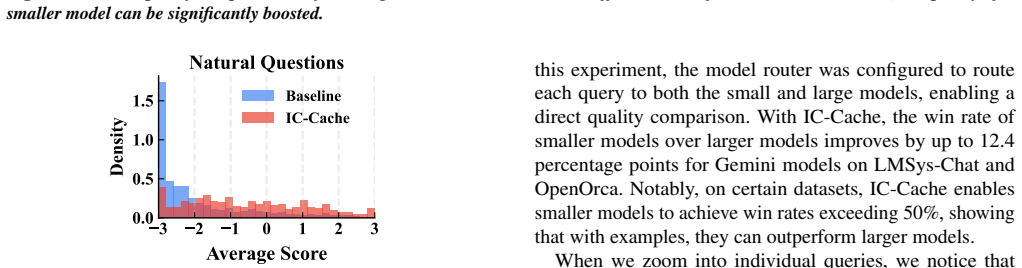
- [§2.3, Figure 4] The load-bearing claim that small models 'imitate and even exceed' larger models on compositional abilities is not supported by the paper's own data: on Math-500-Hard, Qwen-3B with curated IC examples reaches 34.4% accuracy versus 54.5% for Qwen-32B. The end-to-end quality results in §6.2 and Figures 12-17 cover conversational and QA datasets (LMSys-Chat, MS MARCO, Natural Questions, Orca), not math or code reasoning. Please add an end-to-end evaluation on a reasoning workload that reports both the router's offloading ratio and a correctness-based quality metric (e.g., exact-match or verifier accuracy) for the small model, the large model, and IC-Cache; without it, the 'without hurting response quality' claim is only established for style-sensitive tasks.
- [§6.1-6.2] The quality-parity result rests entirely on LLM-as-a-judge pairwise scores, and the paper reports a single run per configuration with no error bars, seeds, or statistical tests. Since the win-rate definition counts ties as 0.5 and the system is evaluated near parity, small evaluation noise can change the conclusion. Please report multiple evaluation seeds or bootstrap confidence intervals, and include at least one objective metric (e.g., code compilation/pass rate, math exact match) on datasets with ground truth, together with the MT-Bench human-alignment numbers for the actual judge-model combination used in each experiment.
- [§6.2, Figure 13] The headline throughput gains (1.4-5.9x) are not reproducible from the text: the paper does not state how throughput is measured (e.g., goodput under an SLO, requests/s at what batch and concurrency), how the Microsoft trace is scaled to the 16-A100 cluster, or what fraction of requests are offloaded in the reported end-to-end runs. Please specify the measurement protocol and report offloading ratios for each dataset/model pair, especially for reasoning-heavy workloads where the capability transfer is weaker.
- [§4.3 (Eq. 1) and Figure 11] The replay gain formula G(e) is introduced as the basis for cost-aware replay, but the paper does not validate that this proxy predicts actual offloading benefit. Figure 11 shows that replay improves response quality, which is a different claim. Please add an ablation that compares replay selection by G(e) against alternatives (e.g., random, frequency-only, quality-only) in terms of end-to-end throughput and quality, and report the sensitivity to the constants in the formula.
- [Appendix A.2] The 'formal' sample-complexity analysis is not rigorous as written. Theorem 1's proof sets C=2K and applies Hoeffding without stating boundedness of utilities; Theorem 4 concludes convergence to the 'minimum-cost model j' but relies on a 'sufficiently large' λ0, which is a free parameter, so the result is conditional. Since §4.2 advertises a formal analysis, either correct these proofs or soften the claim to an empirical observation.
minor comments (6)
- [§6 summary bullet] The text says 'without comprising response quality'; this should be 'without compromising response quality'.
- [Table 1 and Figure 4] Please clarify the relationship between 'Math500-Level5' (listed as 7,500 requests in Table 1) and 'Math-500-Hard' used in §2.3; the naming and sizes are inconsistent.
- [Figures 3, 10, 12, 13, 16, 19] The PDF text contains glyph artifacts such as '/glyph1197atural' and '/glyph1197umber'; these need to be repaired before publication.
- [Figure 10 and captions] The paper uses 'MS MACRO' in some places and 'MS MARCO' in others; please use a single consistent name.
- [§2.3] The grounding in in-context learning theory [32,72] is invoked without stating which theorem or result implies that prepended historical Q-A pairs transfer reasoning competence rather than surface format. Please cite a specific result or present a small controlled experiment that separates reasoning transfer from formatting imitation.
- [§5] The paper describes an implementation but does not release code or artifacts; given the systems claims, an artifact (even a VM image or Dockerfile) would materially strengthen reproducibility.
Circularity Check
No significant circularity: IC-Cache is an empirical systems paper evaluated against external baselines; its components are heuristics, and no headline claim reduces to a fitted input or self-citation.
full rationale
The paper's argument chain is empirical rather than derivational: it observes request similarity, hypothesizes that historical request-response pairs can serve as in-context examples, designs an example selector, router, and manager, and then measures throughput, latency, and quality against external baselines such as RouteLLM, LongRAG, and semantic caching. No load-bearing prediction is obtained by fitting a parameter to the target metric. The replay-gain formula G(e) = (1 - normalized_response_quality) x normalized_model_cost is an explicitly stated prioritization heuristic, not a quantity fitted to reproduce the reported gains; the bandit sample-complexity theorems are standard concentration and union-bound arguments; and the load-bias theorem is a direct consequence of the softmax score definition, not evidence for the end-to-end serving claims. The paper does not rely on self-citations to justify its central premise: in-context learning is grounded in external references, and the router's benefit is demonstrated against independent systems baselines. The only mild self-referential aspect is that the proxy helpfulness model is trained on preference-style feedback resembling the evaluation signal used for quality measurement, but the paper nowhere states that the LLM-as-judge evaluation score is the proxy's training target, so this remains an evaluation-validity concern rather than a demonstrated circular step. Likewise, the paper's own Figure 4 shows the reasoning transfer is incomplete (Qwen-3B with IC examples reaches 34.4% versus 54.5% for Qwen-32B on Math-500-Hard), which weakens the claim that small models exceed larger ones, but a correctness or scope limitation is not circularity. Overall the claim structure is self-contained and externally checked.
Assumptions & free parameters
free parameters (7)
- Number of in-context examples =
5 in Fig. 4; adaptive utility threshold otherwise
- Utility threshold for example selection =
not specified
- Load threshold for router =
not specified
- Load-bias constants λ0, γ =
not specified
- Example replay cutoff =
determined online
- Cache utility decay factor =
0.9 per hour
- Semantic-similarity threshold =
0.8
assumptions (5)
- domain assumption In-context learning transfers reasoning capability, not just style, from demonstrations to small models
- domain assumption User preference feedback (thumbs up/down, or pairwise) is a reliable, available quality signal for router and proxy training
- standard math The sample-complexity analysis relies on standard concentration results (Hoeffding, union bound) and Thompson sampling regret bounds [19]
- ad hoc to paper Replay gain G(e) = (1 - normalized_response_quality) × normalized_model_cost is an adequate proxy for future replay benefit
- domain assumption Semantic similarity via T5 embeddings is a sufficient prefilter for example relevance at scale
Cite this review
Pith. "Pith review of IC-Cache: Efficient Large Language Model Serving via In-context Caching." pith.science (2026). https://pith.science/paper/53GA4MRJ
@misc{pith2026250112689,
  author       = {Pith},
  title        = {Pith review of: IC-Cache: Efficient Large Language Model Serving via In-context Caching},
  year         = {2026},
  howpublished = {\url{https://pith.science/paper/53GA4MRJ}},
  note         = {Machine review of arXiv:2501.12689}
}
read the original abstract
Large language models (LLMs) have excelled in various applications, yet serving them at scale is challenging due to their substantial resource demands and high latency. Our real-world studies reveal that over 70% of user requests to LLMs have semantically similar counterparts, suggesting the potential for knowledge transfer among requests. However, naively caching and reusing past responses leads to a big quality drop. In this paper, we introduce IC-Cache, a caching system that enables live LLM capability augmentation to improve serving efficiency: by leveraging historical request-response pairs from larger models as in-context examples, IC-Cache empowers small LLMs to imitate and even exceed the compositional abilities (e.g., reasoning) of their larger counterparts, enabling selective offloading of requests to reduce cost and latency. Achieving this live augmentation at scale introduces intricate trade-offs between response quality, latency, and system throughput. For a new request, IC-Cache efficiently selects similar, high-utility examples to prepend them to the new request's input. At scale, it adaptively routes requests across LLMs of varying capabilities, accounting for response quality and serving loads. IC-Cache employs a cost-aware cache replay mechanism that refines example quality offline to maximize online cache utility and efficiency. Evaluations on millions of realistic requests demonstrate that IC-Cache improves LLM serving throughput by 1.4-5.9x and reduces latency by 28-71% without hurting response quality.
Figures


Figures from the paper (13 more)


Forward citations
Cited by 1 Pith paper
-
CORRECT: COndensed eRror RECognition via knowledge Transfer in multi-agent systems
CORRECT distills recurring multi-agent failure patterns into reusable error schemas and retrieves them at inference time to localize the decisive error step more accurately than judging or fine-tuning baselines.
Reference graph
Works this paper leans on
-
[1]
https://developers.google.com/ search/docs/appearance/ai-overviews
AI Overviews and Your Website. https://developers.google.com/ search/docs/appearance/ai-overviews
-
[2]
https://aws.amazon.com/codewhisperer/
Amazon codewhisperer. https://aws.amazon.com/codewhisperer/
-
[3]
https://claude.ai/
Anthropic claude. https://claude.ai/
-
[4]
https://character.ai/
Character ai. https://character.ai/
-
[5]
https://openai.com/index/ introducing-deep-research/
ChatGPT: Introducing deep research. https://openai.com/index/ introducing-deep-research/
-
[6]
https://api-docs.deepseek.com/guides/ kv_cache
DeepSeek Context caching. https://api-docs.deepseek.com/guides/ kv_cache
-
[7]
https: //github.com/deepseek-ai/open-infra-index/blob/main/ 202502OpenSourceWeek/day_6_one_more_thing_ deepseekV3R1_inference_system_overview.md
DeepSeek-V3/R1 Inference System Overview. https: //github.com/deepseek-ai/open-infra-index/blob/main/ 202502OpenSourceWeek/day_6_one_more_thing_ deepseekV3R1_inference_system_overview.md
-
[8]
https: //developers.googleblog.com/en/gemini-15-flash-8b-is-now- generally-\available-for-use/
Gemini 1.5 Flash-8B is now production ready. https: //developers.googleblog.com/en/gemini-15-flash-8b-is-now- generally-\available-for-use/
Show all 92 references
-
[9]
https://ai.google.dev/gemini-api/docs/ caching?lang=python
Gemini Context caching. https://ai.google.dev/gemini-api/docs/ caching?lang=python
-
[10]
https://github.com/features/copilot/
Github copilot. https://github.com/features/copilot/
-
[11]
https://www
Helicone:Open source LLM observability platform. https://www. helicone.ai/status/provider/Google
-
[12]
https://huggingface.co/spaces/lmarena-ai/chatbot-arena- leaderboard
https://huggingface.co/spaces/lmarena-ai/chatbot-arena-leaderboard. https://huggingface.co/spaces/lmarena-ai/chatbot-arena- leaderboard
-
[13]
https://huggingface.co/docs/ api-inference/index
HuggingFace Serverless Inference API. https://huggingface.co/docs/ api-inference/index
-
[14]
https://github
LangChain: Build context-aware reasoning applications. https://github. com/langchain-ai/langchain
-
[15]
https://microsoft.github.io/msmarco/
MS MARCO. https://microsoft.github.io/msmarco/
-
[16]
https: //github.com/explosion/spaCy
spaCy: Industrial-strength Natural Language Processing (NLP). https: //github.com/explosion/spaCy
-
[17]
https://www.databricks.com/blog/building-cost-optimized- chatbot-semantic-caching, 2024
Databricks: Building a cost-optimized chatbot with semantic caching. https://www.databricks.com/blog/building-cost-optimized- chatbot-semantic-caching, 2024
2024
-
[18]
Sarathi: Efficient llm in- ference by piggybacking decodes with chunked prefills
Amey Agrawal, Ashish Panwar, Jayashree Mohan, Nipun Kwatra, Bhar- gav S Gulavani, and Ramachandran Ramjee. Sarathi: Efficient llm in- ference by piggybacking decodes with chunked prefills. arXiv preprint arXiv:2308.16369, 2023
2023 arXiv
-
[19]
Analysis of thompson sampling for the multi-armed bandit problem
Shipra Agrawal and Navin Goyal. Analysis of thompson sampling for the multi-armed bandit problem. In Shie Mannor, Nathan Srebro, and Robert C. Williamson, editors, Proceedings of the 25th Annual Conference on Learning Theory, volume 23 of Proceedings of Machine Learning Resear...
-
[20]
Self-rag: Learning to retrieve, generate, and critique through self-reflection
Akari Asai, Zeqiu Wu, Yizhong Wang, Avirup Sil, and Hannaneh Hajishirzi. Self-rag: Learning to retrieve, generate, and critique through self-reflection. arXiv preprint arXiv:2310.11511, 2023
2023 arXiv
-
[21]
Gptcache: An open-source semantic cache for llm applica- tions enabling faster answers and cost savings
Fu Bang. Gptcache: An open-source semantic cache for llm applica- tions enabling faster answers and cost savings. In Proceedings of the 3rd Workshop for Natural Language Processing Open Source Software (NLP-OSS 2023), pages 212–218, 2023
2023
-
[22]
Findings of the 2016 conference on machine translation
Ondˇrej Bojar, Rajen Chatterjee, Christian Federmann, Yvette Graham, Barry Haddow, Matthias Huck, Antonio Jimeno Yepes, Philipp Koehn, IC-Cache: Efficient Large Language Model Serving via In-context Caching SOSP ’25, October 13–16, 2025, Seoul, Republic of Korea Varvara Logach...
2025
-
[23]
JAX: compos- able transformations of Python+NumPy programs, 2018
James Bradbury, Roy Frostig, Peter Hawkins, Matthew James Johnson, Chris Leary, Dougal Maclaurin, George Necula, Adam Paszke, Jake VanderPlas, Skye Wanderman-Milne, and Qiao Zhang. JAX: compos- able transformations of Python+NumPy programs, 2018
2018
-
[24]
Language models are few-shot learners
Tom B Brown. Language models are few-shot learners. arXiv preprint arXiv:2005.14165, 2020
2005 arXiv
-
[25]
Are more llm calls all you need? towards scaling laws of compound inference systems
Lingjiao Chen, Jared Quincy Davis, Boris Hanin, Peter Bailis, Ion Stoica, Matei Zaharia, and James Zou. Are more llm calls all you need? towards scaling laws of compound inference systems. In NeurIPS, 2024
2024
-
[26]
Safe rlhf: Safe reinforcement learning from human feedback
Josef Dai, Xuehai Pan, Ruiyang Sun, Jiaming Ji, Xinbo Xu, Mickel Liu, Yizhou Wang, and Yaodong Yang. Safe rlhf: Safe reinforcement learning from human feedback. arXiv preprint arXiv:2310.12773, 2023
2023 arXiv
-
[27]
Learning semantic similarity in a continuous space
Michel Deudon. Learning semantic similarity in a continuous space. In NeurIPS, 2018
2018
-
[28]
A survey on in-context learning
Qingxiu Dong, Lei Li, Damai Dai, Ce Zheng, Jingyuan Ma, Rui Li, Heming Xia, Jingjing Xu, Zhiyong Wu, Tianyu Liu, Baobao Chang, Xu Sun, Lei Li, and Zhifang Sui. A survey on in-context learning. In Arxiv: 2301.00234, 2023
2023 arXiv
-
[29]
Gemini: A family of highly capable multimodal models
Gemini Team Google. Gemini: A family of highly capable multimodal models. arXiv preprint arXiv:2312.11805, 2023
2023 arXiv
-
[30]
Reso, Maxim Groshev, Maxim Naumov, Maya Lathi, Meghan Ke- neally, Miao Liu, Michael L
Aaron Grattafiori, Abhimanyu Dubey, Abhinav Jauhri, Abhinav Pandey, Abhishek Kadian, Ahmad Al-Dahle, Aiesha Letman, Akhil Mathur, Alan Schelten, Alex Vaughan, Amy Yang, Angela Fan, Anirudh Goyal, Anthony Hartshorn, Aobo Yang, Archi Mitra, Archie Sravankumar, Artem Korenev, Art...
2025 arXiv
-
[31]
Apple intelligence foundation lan- guage models
Tom Gunter, Zirui Wang, Chong Wang, Ruoming Pang, Andy Narayanan, Aonan Zhang, Bowen Zhang, Chen Chen, Chung-Cheng Chiu, David Qiu, Deepak Gopinath, Dian Ang Yap, Dong Yin, Feng Nan, Floris Weers, Guoli Yin, Haoshuo Huang, Jianyu Wang, Jiarui Lu, John Peebles, Ke Ye, Mark Lee,...
2024
-
[32]
A theory of emergent in-context learning as implicit structure induction
Michael Hahn and Navin Goyal. A theory of emergent in-context learning as implicit structure induction. In arXiv: 2303.07971, 2023
2023 arXiv
-
[33]
Inference without interference: Disaggregate llm inference for mixed downstream workloads
Cunchen Hu, Heyang Huang, Liangliang Xu, Xusheng Chen, Jiang Xu, Shuang Chen, Hao Feng, Chenxi Wang, Sa Wang, Yungang Bao, et al. Inference without interference: Disaggregate llm inference for mixed downstream workloads. arXiv preprint arXiv:2401.11181, 2024
2024 arXiv
-
[34]
An empirical study of llm-as-a-judge for llm evaluation: Fine-tuned judge models are task-specific classifiers
Hui Huang, Yingqi Qu, Jing Liu, Muyun Yang, and Tiejun Zhao. An empirical study of llm-as-a-judge for llm evaluation: Fine-tuned judge models are task-specific classifiers. arXiv preprint arXiv:2403.02839, 2024
2024 arXiv
-
[35]
Evaluation of best-of-n sampling strategies for language model alignment
Yuki Ichihara, Yuu Jinnai, Tetsuro Morimura, Kaito Ariu, Kenshi Abe, Mitsuki Sakamoto, and Eiji Uchibe. Evaluation of best-of-n sampling strategies for language model alignment. In arXiv: 2502.12668, 2025
2025 arXiv
-
[36]
Active retrieval augmented generation
Zhengbao Jiang, Frank F Xu, Luyu Gao, Zhiqing Sun, Qian Liu, Jane Dwivedi-Yu, Yiming Yang, Jamie Callan, and Graham Neubig. Active retrieval augmented generation. arXiv preprint arXiv:2305.06983 , 2023
2023 arXiv
-
[37]
MegaScale: Scaling large language model training to more than 10,000 GPUs
Ziheng Jiang, Haibin Lin, Yinmin Zhong, Qi Huang, Yangrui Chen, Zhi Zhang, Yanghua Peng, Xiang Li, Cong Xie, Shibiao Nong, Yulu Jia, Sun He, Hongmin Chen, Zhihao Bai, Qi Hou, Shipeng Yan, Ding Zhou, Yiyao Sheng, Zhuo Jiang, Haohan Xu, Haoran Wei, Zhang Zhang, Pengfei Nie, Leqi...
-
[38]
Billion-scale similarity search with GPUs
Jeff Johnson, Matthijs Douze, and Hervé Jégou. Billion-scale similarity search with GPUs. IEEE Transactions on Big Data, 2019
2019
-
[39]
Tanh works better with asymmetry
Dongjin Kim, Woojeong Kim, and Suhyun Kim. Tanh works better with asymmetry. In NeurIPS, 2023
2023
-
[40]
Tree of clarifications: Answering ambiguous ques- tions with retrieval-augmented large language models
Gangwoo Kim, Sungdong Kim, Byeongguk Jeon, Joonsuk Park, and Jaewoo Kang. Tree of clarifications: Answering ambiguous ques- tions with retrieval-augmented large language models. arXiv preprint arXiv:2310.14696, 2023
2023 arXiv
-
[41]
Toutanova, Llion Jones, Ming-Wei Chang, Andrew Dai, Jakob Uszkoreit, Quoc Le, and Slav Petrov
Tom Kwiatkowski, Jennimaria Palomaki, Olivia Redfield, Michael Collins, Ankur Parikh, Chris Alberti, Danielle Epstein, Illia Polosukhin, Matthew Kelcey, Jacob Devlin, Kenton Lee, Kristina N. Toutanova, Llion Jones, Ming-Wei Chang, Andrew Dai, Jakob Uszkoreit, Quoc Le, and Slav...
2019
-
[42]
Efficient memory management for large language model serving with pagedattention
Woosuk Kwon, Zhuohan Li, Siyuan Zhuang, Ying Sheng, Lianmin Zheng, Cody Hao Yu, Joseph Gonzalez, Hao Zhang, and Ion Stoica. Efficient memory management for large language model serving with pagedattention. In SOSP, 2023
2023
-
[43]
Auto-gda: Automatic domain adaptation for efficient grounding verification in retrieval aug- mented generation
Tobias Leemann, Periklis Petridis, Giuseppe Vietri, Dionysis Manousakas, Aaron Roth, and Sergul Aydore. Auto-gda: Automatic domain adaptation for efficient grounding verification in retrieval aug- mented generation. arXiv preprint arXiv:2410.03461, 2024
-
[44]
Retrieval-augmented generation for knowledge- intensive nlp tasks
Patrick Lewis, Ethan Perez, Aleksandra Piktus, Fabio Petroni, Vladimir Karpukhin, Naman Goyal, Heinrich Küttler, Mike Lewis, Wen-tau Yih, Tim Rocktäschel, et al. Retrieval-augmented generation for knowledge- intensive nlp tasks. Advances in Neural Information Processing Sys- t...
2020
-
[45]
Dpsynthe- sizer: differentially private data synthesizer for privacy preserving data sharing
Haoran Li, Li Xiong, Lifan Zhang, and Xiaoqian Jiang. Dpsynthe- sizer: differentially private data synthesizer for privacy preserving data sharing. VLDB, 2014
2014
-
[46]
Schapire
Lihong Li, Wei Chu, John Langford, and Robert E. Schapire. A contextual-bandit approach to personalized news article recommen- dation. In WWW, 2010. IC-Cache: Efficient Large Language Model Serving via In-context Caching SOSP ’25, October 13–16, 2025, Seoul, Republic of Korea
2010
-
[47]
Gon- zalez, and Ion Stoica
Zhuohan Li, Lianmin Zheng, Yinmin Zhong, Vincent Liu, Ying Sheng, Xin Jin, Yanping Huang, Zhifeng Chen, Hao Zhang, Joseph E. Gon- zalez, and Ion Stoica. AlpaServe: Statistical multiplexing with model parallelism for deep learning serving. In OSDI, 2023
2023
-
[48]
Adaserve: Slo- customized llm serving with fine-grained speculative decoding
Zikun Li, Zhuofu Chen, Remi Delacourt, Gabriele Oliaro, Zeyu Wang, Qinghan Chen, Shuhuai Lin, April Yang, Zhihao Zhang, Zhuom- ing Chen, Sean Lai, Xupeng Miao, and Zhihao Jia. Adaserve: Slo- customized llm serving with fine-grained speculative decoding. In arXiv: 2501.12162, 2025
2025 arXiv
-
[49]
Openorca: An open dataset of gpt augmented flan reasoning traces
Wing Lian, Bleys Goodson, Eugene Pentland, Austin Cook, Chanvichet V ong, and "Teknium". Openorca: An open dataset of gpt augmented flan reasoning traces. https://https://huggingface.co/Open-Orca/ OpenOrca, 2023
2023
-
[50]
Parrot: Efficient serving of llm-based applications with semantic variable
Chaofan Lin, Zhenhua Han, Chengruidong Zhang, Yuqing Yang, Fan Yang, Chen Chen, and Lili Qiu. Parrot: Efficient serving of llm-based applications with semantic variable. In OSDI, 2024
2024
-
[51]
Andes: Defining and enhancing quality-of- experience in llm-based text streaming services
Jiachen Liu, Jae-Won Chung, Zhiyu Wu, Fan Lai, Myungjin Lee, and Mosharaf Chowdhury. Andes: Defining and enhancing quality-of- experience in llm-based text streaming services. 2024
2024
-
[52]
In-context learning with retrieved demonstrations for language models: A survey
Man Luo, Xin Xu, Yue Liu, Panupong Pasupat, and Mehran Kazemi. In-context learning with retrieved demonstrations for language models: A survey. arXiv preprint arXiv:2401.11624, 2024
2024 arXiv
-
[53]
Simpo: Simple preference optimization with a reference-free reward
Yu Meng, Mengzhou Xia, and Danqi Chen. Simpo: Simple preference optimization with a reference-free reward. In Advances in Neural Information Processing Systems (NeurIPS), 2024
2024
-
[54]
MS MARCO: A human generated machine reading comprehension dataset
Tri Nguyen, Mir Rosenberg, Xia Song, Jianfeng Gao, Saurabh Tiwary, Rangan Majumder, and Li Deng. MS MARCO: A human generated machine reading comprehension dataset. CoRR, abs/1611.09268, 2016
2016 arXiv
-
[55]
Gonzalez, M Waleed Kadous, and Ion Stoica
Isaac Ong, Amjad Almahairi, Vincent Wu, Wei-Lin Chiang, Tianhao Wu, Joseph E. Gonzalez, M Waleed Kadous, and Ion Stoica. Routellm: Learning to route llms with preference data. In arXiv: 2406.18665, 2024
2024 arXiv
-
[56]
Training language models to follow instruc- tions with human feedback
Long Ouyang, Jeffrey Wu, Xu Jiang, Diogo Almeida, Carroll Wain- wright, Pamela Mishkin, Chong Zhang, Sandhini Agarwal, Katarina Slama, Alex Ray, et al. Training language models to follow instruc- tions with human feedback. Advances in neural information processing systems, 35:...
2022
-
[57]
Splitwise: Efficient gen- erative llm inference using phase splitting
Pratyush Patel, Esha Choukse, Chaojie Zhang, Aashaka Shah, Íñigo Goiri, Saeed Maleki, and Ricardo Bianchini. Splitwise: Efficient gen- erative llm inference using phase splitting. In 2024 ACM/IEEE 51st Annual International Symposium on Computer Architecture (ISCA) , pages 118–...
2024
-
[58]
Conserve: Harvesting gpus for low-latency and high-throughput large language model serving
Yifan Qiao, Shu Anzai, Shan Yu, Haoran Ma, Yang Wang, Miryung Kim, and Harry Xu. Conserve: Harvesting gpus for low-latency and high-throughput large language model serving. In arXiv: 2410.01228, 2024
2024 arXiv
-
[59]
Modserve: Scal- able and resource-efficient large multimodal model serving
Haoran Qiu, Anish Biswas, Zihan Zhao, Jayashree Mohan, Alind Khare, Esha Choukse, Inigo Goiri, Zeyu Zhang, Haiying Shen, Chetan Bansal, Ramachandran Ramjee, and Rodrigo Fonseca. Modserve: Scal- able and resource-efficient large multimodal model serving. In arXiv: 2502.00937, 2025
2025
-
[60]
Colin Raffel, Noam Shazeer, Adam Roberts, Katherine Lee, Sharan Narang, Michael Matena, Yanqi Zhou, Wei Li, and Peter J. Liu. Explor- ing the limits of transfer learning with a unified text-to-text transformer. Journal of Machine Learning Research, 21(140):1–67, 2020
2020
-
[61]
The probabilistic relevance framework: Bm25 and beyond
Stephen Robertson, Hugo Zaragoza, et al. The probabilistic relevance framework: Bm25 and beyond. Foundations and Trends® in Informa- tion Retrieval, 3(4):333–389, 2009
2009
-
[62]
Enhancing retrieval-augmented large language models with iterative retrieval-generation synergy
Zhihong Shao, Yeyun Gong, Yelong Shen, Minlie Huang, Nan Duan, and Weizhu Chen. Enhancing retrieval-augmented large language models with iterative retrieval-generation synergy. arXiv preprint arXiv:2305.15294, 2023
2023 arXiv
-
[63]
Gonzalez, and Ion Stoica
Ying Sheng, Shiyi Cao, Dacheng Li, Banghua Zhu, Zhuohan Li, Danyang Zhuo, Joseph E. Gonzalez, and Ion Stoica. Fairness in serving large language models. In OSDI, 2024
2024
-
[64]
A statistical interpretation of term specificity and its application in retrieval
Karen Sparck Jones. A statistical interpretation of term specificity and its application in retrieval. Journal of documentation , 28(1):11–21, 1972
1972
-
[65]
Hygen: Efficient llm serving via elastic online-offline request co-location
Ting Sun, Penghan Wang, and Fan Lai. Hygen: Efficient llm serving via elastic online-offline request co-location. In arXiv: 2501.14808, 2025
2025
-
[66]
Hashimoto
Rohan Taori, Ishaan Gulrajani, Tianyi Zhang, Yann Dubois, Xuechen Li, Carlos Guestrin, Percy Liang, and Tatsunori B. Hashimoto. Stanford alpaca: An instruction-following llama model. https://github.com/ tatsu-lab/stanford_alpaca, 2023
2023
-
[67]
Gemma 2: Im- proving open language models at a practical size
Gemma Team, Morgane Riviere, Shreya Pathak, Pier Giuseppe Sessa, Cassidy Hardin, Surya Bhupatiraju, Léonard Hussenot, Thomas Mes- nard, Bobak Shahriari, Alexandre Ramé, et al. Gemma 2: Im- proving open language models at a practical size. arXiv preprint arXiv:2408.00118, 2024
2024 arXiv
-
[68]
Jaylen Wang, Daniel S. Berger, Fiodar Kazhamiaka, Celine Irvene, Chaojie Zhang, Esha Choukse, Kali Frost, Rodrigo Fonseca, Brijesh Warrier, Chetan Bansal, Jonathan Stern, Ricardo Bianchini, and Ak- shitha Sriraman. Designing cloud servers for lower carbon. In ISCA, 2024
2024
-
[69]
Emergent abilities of large language models
Jason Wei, Yi Tay, Rishi Bommasani, Colin Raffel, Barret Zoph, Sebas- tian Borgeaud, Dani Yogatama, Maarten Bosma, Denny Zhou, Donald Metzler, et al. Emergent abilities of large language models. arXiv preprint arXiv:2206.07682, 2022
2022 arXiv
-
[70]
Fast dis- tributed inference serving for large language models
Bingyang Wu, Yinmin Zhong, Zili Zhang, Shengyu Liu, Fangyue Liu, Yuanhang Sun, Gang Huang, Xuanzhe Liu, and Xin Jin. Fast dis- tributed inference serving for large language models. arXiv preprint arXiv:2305.05920, 2023
2023 arXiv
-
[71]
dLoRA: Dynamically orchestrating requests and adapters for LoRA LLM serving
Bingyang Wu, Ruidong Zhu, Zili Zhang, Peng Sun, Xuanzhe Liu, and Xin Jin. dLoRA: Dynamically orchestrating requests and adapters for LoRA LLM serving. In OSDI, 2024
2024
-
[72]
Why in-context learning models are good few-shot learners? In ICLR, 2025
Shiguang Wu, Yaqing Wang, and Quanming Yao. Why in-context learning models are good few-shot learners? In ICLR, 2025
2025
-
[73]
Powerinfer-2: Fast large language model inference on a smart- phone
Zhenliang Xue, Yixin Song, Zeyu Mi, Le Chen, Yubin Xia, and Haibo Chen. Powerinfer-2: Fast large language model inference on a smart- phone. arXiv preprint arXiv:2406.06282, 2024
2024 arXiv
-
[74]
Cacheblend: Fast large language model serving with cached knowledge fusion
Jiayi Yao, Hanchen Li, Yuhan Liu, Siddhant Ray, Yihua Cheng, Qizheng Zhang, Kuntai Du, Shan Lu, and Junchen Jiang. Cacheblend: Fast large language model serving with cached knowledge fusion. arXiv preprint arXiv:2405.16444, 2024
2024 arXiv
-
[75]
Generating data for symbolic language with large language models
Jiacheng Ye, Chengzu Li, Lingpeng Kong, and Tao Yu. Generating data for symbolic language with large language models. arXiv preprint arXiv:2305.13917, 2023
2023 arXiv
-
[76]
Compositional exemplars for in-context learning
Jiacheng Ye, Zhiyong Wu, Tao Yu, and Lingpeng Kong. Compositional exemplars for in-context learning. ICML, 2023
2023
-
[77]
Orca: A distributed serving system for{Transformer- Based} generative models
Gyeong-In Yu, Joo Seong Jeong, Geon-Woo Kim, Soojeong Kim, and Byung-Gon Chun. Orca: A distributed serving system for{Transformer- Based} generative models. In 16th USENIX Symposium on Operating Systems Design and Implementation (OSDI 22), pages 521–538, 2022
2022
-
[78]
Longrag: A dual-perspective retrieval- augmented generation paradigm for long-context question answering
Qingfei Zhao, Ruobing Wang, Yukuo Cen, Daren Zha, Shicheng Tan, Yuxiao Dong, and Jie Tang. Longrag: A dual-perspective retrieval- augmented generation paradigm for long-context question answering. EMNLP, 2024
2024
-
[79]
Xing, Joseph E
Lianmin Zheng, Wei-Lin Chiang, Ying Sheng, Tianle Li, Siyuan Zhuang, Zhanghao Wu, Yonghao Zhuang, Zhuohan Li, Zi Lin, Eric P. Xing, Joseph E. Gonzalez, Ion Stoica, and Hao Zhang. Lmsys-chat-1m: A large-scale real-world llm conversation dataset. arXiv: 2309.11998, 2024
2024 arXiv
-
[80]
Judging llm-as-a-judge with mt-bench and chatbot arena.NeurIPS, 2023
Lianmin Zheng, Wei-Lin Chiang, Ying Sheng, Siyuan Zhuang, Zhang- hao Wu, Yonghao Zhuang, Zi Lin, Zhuohan Li, Dacheng Li, Eric Xing, et al. Judging llm-as-a-judge with mt-bench and chatbot arena.NeurIPS, 2023. SOSP ’25, October 13–16, 2025, Seoul, Republic of Korea Yu et al
2023
-
[81]
Gonzalez, Clark Barrett, and Ying Sheng
Lianmin Zheng, Liangsheng Yin, Zhiqiang Xie, Chuyue Sun, Jeff Huang, Cody Hao Yu, Shiyi Cao, Christos Kozyrakis, Ion Stoica, Joseph E. Gonzalez, Clark Barrett, and Ying Sheng. Sglang: Effi- cient execution of structured language model programs. In ASPLOS, 2023
2023
-
[82]
Distserve: Disaggregating prefill and decoding for goodput-optimized large language model serving
Yinmin Zhong, Shengyu Liu, Junda Chen, Jianbo Hu, Yibo Zhu, Xu- anzhe Liu, Xin Jin, and Hao Zhang. Distserve: Disaggregating prefill and decoding for goodput-optimized large language model serving. arXiv preprint arXiv:2401.09670, 2024
2024 arXiv
-
[83]
Distillspec: Improving speculative decoding via knowledge distillation, 2024
Yongchao Zhou, Kaifeng Lyu, Ankit Singh Rawat, Aditya Krishna Menon, Afshin Rostamizadeh, Sanjiv Kumar, Jean-Francois Kagy, and Rishabh Agarwal. Distillspec: Improving speculative decoding via knowledge distillation, 2024. IC-Cache: Efficient Large Language Model Serving via I...
2024
-
[84]
We can bound this with the union bound: 𝑃(ˆ𝑖𝑇 ≠ 1)≤ 𝑁∑︁ 𝑖=2 𝑃(𝜇𝑖 >𝜇1) (2)
Union Bound: The overall probability of failure is the probability that any suboptimal model 𝑖’s estimated utility 𝜇𝑖 is greater than the best model’s estimated utility𝜇1. We can bound this with the union bound: 𝑃(ˆ𝑖𝑇 ≠ 1)≤ 𝑁∑︁ 𝑖=2 𝑃(𝜇𝑖 >𝜇1) (2)
-
[85]
We can state this more formally for the number of comparisons,𝑚𝑖(𝑇), for a sufficiently large T: 𝑚𝑖(𝑇)≥ 𝐾 log(𝑇) Δ2 𝑖 (3) where𝐾 is a positive constant
Number of Samples: For Thompson sampling, each suboptimal model 𝑖 is sampled approximately 𝑂(log(𝑇)/Δ2 𝑖) times in𝑇 rounds [19]. We can state this more formally for the number of comparisons,𝑚𝑖(𝑇), for a sufficiently large T: 𝑚𝑖(𝑇)≥ 𝐾 log(𝑇) Δ2 𝑖 (3) where𝐾 is a positive constant
-
[86]
Let the em- pirical difference be ˆΔ𝑖(𝑚) = 𝜇1−𝜇𝑖 after𝑚 compar- isons, whose true mean is the utility gap Δ𝑖 =𝑈1−𝑈𝑖
Applying Hoeffding’s Inequality: Let’s analyze the probability of a single error, 𝑃(𝜇𝑖 > 𝜇1). Let the em- pirical difference be ˆΔ𝑖(𝑚) = 𝜇1−𝜇𝑖 after𝑚 compar- isons, whose true mean is the utility gap Δ𝑖 =𝑈1−𝑈𝑖. The error event 𝜇𝑖 > 𝜇1 is equivalent to ˆΔ𝑖(𝑚) < 0. This can be w...
-
[87]
Now we substitute the bound for the number of samples 𝑚𝑖(𝑇): 𝑃(𝜇𝑖 >𝜇1)≤ exp −2 𝐾 log(𝑇) Δ2 𝑖 Δ2 𝑖 (5) Which simplifies to: 𝑃(𝜇𝑖 >𝜇1)≤ 𝑒−2𝐾 log(𝑇) =𝑒log(𝑇−2𝐾) =𝑇−2𝐾 (6)
-
[88]
Substitut- ing this result back into the union bound from step 1 gives the final bound
Setting𝐶 = 2𝐾 ,we have𝑃(𝜇𝑖 >𝜇1)≤ 𝑇−𝐶. Substitut- ing this result back into the union bound from step 1 gives the final bound. Theorem 2: To identify the best model with probability at least 1−𝛿, the hybrid Thompson sampling approach requires: 𝑇 =𝑂 𝑁 Δ2 min log 𝑁 𝛿 ! (7) compar...
2025
-
[89]
Limiting Behavior of Tanh:As the load𝐿→∞ , the hyperbolic tangent term approaches its maximum value: lim𝐿→∞ tanh(𝛾𝐿) = 1
-
[90]
Ratio of Probabilities: Consider the ratio of probabili- ties between any model𝑘 ≠ 𝑗 (where𝐶𝑘 >𝐶𝑗) and the minimum-cost model 𝑗: 𝑃𝑘(𝐿) 𝑃𝑗(𝐿) = exp(𝑆𝑘(𝐿)) exp(𝑆𝑗(𝐿)) = exp(𝑆𝑘(𝐿)− 𝑆𝑗(𝐿)) (10) Substituting the score definition: 𝑆𝑘(𝐿)− 𝑆𝑗(𝐿) =(𝜇𝑘−𝜇𝑗)− 𝜆0 tanh(𝛾𝐿)(𝐶𝑘−𝐶𝑗) (11)
-
[91]
Asymptotic Limit: We take the limit of this difference as𝐿→∞ : lim 𝐿→∞ (𝑆𝑘(𝐿)− 𝑆𝑗(𝐿)) =(𝜇𝑘−𝜇𝑗)− 𝜆0(𝐶𝑘−𝐶𝑗) (12) Since𝐶𝑘 >𝐶𝑗, the term(𝐶𝑘−𝐶𝑗) is a positive constant. For a sufficiently large cost-sensitivity parameter 𝜆0, the negative cost term−𝜆0(𝐶𝑘−𝐶𝑗) will dominate the consta...
-
[92]
As the exponent approaches−∞, the ratio of probabili- ties approaches zero: lim 𝐿→∞ 𝑃𝑘(𝐿) 𝑃𝑗(𝐿) = 0 for all𝑘 ≠ 𝑗 (13) Since Í𝑁 𝑖=1𝑃𝑖(𝐿) = 𝑃𝑗(𝐿)+ Í 𝑘≠𝑗𝑃𝑘(𝐿) = 1, and the ratio of every other model’s probability to model 𝑗’s probability goes to zero, it must be thatlim𝐿→∞𝑃𝑗(𝐿) =...
2025
Reviewed August 10, 2026 · model on record in the stance chip above.
Discussion (0). Continue with ORCID to comment.