REVIEW 4 major objections 5 minor 299 references
SMART-Vision: Survey of Modern Action Recognition Techniques in Vision
T0 review · 4 major / 5 minor · reviewed 2026-08-10 · deepseek-v4-flash
Pith's one-line read A new survey taxonomy, SMART-Vision, argues that most modern human-action-recognition systems are hybrids of two-stream, 3D-convolutional, graph-convolutional, motion, and transformer designs, and gives a first overview of the emerging…
desk verdict A useful hybrid-taxonomy and Open-HAR overview, but the benchmark tables have verified errors that currently undermine the paper's comparative claims. read the letter →
The pith
A machine-rendered reading of the paper's core claim, the machinery that carries it, and where it could break.
The reading
What carries the argument
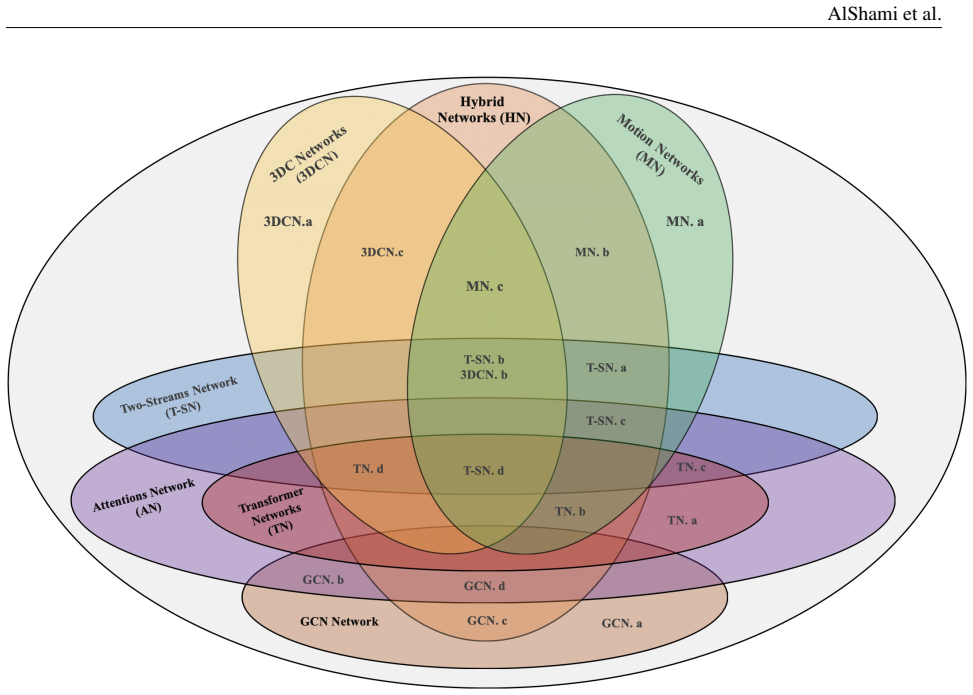
The central object is the SMART-Vision taxonomy: a Venn diagram (Figure 1) with five architectural families as overlapping regions and a Hybrid Networks region formed by their unions, accompanied by per-intersection tables (Tables 1-8, 9-11) that list representative papers for each combination. It is the device that carries the argument, because each citation's placement in an intersection is the evidence that the system is hybrid. The second machinery is the Open-HAR framing, which imports the open-set and open-world distinction from general recognition into HAR: open-set systems reject unknown classes, while open-world systems detect, cluster, and incrementally learn them. The taxonomy's claim that many proposed systems are inherently hybrid is operationalized entirely through these placements.
What would settle it
Check each entry of Tables 9-11 against the cited original papers: if entries such as X3D's 94.6%, TubeViT-H's XSub and XView figures, and UMT-L's XView figure are confirmed to be assigned to the wrong datasets or values, the comprehensive evaluation and performance comparison contribution is not reliable; a full re-verification would settle the question.
Extended reading notes
Core claim
On the paper's own terms, the discovery is that hybridity is the norm rather than the exception in modern HAR. The authors organize the literature into five foundational families — two-stream networks, 3D convolutional networks, graph convolutional networks, motion networks, and transformer networks — and then show, paper by paper, that the most successful systems occupy the intersections: two-stream I3D couples motion with 3D convolution, ST-TR and RGBSformer pair skeletons with transformer attention, and SlowFast-style designs merge dual-rate streams with 3D backbones. For Open-HAR, the paper assembles the scattered open-set and open-world work, from evidential and capsule-based open-set classifiers to the KOWL-718 open-world protocol, into a single discussion with the explicit claim that no accepted large-scale evaluation standard yet exists. The claim is therefore about how to read the field: a fair reader should see modern action recognition as a web of complementary design choices, not a race between monolithic architectures.
Load-bearing premise
The load-bearing premise of the survey's comparative claims is that the accuracy numbers transcribed into Tables 9-11 are correct and assigned to the right dataset columns; at least one entry violates this premise, since Table 9 lists X3D's 94.6% under HMDB-51 while the text describes it as a Kinetics-400 result.
Editorial extensions
If this is right
- A newcomer can use the intersection tables to find the hybrid recipe that matches a task, such as skeleton plus transformer or two-stream plus 3D convolution, instead of reading the full literature.
- If hybridity is the norm, the field's next advances are likely to come from combining existing families, such as GCN pose encoders with masked-autoencoder transformers, rather than from a new monolithic architecture.
- Open-HAR becomes a testable research program: with the KOWL-718 protocol available, future open-world HAR systems can be compared on a common large-scale baseline.
- The dataset and benchmark tables give a single place to compare representative accuracy figures across UCF-101, HMDB-51, Kinetics, and NTU RGB+D, subject to verification of the transcribed numbers.
- The survey's challenges list points to occlusion, viewpoint, efficiency, and generalization as the binding constraints on deployed HAR systems, not classification accuracy alone.
Reading between the lines
- If the hybrid map is right, performance comparisons should routinely ablate each component of a hybrid system; the survey does not itself provide such ablations, so readers cannot tell which ingredient carries the gain.
- The same Venn-style mapping could be applied to neighboring video tasks, such as temporal action localization, video-text retrieval, and egocentric action recognition, where similar paradigm blending is underway but not yet cataloged.
- Open-HAR's lack of a standard evaluation protocol suggests a concrete next step: re-run existing open-set HAR methods on the KOWL-718 splits using OWM-style metrics, which the survey notes have not yet been adopted.
- Because the comparison tables already contain at least one dataset-column mismatch, the benchmark inventory should be treated as a pointer to original papers rather than as a verified leaderboard.
Editorial analysis
A structured set of objections, weighed in public.
Referee Report
Summary. The paper is a survey of deep-learning-based vision approaches to human action recognition (HAR). Its central contribution is a 'SMART-Vision' taxonomy, displayed as a Venn diagram, that groups HAR architectures into two-stream, 3D convolutional, graph convolutional, motion, and Transformer families, and emphasizes that many recent systems are hybrids of these families. The survey also claims to provide the first comprehensive analysis of Open-HAR (open-set and open-world HAR), a comparison of benchmark results in Tables 9-11, a review of HAR datasets, and a discussion of challenges and future directions.
Significance. If the taxonomy and literature mapping are accurate, the survey is a useful organizing resource for a fast-moving field: the Venn-diagram structure and the per-intersection citation tables give a practical map of how 2D/3D CNNs, GCNs, motion modules, and Transformers are combined. The Open-HAR section is a valuable collection of scattered work on open-set and open-world HAR, including the KOWL-718 protocol, and it is more detailed than in most prior HAR surveys. The paper does not claim a new empirical result or benchmark, so its value rests on the reliability of its literature assignments and tables. That reliability is currently compromised by verified transcription and labeling errors in the comparative core (Tables 9, 11, 13, 14), which must be corrected before the survey's 'comprehensive evaluation and performance comparison' claim can be accepted.
major comments (4)
- [Table 9 / Section 3.9] Table 9 lists X3D as achieving 94.6% under the HMDB-51 column, while the text in Section 3.9 explicitly states that this value is a Kinetics-400 accuracy. The same row leaves the K400 column blank. Because Table 9 is the evidence base for the paper's 'comprehensive evaluation and performance comparison' contribution, this is a load-bearing data-integrity error, not a formatting slip. All numbers in Tables 9-11 should be re-verified against the primary sources and placed in the correct dataset columns.
- [Section 3.9 / Table 11] The paragraph discussing TubeViT-H and UMT-L reports Kinetics-400 and Kinetics-600 Top-1/Top-5 accuracies using NTU-style split names: 'TubeViT-H model produced 90.9% accuracy for the XSub and 98.9% the XView on Kinetics-400' and 'UMT-L Model provide 98.8% for XView on Kinetics-600.' Table 11 repeats these values as Top-1/Top-5, so the text contradicts its own table and mislabels standard Kinetics metrics as cross-subject/cross-view splits. The section should clearly separate Kinetics Top-1/Top-5 results from NTU RGB+D XSub/XView results.
- [Table 13] Table 13 lists HMDB51 twice with contradictory modality entries: the first entry marks it as RGB-only, while a later entry for the same dataset marks RGB, Skeleton, Depth, and Infrared as available. This second row contradicts the dataset description in Section 5, where HMDB51 is presented as an RGB dataset. Since the table is the survey's modality-coverage reference, the duplicated row and its checkmarks must be reconciled with the primary dataset documentation.
- [Table 14] Table 14 contains duplicate rows for UCFKinect, with sample counts written as '12,80' (presumably 1,280), and it labels Kinetics-400/600/700 as 'Kinectis' throughout. These entries, together with the errors in Tables 9 and 13, indicate that the tabulated inventories were not carefully checked against the cited sources; a systematic verification pass is needed before the survey can serve as a reliable reference.
minor comments (5)
- [Section 3.4.3] The text contains 'ST-GNC' where ST-GCN is meant, and 'different mythologies' where 'methodologies' is intended; these typos should be corrected.
- [Table 9] The RHN row reports '71.8' without a percent sign, unlike all other entries; this is likely a typographical omission, but every numerical cell should be checked for consistency.
- [Figure 1 caption] The caption abbreviates '3D Convolutional Networks' as '3DCN', while the text immediately below refers to 'Graph Convolutional Networks (3DCN)', creating an ambiguous acronym; the abbreviations for the two network families should be made distinct.
- [Section 3.2.2] The sentence 'Other researchers have contributed exciting to the two-stream architecture' appears to be missing a noun or adjective; it should read 'exciting contributions' or similar.
- [Section 5, Table 14] The Kinetics series is consistently misspelled as 'Kinectis' in Table 14 and in parts of Section 5; the correct spelling should be used throughout.
Circularity Check
No significant circularity: SMART-Vision is a survey whose taxonomy, hybrid-architecture claims, and Open-HAR discussion rest on literature classification and reported results, not on a derivation that re-imports its own conclusions.
full rationale
This paper is a survey and provides no fitted-parameter-to-prediction chain, no uniqueness theorem imported from prior work, and no equation-level reduction of a claimed result to its inputs. The SMART-Vision taxonomy is an organizational Venn diagram: Section 3.7 states that hybrid models are 'by definition, not exclusive in our taxonomy,' and the claim that many systems are 'inherently hybrid' is a classification observation, not a derived prediction. The self-citations that appear are not load-bearing in the central taxonomy: [22] and [23] are application examples (Amazon Go, tennis motion analysis), and the Open-HAR section draws on foundational novelty and Open-world works for background and evaluation protocols, but the survey's coverage claim does not reduce to those references. The paper's actual weakness is data integrity in the comparison tables: Table 9 lists X3D as '94.6%' under HMDB-51 while Section 3.9 says the 94.6% figure is Kinetics-400, and Table 11 assigns NTU RGB+D 'XSub/XView' split names to Kinetics-400 and Kinetics-600 results for TubeViT-H and UMT-L. Those are transcription and mislabeling problems that damage the reliability of the 'comprehensive evaluation' contribution, but they are not circularity: the tables report externally reported accuracies rather than fitting or defining the phenomena they claim to compare. No circularity score above 0 is warranted.
Assumptions & free parameters
assumptions (3)
- domain assumption The five archetypes (two-stream, 3D convolutional, graph convolutional, motion, transformer) are the correct fundamental categories for modern HAR, and their intersections are the right unit of analysis.
- domain assumption Benchmark numbers transcribed from cited papers are accurate and placed under the correct dataset columns.
- domain assumption The unified novelty framework of Boult et al. [197] and the KOWL-718 protocol of Prijatel et al. [198] are the accepted foundation for Open-HAR.
Cite this review
Pith. "Pith review of SMART-Vision: Survey of Modern Action Recognition Techniques in Vision." pith.science (2026). https://pith.science/paper/FOKDJOJV
@misc{pith2026250113066,
  author       = {Pith},
  title        = {Pith review of: SMART-Vision: Survey of Modern Action Recognition Techniques in Vision},
  year         = {2026},
  howpublished = {\url{https://pith.science/paper/FOKDJOJV}},
  note         = {Machine review of arXiv:2501.13066}
}
read the original abstract
Human Action Recognition (HAR) is a challenging domain in computer vision, involving recognizing complex patterns by analyzing the spatiotemporal dynamics of individuals' movements in videos. These patterns arise in sequential data, such as video frames, which are often essential to accurately distinguish actions that would be ambiguous in a single image. HAR has garnered considerable interest due to its broad applicability, ranging from robotics and surveillance systems to sports motion analysis, healthcare, and the burgeoning field of autonomous vehicles. While several taxonomies have been proposed to categorize HAR approaches in surveys, they often overlook hybrid methodologies and fail to demonstrate how different models incorporate various architectures and modalities. In this comprehensive survey, we present the novel SMART-Vision taxonomy, which illustrates how innovations in deep learning for HAR complement one another, leading to hybrid approaches beyond traditional categories. Our survey provides a clear roadmap from foundational HAR works to current state-of-the-art systems, highlighting emerging research directions and addressing unresolved challenges in discussion sections for architectures within the HAR domain. We provide details of the research datasets that various approaches used to measure and compare goodness HAR approaches. We also explore the rapidly emerging field of Open-HAR systems, which challenges HAR systems by presenting samples from unknown, novel classes during test time.
Figures


Figures from the paper (9 more)




Reference graph
Works this paper leans on
-
[1]
Human action recognition from various data modalities: A review
Zehua Sun, Qiuhong Ke, Hossein Rahmani, Mohammed Bennamoun, Gang Wang, and Jun Liu. Human action recognition from various data modalities: A review. IEEE transactions on pattern analysis and machine intelligence, 2022
2022
-
[2]
Human action recognition: A taxonomy-based survey, updates, and opportunities
Md Golam Morshed, Tangina Sultana, Aftab Alam, and Young-Koo Lee. Human action recognition: A taxonomy-based survey, updates, and opportunities. Sensors, 23(4):2182, 2023
2023
-
[3]
Graph convolutional neural network for human action recognition: A comprehensive survey
Tasweer Ahmad, Lianwen Jin, Xin Zhang, Songxuan Lai, Guozhi Tang, and Luojun Lin. Graph convolutional neural network for human action recognition: A comprehensive survey. IEEE Transactions on Artificial Intelligence, 2(2):128–145, 2021
2021
-
[4]
Vision transformers for action recognition: A survey
Anwaar Ulhaq, Naveed Akhtar, Ganna Pogrebna, and Ajmal Mian. Vision transformers for action recognition: A survey. arXiv preprint arXiv:2209.05700, 2022
arXiv 2022
-
[5]
A survey on video-based human action recognition: recent updates, datasets, challenges, and applications
Preksha Pareek and Ankit Thakkar. A survey on video-based human action recognition: recent updates, datasets, challenges, and applications. Artificial Intelligence Review, 54(3):2259–2322, 2021
2021
-
[6]
Human activity recognition: A survey.Procedia Computer Science, 155:698–703, 2019
Charmi Jobanputra, Jatna Bavishi, and Nishant Doshi. Human activity recognition: A survey.Procedia Computer Science, 155:698–703, 2019
2019
-
[7]
Human action recognition and prediction: A survey.International Journal of Computer Vision, 130(5):1366–1401, 2022
Yu Kong and Yun Fu. Human action recognition and prediction: A survey.International Journal of Computer Vision, 130(5):1366–1401, 2022
2022
-
[8]
A survey on intelligent human action recognition techniques
Rahul Kumar and Shailender Kumar. A survey on intelligent human action recognition techniques. Multimedia Tools and Applications, 83(17):52653–52709, 2024
2024
Show all 299 references
-
[9]
A comprehensive study of deep video action recognition
Yi Zhu, Xinyu Li, Chunhui Liu, Mohammadreza Zolfaghari, Yuanjun Xiong, Chongruo Wu, Zhi Zhang, Joseph Tighe, R Manmatha, and Mu Li. A comprehensive study of deep video action recognition. arXiv preprint arXiv:2012.06567, 2020
2012 arXiv
-
[10]
Imagenet classification with deep convolutional neural networks
Alex Krizhevsky, Ilya Sutskever, and Geoffrey E Hinton. Imagenet classification with deep convolutional neural networks. Advances in neural information processing systems, 25, 2012
2012
-
[11]
Action recognition and detection by combining motion and appearance features
Limin Wang, Yu Qiao, Xiaoou Tang, et al. Action recognition and detection by combining motion and appearance features. THUMOS14 Action Recognition Challenge, 1(2):2, 2014
2014
-
[12]
Large-scale video classification with convolutional neural networks
Andrej Karpathy, George Toderici, Sanketh Shetty, Thomas Leung, Rahul Sukthankar, and Li Fei-Fei. Large-scale video classification with convolutional neural networks. In Proceedings of the IEEE conference on Computer Vision and Pattern Recognition, pages 1725–1732, 2014
2014
-
[13]
A key volume mining deep framework for action recognition
Wangjiang Zhu, Jie Hu, Gang Sun, Xudong Cao, and Yu Qiao. A key volume mining deep framework for action recognition. In Proceedings of the IEEE conference on computer vision and pattern recognition, pages 1991–1999, 2016
1991
-
[14]
Temporal action localization in untrimmed videos via multi-stage cnns
Zheng Shou, Dongang Wang, and Shih-Fu Chang. Temporal action localization in untrimmed videos via multi-stage cnns. In Proceedings of the IEEE conference on computer vision and pattern recognition, pages 1049–1058, 2016
2016
-
[15]
A review of human activity recognition methods
Michalis Vrigkas, Christophoros Nikou, and Ioannis A Kakadiaris. A review of human activity recognition methods. Frontiers in Robotics and AI, 2:28, 2015
2015
-
[16]
Analysis and predictive modeling of body language behavior in dyadic interactions from multimodal interlocutor cues
Zhaojun Yang, Angeliki Metallinou, and Shrikanth Narayanan. Analysis and predictive modeling of body language behavior in dyadic interactions from multimodal interlocutor cues. IEEE Transactions on Multimedia, 16(6):1766–1778, 2014
2014
-
[17]
Motion part regularization: Improving action recognition via trajectory selection
Bingbing Ni, Pierre Moulin, Xiaokang Yang, and Shuicheng Yan. Motion part regularization: Improving action recognition via trajectory selection. In Proceedings of the IEEE Conference on Computer Vision and Pattern Recognition, pages 3698–3706, 2015
2015
-
[18]
Structured learning of human interactions in tv shows
Alonso Patron-Perez, Marcin Marszalek, Ian Reid, and Andrew Zisserman. Structured learning of human interactions in tv shows. IEEE Transactions on Pattern Analysis and Machine Intelligence, 34(12):2441–2453, 2012
2012
-
[19]
Part-based motion descriptor image for human action recognition
Khai N Tran, Ioannis A Kakadiaris, and Shishir K Shah. Part-based motion descriptor image for human action recognition. Pattern Recognition, 45(7):2562–2572, 2012. Published in Multimedia Tools and Applications Journal AlShami et al
2012
-
[20]
Don’t classify ratings of affect; rank them! IEEE transactions on affective computing, 5(3):314–326, 2014
Hector P Martinez, Georgios N Yannakakis, and John Hallam. Don’t classify ratings of affect; rank them! IEEE transactions on affective computing, 5(3):314–326, 2014
2014
-
[21]
Discriminative latent models for recognizing contextual group activities
Tian Lan, Yang Wang, Weilong Yang, Stephen N Robinovitch, and Greg Mori. Discriminative latent models for recognizing contextual group activities. IEEE transactions on pattern analysis and machine intelligence, 34(8): 1549–1562, 2011
2011
-
[22]
Generating Tennis Player by the Predicting Movement Using 2D Pose Estimation
Ali Kareem Al Shami. Generating Tennis Player by the Predicting Movement Using 2D Pose Estimation. PhD thesis, University of Colorado Colorado Springs, 2022
2022
-
[23]
Pose2trajectory: Using transformers on body pose to predict tennis player’s trajectory
Ali AlShami, Terrance Boult, and Jugal Kalita. Pose2trajectory: Using transformers on body pose to predict tennis player’s trajectory. Journal of Visual Communication and Image Representation, 97:103954, 2023
2023
-
[24]
Deep learning based advanced spatio-temporal extraction model in medical sports rehabilitation for motion analysis and data processing
Huayun Cui and Cunqiang Chang. Deep learning based advanced spatio-temporal extraction model in medical sports rehabilitation for motion analysis and data processing. IEEE Access, 8:115848–115856, 2020
2020
-
[25]
Two-stream convolutional networks for action recognition in videos
Karen Simonyan and Andrew Zisserman. Two-stream convolutional networks for action recognition in videos. Advances in neural information processing systems, 27, 2014
2014
-
[26]
Going deeper with two-stream ConvNets for action recognition in video surveillance
Yamin Han, Peng Zhang, Tao Zhuo, Wei Huang, and Yanning Zhang. Going deeper with two-stream ConvNets for action recognition in video surveillance. Pattern Recognition Letters, 107:83–90, 2018. ISSN 01678655
2018
-
[27]
Distinct two-stream convolutional networks for human action recognition in videos using segment-based temporal modeling
Ashok Sarabu and Ajit Kumar Santra. Distinct two-stream convolutional networks for human action recognition in videos using segment-based temporal modeling. Data, 5(4), 2020
2020
-
[28]
Action Recognition Based on Two-Stream Convolutional Networks With Long-Short-Term Spatiotemporal Features
Yanqin Wan, Zujun Yu, Yao Wang, and Xingxin Li. Action Recognition Based on Two-Stream Convolutional Networks With Long-Short-Term Spatiotemporal Features. IEEE Access, 8:85284–85293, 2020
2020
-
[29]
Learning Long-Term Temporal Features With Deep Neural Networks for Human Action Recognition
Sheng Yu, Li Xie, Lin Liu, and Daoxun Xia. Learning Long-Term Temporal Features With Deep Neural Networks for Human Action Recognition. IEEE Access, 8:1840–1850, 2020
2020
-
[30]
Human action recognition using two-stream attention based LSTM networks
Cheng Dai, Xingang Liu, and Jinfeng Lai. Human action recognition using two-stream attention based LSTM networks. Applied Soft Computing, 86:105820, January 2020. ISSN 15684946
2020
-
[31]
Human Action Recognition Based on Improved Two- Stream Convolution Network
Zhongwen Wang, Haozhu Lu, Junlan Jin, and Kai Hu. Human Action Recognition Based on Improved Two- Stream Convolution Network. Applied Sciences, 12(12):5784, January 2022. ISSN 2076-3417
2022
-
[32]
Toward Efficient Action Recognition: Principal Backpropagation for Training Two-Stream Networks
Wenbing Huang, Lijie Fan, Mehrtash Harandi, Lin Ma, Huaping Liu, Wei Liu, and Chuang Gan. Toward Efficient Action Recognition: Principal Backpropagation for Training Two-Stream Networks. IEEE Transactions on Image Processing, 28(4):1773–1782, April 2019. ISSN 1941-0042
2019
-
[33]
Two-stream flow-guided convolutional attention networks for action recognition
An Tran and Loong-Fah Cheong. Two-stream flow-guided convolutional attention networks for action recognition. In Proceedings of the IEEE International Conference on Computer Vision Workshops, pages 3110–3119, 2017
2017
-
[34]
Convolutional two-stream network fusion for video action recognition
Christoph Feichtenhofer, Axel Pinz, and Andrew Zisserman. Convolutional two-stream network fusion for video action recognition. In Proceedings of the IEEE conference on computer vision and pattern recognition, pages 1933–1941, 2016
1933
-
[35]
Unsupervised motion representation enhanced network for action recognition
Xiaohang Yang, Lingtong Kong, and Jie Yang. Unsupervised motion representation enhanced network for action recognition. In ICASSP 2021 - 2021 IEEE International Conference on Acoustics, Speech and Signal Processing (ICASSP), pages 2445–2449, 2021
2021
-
[36]
Two stream lstm: A deep fusion framework for human action recognition
Harshala Gammulle, Simon Denman, Sridha Sridharan, and Clinton Fookes. Two stream lstm: A deep fusion framework for human action recognition. In 2017 IEEE winter conference on applications of computer vision (W ACV), pages 177–186. IEEE, 2017
2017
-
[37]
Learning from temporal gradient for semi-supervised action recognition
Junfei Xiao, Longlong Jing, Lin Zhang, Ju He, Qi She, Zongwei Zhou, Alan Yuille, and Yingwei Li. Learning from temporal gradient for semi-supervised action recognition. In Proceedings of the IEEE/CVF Conference on Computer Vision and Pattern Recognition (CVPR), pages 3252–3262...
2022
-
[38]
Deep residual learning for image recognition
Kaiming He, Xiangyu Zhang, Shaoqing Ren, and Jian Sun. Deep residual learning for image recognition. In Proceedings of the IEEE conference on computer vision and pattern recognition, pages 770–778, 2016
2016
-
[39]
Batch normalization: Accelerating deep network training by reducing internal covariate shift
Sergey Ioffe and Christian Szegedy. Batch normalization: Accelerating deep network training by reducing internal covariate shift. In International conference on machine learning, pages 448–456. pmlr, 2015
2015
-
[40]
Very deep convolutional networks for large-scale image recognition
Karen Simonyan and Andrew Zisserman. Very deep convolutional networks for large-scale image recognition. arXiv preprint arXiv:1409.1556, 2014
2014 arXiv
-
[41]
Hearst, Susan T Dumais, Edgar Osuna, John Platt, and Bernhard Scholkopf
Marti A. Hearst, Susan T Dumais, Edgar Osuna, John Platt, and Bernhard Scholkopf. Support vector machines. IEEE Intelligent Systems and their applications, 13(4):18–28, 1998. Published in Multimedia Tools and Applications Journal AlShami et al
1998
-
[42]
A novel recurrent hybrid network for feature fusion in action recognition
Sheng Yu, Yun Cheng, Li Xie, Zhiming Luo, Min Huang, and Shaozi Li. A novel recurrent hybrid network for feature fusion in action recognition. Journal of Visual Communication and Image Representation, 49:192–203, 2017
2017
-
[43]
Going deeper with convolutions
Christian Szegedy, Wei Liu, Yangqing Jia, Pierre Sermanet, Scott Reed, Dragomir Anguelov, Dumitru Erhan, Vincent Vanhoucke, and Andrew Rabinovich. Going deeper with convolutions. In Proceedings of the IEEE conference on computer vision and pattern recognition, pages 1–9, 2015
2015
-
[44]
Temporal segment networks: Towards good practices for deep action recognition
Limin Wang, Yuanjun Xiong, Zhe Wang, Yu Qiao, Dahua Lin, Xiaoou Tang, and Luc Van Gool. Temporal segment networks: Towards good practices for deep action recognition. In European conference on computer vision, pages 20–36. Springer, 2016
2016
-
[45]
Fsformer: Fast-slow transformer for video action recognition
Shibao Li, Zhaoyu Wang, Yixuan Liu, Yunwu Zhang, Jinze Zhu, Xuerong Cui, and Jianhang Liu. Fsformer: Fast-slow transformer for video action recognition. Image and Vision Computing, page 104740, 2023
2023
-
[46]
Slowfast networks for video recognition
Christoph Feichtenhofer, Haoqi Fan, Jitendra Malik, and Kaiming He. Slowfast networks for video recognition. In Proceedings of the IEEE/CVF international conference on computer vision, pages 6202–6211, 2019
2019
-
[47]
A novel two-stream transformer-based framework for multi-modality human action recognition
Jing Shi, Yuanyuan Zhang, Weihang Wang, Bin Xing, Dasha Hu, and Liangyin Chen. A novel two-stream transformer-based framework for multi-modality human action recognition. Applied Sciences, 13(4):2058, 2023
2023
-
[48]
Learning long-term temporal features with deep neural networks for human action recognition
Sheng Yu, Li Xie, Lin Liu, and Daoxun Xia. Learning long-term temporal features with deep neural networks for human action recognition. IEEE Access, 8:1840–1850, 2019
2019
-
[49]
An image is worth 16x16 words: Transformers for image recognition at scale
Alexey Dosovitskiy, Lucas Beyer, Alexander Kolesnikov, Dirk Weissenborn, Xiaohua Zhai, Thomas Unterthiner, Mostafa Dehghani, Matthias Minderer, Georg Heigold, Sylvain Gelly, et al. An image is worth 16x16 words: Transformers for image recognition at scale. arXiv preprint arXiv...
2010 arXiv
-
[50]
Neocognitron: A self-organizing neural network model for a mechanism of pattern recognition unaffected by shift in position
Kunihiko Fukushima. Neocognitron: A self-organizing neural network model for a mechanism of pattern recognition unaffected by shift in position. Biological cybernetics, 36(4):193–202, 1980
1980
-
[51]
3d convolutional neural networks for human action recognition
Shuiwang Ji, Wei Xu, Ming Yang, and Kai Yu. 3d convolutional neural networks for human action recognition. IEEE transactions on pattern analysis and machine intelligence, 35(1):221–231, 2012
2012
-
[52]
Detecting human actions in surveillance videos
Ming Yang, Shuiwang Ji, Wei Xu, Jinjun Wang, Fengjun Lv, Kai Yu, Yihong Gong, Mert Dikmen, Dennis J Lin, and Thomas S Huang. Detecting human actions in surveillance videos. In TRECVID, 2009
2009
-
[53]
Recognizing human actions: a local svm approach
Christian Schuldt, Ivan Laptev, and Barbara Caputo. Recognizing human actions: a local svm approach. In Proceedings of the 17th International Conference on Pattern Recognition, 2004. ICPR 2004., volume 3, pages 32–36. IEEE, 2004
2004
-
[54]
Learning spatiotemporal features with 3d convolutional networks
Du Tran, Lubomir Bourdev, Rob Fergus, Lorenzo Torresani, and Manohar Paluri. Learning spatiotemporal features with 3d convolutional networks. In Proceedings of the IEEE international conference on computer vision, pages 4489–4497, 2015
2015
-
[55]
Quo vadis, action recognition? a new model and the kinetics dataset
Joao Carreira and Andrew Zisserman. Quo vadis, action recognition? a new model and the kinetics dataset. In proceedings of the IEEE Conference on Computer Vision and Pattern Recognition, pages 6299–6308, 2017
2017
-
[56]
Imagenet: A large-scale hierarchical image database
Jia Deng, Wei Dong, Richard Socher, Li-Jia Li, Kai Li, and Li Fei-Fei. Imagenet: A large-scale hierarchical image database. In 2009 IEEE conference on computer vision and pattern recognition, pages 248–255. Ieee, 2009
2009
-
[57]
Learning spatio-temporal representation with pseudo-3d residual networks
Zhaofan Qiu, Ting Yao, and Tao Mei. Learning spatio-temporal representation with pseudo-3d residual networks. In proceedings of the IEEE International Conference on Computer Vision, pages 5533–5541, 2017
2017
-
[58]
Non-local neural networks
Xiaolong Wang, Ross Girshick, Abhinav Gupta, and Kaiming He. Non-local neural networks. In Proceedings of the IEEE conference on computer vision and pattern recognition, pages 7794–7803, 2018
2018
-
[59]
Eco: Efficient convolutional network for online video understanding
Mohammadreza Zolfaghari, Kamaljeet Singh, and Thomas Brox. Eco: Efficient convolutional network for online video understanding. In Proceedings of the European conference on computer vision (ECCV), pages 695–712, 2018
2018
-
[60]
X3d: Expanding architectures for efficient video recognition
Christoph Feichtenhofer. X3d: Expanding architectures for efficient video recognition. In Proceedings of the IEEE/CVF conference on computer vision and pattern recognition, pages 203–213, 2020
2020
-
[61]
3d deformable convolution temporal reasoning network for action recognition
Yangjun Ou and Zhenzhong Chen. 3d deformable convolution temporal reasoning network for action recognition. Journal of Visual Communication and Image Representation, 93:103804, 2023
2023
-
[62]
The graph neural network model
Franco Scarselli, Marco Gori, Ah Chung Tsoi, Markus Hagenbuchner, and Gabriele Monfardini. The graph neural network model. IEEE transactions on neural networks, 20(1):61–80, 2008
2008
-
[63]
Adaptive graph convolutional neural networks
Ruoyu Li, Sheng Wang, Feiyun Zhu, and Junzhou Huang. Adaptive graph convolutional neural networks. In Proceedings of the AAAI conference on artificial intelligence, volume 32, 2018. Published in Multimedia Tools and Applications Journal AlShami et al
2018
-
[64]
Semi-supervised classification with graph convolutional networks
Thomas N Kipf and Max Welling. Semi-supervised classification with graph convolutional networks. arXiv preprint arXiv:1609.02907, 2016
2016 arXiv
-
[65]
Graph attention networks
Petar Veliˇckovi´c, Guillem Cucurull, Arantxa Casanova, Adriana Romero, Pietro Lio, and Yoshua Bengio. Graph attention networks. arXiv preprint arXiv:1710.10903, 2017
2017 arXiv
-
[66]
How powerful are graph neural networks? arXiv preprint arXiv:1810.00826, 2018
Keyulu Xu, Weihua Hu, Jure Leskovec, and Stefanie Jegelka. How powerful are graph neural networks? arXiv preprint arXiv:1810.00826, 2018
2018 arXiv
-
[67]
Graphsage-based traffic speed forecasting for segment network with sparse data
Jielun Liu, Ghim Ping Ong, and Xiqun Chen. Graphsage-based traffic speed forecasting for segment network with sparse data. IEEE Transactions on Intelligent Transportation Systems, 23(3):1755–1766, 2020
2020
-
[68]
3d vsg: Long- term semantic scene change prediction through 3d variable scene graphs
Samuel Looper, Javier Rodriguez-Puigvert, Roland Siegwart, Cesar Cadena, and Lukas Schmid. 3d vsg: Long- term semantic scene change prediction through 3d variable scene graphs. arXiv preprint arXiv:2209.07896, 2022
2022 arXiv
-
[69]
Learning graph convolutional network for skeleton- based human action recognition by neural searching
Wei Peng, Xiaopeng Hong, Haoyu Chen, and Guoying Zhao. Learning graph convolutional network for skeleton- based human action recognition by neural searching. In Proceedings of the AAAI conference on artificial intelligence, volume 34, pages 2669–2676, 2020
2020
-
[70]
Spatial temporal graph convolutional networks for skeleton-based action recognition
Sijie Yan, Yuanjun Xiong, and Dahua Lin. Spatial temporal graph convolutional networks for skeleton-based action recognition. In Proceedings of the AAAI conference on artificial intelligence, volume 32, 2018
2018
-
[71]
Actional-structural graph convolu- tional networks for skeleton-based action recognition
Maosen Li, Siheng Chen, Xu Chen, Ya Zhang, Yanfeng Wang, and Qi Tian. Actional-structural graph convolu- tional networks for skeleton-based action recognition. In Proceedings of the IEEE/CVF conference on computer vision and pattern recognition, pages 3595–3603, 2019
2019
-
[72]
Disentangling and unifying graph convolutions for skeleton-based action recognition
Ziyu Liu, Hongwen Zhang, Zhenghao Chen, Zhiyong Wang, and Wanli Ouyang. Disentangling and unifying graph convolutions for skeleton-based action recognition. In Proceedings of the IEEE/CVF conference on computer vision and pattern recognition, pages 143–152, 2020
2020
-
[73]
An attention enhanced graph convolutional lstm network for skeleton-based action recognition
Chenyang Si, Wentao Chen, Wei Wang, Liang Wang, and Tieniu Tan. An attention enhanced graph convolutional lstm network for skeleton-based action recognition. In proceedings of the IEEE/CVF conference on computer vision and pattern recognition, pages 1227–1236, 2019
2019
-
[74]
Skeleton-based action recognition by part-aware graph convolutional networks
Yang Qin, Lingfei Mo, Chenyang Li, and Jiayi Luo. Skeleton-based action recognition by part-aware graph convolutional networks. The visual computer, 36:621–631, 2020
2020
-
[75]
Language supervised training for skeleton-based action recognition
Wangmeng Xiang, Chao Li, Yuxuan Zhou, Biao Wang, and Lei Zhang. Language supervised training for skeleton-based action recognition. arXiv preprint arXiv:2208.05318, 2022
2022 arXiv
-
[76]
Language knowledge-assisted representation learning for skeleton-based action recognition
Haojun Xu, Yan Gao, Zheng Hui, Jie Li, and Xinbo Gao. Language knowledge-assisted representation learning for skeleton-based action recognition. arXiv preprint arXiv:2305.12398, 2023
2023 arXiv
-
[77]
Hierarchically decomposed graph convolutional networks for skeleton-based action recognition
Jungho Lee, Minhyeok Lee, Dogyoon Lee, and Sangyoon Lee. Hierarchically decomposed graph convolutional networks for skeleton-based action recognition. arXiv preprint arXiv:2208.10741, 2022
2022 arXiv
-
[78]
Dg-stgcn: Dynamic spatial-temporal modeling for skeleton-based action recognition
Haodong Duan, Jiaqi Wang, Kai Chen, and Dahua Lin. Dg-stgcn: Dynamic spatial-temporal modeling for skeleton-based action recognition. arXiv preprint arXiv:2210.05895, 2022
2022 arXiv
-
[79]
Infogcn: Representation learning for human skeleton-based action recognition
Hyung-gun Chi, Myoung Hoon Ha, Seunggeun Chi, Sang Wan Lee, Qixing Huang, and Karthik Ramani. Infogcn: Representation learning for human skeleton-based action recognition. In Proceedings of the IEEE/CVF Conference on Computer Vision and Pattern Recognition, pages 20186–20196, 2022
2022
-
[80]
Graph contrastive learning for skeleton-based action recognition
Xiaohu Huang, Hao Zhou, Bin Feng, Xinggang Wang, Wenyu Liu, Jian Wang, Haocheng Feng, Junyu Han, Errui Ding, and Jingdong Wang. Graph contrastive learning for skeleton-based action recognition. arXiv preprint arXiv:2301.10900, 2023
2023 arXiv
-
[81]
Spatial–temporal dynamic graph attention network for skeleton-based action recognition
Mrugendrasinh Rahevar, Amit Ganatra, Tanzila Saba, Amjad Rehman, and Saeed Ali Bahaj. Spatial–temporal dynamic graph attention network for skeleton-based action recognition. IEEE Access, 11:21546–21553, 2023
2023
-
[82]
Psumnet: Unified modality part streams are all you need for efficient pose-based action recognition
Neel Trivedi and Ravi Kiran Sarvadevabhatla. Psumnet: Unified modality part streams are all you need for efficient pose-based action recognition. arXiv preprint arXiv:2208.05775, 2022
2022 arXiv
-
[83]
Learning discriminative representations for skeleton-based action recognition
Huanyu Zhou, Qingjie Liu, and Yunhong Wang. Learning discriminative representations for skeleton-based action recognition. In Proceedings of the IEEE/CVF Conference on Computer Vision and Pattern Recognition, pages 10608–10617, 2023
2023
-
[84]
Spatial temporal graph attention network for skeleton-based action recognition
Lianyu Hu, Shenglan Liu, and Wei Feng. Spatial temporal graph attention network for skeleton-based action recognition. arXiv preprint arXiv:2208.08599, 2022
2022 arXiv
-
[85]
Skeleton-based action recognition via temporal-channel aggregation
Shengqin Wang, Yongji Zhang, Fenglin Wei, Kai Wang, Minghao Zhao, and Yu Jiang. Skeleton-based action recognition via temporal-channel aggregation. arXiv preprint arXiv:2205.15936, 2022. Published in Multimedia Tools and Applications Journal AlShami et al
2022 arXiv
-
[86]
Temporal decoupling graph convolutional network for skeleton-based gesture recognition
Jinfu Liu, Xinshun Wang, Can Wang, Yuan Gao, and Mengyuan Liu. Temporal decoupling graph convolutional network for skeleton-based gesture recognition. IEEE Transactions on Multimedia, 2023
2023
-
[87]
Mict: Mixed 3d/2d convolutional tube for human action recognition
Yizhou Zhou, Xiaoyan Sun, Zheng-Jun Zha, and Wenjun Zeng. Mict: Mixed 3d/2d convolutional tube for human action recognition. In Proceedings of the IEEE conference on computer vision and pattern recognition, pages 449–458, 2018
2018
-
[88]
Stacked spatio-temporal graph convolutional networks for action segmentation
Pallabi Ghosh, Yi Yao, Larry Davis, and Ajay Divakaran. Stacked spatio-temporal graph convolutional networks for action segmentation. In Proceedings of the IEEE/CVF winter conference on applications of computer vision, pages 576–585, 2020
2020
-
[89]
Dynamic multiscale graph neural networks for 3d skeleton based human motion prediction
Maosen Li, Siheng Chen, Yangheng Zhao, Ya Zhang, Yanfeng Wang, and Qi Tian. Dynamic multiscale graph neural networks for 3d skeleton based human motion prediction. In Proceedings of the IEEE/CVF conference on computer vision and pattern recognition, pages 214–223, 2020
2020
-
[90]
Two-stream adaptive graph convolutional networks for skeleton-based action recognition
Lei Shi, Yifan Zhang, Jian Cheng, and Hanqing Lu. Two-stream adaptive graph convolutional networks for skeleton-based action recognition. In Proceedings of the IEEE/CVF conference on computer vision and pattern recognition, pages 12026–12035, 2019
2019
-
[91]
Edge and node graph convolutional neural network for human action recognition
Gang Li, Shengjie Yang, and Jianxun Li. Edge and node graph convolutional neural network for human action recognition. In 2020 Chinese Control And Decision Conference (CCDC), pages 4630–4635. IEEE, 2020
2020
-
[92]
Improving action recognition with the graph- neural-network-based interaction reasoning
Wu Luo, Chongyang Zhang, Xiaoyun Zhang, and Haiyan Wu. Improving action recognition with the graph- neural-network-based interaction reasoning. In 2019 IEEE Visual Communications and Image Processing (VCIP), pages 1–4. IEEE, 2019
2019
-
[93]
Skeleton-based action recognition with directed graph neural networks
Lei Shi, Yifan Zhang, Jian Cheng, and Hanqing Lu. Skeleton-based action recognition with directed graph neural networks. In Proceedings of the IEEE/CVF conference on computer vision and pattern recognition, pages 7912–7921, 2019
2019
-
[94]
Graph interaction networks for relation transfer in human activity videos
Yansong Tang, Yi Wei, Xumin Yu, Jiwen Lu, and Jie Zhou. Graph interaction networks for relation transfer in human activity videos. IEEE Transactions on Circuits and Systems for Video Technology, 30(9):2872–2886, 2020
2020
-
[95]
I know the relationships: Zero-shot action recognition via two-stream graph convolutional networks and knowledge graphs
Junyu Gao, Tianzhu Zhang, and Changsheng Xu. I know the relationships: Zero-shot action recognition via two-stream graph convolutional networks and knowledge graphs. In Proceedings of the AAAI conference on artificial intelligence, volume 33, pages 8303–8311, 2019
2019
-
[96]
Learning to model relationships for zero-shot video classifica- tion
Junyu Gao, Tianzhu Zhang, and Changsheng Xu. Learning to model relationships for zero-shot video classifica- tion. IEEE transactions on pattern analysis and machine intelligence, 43(10):3476–3491, 2020
2020
-
[97]
Deep progressive reinforcement learning for skeleton-based action recognition
Yansong Tang, Yi Tian, Jiwen Lu, Peiyang Li, and Jie Zhou. Deep progressive reinforcement learning for skeleton-based action recognition. In Proceedings of the IEEE conference on computer vision and pattern recognition, pages 5323–5332, 2018
2018
-
[98]
Skeleton-based action recognition using multi-scale and multi-stream improved graph convolutional network
Wang Li, Xu Liu, Zheng Liu, Feixiang Du, and Qiang Zou. Skeleton-based action recognition using multi-scale and multi-stream improved graph convolutional network. IEEE Access, 8:144529–144542, 2020
2020
-
[99]
Aggarwal and Q
J.K. Aggarwal and Q. Cai. Human motion analysis: a review. In Proceedings IEEE Nonrigid and Articulated Motion Workshop, pages 90–102, 1997
1997
-
[100]
Horn and Brian G
Berthold K.P. Horn and Brian G. Schunck. Determining optical flow. Artificial Intelligence, 17(1):185–203,
-
[101]
Tf-blender: Temporal feature blender for video object detection
Yiming Cui, Liqi Yan, Zhiwen Cao, and Dongfang Liu. Tf-blender: Temporal feature blender for video object detection. In Proceedings of the IEEE/CVF international conference on computer vision, pages 8138–8147, 2021
2021
-
[102]
Video captioning using global-local representation
Liqi Yan, Siqi Ma, Qifan Wang, Yingjie Chen, Xiangyu Zhang, Andreas Savakis, and Dongfang Liu. Video captioning using global-local representation. IEEE Transactions on Circuits and Systems for Video Technology, 32(10):6642–6656, 2022
2022
-
[103]
Transflow: Transformer as flow learner
Yawen Lu, Qifan Wang, Siqi Ma, Tong Geng, Yingjie Victor Chen, Huaijin Chen, and Dongfang Liu. Transflow: Transformer as flow learner. In Proceedings of the IEEE/CVF conference on computer vision and pattern recognition, pages 18063–18073, 2023
2023
-
[104]
Action recognition with trajectory-pooled deep-convolutional de- scriptors
Limin Wang, Yu Qiao, and Xiaoou Tang. Action recognition with trajectory-pooled deep-convolutional de- scriptors. In Proceedings of the IEEE conference on computer vision and pattern recognition, pages 4305–4314, 2015
2015
-
[105]
Rank pooling for action recognition
Basura Fernando, Efstratios Gavves, José Oramas, Amir Ghodrati, and Tinne Tuytelaars. Rank pooling for action recognition. IEEE transactions on pattern analysis and machine intelligence, 39(4):773–787, 2016. Published in Multimedia Tools and Applications Journal AlShami et al
2016
-
[106]
Shuffle and learn: unsupervised learning using temporal order verification
Ishan Misra, C Lawrence Zitnick, and Martial Hebert. Shuffle and learn: unsupervised learning using temporal order verification. In Computer Vision–ECCV 2016: 14th European Conference, Amsterdam, The Netherlands, October 11–14, 2016, Proceedings, Part I 14, pages 527–544. Spri...
2016
-
[107]
Hidden two-stream convolutional networks for action recognition
Yi Zhu, Zhenzhong Lan, Shawn Newsam, and Alexander Hauptmann. Hidden two-stream convolutional networks for action recognition. In Computer Vision–ACCV 2018: 14th Asian Conference on Computer Vision, Perth, Australia, December 2–6, 2018, Revised Selected Papers, Part III 14, pa...
2018
-
[108]
Temporal relational reasoning in videos
Bolei Zhou, Alex Andonian, Aude Oliva, and Antonio Torralba. Temporal relational reasoning in videos. In Proceedings of the European conference on computer vision (ECCV), pages 803–818, 2018
2018
-
[109]
Tsm: Temporal shift module for efficient video understanding
Ji Lin, Chuang Gan, and Song Han. Tsm: Temporal shift module for efficient video understanding. InProceedings of the IEEE/CVF international conference on computer vision, pages 7083–7093, 2019
2019
-
[110]
Something-else: Compositional action recognition with spatial-temporal interaction networks
Joanna Materzynska, Tete Xiao, Roei Herzig, Huijuan Xu, Xiaolong Wang, and Trevor Darrell. Something-else: Compositional action recognition with spatial-temporal interaction networks. In Proceedings of the IEEE/CVF Conference on Computer Vision and Pattern Recognition, pages 1...
2020
-
[111]
Stm: Spatiotemporal and motion encoding for action recognition
Boyuan Jiang, MengMeng Wang, Weihao Gan, Wei Wu, and Junjie Yan. Stm: Spatiotemporal and motion encoding for action recognition. In Proceedings of the IEEE/CVF International Conference on Computer Vision, pages 2000–2009, 2019
2000
-
[112]
Tea: Temporal excitation and aggregation for action recognition
Yan Li, Bin Ji, Xintian Shi, Jianguo Zhang, Bin Kang, and Limin Wang. Tea: Temporal excitation and aggregation for action recognition. In Proceedings of the IEEE/CVF Conference on Computer Vision and Pattern Recognition (CVPR), June 2020
2020
-
[113]
Multi-kernel excitation network for video action recognition
Qingze Tian, Kun Wang, Baodi Liu, and Yanjiang Wang. Multi-kernel excitation network for video action recognition. In 2022 16th IEEE International Conference on Signal Processing (ICSP), volume 1, pages 155– 159, 2022
2022
-
[114]
Video action recognition using motion and multi-view excitation with temporal aggregation
Yuri Yudhaswana Joefrie and Masaki Aono. Video action recognition using motion and multi-view excitation with temporal aggregation. Entropy, 24(11), 2022. ISSN 1099-4300
2022
-
[115]
Team deep-hri moments in time challenge 2018 technical report
Chao Li, Zhi Hou, Jiaxu Chen, Yingjia Bu, Jiqiang Zhou, Qiaoyong Zhong, Di Xie, and Shiliang Pu. Team deep-hri moments in time challenge 2018 technical report. In Computer Vision and Pattern Recognition, 2018
2018
-
[116]
A spatio-temporal motion network for action recognition based on spatial attention
Qi Yang, Tongwei Lu, and Huabing Zhou. A spatio-temporal motion network for action recognition based on spatial attention. Entropy, 24(3):368, 2022
2022
-
[117]
Neural machine translation by jointly learning to align and translate
Dzmitry Bahdanau, Kyunghyun Cho, and Yoshua Bengio. Neural machine translation by jointly learning to align and translate. arXiv preprint arXiv:1409.0473, 2014
2014 arXiv
-
[118]
Show, attend and tell: Neural image caption generation with visual attention
Kelvin Xu, Jimmy Ba, Ryan Kiros, Kyunghyun Cho, Aaron Courville, Ruslan Salakhudinov, Rich Zemel, and Yoshua Bengio. Show, attend and tell: Neural image caption generation with visual attention. In International conference on machine learning, pages 2048–2057. PMLR, 2015
2015
-
[119]
Simple statistical gradient-following algorithms for connectionist reinforcement learning
Ronald J Williams. Simple statistical gradient-following algorithms for connectionist reinforcement learning. Machine learning, 8:229–256, 1992
1992
-
[120]
Attention is all you need
Ashish Vaswani, Noam Shazeer, Niki Parmar, Jakob Uszkoreit, Llion Jones, Aidan N Gomez, Łukasz Kaiser, and Illia Polosukhin. Attention is all you need. Advances in neural information processing systems, 30, 2017
2017
-
[121]
Long short-term memory-networks for machine reading
Jianpeng Cheng, Li Dong, and Mirella Lapata. Long short-term memory-networks for machine reading. arXiv preprint arXiv:1601.06733, 2016
2016 arXiv
-
[122]
A decomposable attention model for natural language inference
Ankur P Parikh, Oscar Täckström, Dipanjan Das, and Jakob Uszkoreit. A decomposable attention model for natural language inference. arXiv preprint arXiv:1606.01933, 2016
2016 arXiv
-
[123]
A deep reinforced model for abstractive summarization
Romain Paulus, Caiming Xiong, and Richard Socher. A deep reinforced model for abstractive summarization. arXiv preprint arXiv:1705.04304, 2017
2017 arXiv
-
[124]
A structured self-attentive sentence embedding
Zhouhan Lin, Minwei Feng, Cicero Nogueira dos Santos, Mo Yu, Bing Xiang, Bowen Zhou, and Yoshua Bengio. A structured self-attentive sentence embedding. arXiv preprint arXiv:1703.03130, 2017
2017 arXiv
-
[125]
Image transformer
Niki Parmar, Ashish Vaswani, Jakob Uszkoreit, Lukasz Kaiser, Noam Shazeer, Alexander Ku, and Dustin Tran. Image transformer. In International conference on machine learning, pages 4055–4064. PMLR, 2018
2018
-
[126]
Video action transformer network
Rohit Girdhar, Joao Carreira, Carl Doersch, and Andrew Zisserman. Video action transformer network. In Proceedings of the IEEE/CVF conference on computer vision and pattern recognition, pages 244–253, 2019
2019
-
[127]
Spatial temporal transformer network for skeleton- based action recognition
Chiara Plizzari, Marco Cannici, and Matteo Matteucci. Spatial temporal transformer network for skeleton- based action recognition. In Pattern Recognition. ICPR International Workshops and Challenges: Virtual Event, January 10–15, 2021, Proceedings, Part III, pages 694–701. Spr...
2021
-
[128]
Skeleton-based action recognition via spatial and temporal transformer networks
Chiara Plizzari, Marco Cannici, and Matteo Matteucci. Skeleton-based action recognition via spatial and temporal transformer networks. Computer Vision and Image Understanding, 208:103219, 2021
2021
-
[129]
Star: Sparse transformer-based action recognition
Feng Shi, Chonghan Lee, Liang Qiu, Yizhou Zhao, Tianyi Shen, Shivran Muralidhar, Tian Han, Song- Chun Zhu, and Vijaykrishnan Narayanan. Star: Sparse transformer-based action recognition. arXiv preprint arXiv:2107.07089, 2021
2021 arXiv
-
[130]
STST: Spatial-temporal specialized transformer for skeleton-based action recognition
Yuhan Zhang, Bo Wu, Wen Li, Lixin Duan, and Chuang Gan. STST: Spatial-temporal specialized transformer for skeleton-based action recognition. In Proceedings of the 29th ACM International Conference on Multimedia, pages 3229–3237, 2021
2021
-
[131]
Star-transformer: A spatio-temporal cross attention transformer for human action recognition
Dasom Ahn, Sangwon Kim, Hyunsu Hong, and Byoung Chul Ko. Star-transformer: A spatio-temporal cross attention transformer for human action recognition. In Proceedings of the IEEE/CVF Winter Conference on Applications of Computer Vision, pages 3330–3339, 2023
2023
-
[132]
Cross-modal learning with 3d deformable attention for action recognition
Sangwon Kim, Dasom Ahn, and Byoung Chul Ko. Cross-modal learning with 3d deformable attention for action recognition. arXiv preprint arXiv:2212.05638, 2022
2022 arXiv
-
[133]
Co-training transformer with videos and images improves action recognition
Bowen Zhang, Jiahui Yu, Christopher Fifty, Wei Han, Andrew M Dai, Ruoming Pang, and Fei Sha. Co-training transformer with videos and images improves action recognition. arXiv preprint arXiv:2112.07175, 2021
2021 arXiv
-
[134]
Uniformer: Unified transformer for efficient spatiotemporal representation learning
Kunchang Li, Yali Wang, Peng Gao, Guanglu Song, Yu Liu, Hongsheng Li, and Yu Qiao. Uniformer: Unified transformer for efficient spatiotemporal representation learning. In Proceedings of the Tenth International Conference on Learning Representations, 2022
2022
-
[135]
Dualformer: Local-global stratified transformer for efficient video recognition
Yuxuan Liang, Pan Zhou, Roger Zimmermann, and Shuicheng Yan. Dualformer: Local-global stratified transformer for efficient video recognition. In European Conference on Computer Vision, pages 577–595. Springer, 2022
2022
-
[136]
ViViT: A video vision transformer
Anurag Arnab, Mostafa Dehghani, Georg Heigold, Chen Sun, Mario Lu ˇci´c, and Cordelia Schmid. ViViT: A video vision transformer. In Proceedings of the IEEE/CVF international conference on computer vision, pages 6836–6846, 2021
2021
-
[137]
Is space-time attention all you need for video understand- ing? In International Conference on Machine Learning, volume 2, page 4, 2021
Gedas Bertasius, Heng Wang, and Lorenzo Torresani. Is space-time attention all you need for video understand- ing? In International Conference on Machine Learning, volume 2, page 4, 2021
2021
-
[138]
Multiview transformers for video recognition
Shen Yan, Xuehan Xiong, Anurag Arnab, Zhichao Lu, Mi Zhang, Chen Sun, and Cordelia Schmid. Multiview transformers for video recognition. In Proceedings of the IEEE/CVF conference on computer vision and pattern recognition, pages 3333–3343, 2022
2022
-
[139]
Action transformer: A self-attention model for short-time pose-based human action recognition
Vittorio Mazzia, Simone Angarano, Francesco Salvetti, Federico Angelini, and Marcello Chiaberge. Action transformer: A self-attention model for short-time pose-based human action recognition. Pattern Recognition, 124:108487, 2022
2022
-
[140]
Mm-vit: Multi-modal video transformer for compressed video action recognition
Jiawei Chen and Chiu Man Ho. Mm-vit: Multi-modal video transformer for compressed video action recognition. In Proceedings of the IEEE/CVF winter conference on applications of computer vision, pages 1910–1921, 2022
1910
-
[141]
Multiscale vision Transformers
Haoqi Fan, Bo Xiong, Karttikeya Mangalam, Yanghao Li, Zhicheng Yan, Jitendra Malik, and Christoph Feichtenhofer. Multiscale vision Transformers. In Proceedings of the IEEE/CVF international conference on computer vision, pages 6824–6835, 2021
2021
-
[142]
Mvitv2: Improved multiscale vision transformers for classification and detection
Yanghao Li, Chao-Yuan Wu, Haoqi Fan, Karttikeya Mangalam, Bo Xiong, Jitendra Malik, and Christoph Feichtenhofer. Mvitv2: Improved multiscale vision transformers for classification and detection. In Proceedings of the IEEE/CVF Conference on Computer Vision and Pattern Recogniti...
2022
-
[143]
Mask r-cnn
Kaiming He, Georgia Gkioxari, Piotr Dollár, and Ross Girshick. Mask r-cnn. In Proceedings of the IEEE international conference on computer vision, pages 2961–2969, 2017
2017
-
[144]
Feature pyramid networks for object detection
Tsung-Yi Lin, Piotr Dollár, Ross Girshick, Kaiming He, Bharath Hariharan, and Serge Belongie. Feature pyramid networks for object detection. In Proceedings of the IEEE conference on computer vision and pattern recognition, pages 2117–2125, 2017
2017
-
[145]
Hiera: A hierarchical vision transformer without the bells-and-whistles
Chaitanya Ryali, Yuan-Ting Hu, Daniel Bolya, Chen Wei, Haoqi Fan, Po-Yao Huang, Vaibhav Aggarwal, Arkabandhu Chowdhury, Omid Poursaeed, Judy Hoffman, et al. Hiera: A hierarchical vision transformer without the bells-and-whistles. arXiv preprint arXiv:2306.00989, 2023
2023 arXiv
-
[146]
Uniformerv2: Spatiotem- poral learning by arming image vits with video uniformer
Kunchang Li, Yali Wang, Yinan He, Yizhuo Li, Yi Wang, Limin Wang, and Yu Qiao. Uniformerv2: Spatiotem- poral learning by arming image vits with video uniformer. arXiv preprint arXiv:2211.09552, 2022
2022 arXiv
-
[147]
Integrating Vision Transformer-Based Bilinear Pooling and Attention Network Fusion of RGB and Skeleton Features for Human Action Recognition
Yaohui Sun, Weiyao Xu, Xiaoyi Yu, Ju Gao, and Ting Xia. Integrating Vision Transformer-Based Bilinear Pooling and Attention Network Fusion of RGB and Skeleton Features for Human Action Recognition. International Journal of Computational Intelligence Systems, 16(1):116, 2023. P...
2023
-
[148]
Masked autoencoders are scalable vision learners
Kaiming He, Xinlei Chen, Saining Xie, Yanghao Li, Piotr Dollár, and Ross Girshick. Masked autoencoders are scalable vision learners. In Proceedings of the IEEE/CVF conference on computer vision and pattern recognition, pages 16000–16009, 2022
2022
-
[149]
Videomae: Masked autoencoders are data-efficient learners for self-supervised video pre-training
Zhan Tong, Yibing Song, Jue Wang, and Limin Wang. Videomae: Masked autoencoders are data-efficient learners for self-supervised video pre-training. Advances in neural information processing systems, 35:10078–10093, 2022
2022
-
[150]
Videomae v2: Scaling video masked autoencoders with dual masking
Limin Wang, Bingkun Huang, Zhiyu Zhao, Zhan Tong, Yinan He, Yi Wang, Yali Wang, and Yu Qiao. Videomae v2: Scaling video masked autoencoders with dual masking. In Proceedings of the IEEE/CVF Conference on Computer Vision and Pattern Recognition, pages 14549–14560, 2023
2023
-
[151]
Masked motion encoding for self-supervised video representation learning
Xinyu Sun, Peihao Chen, Liangwei Chen, Changhao Li, Thomas H Li, Mingkui Tan, and Chuang Gan. Masked motion encoding for self-supervised video representation learning. In Proceedings of the IEEE/CVF Conference on Computer Vision and Pattern Recognition, pages 2235–2245, 2023
2023
-
[152]
Rethinking video vits: Sparse video tubes for joint image and video learning
AJ Piergiovanni, Weicheng Kuo, and Anelia Angelova. Rethinking video vits: Sparse video tubes for joint image and video learning. In Proceedings of the IEEE/CVF Conference on Computer Vision and Pattern Recognition, pages 2214–2224, 2023
2023
-
[153]
Omnivec: Learning robust representations with cross modal sharing
Siddharth Srivastava and Gaurav Sharma. Omnivec: Learning robust representations with cross modal sharing. In Proceedings of the IEEE/CVF winter conference on applications of computer vision, pages 1236–1248, 2024
2024
-
[154]
Omnivec2-a novel transformer based network for large scale mul- timodal and multitask learning
Siddharth Srivastava and Gaurav Sharma. Omnivec2-a novel transformer based network for large scale mul- timodal and multitask learning. In Proceedings of the IEEE/CVF Conference on Computer Vision and Pattern Recognition, pages 27412–27424, 2024
2024
-
[155]
Expanding language-image pretrained models for general video recognition
Bolin Ni, Houwen Peng, Minghao Chen, Songyang Zhang, Gaofeng Meng, Jianlong Fu, Shiming Xiang, and Haibin Ling. Expanding language-image pretrained models for general video recognition. In European Conference on Computer Vision, pages 1–18. Springer, 2022
2022
-
[156]
Bidirectional cross- modal knowledge exploration for video recognition with pre-trained vision-language models
Wenhao Wu, Xiaohan Wang, Haipeng Luo, Jingdong Wang, Yi Yang, and Wanli Ouyang. Bidirectional cross- modal knowledge exploration for video recognition with pre-trained vision-language models. In Proceedings of the IEEE/CVF Conference on Computer Vision and Pattern Recognition,...
2023
-
[157]
Learning transferable visual models from natural language supervision
Alec Radford, Jong Wook Kim, Chris Hallacy, Aditya Ramesh, Gabriel Goh, Sandhini Agarwal, Girish Sastry, Amanda Askell, Pamela Mishkin, Jack Clark, et al. Learning transferable visual models from natural language supervision. In International conference on machine learning, pa...
2021
-
[158]
Revisiting classifier: Transferring vision-language models for video recognition
Wenhao Wu, Zhun Sun, and Wanli Ouyang. Revisiting classifier: Transferring vision-language models for video recognition. In Proceedings of the AAAI Conference on Artificial Intelligence, volume 37, pages 2847–2855, 2023
2023
-
[159]
ViLP: Knowledge exploration using vision, language, and pose embeddings for video action recognition
Soumyabrata Chaudhuri and Saumik Bhattacharya. ViLP: Knowledge exploration using vision, language, and pose embeddings for video action recognition. arXiv preprint arXiv:2308.03908, 2023
2023 arXiv
-
[160]
Unmasked teacher: Towards training-efficient video foundation models
Kunchang Li, Yali Wang, Yizhuo Li, Yi Wang, Yinan He, Limin Wang, and Yu Qiao. Unmasked teacher: Towards training-efficient video foundation models. arXiv preprint arXiv:2303.16058, 2023
2023 arXiv
-
[161]
Svt: Supertoken video transformer for efficient video understanding
Chenbin Pan, Rui Hou, Hanchao Yu, Qifan Wang, Senem Velipasalar, and Madian Khabsa. Svt: Supertoken video transformer for efficient video understanding. arXiv preprint arXiv:2304.00325, 2023
2023 arXiv
-
[162]
Visual instruction tuning
Haotian Liu, Chunyuan Li, Qingyang Wu, and Yong Jae Lee. Visual instruction tuning. Advances in neural information processing systems, 36, 2024
2024
-
[163]
Enhancing video transformers for action understanding with vlm-aided training
Hui Lu, Hu Jian, Ronald Poppe, and Albert Ali Salah. Enhancing video transformers for action understanding with vlm-aided training. arXiv preprint arXiv:2403.16128, 2024
2024 arXiv
-
[164]
Mmpt: Multimodal prompt tuning for zero-shot instruction learning
Taowen Wang, Yiyang Liu, James Chenhao Liang, Yiming Cui, Yuning Mao, Shaoliang Nie, Jiahao Liu, Fuli Feng, Zenglin Xu, Cheng Han, et al. Mmpt: Multimodal prompt tuning for zero-shot instruction learning. arXiv preprint arXiv:2409.15657, 2024
2024 arXiv
-
[165]
Eˆ 2vpt: An effective and efficient approach for visual prompt tuning
Cheng Han, Qifan Wang, Yiming Cui, Zhiwen Cao, Wenguan Wang, Siyuan Qi, and Dongfang Liu. Eˆ 2vpt: An effective and efficient approach for visual prompt tuning. arXiv preprint arXiv:2307.13770, 2023
2023 arXiv
-
[166]
Facing the elephant in the room: Visual prompt tuning or full finetuning? arXiv preprint arXiv:2401.12902, 2024
Cheng Han, Qifan Wang, Yiming Cui, Wenguan Wang, Lifu Huang, Siyuan Qi, and Dongfang Liu. Facing the elephant in the room: Visual prompt tuning or full finetuning? arXiv preprint arXiv:2401.12902, 2024
2024 arXiv
-
[167]
Video swin transformer
Ze Liu, Jia Ning, Yue Cao, Yixuan Wei, Zheng Zhang, Stephen Lin, and Han Hu. Video swin transformer. In Proceedings of the IEEE/CVF conference on computer vision and pattern recognition, pages 3202–3211, 2022
2022
-
[168]
Clusterfomer: clustering as a universal visual learner
James Liang, Yiming Cui, Qifan Wang, Tong Geng, Wenguan Wang, and Dongfang Liu. Clusterfomer: clustering as a universal visual learner. Advances in neural information processing systems, 36, 2024. Published in Multimedia Tools and Applications Journal AlShami et al
2024
-
[169]
Spatio-temporal deformable 3d convnets with attention for action recognition
Jun Li, Xianglong Liu, Mingyuan Zhang, and Deqing Wang. Spatio-temporal deformable 3d convnets with attention for action recognition. Pattern Recognition, 98:107037, 2020
2020
-
[170]
Dynamic gcn: Context- enriched topology learning for skeleton-based action recognition
Fanfan Ye, Shiliang Pu, Qiaoyong Zhong, Chao Li, Di Xie, and Huiming Tang. Dynamic gcn: Context- enriched topology learning for skeleton-based action recognition. In Proceedings of the 28th ACM International Conference on Multimedia, pages 55–63, 2020
2020
-
[171]
Constructing stronger and faster baselines for skeleton-based action recognition
Yi-Fan Song, Zhang Zhang, Caifeng Shan, and Liang Wang. Constructing stronger and faster baselines for skeleton-based action recognition. IEEE transactions on pattern analysis and machine intelligence, 45(2):1474– 1488, 2022
2022
-
[172]
Stronger, faster and more explainable: A graph convolutional baseline for skeleton-based action recognition
Yi-Fan Song, Zhang Zhang, Caifeng Shan, and Liang Wang. Stronger, faster and more explainable: A graph convolutional baseline for skeleton-based action recognition. In proceedings of the 28th ACM international conference on multimedia, pages 1625–1633, 2020
2020
-
[173]
Internvideo: General video foundation models via generative and discriminative learning
Yi Wang, Kunchang Li, Yizhuo Li, Yinan He, Bingkun Huang, Zhiyu Zhao, Hongjie Zhang, Jilan Xu, Yi Liu, Zun Wang, et al. Internvideo: General video foundation models via generative and discriminative learning. arXiv preprint arXiv:2212.03191, 2022
2022 arXiv
-
[174]
Internvideo2: Scaling video foundation models for multimodal video understanding
Yi Wang, Kunchang Li, Xinhao Li, Jiashuo Yu, Yinan He, Guo Chen, Baoqi Pei, Rongkun Zheng, Jilan Xu, Zun Wang, et al. Internvideo2: Scaling video foundation models for multimodal video understanding. arXiv preprint arXiv:2403.15377, 2024
2024 arXiv
-
[175]
Hybridnet: Integrating gcn and cnn for skeleton-based action recognition
Wenjie Yang, Jianlin Zhang, Jingju Cai, and Zhiyong Xu. Hybridnet: Integrating gcn and cnn for skeleton-based action recognition. Applied Intelligence, 53(1):574–585, 2023
2023
-
[176]
Revisiting skeleton-based action recognition
Haodong Duan, Yue Zhao, Kai Chen, Dahua Lin, and Bo Dai. Revisiting skeleton-based action recognition. In Proceedings of the IEEE/CVF Conference on Computer Vision and Pattern Recognition, pages 2969–2978, 2022
2022
-
[177]
Deformable convnets v2: More deformable, better results
Xizhou Zhu, Han Hu, Stephen Lin, and Jifeng Dai. Deformable convnets v2: More deformable, better results. In Proceedings of the IEEE/CVF conference on computer vision and pattern recognition, pages 9308–9316, 2019
2019
-
[178]
Vpn: Learning video-pose embedding for activities of daily living
Srijan Das, Saurav Sharma, Rui Dai, Francois Bremond, and Monique Thonnat. Vpn: Learning video-pose embedding for activities of daily living. In Computer Vision–ECCV 2020: 16th European Conference, Glasgow, UK, August 23–28, 2020, Proceedings, Part IX 16, pages 72–90. Springer, 2020
2020
-
[179]
Mmnet: A model-based multimodal network for human action recognition in rgb-d videos
XB Bruce, Yan Liu, Xiang Zhang, Sheng-hua Zhong, and Keith CC Chan. Mmnet: A model-based multimodal network for human action recognition in rgb-d videos. IEEE Transactions on Pattern Analysis and Machine Intelligence, 45(3):3522–3538, 2022
2022
-
[180]
Dynamic motion representation for human action recognition
Sadjad Asghari-Esfeden, Mario Sznaier, and Octavia Camps. Dynamic motion representation for human action recognition. In Proceedings of the IEEE/CVF winter conference on applications of computer vision, pages 557–566, 2020
2020
-
[181]
Listen to look: Action recognition by previewing audio
Ruohan Gao, Tae-Hyun Oh, Kristen Grauman, and Lorenzo Torresani. Listen to look: Action recognition by previewing audio. In Proceedings of the IEEE/CVF Conference on Computer Vision and Pattern Recognition, pages 10457–10467, 2020
2020
-
[182]
Actionbytes: Learning from trimmed videos to localize actions
Mihir Jain, Amir Ghodrati, and Cees GM Snoek. Actionbytes: Learning from trimmed videos to localize actions. In Proceedings of the IEEE/CVF Conference on Computer Vision and Pattern Recognition, pages 1171–1180, 2020
2020
-
[183]
Action genome: Actions as compositions of spatio-temporal scene graphs
Jingwei Ji, Ranjay Krishna, Li Fei-Fei, and Juan Carlos Niebles. Action genome: Actions as compositions of spatio-temporal scene graphs. In Proceedings of the IEEE/CVF Conference on Computer Vision and Pattern Recognition, pages 10236–10247, 2020
2020
-
[184]
3d human keypoints estimation from point clouds in the wild without human labels
Zhenzhen Weng, Alexander S Gorban, Jingwei Ji, Mahyar Najibi, Yin Zhou, and Dragomir Anguelov. 3d human keypoints estimation from point clouds in the wild without human labels. In Proceedings of the IEEE/CVF Conference on Computer Vision and Pattern Recognition, pages 1158–1167, 2023
2023
-
[185]
Large-scale few-shot learning: Knowledge trans- fer with class hierarchy
Aoxue Li, Tiange Luo, Zhiwu Lu, Tao Xiang, and Liwei Wang. Large-scale few-shot learning: Knowledge trans- fer with class hierarchy. In Proceedings of the ieee/cvf conference on computer vision and pattern recognition, pages 7212–7220, 2019
2019
-
[186]
Y . Wang, Y . Xiao, F. Xiong, W. Jiang, Z. Cao, J.T. Zhou, and J. Yuan. 3dv: 3d dynamic voxel for action recognition in depth video. In Proceedings of the IEEE Conference on Computer Vision and Pattern Recognition (CVPR), 2020
2020
-
[187]
Pointnet++: Deep hierarchical feature learning on point sets in a metric space
Charles Ruizhongtai Qi, Li Yi, Hao Su, and Leonidas J Guibas. Pointnet++: Deep hierarchical feature learning on point sets in a metric space. Advances in neural information processing systems, 30, 2017. Published in Multimedia Tools and Applications Journal AlShami et al
2017
-
[188]
Ucf101: A dataset of 101 human actions classes from videos in the wild
Khurram Soomro, Amir Roshan Zamir, and Mubarak Shah. Ucf101: A dataset of 101 human actions classes from videos in the wild. arXiv preprint arXiv:1212.0402, 2012
2012 arXiv
-
[189]
Hmdb: a large video database for human motion recognition
Hildegard Kuehne, Hueihan Jhuang, Estíbaliz Garrote, Tomaso Poggio, and Thomas Serre. Hmdb: a large video database for human motion recognition. In 2011 International conference on computer vision, pages 2556–2563. IEEE, 2011
2011
-
[190]
The kinetics human action video dataset
Will Kay, Joao Carreira, Karen Simonyan, Brian Zhang, Chloe Hillier, Sudheendra Vijayanarasimhan, Fabio Viola, Tim Green, Trevor Back, Paul Natsev, et al. The kinetics human action video dataset. arXiv preprint arXiv:1705.06950, 2017
2017 arXiv
-
[191]
Ntu rgb+ d: A large scale dataset for 3d human activity analysis
Amir Shahroudy, Jun Liu, Tian-Tsong Ng, and Gang Wang. Ntu rgb+ d: A large scale dataset for 3d human activity analysis. In Proceedings of the IEEE conference on computer vision and pattern recognition, pages 1010–1019, 2016
2016
-
[192]
Ntu rgb+ d 120: A large-scale benchmark for 3d human activity understanding
Jun Liu, Amir Shahroudy, Mauricio Perez, Gang Wang, Ling-Yu Duan, and Alex C Kot. Ntu rgb+ d 120: A large-scale benchmark for 3d human activity understanding. IEEE transactions on pattern analysis and machine intelligence, 42(10):2684–2701, 2019
2019
-
[193]
Explainable artificial intelligence: A survey of needs, techniques, applications, and future direction
Melkamu Mersha, Khang Lam, Joseph Wood, Ali AlShami, and Jugal Kalita. Explainable artificial intelligence: A survey of needs, techniques, applications, and future direction. Neurocomputing, page 128111, 2024
2024
-
[194]
Towards open world recognition
Abhijit Bendale and Terrance Boult. Towards open world recognition. In Proceedings of the IEEE conference on computer vision and pattern recognition, pages 1893–1902, 2015
1902
-
[195]
Toward open set recognition
Walter J Scheirer, Anderson de Rezende Rocha, Archana Sapkota, and Terrance E Boult. Toward open set recognition. IEEE transactions on pattern analysis and machine intelligence, 35(7):1757–1772, 2012
2012
-
[196]
Probability models for open set recognition
Walter J Scheirer, Lalit P Jain, and Terrance E Boult. Probability models for open set recognition. IEEE transactions on pattern analysis and machine intelligence, 36(11):2317–2324, 2014
2014
-
[197]
Towards a unifying framework for formal theories of novelty
Terrance Boult, Przemyslaw Grabowicz, Derek Prijatelj, Roni Stern, Lawrence Holder, Joshua Alspector, Mohsen M Jafarzadeh, Toqueer Ahmad, Akshay Dhamija, Chunchun Li, et al. Towards a unifying framework for formal theories of novelty. In Proceedings of the AAAI Conference on A...
2021
-
[198]
Prijatelj, Samuel Grieggs, Jin Huang, Dawei Du, Ameya Shringi, Christopher Funk, Adam Kaufman, Eric Robertson, and Walter J
Derek S. Prijatelj, Samuel Grieggs, Jin Huang, Dawei Du, Ameya Shringi, Christopher Funk, Adam Kaufman, Eric Robertson, and Walter J. Scheirer. Human activity recognition in an open world, 2022
2022
-
[199]
Novelty in image classification
A Shrivastava, P Kumar, Anubhav, C V ondrick, W Scheirer, DS Prijatelj, M Jafarzadeh, T Ahmad, S Cruz, R Rabinowitz, et al. Novelty in image classification. In A Unifying Framework for Formal Theories of Novelty: Discussions, Guidelines, and Examples for Artificial Intelligenc...
2023
-
[200]
Fuzzy sets
Lotfi Asker Zadeh. Fuzzy sets. Information and control, 8(3):338–353, 1965
1965
-
[201]
Open action recognition by a 3d convolutional neural network combining with an open fuzzy min-max neural network
Chia-Ying Wu, Yu-Wei Tsay, and Arthur Chun-Chieh Shih. Open action recognition by a 3d convolutional neural network combining with an open fuzzy min-max neural network. In 2022 International Conference on Advanced Robotics and Intelligent Systems (ARIS), pages 1–6. IEEE, 2022
2022
-
[202]
Fuzzy min-max neural networks
Patrick K Simpson. Fuzzy min-max neural networks. i. classification. IEEE transactions on neural networks, 3 (5):776–786, 1992
1992
-
[203]
The extreme value machine
Ethan M Rudd, Lalit P Jain, Walter J Scheirer, and Terrance E Boult. The extreme value machine. IEEE transactions on pattern analysis and machine intelligence, 40(3):762–768, 2017
2017
-
[204]
Open set learning with counterfactual images
Lawrence Neal, Matthew Olson, Xiaoli Fern, Weng-Keen Wong, and Fuxin Li. Open set learning with counterfactual images. In Proceedings of the European Conference on Computer Vision (ECCV), pages 613– 628, 2018
2018
-
[205]
Generative-discriminative feature representations for open-set recognition
Pramuditha Perera, Vlad I Morariu, Rajiv Jain, Varun Manjunatha, Curtis Wigington, Vicente Ordonez, and Vishal M Patel. Generative-discriminative feature representations for open-set recognition. In Proceedings of the IEEE/CVF conference on computer vision and pattern recognit...
2020
-
[206]
Learning placeholders for open-set recognition
Da-Wei Zhou, Han-Jia Ye, and De-Chuan Zhan. Learning placeholders for open-set recognition. In Proceedings of the IEEE/CVF conference on computer vision and pattern recognition, pages 4401–4410, 2021
2021
-
[207]
Convolutional prototype network for open set recognition
Hong-Ming Yang, Xu-Yao Zhang, Fei Yin, Qing Yang, and Cheng-Lin Liu. Convolutional prototype network for open set recognition. IEEE Transactions on Pattern Analysis and Machine Intelligence, 44(5):2358–2370, 2020
2020
-
[208]
Open-set recognition: A good closed-set classifier is all you need? Oxford University Research Archive, 2021
Sagar Vaze, Kai Han, Andrea Vedaldi, and Andrew Zisserman. Open-set recognition: A good closed-set classifier is all you need? Oxford University Research Archive, 2021. Published in Multimedia Tools and Applications Journal AlShami et al
2021
-
[209]
Evidential deep learning for open set action recognition
Wentao Bao, Qi Yu, and Yu Kong. Evidential deep learning for open set action recognition. InProceedings of the IEEE/CVF International Conference on Computer Vision, pages 13349–13358, 2021
2021
-
[210]
Open set action recognition via multi-label evidential learning
Chen Zhao, Dawei Du, Anthony Hoogs, and Christopher Funk. Open set action recognition via multi-label evidential learning. In Proceedings of the IEEE/CVF Conference on Computer Vision and Pattern Recognition, pages 22982–22991, 2023
2023
-
[211]
Spatial-temporal exclusive capsule network for open set action recognition
Yangbo Feng, Junyu Gao, Shicai Yang, and Changsheng Xu. Spatial-temporal exclusive capsule network for open set action recognition. IEEE Transactions on Multimedia, 2023
2023
-
[212]
Conditional variational capsule network for open set recognition
Yunrui Guo, Guglielmo Camporese, Wenjing Yang, Alessandro Sperduti, and Lamberto Ballan. Conditional variational capsule network for open set recognition. In Proceedings of the IEEE/CVF International Conference on Computer Vision, pages 103–111, 2021
2021
-
[213]
Deep metric learning for open-set human action recognition in videos
Matheus Gutoski, Andre Eugenio Lazzaretti, and Heitor Silvério Lopes. Deep metric learning for open-set human action recognition in videos. Neural Computing and Applications, 33:1207–1220, 2021
2021
-
[214]
Odn: Opening the deep network for open-set action recognition
Yu Shu, Yemin Shi, Yaowei Wang, Yixiong Zou, Qingsheng Yuan, and Yonghong Tian. Odn: Opening the deep network for open-set action recognition. In 2018 IEEE international conference on multimedia and expo (ICME), pages 1–6. IEEE, 2018
2018
-
[215]
Towards open set deep networks
Abhijit Bendale and Terrance E Boult. Towards open set deep networks. In Proceedings of the IEEE conference on computer vision and pattern recognition, pages 1563–1572, 2016
2016
-
[216]
Sensor-based open-set human activity recognition using representation learning with mixup triplets
Minjung Lee and Seoung Bum Kim. Sensor-based open-set human activity recognition using representation learning with mixup triplets. IEEE Access, 10:119333–119344, 2022
2022
-
[217]
Opengan: Open-set recognition via open data generation
Shu Kong and Deva Ramanan. Opengan: Open-set recognition via open data generation. In Proceedings of the IEEE/CVF International Conference on Computer Vision, pages 813–822, 2021
2021
-
[218]
mixup: Beyond empirical risk minimization
Hongyi Zhang, Moustapha Cisse, Yann N Dauphin, and David Lopez-Paz. mixup: Beyond empirical risk minimization. arXiv preprint arXiv:1710.09412, 2017
2017 arXiv
-
[219]
Manifold mixup: Better representations by interpolating hidden states
Vikas Verma, Alex Lamb, Christopher Beckham, Amir Najafi, Ioannis Mitliagkas, David Lopez-Paz, and Yoshua Bengio. Manifold mixup: Better representations by interpolating hidden states. In International conference on machine learning, pages 6438–6447. PMLR, 2019
2019
-
[220]
Action matching network: open-set action recognition using spatio-temporal representation matching
Jongmin Yu, Du Yong Kim, Yongsang Yoon, and Moongu Jeon. Action matching network: open-set action recognition using spatio-temporal representation matching. The Visual Computer, 36:1457–1471, 2020
2020
-
[221]
P-odn: Prototype-based open deep network for open set recognition
Yu Shu, Yemin Shi, Yaowei Wang, Tiejun Huang, and Yonghong Tian. P-odn: Prototype-based open deep network for open set recognition. Scientific reports, 10(1):7146, 2020
2020
-
[222]
Pmal: Open set recognition via robust prototype mining
Jing Lu, Yunlu Xu, Hao Li, Zhanzhan Cheng, and Yi Niu. Pmal: Open set recognition via robust prototype mining. In Proceedings of the AAAI Conference on Artificial Intelligence, volume 36, pages 1872–1880, 2022
2022
-
[223]
A closer look at spatiotemporal convolutions for action recognition
Du Tran, Heng Wang, Lorenzo Torresani, Jamie Ray, Yann LeCun, and Manohar Paluri. A closer look at spatiotemporal convolutions for action recognition. In Proceedings of the IEEE conference on Computer Vision and Pattern Recognition, pages 6450–6459, 2018
2018
-
[224]
Leveraging attribute knowledge for open-set action recognition
Kaixiang Yang, Junyu Gao, Yangbo Feng, and Changsheng Xu. Leveraging attribute knowledge for open-set action recognition. In 2023 IEEE International Conference on Multimedia and Expo (ICME), pages 762–767. IEEE, 2023
2023
-
[225]
Open-set human activity recognition based on micro-doppler signatures
Yang Yang, Chunping Hou, Yue Lang, Dai Guan, Danyang Huang, and Jinchen Xu. Open-set human activity recognition based on micro-doppler signatures. Pattern Recognition, 85:60–69, 2019
2019
-
[226]
Generative openmax for multi-class open set classification
ZongYuan Ge, Sergey Demyanov, Zetao Chen, and Rahil Garnavi. Generative openmax for multi-class open set classification. arXiv preprint arXiv:1707.07418, 2017
2017 arXiv
-
[227]
Opengan: Open set generative adversarial networks
Luke Ditria, Benjamin J Meyer, and Tom Drummond. Opengan: Open set generative adversarial networks. In Proceedings of the Asian Conference on Computer Vision, 2020
2020
-
[228]
Difficulty-aware simulator for open set recognition
WonJun Moon, Junho Park, Hyun Seok Seong, Cheol-Ho Cho, and Jae-Pil Heo. Difficulty-aware simulator for open set recognition. In European Conference on Computer Vision, pages 365–381. Springer, 2022
2022
-
[229]
Open-set human micro-doppler action recognition by extreme value theory
Xu Si, Chi Zhang, Siwei Li, and Jing Liang. Open-set human micro-doppler action recognition by extreme value theory. In International Conference in Communications, Signal Processing, and Systems, pages 366–373. Springer, 2022
2022
-
[230]
Cosface: Large margin cosine loss for deep face recognition
Hao Wang, Yitong Wang, Zheng Zhou, Xing Ji, Dihong Gong, Jingchao Zhou, Zhifeng Li, and Wei Liu. Cosface: Large margin cosine loss for deep face recognition. In Proceedings of the IEEE conference on computer vision and pattern recognition, pages 5265–5274, 2018. Published in M...
2018
-
[231]
Soar: Scene-debiasing open-set action recognition
Yuanhao Zhai, Ziyi Liu, Zhenyu Wu, Yi Wu, Chunluan Zhou, David Doermann, Junsong Yuan, and Gang Hua. Soar: Scene-debiasing open-set action recognition. In Proceedings of the IEEE/CVF International Conference on Computer Vision, pages 10244–10254, 2023
2023
-
[232]
Learning discriminative feature representation for open set action recognition
Hongjie Zhang, Yi Liu, Yali Wang, Limin Wang, and Yu Qiao. Learning discriminative feature representation for open set action recognition. In Proceedings of the 31st ACM International Conference on Multimedia, pages 7696–7705, 2023
2023
-
[233]
Reconstructing humpty dumpty: Multi- feature graph autoencoder for open set action recognition
Dawei Du, Ameya Shringi, Anthony Hoogs, and Christopher Funk. Reconstructing humpty dumpty: Multi- feature graph autoencoder for open set action recognition. In Proceedings of the IEEE/CVF Winter Conference on Applications of Computer Vision, pages 3371–3380, 2023
2023
-
[235]
Unsupervised open-world human action recognition
Matheus Gutoski, André Eugenio Lazzaretti, and Heitor Silvério Lopes. Unsupervised open-world human action recognition. Pattern Analysis and Applications, 26(4):1753–1770, 2023
2023
-
[236]
Incremental human action recognition with dual memory
Matheus Gutoski, André Eugenio Lazzaretti, and Heitor Silvério Lopes. Incremental human action recognition with dual memory. Image and Vision Computing, 116:104313, 2021
2021
-
[237]
Index for rating diagnostic tests
William J Youden. Index for rating diagnostic tests. Cancer, 3(1):32–35, 1950
1950
-
[238]
A review of open-world learning and steps toward open-world learning without labels
Mohsen Jafarzadeh, Akshay Raj Dhamija, Steve Cruz, Chunchun Li, Touqeer Ahmad, and Terrance E Boult. A review of open-world learning and steps toward open-world learning without labels. arXiv preprint arXiv:2011.12906, 2020
2011 arXiv
-
[239]
A survey on behavior recognition using wifi channel state information
Siamak Yousefi, Hirokazu Narui, Sankalp Dayal, Stefano Ermon, and Shahrokh Valaee. A survey on behavior recognition using wifi channel state information. IEEE Communications Magazine, 55(10):98–104, 2017
2017
-
[240]
Xia, C.C
L. Xia, C.C. Chen, and JK Aggarwal. View invariant human action recognition using histograms of 3d joints. In Computer Vision and Pattern Recognition Workshops (CVPRW), 2012 IEEE Computer Society Conference on, pages 20–27. IEEE, 2012
2012
-
[241]
Infar dataset: Infrared action recognition at different times
Chenqiang Gao, Yinhe Du, Jiang Liu, Jing Lv, Luyu Yang, Deyu Meng, and Alexander G Hauptmann. Infar dataset: Infrared action recognition at different times. Neurocomputing, 212:36–47, 2016
2016
-
[242]
Orthogonal moment-based descriptors for pose shape query on 3d point cloud patches
Huaining Cheng and Soon M Chung. Orthogonal moment-based descriptors for pose shape query on 3d point cloud patches. Pattern Recognition, 52:397–409, 2016
2016
-
[243]
Dhp19: Dynamic vision sensor 3d human pose dataset
Enrico Calabrese, Gemma Taverni, Christopher Awai Easthope, Sophie Skriabine, Federico Corradi, Luca Longinotti, Kynan Eng, and Tobi Delbruck. Dhp19: Dynamic vision sensor 3d human pose dataset. In Proceedings of the IEEE/CVF conference on computer vision and pattern recogniti...
2019
-
[244]
Benchmarking a multimodal and multiview and interactive dataset for human action recognition
An-An Liu, Ning Xu, Wei-Zhi Nie, Yu-Ting Su, Yongkang Wong, and Mohan Kankanhalli. Benchmarking a multimodal and multiview and interactive dataset for human action recognition. IEEE Transactions on cybernetics, 47(7):1781–1794, 2016
2016
-
[245]
A survey on vision-based human action recognition
Ronald Poppe. A survey on vision-based human action recognition. Image and Vision Computing, 28(6): 976–990, 2010
2010
-
[246]
Berkeley mhad: A comprehen- sive multimodal human action database
Ferda Ofli, Rizwan Chaudhry, Gregorij Kurillo, René Vidal, and Ruzena Bajcsy. Berkeley mhad: A comprehen- sive multimodal human action database. In 2013 IEEE workshop on applications of computer vision (W ACV), pages 53–60. IEEE, 2013
2013
-
[247]
Activity recognition using cell phone accelerometers
Jennifer R Kwapisz, Gary M Weiss, and Samuel A Moore. Activity recognition using cell phone accelerometers. ACM SigKDD Explorations Newsletter, 12(2):74–82, 2011
2011
-
[248]
Diat- µ radhar (micro-doppler signature dataset) & µ radnet (a lightweight dcnn)—for human suspicious activity recognition
Mainak Chakraborty, Harish C Kumawat, Sunita Vikrant Dhavale, and A Arockia Bazil Raj. Diat- µ radhar (micro-doppler signature dataset) & µ radnet (a lightweight dcnn)—for human suspicious activity recognition. IEEE Sensors Journal, 22(7):6851–6858, 2022
2022
-
[249]
F. Wang, Y . Song, J. Zhang, J. Han, and D. Huang. Temporal unet: Sample-level human action recognition using wifi. arXiv preprint arXiv:1904.11953, 2019
1904 arXiv
-
[250]
Deep ensemble learning for human activity recognition using smartphone
Ran Zhu, Zhuoling Xiao, Mo Cheng, Liang Zhou, Bo Yan, Shuisheng Lin, and HongKai Wen. Deep ensemble learning for human activity recognition using smartphone. In 2018 IEEE 23rd International Conference on Digital Signal Processing (DSP), pages 1–5. IEEE, 2018
2018
-
[251]
Human activity recognition using wearable sensors by deep convolutional neural networks
Wenchao Jiang and Zhaozheng Yin. Human activity recognition using wearable sensors by deep convolutional neural networks. In Proceedings of the 23rd ACM international conference on Multimedia, pages 1307–1310, 2015. Published in Multimedia Tools and Applications Journal AlShami et al
2015
-
[252]
An effective deep autoencoder approach for online smartphone-based human activity recognition
Bandar Almaslukh, Jalal AlMuhtadi, and Abdelmonim Artoli. An effective deep autoencoder approach for online smartphone-based human activity recognition. Int. J. Comput. Sci. Netw. Secur, 17(4):160–165, 2017
2017
-
[253]
Deepsense: A unified deep learning framework for time-series mobile sensing data processing
Shuochao Yao, Shaohan Hu, Yiran Zhao, Aston Zhang, and Tarek Abdelzaher. Deepsense: A unified deep learning framework for time-series mobile sensing data processing. In Proceedings of the 26th international conference on world wide web, pages 351–360, 2017
2017
-
[254]
C. Liu, Y . Hu, Y . Li, S. Song, and J. Liu. Pku-mmd: A large-scale benchmark for continuous multi-modal human action understanding. arXiv preprint arXiv:1703.07475, 2017
2017 arXiv
-
[255]
Rahmani and A
H. Rahmani and A. Mian. 3d action recognition from novel viewpoints. In Proceedings of the IEEE Conference on Computer Vision and Pattern Recognition (CVPR), 2016
2016
-
[256]
Jiang, V
Z. Jiang, V . Rozgic, and S. Adali. Learning spatiotemporal features for infrared action recognition with 3d convolutional neural networks. In Proceedings of the IEEE Conference on Computer Vision and Pattern Recognition Workshops (CVPRW), 2017
2017
-
[257]
Ghosh, A
R. Ghosh, A. Gupta, A. Nakagawa, A. Soares, and N. Thakor. Spatiotemporal filtering for event-based action recognition. arXiv preprint arXiv:1903.07067, 2019
1903 arXiv
-
[258]
Liang and E
D. Liang and E. Thomaz. Audio-based activities of daily living (adl) recognition with large-scale acoustic embeddings from online videos. Proceedings of the ACM on Interactive, Mobile, Wearable and Ubiquitous Technologies (IMWUT), 3(1), 2019
2019
-
[259]
Zeng, L.T
M. Zeng, L.T. Nguyen, B. Yu, O.J. Mengshoel, J. Zhu, P. Wu, and J. Zhang. Convolutional neural networks for human activity recognition using mobile sensors. In Proceedings of the International Conference on Mobile Computing, Applications, and Services (MobiCASE), 2014
2014
-
[260]
Kim and T
Y . Kim and T. Moon. Human detection and activity classification based on micro-doppler signatures using deep convolutional neural networks. IEEE Geoscience and Remote Sensing Letters (GRSL), 13(1), 2015
2015
-
[261]
Human activity recognition for video surveillance
Weiyao Lin, Ming-Ting Sun, Radha Poovandran, and Zhengyou Zhang. Human activity recognition for video surveillance. In 2008 IEEE International Symposium on Circuits and Systems (ISCAS), pages 2737–2740. IEEE, 2008
2008
-
[262]
Driver action recognition using deformable and dilated faster r-cnn with optimized region proposals
Mingqi Lu, Yaocong Hu, and Xiaobo Lu. Driver action recognition using deformable and dilated faster r-cnn with optimized region proposals. Applied Intelligence, 50:1100–1111, 2020
2020
-
[263]
Action recognition in realistic sports videos
Khurram Soomro and Amir R Zamir. Action recognition in realistic sports videos. In Computer vision in sports, pages 181–208. Springer, 2015
2015
-
[264]
Chaquet, Emilio J
Jose M. Chaquet, Emilio J. Carmona, and Antonio Fernández-Caballero. A survey of video datasets for human action and activity recognition. Computer Vision and Image Understanding, 117(6):633–659, 2013
2013
-
[265]
Delaitre, I
V . Delaitre, I. Laptev, and J. Sivic. Recognizing human actions in still images: A study of bag-of-features and part-based representations. In Proceedings of the British Machine Vision Conference (BMVC), 2010
2010
-
[266]
Yao and L
B. Yao and L. Fei-Fei. Grouplet: A structured image representation for recognizing human and object interactions. In Proceedings of the IEEE Conference on Computer Vision and Pattern Recognition (CVPR), 2010
2010
-
[267]
Sharma, F
G. Sharma, F. Jurie, and C. Schmid. Discriminative spatial saliency for image classification. In Proceedings of the IEEE Conference on Computer Vision and Pattern Recognition (CVPR), 2012
2012
-
[268]
Deep high-resolution representation learning for human pose estimation
Ke Sun, Bin Xiao, Dong Liu, and Jingdong Wang. Deep high-resolution representation learning for human pose estimation. In Proceedings of the IEEE/CVF conference on computer vision and pattern recognition, pages 5693–5703, 2019
2019
-
[269]
Real-time human pose recognition in parts from single depth images
Jamie Shotton, Andrew Fitzgibbon, Mat Cook, Toby Sharp, Mark Finocchio, Richard Moore, Alex Kipman, and Andrew Blake. Real-time human pose recognition in parts from single depth images. In CVPR 2011, pages 1297–1304. Ieee, 2011
2011
-
[270]
A survey of human motion analysis using depth imagery
Lulu Chen, Hong Wei, and James Ferryman. A survey of human motion analysis using depth imagery. Pattern Recognition Letters, 34(15):1995–2006, 2013
1995
-
[271]
3D Reconstruction of 2D Images Using Deep Leaning
Yousra Abdulhakim Shleibik. 3D Reconstruction of 2D Images Using Deep Leaning. PhD thesis, University of Colorado Colorado Springs, 2023
2023
-
[272]
Temporal binary representation for event-based action recognition
Simone Undri Innocenti, Federico Becattini, Federico Pernici, and Alberto Del Bimbo. Temporal binary representation for event-based action recognition. In 2020 25th International Conference on Pattern Recognition (ICPR), pages 10426–10432. IEEE, 2021
2020
-
[273]
backslash times$128120db15$$\mu $ s latency asynchronous temporal contrast vision sensor
Patrick Lichtsteiner, Christoph Posch, and Tobi Delbruck. backslash times$128120db15$$\mu $ s latency asynchronous temporal contrast vision sensor. IEEE journal of solid-state circuits, 43(2):566–576, 2008. Published in Multimedia Tools and Applications Journal AlShami et al
2008
-
[274]
A 240 × 180 10mw 12us latency sparse-output vision sensor for mobile applications
Raphael Berner, Christian Brandli, Minhao Yang, Shih-Chii Liu, and Tobi Delbruck. A 240 × 180 10mw 12us latency sparse-output vision sensor for mobile applications. In 2013 Symposium on VLSI Circuits, pages C186–C187. IEEE, 2013
2013
-
[275]
Uav-human: A large benchmark for human behavior understanding with unmanned aerial vehicles
Tianjiao Li, Jun Liu, Wei Zhang, Yun Ni, Wenqian Wang, and Zhiheng Li. Uav-human: A large benchmark for human behavior understanding with unmanned aerial vehicles. In Proceedings of the IEEE/CVF conference on computer vision and pattern recognition, pages 16266–16275, 2021
2021
-
[276]
A short note about kinetics-600
Joao Carreira, Eric Noland, Andras Banki-Horvath, Chloe Hillier, and Andrew Zisserman. A short note about kinetics-600. arXiv preprint arXiv:1808.01340, 2018
2018 arXiv
-
[277]
A short note on the kinetics-700 human action dataset
Joao Carreira, Eric Noland, Chloe Hillier, and Andrew Zisserman. A short note on the kinetics-700 human action dataset. arXiv preprint arXiv:1907.06987, 2019
1907 arXiv
-
[278]
Scaling egocentric vision: The epic-kitchens dataset
Dima Damen, Hazel Doughty, Giovanni Maria Farinella, Sanja Fidler, Antonino Furnari, Evangelos Kazakos, Davide Moltisanti, Jonathan Munro, Toby Perrett, Will Price, et al. Scaling egocentric vision: The epic-kitchens dataset. In Proceedings of the European conference on comput...
2018
-
[279]
Thumos challenge: Action recognition with a large number of classes, 2015
Alex Gorban, Haroon Idrees, Yu-Gang Jiang, A Roshan Zamir, Ivan Laptev, Mubarak Shah, and Rahul Sukthankar. Thumos challenge: Action recognition with a large number of classes, 2015
2015
-
[280]
Activitynet: A large-scale video benchmark for human activity understanding
Fabian Caba Heilbron, Victor Escorcia, Bernard Ghanem, and Juan Carlos Niebles. Activitynet: A large-scale video benchmark for human activity understanding. In Proceedings of the ieee conference on computer vision and pattern recognition, pages 961–970, 2015
2015
-
[281]
something something
Raghav Goyal, Samira Ebrahimi Kahou, Vincent Michalski, Joanna Materzynska, Susanne Westphal, Heuna Kim, Valentin Haenel, Ingo Fruend, Peter Yianilos, Moritz Mueller-Freitag, et al. The" something something" video database for learning and evaluating visual common sense. In Pr...
2017
-
[282]
Mining actionlet ensemble for action recognition with depth cameras
Jiang Wang, Zicheng Liu, Ying Wu, and Junsong Yuan. Mining actionlet ensemble for action recognition with depth cameras. In 2012 IEEE conference on computer vision and pattern recognition, pages 1290–1297. IEEE, 2012
2012
-
[283]
Cross-view action modeling, learning and recognition
Jiang Wang, Xiaohan Nie, Yin Xia, Ying Wu, and Song-Chun Zhu. Cross-view action modeling, learning and recognition. In Proceedings of the IEEE conference on computer vision and pattern recognition, pages 2649–2656, 2014
2014
-
[284]
Hopc: Histogram of oriented principal com- ponents of 3d pointclouds for action recognition
Hossein Rahmani, Arif Mahmood, Du Q Huynh, and Ajmal Mian. Hopc: Histogram of oriented principal com- ponents of 3d pointclouds for action recognition. In Computer Vision–ECCV 2014: 13th European Conference, Zurich, Switzerland, September 6-12, 2014, Proceedings, Part II 13, p...
2014
-
[285]
Histogram of oriented principal components for cross-view action recognition
Hossein Rahmani, Arif Mahmood, Du Huynh, and Ajmal Mian. Histogram of oriented principal components for cross-view action recognition. IEEE transactions on pattern analysis and machine intelligence, 38(12): 2430–2443, 2016
2016
-
[286]
A low power, fully event-based gesture recognition system
Arnon Amir, Brian Taba, David Berg, Timothy Melano, Jeffrey McKinstry, Carmelo Di Nolfo, Tapan Nayak, Alexander Andreopoulos, Guillaume Garreau, Marcela Mendoza, et al. A low power, fully event-based gesture recognition system. In Proceedings of the IEEE conference on computer...
2017
-
[287]
Mmact: A large-scale dataset for cross modal human action understanding
Quan Kong, Ziming Wu, Ziwei Deng, Martin Klinkigt, Bin Tong, and Tomokazu Murakami. Mmact: A large-scale dataset for cross modal human action understanding. In Proceedings of the IEEE/CVF International Conference on Computer Vision, pages 8658–8667, 2019
2019
-
[288]
Utd-mhad: A multimodal dataset for human action recognition utilizing a depth camera and a wearable inertial sensor
Chen Chen, Roozbeh Jafari, and Nasser Kehtarnavaz. Utd-mhad: A multimodal dataset for human action recognition utilizing a depth camera and a wearable inertial sensor. In 2015 IEEE International conference on image processing (ICIP), pages 168–172. IEEE, 2015
2015
-
[289]
Exploring the trade-off between accuracy and observational latency in action recognition
Chris Ellis, Syed Zain Masood, Marshall F Tappen, Joseph J LaViola, and Rahul Sukthankar. Exploring the trade-off between accuracy and observational latency in action recognition. International Journal of Computer Vision, 101:420–436, 2013
2013
-
[290]
Haa500: Human-centric atomic action dataset with curated videos
Jihoon Chung, Cheng-hsin Wuu, Hsuan-ru Yang, Yu-Wing Tai, and Chi-Keung Tang. Haa500: Human-centric atomic action dataset with curated videos. In Proceedings of the IEEE/CVF International Conference on Computer Vision, pages 13465–13474, 2021
2021
-
[291]
Max-margin heterogeneous information machine for rgb-d action recognition.International Journal of Computer Vision, 123:350–371, 2017
Yu Kong and Yun Fu. Max-margin heterogeneous information machine for rgb-d action recognition.International Journal of Computer Vision, 123:350–371, 2017. Published in Multimedia Tools and Applications Journal AlShami et al
2017
-
[292]
Ava: A video dataset of spatio- temporally localized atomic visual actions
Chunhui Gu, Chen Sun, David A Ross, Carl V ondrick, Caroline Pantofaru, Yeqing Li, Sudheendra Vijaya- narasimhan, George Toderici, Susanna Ricco, Rahul Sukthankar, et al. Ava: A video dataset of spatio- temporally localized atomic visual actions. In Proceedings of the IEEE con...
2018
-
[293]
Microsoft coco: Common objects in context
Tsung-Yi Lin, Michael Maire, Serge Belongie, James Hays, Pietro Perona, Deva Ramanan, Piotr Dollár, and C Lawrence Zitnick. Microsoft coco: Common objects in context. In Computer Vision–ECCV 2014: 13th European Conference, Zurich, Switzerland, September 6-12, 2014, Proceedings...
2014
-
[294]
Learning to detect human-object interactions
Yu-Wei Chao, Yunfan Liu, Xieyang Liu, Huayi Zeng, and Jia Deng. Learning to detect human-object interactions. In 2018 ieee winter conference on applications of computer vision (wacv), pages 381–389. IEEE, 2018
2018
-
[295]
Gorelick, M
L. Gorelick, M. Blank, E. Shechtman, M. Irani, and R. Basri. Actions as space-time shapes. IEEE Transactions on Pattern Analysis and Machine Intelligence (TPAMI), 29(12), 2007
2007
-
[296]
Towards understanding action recognition
Hueihan Jhuang, Juergen Gall, Silvia Zuffi, Cordelia Schmid, and Michael J Black. Towards understanding action recognition. In Proceedings of the IEEE international conference on computer vision, pages 3192–3199, 2013
2013
-
[297]
Ego4d: Around the world in 3,000 hours of egocentric video
Kristen Grauman, Andrew Westbury, Eugene Byrne, Zachary Chavis, Antonino Furnari, Rohit Girdhar, Jackson Hamburger, Hao Jiang, Miao Liu, Xingyu Liu, et al. Ego4d: Around the world in 3,000 hours of egocentric video. In Proceedings of the IEEE/CVF Conference on Computer Vision ...
2022
-
[298]
Mars: Mixed virtual and real wearable sensors for human activity recognition with multidomain deep learning model
Ling Pei, Songpengcheng Xia, Lei Chu, Fanyi Xiao, Qi Wu, Wenxian Yu, and Robert Qiu. Mars: Mixed virtual and real wearable sensors for human activity recognition with multidomain deep learning model. IEEE Internet of Things Journal, 8(11):9383–9396, 2021
2021
-
[299]
Open set mixed-reality human activity recognition
Zixuan Zhang, Lei Chu, Songpengcheng Xia, and Ling Pei. Open set mixed-reality human activity recognition. In 2021 IEEE Global Communications Conference (GLOBECOM), pages 1–7. IEEE, 2021
2021
-
[300]
Oops! predicting unintentional action in video
Dave Epstein, Boyuan Chen, and Carl V ondrick. Oops! predicting unintentional action in video. In Proceedings of the IEEE/CVF conference on computer vision and pattern recognition, pages 919–929, 2020
2020
Reviewed August 10, 2026 · model on record in the stance chip above.
Discussion (0). Continue with ORCID to comment.