REVIEW 3 major objections 4 minor 3 cited by
Time-Dependent Radiation Transport Simulations of Infrared Echoes from Dust-Shrouded Luminous Transients
T0 review · 3 major / 4 minor · reviewed 2026-08-10 · deepseek-v4-flash
Pith's one-line read A single ratio, the transient rise time divided by the dust photosphere's light-crossing time, decides whether a dust-shrouded transient produces a delayed infrared echo or an infrared rise that precedes its ultraviolet escape.
desk verdict First time-dependent dust-echo simulations with a genuinely useful fast/slow-rise dichotomy; the AT2018cow fit leans on a gray-opacity approximation that deserves a multigroup check. read the letter →
The pith
A machine-rendered reading of the paper's core claim, the machinery that carries it, and where it could break.
The reading
What carries the argument
The carrying mechanism is the ratio $t_{\rm rise}/t_{\rm lc}$, with $t_{\rm lc}=R_{\rm ph,0}/c$ the light-crossing time of the initial dust photosphere and $t_{\rm rise}$ the time the transient spends near the photosphere-sublimation luminosity $L_{\rm thin}$. It enters through the sublimation-front speed $v_{\rm sub}/c=t_{\rm lc}/(t_{\rm lc}+2t_{\rm rise})$ and the diffusion/escape criterion $t_{\rm esc}$, which translate into the two distinct light-curve families summarized in the paper's Table 1. Numerically, the argument is carried by a customized angular grid that adds purely radial rays to the radiation-transport discretization, so that in the frequency-integrated calculation outward radial rays can be counted as the transient's UV light and all non-radial rays as reprocessed IR radiation.
What would settle it
Run the same fast-rise spherical model with frequency-dependent opacities instead of gray averages: if the infrared light curve then peaks on the transient's own rise timescale rather than lasting about two light-crossing times, the dichotomy is wrong.
Extended reading notes
Core claim
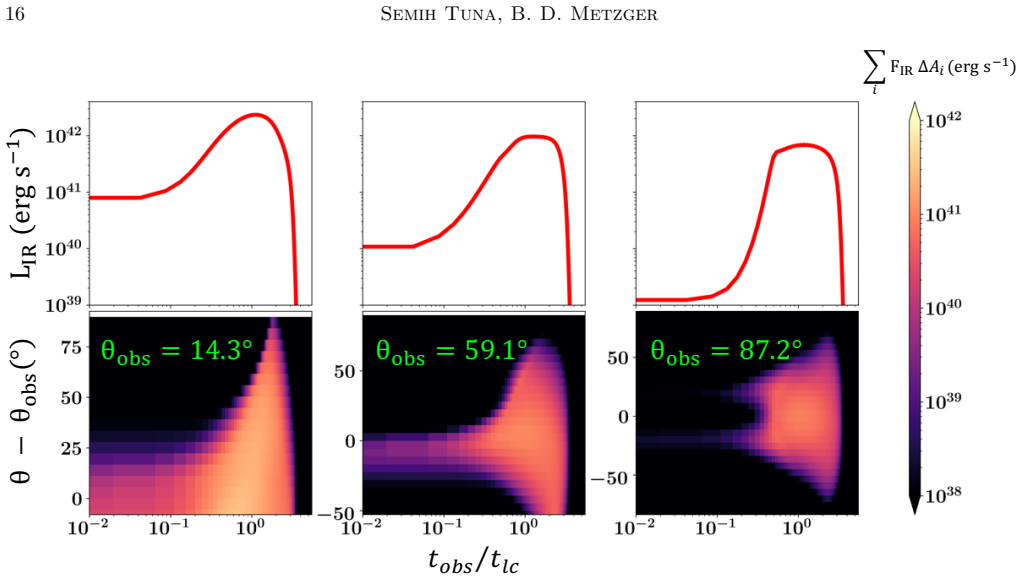
On the paper's own terms, the central discovery is a dichotomy. In axisymmetric time-dependent radiation transport with gray opacities, the speed of the dust sublimation front is $v_{\rm sub}/c=t_{\rm lc}/(t_{\rm lc}+2t_{\rm rise})$, so the ratio $t_{\rm rise}/t_{\rm lc}$ decides whether reprocessed photons can diffuse ahead of the front. For slow-rising transients ($t_{\rm rise}\gg t_{\rm lc}$) the infrared light curve rises before the UV/optical escapes and peaks on a timescale $\sim t_{\rm rise}$; for fast-rising transients ($t_{\rm rise}\ll t_{\rm lc}$) the UV and IR begin to escape around the same time, but the reprocessed energy arrives as an echo lasting $\sim 2t_{\rm lc}$, long after the transient's peak. In a torus geometry the echo shape depends on viewing angle: equatorial observers see flatter, dimmer, longer-lived emission similar to the spherical shell, while polar observers see earlier, brighter, shorter-lived emission. Applied to AT2018cow, a spherical fast-rise model with a raised sublimation temperature of 1300 K reproduces the early IR excess, supporting a dust-echo origin.
Load-bearing premise
The loaded assumption is that the code can tell the transient's direct light from the dust's reradiated infrared simply by the direction the rays travel, and that the averaged opacities get ultraviolet absorption roughly right.
Editorial extensions
If this is right
- Slow-rising dusty transients should emit detectable infrared before their ultraviolet/optical light escapes, so the IR rise can serve as an early signal for events that optical surveys catch later.
- Fast-rising transients should leave an infrared echo lasting about $2t_{\rm lc}$ even after the transient has faded, so monitoring IR after peak reveals the size of the pre-explosion dust photosphere.
- For dusty tori, polar observers see earlier, brighter, shorter-lived infrared while equatorial observers see flatter, longer-lived emission; fitting both shapes can constrain viewing angle and torus opening angle.
- The AT2018cow infrared excess is reproduced as a fast-rise dust echo, favoring the picture in which at least some fast blue optical transients explode inside opaque dusty media.
Reading between the lines
- By extension, the same ratio should organize infrared echoes across explosion classes: luminous red novae and classical novae in the slow-rise regime should show IR rising before optical, while the fastest tidal disruption events should show the two-light-crossing echo; stacking IR light curves by explosion class would test this directly.
- The torus models imply that a population of dusty transients viewed from random angles should show a spread in IR peak luminosity and delay of about a factor of two, making the echo an inclination diagnostic independent of jet orientation.
- If the AT2018cow requirement of a raised sublimation temperature is generic, the infrared echo becomes a grain-composition probe: future events whose echoes demand $T_{\rm sub}$ well above 1000 K would favor refractory or carbonaceous grains in the pre-explosion environment.
- The appendix's late-time scaling $L_{\rm IR,thin}\propto t^{-p}$ could be inverted against observed IR echo decays to measure the outer density profile index $p$ of the surrounding medium, extending the method beyond the optically thick phase.
Editorial analysis
A structured set of objections, weighed in public.
Referee Report
Summary. This paper presents 2D axisymmetric, time-dependent gray radiation transport simulations of dust-shrouded optical/UV transients, using Athena++ with tabulated dust opacities, to predict the bolometric IR light curves produced as a rising transient sublimates its surrounding dust. The central physical result is a dichotomy controlled by the ratio trise/tlc: for fast-rising transients the reprocessed radiation arrives as an IR echo with duration ~2 tlc and luminosity ~Lthin trise/(2 tlc), while for slow-rising transients the IR emission tracks the transient, peaking near Lthin on a timescale ~trise. Spherical and torus dust geometries are compared, and the models are applied to the IR excess of AT2018cow.
Significance. If the results hold, the paper provides a simple and physically motivated diagnostic for inferring the presence and geometry of dusty circumstellar material from IR light curves, and it gives a concrete dust-echo interpretation for AT2018cow. The simulations reproduce the analytic scalings in both regimes (e.g., vsub ~ 0.68c versus the predicted ~0.72c, and the slow-rise onset time close to Eq. (17)), which is a genuine quantitative check and a strength of the paper. The work is also transparent about its gray-opacity approximation and the artificial opacity cutoff. However, the quantitative LIR predictions and the AT2018cow fit rest on an unvalidated directional decomposition of the radiation field and on a post-processing time-delay formula that, as written, appears to be in error; these issues need to be addressed before the central quantitative claims can be accepted.
major comments (3)
- [Sec. 3.1 and Sec. 3.5] The time-delay mapping in Eq. (23) appears incorrect as written. For a point source at the origin and a thin shell at radius r, a photon reprocessed at position r_vec at simulation time t_e reaches the observer at tobs = t_e - (n_hat·r_vec)/c (with tobs = 0 for a direct photon from the origin), so t_e = tobs + (n_hat·r_vec)/c. Equation (23) instead gives t_e = tobs + 2r/c - (n_hat·r_vec)/c, which equals the correct expression only at the near point n_hat·r_vec = r and yields negative arrival times for far-side points when inverted. Since this mapping is used to construct all light curves in Figs. 5, 7, 9, and 10, the reported peak times, shapes, and the AT2018cow fit could be affected. Please correct the formula and the definition of tobs, or explicitly verify that the simulations used the correct mapping.
- The separation of the radiation field into 'UV' radial rays and 'IR' non-radial rays is a load-bearing assumption that is never validated. Direct source radiation that is scattered, or that leaks into non-radial directions because of the gray transport and the acknowledged factor-of-3-10 underestimate of UV opacity (Sec. 6), would be misclassified as reprocessed IR and would contaminate LIR and the inferred luminosities such as LIR ~ 0.1 Lthin in SPHERE FAST. Please quantify this leakage, e.g., by comparing the non-radial luminosity with the independently predicted Lthin trise/(2 tlc), or by running at least one multigroup/frequency-dependent test in the fast-rise regime.
- The AT2018cow application is not an independent validation of the dust-echo interpretation. The sublimation temperature is raised from ~1000 K to 1300 K specifically to satisfy the fast-rise requirement in Eq. (16) (see the discussion near Eq. (25)), the comparison is restricted to the first ~20 days because of the opacity cutoff in Sec. 3.4, and the first two data points are excluded. Please present the sensitivity of the fit to the free parameters (Tsub, trise, Xd, Delta) or explicitly label the model as an illustrative proof of concept rather than as a successful quantitative fit.
minor comments (4)
- The text states that 'purely radial (cos zeta = 0) rays travel along straight paths', which contradicts Eq. (18), where cos zeta = r_hat·n_hat; radial rays correspond to cos zeta = ±1. Please correct this typo.
- It would improve reproducibility to state explicitly how the control parameters {LQ, Lpk, trise} determine t0 and t1 in Eq. (20), since the paper refers to this inversion but does not give it.
- The measurement sphere is said to be at r ~ Rph,0, but the figure caption mentions 1.2 Rph,0; please state the exact radius in the text for clarity.
- The manuscript uses both 'AT2018cow' and 'AT2018COW'; please standardize the spelling.
Circularity Check
No significant circularity: the fast/slow IR-echo scalings are derived from stated transport assumptions and checked against independent radiation-transport simulations; the AT2018cow section is an openly parameterized fit rather than a renamed prediction.
full rationale
The paper's central derivation chain is self-contained. The analytic scalings (Eqs. 10, 15-17) are order-of-magnitude estimates built from the assumed rise law, the sublimation condition, and the light-crossing time; they do not import the simulation outputs as inputs. The simulations are then used as an independent numerical test, e.g. Sec. 4.1 reports LIR ~ 0.1 Lthin, 'consistent with analytic expectations (Eq. (16))'. The gray-opacity and ray-direction split in Sec. 3.1 is a stated approximation and a genuine correctness risk, but it is not circular: the UV/IR separation by ray direction is an identification used to post-process the same transport solution, not an assumption that by itself forces the predicted scaling or the fast/slow dichotomy. The AT2018cow comparison is a fit, with Tsub = 1300 K, trise, and viewing angle adjusted to match the observed excess; the paper does not dress this fit up as an independent prediction of those parameters, and the dust-echo interpretation is anchored to external Perley et al. (2019) data plus a consistency condition (Eq. 25). Self-citations to Metzger & Perley (2023) motivate the AT2018cow application and some grain-size/sublimation-temperature choices, but the central regime dichotomy and the light-curve predictions do not reduce to those citations. No step in the derivation is equivalent by construction to its own input.
Assumptions & free parameters
free parameters (10)
- Tsub =
1000 K (fiducial); 1300 K (COW models)
- trise =
1.9 d (SPHERE FAST), 19 d (SPHERE SLOW), 0.8 d (COW SPHERE), 1.5 d (COW TORUS)
- rho0 =
1e-16 g cm^-3
- p =
3
- Xd =
0.1
- Delta =
infinity (sphere) or 0.2 (torus)
- amax =
1 micron
- Lpk =
4e42 erg/s (SPHERE models); about 1e44 erg/s (AT2018cow models)
- tpk =
7.1 d (SPHERE models); about 3 d (AT2018cow models)
- theta_obs =
14.3, 59.1, 87.2 degrees; equatorial preferred for AT2018cow
assumptions (9)
- standard math Radiation hydrodynamics equations as implemented in Athena++ (Jiang 2021)
- domain assumption Rosseland mean (gray) opacity approximation
- domain assumption Dust sublimation at Tsub with no reformation
- ad hoc to paper Power-law density profile with torus modulation (Eq. 21)
- ad hoc to paper Transient light-curve shape (Eq. 20)
- ad hoc to paper Opacity cutoff beyond the initial photosphere (Sec. 3.4)
- ad hoc to paper Radial/non-radial ray classification as UV/IR (Sec. 3.1)
- domain assumption Neglect of radiation pressure on the gas (Eq. 3)
- domain assumption Instantaneous thermal coupling of dust and gas (Eq. 4)
Cite this review
Pith. "Pith review of Time-Dependent Radiation Transport Simulations of Infrared Echoes from Dust-Shrouded Luminous Transients." pith.science (2026). https://pith.science/paper/AJ4TKBSF
@misc{pith2026250113157,
  author       = {Pith},
  title        = {Pith review of: Time-Dependent Radiation Transport Simulations of Infrared Echoes from Dust-Shrouded Luminous Transients},
  year         = {2026},
  howpublished = {\url{https://pith.science/paper/AJ4TKBSF}},
  note         = {Machine review of arXiv:2501.13157}
}
abstract
A wide range of stellar explosions, including supernovae (SNe), tidal disruption events (TDE), and fast blue optical transients (FBOT), can occur in dusty environments initially opaque to the transient's optical/UV light, becoming visible only once the dust is destroyed by the transient's rising luminosity. We present axisymmetric time-dependent radiation transport simulations of dust-shrouded transients with \texttt{Athena++} and tabulated gray opacities, which predict the light-curves of the dust-reprocessed infrared (IR) radiation. The luminosity and timescale of the IR light-curve depends on whether the transient rises rapidly or slowly compared to the light crossing-time of the photosphere, $t_{\rm lc}$. For slow-rising transients ($t_{\rm rise} \gg t_{\rm lc}$) such as SNe, the reprocessed IR radiation diffuses outwards through the dust shell faster than the sublimation front expands; the IR light-curve therefore begins rising prior to the escape of UV/optical light, but peaks on a timescale $\sim t_{\rm rise}$ shorter than the transient duration. By contrast, for fast-rising transients ($t_{\rm rise} \ll t_{\rm lc}$) such as FBOTs and some TDEs, the finite light-travel time results in the reprocessed radiation arriving as an ``echo'' lasting much longer than the transient itself (despite the dust photosphere having already being destroyed by peak light). We explore the effects of the system geometry by considering a torus-shaped distribution of dust. The IR light-curves seen by observers in the equatorial plane of the torus resemble those for a spherical dust shell, while polar observers see faster-rising, brighter and shorter-lived emission. We successfully model the IR excess seen in AT2018cow as a dust echo, supporting the presence of an opaque dusty medium surrounding FBOTs prior to explosion.
Figures


Figures from the paper (7 more)



Forward citations
Cited by 3 Pith papers
-
The Most Luminous Known Fast Blue Optical Transient AT 2024wpp: Unprecedented Evolution and Properties in the Ultraviolet to the Near-Infrared
AT 2024wpp radiated more than 10^51 erg in 45 days, showing persistent 20,000 K blackbody emission, two-velocity hydrogen and helium lines, and a near-infrared excess, indicating an accretion-powered compact object.
-
Implications of the UV/optical Plateau of AT2018cow
A wind-and-irradiation disk model fits the AT2018cow UV plateau with accretor masses from 1.4 to ~100 solar masses, removing the need for a >200 solar-mass black hole.
-
A Torus Remnant Revealed by the Infrared Echo of Tidal Disruption Event AT 2019qiz: Implications for the Missing Energy and Quasiperiodic Eruption Formation
The infrared echo of AT 2019qiz reveals parsec-scale dust, implying a remnant AGN torus and a peak luminosity much higher than the optical output, which points to missing extreme-ultraviolet energy.
Reference graph
Works this paper leans on
-
[1]
D., van Velzen, S., Horesh, A., & Zauderer, B
Alexander, K. D., van Velzen, S., Horesh, A., & Zauderer, B. A. 2020, SSRv, 216, 81, doi: 10.1007/s11214-020-00702-w
-
[2]
Andrews, J. E., & Smith, N. 2018, MNRAS, 477, 74, doi: 10.1093/mnras/sty584
-
[3]
1987, ApJ, 320, 537, doi: 10.1086/165571
Barvainis, R. 1987, ApJ, 320, 537, doi: 10.1086/165571
doi:10.1086/165571 1987
-
[4]
Berger, E., Soderberg, A. M., Chevalier, R. A., et al. 2009, ApJ, 699, 1850, doi: 10.1088/0004-637X/699/2/1850
-
[5]
Birnstiel, T., Dullemond, C. P., Zhu, Z., et al. 2018, ApJL, 869, L45, doi: 10.3847/2041-8213/aaf743
-
[6]
K., Nicholl, M., Berger, E., et al
Blanchard, P. K., Nicholl, M., Berger, E., et al. 2017, ApJ, 843, 106, doi: 10.3847/1538-4357/aa77f7 20 Semih Tuna, B. D. Metzger
-
[7]
Bohren, C. F., & Huffman, D. R. 1998, Absorption and Scattering of Light by Small Particles (John Wiley and
work page 1998
-
[8]
Bond, H. E., Bedin, L. R., Bonanos, A. Z., et al. 2009, ApJL, 695, L154, doi: 10.1088/0004-637X/695/2/L154
Show all 72 references
- [9]
-
[10]
A., & Fransson, C
Chevalier, R. A., & Fransson, C. 1994, ApJ, 420, 268, doi: 10.1086/173557
1994 doi
-
[11]
Crotts, A. P. S. 1988, ApJL, 333, L51, doi: 10.1086/185286
1988 doi
-
[12]
W., & Gammie, C
Davis, S. W., & Gammie, C. F. 2020, ApJ, 888, 94, doi: 10.3847/1538-4357/ab5950
2020 doi
-
[13]
2017, ApJL, 841, L8, doi: 10.3847/2041-8213/aa7130
Dou, L., Wang, T., Yan, L., et al. 2017, ApJL, 841, L8, doi: 10.3847/2041-8213/aa7130
2017 doi
- [14]
-
[15]
R., Chornock, R., Soderberg, A
Drout, M. R., Chornock, R., Soderberg, A. M., Sanders, N. E., et al. 2014, ApJ, 794, 23, doi: 10.1088/0004-637X/794/1/23
2014 doi
-
[16]
P., Juhasz, A., Pohl, A., et al
Dullemond, C. P., Juhasz, A., Pohl, A., et al. 2012, RADMC-3D: A multi-purpose radiative transfer tool, Astrophysics Source Code Library, record ascl:1202.015
2012
- [17]
-
[18]
R., & Kochanek, C
Evans, C. R., & Kochanek, C. S. 1989, ApJL, 346, L13, doi: 10.1086/185567
1989 doi
-
[19]
C., & Metzger, B
Generozov, A., Stone, N. C., & Metzger, B. D. 2015, MNRAS, 453, 775, doi: 10.1093/mnras/stv1607
2015 doi
-
[20]
R., Meikle, W
Graham, J. R., Meikle, W. P. S., Selby, M. J., et al. 1983, Nature, 304, 709, doi: 10.1038/304709a0
1983 doi
-
[21]
2007, ApJ, 662, 1119, doi: 10.1086/517913
Heng, K., Lazzati, D., & Perna, R. 2007, ApJ, 662, 1119, doi: 10.1086/517913
2007 doi
- [22]
-
[23]
Ho, A. Y. Q., Phinney, E. S., Ravi, V., et al. 2019, ApJ, 871, 73, doi: 10.3847/1538-4357/aaf473
2019 doi
-
[24]
Ho, A. Y. Q., Margalit, B., Bremer, M., et al. 2021, arXiv e-prints, arXiv:2110.05490. https://arxiv.org/abs/2110.05490
2021 arXiv
-
[25]
2013, A&A Rv, 21, 59, doi: 10.1007/s00159-013-0059-2
Ivanova, N., Justham, S., Chen, X., et al. 2013, A&A Rv, 21, 59, doi: 10.1007/s00159-013-0059-2
2013 doi
-
[26]
1997, MNRAS, 287, 799, doi: 10.1093/mnras/287.4.799 Ivezi´ c,ˇZ., Kahn, S
Ivezic, Z., & Elitzur, M. 1997, MNRAS, 287, 799, doi: 10.1093/mnras/287.4.799 Ivezi´ c,ˇZ., Kahn, S. M., Tyson, J. A., et al. 2019, ApJ, 873, 111, doi: 10.3847/1538-4357/ab042c
1997 doi
-
[27]
Jaffe, W., Meisenheimer, K., R¨ ottgering, H. J. A., et al. 2004, Nature, 429, 47, doi: 10.1038/nature02531
2004 doi
-
[28]
E., Adams, S
Jencson, J. E., Adams, S. M., Bond, H. E., et al. 2019, ApJL, 880, L20, doi: 10.3847/2041-8213/ab2c05
2019 doi
-
[29]
2021, ApJ, 911, 31, doi: 10.3847/1538-4357/abe772
Jiang, N., Wang, T., Hu, X., et al. 2021, ApJ, 911, 31, doi: 10.3847/1538-4357/abe772
2021 doi
-
[30]
2019, ApJ, 871, 15, doi: 10.3847/1538-4357/aaf6b2
Jiang, N., Wang, T., Mou, G., et al. 2019, ApJ, 871, 15, doi: 10.3847/1538-4357/aaf6b2
2019 doi
-
[31]
2021, ApJS, 253, 49, doi: 10.3847/1538-4365/abe303
Jiang, Y.-F. 2021, ApJS, 253, 49, doi: 10.3847/1538-4365/abe303
2021 doi
-
[32]
2017, ApJ, 843, 68, doi: 10.3847/1538-4357/aa77b0
Blaes, O. 2017, ApJ, 843, 68, doi: 10.3847/1538-4357/aa77b0
2017 doi
- [33]
- [34]
-
[35]
2009, ApJ, 701, 105, doi: 10.1088/0004-637X/701/1/105
Komossa, S., Zhou, H., Rau, A., et al. 2009, ApJ, 701, 105, doi: 10.1088/0004-637X/701/1/105
2009 doi
-
[36]
C., Reynolds, T
Kool, E. C., Reynolds, T. M., Mattila, S., et al. 2020, MNRAS, 498, 2167, doi: 10.1093/mnras/staa2351
2020 doi
- [37]
-
[38]
Lu, W., Kumar, P., & Evans, N. J. 2016, MNRAS, 458, 575, doi: 10.1093/mnras/stw307
2016 doi
-
[39]
D., Chornock, R., et al
Margutti, R., Metzger, B. D., Chornock, R., et al. 2019, ApJ, 872, 18, doi: 10.3847/1538-4357/aafa01
2019 doi
-
[40]
2024, ApJ, 961, 211, doi: 10.3847/1538-4357/ad18bb
Masterson, M., De, K., Panagiotou, C., et al. 2024, ApJ, 961, 211, doi: 10.3847/1538-4357/ad18bb
2024 doi
-
[41]
Matsumoto, T., & Metzger, B. D. 2022, ApJ, 936, 114, doi: 10.3847/1538-4357/ac892c
2022 doi
-
[42]
2018, Science, 361, 482, doi: 10.1126/science.aao4669
Mattila, S., P´ erez-Torres, M., Efstathiou, A., et al. 2018, Science, 361, 482, doi: 10.1126/science.aao4669
2018 doi
-
[43]
Metzger, B. D. 2010, MNRAS, 409, 284, doi: 10.1111/j.1365-2966.2010.17308.x —. 2022, arXiv e-prints, arXiv:2203.04331. https://arxiv.org/abs/2203.04331
2010
-
[44]
D., & Perley, D
Metzger, B. D., & Perley, D. A. 2023, ApJ, 944, 74, doi: 10.3847/1538-4357/acae89
2023 doi
- [45]
-
[46]
1984, A&A, 136, 306
Pearce, G., & Evans, A. 1984, A&A, 136, 306
1984
-
[47]
D., & Tomida, K
Pejcha, O., Metzger, B. D., & Tomida, K. 2016a, MNRAS, 455, 4351, doi: 10.1093/mnras/stv2592 —. 2016b, MNRAS, 461, 2527, doi: 10.1093/mnras/stw1481
-
[48]
D., Tyles, J
Pejcha, O., Metzger, B. D., Tyles, J. G., & Tomida, K. 2017, ApJ, 850, 59, doi: 10.3847/1538-4357/aa95b9
2017 doi
-
[49]
A., Mazzali, P
Perley, D. A., Mazzali, P. A., Yan, L., et al. 2019, MNRAS, 484, 1031, doi: 10.1093/mnras/sty3420 Infrared Echoes from Dust-Shrouded Luminous Transients 21
2019 doi
-
[50]
2002, ApJ, 580, 261, doi: 10.1086/343081
Perna, R., & Lazzati, D. 2002, ApJ, 580, 261, doi: 10.1086/343081
2002 doi
-
[51]
B., Hollenbach, D., Beckwith, S., et al
Pollack, J. B., Hollenbach, D., Beckwith, S., et al. 1994, ApJ, 421, 615, doi: 10.1086/173677
1994 doi
-
[52]
2012, MNRAS, 423, L92, doi: 10.1111/j.1745-3933.2012.01264.x
Quataert, E., & Shiode, J. 2012, MNRAS, 423, L92, doi: 10.1111/j.1745-3933.2012.01264.x
2012
-
[53]
M., Bregman, J., Witteborn, F
Rank, D. M., Bregman, J., Witteborn, F. C., et al. 1988, ApJL, 325, L1, doi: 10.1086/185096
1988 doi
-
[54]
Rees, M. J. 1988, Nature, 333, 523, doi: 10.1038/333523a0
1988 doi
-
[55]
O., et al
Sagiv, I., Gal-Yam, A., Ofek, E. O., et al. 2014, AJ, 147, 79, doi: 10.1088/0004-6256/147/4/79
2014 doi
-
[56]
2019, ApJ, 884, 58, doi: 10.3847/1538-4357/ab3f2a
Segev, R., Sabach, E., & Soker, N. 2019, ApJ, 884, 58, doi: 10.3847/1538-4357/ab3f2a
2019 doi
-
[57]
Smith, N., & Arnett, W. D. 2014, ApJ, 785, 82, doi: 10.1088/0004-637X/785/2/82
2014 doi
-
[58]
2006, MNRAS, 373, 733, doi: 10.1111/j.1365-2966.2006.11056.x
Soker, N., & Tylenda, R. 2006, MNRAS, 373, 733, doi: 10.1111/j.1365-2966.2006.11056.x
2006
-
[59]
L., Crotts, A
Sokoloski, J. L., Crotts, A. P. S., Lawrence, S., & Uthas, H. 2013, ApJL, 770, L33, doi: 10.1088/2041-8205/770/2/L33
2013 doi
- [60]
-
[61]
M., Tomida, K., White, C
Stone, J. M., Tomida, K., White, C. J., & Felker, K. G. 2020, ApJS, 249, 4, doi: 10.3847/1538-4365/ab929b
2020 doi
-
[62]
C., & Metzger, B
Stone, N. C., & Metzger, B. D. 2016, MNRAS, 455, 859, doi: 10.1093/mnras/stv2281
2016 doi
-
[63]
2020, ApJ, 898, 129, doi: 10.3847/1538-4357/ab9f2c
Sun, L., Jiang, N., Wang, T., et al. 2020, ApJ, 898, 129, doi: 10.3847/1538-4357/ab9f2c
2020 doi
-
[64]
A., Prieto, J
Thompson, T. A., Prieto, J. L., Stanek, K. Z., et al. 2009, ApJ, 705, 1364, doi: 10.1088/0004-637X/705/2/1364
2009 doi
-
[65]
Tuna, S., & Metzger, B. D. 2023, ApJ, 955, 125, doi: 10.3847/1538-4357/acef17
2023 doi
-
[66]
2011, A&A, 528, A114, doi: 10.1051/0004-6361/201016221
Tylenda, R., Hajduk, M., Kami´ nski, T., et al. 2011, A&A, 528, A114, doi: 10.1051/0004-6361/201016221
2011 doi
-
[67]
2003, ApJ, 586, 1338, doi: 10.1086/367818 Van Dyk, S
Ueta, T., & Meixner, M. 2003, ApJ, 586, 1338, doi: 10.1086/367818 Van Dyk, S. D. 2013, AJ, 146, 24, doi: 10.1088/0004-6256/146/2/24 van Velzen, S., Mendez, A. J., Krolik, J. H., & Gorjian, V. 2016, ApJ, 829, 19, doi: 10.3847/0004-637X/829/1/19 van Velzen, S., Pasham, D. R., Ko...
2003 doi
-
[68]
Kara, E. A. 2021, SSRv, 217, 63, doi: 10.1007/s11214-021-00835-6
2021 doi
-
[69]
Waxman, E., & Draine, B. T. 2000, ApJ, 537, 796, doi: 10.1086/309053
2000 doi
- [70]
-
[71]
2010, ApJL, 717, L62, doi: 10.1088/2041-8205/717/1/L62
Yoon, S.-C., & Cantiello, M. 2010, ApJL, 717, L62, doi: 10.1088/2041-8205/717/1/L62
2010 doi
-
[72]
2021, MNRAS, 508, 453, doi: 10.1093/mnras/stab2517
Zhu, Z., Jiang, Y.-F., Baehr, H., et al. 2021, MNRAS, 508, 453, doi: 10.1093/mnras/stab2517
2021 doi
Reviewed August 10, 2026 · model on record in the stance chip above.
Discussion (0). Continue with ORCID to comment.