REVIEW 3 major objections 4 minor 201 references
Searching for Dark Matter with MeVCube
T0 review · 3 major / 4 minor · reviewed 2026-08-10 · deepseek-v4-flash
Pith's one-line read The paper claims that MeVCube, a proposed CubeSat MeV telescope, could find or constrain dark matter using gamma rays from evaporating primordial black holes and from particle dark matter decaying or annihilating to photons.
desk verdict Solid first DM forecast for MeVCube, but the abstract's 'much better discovery reach' overstates the FSR cases and the LEO background omission leaves the size of the reach uncertain. read the letter →
The pith
A machine-rendered reading of the paper's core claim, the machinery that carries it, and where it could break.
The reading
What carries the argument
The forecasting machinery is a $7\times 7$ Fisher information matrix built from one dark-matter parameter ($f_{\rm PBH}$, $1/\tau$, or $\langle\sigma v\rangle$) and six diffuse-background parameters, with the signal weighted by MeVCube's simulated effective area and convolved with its energy resolution. The dark-matter flux uses the standard J-factor expression for Galactic halo models, Hawking-evaporation photon spectra are taken from the BlackHawk code, direct photon channels are treated as delta-function lines, and final-state-radiation spectra use the closed-form photon spectrum of Eq. (10). The background is the sum of a broken power law with exponential cutoff for Galactic photons and a power law for extragalactic photons.
What would settle it
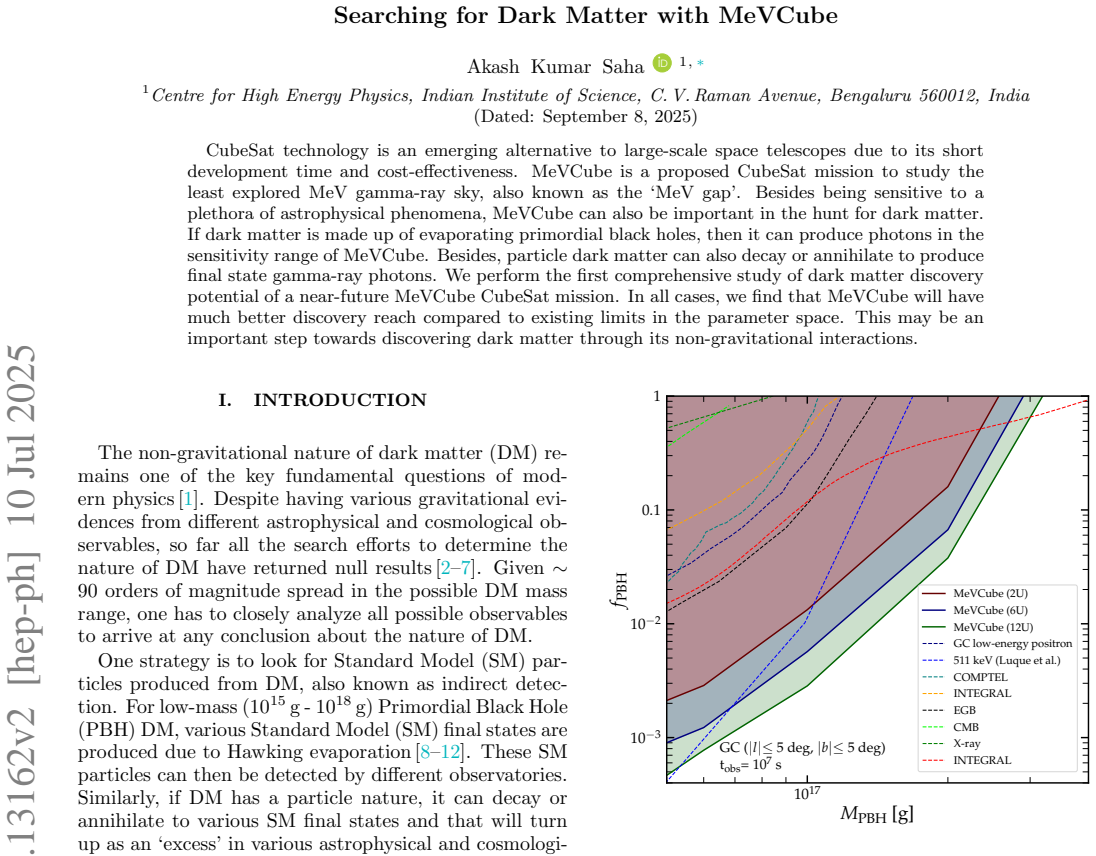
A full detector-level background simulation of the CdZnTe instrument in low Earth orbit, including charged cosmic rays, trapped-radiation encounters such as the South Atlantic Anomaly, albedo photons, and instrumental noise, would settle whether the added event rate exceeds the diffuse photon background used in the Fisher forecast; if it does, the projected limits in Figs. 1 and 2 weaken and could fall back to the existing COMPTEL, INTEGRAL, and CMB bounds.
Extended reading notes
Core claim
Using a benchmark observation of the Galactic Center region $|l|\le 5^\circ$, $|b|\le 5^\circ$ for $10^7$ s, with an NFW dark-matter profile, MeVCube in 2U, 6U, and 12U configurations would set projected 95% upper limits on the PBH dark-matter fraction that penetrate parameter space not yet excluded by 511 keV, COMPTEL, INTEGRAL, X-ray, and CMB bounds. For particle dark matter decaying or annihilating directly to two photons, the same analysis probes longer lifetimes and smaller velocity-averaged annihilation cross-sections than all existing limits shown. The 12U configuration reaches heavier dark-matter masses because its effective area extends to about 10 MeV. For the $\chi\to e^+e^-$ and $\chi\chi\to e^+e^-$ channels with final-state radiation, MeVCube's projected limits do not beat existing constraints, but the paper presents them as complementary probes.
Load-bearing premise
The projections assume that the only backgrounds that matter for the Galactic Center observation are the diffuse Galactic and extragalactic photon fluxes of Eqs. (14) and (15), leaving out instrumental backgrounds, cosmic-ray charged particles, and Earth-albedo photons, which the paper notes but does not quantify.
Editorial extensions
If this is right
- If the forecast is correct, a 2U to 12U MeVCube staring at the Galactic Center for $10^7$ s would improve on the best existing limits on evaporating primordial-black-hole dark matter in the asteroid-mass window.
- For dark matter decaying or annihilating directly to two photons, MeVCube would probe lifetimes longer than and annihilation cross-sections smaller than those currently excluded by COMPTEL, INTEGRAL, and CMB data.
- The 12U configuration's extended energy response lets it reach heavier dark-matter masses than the 2U and 6U versions.
- The $\sqrt{t_{\rm obs}}$ scaling shown for PBH dark matter means even a one-day observation can enter new parameter space, with longer exposures giving proportionally better reach.
- For the $e^+e^-$ final-state channels, MeVCube would provide weaker but complementary limits that can cross-check other MeV instruments.
Reading between the lines
- If the sensitivity holds, the economics of indirect dark-matter searches shift: a constellation of small MeVCube-type satellites could collectively reach the effective area of a flagship mission at a fraction of the launch cost and could be launched much sooner than a large telescope.
- Because the reach depends on the Galactic dark-matter profile, with Einasto giving stronger limits than NFW and isothermal giving weaker ones, the same observations could double as a probe of the halo profile when combined with other data.
- The paper's correction of the Galactic-background exponential cutoff from 2 MeV to 20 MeV implies that some earlier MeV-telescope forecasts for heavy decaying or annihilating dark matter may have been too optimistic; re-running those forecasts with the corrected background would test how many published projections shift.
- A null result from MeVCube before larger MeV missions launch would provide the first real MeV-gap constraints since COMPTEL's era, sharpening the science case for the next generation of telescopes in this band.
Editorial analysis
A structured set of objections, weighed in public.
Referee Report
Summary. The paper presents a Fisher-matrix forecast of the dark matter discovery potential of the proposed MeVCube CubeSat. It computes gamma-ray fluxes from evaporating primordial black holes (using BlackHawk and Hazma) and from particle dark matter decaying or annihilating to photons or to e+e− with final-state radiation. The forecast uses the MeVCube effective area and energy resolution from Ref. [43], a 10^7 s observation of the Galactic Center region |l|,|b|≤5°, and a diffuse Galactic plus extragalactic background model. It reports projected 95% limits for 2U, 6U, and 12U configurations, finding that the direct photon channels can surpass existing limits, while the FSR channels are weaker than existing constraints. The paper explicitly acknowledges LEO instrumental, albedo, and cosmic-ray backgrounds as a caveat but does not model or quantify them.
Significance. If the projected sensitivities are confirmed under more realistic background assumptions, the paper would provide a strong quantitative argument that small, low-cost CubeSats can probe new parameter space in the under-explored MeV gap. The strengths are the use of publicly available spectral codes (BlackHawk, Hazma), the inclusion of the telescope energy resolution, the marginalization over background parameters, and the appendices that test dependence on DM density profile, observation time, and the Ec=20 MeV correction of the galactic background model. The central limitation is that the discovery reach is computed with a photon-only diffuse background model that omits LEO-specific backgrounds; the magnitude of the resulting degradation is not quantified. A second, smaller normalization error in the annihilation flux also needs correction.
major comments (3)
- [Section V, Appendix E, Eqs. (14)-(21)] The forecast includes only the Galactic and extragalactic diffuse photon backgrounds. The manuscript acknowledges in Section V, citing Cumani et al. [148], that a LEO CubeSat will also see cosmic-ray induced events, albedo photons, and instrumental backgrounds, but it does not implement these in the Fisher analysis. This is load-bearing because the projected limits in Figs. 1 and 2 depend on the background entering Eq. (20); with a 12U effective area of only about 22 cm^2 at 1 MeV, an unvetoed albedo plus instrumental component at the levels expected from the Cumani et al. model could dominate the extragalactic component of Eq. (15) and correspondingly degrade the limits. I ask the authors to add a quantitative estimate of these LEO backgrounds, using the model in Ref. [148] or an equivalent treatment, and to show the resulting sensitivity curves for at least the benchmark 12U case.
- [Eq. (1) with Eq. (2) and Eq. (9)] For α=2, Eq. (1) uses the prefactor 1/(2α−1)=1/3. With J defined in Eq. (2) and the annihilation spectrum given in Eq. (9), the standard flux for self-conjugate annihilating dark matter has a prefactor 1/2, not 1/3. The resulting annihilation flux in the paper is therefore low by a factor 2/3, and the projected ⟨σv⟩ limits in the right panels of Fig. 2 are weakened by a factor 1.5 relative to the correct normalization. The same factor propagates to the FSR annihilation channel through C_2 in Eq. (10). This does not change the qualitative conclusion for direct annihilation, but the normalization should be corrected.
- [Abstract and Section IV, Fig. 2 (bottom row)] The abstract states "In all cases, we find that MeVCube will have much better discovery reach compared to existing limits," but the text in Section IV and the bottom row of Fig. 2 show that for χ→e+e− and χχ→e+e− with FSR, the MeVCube sensitivities are weaker than existing X-ray and gamma-ray limits. This overstatement should be corrected, for example by restricting the claim to the direct photon channels and presenting the FSR results as complementary probes.
minor comments (4)
- [Section V] The word "insteresting" in the discussion of strongly interacting dark matter should be "interesting."
- [Appendix E] The phrase "father orbits" should be "farther orbits."
- [Eq. (16)-(17)] The symbol ϵ is used both as the Gaussian width parameter in Eq. (16) and, through Eq. (17), as the fractional energy resolution; renaming one of them would avoid ambiguity.
- [Appendix D and Section IV] The effective area curves from Ref. [43] are used numerically but are not reproduced in the paper; providing a small table or a link to digitized values would improve reproducibility.
Circularity Check
No significant circularity: the DM signal fluxes, instrument response, and background inputs are external and independent, and the projected sensitivities are benchmarked against published limits.
full rationale
The derivation chain is self-contained. DM signal fluxes are computed from independent physics: PBH Hawking spectra are obtained from the public BlackHawk code and cross-checked against semi-analytic greybody factors (Eqs. 5-7, Section II A), while particle DM decay and annihilation spectra are analytic (Eqs. 8-13). The instrument response, including effective area and energy resolution, is taken from the separate MeVCube instrument paper [43], not from this work. The astrophysical backgrounds in Eqs. (14)-(15) have fiducial values fixed by external COMPTEL and cosmic X-ray background fits (Section IV), and the Fisher matrix in Eqs. (20)-(21) marginalizes over the six background parameters rather than fitting any dark matter parameter. The resulting limits are displayed against independent published bounds from INTEGRAL, COMPTEL, CMB, XMM-Newton, and Voyager; no dark matter parameter is fitted to data. The author's self-citations (Refs. [126,128]) appear only as contextual constraints in the literature summary and are not load-bearing for the MeVCube projection. The acknowledged omission of LEO instrumental, cosmic-ray, and albedo backgrounds (Section V, Appendix E) is an unquantified assumption affecting robustness of the projected reach, but it is not a circular step: it does not make any output equivalent to an input by construction. Thus no circularity is found.
Assumptions & free parameters
free parameters (7)
- Galactic background normalization Abkg_g =
0.013 MeV^-1 cm^-2 s^-1 sr^-1
- Galactic background slope alpha_g =
1.8
- Galactic background cutoff index gamma_bar =
2
- Galactic background cutoff energy Ec =
20 MeV
- Extragalactic background normalization Abkg_eg =
0.004135 MeV^-1 cm^-2 s^-1 sr^-1
- Extragalactic background slope alpha_eg =
2.8956
- Observation time tobs =
1e7 s
assumptions (7)
- domain assumption NFW DM density profile with (a,b,c)=(1,3,1), rs=20 kpc, rho_sun=0.4 GeV/cm^3, r_sun=8.3 kpc
- domain assumption PBHs are non-spinning, uncharged, and have a monochromatic mass distribution
- domain assumption 100% branching ratio for each particle DM channel
- domain assumption DM is self-conjugated for annihilation
- domain assumption Only the Galactic DM signal is considered; extragalactic DM is subdominant for the chosen ROI
- domain assumption Background functional forms in Eqs. (14) and (15) from Bartels et al. and Beacom-Yuksel
- standard math Fisher matrix Gaussianity with fiducial DM signal equal to zero
Cite this review
Pith. "Pith review of Searching for Dark Matter with MeVCube." pith.science (2026). https://pith.science/paper/4FL5PC4E
@misc{pith2026250113162,
  author       = {Pith},
  title        = {Pith review of: Searching for Dark Matter with MeVCube},
  year         = {2026},
  howpublished = {\url{https://pith.science/paper/4FL5PC4E}},
  note         = {Machine review of arXiv:2501.13162}
}
read the original abstract
CubeSat technology is an emerging alternative to large-scale space telescopes due to its short development time and cost-effectiveness. MeVCube is a proposed CubeSat mission to study the least explored MeV gamma-ray sky, also known as the `MeV gap'. Besides being sensitive to a plethora of astrophysical phenomena, MeVCube can also be important in the hunt for dark matter. If dark matter is made up of evaporating primordial black holes, then it can produce photons in the sensitivity range of MeVCube. Besides, particle dark matter can also decay or annihilate to produce final state gamma-ray photons. We perform the first comprehensive study of dark matter discovery potential of a near-future MeVCube CubeSat mission. In all cases, we find that MeVCube will have much better discovery reach compared to existing limits in the parameter space. This may be an important step towards discovering dark matter through its non-gravitational interactions.
Figures


Figures from the paper (3 more)


Reference graph
Works this paper leans on
-
[43]
M. Cirelli, N. Fornengo, J. Koechler, E. Pinetti and B. M. Roach, Putting all the X in one basket: Updated X-ray constraints on sub-GeV Dark Matter , JCAP 07 (2023) 026, [ 2303.08854]
arXiv 2023
-
[148]
P. De la Torre Luque, S. Balaji and J. Silk, New 511 keV Line Data Provide Strongest sub-GeV Dark Matter Constraints, Astrophys. J. Lett. 973 (2024) L6, [2312.04907]
arXiv 2024
-
[1]
G. Bertone and D. Hooper, History of dark matter , Rev. Mod. Phys. 90 (2018) 045002, [ 1605.04909]
arXiv 2018
-
[2]
The variation in our limits due to different values of tobs is shown in Appendix B
We choose tobs = 107 s as our benchmark observation time. The variation in our limits due to different values of tobs is shown in Appendix B. The effective area, Aeff (Eγ) is taken from Fig. 5 of Ref. [43]. In our case, F is a 7×7 symmetric matrix with 1 model parameter ( fPBH or (1 /τ ) or ⟨σv⟩) and 6 background parameters ( Abkg g , αg, ¯γ, Ec, Abkg eg ...
2023
- [3]
-
[4]
Aghanim et al., Planck 2018 results
Planck collaboration, N. Aghanim et al., Planck 2018 results. VI. Cosmological parameters, Astron. Astrophys. 641 (2020) A6, [ 1807.06209]
arXiv 2020
-
[5]
M. Lisanti, Lectures on Dark Matter Physics , in Theoretical Advanced Study Institute in Elementary Particle Physics: New Frontiers in Fields and Strings , pp. 399–446, 2017. 1603.03797. DOI
arXiv 2017
-
[6]
L. E. Strigari, Galactic Searches for Dark Matter , Phys. Rept. 531 (2013) 1–88, [ 1211.7090]
arXiv 2013
Show all 201 references
-
[7]
Lin, Dark matter models and direct detection , PoS 333 (2019) 009, [ 1904.07915]
T. Lin, Dark matter models and direct detection , PoS 333 (2019) 009, [ 1904.07915]
2019 arXiv
-
[8]
T. R. Slatyer, Indirect detection of dark matter. , in Theoretical Advanced Study Institute in Elementary Particle Physics: Anticipating the Next Discoveries in Particle Physics, pp. 297–353, 2018. 1710.05137. DOI
2018 arXiv
-
[9]
Hawking, Gravitationally collapsed objects of very low mass , Monthly Notices of the Royal Astronomical Society 152 (04, 1971) 75–78
S. Hawking, Gravitationally collapsed objects of very low mass , Monthly Notices of the Royal Astronomical Society 152 (04, 1971) 75–78
1971
-
[10]
Y. B. Zel’dovich and I. D. Novikov, The Hypothesis of Cores Retarded during Expansion and the Hot Cosmological Model, Sov. Astron. 10 (1967) 602
1967
-
[11]
S. W. Hawking, Particle Creation by Black Holes , Commun. Math. Phys. 43 (1975) 199–220
1975
-
[12]
S. W. Hawking, Black hole explosions? , Nature 248 (Mar., 1974) 30–31
1974
-
[13]
Kn¨ odlseder,The future of gamma-ray astronomy , Comptes Rendus Physique 17 (2016) 663–678, [1602.02728]
J. Kn¨ odlseder,The future of gamma-ray astronomy , Comptes Rendus Physique 17 (2016) 663–678, [1602.02728]
2016 arXiv
-
[14]
B. J. Carr, The primordial black hole mass spectrum. , ApJ 201 (Oct., 1975) 1–19
1975
-
[15]
Kierans, T
C. Kierans, T. Takahashi and G. Kanbach, Compton Telescopes for Gamma-ray Astrophysics, 2208.07819
-
[16]
Engel et al., The Future of Gamma-Ray Experiments in the MeV-EeV Range , in Snowmass 2021, 3, 2022
K. Engel et al., The Future of Gamma-Ray Experiments in the MeV-EeV Range , in Snowmass 2021, 3, 2022. 2203.07360
2021
-
[17]
J. A. Tomsick et al., The Compton Spectrometer and Imager, 1908.04334
1908 arXiv
-
[18]
Schoenfelder, H
V. Schoenfelder, H. Aarts, K. Bennett, H. de Boer, J. Clear, W. Collmar et al., Instrument Description and Performance of the Imaging Gamma-Ray Telescope COMPTEL aboard the Compton Gamma-Ray Observatory, ApJS 86 (June, 1993) 657
1993
-
[19]
Fleischhack, AMEGO-X: MeV gamma-ray Astronomy in the Multi-messenger Era , PoS ICRC2021 (2021) 649, [ 2108.02860]
H. Fleischhack, AMEGO-X: MeV gamma-ray Astronomy in the Multi-messenger Era , PoS ICRC2021 (2021) 649, [ 2108.02860]
2021 arXiv
-
[20]
Caputo et al., All-sky Medium Energy Gamma-ray Observatory: Exploring the Extreme Multimessenger Universe , 1907.07558
AMEGO collaboration, R. Caputo et al., All-sky Medium Energy Gamma-ray Observatory: Exploring the Extreme Multimessenger Universe , 1907.07558
1907 arXiv
-
[21]
E. Orlando et al., Exploring the MeV sky with a combined coded mask and Compton telescope: the Galactic Explorer with a Coded aperture mask Compton telescope (GECCO) , JCAP 07 (2022) 036, [2112.07190]
2022 arXiv
-
[22]
Tavani et al., Science with e-ASTROGAM: A space mission for MeV–GeV gamma-ray astrophysics , JHEAp 19 (2018) 1–106, [1711.01265]
e-ASTROGAM collaboration, M. Tavani et al., Science with e-ASTROGAM: A space mission for MeV–GeV gamma-ray astrophysics , JHEAp 19 (2018) 1–106, [1711.01265]
2018 arXiv
-
[23]
Aramaki, P
T. Aramaki, P. Hansson Adrian, G. Karagiorgi and H. Odaka, Dual MeV Gamma-Ray and Dark Matter Observatory - GRAMS Project , Astropart. Phys. 114 (2020) 107–114, [ 1901.03430]
2020 arXiv
-
[24]
Dzhatdoev and E
T. Dzhatdoev and E. Podlesnyi, Massive Argon Space Telescope (MAST): A concept of heavy time projection chamber for γ-ray astronomy in the 100 MeV–1 TeV energy range, Astropart. Phys. 112 (2019) 1–7, [1902.01491]
2019 arXiv
-
[25]
https://science.nasa.gov/mission/cosi/
-
[26]
One of the problems faced by any upcoming telescope collaboration is the long planning duration and financial constraints
and blue [27]), measurements of the diffuse Galactic gamma-ray flux by COMPTEL (teal) [28] and INTEGRAL (orange [29] and red [30]), extra-Galactic gamma-ray mea- surement (black) [31, 32], CMB measurements by PLANCK (lime) [33], and Galactic diffuse X-ray emission measurement ...
2025 arXiv
-
[27]
X. Wu, M. Su, A. Bravar, J. Chang, Y. Fan, M. Pohl et al., PANGU: A High Resolution Gamma-ray Space Telescope, Proc. SPIE Int. Soc. Opt. Eng. 9144 (2014) 91440F, [1407.0710]
2014 arXiv
-
[28]
Laha, Primordial Black Holes as a Dark Matter Candidate Are Severely Constrained by the Galactic Center 511 keV γ -Ray Line, Phys
R. Laha, Primordial Black Holes as a Dark Matter Candidate Are Severely Constrained by the Galactic Center 511 keV γ -Ray Line, Phys. Rev. Lett. 123 (2019) 251101, [ 1906.09994]
2019 arXiv
-
[29]
De la Torre Luque, J
P. De la Torre Luque, J. Koechler and S. Balaji, Refining Galactic primordial black hole evaporation constraints, 2406.11949
-
[30]
Coogan, L
A. Coogan, L. Morrison and S. Profumo, Direct detection of hawking radiation from asteroid-mass primordial black holes , Phys. Rev. Lett. 126 (Apr,
-
[31]
R. Laha, J. B. Mu˜ noz and T. R. Slatyer, INTEGRAL constraints on primordial black holes and particle dark matter, Phys. Rev. D 101 (2020) 123514, [2004.00627]
2020 arXiv
-
[32]
Berteaud, F
J. Berteaud, F. Calore, J. Iguaz, P. D. Serpico and T. Siegert, Strong constraints on primordial black hole dark matter from 16 years of INTEGRAL/SPI observations, Phys. Rev. D 106 (2022) 023030, [2202.07483]
2022 arXiv
-
[33]
Arbey, J
A. Arbey, J. Auffinger and J. Silk, Constraining primordial black hole masses with the isotropic gamma ray background, Phys. Rev. D 101 (Jan, 2020) 023010
2020
-
[34]
Chen, H.-H
S. Chen, H.-H. Zhang and G. Long, Revisiting the constraints on primordial black hole abundance with the isotropic gamma ray background , 2112.15463
-
[35]
Clark, B
S. Clark, B. Dutta, Y. Gao, L. E. Strigari and S. Watson, Planck Constraint on Relic Primordial Black Holes , Phys. Rev. D 95 (2017) 083006, [1612.07738]
2017 arXiv
-
[36]
Siegert, C
T. Siegert, C. Boehm, F. Calore, R. Diehl, M. G. H. Krause, P. D. Serpico et al., An INTEGRAL/SPI view of reticulum II: particle dark matter and primordial black holes limits in the MeV range , Mon. Not. Roy. Astron. Soc. 511 (2022) 914–924, [ 2109.03791]
2022 arXiv
-
[37]
Essig, E
R. Essig, E. Kuflik, S. D. McDermott, T. Volansky and K. M. Zurek, Constraining Light Dark Matter with Diffuse X-Ray and Gamma-Ray Observations , JHEP 11 (2013) 193, [ 1309.4091]
2013 arXiv
-
[38]
T. R. Slatyer, Indirect dark matter signatures in the cosmic dark ages. I. Generalizing the bound on s-wave dark matter annihilation from Planck results , Phys. Rev. D 93 (2016) 023527, [ 1506.03811]
2016 arXiv
-
[39]
H. Liu, T. R. Slatyer and J. Zavala, Contributions to cosmic reionization from dark matter annihilation and decay, Phys. Rev. D 94 (2016) 063507, [ 1604.02457]. 13
2016 arXiv
-
[40]
Calore, A
F. Calore, A. Dekker, P. D. Serpico and T. Siegert, Constraints on light decaying dark matter candidates from 16 yr of INTEGRAL/SPI observations , Mon. Not. Roy. Astron. Soc. 520 (2023) 4167–4172, [2209.06299]
2023
-
[41]
Wadekar and Z
D. Wadekar and Z. Wang, Strong constraints on decay and annihilation of dark matter from heating of gas-rich dwarf galaxies , Phys. Rev. D 106 (2022) 075007, [2111.08025]
2022 arXiv
-
[42]
Boudaud, J
M. Boudaud, J. Lavalle and P. Salati, Novel cosmic-ray electron and positron constraints on MeV dark matter particles , Phys. Rev. Lett. 119 (2017) 021103, [1612.07698]
2017 arXiv
-
[44]
https://www.cubesat.org/cubesatinfo
-
[45]
Lucchetta, M
G. Lucchetta, M. Ackermann, D. Berge and R. B¨ uhler, Introducing the MeVCube concept: a CubeSat for MeV observations, JCAP 08 (2022) 013, [ 2204.01325]
2022 arXiv
-
[46]
Lucchetta, M
G. Lucchetta, M. Ackermann, D. Berge, I. Bloch, R. B¨ uhler, H. Kolanoski et al.,Characterization of a CdZnTe detector for a low-power CubeSat application , JINST 17 (2022) P08004, [ 2204.00475]
2022 arXiv
-
[47]
K. K. Boddy and J. Kumar, Indirect Detection of Dark Matter Using MeV-Range Gamma-Ray Telescopes , Phys. Rev. D 92 (2015) 023533, [ 1504.04024]
2015 arXiv
-
[48]
A. Ray, R. Laha, J. B. Mu˜ noz and R. Caputo, Near future MeV telescopes can discover asteroid-mass primordial black hole dark matter , Phys. Rev. D 104 (2021) 023516, [ 2102.06714]
2021 arXiv
-
[49]
Coogan, L
A. Coogan, L. Morrison and S. Profumo, Direct Detection of Hawking Radiation from Asteroid-Mass Primordial Black Holes , Phys. Rev. Lett. 126 (2021) 171101, [2010.04797]
2021 arXiv
-
[50]
Coogan, L
A. Coogan, L. Morrison and S. Profumo, Precision gamma-ray constraints for sub-GeV dark matter models, JCAP 08 (2021) 044, [ 2104.06168]
2021 arXiv
-
[51]
Caputo, M
A. Caputo, M. Negro, M. Regis and M. Taoso, Dark matter prospects with COSI: ALPs, PBHs and sub-GeV dark matter , JCAP 02 (2023) 006, [2210.09310]
2023 arXiv
-
[52]
Coogan et al., Hunting for dark matter and new physics with GECCO , Phys
A. Coogan et al., Hunting for dark matter and new physics with GECCO , Phys. Rev. D 107 (2023) 023022, [2101.10370]
2023 arXiv
-
[53]
Ghosh, D
D. Ghosh, D. Sachdeva and P. Singh, Future constraints on primordial black holes from XGIS-THESEUS, Phys. Rev. D 106 (2022) 023022, [2110.03333]
2022 arXiv
-
[54]
Tseng and Y.-M
P.-Y. Tseng and Y.-M. Yeh, 511 keV line and primordial black holes from first-order phase transitions, JCAP 08 (2023) 035, [ 2209.01552]
2023 arXiv
-
[55]
Carenza and P
P. Carenza and P. De la Torre Luque, Detecting neutrino-boosted axion dark matter in the MeV gap , Eur. Phys. J. C 83 (2023) 110, [ 2210.17206]
2023 arXiv
-
[56]
Xie, Pinning down the primordial black hole formation mechanism with gamma-rays and gravitational waves, JCAP 06 (2023) 008, [2301.02352]
K.-P. Xie, Pinning down the primordial black hole formation mechanism with gamma-rays and gravitational waves, JCAP 06 (2023) 008, [2301.02352]
2023 arXiv
-
[57]
Berlin, G
A. Berlin, G. Krnjaic and E. Pinetti, Reviving MeV-GeV indirect detection with inelastic dark matter , Phys. Rev. D 110 (2024) 035015, [ 2311.00032]
2024 arXiv
-
[58]
Calz` a, J
M. Calz` a, J. a. G. Rosa and F. Serrano, Primordial black hole superradiance and evaporation in the string axiverse, JHEP 05 (2024) 140, [ 2306.09430]
2024 arXiv
-
[59]
Kasuya, M
S. Kasuya, M. Kawasaki and N. Tsuji, MeV gamma rays from Q-ball decay , Phys. Rev. D 109 (2024) 083039, [2403.01675]
2024 arXiv
-
[60]
H.-R. Cui, Y. Tsai and T. Xu, Hawking radiation of nonrelativistic scalars: applications to pion and axion production, JHEP 11 (2024) 071, [ 2407.01675]
2024
-
[61]
K. E. O’Donnell and T. R. Slatyer, Constraints on Dark Matter with Future MeV Gamma-Ray Telescopes , 2411.00087
-
[62]
J. B. Dent, B. Dutta and T. Xu, Multi-messenger Probes of Asteroid Mass Primordial Black Holes: Superradiance Spectroscopy, Hawking Radiation, and Microlensing, 2404.02956
-
[63]
Z. Xie, B. Liu, J. Liu, Y.-F. Cai and R. Yang, Limits on the primordial black holes dark matter with future MeV detectors, Phys. Rev. D 109 (2024) 043020, [2401.06440]
2024
-
[64]
Agashe, M
K. Agashe, M. Buen-Abad, J. H. Chang, S. J. Clark, B. Dutta, Y. Tsai et al., Light in the Shadows: Primordial Black Holes Making Dark Matter Shine , 2409.13811
-
[65]
Compagnin, S
F. Compagnin, S. Profumo and N. Fornengo, MeV dark matter with MeV dark photons in Abelian kinetic mixing theories, JCAP 03 (2023) 061, [ 2211.13825]
2023 arXiv
-
[66]
Abusleme et al., JUNO sensitivity to the annihilation of MeV dark matter in the galactic halo , JCAP 09 (2023) 001, [ 2306.09567]
JUNO collaboration, A. Abusleme et al., JUNO sensitivity to the annihilation of MeV dark matter in the galactic halo , JCAP 09 (2023) 001, [ 2306.09567]
2023
-
[67]
K. K. Boddy, B. Dutta, A. J. Evans, W.-C. Huang, S. Moltner and L. E. Strigari, Indirect detection of dark matter absorption in the Galactic Center , 2404.17418
-
[68]
C. A. Manzari, Y. Park, B. R. Safdi and I. Savoray, Supernova Axions Convert to Gamma Rays in Magnetic Fields of Progenitor Stars , Phys. Rev. Lett. 133 (2024) 211002, [ 2405.19393]
2024
-
[69]
Alpine et al., DarkNESS: developing a skipper-CCD instrument to search for Dark Matter from Low Earth Orbit, 2412.12084
P. Alpine et al., DarkNESS: developing a skipper-CCD instrument to search for Dark Matter from Low Earth Orbit, 2412.12084
-
[70]
J. H. Buckley, P. S. B. Dev, F. Ferrer and T. Okawa, Probing Heavy Axion-like Particles from Massive Stars with X-rays and Gamma Rays , 2412.21163
-
[71]
Boehm and P
C. Boehm and P. Fayet, Scalar dark matter candidates , Nucl. Phys. B 683 (2004) 219–263, [ hep-ph/0305261]
2004 arXiv
-
[72]
Pospelov, A
M. Pospelov, A. Ritz and M. B. Voloshin, Secluded WIMP Dark Matter , Phys. Lett. B 662 (2008) 53–61, [0711.4866]
2008 arXiv
-
[73]
Hochberg, E
Y. Hochberg, E. Kuflik, T. Volansky and J. G. Wacker, Mechanism for Thermal Relic Dark Matter of Strongly Interacting Massive Particles , Phys. Rev. Lett. 113 (2014) 171301, [ 1402.5143]
2014 arXiv
-
[74]
Boyarsky, M
A. Boyarsky, M. Drewes, T. Lasserre, S. Mertens and O. Ruchayskiy, Sterile neutrino Dark Matter , Prog. Part. Nucl. Phys. 104 (2019) 1–45, [ 1807.07938]
2019 arXiv
-
[75]
J. A. Evans, A. Ghalsasi, S. Gori, M. Tammaro and J. Zupan, Light Dark Matter from Entropy Dilution , JHEP 02 (2020) 151, [ 1910.06319]
2020 arXiv
-
[76]
Dasgupta and J
B. Dasgupta and J. Kopp, Sterile Neutrinos , Phys. Rept. 928 (2021) 1–63, [ 2106.05913]
2021 arXiv
-
[77]
Chu, J.-L
X. Chu, J.-L. Kuo and J. Pradler, Toward a full description of MeV dark matter decoupling: A self-consistent determination of relic abundance and Neff, Phys. Rev. D 106 (2022) 055022, [ 2205.05714]. 14
2022 arXiv
-
[78]
Linden, T
T. Linden, T. T. Q. Nguyen and T. M. P. Tait, X-Ray Constraints on Dark Photon Tridents , 2406.19445
-
[79]
T. T. Q. Nguyen, I. John, T. Linden and T. M. P. Tait, Strong Constraints on Dark Photon and Scalar Dark Matter Decay from INTEGRAL and AMS-02 , 2412.00180
-
[80]
Balan et al., Resonant or asymmetric: the status of sub-GeV dark matter , JCAP 01 (2025) 053, [2405.17548]
S. Balan et al., Resonant or asymmetric: the status of sub-GeV dark matter , JCAP 01 (2025) 053, [2405.17548]
2025 arXiv
-
[81]
Bringmann and C
T. Bringmann and C. Weniger, Gamma Ray Signals from Dark Matter: Concepts, Status and Prospects , Phys. Dark Univ. 1 (2012) 194–217, [ 1208.5481]
2012 arXiv
-
[82]
Shibata and M
M. Shibata and M. Sasaki, Black hole formation in the Friedmann universe: Formulation and computation in numerical relativity, Phys. Rev. D 60 (1999) 084002, [gr-qc/9905064]
1999 arXiv
-
[83]
Harada, C.-M
T. Harada, C.-M. Yoo and K. Kohri, Threshold of primordial black hole formation , Phys. Rev. D 88 (2013) 084051, [ 1309.4201]
2013 arXiv
-
[84]
Musco, K
I. Musco, K. Jedamzik and S. Young, Primordial black hole formation during the QCD phase transition: Threshold, mass distribution, and abundance , Phys. Rev. D 109 (2024) 083506, [ 2303.07980]
2024 arXiv
-
[85]
Harada, C.-M
T. Harada, C.-M. Yoo, K. Kohri, K.-i. Nakao and S. Jhingan, Primordial black hole formation in the matter-dominated phase of the Universe , Astrophys. J. 833 (2016) 61, [ 1609.01588]
2016 arXiv
-
[86]
J. C. Niemeyer and K. Jedamzik, Dynamics of primordial black hole formation , Phys. Rev. D 59 (1999) 124013, [ astro-ph/9901292]
1999 arXiv
-
[87]
Musco, Threshold for primordial black holes: Dependence on the shape of the cosmological perturbations, Phys
I. Musco, Threshold for primordial black holes: Dependence on the shape of the cosmological perturbations, Phys. Rev. D 100 (2019) 123524, [1809.02127]
2019 arXiv
-
[88]
B. J. Carr and S. W. Hawking, Black holes in the early Universe, Mon. Not. Roy. Astron. Soc. 168 (1974) 399–415
1974
-
[89]
C.-M. Yoo, T. Harada and H. Okawa, Threshold of Primordial Black Hole Formation in Nonspherical Collapse, Phys. Rev. D 102 (2020) 043526, [2004.01042]
2020 arXiv
-
[90]
Clesse and J
S. Clesse and J. Garc ´ ıa-Bellido,Massive Primordial Black Holes from Hybrid Inflation as Dark Matter and the seeds of Galaxies , Phys. Rev. D 92 (2015) 023524, [1501.07565]
2015 arXiv
-
[91]
Jedamzik, Primordial black hole formation during the QCD epoch , Phys
K. Jedamzik, Primordial black hole formation during the QCD epoch , Phys. Rev. D 55 (1997) 5871–5875, [astro-ph/9605152]
1997 arXiv
-
[92]
Bhattacharya, S
S. Bhattacharya, S. Mohanty and P. Parashari, Primordial black holes and gravitational waves in nonstandard cosmologies, Phys. Rev. D 102 (2020) 043522, [1912.01653]
2020 arXiv
-
[93]
Bhaumik and R
N. Bhaumik and R. K. Jain, Primordial black holes dark matter from inflection point models of inflation and the effects of reheating , JCAP 01 (2020) 037, [1907.04125]
2020 arXiv
-
[94]
Bhaumik and R
N. Bhaumik and R. K. Jain, Small scale induced gravitational waves from primordial black holes, a stringent lower mass bound, and the imprints of an early matter to radiation transition , Phys. Rev. D 104 (2021) 023531, [ 2009.10424]
2021 arXiv
-
[95]
Escriv` a, C
A. Escriv` a, C. Germani and R. K. Sheth, Universal threshold for primordial black hole formation , Phys. Rev. D 101 (2020) 044022, [ 1907.13311]
2020 arXiv
-
[96]
Escriv` a, E
A. Escriv` a, E. Bagui and S. Clesse,Simulations of PBH formation at the QCD epoch and comparison with the GWTC-3 catalog , JCAP 05 (2023) 004, [2209.06196]
2023 arXiv
-
[97]
Escriv` a and C.-M
A. Escriv` a and C.-M. Yoo,Simulations of Ellipsoidal Primordial Black Hole Formation , 2410.03452
-
[98]
D. N. Page, Particle Emission Rates from a Black Hole: Massless Particles from an Uncharged, Nonrotating Hole, Phys. Rev. D 13 (1976) 198–206
1976
-
[99]
D. N. Page, Particle Emission Rates from a Black Hole. 2. Massless Particles from a Rotating Hole , Phys. Rev. D 14 (1976) 3260–3273
1976
-
[100]
J. H. MacGibbon and B. R. Webber, Quark and gluon jet emission from primordial black holes: The instantaneous spectra, Phys. Rev. D 41 (1990) 3052–3079
1990
-
[101]
Arbey and J
A. Arbey and J. Auffinger, BlackHawk: A public code for calculating the Hawking evaporation spectra of any black hole distribution , Eur. Phys. J. C 79 (2019) 693, [1905.04268]
2019 arXiv
-
[102]
Arbey and J
A. Arbey and J. Auffinger, Physics Beyond the Standard Model with BlackHawk v2.0 , Eur. Phys. J. C 81 (2021) 910, [ 2108.02737]
2021 arXiv
-
[103]
Coogan, L
A. Coogan, L. Morrison and S. Profumo, Hazma: A Python Toolkit for Studying Indirect Detection of Sub-GeV Dark Matter , JCAP 01 (2020) 056, [1907.11846]
2020 arXiv
-
[104]
Cirelli, N
M. Cirelli, N. Fornengo, B. J. Kavanagh and E. Pinetti, Integral X-ray constraints on sub-GeV Dark Matter , Phys. Rev. D 103 (2021) 063022, [ 2007.11493]
2021 arXiv
-
[105]
Goodman, M
J. Goodman, M. Ibe, A. Rajaraman, W. Shepherd, T. M. P. Tait and H.-B. Yu, Gamma Ray Line Constraints on Effective Theories of Dark Matter , Nucl. Phys. B 844 (2011) 55–68, [ 1009.0008]
2011 arXiv
-
[106]
Rajaraman, T
A. Rajaraman, T. M. P. Tait and D. Whiteson, Two Lines or Not Two Lines? That is the Question of Gamma Ray Spectra, JCAP 09 (2012) 003, [1205.4723]
2012 arXiv
-
[107]
Bergstrom, G
L. Bergstrom, G. Bertone, J. Conrad, C. Farnier and C. Weniger, Investigating Gamma-Ray Lines from Dark Matter with Future Observatories , JCAP 11 (2012) 025, [ 1207.6773]
2012 arXiv
-
[108]
Ibarra, S
A. Ibarra, S. Lopez Gehler and M. Pato, Dark matter constraints from box-shaped gamma-ray features, JCAP 07 (2012) 043, [ 1205.0007]
2012 arXiv
-
[109]
L. Li, G. Huang, S. Xi, S. Zhang, C. Zhou, D. Liu et al., γ-ray energy spectrum response tailing in CdZnTe detector, Nuclear Instruments and Methods in Physics Research A 1037 (Aug., 2022) 166922
2022
-
[110]
Schlesinger, J
T. Schlesinger, J. Toney, H. Yoon, E. Lee, B. Brunett, L. Franks et al., Cadmium zinc telluride and its use as a nuclear radiation detector material , Materials Science and Engineering: R: Reports 32 (2001) 103–189
2001
-
[111]
https://cztlab.engin.umich.edu/wp-content/ uploads/sites/187/2015/03/Willy-Kaye.pdf
2015
-
[112]
Bartels, D
R. Bartels, D. Gaggero and C. Weniger, Prospects for indirect dark matter searches with MeV photons , JCAP 05 (2017) 001, [ 1703.02546]
2017 arXiv
-
[113]
J. F. Beacom and H. Yuksel, Stringent constraint on galactic positron production, Phys. Rev. Lett. 97 (2006) 071102, [ astro-ph/0512411]
2006 arXiv
-
[114]
A. W. Strong, R. Diehl, H. Halloin, V. Sch¨ onfelder, L. Bouchet, P. Mandrou et al., Gamma-ray continuum 15 emission from the inner Galactic region as observed with INTEGRAL/SPI , A&A 444 (Dec., 2005) 495–503, [astro-ph/0509290]
2005 arXiv
-
[115]
A. W. Strong, H. Bloemen, R. Diehl, W. Hermsen and V. Schoenfelder, Comptel skymapping: A New approach using parallel computing , Astrophys. Lett. Commun. 39 (1999) 209, [ astro-ph/9811211]
1999 arXiv
-
[116]
Ballesteros, J
G. Ballesteros, J. Coronado-Bl´ azquez and D. Gaggero, X-ray and gamma-ray limits on the primordial black hole abundance from Hawking radiation , Phys. Lett. B 808 (2020) 135624, [ 1906.10113]
2020 arXiv
-
[117]
Bringmann, M
T. Bringmann, M. Doro and M. Fornasa, Dark Matter signals from Draco and Willman 1: Prospects for MAGIC II and CTA , JCAP 01 (2009) 016, [0809.2269]
2009 arXiv
-
[118]
T. D. P. Edwards and C. Weniger, A Fresh Approach to Forecasting in Astroparticle Physics and Dark Matter Searches, JCAP 02 (2018) 021, [ 1704.05458]
2018 arXiv
-
[119]
Dasgupta, R
B. Dasgupta, R. Laha and A. Ray, Neutrino and positron constraints on spinning primordial black hole dark matter , Phys. Rev. Lett. 125 (2020) 101101, [1912.01014]
2020 arXiv
-
[120]
R. Laha, P. Lu and V. Takhistov, Gas heating from spinning and non-spinning evaporating primordial black holes , Phys. Lett. B 820 (2021) 136459, [2009.11837]
2021 arXiv
-
[121]
Kim, A constraint on light primordial black holes from the interstellar medium temperature , 2007.07739
H. Kim, A constraint on light primordial black holes from the interstellar medium temperature , 2007.07739
2007 arXiv
-
[122]
Bernal, V
N. Bernal, V. Mu˜ noz Albornoz, S. Palomares-Ruiz and P. Villanueva-Domingo, Current and future neutrino limits on the abundance of primordial black holes , JCAP 10 (2022) 068, [ 2203.14979]
2022 arXiv
-
[123]
Wang, D.-M
S. Wang, D.-M. Xia, X. Zhang, S. Zhou and Z. Chang, Constraining primordial black holes as dark matter at JUNO, Phys. Rev. D 103 (2021) 043010, [2010.16053]
2021 arXiv
-
[124]
Liu and K
Q. Liu and K. C. Y. Ng, Sensitivity floor for primordial black holes in neutrino searches , Phys. Rev. D 110 (2024) 063024, [ 2312.06108]
2024 arXiv
-
[125]
De Romeri, P
V. De Romeri, P. Mart ´ ınez-Mirav´ e and M. T´ ortola, Signatures of primordial black hole dark matter at DUNE and THEIA , JCAP 10 (2021) 051, [2106.05013]
2021 arXiv
-
[126]
Clark, B
S. Clark, B. Dutta, Y. Gao, Y.-Z. Ma and L. E. Strigari, 21 cm limits on decaying dark matter and primordial black holes , Phys. Rev. D 98 (2018) 043006, [1803.09390]
2018 arXiv
-
[127]
Mittal, A
S. Mittal, A. Ray, G. Kulkarni and B. Dasgupta, Constraining primordial black holes as dark matter using the global 21-cm signal with X-ray heating and excess radio background, JCAP 03 (2022) 030, [2107.02190]
2022 arXiv
-
[128]
A. K. Saha and R. Laha, Sensitivities on nonspinning and spinning primordial black hole dark matter with global 21-cm troughs , Phys. Rev. D 105 (2022) 103026, [2112.10794]
2022 arXiv
-
[129]
P. K. Natwariya, A. C. Nayak and T. Srivastava, Constraining spinning primordial black holes with global 21-cm signal , Mon. Not. Roy. Astron. Soc. 510 (2021) 4236, [ 2107.12358]
2021 arXiv
-
[130]
A. K. Saha, A. Singh, P. Parashari and R. Laha, Hunting Primordial Black Hole Dark Matter in Lyman-α Forest, 2409.10617
-
[131]
Boudaud and M
M. Boudaud and M. Cirelli, Voyager 1 e± Further Constrain Primordial Black Holes as Dark Matter , Phys. Rev. Lett. 122 (2019) 041104, [ 1807.03075]
2019 arXiv
-
[132]
M. H. Chan and C. M. Lee, Constraining Primordial Black Hole Fraction at the Galactic Centre using radio observational data , Mon. Not. Roy. Astron. Soc. 497 (2020) 1212–1216, [ 2007.05677]
2020 arXiv
-
[133]
Gould, Femtolensing of Gamma-Ray Bursters , ApJ 386 (Feb., 1992) L5
A. Gould, Femtolensing of Gamma-Ray Bursters , ApJ 386 (Feb., 1992) L5
1992
-
[134]
A. Katz, J. Kopp, S. Sibiryakov and W. Xue, Femtolensing by Dark Matter Revisited , JCAP 12 (2018) 005, [ 1807.11495]
2018 arXiv
-
[135]
R. J. Nemiroff and A. Gould, Probing for MACHOs of mass 10(**-15)-solar-mass - 10**-7-solar-mass with gamma-ray burst parallax spacecraft, Astrophys. J. Lett. 452 (1995) L111, [ astro-ph/9505019]
1995 arXiv
-
[136]
Jung and T
S. Jung and T. Kim, Gamma-ray burst lensing parallax: Closing the primordial black hole dark matter mass window , Phys. Rev. Res. 2 (2020) 013113, [1908.00078]
2020 arXiv
-
[137]
Bai and N
Y. Bai and N. Orlofsky, Microlensing of X-ray Pulsars: a Method to Detect Primordial Black Hole Dark Matter, Phys. Rev. D 99 (2019) 123019, [ 1812.01427]
2019 arXiv
-
[138]
R. Laha, Lensing of fast radio bursts: Future constraints on primordial black hole density with an extended mass function and a new probe of exotic compact fermion and boson stars , Phys. Rev. D 102 (2020) 023016, [ 1812.11810]
2020 arXiv
-
[139]
Montero-Camacho, X
P. Montero-Camacho, X. Fang, G. Vasquez, M. Silva and C. M. Hirata, Revisiting constraints on asteroid-mass primordial black holes as dark matter candidates, JCAP 08 (2019) 031, [ 1906.05950]
2019 arXiv
-
[140]
Ghosh and A
D. Ghosh and A. K. Mishra, Gravitation wave signal from asteroid mass primordial black hole dark matter , Phys. Rev. D 109 (2024) 043537, [ 2208.14279]
2024 arXiv
-
[141]
T. X. Tran, S. R. Geller, B. V. Lehmann and D. I. Kaiser, Close encounters of the primordial kind: a new observable for primordial black holes as dark matter , 2312.17217
-
[142]
Gawade, S
P. Gawade, S. More and V. Bhalerao, On the feasibility of primordial black hole abundance constraints using lensing parallax of GRBs , Mon. Not. Roy. Astron. Soc. 527 (2023) 3306–3314, [ 2308.01775]
2023 arXiv
-
[143]
Tamta, N
M. Tamta, N. Raj and P. Sharma, Breaking into the window of primordial black hole dark matter with x-ray microlensing, 2405.20365
-
[144]
Crescimbeni, G
F. Crescimbeni, G. Franciolini, P. Pani and A. Riotto, Can we identify primordial black holes? Tidal tests for subsolar-mass gravitational-wave observations , Phys. Rev. D 109 (2024) 124063, [ 2402.18656]
2024 arXiv
- [145]
-
[146]
Crescimbeni, G
F. Crescimbeni, G. Franciolini, P. Pani and M. Vaglio, Cosmology and nuclear-physics implications of a subsolar gravitational-wave event , 2408.14287
-
[147]
De la Torre Luque, S
P. De la Torre Luque, S. Balaji and J. Koechler, Importance of Cosmic-Ray Propagation on Sub-GeV Dark Matter Constraints , Astrophys. J. 968 (2024) 46, [2311.04979]
2024 arXiv
-
[149]
De la Torre Luque, S
P. De la Torre Luque, S. Balaji, M. Fairbairn, F. Sala and J. Silk, 511 keV Galactic Photons from a Dark Matter Spike , 2410.16379. 16
-
[150]
Cumani, M
P. Cumani, M. Hernanz, J. Kiener, V. Tatischeff and A. Zoglauer, Background for a gamma-ray satellite on a low-Earth orbit , Exper. Astron. 47 (2019) 273–302, [1902.06944]
2019 arXiv
-
[151]
Bhoonah, J
A. Bhoonah, J. Bramante, B. Courtman and N. Song, Etched plastic searches for dark matter , Phys. Rev. D 103 (2021) 103001, [ 2012.13406]
2021 arXiv
-
[152]
Y. Li, Z. Liu and Y. Xue, XQC and CSR constraints on strongly interacting dark matter with spin and velocity dependent cross sections, JCAP 05 (2023) 060, [2209.04387]
2023 arXiv
-
[153]
B. D. Wandelt, R. Dave, G. R. Farrar, P. C. McGuire, D. N. Spergel and P. J. Steinhardt, Selfinteracting dark matter, in 4th International Symposium on Sources and Detection of Dark Matter in the Universe (DM 2000), pp. 263–274, 6, 2000. astro-ph/0006344
2000 arXiv
-
[154]
P. Du, R. Essig, B. J. Rauscher and H. Xu, Constraints on Strongly-Interacting Dark Matter from the James Webb Space Telescope , 2412.13131
-
[155]
Tamagawa et al., NinjaSat: Astronomical X-ray CubeSat Observatory, 2412.03016
T. Tamagawa et al., NinjaSat: Astronomical X-ray CubeSat Observatory, 2412.03016
-
[156]
https://cosi.ssl.berkeley.edu/
-
[157]
Brown, T
K. Brown, T. G. Rose, B. K. Malphrus, J. A. Kruth, E. T. Thomas, M. S. Combs et al., The cosmic x-ray background nanosat (cxbn): Measuring the cosmic x-ray background using the cubesat form factor , 2012
2012
-
[158]
Weiss, A
W. Weiss, A. Moffat, A. Schwarzenberg-Czerny, O. Koudelka, C. Grant, R. Zee et al., Brite-constellation: Nanosatellites for precision photometry of bright stars , Publications of the Astronomical Society of the Pacific 126 (09, 2013)
2013
-
[159]
J. P. Mason, T. N. Woods, A. Caspi, P. C. Chamberlin, C. Moore, A. Jones et al., Miniature X-Ray Solar Spectrometer (MinXSS) - A Science-Oriented, University 3U CubeSat , 1508.05354
-
[160]
B. R. Johnson, C. J. Vourch, T. D. Drysdale, A. Kalman, S. Fujikawa, B. Keating et al., A CubeSat for Calibrating Ground-Based and Sub-Orbital Millimeter-Wave Polarimeters (CalSat) , J. Astron. Inst. 04 (2015) 1550007, [ 1505.07033]
2015 arXiv
-
[161]
Chattopadhyay, A
T. Chattopadhyay, A. D. Falcone, D. N. Burrows, D. B. Fox and D. Palmer, BlackCAT CubeSat: A Soft X-ray Sky Monitor, Transient Finder, and Burst Detector for High-energy and Multimessenger Astrophysics, 1807.03333
-
[162]
Iuzzolino, D
M. Iuzzolino, D. Accardo, G. Rufino, E. Oliva, A. Tozzi and P. Schipani, A cubesat payload for exoplanet detection, Sensors 17 (2017)
2017
-
[163]
Kaaret et al., HaloSat: A CubeSat to Study the Hot Galactic Halo , Astrophys
P. Kaaret et al., HaloSat: A CubeSat to Study the Hot Galactic Halo , Astrophys. J. 884 (2019) 162, [1909.13822]
2019 arXiv
-
[164]
Yang, Y.-C
C.-Y. Yang, Y.-C. Chang, H.-H. Liang, C.-Y. Chu, J.-Y. Hsiang, J.-L. Chiu et al., Feasibility of Observing Gamma-ray Polarization from Cygnus X-1 Using a CubeSat, Astron. J. 160 (2020) 54, [ 1911.12958]
2020 arXiv
-
[165]
Feng et al., PolarLight: a CubeSat X-ray Polarimeter based on the Gas Pixel Detector , Exper
H. Feng et al., PolarLight: a CubeSat X-ray Polarimeter based on the Gas Pixel Detector , Exper. Astron. 47 (2019) 225–243, [ 1903.01619]
2019 arXiv
-
[166]
Yatsu and N
Y. Yatsu and N. Kawai, Cubesat for ultraviolet time-domain astronomy, 2019
2019
-
[167]
Fuschino et al., HERMES: An ultra-wide band X and gamma-ray transient monitor on board a nano-satellite constellation , Nucl
F. Fuschino et al., HERMES: An ultra-wide band X and gamma-ray transient monitor on board a nano-satellite constellation , Nucl. Instrum. Meth. A 936 (2019) 199–203, [ 1812.02432]
2019 arXiv
-
[168]
Elsaesser, F
A. Elsaesser, F. Merenda, R. K. Lindner, R. Walker, S. Buehler, G. Boer et al., Spectrocube: a european 6u nanosatellite spectroscopy platform for astrobiology and astrochemistry, Acta Astronautica (2020)
2020
-
[169]
Fabiani, E
S. Fabiani, E. Del Monte, I. Baffo, S. Bonomo, D. Brienza, R. Campana et al., The cubesat solar polarimeter (cusp) mission overview , in Space Telescopes and Instrumentation 2024: Ultraviolet to Gamma Ray, vol. 13093, pp. 850–857, SPIE, 2024
2024
-
[170]
Solomey et al., Concept for a space-based near-solar neutrino detector, Nucl
N. Solomey et al., Concept for a space-based near-solar neutrino detector, Nucl. Instrum. Meth. A 1049 (2023) 168064, [2206.00703]
2023 arXiv
-
[171]
France, B
K. France, B. Fleming, A. Egan, J.-M. Desert, L. Fossati, T. T. Koskinen et al., The colorado ultraviolet transit experiment mission overview , The Astronomical Journal 165 (2023) 63
2023
-
[172]
P. F. Bloser, D. Murphy, F. Fiore and J. Perkins, CubeSats for Gamma-Ray Astronomy , 2212.11413
-
[173]
Braga et al., LECX: a cubesat experiment to detect and localize cosmic explosions in hard X rays , Mon
J. Braga et al., LECX: a cubesat experiment to detect and localize cosmic explosions in hard X rays , Mon. Not. Roy. Astron. Soc. 493 (2020) 4852–4860, [2001.08278]
2020 arXiv
-
[174]
Wen, X.-T
J.-X. Wen, X.-T. Zheng, J.-D. Yu, Y.-P. Che, D.-X. Yang, H.-Z. Gao et al., Compact cubesat gamma-ray detector for grid mission , Nuclear Science and Techniques 32 (2021) 99
2021
-
[175]
Rukdee, Trade-off study of a high-resolution spectrograph on a CubeSat to study exoplanets , in Techniques and Instrumentation for Detection of Exoplanets X (S
S. Rukdee, Trade-off study of a high-resolution spectrograph on a CubeSat to study exoplanets , in Techniques and Instrumentation for Detection of Exoplanets X (S. B. Shaklan and G. J. Ruane, eds.), vol. 11823, p. 118230K, International Society for Optics and Photonics, SPIE, ...
2021
-
[176]
Kushwah, T
R. Kushwah, T. A. Stana and M. Pearce, The design and performance of CUBES — a CubeSat X-ray detector, JINST 16 (2021) P08038, [ 2107.09281]
2021 arXiv
-
[177]
D. R. Ardila, E. Shkolnik, P. Scowen, D. Jacobs, D. Gregory, T. Barman et al., The star-planet activity research cubesat (sparcs): Determining inputs to planetary habitability , arXiv:2211.05897 (2022)
2022 arXiv
-
[178]
Lehtolainen, J
A. Lehtolainen, J. Huovelin, S. Korpela, E. Kilpua, H. Andersson, D. Giurisato et al., Sunstorm 1/x-ray flux monitor for cubesats (xfm-cs): Instrument characterization and first results , Nuclear Instruments and Methods in Physics Research Section A: Accelerators, Spectrometer...
2022
-
[179]
Knapp, S
M. Knapp, S. Seager, B.-O. Demory, A. Krishnamurthy, M. W. Smith, C. M. Pong et al., Demonstrating high-precision photometry with a cubesat: Asteria observations of 55 cancri e , The astronomical journal 160 (2020) 23
2020
-
[180]
Raskin, T
G. Raskin, T. Delabie, W. De Munter, H. Sana, B. Vandenbussche, B. Vandoren et al., Cubespec: low-cost space-based astronomical spectroscopy, in Space Telescopes and Instrumentation 2018: Optical, Infrared, and Millimeter Wave , vol. 10698, pp. 1639–1650, SPIE, 2018
2018
-
[181]
P´ al et al.,GRBAlpha: The smallest astrophysical space observatory - I
A. P´ al et al.,GRBAlpha: The smallest astrophysical space observatory - I. Detector design, system description, and satellite operations , Astron. Astrophys. 677 (2023) A40, [ 2302.10048]
2023
-
[182]
Werner et al., CAMELOT: Cubesats Applied for MEasuring and LOcalising Transients - Mission Overview , Proc
CAMELOT collaboration, N. Werner et al., CAMELOT: Cubesats Applied for MEasuring and LOcalising Transients - Mission Overview , Proc. SPIE 17 Int. Soc. Opt. Eng. 10699 (2018) 106992P, [1806.03681]
2018 arXiv
-
[183]
Zhu et al., MeV astrophysical spectroscopic surveyor (MASS): a compton telescope mission concept , Exper
J. Zhu et al., MeV astrophysical spectroscopic surveyor (MASS): a compton telescope mission concept , Exper. Astron. 57 (2024) 2, [ 2312.11900]
2024 arXiv
-
[184]
Diwan, K
R. Diwan, K. de Kuijper, P. S. Pal, A. Ritter, P. Saz Parkinson, A. C. T. Kong et al., Performance Evaluation of a silicon-based 6U Cubesat detector for soft γ-ray astronomy, 2308.09266
-
[185]
de Kuijper, R
K. de Kuijper, R. Diwan, P. S. Pal, A. Ritter, P. M. Saz Parkinson, A. C. T. Kong et al., Evaluation of the performance of a CdZnTe-based soft γ-ray detector for CubeSat payloads, Exper. Astron. 57 (2024) 16, [2401.09735]
2024 arXiv
-
[186]
Lacour, M
S. Lacour, M. Nowak, P. Bourget, F. Vincent, A. Kellerer, V. Lapeyr` ere et al.,SAGE: using CubeSats for Gravitational Wave Detection , Proc. SPIE Int. Soc. Opt. Eng. 10699 (2018) 106992R, [ 1806.08106]
2018 arXiv
-
[187]
Albrecht et al., Report of the Dark Energy Task Force, astro-ph/0609591
A. Albrecht et al., Report of the Dark Energy Task Force, astro-ph/0609591
-
[188]
Wittman, Fisher Matrix for Beginners, https: // wittman
D. Wittman, Fisher Matrix for Beginners, https: // wittman. physics. ucdavis. edu/ Fisher-matrix-guide. pdf,
-
[189]
Albrecht, L
A. Albrecht, L. Amendola, G. Bernstein, D. Clowe, D. Eisenstein, L. Guzzo et al., Findings of the Joint Dark Energy Mission Figure of Merit Science Working Group, arXiv e-prints (Jan., 2009) arXiv:0901.0721, [0901.0721]
2009 arXiv
-
[190]
Coe, Fisher Matrices and Confidence Ellipses: A Quick-Start Guide and Software , arXiv e-prints (June,
D. Coe, Fisher Matrices and Confidence Ellipses: A Quick-Start Guide and Software , arXiv e-prints (June,
-
[191]
https://www.nasa.gov/news-release/ nasa-awards-launch-services-contract-for-space-telescope-mission/
-
[192]
L. Wolz, M. Kilbinger, J. Weller and T. Giannantonio, On the Validity of Cosmological Fisher Matrix Forecasts, JCAP 09 (2012) 009, [ 1205.3984]
2012 arXiv
-
[193]
A. S. Lamperstorfer, Spectral Features from Dark Matter Annihilations and Decays in Indirect Searches . PhD thesis, Munich, Tech. U., 9, 2015
2015
-
[194]
https://www.spacex.com/rideshare/
-
[195]
https://www.nanosats.eu/
-
[196]
https://www.nanosats.eu/img/fig/Nanosats_years_ black_2024-12-31_large.png
-
[197]
ˇR ´ ıpa, G
J. ˇR ´ ıpa, G. Dilillo, R. Campana and G. Galg´ oczi,A comparison of trapped particle models in low earth orbit, in Space Telescopes and Instrumentation 2020: Ultraviolet to Gamma Ray , vol. 11444, pp. 597–606, SPIE, 2020
2020
-
[198]
https://www.rocketlabusa.com/launch/electron/
-
[199]
Tatischeff, P
V. Tatischeff, P. Ubertini, T. Mizuno and L. Natalucci, Orbits and background of gamma-ray space instruments. 2022. 2209.07316
2022 arXiv
-
[201]
https://www.eoportal.org/satellite-missions/ integral#eop-quick-facts-section . 18
-
[2009]
arXiv:0906.4123, [ 0906.4123]
Reviewed August 10, 2026 · model on record in the stance chip above.
Discussion (0). Continue with ORCID to comment.