REVIEW 3 major objections 6 minor 24 references
Learning in Log-Domain: Subthreshold Analog AI Accelerator Based on Stochastic Gradient Descent
T0 review · 3 major / 6 minor · reviewed 2026-08-10 · deepseek-v4-flash
Pith's one-line read An analog accelerator for AI/ML training implements stochastic gradient descent with L2 regularization in continuous time, using subthreshold log-domain circuits and capacitor-based volatile memory.
desk verdict Coherent proof-of-principle for a log-domain SGD node; the accelerator framing outruns the evidence, but the circuit mapping deserves a referee. read the letter →
The pith
A machine-rendered reading of the paper's core claim, the machinery that carries it, and where it could break.
The reading
What carries the argument
The central object is the weight-learning node, made of two identical unidirectional log-domain cells (positive and negative). The load-bearing identity is the circuit equation $\dot I_w^+ + \frac{u}{nCV_T} I_w^+ = \frac{I_q}{nCV_T}\frac{I_\delta^- I_x}{I_u}$, which matches the positive learning equation after mapping model variables to currents. The derivation uses the log-domain state-space approach and the Bernoulli Cell: a nonlinear transistor-capacitor ODE in Bernoulli form is linearized by substituting $T(t)=1/I_D$, and a translinear loop enforces the current product $I_z I_\delta^- I_q = I_u I_w^+ / T(t)$, closing the feedback that makes the cell integrate the product of error and feature currents. This machinery carries the argument because the whole fidelity claim reduces to whether these translinear products and the exponential subthreshold I-V relation hold.
What would settle it
Run a Monte Carlo mismatch sweep on threshold voltage and transistor geometry across the translinear loops, without retuning, and compare the final weight to the ideal SGDr trajectory: if the maximum absolute weight error exceeds 0.71% on the univariate datasets, the ideal-weak-inversion assumption is violated. Alternatively, measure the drain-current ratio $I_{out}/I_{in}$ of the translinear loop as $\lambda$ is swept below 0.05; the point where the ratio leaves the exponential subthreshold law marks the boundary of the claimed hyperparameter range.
Extended reading notes
Core claim
The paper's central claim is that the discrete SGDr update $w[n+1]=w[n]-\alpha\delta[n]x[n]-\alpha\lambda w[n]$ can be solved continuously, and that a subthreshold MOS circuit built from log-domain translinear loops implements that continuous solver with high fidelity. After converting the discrete recurrence to the ODE $\dot w(t)+\frac{\alpha}{\Delta s}\lambda w(t)+\frac{\alpha}{\Delta s}\delta(t)x(t)=0$ (SGDr-CT), the weights and error are split into strictly positive differential pairs, yielding the positive and negative learning equations (11)-(12). The positive learning cell realizes equation (13) via the log-domain state-space/Bernoulli Cell construction, with a translinear loop enforcing the current product that closes the weight-update dynamics. Simulation against an ideal Python SGDr implementation on univariate datasets shows maximum weight error 0.71% and MSE error below 0.87%; on Boston Housing linear regression the maximum weight error is 0.527%, which the paper converts to about 8-bit resolution.
Load-bearing premise
The design assumes every transistor in the learning loop stays in ideal weak inversion with perfectly matched translinear loops, so real process variation or very small regularization coefficients can break the exponential current-voltage relation and the claimed fidelity.
Editorial extensions
If this is right
- During training the weight update is computed in the current domain with the capacitor as the memory, so no weight storage is read or written during the epoch; weights are sampled only at the end.
- The same learning rate $\alpha$ can be mapped to different combinations of reference current and sample hold time, letting a designer trade capacitance and area against speed by scaling $\Delta s$.
- Because the continuous-time ODE reproduces the discrete SGDr recurrence through Euler integration over each sample hold interval, one epoch completes in $m\times\Delta s$ seconds.
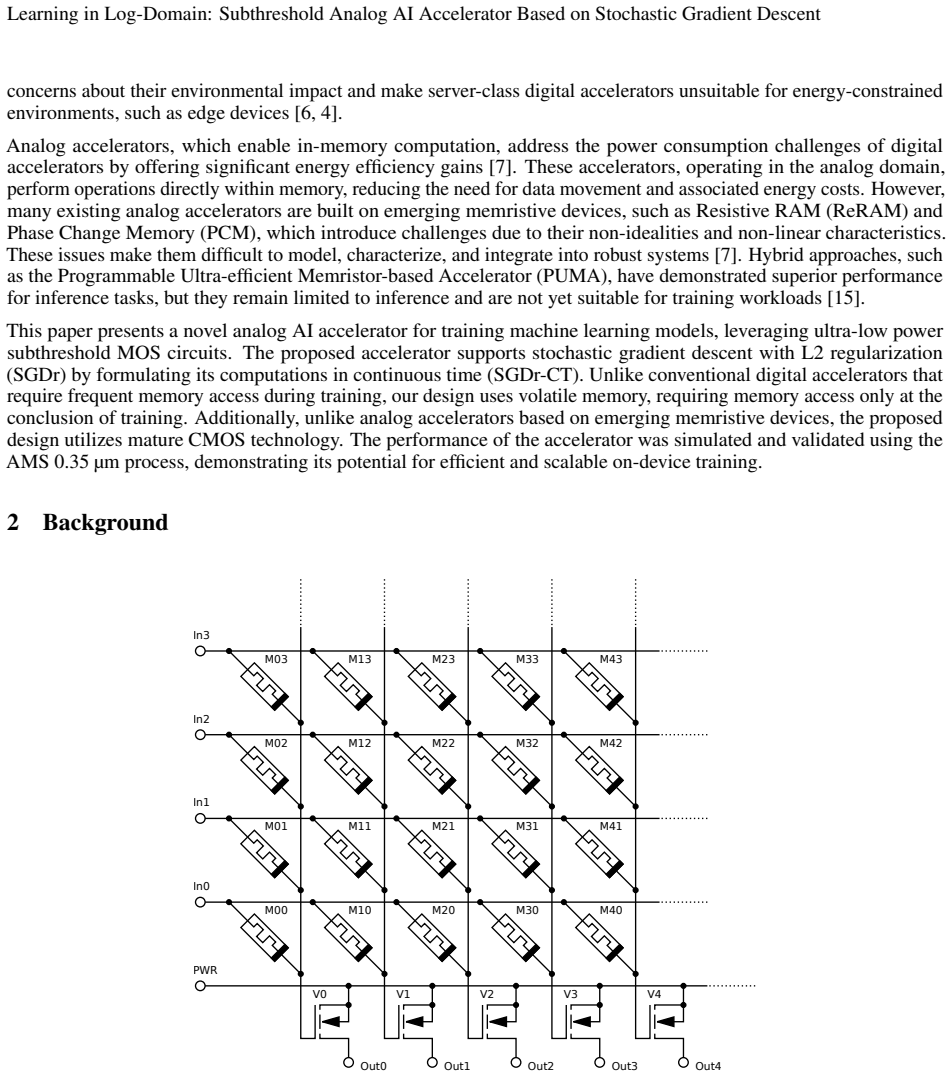
- Multi-layer networks can be formed by stacking crossbar layers, and the paper gives circuit proposals for ReLU and its derivative using current mirrors and a winner-take-all comparator.
- Smaller regularization coefficients require extra stacked transistors in the translinear loop, with the modified circuit equation provided for coefficients two orders of magnitude below 0.05.
Reading between the lines
- A consequence the paper leaves implicit: the same positive/negative decomposition could handle bidirectional inputs by using four unidirectional cells per weight, duplicating the input path rather than altering the translinear core.
- A testable extension of the one-to-many mapping claim: fix $\alpha$, shrink $C$ and $\Delta s$ together, and check whether the training error stays below 1% as throughput increases.
- The paper's 'wide hyperparameter range' is bounded by the weak-inversion region, since $\lambda$ much below 0.05 pushes transistors out of subthreshold; a continuous $\lambda$ sweep would locate that boundary empirically.
Signed reviews
Editorial analysis
A structured set of objections, weighed in public.
Referee Report
Summary. The paper proposes a subthreshold MOS log-domain analog accelerator for continuous-time stochastic gradient descent with L2 regularization (SGDr-CT). It derives differential learning equations from the discrete SGDr update, maps them to a Bernoulli-cell-based weight-learning node, and validates the node in AMS 0.35 µm SPICE simulations against an ideal Python SGDr implementation on univariate datasets and Boston Housing linear regression, reporting mean-squared-error deviations below 0.87% and weight-parameter deviations around 0.5%.
Significance. If the fidelity and hyperparameter-range claims hold, the work offers a promising path toward energy-efficient on-chip training using mature CMOS and volatile memory, avoiding the non-idealities of memristive devices. The derivation of Eq. (13) from the Bernoulli cell is coherent, and the nominal SPICE-versus-ideal agreement at the tested operating point is a useful first validation. However, the current evidence supports only a single nominal operating point of the weight-learning node, not the full architecture or the advertised wide hyperparameter range; several limitations are acknowledged in the paper itself and need to be addressed or clearly scoped.
major comments (3)
- [Section 5.1 and Table 1] The hyperparameter-sweep results are not a valid fidelity test at the requested λ values: for λ = 0.2 and λ = 0.05 the authors report correcting observed deviations by retuning the mapped currents to 0.27 and 0.03. Since Table 1 maps λ to u/Iq, this retuning changes the optimization objective itself, so the post-retuning comparison demonstrates agreement at a different λ than the one claimed. The claim that the circuit supports a wide range of hyperparameters at the specified values is therefore unsupported by the presented experiments.
- [Sections 5 and 6.2, Eq. (24)] All headline accuracy numbers (0.71% weight error, 0.87% MSE, 8-bit precision) come from a single SPICE run at one nominal operating point under the ideal weak-inversion assumption of Eq. (24). The paper itself states in Section 6.2 that λ values much smaller than 0.05 push transistors out of weak inversion, and the proposed extended translinear loop is not simulated. Without Monte Carlo mismatch, process-corner, or temperature analysis, the claimed precision and wide-range operation are not established.
- [Sections 5.2 and 6.1] The experimental validation covers a single weight-learning node and a linear-regression task; bias terms, activation-function gradients, the full crossbar array, and multi-layer backpropagation are not implemented or simulated. Section 6.1 explicitly defers the bias term to future work. The abstract and introduction claim an accelerator architecture for AI/ML training workloads, which is broader than the evidence provided, so the scope of the claims needs to be narrowed to the core weight-update node.
minor comments (6)
- [Section 3] Two nearly identical consecutive paragraphs begin with 'To simplify the derivation...'; the duplicate paragraph should be removed.
- [Section 5.1 and Figure 4] The text states that λ and α were set to 1e−3 and 0.1, respectively, but Figure 4's caption and Table 2's nominal values indicate λ = 0.1 and α = 1e−3; this inconsistency should be corrected.
- [Appendix A.1] Equation (20) uses an equality sign where the preceding line is an Euler approximation; it should use '≈' unless the equivalence is otherwise justified.
- [Section 3, Eq. (10)] Calling the separation of Eq. (10) a 'tautology' is imprecise; setting c(t) = 0 is a design choice that gives sufficient conditions (11) and (12) for the difference equation, not an identity that holds for all c(t).
- [Table 3] The 'Dataset#' column shows 1 in all five rows; the rows should be numbered 1 through 5.
- [Eq. (14)] The definition of 'Full scale' in the bit-precision formula should be clarified: with a full-scale range of [−1, 1] and max error 0.527%, the result is about 7.6 bits if full scale is taken as 1, so the '8-bit' claim needs a precise convention.
Circularity Check
Core derivation is self-contained; the wide-hyperparameter claim rests on refitting the λ-defining current, a fitted-input issue.
-
fitted input called prediction
[Section 5.1, Figure 5 and Table 1 mapping]
"For λ = 0.2 and λ = 0.05, slight deviations were observed between the circuit and the ideal behavior. These deviations were corrected by tuning the mapped currents in the circuit to 0.27 and 0.03, respectively. The deviations occurred because the transistor dimensions were optimized for λ = 0.1."
Under the paper's own mapping (Table 1), λ is implemented as the current ratio u/Iq, with nominal values u=10 nA and Iq=100 nA giving λ=0.1. Retuning the mapped currents to 0.27 and 0.03 therefore changes the value of λ that the circuit actually implements. The subsequent agreement between circuit and ideal at the labels λ=0.2 and λ=0.05 is obtained by adjusting the hyperparameter-defining current until the behavior matches, i.e., the claimed support for those λ values is fitted rather than predicted by a fixed design. This does not invalidate the nominal λ=0.1 result, where no retuning is reported, but it does undermine the paper's wide-hyperparameter-range claim.
full rationale
No derivation-level circularity is present. Appendix A.1 derives the continuous-time SGDr-CT ODE (7) from the discrete SGD rule (5) by a stated Euler/step-function approximation; this is an explicit modelling step, not an assumption of the conclusion. Appendix A.2 derives the positive-cell equation (13) from the subthreshold MOS exponential law and the translinear loop of the same circuit; the parameter mapping in Table 1 then makes (13) algebraically identical to the target learning equation (11). Checking the SPICE implementation against an ideal Python SGD solver is therefore a consistency/verification test of whether the transistor circuit realizes its design equation, rather than a prediction of an independent quantity. The one substantive circularity concern is the hyperparameter sweep in Section 5.1: because λ is defined as a current ratio, retuning the mapped currents to 0.27 and 0.03 changes the actual λ being implemented, so the wide-range claim for λ=0.2 and λ=0.05 is achieved by fitting the input rather than by a fixed design. The nominal λ=0.1 headline numbers (0.71% weight error, 0.87% MSE, 8-bit equivalent) are not circular, though they are single-point and lack Monte Carlo/process-corner support; that is a robustness limitation, not circularity. The citation to the log-domain state-space method [16] is a normal use of established prior work by one coauthor and does not smuggle in the paper's conclusion.
Assumptions & free parameters
free parameters (4)
- Nominal circuit parameters (C, Iu, u, Iq, W/L) =
C=39nF, Iu=10nA, u=10nA, Iq=100nA, W/L=1µm/0.5µm
- Mapped current for λ=0.2 =
0.27
- Mapped current for λ=0.05 =
0.03
- DAC step rise time =
0.5% of Δs
assumptions (6)
- standard math Euler's method and the assumption that δ(t) and w(t) vary minimally over Δs connect the continuous ODE (7) to the discrete SGDr update (5).
- domain assumption Subthreshold MOS transistors follow the exponential drain current relation I_D = I_D0 exp((V_G - V_C)/(nV_T)).
- domain assumption Translinear loops are ideal and perfectly matched, so the product and geometric-mean relations (e.g., equation (36)) hold exactly.
- domain assumption Inputs are unidirectional (strictly positive) and weights are bidirectional, represented as the difference of two unidirectional currents.
- ad hoc to paper The circuit remains in weak inversion across the claimed hyperparameter range.
- ad hoc to paper The 'tautology' c(t) argument allows separation of equation (10) into (11) and (12).
Cite this review
Pith. "Pith review of Learning in Log-Domain: Subthreshold Analog AI Accelerator Based on Stochastic Gradient Descent." pith.science (2026). https://pith.science/paper/MLJNS4RZ
@misc{pith2026250113181,
  author       = {Pith},
  title        = {Pith review of: Learning in Log-Domain: Subthreshold Analog AI Accelerator Based on Stochastic Gradient Descent},
  year         = {2026},
  howpublished = {\url{https://pith.science/paper/MLJNS4RZ}},
  note         = {Machine review of arXiv:2501.13181}
}
read the original abstract
The rapid proliferation of AI models, coupled with growing demand for edge deployment, necessitates the development of AI hardware that is both high-performance and energy-efficient. In this paper, we propose a novel analog accelerator architecture designed for AI/ML training workloads using stochastic gradient descent with L2 regularization (SGDr). The architecture leverages log-domain circuits in subthreshold MOS and incorporates volatile memory. We establish a mathematical framework for solving SGDr in the continuous time domain and detail the mapping of SGDr learning equations to log-domain circuits. By operating in the analog domain and utilizing weak inversion, the proposed design achieves significant reductions in transistor area and power consumption compared to digital implementations. Experimental results demonstrate that the architecture closely approximates ideal behavior, with a mean square error below 0.87% and precision as low as 8 bits. Furthermore, the architecture supports a wide range of hyperparameters. This work paves the way for energy-efficient analog AI hardware with on-chip training capabilities.
Figures


Figures from the paper (4 more)


Reference graph
Works this paper leans on
-
[1]
Privacy-preserving heterogeneous federated transfer learning
Dashan Gao, Yang Liu, Anbu Huang, Ce Ju, Han Yu, and Qiang Yang. Privacy-preserving heterogeneous federated transfer learning. In 2019 IEEE International Conference on Big Data (Big Data) , pages 2552–2559, 2019
work page 2019
-
[2]
Attention is all you need
Ashish Vaswani, Noam Shazeer, Niki Parmar, Jakob Uszkoreit, Llion Jones, Aidan N Gomez, Ł ukasz Kaiser, and Illia Polosukhin. Attention is all you need. In I. Guyon, U. V on Luxburg, S. Bengio, H. Wallach, R. Fergus, S. Vishwanathan, and R. Garnett, editors, Advances in Neural Information Processing Systems , volume 30. Curran Associates, Inc., 2017
2017
-
[3]
Adam Coates, Brody Huval, Tao Wang, David J. Wu, Andrew Y . Ng, and Bryan Catanzaro. Deep learning with cots hpc systems. In Proceedings of the 30th International Conference on International Conference on Machine Learning - V olume 28, ICML’13, page III–1337–III–1345. JMLR.org, 2013
work page 2013
-
[4]
Wolff Anthony, Benjamin Kanding, and Raghavendra Selvan
Lasse F. Wolff Anthony, Benjamin Kanding, and Raghavendra Selvan. Carbontracker: Tracking and predicting the carbon footprint of training deep learning models. ICML Workshop on Challenges in Deploying and monitoring Machine Learning Systems, July 2020. arXiv:2007.03051
arXiv 2020
-
[5]
Yodann: An ultra-low power convolutional neural network accelerator based on binary weights
Renzo Andri, Lukas Cavigelli, Davide Rossi, and Luca Benini. Yodann: An ultra-low power convolutional neural network accelerator based on binary weights. In 2016 IEEE Computer Society Annual Symposium on VLSI (ISVLSI), pages 236–241, 2016. 16 Learning in Log-Domain: Subthreshold Analog AI Accelerator Based on Stochastic Gradient Descent
work page 2016
-
[6]
Energy and policy considerations for deep learning in NLP
Emma Strubell, Ananya Ganesh, and Andrew McCallum. Energy and policy considerations for deep learning in NLP. In Anna Korhonen, David Traum, and Lluís Màrquez, editors, Proceedings of the 57th Annual Meeting of the Association for Computational Linguistics , pages 3645–3650, Florence, Italy, July 2019. Association for Computational Linguistics
work page 2019
-
[7]
T. Patrick Xiao, Christopher H. Bennett, Ben Feinberg, Sapan Agarwal, and Matthew J. Marinella. Analog architectures for neural network acceleration based on non-volatile memory. Applied Physics Reviews, 7(3), 2020
work page 2020
-
[8]
Vivienne Sze, Yu Hsin Chen, Tien Ju Yang, and Joel S. Emer. Efficient Processing of Deep Neural Networks: A Tutorial and Survey. Proceedings of the IEEE, 105(12):2295–2329, 2017
work page 2017
Show all 24 references
-
[9]
Survey of Machine Learning Accelerators
Albert Reuther, Peter Michaleas, Michael Jones, Vijay Gadepally, Siddharth Samsi, and Jeremy Kepner. Survey of Machine Learning Accelerators. 2020 IEEE High Performance Extreme Computing Conference, HPEC 2020 , pages 1–9, 2020
2020
-
[10]
Eric Chung, Jeremy Fowers, Kalin Ovtcharov, Michael Papamichael, Adrian Caulfield, Todd Massengill, Ming Liu, Daniel Lo, Shlomi Alkalay, Michael Haselman, Maleen Abeydeera, Logan Adams, Hari Angepat, Christian Boehn, Derek Chiou, Oren Firestein, Alessandro Forin, Kang Su Gatli...
2018
-
[11]
Norman P. Jouppi, Cliff Young, Nishant Patil, David Patterson, Gaurav Agrawal, Raminder Bajwa, Sarah Bates, Suresh Bhatia, Nan Boden, Al Borchers, Rick Boyle, Pierre luc Cantin, Clifford Chao, Chris Clark, Jeremy Coriell, Mike Daley, Matt Dau, Jeffrey Dean, Ben Gelb, Tara Vazi...
2017
-
[12]
Unpu: A 50.6tops/w unified deep neural network accelerator with 1b-to-16b fully-variable weight bit-precision
Jinmook Lee, Changhyeon Kim, Sanghoon Kang, Dongjoo Shin, Sangyeob Kim, and Hoi-Jun Yoo. Unpu: A 50.6tops/w unified deep neural network accelerator with 1b-to-16b fully-variable weight bit-precision. In 2018 IEEE International Solid - State Circuits Conference - (ISSCC) , page...
2018
-
[13]
Brein memory: A single-chip binary/ternary reconfigurable in-memory deep neural network accelerator achieving 1.4 tops at 0.6 w
Kota Ando, Kodai Ueyoshi, Kentaro Orimo, Haruyoshi Yonekawa, Shimpei Sato, Hiroki Nakahara, Shinya Takamaeda-Yamazaki, Masayuki Ikebe, Tetsuya Asai, Tadahiro Kuroda, and Masato Motomura. Brein memory: A single-chip binary/ternary reconfigurable in-memory deep neural network ac...
2018
-
[14]
The carbon footprint of machine learning
David Patterson et al. The carbon footprint of machine learning. Communications of the ACM , 64(7):16–18, 2021
2021
-
[15]
Stanley Williams, Paolo Faraboschi, Wen-mei W Hwu, John Paul Strachan, Kaushik Roy, and Dejan S
Aayush Ankit, Izzat El Hajj, Sai Rahul Chalamalasetti, Geoffrey Ndu, Martin Foltin, R. Stanley Williams, Paolo Faraboschi, Wen-mei W Hwu, John Paul Strachan, Kaushik Roy, and Dejan S. Milojicic. Puma: A programmable ultra-efficient memristor-based accelerator for machine learn...
2019
-
[16]
log-domain state-space
E.M. Drakakis, A.J. Payne, and C. Toumazou. "log-domain state-space": a systematic transistor-level approach for log-domain filtering. IEEE Transactions on Circuits and Systems II: Analog and Digital Signal Processing , 46(3):290–305, 1999
1999
-
[17]
Lyon, and Emmanuel
Guang Yang, Richard F. Lyon, and Emmanuel. M. Drakakis. A 6µw per channel analog biomimetic cochlear implant processor filterbank architecture with across channels agc. IEEE Transactions on Biomedical Circuits and Systems, 9(1):72–86, 2015
2015
-
[18]
Hedonic housing prices and the demand for clean air
David Harrison and Daniel L Rubinfeld. Hedonic housing prices and the demand for clean air. Journal of Environmental Economics and Management, 5(1):81–102, March 1978
1978
-
[19]
The scikit-learn boston housing dataset documentation
The scikit-learn developers. The scikit-learn boston housing dataset documentation. 2021. Accessed: 2024-12-29
2021
-
[20]
The boston housing dataset and fairness concerns
Fairlearn Developers. The boston housing dataset and fairness concerns. Fairlearn Documentation, 2021. Accessed: 2024-12-29. 17 Learning in Log-Domain: Subthreshold Analog AI Accelerator Based on Stochastic Gradient Descent
2021
-
[21]
A comparative study of different curve fitting algorithms in artificial neural network using housing dataset
Ali Al Bataineh and Devinder Kaur. A comparative study of different curve fitting algorithms in artificial neural network using housing dataset. In NAECON 2018 - IEEE National Aerospace and Electronics Conference , pages 174–178, 2018
2018
-
[22]
Gerosa, A
A. Gerosa, A. Maniero, and A. Neviani. A fully integrated dual-channel log-domain programmable preamplifier and filter for an implantable cardiac pacemaker. IEEE Transactions on Circuits and Systems I: Regular Papers , 51(10):1916–1925, 2004
1916
-
[23]
Seevinck
E. Seevinck. Companding current-mode integrator: A new circuit principle for continuous-time monolithic filters. Electronics Letters, 26:2046–2047, 1990
1990
-
[24]
Moro-Frias, M
D. Moro-Frias, M. T. Sanz-Pascual, and C. A. de la Cruz Blas. A novel current-mode winner-take-all topology. In 2011 20th European Conference on Circuit Theory and Design (ECCTD) , pages 134–137, 2011. 18
2011
Reviewed August 10, 2026 · model on record in the stance chip above.
Discussion (0). Continue with ORCID to comment.