REVIEW 3 major objections 4 minor 4 cited by
Boundary imprint of bulk causality
T0 review · 3 major / 4 minor · reviewed 2026-08-10 · deepseek-v4-flash
Pith's one-line read A single quadratic condition on boundary lightcone imprints is equivalent to the bulk Hamilton-Jacobi equation, so bulk geodesics can be derived from boundary causality.
desk verdict Solid Hamilton-Jacobi framework for boundary hyperboloids, but the claimed derivation of bulk geodesics from causality assumes the quadratic null-cone structure it aims to derive. read the letter →
The pith
A machine-rendered reading of the paper's core claim, the machinery that carries it, and where it could break.
The reading
What carries the argument
The load-bearing object is the Hamilton-Jacobi function $S(p;X)=p_\mu x^\mu(p;X)$, whose gradient in p gives the boundary hyperboloid and whose gradient in X gives the bulk momentum. The main identity is the quadratic tangent condition (4.16): the infinitesimal displacements $\delta X(p;X)$ that keep the boundary hyperboloid tangent to itself are null with respect to a single metric g. The paper proves that this condition is equivalent to the Hamilton-Jacobi equation $g^{MN}(\partial_M S)(\partial_N S)=0$, and that the flow generated by $g^{MN}\partial_N S$ satisfies the geodesic equation. This equivalence is what lets boundary curves, treated as given data, be reinterpreted as null geodesic congruences of the reconstructed conformal metric.
What would settle it
Take a known bulk spacetime without symmetries, compute its boundary hyperboloids, and apply the reverse algorithm of section 4.2 to reconstruct the conformal metric; if the reconstructed metric differs from the original beyond a Weyl rescaling at any bulk point, the quadratic-cone assumption fails. Alternatively, search for a family of boundary hyperboloids whose tangent displacements respect causal inclusion but whose null directions cannot be fit by a single quadratic form, which would violate condition (4.16) and invalidate the geodesic derivation.
Extended reading notes
Core claim
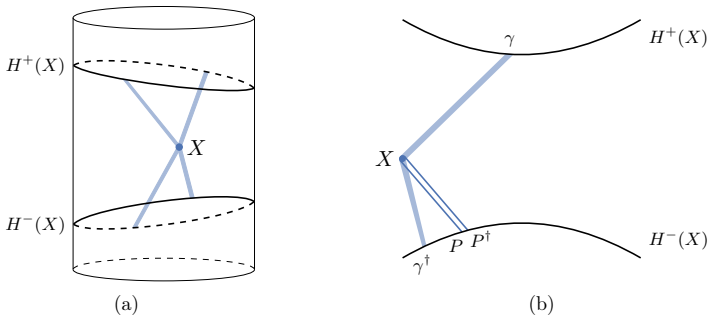
The paper's central claim is that bulk causality leaves an imprint on the boundary strong enough to reconstruct the bulk metric and its null geodesics. For a fixed bulk point X, the future and past lightcones intersect the asymptotic boundary in codimension-one surfaces $x^\mu(p;X)$, parametrized by the boundary momentum p, which is also the surface normal. The paper shows that if every infinitesimal bulk displacement $\delta X$ that produces a tangent change of these surfaces satisfies a common quadratic equation $g_{MN}\delta X^M\delta X^N=0$ for some non-degenerate metric g, then that condition is equivalent to the bulk Hamilton-Jacobi equation. Consequently a family of boundary hyperboloids satisfying the quadratic tangent condition is exactly the null geodesic congruence of the reconstructed conformal metric, and the bulk geodesic equation follows from boundary data. The paper also gives an explicit algebraic procedure that recovers the conformal metric from nearby hyperboloids and verifies it on planar and spherical black hole examples, including points behind which orbiting geodesics create many branches.
Load-bearing premise
The argument assumes there is a single, fixed notion of 'null' in the bulk: every infinitesimal shift of a bulk point that leaves a boundary hyperboloid tangent must lie on one common quadratic lightcone, and nothing in the causality-inclusion property alone forces that to be true.
Editorial extensions
If this is right
- A holographic observer who can measure correlation-function singularities along boundary hyperboloids can determine the bulk conformal metric up to an overall Weyl factor, without solving any bulk equations of motion.
- The inclusion property of hyperboloids for timelike-separated bulk points becomes a testable boundary signature of bulk causality; points close to black-hole horizons appear as time-translated copies of a common shape with logarithmically growing time delay.
- Because the quadratic condition fixes the metric algebraically from finitely many tangent points, a finite set of boundary measurements over-determines the bulk metric and provides built-in consistency checks.
- The same logic applies beyond asymptotically AdS boundaries, such as null infinity in flat space or artificial boundaries around local observers, making the construction a general way to read geometry from lightcone cuts.
Reading between the lines
- One could test the reverse construction numerically in a non-symmetric spacetime by generating hyperboloids from a known metric and then running the section 4.2 algorithm to see whether the recovered conformal metric agrees with the original; agreement would confirm the equivalence beyond the symmetric examples.
- The quadratic-cone assumption is essentially a statement of the equivalence principle; if an emergent bulk had momentum-dependent or non-Lorentzian null directions at some scale, the boundary data would show a p-dependent 'metric' and the reconstruction would break down, offering a diagnostic for Lorentz violation.
- The same hyperboloid data may give access to gravitational focusing and geodesic deviation: the paper leaves open whether the boundary inclusion property implies convergence of nearby null geodesics, which would connect this kinematic construction to the emergence of gravity rather than just geometry.
- A practical extension would be to feed the reconstructed conformal metric into a boundary-correlator search for bulk-point singularities, using the hyperboloid shapes as a prior for where to look for scattering events.
Editorial analysis
A structured set of objections, weighed in public.
Referee Report
Summary. This paper develops a Hamilton-Jacobi description of the boundary hyperboloids H±(X) formed by null geodesics emitted from a bulk point X and reaching an asymptotic AdS boundary. The authors first review how a bulk Hamilton-Jacobi function S(p;X) controls these surfaces and how, under a rank assumption, the Hamilton-Jacobi equation implies the bulk null geodesic equation. They then compute explicit hyperboloids for Poincaré AdS, planar black holes, and small AdS-Schwarzschild black holes, including photon-sphere effects. In Section 4, they translate bulk causality into a boundary inclusion property for light-cone cuts and use it to propose a method for measuring the bulk conformal metric from families of hyperboloids. Section 4.2 contains the paper's central converse: if a family of boundary hyperboloids satisfies the quadratic tangent condition (4.16) for a fixed nondegenerate metric g, then S = p·x satisfies the Hamilton-Jacobi equation and the curves are null geodesics of g. The paper is candid in Section 5 that the origin of the quadratic condition remains open and that it is tied to the equivalence principle.
Significance. If taken as a conditional reformulation, the paper is a useful and concrete contribution. The derivation in §2.1.1 is sound, the examples in §3 are worked out in explicit parametric form, and the photon-sphere analysis in §3.2 is physically interesting. The numerical check in §4.1 that the metric reconstruction reproduces the AdS5 planar black hole metric adds concreteness. The main limitation is that the reverse derivation in §4.2 does not derive a common quadratic null cone from the causality inclusion property; instead, it assumes such a cone through (4.16). Since the paper acknowledges this in §5, the value lies in a precise equivalence statement and an algorithmic measurement protocol, not in a derivation of bulk geometry from boundary causality alone. With this caveat made central, the paper would be a reasonable and publishable contribution.
major comments (3)
- [§4.2, Eq. (4.16); §5; Abstract] The central theorem is conditional on the quadratic tangent condition (4.16), but (4.16) is not derived from the causality inclusion property (4.1). Inequality (4.1) only constrains boundary displacements for timelike or null bulk displacements; saturation selects one null direction per boundary momentum p. That all these selected directions lie on the null cone of a single quadratic form g is an additional postulate, essentially the equivalence principle. The paper states this in §5, calling it 'the essential question,' so the derivation itself is not circular. However, the abstract's phrase 'from which the bulk geodesic equation can be derived' and the heading of §4.2 ('null geodesics in the bulk from causality') overstate the result. I recommend rephrasing the claim to state explicitly that (4.16) is an assumption and that the result is an equivalence: given a common quadratic null cone, boundary hyperboloids satisfying the tangent condition are exactly the null geodesic congruences of that cone. This is a substantive framing issue because it determines what the paper has actually proved.
- [§4.1, Eqs. (4.1)–(4.3)] The metric-measurement protocol also silently uses the bulk Lorentzian structure that it claims to measure. The forward direction is correct: if the bulk metric is known, then the saturation vectors of (4.1) are indeed null, and equal-slope displacements on nearby hyperboloids give null vectors. But the transition from 'saturation' to the existence of a single g in (4.3) uses the bulk notions of promptness and Lorentzian geometry. If the protocol is intended as a purely boundary reconstruction without prior bulk input, the existence of the quadratic form must be stated as an assumption rather than as a consequence of the inclusion property. Please make explicit in §4.1 that the measurement recovers the metric only after a quadratic null cone is assumed or supplied by the bulk theory.
- [§4.2.1, rank assumptions] The proof of the converse is valid under the stated maximal-rank assumptions, but the physical regime where these assumptions hold is not discussed. In particular, the matrix ∂δX^M/∂p^ν is required to have rank d, and ∂x^μ/∂X^M is required to have rank d. These conditions can fail at conjugate points, caustics, or where boundary hyperboloids develop cusps, as can occur near the photon sphere in the AdS-Schwarzschild example. The paper already acknowledges isolated singular points in §2.2, but a more precise statement of where the genericity assumptions hold, and what happens at their failure, would strengthen the claim that the construction applies to realistic bulk geometries.
minor comments (4)
- [Eq. (4.3)] There is a typo: the expression 'δX^M δX^M' should read 'g_{MN}(X) δX^M δX^N'.
- [Eq. (2.22)] The index notation is inconsistent: the surface coordinate is x^μ(p;X), but (2.22) writes ∂x_{˙μ}/∂p_{˙ν}. This should be ∂x^{˙μ}/∂p_{˙ν} or equivalent, with the metric on the boundary used consistently.
- [Section 4.1, counting of evaluations] The statement that 'd(d+3)/2 discrete values of p generically suffice' is plausible by counting symmetric matrices up to scale, but the nonlinear dependence of the null vector on p means a rank argument is needed. A brief justification or a reference would be helpful.
- [References] Reference [13] is given as 'arXiv:25XX.XXXXX'. This placeholder should be updated or the reference should be marked as forthcoming with a working identifier.
Circularity Check
The reverse derivation in §4.2 is mathematically valid only conditional on Eq. (4.16), which already postulates a bulk conformal metric; the advertised derivation of bulk geodesics from boundary causality is therefore a reformulation rather than a derivation.
-
self definitional
[Section 4.2, Eq. (4.16), with acknowledgment in Section 5]
"The main physical assumption is that, for any p, we can find a small displacement that satisfies the tangent condition (4.2), and that the collection of these displacements satisfies a quadratic equation: ∃ gM N(X), such that ∀ p, ∂xµ (p; X) ∂X M δX M = 0 implies gM N(X)δX M δX N = 0. (4.16)"
The central theorem of §4.2 proves that condition (4.16) is equivalent to the Hamilton-Jacobi equation (4.23) and hence that the boundary curves are null geodesics of the metric g. But (4.16) already postulates the existence of a single non-degenerate quadratic form g whose null cone contains all bulk displacements that preserve a tangent boundary point. That is exactly the conformal metric that the paper claims to derive. The causality inclusion property (4.1) only gives a family of linear inequalities and does not imply that the boundary-selected null directions form a quadric. Thus the 'derivation' reduces to an equivalence between two forms of the same geometric postulate.
full rationale
The paper contains substantial valid mathematics: the Hamilton-Jacobi formalism in Section 2, the explicit hyperboloid computations in Section 3, and the metric-measurement procedure in Section 4.1 are self-contained and correctly executed against known examples. The reverse theorem in §4.2 is also internally sound: given a family of boundary surfaces and assuming (4.16), the proof that S = p·x satisfies the Hamilton-Jacobi equation and that the surfaces are null geodesic congruences is rigorous. The circularity lies in the interpretive claim that this constitutes a derivation of bulk geometry from boundary causality. Condition (4.16) is not derived from the inclusion inequality (4.1); it is an independent postulate that the tangent-selected displacements lie on a single quadratic null cone, which is precisely the conformal metric. The paper's own concluding section identifies the missing derivation as the equivalence principle and calls it an outstanding question. Hence the central result reduces by construction: the metric appearing in the conclusion is the same g assumed in (4.16). This is a partial, definitional circularity rather than a defect in the conditional mathematics. There are no load-bearing self-citation chains or fitted parameters disguised as predictions; the issue is that the key physical assumption is equivalent to the claimed output.
Assumptions & free parameters
assumptions (6)
- standard math Hamilton-Jacobi formalism and the geodesic equation for massive and massless particles.
- domain assumption The bulk is a Lorentzian manifold with an asymptotic AdS boundary; the boundary is flat Minkowski space.
- domain assumption Causal transitivity and future inclusion: if X is in the causal past of Y, then the future of Y is contained in the future of X, with infinitesimal version (4.1).
- ad hoc to paper Quadratic tangent condition (4.16): for every p, any displacement satisfying tangency is null with respect to a single non-degenerate metric g.
- ad hoc to paper Genericity and rank assumptions: the matrices ∂x^μ/∂X^M and ∂δX^M/∂p^ν have maximal rank d.
- standard math The Hamilton-Jacobi function S(p;X) is homogeneous of degree one in p, so p is the surface normal.
Cite this review
Pith. "Pith review of Boundary imprint of bulk causality." pith.science (2026). https://pith.science/paper/BUIS224V
@misc{pith2026250113182,
  author       = {Pith},
  title        = {Pith review of: Boundary imprint of bulk causality},
  year         = {2026},
  howpublished = {\url{https://pith.science/paper/BUIS224V}},
  note         = {Machine review of arXiv:2501.13182}
}
read the original abstract
Motivated by the holographic correspondence, we study the boundary imprint of bulk lightcones in spacetimes with boundaries. These lightcones can be observed whenever a localized event takes place in the bulk. The associated boundary surfaces (hyperboloids) reveal the bulk conformal metric. We work out a Hamilton-Jacobi description of these surfaces and analyze them in explicit examples. Bulk causality translates into a boundary inclusion property from which the bulk geodesic equation can be derived under some assumptions.
Figures


Figures from the paper (3 more)


Forward citations
Cited by 4 Pith papers
-
Imprint of the black hole singularity on thermal two-point functions
Thermal two-point functions in holographic AdS black holes receive exponentially small non-perturbative corrections controlled by null geodesics bouncing off the singularity.
-
Bouncing singularities and thermal correlators on line defects
Retarded correlators of displacement operators on line defects in holographic thermal CFTs exhibit bouncing singularities that match between interior-sensitive WKB and boundary-only OPE analyses.
-
Imprint of the black hole interior on thermal four-point correlators
Analytically continuing and smearing thermal four-point correlators turns them into flat-space scattering amplitudes at a bulk point inside the black hole.
-
Composite AdS geodesics for CFT correlators and timelike entanglement entropy
A bulk extremization prescription produces composite timelike-spacelike geodesics whose complex length exactly matches CFT two-point functions at timelike separation, including behind the BTZ horizon.
Reference graph
Works this paper leans on
-
[1]
J. M. Maldacena, The Large N limit of superconformal field theories and superg ravity, Int. J. Theor. Phys. 38 (1999) 1113–1133, [ hep-th/9711200]
arXiv 1999
-
[2]
Polchinski, S matrices from AdS space-time , hep-th/9901076
J. Polchinski, S matrices from AdS space-time , hep-th/9901076
-
[3]
S. B. Giddings, Flat space scattering and bulk locality in the AdS / CFT corre spondence, Phys. Rev. D 61 (2000) 106008, [ hep-th/9907129]
arXiv 2000
-
[4]
M. Gary, S. B. Giddings, and J. Penedones, Local bulk S-matrix elements and CFT singularities, Phys. Rev. D 80 (2009) 085005, [ arXiv:0903.4437]
arXiv 2009
-
[5]
I. Heemskerk, J. Penedones, J. Polchinski, and J. Sully, Holography from Conformal Field Theory, JHEP 10 (2009) 079, [ arXiv:0907.0151]
arXiv 2009
-
[6]
J. Maldacena, D. Simmons-Duffin, and A. Zhiboedov, Looking for a bulk point , JHEP 01 (2017) 013, [ arXiv:1509.03612]
arXiv 2017
-
[7]
S. Komatsu, M. F. Paulos, B. C. Van Rees, and X. Zhao, Landau diagrams in AdS and S-matrices from conformal correlators , JHEP 11 (2020) 046, [ arXiv:2007.13745]
arXiv 2020
-
[8]
N. Engelhardt and G. T. Horowitz, Towards a Reconstruction of General Bulk Metrics , Class. Quant. Grav. 34 (2017), no. 1 015004, [ arXiv:1605.01070]
arXiv 2017
Show all 29 references
-
[9]
Engelhardt and G
N. Engelhardt and G. T. Horowitz, Recovering the spacetime metric from a holographic dual, Adv. Theor. Math. Phys. 21 (2017) 1635–1653, [ arXiv:1612.00391]
2017 arXiv
-
[10]
Fefferman and C
C. Fefferman and C. R. Graham, Conformal invariants , in Élie Cartan et les mathématiques d’aujourd’hui, no. S131 in Astérisque, pp. 95–116. Société mathématique de France, 1985. 20
1985
-
[11]
Hamilton, D
A. Hamilton, D. N. Kabat, G. Lifschytz, and D. A. Lowe, Holographic representation of local bulk operators, Phys. Rev. D 74 (2006) 066009, [ hep-th/0606141]
2006 arXiv
-
[12]
Caron-Huot, Holographic cameras: an eye for the bulk , JHEP 03 (2023) 047, [arXiv:2211.11791]
S. Caron-Huot, Holographic cameras: an eye for the bulk , JHEP 03 (2023) 047, [arXiv:2211.11791]
2023 arXiv
-
[13]
Caron-Huot, J
S. Caron-Huot, J. Chakravarty, and K. Namjou, Looking at bulk points in general geometries, arXiv:25XX.XXXXX
-
[14]
Ammon and J
M. Ammon and J. Erdmenger, Gauge/gravity duality: Foundations and applications . Cambridge University Press, Cambridge, 4, 2015
2015
-
[15]
Berenstein, Z
D. Berenstein, Z. Li, and J. Simon, ISCOs in AdS/CFT , Class. Quant. Grav. 38 (2021), no. 4 045009, [ arXiv:2009.04500]
2021 arXiv
-
[16]
N. Cruz, C. Martinez, and L. Pena, Geodesic structure of the (2+1) black hole , Class. Quant. Grav. 11 (1994) 2731–2740, [ gr-qc/9401025]
1994 arXiv
-
[17]
Hashimoto, S
K. Hashimoto, S. Kinoshita, and K. Murata, Imaging black holes through the AdS/CFT correspondence, Phys. Rev. D 101 (2020), no. 6 066018, [ arXiv:1811.12617]
2020 arXiv
-
[18]
Hashimoto, S
K. Hashimoto, S. Kinoshita, and K. Murata, Einstein Rings in Holography , Phys. Rev. Lett. 123 (2019), no. 3 031602, [ arXiv:1906.09113]
2019 arXiv
-
[19]
Y. Kaku, K. Murata, and J. Tsujimura, Observing black holes through superconductors , JHEP 09 (2021) 138, [ arXiv:2106.00304]
2021 arXiv
-
[20]
Dodelson and A
M. Dodelson and A. Zhiboedov, Gravitational orbits, double-twist mirage, and many-body scars, JHEP 12 (2022) 163, [ arXiv:2204.09749]
2022 arXiv
-
[21]
Kinoshita, K
S. Kinoshita, K. Murata, and D. Takeda, Shooting null geodesics into holographic spacetimes, JHEP 10 (2023) 074, [ arXiv:2304.01936]
2023 arXiv
-
[22]
Dodelson, C
M. Dodelson, C. Iossa, R. Karlsson, A. Lupsasca, and A. Z hiboedov, Black hole bulk-cone singularities, JHEP 07 (2024) 046, [ arXiv:2310.15236]
2024 arXiv
-
[23]
Gao and R
S. Gao and R. M. Wald, Theorems on gravitational time delay and related issues , Class. Quant. Grav. 17 (2000) 4999–5008, [ gr-qc/0007021]
2000 arXiv
-
[24]
Witten, Light Rays, Singularities, and All That , Rev
E. Witten, Light Rays, Singularities, and All That , Rev. Mod. Phys. 92 (2020), no. 4 045004, [ arXiv:1901.03928]
2020 arXiv
-
[25]
Engelhardt, Into the Bulk: A Covariant Approach , Phys
N. Engelhardt, Into the Bulk: A Covariant Approach , Phys. Rev. D 95 (2017), no. 6 066005, [ arXiv:1610.08516]
2017 arXiv
-
[26]
Czech, L
B. Czech, L. Lamprou, S. McCandlish, B. Mosk, and J. Sully, A Stereoscopic Look into the Bulk, JHEP 07 (2016) 129, [ arXiv:1604.03110]
2016 arXiv
-
[27]
de Boer, F
J. de Boer, F. M. Haehl, M. P. Heller, and R. C. Myers, Entanglement, holography and causal diamonds , JHEP 08 (2016) 162, [ arXiv:1606.03307]
2016 arXiv
-
[28]
Van Raamsdonk, Building up spacetime with quantum entanglement , Gen
M. Van Raamsdonk, Building up spacetime with quantum entanglement , Gen. Rel. Grav. 42 (2010) 2323–2329, [ arXiv:1005.3035]. 21
2010 arXiv
-
[29]
Berenstein, E
D. Berenstein, E. Maderazo, R. Mancilla, and A. Ramirez, Chaotic LLM billiards , JHEP 08 (2024) 056, [ arXiv:2305.19321]. 22
2024 arXiv
Reviewed August 10, 2026 · model on record in the stance chip above.
Discussion (0). Continue with ORCID to comment.