REVIEW 4 major objections 5 minor 60 references
Co-Learning Bayesian Optimization
T0 review · 4 major / 5 minor · reviewed 2026-08-10 · deepseek-v4-flash
Pith's one-line read Co-learning Bayesian optimization replaces the lone Gaussian process surrogate with an agreement-constrained GP ensemble, claiming this sharpens predictions near the optimum and fixes the over-exploitation and over-exploration failures of…
desk verdict A clearly specified ensemble-BO variant with consistent but modest empirical gains; the co-training theory is asserted, not derived, and the 'agreement' is just tied lengthscales. read the letter →
The pith
A machine-rendered reading of the paper's core claim, the machinery that carries it, and where it could break.
The reading
What carries the argument
The load-bearing object is the multi-form GP (MFGP), a multi-output Gaussian process in which each output is a GP trained on one bootstrap subset of the data, and the outputs are coupled by a correlation matrix $\rho_{ij}$. The agreement constraint is the shared length-scale condition $l^2_{h,1} = \cdots = l^2_{h,m} \equiv l^2_h$: all subsets must model the same curve bumpiness. This is the unlabeled-information agreement that the paper connects to co-training theory; the correlation coefficients and noise terms remain free hyperparameters, which preserves diversity. A second component, the single-output GP (SOGP) trained on the full data set, supplies a globally reasonable averaged prediction. The final ensemble combines MFGP and SOGP predictions, and each cycle selects one new point per model by maximizing expected improvement, with a minimum-distance rule and pseudo-EI as repair when sampled points are too close together.
What would settle it
Run CLBO's exact pipeline on the five numerical benchmarks with the shared length-scale agreement constraint removed, letting each bootstrap subset tune its own smoothness parameter, and compare prediction error near the global optimum and final regret; if the constrained version is not better, the agreement mechanism is not carrying the claimed improvement.
Extended reading notes
Core claim
The central discovery claimed is that an agreement-constrained multi-output GP (called MFGP) built from bootstrap subsets, combined with a single-output GP (SOGP) trained on the full data, yields a surrogate ensemble whose overall prediction error near optima is lower than that of a standard GP, and that this improvement transfers into better optimization outcomes under an unchanged expected-improvement acquisition rule. The mechanism rests on two identities: the bias-variance decomposition $E = E_{\mathrm{ind}} - \mathrm{Diversity}$, which says combining diverse models helps only if individual errors stay low, and the Rademacher-complexity bound $E(L(Y,f(X))) \le \hat{E}_n(L(Y,f(X))) + R_n(\tilde{L}\circ F) + \sqrt{8\log(2/\delta)/n}$, which says agreement on unlabeled information can shrink the hypothesis space. The agreement constraint is implemented as $l^2_{h,1} = \cdots = l^2_{h,m} \equiv l^2_h$, forcing all bootstrap-trained sub-models to share one length-scale hyperparameter, i.e., the same curve bumpiness. On Michalewicz, Rastrigin, Ackley, Hartman6, and Trid functions and on robot pushing, bipedal-walker control, and airfoil design, CLBO is reported to achieve the best or second-best solutions within budget, with lower variance across runs than the baselines.
Load-bearing premise
The load-bearing premise is that forcing bootstrap-trained GPs to share one smoothness parameter is the same kind of agreement on unlabeled points that co-training theory shows reduces the required number of samples.
Editorial extensions
If this is right
- Improving surrogate accuracy near optima is a viable route to fix EI's over-exploitation and over-exploration, so the suboptimality of BO can be attacked at the surrogate level rather than by redesigning the acquisition function.
- Because each model contributes one query per cycle, CLBO obtains a batch of samples without modifying EI, and in the paper's comparisons it is the only batch method whose convergence beats the sequential baselines.
- The agreement constraint reduces the sample complexity of the effective hypothesis space, so with the same number of subset samples the constrained individual models are expected to be more accurate than unconstrained subset models.
- Combining a full-data GP with a few agreement-constrained subset GPs balances diversity and individual accuracy; using too many agreement-constrained models reduces diversity and worsens performance, as the sensitivity analysis shows.
Reading between the lines
- Because the acquisition function is untouched, the same agreement-constrained surrogate ensemble could be paired with UCB, entropy search, or knowledge-gradient acquisition rules; the paper only mentions non-EI acquisition functions as future work.
- Stronger agreement constraints, such as sharing gradient information or penalizing predictive disagreement at unlabeled points, might sharpen the co-training benefit further, though at the cost of diversity; the paper does not test these variants.
- The same co-learning construction could apply to non-GP surrogates, since the bias-variance and Rademacher-complexity arguments are not GP-specific, but the paper reports no such experiments.
- The structure suggests a generic recipe for batch BO: run any single-point acquisition on an agreement-constrained ensemble and query one point per member; this is a generalization the paper does not state.
Editorial analysis
A structured set of objections, weighed in public.
Referee Report
Summary. The paper proposes CLBO, a Bayesian optimization framework that replaces the single Gaussian-process surrogate with (i) a multi-output GP (MFGP) built on bootstrap subsamples of the training data, with all sub-models forced to share one length-scale hyperparameter, and (ii) a standard single-output GP (SOGP) trained on the full sample set. EI is applied to each sub-model to generate multiple candidate points per iteration, and the training sets are exchanged according to a hand-designed rule. The authors motivate the shared length-scale as an "agreement constraint on curve bumpiness," invoke co-training/Rademacher-complexity theory to argue that this agreement reduces the sample complexity of the hypothesis space, and present experiments on five numerical benchmarks and three engineering benchmarks against sequential, batch, and multi-surrogate BO baselines.
Significance. If the mechanism claimed by the paper were established, CLBO would be a useful template for combining model diversity with agreement-based regularization in BO, and the engineering demonstrations on robot pushing, bipedal walking, and airfoil design are potentially valuable. The algorithm itself is clearly specified in Algorithms 1-4, the experimental setup is mostly reproducible from the text, and the comparison with a deliberately constructed MSBO baseline is a good idea for isolating the effect of the multi-model structure. However, the theoretical mechanism asserted in the abstract and Section IV is not derived: the only implemented constraint, the shared length-scale in Eq. (20), is a hyperparameter tie rather than an agreement constraint on unlabeled predictions, and the paper gives no argument connecting it to the Rademacher-complexity bound in Eq. (2). The empirical evaluation also lacks statistical significance tests and omits several baselines from the engineering sections. The central claim is therefore currently supported only by the raw experimental curves, which are suggestive but not conclusive.
major comments (4)
- [Section III-B, Eq. (20)] The central theoretical motivation is not supported by the implemented constraint. Eq. (20) forces all MFGP sub-models to share a single length-scale l_h^2, which is a hyperparameter-sharing constraint. The cited co-training/Rademacher theory in Eq. (2) and refs. [32],[33] concerns agreement of hypotheses on unlabeled inputs, i.e., a constraint on predictions at previously unseen points. The paper does not identify any unlabeled data used in training, does not define the hypothesis space F or loss class L in Eq. (2) for MFGP, and does not show that Eq. (20) reduces the relevant Rademacher complexity. This is load-bearing because the abstract and Sections I and IV repeatedly attribute CLBO's success to "agreement on unlabeled information." The paper should either derive a Rademacher-complexity reduction for the tied-length-scale MFGP hypothesis class or substantially soften the theoretical attribution and re-frame the contribution as an empirical ensemble heuristic.
- [Section IV-C and IV-D, Figures 2-6 and 9-11] The experimental comparisons are presented only as convergence plots and boxplots over 20 or 10 runs, with no significance tests or effect-size measures. Several claims such as "CLBO always achieves the best or second best optimal solutions" and "the variation of final solutions of CLBO is the smallest" would be much stronger with pairwise significance tests (e.g., Mann-Whitney U with a multiple-comparison correction) or at least a table of medians, interquartile ranges, and p-values. Without these, the reader cannot judge whether the visible differences, particularly on Hartman6 and the engineering benchmarks, are real or due to run-to-run variability.
- [Section IV-D] Three of the baselines used in the numerical tests—BBO-LP, BO-MCMC, and MSBO—are excluded from the engineering benchmark comparisons, with only a brief explanation. Since the paper's broad conclusion is that CLBO outperforms both sequential and batch BO algorithms, the absence of batch BBO-LP and of the multi-surrogate MSBO baseline from the engineering results weakens that conclusion. The authors should either provide the engineering results for these baselines or explicitly report the failure mode that prevented the comparison, rather than only stating that code modification was inconvenient for BBO-LP.
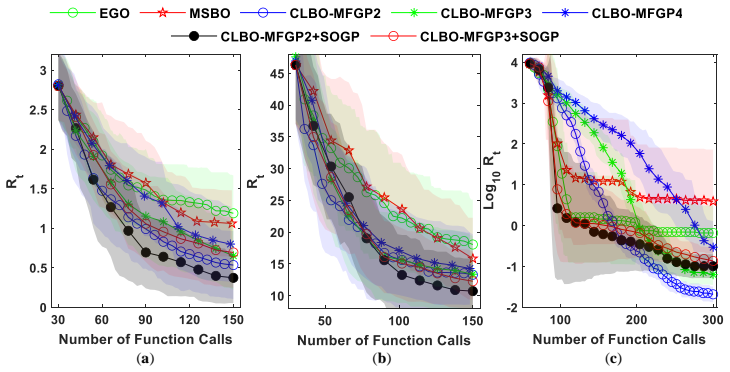
- [Section IV-E, Figure 12] The sensitivity analysis does not actually isolate the effect of the agreement constraint. The paper states that "the effectiveness of the agreement constraint in MFGP will be verified in Section IV," but Section IV-E varies only the number of MFGP sub-models and whether SOGP is included; it does not compare MFGP with tied length-scales against an otherwise identical model with independent per-subset length-scales (which is essentially the MSBO construction). Without that ablation, the improved accuracy cannot be attributed to the agreement constraint rather than to the multi-output structure or to sharing information through the joint covariance matrix in Eq. (15).
minor comments (5)
- [Section II-A, Eq. (7)] The EI expression has a notational error: the integrand should be max(fmin - Y(x), 0), not (fmin - Y(x), 0).
- [Section II-A.2, Eqs. (10)-(12)] The equation references in the text are inconsistent: the text says "As shown in Eq.(11), the condition z > 0" but Eq. (11) is the z < -3 approximation, and the z > 0 statement appears in Eq. (12). Please renumber or fix the cross-references.
- [Section II-A, Eq. (1)] The sentence defining the symbols in Eq. (1) appears to invert the roles: it says "where, yhat^(i) and yhat denote the overall prediction and the individual model prediction," but the equation and the following text indicate that yhat is the overall prediction and yhat^(i) are the individual predictions.
- [Algorithm 3] Line 6 uses the notation "arg maxP EI(x, xnew)" without defining the optimization variable or the domain; it should state explicitly that the maximization is over x and that PEI is being maximized as a function of x.
- [Abstract and Section I] The phrase "agreement on unlabeled information" is used loosely throughout; since no unlabeled data are ever introduced in the training procedure, this phrase should be defined operationally or replaced by a more precise term such as "shared hyperparameter constraint" unless the authors actually use unlabeled input locations in the MFGP training objective.
Circularity Check
No significant circularity: CLBO's empirical claims are tested against external benchmarks and an ablation variant (MSBO), and no central prediction reduces to a fitted input or a self-citation chain.
full rationale
The paper's central empirical claim is that combining a multi-output GP with a shared length-scale (Eq. 20) and a full-data single-output GP improves BO surrogate accuracy. This is assessed by comparison with multiple independent baselines (EGO, MSEGO, GEI, E3I, batch BO methods) and, crucially, with MSBO, which is described as training standard GPs on full and subset samples while keeping all other CLBO settings identical (Section 4.1). That ablation isolates the effect of the shared-hyperparameter MFGP construction, so the reported gains are not obtained by fitting a parameter and then relabeling the fit as a prediction. The theoretical motivation invokes the Rademacher-complexity/co-training result of Leskes and Torenvliet [32] and Farquhar et al. [33] to argue that agreement on unlabeled information reduces hypothesis-space complexity. The paper asserts, rather than derives, that tying length-scales across bootstrap subsets (Eq. 20) is the same kind of agreement over unlabeled information treated by that theory. This is a gap in the theoretical justification and a possible correctness concern, but it is not circularity: Eq. (2) is not defined in terms of Eq. (20), and Eq. (20) is not defined in terms of the claimed outcome. The self-citations in the paper (e.g., following benchmark settings from [2] and referencing multi-output GP remarks in [45]) are not load-bearing for the main algorithmic claim; they concern experimental setup and background methodology. No equation in the derivation chain reduces to its own input, no fitted value is renamed as a prediction, and no uniqueness or correctness premise is imported solely from the authors' prior work. Under the requested standard, where only exhibitible reductions count as circularity, the paper receives a clean finding.
Assumptions & free parameters
free parameters (3)
- number of MFGP sub-models m =
2 by default, variants 3 and 4 in Section IV.E
- minimum sample distance epsilon =
0.001
- termination iteration threshold t_T =
not reported
assumptions (5)
- standard math The bias-variance decomposition Eq.(1) describes the combined surrogate error
- standard math The Rademacher complexity bound Eq.(2) applies
- ad hoc to paper Agreement of models on unlabeled information reduces hypothesis-space complexity, and the shared length-scale in MFGP is such an agreement
- domain assumption Bootstrap subsamples of one objective function can be treated as related tasks in a multi-task GP
- domain assumption Squared-exponential GP with zero mean is an adequate surrogate for the test functions
Cite this review
Pith. "Pith review of Co-Learning Bayesian Optimization." pith.science (2026). https://pith.science/paper/VNANM4YJ
@misc{pith2026250113332,
  author       = {Pith},
  title        = {Pith review of: Co-Learning Bayesian Optimization},
  year         = {2026},
  howpublished = {\url{https://pith.science/paper/VNANM4YJ}},
  note         = {Machine review of arXiv:2501.13332}
}
read the original abstract
Bayesian optimization (BO) is well known to be sample-efficient for solving black-box problems. However, the BO algorithms can sometimes get stuck in suboptimal solutions even with plenty of samples. Intrinsically, such suboptimal problem of BO can attribute to the poor surrogate accuracy of the trained Gaussian process (GP), particularly that in the regions where the optimal solutions locate. Hence, we propose to build multiple GP models instead of a single GP surrogate to complement each other and thus resolving the suboptimal problem of BO. Nevertheless, according to the bias-variance tradeoff equation, the individual prediction errors can increase when increasing the diversity of models, which may lead to even worse overall surrogate accuracy. On the other hand, based on the theory of Rademacher complexity, it has been proved that exploiting the agreement of models on unlabeled information can help to reduce the complexity of the hypothesis space, and therefore achieving the required surrogate accuracy with fewer samples. Such value of model agreement has been extensively demonstrated for co-training style algorithms to boost model accuracy with a small portion of samples. Inspired by the above, we propose a novel BO algorithm labeled as co-learning BO (CLBO), which exploits both model diversity and agreement on unlabeled information to improve the overall surrogate accuracy with limited samples, and therefore achieving more efficient global optimization. Through tests on five numerical toy problems and three engineering benchmarks, the effectiveness of proposed CLBO has been well demonstrated.
Figures


Figures from the paper (9 more)


Reference graph
Works this paper leans on
-
[32]
The value of agreement a new boosting algorithm,
B. Leskes and L. Torenvliet, “The value of agreement a new boosting algorithm,” Journal of Com- puter and System Sciences , vol. 74, no. 4, pp. 557–586, 2008
work page 2008
-
[33]
Two view learning: Svm- 2k, theory and practice,
J. Farquhar, D. Hardoon, H. Meng, J. S. Shawe-Taylor, and S. Szedmak, “Two view learning: Svm- 2k, theory and practice,” in Advances in neural information processing systems , 2006, pp. 355–362
work page 2006
-
[1]
Funneled bayesian optimization for design, tuning and control of autonomous systems,
R. Martinez-Cantin, “Funneled bayesian optimization for design, tuning and control of autonomous systems,” IEEE transactions on cybernetics , no. 99, pp. 1–12, 2018
work page 2018
-
[2]
Calibrated and recalibrated expected improvements for bayesian optimization,
Z. Guo, Y. Ong, and H. Liu, “Calibrated and recalibrated expected improvements for bayesian optimization,” Structural and Multidisciplinary Optimization , 2021
work page 2021
-
[3]
Research on metamodel-based global design optimization and data mining methods,
L. Song, Z. Guo, J. Li, and Z. Feng, “Research on metamodel-based global design optimization and data mining methods,” Journal of Engineering for Gas Turbines and Power , vol. 138, no. 9, 2016
work page 2016
-
[4]
Feeling the shape: Active exploration behaviors for object recognition with a robotic hand,
U. Martinez-Hernandez, T. J. Dodd, and T. J. Prescott, “Feeling the shape: Active exploration behaviors for object recognition with a robotic hand,” IEEE Transactions on Systems, Man, and Cybernetics: Systems , vol. 48, no. 12, pp. 2339–2348, 2017. 18
work page 2017
-
[5]
Multi-task bayesian optimization,
K. Swersky, J. Snoek, and R. P. Adams, “Multi-task bayesian optimization,” in Advances in neural information processing systems, 2013, pp. 2004–2012
work page 2013
-
[6]
Gaussian processes for machine learning (gpml) toolbox,
C. E. Rasmussen and H. Nickisch, “Gaussian processes for machine learning (gpml) toolbox,” Jour- nal of machine learning research , vol. 11, no. Nov, pp. 3011–3015, 2010
work page 2010
Show all 60 references
-
[7]
Efficient global optimization of expensive black-box functions,
D. R. Jones, M. Schonlau, and W. J. Welch, “Efficient global optimization of expensive black-box functions,” Journal of Global optimization , vol. 13, no. 4, pp. 455–492, 1998
1998
-
[8]
Fast calculation of multiobjective probability of improvement and expected improvement criteria for pareto optimization,
I. Couckuyt, D. Deschrijver, and T. Dhaene, “Fast calculation of multiobjective probability of improvement and expected improvement criteria for pareto optimization,” Journal of Global Opti- mization, vol. 60, no. 3, pp. 575–594, 2014
2014
-
[9]
Entropy search for information-efficient global optimization,
P. Hennig and C. J. Schuler, “Entropy search for information-efficient global optimization,” Journal of Machine Learning Research, vol. 13, no. Jun, pp. 1809–1837, 2012
2012
-
[10]
The parallel knowledge gradient method for batch bayesian optimization,
J. Wu and P. Frazier, “The parallel knowledge gradient method for batch bayesian optimization,” in Advances in Neural Information Processing Systems , 2016, pp. 3126–3134
2016
-
[11]
A comparison of bayesian/sampling global optimization tech- niques,
B. E. Stuckman and E. E. Easom, “A comparison of bayesian/sampling global optimization tech- niques,” IEEE Transactions on Systems, Man, and Cybernetics , vol. 22, no. 5, pp. 1024–1032, 1992
1992
-
[12]
Global optimization of stochastic black-box systems via sequential kriging meta-models,
D. Huang, T. T. Allen, W. I. Notz, and N. Zeng, “Global optimization of stochastic black-box systems via sequential kriging meta-models,” Journal of global optimization , vol. 34, no. 3, pp. 441–466, 2006
2006
-
[13]
Convergence rates of efficient global optimization algorithms,
A. D. Bull, “Convergence rates of efficient global optimization algorithms,” Journal of Machine Learning Research, vol. 12, no. Oct, pp. 2879–2904, 2011
2011
-
[14]
Improving the expected improvement algorithm,
C. Qin, D. Klabjan, and D. Russo, “Improving the expected improvement algorithm,” in Advances in Neural Information Processing Systems , 2017, pp. 5381–5391
2017
-
[15]
Flexibility and efficiency enhancements for constrained global design optimization with kriging approximations,
M. J. Sasena, “Flexibility and efficiency enhancements for constrained global design optimization with kriging approximations,” Ph.D. dissertation, University of Michigan., 2002
2002
-
[16]
Taking the human out of the loop: A review of bayesian optimization,
B. Shahriari, K. Swersky, Z. Wang, R. P. Adams, and N. De Freitas, “Taking the human out of the loop: A review of bayesian optimization,” Proceedings of the IEEE , vol. 104, no. 1, pp. 148–175, 2015
2015
-
[17]
A flexible transfer learning framework for bayesian optimization with convergence guarantee,
T. T. Joy, S. Rana, S. Gupta, and S. Venkatesh, “A flexible transfer learning framework for bayesian optimization with convergence guarantee,” Expert Systems with Applications , vol. 115, pp. 656–672, 2019
2019
-
[18]
Generalizing transfer bayesian optimization to source- target heterogeneity,
A. T. W. Min, A. Gupta, and Y.-S. Ong, “Generalizing transfer bayesian optimization to source- target heterogeneity,” IEEE Transactions on Automation Science and Engineering , 2020
2020
-
[19]
Multi-fidelity bayesian optimisation with continuous approximations,
K. Kandasamy, G. Dasarathy, J. Schneider, and B. P´ oczos, “Multi-fidelity bayesian optimisation with continuous approximations,” in Proceedings of the 34th International Conference on Machine Learning-Volume 70. JMLR. org, 2017, pp. 1799–1808
2017
-
[20]
Analysis of dataset selection for multi-fidelity surrogates for a turbine problem,
Z. Guo, L. Song, C. Park, J. Li, and R. T. Haftka, “Analysis of dataset selection for multi-fidelity surrogates for a turbine problem,” Structural and Multidisciplinary Optimization , vol. 57, no. 6, pp. 2127–2142, 2018
2018
-
[21]
Parallel multi-fidelity expected improvement method for efficient global optimization,
Z. Guo, Q. Wang, L. Song, and J. Li, “Parallel multi-fidelity expected improvement method for efficient global optimization,” Structural and Multidisciplinary Optimization , 2021
2021
-
[22]
Insights on transfer optimization: Because experience is the best teacher,
A. Gupta, Y.-S. Ong, and L. Feng, “Insights on transfer optimization: Because experience is the best teacher,” IEEE Transactions on Emerging Topics in Computational Intelligence , vol. 2, no. 1, pp. 51–64, 2017
2017
-
[23]
Multimodel-based incident predic- tion and risk assessment in dynamic cybersecurity protection for industrial control systems,
Q. Zhang, C. Zhou, N. Xiong, Y. Qin, X. Li, and S. Huang, “Multimodel-based incident predic- tion and risk assessment in dynamic cybersecurity protection for industrial control systems,” IEEE Transactions on Systems, Man, and Cybernetics: Systems , vol. 46, no. 10, pp. 1429–14...
2015
-
[24]
Multiproblem surrogates: transfer evolu- tionary multiobjective optimization of computationally expensive problems,
A. T. W. Min, Y.-S. Ong, A. Gupta, and C.-K. Goh, “Multiproblem surrogates: transfer evolu- tionary multiobjective optimization of computationally expensive problems,” IEEE Transactions on Evolutionary Computation , vol. 23, no. 1, pp. 15–28, 2017
2017
-
[25]
Combining global and local sur- rogate models to accelerate evolutionary optimization,
Z. Zhou, Y. S. Ong, P. B. Nair, A. J. Keane, and K. Y. Lum, “Combining global and local sur- rogate models to accelerate evolutionary optimization,” IEEE Transactions on Systems, Man, and Cybernetics, Part C (Applications and Reviews) , vol. 37, no. 1, pp. 66–76, 2006
2006
-
[26]
Efficient global optimization algorithm assisted by multiple surrogate techniques,
F. A. C. Viana, R. T. Haftka, and L. T. Watson, “Efficient global optimization algorithm assisted by multiple surrogate techniques,” Journal of Global Optimization , vol. 56, no. 2, pp. 669–689, 2013
2013
-
[27]
Contextual correlation preserving multiview featured graph clustering,
T. He, Y. Liu, T. H. Ko, K. C. Chan, and Y.-S. Ong, “Contextual correlation preserving multiview featured graph clustering,” IEEE transactions on cybernetics , 2019
2019
-
[28]
A survey on multi-view learning,
C. Xu, D. Tao, and C. Xu, “A survey on multi-view learning,” arXiv preprint arXiv:1304.5634 , 2013
2013 arXiv
-
[29]
When semi-supervised learning meets ensemble learning,
Z.-H. Zhou, “When semi-supervised learning meets ensemble learning,” in International Workshop on Multiple Classifier Systems . Springer, 2009, pp. 529–538
2009
-
[30]
Neural network ensembles, cross validation, and active learning,
A. Krogh and J. Vedelsby, “Neural network ensembles, cross validation, and active learning,” in Advances in neural information processing systems , 1995, pp. 231–238
1995
-
[31]
Local rademacher complex- ity: Sharper risk bounds with and without unlabeled samples,
Luca, Oneto, Alessandro, Ghio, Sandro, Ridella, Davide, and Anguita, “Local rademacher complex- ity: Sharper risk bounds with and without unlabeled samples,” Neural Networks, 2015
2015
-
[34]
Combining labeled and unlabeled data with co-training,
A. Blum and T. Mitchell, “Combining labeled and unlabeled data with co-training,” in Proceedings of the eleventh annual conference on Computational learning theory , 1998, pp. 92–100
1998
-
[35]
The joint manifold model for semi-supervised multi-valued regression,
R. Navaratnam, A. W. Fitzgibbon, and R. Cipolla, “The joint manifold model for semi-supervised multi-valued regression,” in 2007 IEEE 11th International Conference on Computer Vision . IEEE, 2007, pp. 1–8
2007
-
[36]
Democratic co-learning,
Y. Zhou and S. Goldman, “Democratic co-learning,” in 16th IEEE International Conference on Tools with Artificial Intelligence . IEEE, 2004, pp. 594–602
2004
-
[37]
Active learning with multiple views,
I. Muslea, S. Minton, and C. A. Knoblock, “Active learning with multiple views,” Journal of Arti- ficial Intelligence Research, vol. 27, pp. 203–233, 2006
2006
-
[38]
Multi-task gaussian process prediction,
E. V. Bonilla, K. M. Chai, and C. Williams, “Multi-task gaussian process prediction,” in Advances in neural information processing systems , 2008, pp. 153–160
2008
-
[39]
Revisiting bayesian optimization in the light of the coco benchmark,
R. L. Riche and V. Picheny, “Revisiting bayesian optimization in the light of the coco benchmark,” 2021
2021
-
[40]
Kriging is well-suited to parallelize optimization,
D. Ginsbourger, R. Le Riche, and L. Carraro, “Kriging is well-suited to parallelize optimization,” in Computational intelligence in expensive optimization problems . Springer, 2010, pp. 131–162
2010
-
[41]
Batch bayesian optimization via local penal- ization,
J. Gonz´ alez, Z. Dai, P. Hennig, and N. D. Lawrence, “Batch bayesian optimization via local penal- ization,” statistics, 2015
2015
-
[42]
Schonlau and W
M. Schonlau and W. D. R. Jones, Global versus local search in constrained optimization of computer models. Institute of Mathematical Statistics, 1998
1998
-
[43]
Clustered multiple generalized expected improvement: A novel infill sampling criterion for surrogate models,
W. Ponweiser, T. Wagner, and M. Vincze, “Clustered multiple generalized expected improvement: A novel infill sampling criterion for surrogate models,” in 2008 IEEE Congress on Evolutionary Computation (IEEE World Congress on Computational Intelligence) . IEEE, 2008. 20
2008
-
[44]
Exploration enhanced expected improve- ment for bayesian optimization,
J. Berk, V. Nguyen, S. Gupta, S. Rana, and S. Venkatesh, “Exploration enhanced expected improve- ment for bayesian optimization,” inJoint European Conference on Machine Learning and Knowledge Discovery in Databases . Springer, 2018
2018
-
[45]
Remarks on multi-output gaussian process regression,
H. Liu, J. Cai, and Y.-S. Ong, “Remarks on multi-output gaussian process regression,” Knowledge- Based Systems, vol. 144, pp. 102–121, 2018
2018
-
[46]
Multi-task gaussian process models for biomedical applications,
R. D¨ urichen, M. A. Pimentel, L. Clifton, A. Schweikard, and D. A. Clifton, “Multi-task gaussian process models for biomedical applications,” inIEEE-EMBS International Conference on Biomedical and Health Informatics (BHI) . IEEE, 2014, pp. 492–495
2014
-
[47]
A survey on transfer learning,
S. J. Pan and Q. Yang, “A survey on transfer learning,” IEEE Transactions on knowledge and data engineering, vol. 22, no. 10, pp. 1345–1359, 2009
2009
-
[48]
Evolutionary optimization of expensive multiobjective problems with co-sub-pareto front gaussian process surrogates,
J. Luo, A. Gupta, Y.-S. Ong, and Z. Wang, “Evolutionary optimization of expensive multiobjective problems with co-sub-pareto front gaussian process surrogates,” IEEE transactions on cybernetics , vol. 49, no. 5, pp. 1708–1721, 2018
2018
-
[49]
Source-target similarity modelings for multi- source transfer gaussian process regression,
P. Wei, R. Sagarna, Y. Ke, Y.-S. Ong, and C.-K. Goh, “Source-target similarity modelings for multi- source transfer gaussian process regression,” in Proceedings of the 34th International Conference on Machine Learning-Volume 70. JMLR. org, 2017, pp. 3722–3731
2017
-
[50]
Curbing negative influences online for seamless transfer evolu- tionary optimization,
B. Da, A. Gupta, and Y.-S. Ong, “Curbing negative influences online for seamless transfer evolu- tionary optimization,” IEEE transactions on cybernetics , vol. 49, no. 12, pp. 4365–4378, 2018
2018
-
[51]
Pseudo expected improvement criterion for parallel ego algo- rithm,
D. Zhan, J. Qian, and Y. Cheng, “Pseudo expected improvement criterion for parallel ego algo- rithm,” Journal of Global Optimization , vol. 68, no. 3, pp. 641–662, 2017
2017
-
[52]
Practical bayesian optimization of machine learning algorithms,
J. Snoek, H. Larochelle, and R. P. Adams, “Practical bayesian optimization of machine learning algorithms,” in Advances in neural information processing systems , 2012, pp. 2951–2959
2012
-
[53]
GPyOpt: A bayesian optimization framework in python,
T. G. authors, “GPyOpt: A bayesian optimization framework in python,” http://github.com/ SheffieldML/GPyOpt, 2016
2016
-
[54]
Max-value entropy search for efficient bayesian optimization,
Z. Wang and S. Jegelka, “Max-value entropy search for efficient bayesian optimization,” in Proceed- ings of the 34th International Conference on Machine Learning-Volume 70 . JMLR. org, 2017, pp. 3627–3635
2017
-
[55]
Virtual library of simulation experiments: Test functions and datasets,
S. Surjanovic and D. Bingham, “Virtual library of simulation experiments: Test functions and datasets,” Retrieved June 10, 2021, from http://www.sfu.ca/ ssurjano
2021
-
[56]
Variable-fidelity expected improvement method for efficient global optimization of expensive functions,
Y. Zhang, Z.-H. Han, and K.-S. Zhang, “Variable-fidelity expected improvement method for efficient global optimization of expensive functions,” Structural and Multidisciplinary Optimization , vol. 58, no. 4, pp. 1431–1451, 2018
2018
-
[57]
E. R. Westervelt, J. W. Grizzle, C. Chevallereau, J. H. Choi, and B. Morris, Feedback control of dynamic bipedal robot locomotion. CRC press, 2018
2018
-
[58]
Airfoil design parameterization and optimization using b \’ezier generative adversarial networks,
K. Chiu, M. Fuge et al., “Airfoil design parameterization and optimization using b \’ezier generative adversarial networks,” arXiv preprint arXiv:2006.12496 , 2020
2006 arXiv
-
[59]
Hierarchical surrogate-assisted evolutionary multi-scenario airfoil shape optimization,
H. Wang, J. Doherty, and Y. Jin, “Hierarchical surrogate-assisted evolutionary multi-scenario airfoil shape optimization,” in 2018 IEEE Congress on Evolutionary Computation (CEC) . IEEE, 2018, pp. 1–8
2018
-
[60]
Xfoil: An analysis and design system for low reynolds number airfoils,
M. Drela, “Xfoil: An analysis and design system for low reynolds number airfoils,” in Low Reynolds number aerodynamics. Springer, 1989. 21
1989
Reviewed August 10, 2026 · model on record in the stance chip above.
Discussion (0). Continue with ORCID to comment.