REVIEW 4 major objections 5 minor 76 references
From Images to Point Clouds: An Efficient Solution for Cross-media Blind Quality Assessment without Annotated Training
T0 review · 4 major / 5 minor · reviewed 2026-08-10 · deepseek-v4-flash
Pith's one-line read A network trained only on distorted images and their quality scores can predict the perceptual quality of unlabeled point clouds from new scenes.
desk verdict Sensible extension of IT-PCQA with large reported gains, but the paper's central weighting algorithm is internally inconsistent and the ablation is confounded. read the letter →
The pith
A machine-rendered reading of the paper's core claim, the machinery that carries it, and where it could break.
The reading
What carries the argument
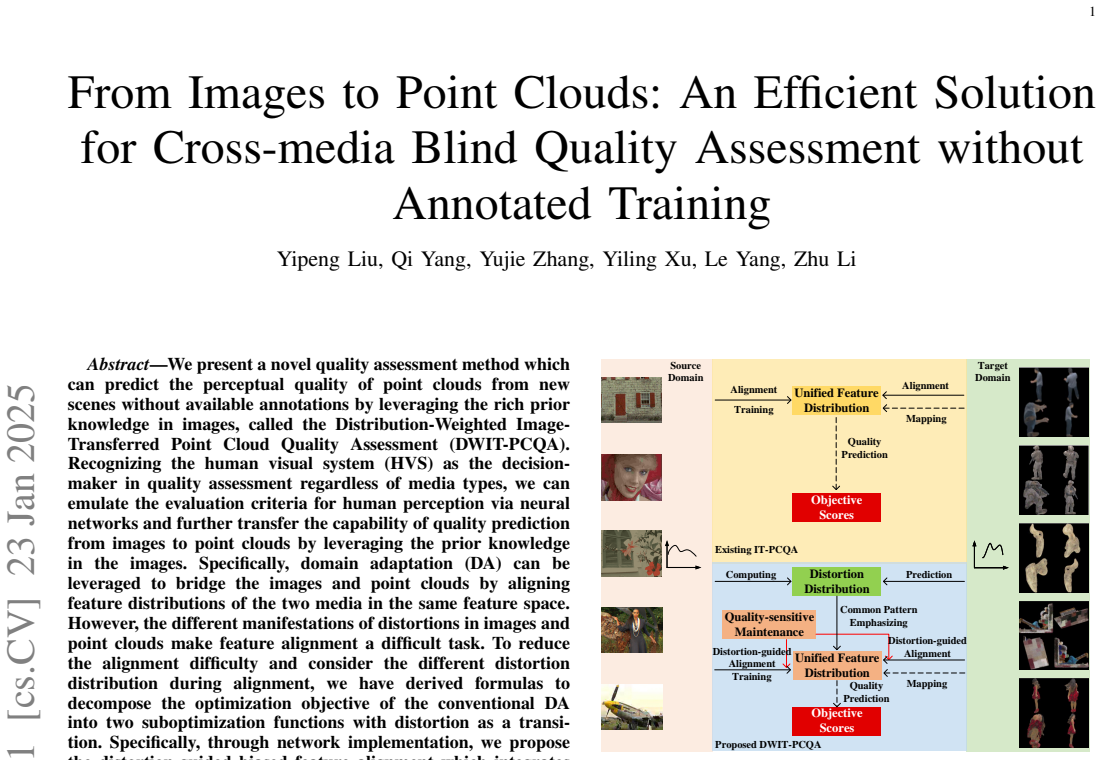
The central object is a decomposition of the domain adaptation objective with distortion as an intermediate variable, turning direct alignment of quality-conditioned features into two subobjectives: one that aligns features conditioned on distortion type and one that maintains consistency between distortion-aware and quality-aware feature representations. The working parts are a distortion classifier that labels target projections, a distribution weight computed from estimated distortion distributions through a quadratic program, a conditional discriminator trained with a distortion-weighted cross-entropy loss, and a contrastive loss over carefully chosen positive and negative samples. Together they re-weight the source feature distribution toward distortions common to both media while preserving the features that predict perceptual quality.
What would settle it
Replace the computed distortion weights with uniform weights in the distortion-weighted cross-entropy loss on the TID2013-to-SJTU-PCQA setup; if SROCC does not drop materially, the distortion-distribution weighting is not doing the work attributed to it.
Extended reading notes
Core claim
The central claim is that cross-media blind quality assessment can be achieved by decomposing the standard domain adaptation objective into two subproblems: aligning feature distributions conditioned on distortion, and preserving the feature-to-quality mapping under biased distortion distributions. The method re-weights source features by the ratio of target to source distortion probabilities, computed from distortion pseudo-labels produced by a classifier, and feeds the re-weighted features into a conditional discriminator. Simultaneously, contrastive learning pulls together features with the same content and distortion while pushing apart features with different distortions, which keeps the aligned representation both distortion-aware and quality-aware. On image datasets as the source and point cloud datasets as the target, the paper reports SROCC gains over the prior transfer method of roughly 20 to 40 percent, landing close to fully supervised point cloud quality metrics.
Load-bearing premise
The method assumes the distortion classifier, trained only on source images, estimates the target point-cloud distortion distribution well enough that the computed importance weights improve alignment rather than adding noise.
Editorial extensions
If this is right
- Point cloud quality assessment for new scenes no longer requires point cloud quality labels; source image quality labels and unlabeled point cloud data suffice.
- The transfer gap to fully supervised point cloud quality metrics is small, around 7 percent SROCC on one dataset and 4.8 percent on another, so the unlabeled approach is practically usable.
- The reported gains over the previous image-to-point-cloud transfer method, roughly 20 percent SROCC on SJTU-PCQA and 40 percent on WPC, indicate that distortion-distribution weighting addresses a real failure mode of direct feature alignment.
- Ablation results show each component contributes: plain image-trained regression reaches 0.667 SROCC, adding distortion-weighted alignment raises it to 0.749, and the full model reaches 0.828 on the TID2013-to-SJTU-PCQA setup.
Reading between the lines
- Beyond the paper: the classifier's distortion accuracy on target point-cloud projections is never reported, so a decisive check is to measure it; near-chance accuracy would mean the computed weights are pseudo-label noise.
- Beyond the paper: the transfer assumes the source distortion taxonomy can express point-cloud distortions, and genuinely novel target distortion types would likely be under-aligned by the importance weighting.
- Beyond the paper: the same distortion-as-transition decomposition could apply to other cross-media quality tasks, such as video-to-mesh or rendered-to-real scenes, wherever a shared feature extractor and a distortion-type predictor are available.
Editorial analysis
A structured set of objections, weighed in public.
Referee Report
Summary. The paper proposes DWIT-PCQA, a no-reference point cloud quality assessment method that transfers image quality priors to point clouds without using point cloud MOS labels. Point clouds are projected into multi-view images, a shared image encoder extracts features, and an adversarial domain adaptation framework aligns source (image) and target (point cloud) feature distributions. To handle distortion distribution mismatch, the paper introduces a distortion-weighted cross-entropy loss whose weights are estimated from a source-trained distortion classifier, together with a contrastive quality-aware feature disentanglement loss. Experiments on TID2013/KADID-10k to SJTU-PCQA/WPC report large gains over the prior IT-PCQA method and competitive performance with supervised PCQA methods.
Significance. If the claims hold, this is a practically valuable result: it would show that point cloud quality can be predicted for new scenes using only image MOS labels and unlabeled target point clouds, addressing the scarcity of PCQA annotations. The paper includes a reasonable empirical protocol with multiple source and target datasets, comparisons against FR and NR PCQA methods, and an ablation study. I credit the authors for not using target MOS labels in training and for reporting gains over the most relevant prior art. However, the central mechanism for the reported gains — the distortion-based distribution weighting — is specified inconsistently in the text, and the claimed improvement from that mechanism is not isolated in the ablation. These issues need to be resolved before the contribution can be fully assessed.
major comments (4)
- [Section IV-B (Algorithm 1, Eqs. (14)–(16))] The specification of the distribution-weight computation is internally inconsistent. Eq. (14) defines C as the source joint distribution D_S(ŷ_d, y_d), which requires the classifier's predictions on the source domain. Algorithm 1, however, receives only source distortion labels and target predictions, and computes C_hat = (cy_t_d')^T (ys_d') — the outer product of the normalized target-prediction histogram and the normalized source-label histogram. This matrix is rank one and is not an estimate of the joint distribution in Eq. (14). Moreover, with the constraint w_y^T D_S(y_d) = 1 and with mu_hat = cy_t_d', every feasible w_y satisfies C_hat w_y = cy_t_d' = mu_hat, so the QP objective in Eq. (16) is identically zero over the feasible set and the returned w_y is arbitrary. As a result, the +0.067 PLCC / +0.045 SROCC gain attributed to w_y in Table IV cannot be traced to the distortion-guided weighting mechanism as written. Please correct Algorithm 1, for example by passing H's source predictions as input and forming C_hat from the source joint histogram, and confirm the ablation result with the corrected weights; releasing code would also help resolve this issue.
- [Section III-A (Eqs. (2)–(4))] The 'decomposition' of the DA objective is not a formal derivation. Eq. (2) aligns the quality-conditioned feature distributions D_S(z|y) and D_T(z|y). The paper replaces it with Eq. (3), alignment of distortion-conditioned distributions, plus Eq. (4), which only penalizes the distance between D_S(z|y) and D_S(z|y_d) within the source domain. No inequality is provided showing that minimizing these two sub-objectives controls the target quality-conditional term D_T(z|y) in Eq. (2). In particular, Eq. (4) does not constrain the target domain conditional distribution, which is the term most relevant to target quality prediction. Please provide a bound connecting the sub-objectives to the original objective, or state explicitly that this is a heuristic surrogate.
- [Section V-D (Table IV)] The ablation does not isolate the effect of the distribution weight w_y. The row 'LReg + LDWCE (w/o wy)' is compared with the row 'LReg + LDWCE (w/ wy) + LCls'; the simultaneous addition of LCls is confounded with the effect of w_y. The claim that 'the distortion-based importance-weighted alignment is necessary and effective' requires an additional condition such as LReg + LDWCE (w/o wy) + LCls. Please also report this comparison on WPC, not only on SJTU-PCQA, to support the generality of the weighting mechanism.
- [Section IV-D (Distortion Distribution Prediction)] The entire weight estimation relies on the source-trained classifier H producing meaningful pseudo-labels on the target point-cloud projections, but the paper never reports H's accuracy, confusion matrix, or prediction entropy on the target domain. If H's target predictions are noisy, then the estimated D_T(y_d), and hence w_y, is essentially noise, and the gains in Table IV may not reflect distortion-guided alignment. Please report quantitative evidence about H on the target projections (at minimum, confidence/entropy statistics and stability of w_y across H initializations) and a sensitivity analysis of the final SROCC/PLCC to the quality of H.
minor comments (5)
- [Section IV-A / IV-D / IV-E] There is a dimension mismatch in the stated network architecture: G maps features to 256 dimensions, but H and R are described with first FC layers of 2048 inputs. Please clarify whether H and R operate on the 2048-d backbone features or on G's 256-d output.
- [Section III-C] The word 'constractive' should be 'contrastive'.
- [Table II caption] The table caption should explicitly state that transfer methods use unlabeled target-domain data during training, whereas the general IQA baselines do not; this is the intended unsupervised domain adaptation protocol, but the asymmetry should be flagged to keep the comparison fair.
- [Section V-A] All weighting factors in Eq. (22) are set to 1 with no sensitivity study; a brief robustness check for lambda_1 to lambda_4 would help establish that the reported results do not hinge on a particular tuning.
- [Section V-E (Fig. 7)] The t-SNE visualization in Fig. 7 is qualitative; a quantitative measure of feature-space regularity, such as a domain alignment error or a nearest-classifier accuracy, would strengthen the claim.
Circularity Check
No significant circularity: the headline transfer result is not fitted to target MOS labels; minor disclosed self-citation is not load-bearing. The Algorithm 1 / Eq. (14) mismatch is an implementation-consistency concern, not circular reasoning.
full rationale
The central claim -- predicting point cloud quality without point cloud MOS annotations -- is not circular in the sense defined here. Training uses image MOS labels and image distortion labels from TID2013/KADID-10k plus unlabeled point cloud projections; SJTU-PCQA and WPC MOS values enter only in evaluation. The importance-weighting step computes w_y from the source distortion labels and the target distortion predictions of H via the label-shift identity D_T(y_hat_d)=D_S(y_hat_d,y_d)D_T(y_d)/D_S(y_d), which is a standard consistency equation (Lipton et al.) and not a reuse of target quality labels. The decomposition of Eq. (2) into Eqs. (3)-(4) is a heuristic triangle-inequality-style decomposition rather than an equivalence by construction; it does not rename a fitted parameter as a prediction. Self-citations, notably IT-PCQA as baseline and as prior transfer work, are disclosed and are not used to prove the new method's validity. The most serious technical issue found is that Algorithm 1 constructs C_hat as an outer product of marginal histograms while Eq. (14) defines C as the joint distribution D_S(c_yd,y_d); under the stated constraint this makes the QP objective identically zero and leaves w_y unidentified. That is an internal consistency or implementation defect that should be corrected and could undermine the specific ablation attribution in Table IV, but it is not an instance of the paper's output being equivalent to its input by definition or of a fitted label being renamed a prediction. Therefore the circularity score remains low.
Assumptions & free parameters
free parameters (3)
- InfoNCE temperature tau =
not reported
- Loss weights lambda1..lambda4 =
1, 1, 1, 1
- Patch count and positive/negative sample counts =
2 positives, 2 negatives, M unspecified
assumptions (4)
- domain assumption HVS is a universal quality evaluator across image and point cloud domains
- standard math The error decomposition theorem and clustering structure theorem apply to this DA setting
- ad hoc to paper The decomposition of Eq. (2) into Eq. (3) and Eq. (4) is a valid optimization surrogate
- domain assumption The distortion classifier H trained on source labels generalizes well enough to estimate target distortion distribution
Cite this review
Pith. "Pith review of From Images to Point Clouds: An Efficient Solution for Cross-media Blind Quality Assessment without Annotated Training." pith.science (2026). https://pith.science/paper/76FZMFBG
@misc{pith2026250113387,
  author       = {Pith},
  title        = {Pith review of: From Images to Point Clouds: An Efficient Solution for Cross-media Blind Quality Assessment without Annotated Training},
  year         = {2026},
  howpublished = {\url{https://pith.science/paper/76FZMFBG}},
  note         = {Machine review of arXiv:2501.13387}
}
read the original abstract
We present a novel quality assessment method which can predict the perceptual quality of point clouds from new scenes without available annotations by leveraging the rich prior knowledge in images, called the Distribution-Weighted Image-Transferred Point Cloud Quality Assessment (DWIT-PCQA). Recognizing the human visual system (HVS) as the decision-maker in quality assessment regardless of media types, we can emulate the evaluation criteria for human perception via neural networks and further transfer the capability of quality prediction from images to point clouds by leveraging the prior knowledge in the images. Specifically, domain adaptation (DA) can be leveraged to bridge the images and point clouds by aligning feature distributions of the two media in the same feature space. However, the different manifestations of distortions in images and point clouds make feature alignment a difficult task. To reduce the alignment difficulty and consider the different distortion distribution during alignment, we have derived formulas to decompose the optimization objective of the conventional DA into two suboptimization functions with distortion as a transition. Specifically, through network implementation, we propose the distortion-guided biased feature alignment which integrates existing/estimated distortion distribution into the adversarial DA framework, emphasizing common distortion patterns during feature alignment. Besides, we propose the quality-aware feature disentanglement to mitigate the destruction of the mapping from features to quality during alignment with biased distortions. Experimental results demonstrate that our proposed method exhibits reliable performance compared to general blind PCQA methods without needing point cloud annotations.
Figures


Figures from the paper (4 more)


Reference graph
Works this paper leans on
-
[1]
Point cloud generation using deep local features for augmented and mixed reality contents,
S. Lim, M. Shin, and J. Paik, “Point cloud generation using deep local features for augmented and mixed reality contents,” in IEEE International Conference on Consumer Electronics (ICCE’20) , 2020, pp. 1–3
work page 2020
-
[2]
S. Chen, B. Liu, C. Feng et al. , “3d point cloud processing and learning for autonomous driving: Impacting map creation, localization, and perception,” IEEE Signal Processing Magazine , vol. 38, no. 1, pp. 68–86, 2021
work page 2021
-
[3]
3d is here: Point cloud library (PCL),
R. B. Rusu and S. Cousins, “3d is here: Point cloud library (PCL),” in IEEE International Conference on Robotics and Automation (ICRA’11) , 2011, pp. 1–4
work page 2011
-
[4]
Comparison of four subjective methods for image quality assessment,
R. K. Mantiuk, A. Tomaszewska, and R. Mantiuk, “Comparison of four subjective methods for image quality assessment,” Computer Graphics Forum, vol. 31, no. 8, pp. 2478–2491, 2012
2012
-
[5]
Y . Liu, Q. Yang, Y . Zhang et al., “Once-training-all-fine: No-reference point cloud quality assessment via domain-relevance degradation de- scription,” arXiv preprint arXiv:2307.01567 , 2023. 12 (a) Irregular feature space of direct feature alignment. (b) Regular feature space of proposed distortion-based conditional feature alignment. Fig. 7: T-SNE plo...
arXiv 2023
-
[6]
Y . Liu, Q. Yang, and Y . Xu, “Differentiable low-computation global correlation loss for monotonicity evaluation in quality assessment,” in IEEE International Conference on Visual Communications and Image Processing (VCIP’24), 2024, pp. 1–5
work page 2024
-
[7]
Reduced reference quality assessment for point cloud compres- sion,
——, “Reduced reference quality assessment for point cloud compres- sion,” in IEEE International Conference on Visual Communications and Image Processing (VCIP’22) , 2022, pp. 1–5
work page 2022
-
[8]
Q. Liu, H. Yuan, R. Hamzaoui et al. , “Reduced reference perceptual quality model with application to rate control for video-based point cloud compression,” IEEE Transactions on Image Processing , vol. 30, pp. 6623–6636, 2021
work page 2021
Show all 76 references
-
[9]
Blind image quality assessment using statistical structural and luminance features,
Q. Li, W. Lin, J. Xu, and Y . Fang, “Blind image quality assessment using statistical structural and luminance features,” IEEE Transactions on Multimedia, vol. 18, no. 12, pp. 2457–2469, 2016
2016
-
[10]
Uncertainty-aware blind image quality assessment in the laboratory and wild,
W. Zhang, K. Ma, G. Zhai, and X. Yang, “Uncertainty-aware blind image quality assessment in the laboratory and wild,” IEEE Transactions on Image Processing, vol. 30, pp. 3474–3486, 2021
2021
-
[11]
PointXR: A toolbox for visualization and subjective evaluation of point clouds in virtual real- ity,
E. Alexiou, N. Yang, and T. Ebrahimi, “PointXR: A toolbox for visualization and subjective evaluation of point clouds in virtual real- ity,” in International Conference on Quality of Multimedia Experience (QoMEX’20), 2020, pp. 1–6
2020
-
[12]
Point cloud ren- dering after coding: Impacts on subjective and objective quality,
A. Javaheri, C. Brites, F. Pereira, and J. Ascenso, “Point cloud ren- dering after coding: Impacts on subjective and objective quality,” IEEE Transactions on Multimedia , vol. 23, pp. 4049–4064, 2021
2021
-
[13]
Predicting the perceptual quality of point cloud: A 3d-to-2d projection-based exploration,
Q. Yang, H. Chen, Z. Ma et al. , “Predicting the perceptual quality of point cloud: A 3d-to-2d projection-based exploration,” IEEE Transac- tions on Multimedia , vol. 23, pp. 3877–3891, 2021
2021
-
[14]
Perceptual quality assessment of 3d point clouds,
H. Su, Z. Duanmu, W. Liu et al., “Perceptual quality assessment of 3d point clouds,” in IEEE International Conference on Image Processing (ICIP’19), 2019, pp. 3182–3186
2019
-
[15]
No-reference point cloud quality as- sessment via domain adaptation,
Q. Yang, Y . Liu, S. Chen et al. , “No-reference point cloud quality as- sessment via domain adaptation,” inIEEE/CVF Conference on Computer Vision and Pattern Recognition (CVPR’22) , 2022, pp. 21 179–21 188
2022
-
[16]
Bridging the synthetic-to-authentic gap: Distortion-guided unsupervised domain adaptation for blind image quality assessment,
A. Li, J. Wu, Y . Liu, and L. Li, “Bridging the synthetic-to-authentic gap: Distortion-guided unsupervised domain adaptation for blind image quality assessment,” in IEEE/CVF Conference on Computer Vision and Pattern Recognition (CVPR’24), 2024, pp. 28 422–28 431
2024
-
[17]
LIVE image quality assessment database release 2,
H. Sheikh, Z.Wang, L. Cormack, and A. Bovik, “LIVE image quality assessment database release 2,” 2003, http://live.ece.utexas.edu/research/ quality
2003
-
[19]
Image database TID2013: Peculiarities, results and perspectives,
N. Ponomarenko, L. Jin, O. Ieremeiev et al., “Image database TID2013: Peculiarities, results and perspectives,” Signal Processing: Image Com- munication, vol. 30, pp. 57–77, 2015
2015
-
[20]
KonIQ-10k: An ecologi- cally valid database for deep learning of blind image quality assessment,
V . Hosu, H. Lin, T. Sziranyi, and D. Saupe, “KonIQ-10k: An ecologi- cally valid database for deep learning of blind image quality assessment,” IEEE Transactions on Image Processing, vol. 29, pp. 4041–4056, 2020
2020
-
[21]
KADID-10k: A large-scale artificially distorted IQA database,
H. Lin, V . Hosu, and D. Saupe, “KADID-10k: A large-scale artificially distorted IQA database,” in International Conference on Quality of Multimedia Experience (QoMEX’19) , 2019, pp. 1–3
2019
-
[22]
3D-PSRNet: Part segmented 3d point cloud reconstruction from a single image,
P. Mandikal, N. K L, and R. Venkatesh Babu, “3D-PSRNet: Part segmented 3d point cloud reconstruction from a single image,” in European Conference on Computer Vision Workshops (ECCVW’18) , 2018
2018
-
[23]
Robust real- time visual tracking using a 2d-3d model-based approach,
E. Marchand, P. Bouthemy, F. Chaumette, and V . Moreau, “Robust real- time visual tracking using a 2d-3d model-based approach,” in IEEE International Conference on Computer Vision (ICCV’99) , vol. 1, 1999, pp. 262–268
1999
-
[24]
Domain separation networks,
K. Bousmalis, G. Trigeorgis, N. Silberman et al. , “Domain separation networks,” in Advances in Neural Information Processing Systems (NeurIPS’16), vol. 29, 2016
2016
-
[25]
Unsupervised domain adaptation by backpropagation,
Y . Ganin and V . Lempitsky, “Unsupervised domain adaptation by backpropagation,” in International Conference on Machine Learning (ICML’15), 2015, pp. 1180–1189
2015
-
[26]
Adversarial discrimi- native domain adaptation,
E. Tzeng, J. Hoffman, K. Saenko, and T. Darrell, “Adversarial discrimi- native domain adaptation,” inIEEE/CVF Conference on Computer Vision and Pattern Recognition (CVPR’17) , 2017, pp. 7167–7176
2017
-
[27]
Blindly assess image quality in the wild guided by a self-adaptive hyper network,
S. Su, Q. Yan, Y . Zhu et al., “Blindly assess image quality in the wild guided by a self-adaptive hyper network,” in IEEE/CVF Conference on Computer Vision and Pattern Recognition (CVPR’20) , 2020
2020
-
[28]
Blind quality assessment of camera images based on low-level and high-level statistical features,
Y . Liu, K. Gu, S. Wang et al. , “Blind quality assessment of camera images based on low-level and high-level statistical features,” IEEE Transactions on Multimedia , vol. 21, no. 1, pp. 135–146, 2019
2019
-
[29]
Evaluation criteria for point cloud compression,
R. Mekuria, Z. Li, C. Tulvan, and P. Chou, “Evaluation criteria for point cloud compression,” ISO/IEC MPEG w16332, Geneva, Switzerland , 2016
2016
-
[30]
Geometric distortion metrics for point cloud compression,
D. Tian, H. Ochimizu, C. Feng et al. , “Geometric distortion metrics for point cloud compression,” in Int. Conf. Image Processing (ICIP’17), 2017, pp. 3460–3464
2017
-
[31]
A novel methodology for quality assessment of voxelized point clouds,
E. M. Torlig, E. Alexiou, T. A. Fonseca et al., “A novel methodology for quality assessment of voxelized point clouds,” in Applications of Digital Image Processing XLI, vol. 10752. Int. Soc. Optics and Photonics, 2018, p. 107520I
2018
-
[32]
On subjective and objective quality evaluation of point cloud geometry,
E. Alexiou, “On subjective and objective quality evaluation of point cloud geometry,” in International Conference on Quality of Multimedia Experience (QoMEX’17), 2017, pp. 1–3. 13
2017
-
[33]
On the performance of metrics to predict quality in point cloud representations,
E. Alexiou and T. Ebrahimi, “On the performance of metrics to predict quality in point cloud representations,” in Applications of Digital Image Processing XL, vol. 10396, 2017, p. 103961H
2017
-
[34]
Pcqm: A full-reference quality metric for colored 3d point clouds,
G. Meynet, Y . Nehm´e, J. Digne, and G. Lavou´e, “Pcqm: A full-reference quality metric for colored 3d point clouds,” in International Conference on Quality of Multimedia Experience (QoMEX’20) , 2020
2020
-
[35]
Inferring point cloud quality via graph similarity,
Q. Yang, Z. Ma, Y . Xu et al., “Inferring point cloud quality via graph similarity,” IEEE Trans. Pattern Analysis and Machine Intelligence , pp. 1–1, 2020
2020
-
[36]
Ms-graphsim: Inferring point cloud quality via multiscale graph similarity,
Y . Zhang, Q. Yang, and Y . Xu, “Ms-graphsim: Inferring point cloud quality via multiscale graph similarity,” in Proceedings of the 29th ACM Int. Conf. Multimedia (ACMMM’21) . New York, NY , USA: Association for Computing Machinery, 2021, p. 1230–1238. [Online]. Available: htt...
2021
-
[37]
MPED: Quantifying point cloud distortion based on multiscale potential energy discrepancy,
Q. Yang, Y . Zhang, S. Chen et al. , “MPED: Quantifying point cloud distortion based on multiscale potential energy discrepancy,” IEEE Transactions on Pattern Analysis and Machine Intelligence , vol. 45, no. 5, pp. 6037–6054, 2023
2023
-
[38]
A point-to-distribution joint geometry and color metric for point cloud quality assessment,
A. Javaheri, C. Brites, F. Pereira, and J. Ascenso, “A point-to-distribution joint geometry and color metric for point cloud quality assessment,” in Int. Workshop on Multimedia Signal Processing (MMSP’21) , 2021, pp. 1–6
2021
-
[39]
Point cloud quality assessment metric based on angular similarity,
E. Alexiou, “Point cloud quality assessment metric based on angular similarity,” in Int. Conf. Multimedia and Expo (ICME’18) , 2018, pp. 1–6
2018
-
[40]
A generalized Haus- dorff distance based quality metric for point cloud geometry,
A. Javaheri, C. Brites, F. Pereira, and J. Ascenso, “A generalized Haus- dorff distance based quality metric for point cloud geometry,” in Inter- national Conference on Quality of Multimedia Experience (QoMEX’20), 2020, pp. 1–6
2020
-
[41]
A color-based objective quality metric for point cloud contents,
I. Viola, S. Subramanyam, and P. Cesar, “A color-based objective quality metric for point cloud contents,” in International Conference on Quality of Multimedia Experience (QoMEX’20) , 2020, pp. 1–6
2020
-
[42]
Towards a point cloud structural similarity metric,
E. Alexiou and T. Ebrahimi, “Towards a point cloud structural similarity metric,” in IEEE International Conference on Multimedia and Expo Workshops (ICMEW’20), 2020, pp. 1–6
2020
-
[43]
Joint geometry and color projection-based point cloud quality metric,
A. Javaheri, C. Brites, F. Pereira, and J. Ascenso, “Joint geometry and color projection-based point cloud quality metric,” IEEE Access, vol. 10, pp. 90 481–90 497, 2022
2022
-
[44]
Point cloud projection and multi-scale feature fusion network based blind quality assessment for colored point clouds,
W. Tao, G. Jiang, Z. Jiang, and M. Yu, “Point cloud projection and multi-scale feature fusion network based blind quality assessment for colored point clouds,” in ACM International Conference on Multimedia, 2021, p. 5266–5272
2021
-
[45]
Deep learning- based quality assessment of 3d point clouds without reference,
A. Chetouani, M. Quach, G. Valenzise, and F. Dufaux, “Deep learning- based quality assessment of 3d point clouds without reference,” in IEEE International Conference on Multimedia and Expo Workshops (ICMEW’21, 2021, pp. 1–6
2021
-
[46]
PQA-Net: Deep no reference point cloud quality assessment via multi-view projection,
Q. Liu, H. Yuan, H. Su et al. , “PQA-Net: Deep no reference point cloud quality assessment via multi-view projection,” IEEE Transactions on Circuits and Systems for Video Technology, vol. 31, no. 12, pp. 4645– 4660, 2021
2021
-
[47]
Plain-PCQA: No-reference point cloud quality assessment by analysis of plain visual and geometrical components,
X. Chai, F. Shao, B. Mu et al. , “Plain-PCQA: No-reference point cloud quality assessment by analysis of plain visual and geometrical components,” IEEE Transactions on Circuits and Systems for Video Technology, vol. 34, no. 7, pp. 6207–6223, 2024
2024
-
[48]
Point cloud quality assessment: Large- scale dataset construction and learning-based no-reference approach,
Y . Liu, Q. Yang, and Y . Xu, “Point cloud quality assessment: Large- scale dataset construction and learning-based no-reference approach,” arXiv preprint arXiv:2012.11895 , 2020
2012 arXiv
-
[49]
A no-reference quality assessment metric for point cloud based on captured video sequences,
Y . Fan, Z. Zhang, W. Sun et al. , “A no-reference quality assessment metric for point cloud based on captured video sequences,” in Int. Workshop on Multimedia Signal Processing (MMSP’22), 2022, pp. 1–5
2022
-
[50]
Evaluating point cloud from moving camera videos: A no-reference metric,
Z. Zhang, W. Sun, Y . Zhu et al., “Evaluating point cloud from moving camera videos: A no-reference metric,” IEEE Transactions on Multime- dia, pp. 1–13, 2023
2023
-
[51]
GPA-Net:no-reference point cloud quality assessment with multi-task graph convolutional network,
Z. Shan, Q. Yang, R. Ye et al. , “GPA-Net:no-reference point cloud quality assessment with multi-task graph convolutional network,” IEEE Transactions on Visualization and Computer Graphics , pp. 1–13, 2023
2023
-
[52]
Dynamic hypergraph convolutional network for no-reference point cloud quality assessment,
W. Chen, Q. Jiang, W. Zhou et al., “Dynamic hypergraph convolutional network for no-reference point cloud quality assessment,” IEEE Trans- actions on Circuits and Systems for Video Technology , vol. 34, no. 10, pp. 10 479–10 493, 2024
2024
-
[53]
MM-PCQA: Multi-modal learning for no-reference point cloud quality assessment,
Z. Zhang, W. Sun, X. Min et al. , “MM-PCQA: Multi-modal learning for no-reference point cloud quality assessment,” in International Joint Conference on Artificial Intelligence , 2023, pp. 1–1
2023
-
[54]
Deep domain confusion:maximizing for domain invariance,
T. Eric, H. Judy, Z. Ning et al. , “Deep domain confusion:maximizing for domain invariance,” arXiv preprint arXiv:1412.3474 , 2014
2014 arXiv
-
[55]
Deep coral: Correlation alignment for deep domain adaptation,
S. Baochen and S. Kate, “Deep coral: Correlation alignment for deep domain adaptation,” in European Conf. Computer Vision (ECCV’16) . Springer, 2016, pp. 443–450
2016
-
[56]
Supervised representation learning: Transfer learning with deep autoencoders,
Z. Fuzhen, C. Xiaohu, L. Ping et al. , “Supervised representation learning: Transfer learning with deep autoencoders,” in Int. Joint Conf. Artificial Intelligence (IJCAI’15) , 2015
2015
-
[57]
No-reference screen content image quality assessment with unsupervised domain adaptation,
B. Chen, H. Li, H. Fan, and S. Wang, “No-reference screen content image quality assessment with unsupervised domain adaptation,” IEEE Transactions on Image Processing , vol. 30, pp. 5463–5476, 2021
2021
-
[58]
Unsupervised curriculum domain adapta- tion for no-reference video quality assessment,
P. Chen, L. Li, J. Wu et al., “Unsupervised curriculum domain adapta- tion for no-reference video quality assessment,” in Proceedings of the IEEE/CVF Int. Conf. Computer Vision Workshops (ICCVW’21) , 2021, pp. 5158–5167
2021
-
[59]
StyleAM: Perception-oriented unsu- pervised domain adaption for non-reference image quality assessment,
Y . Lu, X. Li, J. Liu, and Z. Chen, “StyleAM: Perception-oriented unsu- pervised domain adaption for non-reference image quality assessment,” arXiv preprint arXiv:2207.14489 , 2022
2022 arXiv
-
[60]
Domain adaptation for vehicle detection from bird’s eye view lidar point cloud data,
K. Saleh, A. Abobakr, M. Attia et al., “Domain adaptation for vehicle detection from bird’s eye view lidar point cloud data,” in Proceedings of the IEEE/CVF Int. Conf. Computer Vision Workshops (ICCVW’19) , Oct 2019
2019
-
[61]
Dense 3d point cloud recon- struction using a deep pyramid network,
P. Mandikal and V . B. Radhakrishnan, “Dense 3d point cloud recon- struction using a deep pyramid network,” in 2019 IEEE Winter Conf. Applications of Computer Vision (WACV’19) , 2019, pp. 1052–1060
2019
-
[62]
Pvnet: A joint convolutional network of point cloud and multi-view for 3d shape recognition,
H. You, Y . Feng, J. Rongrong, and Y . Gao, “Pvnet: A joint convolutional network of point cloud and multi-view for 3d shape recognition,” in Proceedings of the 26th ACM Int. Conf. Multimedia (ACMMM’18) , 2018, pp. 1310–1318
2018
-
[63]
Hybrid-MVS: Robust multi-view reconstruction with hybrid optimization of visual and depth cues,
C. Li, L. Zhou, H. Jiang et al. , “Hybrid-MVS: Robust multi-view reconstruction with hybrid optimization of visual and depth cues,” IEEE Transactions on Circuits and Systems for Video Technology , vol. 33, no. 12, pp. 7630–7644, 2023
2023
-
[64]
On learning invariant representations for domain adaptation,
H. Zhao, R. T. D. Combes, K. Zhang, and G. Gordon, “On learning invariant representations for domain adaptation,” in International Con- ference on Machine Learning (ICML’19) , 2019, pp. 7523–7532
2019
-
[65]
A theory of learning from different domains,
S. Ben-David, J. Blitzer, K. Crammer et al., “A theory of learning from different domains,” Machine Learning, vol. 79, no. 1, pp. 151–175, 2010
2010
-
[66]
Do- main adaptation with conditional distribution matching and generalized label shift,
R. Tachet des Combes, H. Zhao, Y .-X. Wang, and G. J. Gordon, “Do- main adaptation with conditional distribution matching and generalized label shift,” in Advances in Neural Information Processing Systems (NeurIPS’20), vol. 33, 2020, pp. 19 276–19 289
2020
-
[67]
Detecting and correcting for label shift with black box predictors,
Z. Lipton, Y .-X. Wang, and A. Smola, “Detecting and correcting for label shift with black box predictors,” in International Conference on Machine Learning (ICML’18) , 2018, pp. 3122–3130
2018
-
[68]
Representation learning with contrastive predictive coding,
A. van den Oord, Y . Li, and O. Vinyals, “Representation learning with contrastive predictive coding,” arXiv preprint arXiv:1807.03748 , 2018
2018 arXiv
-
[69]
Final report from the video quality experts group on the validation of objective models of video quality assessment,
J. Antkowiak, J. Baina, V . Baroncini et al., “Final report from the video quality experts group on the validation of objective models of video quality assessment,” 2000
2000
-
[70]
Image information and visual quality,
H. R. Sheikh and A. C. Bovik, “Image information and visual quality,” IEEE Transactions on Image Processing , vol. 15, no. 2, pp. 430–444, 2006
2006
-
[71]
Imagenet: A large-scale hierarchical image database,
J. Deng, W. Dong, R. Socher et al., “Imagenet: A large-scale hierarchical image database,” in IEEE/CVF Conference on Computer Vision and Pattern Recognition (CVPR’09), 2009, pp. 248–255
2009
-
[72]
Blind image quality assessment using a deep bilinear convolutional neural network,
W. Zhang, K. Ma, J. Yan et al., “Blind image quality assessment using a deep bilinear convolutional neural network,” IEEE Trans. Circuits and Systems for Video Technology, vol. 30, no. 1, pp. 36–47, 2020
2020
-
[73]
Metro: measuring error on simplified surfaces,
P. Cignoni, C. Rocchini, and R. Scopigno, “Metro: measuring error on simplified surfaces,” Computer Graphics Forum, vol. 17, no. 2, pp. 167– 174, 1998
1998
-
[74]
MPEG reference software,
MPEG, “MPEG reference software,” https://git.mpeg.expert/MPEG/ 3dgh/v-pcc/software/mpeg-pcc-dmetric, 2023
2023
-
[75]
PCQM: A full- reference quality metric for colored 3d point clouds,
G. Meynet, Y . Nehm ´e, J. Digne, and G. Lavou ´e, “PCQM: A full- reference quality metric for colored 3d point clouds,” in International Conference on Quality of Multimedia Experience (QoMEX’20) , 2020, pp. 1–6
2020
-
[76]
Inferring point cloud quality via graph similarity,
Q. Yang, Z. Ma, Y . Xu et al. , “Inferring point cloud quality via graph similarity,” IEEE Transactions on Pattern Analysis and Machine Intelligence, vol. 44, no. 6, pp. 3015–3029, 2022
2022
-
[77]
Point cloud quality assessment: Dataset construction and learning-based no-reference metric,
Y . Liu, Q. Yang, Y . Xu, and L. Yang, “Point cloud quality assessment: Dataset construction and learning-based no-reference metric,” ACM Transactions on Multimedia Computing Communications and Applica- tions, vol. 19, no. 2s, pp. 1–26, 2023
2023
Reviewed August 10, 2026 · model on record in the stance chip above.
Discussion (0). Continue with ORCID to comment.