REVIEW 5 major objections 5 minor 37 references
By-Example Synthesis of Vector Textures
T0 review · 5 major / 5 minor · reviewed 2026-08-10 · deepseek-v4-flash
Pith's one-line read A single raster texture can be converted into an editable vector texture of any size.
desk verdict Genuinely new raster-to-vector texture synthesis pipeline with plausible qualitative results, undermined by a degenerate quantitative evaluation that does not support the 'competitive' claim. read the letter →
The pith
A machine-rendered reading of the paper's core claim, the machinery that carries it, and where it could break.
The reading
What carries the argument
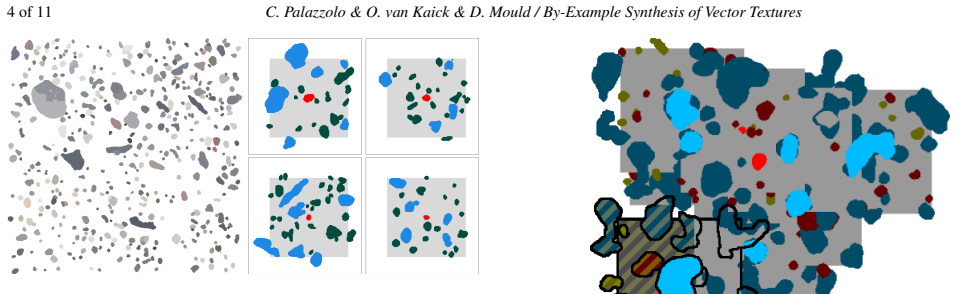
The load-bearing object is the texton neighborhood descriptor: a two-dimensional grid centered on a primary texton whose cells store either the category label of a texton found at that location or a code for 'empty', extended to include textons that protrude past the initial boundary. During synthesis, candidates are placed by scoring them against an incrementally-built target map using a weighted sum of five terms: overlap between the candidate and the desired target region, uncovered target area, coverage of cells marked empty, overlap with a mismatched category, and overlap with another region of the same category. The placement with the highest score is written into the map, while secondary textons are scattered by Poisson-disk sampling and the background is reconstructed from a Voronoi-derived color pool using inverse-distance weighted interpolation.
What would settle it
Take an exemplar with overlapping textons or cast shadows, run the pipeline, and check whether the output vector texture contains detached shadow fragments and distorted texton shapes, as the paper's own failure cases suggest; alternatively, compare the pair-correlation function of texton centers in the synthesized output against the exemplar and look for statistically significant deviations.
Extended reading notes
Core claim
The central claim is that a raster exemplar composed of distinct, non-overlapping textons can be decomposed by segmentation into primary textons, secondary textons, and a background, then re-synthesized as a novel vector texture through a non-parametric placement process. The key discovery is that a local neighborhood descriptor—a grid map recording which texton categories surround a given texton—plus a weighted scoring of candidate placements based on overlap and coverage is sufficient to reproduce convincing inter-texton arrangements without modeling global statistics. The paper demonstrates the method on a variety of natural textures and shows that the resulting vector images support element-wise editing operations that raster outputs do not.
Load-bearing premise
The whole pipeline depends on the segmentation reliably isolating distinct, non-overlapping, shadow-free textons; if the segmentation misses or merges textons, no descriptor can be built and the synthesis fails.
Editorial extensions
If this is right
- Vector textures can be produced directly from ordinary raster photographs of materials, removing the need for manual vectorization or pre-separated vector elements.
- The synthesized textures preserve enough inter-texton spatial relationships to be perceptually comparable to raster-only methods such as Image Quilting, PSGAN, GCD Loss, and Self-Tuning Optimization.
- Because the output is a set of discrete polygons, users can perform element swaps, density-map-driven deletion, forced anisotropy, and texture simplification, all demonstrated in the paper.
- The method scales to arbitrary output size: a 500×500 exemplar yields a 1000×1000 vector texture in about four minutes of synthesis time, and larger outputs are limited only by placement effort.
Reading between the lines
- If the descriptor-based placement strategy generalizes, the same arrangement machinery could be applied to non-texture domains, such as procedural arrangement of discrete objects in illustrations or scene layouts, where the 'textons' are any category-labelled elements.
- Because the pipeline leans on an automatic segmentation model, future improvements in open-world segmentation should directly widen the class of textures the method can handle, including partially occluded or shadowed ones that currently fail.
- The ablation results suggest the perceptual metrics used do not penalize visible texton repetition, since the condition without a repetition penalty scores best on several metrics while producing visibly repetitive output; a natural testable extension is to use a metric that explicitly measures repetition or pair-correlation statistics.
- A direct extension of the method could condition the target map on a user-supplied density or orientation field, turning the current stationary-texture synthesizer into a tool for controlled, non-stationary vector texture design.
Editorial analysis
A structured set of objections, weighed in public.
Referee Report
Summary. The paper proposes a two-stage method for synthesizing arbitrarily sized vector textures from a single raster exemplar. In the analysis phase, Segment Anything is used to segment primary textons, which are clustered by color, area, and compactness; neighborhood descriptors capture inter-texton spatial relationships, secondary textons are extracted by flood fill, and the background is summarized by a Voronoi-based color field. In the synthesis phase, primary textons are placed by descriptor-guided scoring on a target map, secondary textons are placed by Poisson-disk sampling, and the background is generated by inverse-distance interpolation of sampled colors. The authors claim that their method produces vector textures that highly resemble the input exemplars and is competitive with raster-domain texture synthesis methods, and they demonstrate several vector-editing operations enabled by the representation.
Significance. If the central result is established, this is a genuinely novel contribution: it directly converts a natural raster texture into an editable vector representation and synthesizes arbitrarily large vector textures from a single exemplar, which previous vector-texture methods do not do. The paper has clear strengths: the pipeline is described in enough detail to be reimplemented, the qualitative results in Figures 5 and 6 are often convincing, an ablation study is included, and Section 4.6 honestly states the segmentation-dependent scope of the method. However, the quantitative support for the 'competitive' claim is currently unreliable because the headline metric table contains degenerate entries and no measures of variance; until those numbers are corrected and reproduced, the central claim rests mainly on the qualitative figures.
major comments (5)
- [Section 4.2, Table 1] The SIFID value is reported as 0.000 for Image Quilting, Self-Tuning, PSGAN, and Ours, and the EMD value is 0.000 for three baselines, even though Figure 6 shows visibly non-identical outputs. Exact zeros to three decimals are implausible for a genuine feature-statistics or histogram-distance computation and indicate a degenerate evaluation path (for example, an unintended resize, a zero-covariance feature branch, or a failure to compare comparable image sizes). This directly undermines the sentence in Section 4.2 claiming that the method is 'competitive with state-of-the-art methods, with comparable scores in general and among the top SIFID scores.' The authors need to explain the exact metric setup, correct these entries, and report values that distinguish the four methods.
- [Section 4.2-4.3, Tables 1-3] All quantitative comparisons report only means over eight exemplars, with no per-exemplar values, error bars, confidence intervals, or significance tests in the main text. Observed differences such as LPIPS 0.527 vs 0.467, or BRISQUE 20.665 vs 19.400, are plausibly within sampling variability, so the claim of being 'competitive' is not statistically supported. The ablation table is especially concerning: SIFID is 0.042 for all six conditions, which suggests the metric is insensitive to the ablations or is computed incorrectly. Please report per-exemplar distributions or error bars, and clarify why the ablation SIFID values are identical.
- [Section 3.3, Global density correction] The global density correction explicitly deletes textons from each category until the fractional area covered by the category drops below the exemplar's fractional area. This means that any statement about matching the exemplar's texton density, including the coverage comparison in Table 2, is partly enforced by construction rather than produced by the synthesis model. The paper should state this explicitly when interpreting coverage results and, ideally, report coverage with the correction disabled to show how much of the match is due to this post-processing step.
- [Section 3.1.2 and Section 3.2.1] Several central parameters are hand-tuned without sensitivity analysis: the 40th-percentile secondary-texton spacing, the scoring weights w = (0.5, -0.4, -0.2, -0.5, -0.5), the threshold for promoting secondary textons to primary, and the density-correction target. Since the paper's quality claim depends on these choices, a small sensitivity study (for example, varying the percentile across the 30th-60th range that the authors say is stable, and varying the scoring weights by a fixed percentage) would show that the results are not an artifact of a single tuned setting.
- [Section 1 and Section 2] The paper dismisses a raster-to-vector-then-synthesize pipeline by saying that vectorization tools 'often create output that is not separable, with many overlapping polygons,' but it does not provide an experiment demonstrating that failure. Because the novelty claim is that no existing method directly synthesizes vector textures from natural raster images, a concrete comparison against a vectorization-plus-existing-vector-synthesis baseline would make that claim much stronger and would also clarify the advantage of the proposed pipeline.
minor comments (5)
- [Section 2] There is a typo in the phrase 'representative of the state of the are of GAN-based methods'; it should read 'state of the art.'
- [Section 3.2.1] The scoring formula is written as 'sum from i=5 to 5 w_i A_i'; it should be 'sum from i=1 to 5 w_i A_i' to match the five listed area terms.
- [Section 4.4] The sentence 'Table 4 reports the average amount of time required to synthesize 4 500 × 500 exemplars' is ambiguous; it should say four 500x500 exemplars. The table caption also uses 'average time to synthesize a 500 x 500 exemplar,' which should be reconciled.
- [Section 4.4, Table 4] The Image Quilting timing is flagged as coming from an unoptimized third-party implementation, so the timing comparison is not apples-to-apples; consider reporting only the authors' own timings or moving the third-party timing to a footnote with a clearer caveat.
- [Section 4.3] The ablation discussion states that condition E is preferred by the metrics but that its textures contain substantial repetition not captured by the metrics; consider adding a repetition-aware quantitative measure or at least reporting the visual-inspection criterion more explicitly, since the current text makes the metric-based selection and the final choice inconsistent.
Circularity Check
Minor, disclosed density-matching step makes the coverage score partly self-referential; no load-bearing circularity in the synthesis pipeline.
-
other
[Section 3.3 (Enhancements, 'Global density correction') and Section 4.2 (Quantitative evaluation, Table 2)]
"Global density correction. Our method tends to place more textons than necessary, so we remove some: for each texton category, we repeatedly delete a randomly selected texton from that category until the fractional area covered by the category drops below the exemplar's fractional area."
Table 2 reports 'Coverage' and 'Absolute Difference' as quantitative similarity scores between the synthesized image and the exemplar. However, the synthesis stage explicitly deletes textons per category until the category's fractional area no longer exceeds the exemplar's fractional area, so the output coverage is constrained by the exact input statistic it is later compared against. The coverage comparison is therefore partly guaranteed by construction rather than an independent test of the method. The paper discloses the correction and bases its main competitive claim on other perceptual metrics, so the circularity is minor and not load-bearing.
full rationale
The paper is a constructive by-example algorithm rather than a derivation of a predictive law, so reusing input statistics at synthesis time is the intended meaning of by-example synthesis, not circularity. The descriptor matching, Poisson-disk placement, and background gradient interpolation all use disclosed estimates from the exemplar, and no parameter is secretly fit to the evaluation metrics. The comparisons to Image Quilting, PSGAN, GCD Loss, and Self-Tuning are external, and the perceptual metrics come from the independent PyIQA library. There are no load-bearing self-citations; Segment Anything and the metric implementations are outside the authors' prior work. The only self-referential element is the global density correction, which makes the reported coverage score in Table 2 partly a consequence of the algorithm's own deletion rule. Because that correction is clearly described and the central claim of producing plausible, editable vector textures is supported by qualitative results and additional metrics, the overall circularity is minor. The degenerate SIFID/EMD zeros and missing error bars in Table 1 are evaluation-reliability concerns, not circularity.
Assumptions & free parameters
free parameters (8)
- Number of K-means clusters =
15 (typical)
- K-means feature weights =
color channels weighted 2x
- Texton placement scoring weights =
w = (0.5, -0.4, -0.2, -0.5, -0.5)
- Secondary texton spacing percentile =
40th percentile of Delaunay edge lengths
- Threshold for promoting secondary to primary textons =
area exceeding the median primary texton area
- Global density correction target =
exemplar fractional area per category
- Background interpolation exponent and smoothing =
1/r^3 with r0/4 smoothing
- SAM query point density =
10k points on a 500x500 image
assumptions (5)
- domain assumption The exemplar texture is stationary and lacks depth, shadows, and occlusions
- domain assumption Segment Anything (SAM) produces clean, separable segments for natural texture textons
- domain assumption The background can be approximated as a smooth gradient field defined by sparse color samples
- domain assumption Texton neighborhood descriptors at pixel resolution encode the inter-category spatial relationships needed for synthesis
- standard math Standard computational geometry tools (K-means, Delaunay, Poisson disk, Voronoi, inverse-distance interpolation) behave as expected
Cite this review
Pith. "Pith review of By-Example Synthesis of Vector Textures." pith.science (2026). https://pith.science/paper/ASDF64SL
@misc{pith2026250113812,
  author       = {Pith},
  title        = {Pith review of: By-Example Synthesis of Vector Textures},
  year         = {2026},
  howpublished = {\url{https://pith.science/paper/ASDF64SL}},
  note         = {Machine review of arXiv:2501.13812}
}
read the original abstract
We propose a new method for synthesizing an arbitrarily sized novel vector texture given a single raster exemplar. Our method first segments the exemplar to extract the primary textons, and then clusters them based on visual similarity. We then compute a descriptor to capture each texton's neighborhood which contains the inter-category relationships that are used at synthesis time. Next, we use a simple procedure to both extract and place the secondary textons behind the primary polygons. Finally, our method constructs a gradient field for the background which is defined by a set of data points and colors. The color of the secondary polygons are also adjusted to better match the gradient field. To compare our work with other methods, we use a wide range of perceptual-based metrics.
Figures


Figures from the paper (5 more)


Reference graph
Works this paper leans on
-
[1]
write newline
" write newline "" before.all 'output.state := FUNCTION fin.entry add.period write newline FUNCTION new.block output.state before.all = 'skip after.block 'output.state := if FUNCTION new.sentence output.state after.block = 'skip output.state before.all = 'skip after.sentence 'output.state := if if FUNCTION not #0 #1 if FUNCTION and 'skip pop #0 if FUNCTIO...
-
[2]
write newline
" write newline "" before.all 'output.state := FUNCTION fin.entry.original add.period write newline FUNCTION new.block output.state before.all = 'skip after.block 'output.state := if FUNCTION new.sentence output.state after.block = 'skip output.state before.all = 'skip after.sentence 'output.state := if if FUNCTION not #0 #1 if FUNCTION and 'skip pop #0 i...
-
[3]
AlMeraj Z., Kaplan C. S., Asente P. : Patch-based geometric texture synthesis. In Proceedings of the Symposium on Computational Aesthetics (New York, NY, USA, 2013), CAE '13, Association for Computing Machinery, p. 15–19. URL: https://doi.org/10.1145/2487276.2487278, https://doi.org/10.1145/2487276.2487278 doi:10.1145/2487276.2487278
-
[4]
: Learning texture manifolds with the periodic spatial gan, 2017
Bergmann U., Jetchev N., Vollgraf R. : Learning texture manifolds with the periodic spatial gan, 2017. URL: https://arxiv.org/abs/1705.06566, http://arxiv.org/abs/1705.06566 arXiv:1705.06566
arXiv 2017
-
[5]
: Fast poisson disk sampling in arbitrary dimensions
Bridson R. : Fast poisson disk sampling in arbitrary dimensions. In ACM SIGGRAPH 2007 Sketches (New York, NY, USA, 2007), SIGGRAPH '07, Association for Computing Machinery, p. 22–es. URL: https://doi.org/10.1145/1278780.1278807, https://doi.org/10.1145/1278780.1278807 doi:10.1145/1278780.1278807
-
[6]
: IQA-PyTorch : Pytorch toolbox for image quality assessment
Chen C., Mo J. : IQA-PyTorch : Pytorch toolbox for image quality assessment. [Online]. Available: https://github.com/chaofengc/IQA-PyTorch, 2022
work page 2022
-
[7]
Ding K., Ma K., Wang S., Simoncelli E. P. : Image quality assessment: Unifying structure and texture similarity. CoRR abs/2004.07728 (2020). URL: https://arxiv.org/abs/2004.07728, http://arxiv.org/abs/2004.07728 arXiv:2004.07728
arXiv 2020
- [8]
Show all 37 references
-
[9]
A., Freeman W
Efros A. A., Freeman W. T. : Image Quilting for Texture Synthesis and Transfer, 1 ed. Association for Computing Machinery, New York, NY, USA, 2001, pp. 571--576. URL: https://doi.org/10.1145/3596711.3596771
2001
-
[10]
: Texture synthesis by non-parametric sampling
Efros A., Leung T. : Texture synthesis by non-parametric sampling. In Proceedings of the Seventh IEEE International Conference on Computer Vision (1999), vol. 2, pp. 1033--1038 vol.2. https://doi.org/10.1109/ICCV.1999.790383 doi:10.1109/ICCV.1999.790383
1999
-
[11]
A., Ecker A
Gatys L. A., Ecker A. S., Bethge M. : Texture synthesis using convolutional neural networks, 2015. URL: https://arxiv.org/abs/1505.07376, http://arxiv.org/abs/1505.07376 arXiv:1505.07376
2015 arXiv
-
[12]
: Random phase textures: Theory and synthesis
Galerne B., Gousseau Y., Morel J.-M. : Random phase textures: Theory and synthesis. IEEE Transactions on Image Processing 20, 1 (2011), 257--267. https://doi.org/10.1109/TIP.2010.2052822 doi:10.1109/TIP.2010.2052822
2011
-
[13]
: Appearance-guided synthesis of element arrangements by example
Hurtut T., Landes P.-E., Thollot J., Gousseau Y., Drouillhet R., Coeurjolly J.-F. : Appearance-guided synthesis of element arrangements by example. In Proceedings of the 7th International Symposium on Non-Photorealistic Animation and Rendering (New York, NY, USA, 2009), NPAR '...
2009
-
[14]
: High-performance by-example noise using a histogram-preserving blending operator
Heitz E., Neyret F. : High-performance by-example noise using a histogram-preserving blending operator. Proc. ACM Comput. Graph. Interact. Tech. 1, 2 (aug 2018). URL: https://doi.org/10.1145/3233304, https://doi.org/10.1145/3233304 doi:10.1145/3233304
2018 doi
-
[15]
: Texture synthesis with spatial generative adversarial networks, 2017
Jetchev N., Bergmann U., Vollgraf R. : Texture synthesis with spatial generative adversarial networks, 2017. URL: https://arxiv.org/abs/1611.08207, http://arxiv.org/abs/1611.08207 arXiv:1611.08207
2017 arXiv
-
[16]
: Texture optimization for example-based synthesis
Kwatra V., Essa I., Bobick A., Kwatra N. : Texture optimization for example-based synthesis. In ACM SIGGRAPH 2005 Papers (New York, NY, USA, 2005), SIGGRAPH '05, Association for Computing Machinery, p. 795–802. URL: https://doi.org/10.1145/1186822.1073263, https://doi.org/10.1...
2005
-
[17]
C., Lo W.-Y., Doll \'a r P., Girshick R
Kirillov A., Mintun E., Ravi N., Mao H., Rolland C., Gustafson L., Xiao T., Whitehead S., Berg A. C., Lo W.-Y., Doll \'a r P., Girshick R. : Segment anything. arXiv:2304.02643 (2023)
2023 arXiv
-
[18]
: Self tuning texture optimization
Kaspar A., Neubert B., Lischinski D., Pauly M., Kopf J. : Self tuning texture optimization. Computer Graphics Forum 34, 2 (2015), 349--359. URL: https://onlinelibrary.wiley.com/doi/abs/10.1111/cgf.12565, http://arxiv.org/abs/https://onlinelibrary.wiley.com/doi/pdf/10.1111/cgf....
2015 doi
-
[19]
: Differentiable vector graphics rasterization for editing and learning
Li T.-M., Luk\' a c M., Gharbi M., Ragan-Kelley J. : Differentiable vector graphics rasterization for editing and learning. ACM Trans. Graph. 39, 6 (Nov. 2020). URL: https://doi.org/10.1145/3414685.3417871, https://doi.org/10.1145/3414685.3417871 doi:10.1145/3414685.3417871
2020
-
[20]
H., Trumbore W
Laidlaw D. H., Trumbore W. B., Hughes J. F. : Constructive solid geometry for polyhedral objects. SIGGRAPH Comput. Graph. 20, 4 (aug 1986), 161–170. URL: https://doi.org/10.1145/15886.15904, https://doi.org/10.1145/15886.15904 doi:10.1145/15886.15904
1986
-
[21]
J., Krishnan T
McLachlan G. J., Krishnan T. : The EM Algorithm and Extensions, 2E. Wiley Series in Probability and Statistics. John Wiley & Sons, Inc., Hoboken, NJ, USA, Feb. 2008. URL: http://doi.wiley.com/10.1002/9780470191613, https://doi.org/10.1002/9780470191613 doi:10.1002/9780470191613
2008 doi
-
[22]
K., Bovik A
Mittal A., Moorthy A. K., Bovik A. C. : No-reference image quality assessment in the spatial domain. IEEE Transactions on Image Processing 21, 12 (2012), 4695--4708. https://doi.org/10.1109/TIP.2012.2214050 doi:10.1109/TIP.2012.2214050
2012
-
[23]
: Diffusion curves: a vector representation for smooth-shaded images
Orzan A., Bousseau A., Winnem\" o ller H., Barla P., Thollot J., Salesin D. : Diffusion curves: a vector representation for smooth-shaded images. ACM Trans. Graph. 27, 3 (aug 2008), 1–8. URL: https://doi.org/10.1145/1360612.1360691, https://doi.org/10.1145/1360612.1360691 doi:...
2008
-
[24]
: Pieapp: Perceptual image-error assessment through pairwise preference, 2018
Prashnani E., Cai H., Mostofi Y., Sen P. : Pieapp: Perceptual image-error assessment through pairwise preference, 2018. URL: https://arxiv.org/abs/1806.02067, http://arxiv.org/abs/1806.02067 arXiv:1806.02067
2018 arXiv
-
[25]
: Textile: A differentiable metric for texture tileability
Rodriguez-Pardo C., Casas D., Garces E., Lopez-Moreno J. : Textile: A differentiable metric for texture tileability. In Proceedings of the IEEE/CVF Conference on Computer Vision and Pattern Recognition (CVPR) (2024)
2024
-
[26]
R., Dekel T., Michaeli T
Shaham T. R., Dekel T., Michaeli T. : Sin G A N : Learning a generative model from a single natural image. In 2019 IEEE/CVF International Conference on Computer Vision (ICCV) (2019), pp. 4569--4579. https://doi.org/10.1109/ICCV.2019.00467 doi:10.1109/ICCV.2019.00467
2019
-
[27]
: A two-dimensional interpolation function for irregularly-spaced data
Shepard D. : A two-dimensional interpolation function for irregularly-spaced data. In Proceedings of the 1968 23rd ACM National Conference (New York, NY, USA, 1968), ACM '68, Association for Computing Machinery, p. 517–524. URL: https://doi.org/10.1145/800186.810616, https://d...
1968
-
[28]
A., Kaplan C
Saputra R. A., Kaplan C. S., Asente P. : Improved deformation-driven element packing with repulsionpak. IEEE Transactions on Visualization and Computer Graphics 27, 4 (2021), 2396--2408. https://doi.org/10.1109/TVCG.2019.2950235 doi:10.1109/TVCG.2019.2950235
2021
-
[29]
: Image vectorization using optimized gradient meshes
Sun J., Liang L., Wen F., Shum H.-Y. : Image vectorization using optimized gradient meshes. ACM Transactions on Graphics (TOG) 26, 3 (2007)
2007
-
[30]
: Diffusion curve textures for resolution independent texture mapping
Sun X., Xie G., Dong Y., Lin S., Xu W., Wang W., Tong X., Guo B. : Diffusion curve textures for resolution independent texture mapping. ACM Trans. Graph. 31, 4 (July 2012). URL: https://doi-org.proxy.library.carleton.ca/10.1145/2185520.2185570, https://doi.org/10.1145/2185520....
2012
-
[31]
: Continuous curve textures
Tu P., Wei L.-Y., Yatani K., Igarashi T., Zwicker M. : Continuous curve textures. ACM Transactions on Graphics 39, 6 (Nov. 2020), 1–16. URL: http://dx.doi.org/10.1145/3414685.3417780, https://doi.org/10.1145/3414685.3417780 doi:10.1145/3414685.3417780
2020
-
[32]
: Clustered vector textures
Tu P., Wei L.-Y., Zwicker M. : Clustered vector textures. ACM Trans. Graph. 41, 4 (jul 2022). URL: https://doi.org/10.1145/3528223.3530062, https://doi.org/10.1145/3528223.3530062 doi:10.1145/3528223.3530062
2022
-
[33]
C., Loy C
Wang J., Chan K. C., Loy C. C. : Exploring CLIP for assessing the look and feel of images. Proceedings of the AAAI Conference on Artificial Intelligence 37, 2 (Jun. 2023), 2555--2563. URL: https://ojs.aaai.org/index.php/AAAI/article/view/25353, https://doi.org/10.1609/aaai.v37...
2023 doi
-
[34]
: Learning gradient fields for scalable and generalizable irregular packing, 2023
Xue T., Wu M., Lu L., Wang H., Dong H., Chen B. : Learning gradient fields for scalable and generalizable irregular packing, 2023. URL: https://arxiv.org/abs/2310.19814, http://arxiv.org/abs/2310.19814 arXiv:2310.19814
2023 arXiv
-
[35]
: Neural texture synthesis with guided correspondence
Zhou Y., Chen K., Xiao R., Huang H. : Neural texture synthesis with guided correspondence. In Proceedings of the IEEE/CVF Conference on Computer Vision and Pattern Recognition (CVPR) (June 2023), pp. 18095--18104
2023
-
[36]
A., Shechtman E., Wang O
Zhang R., Isola P., Efros A. A., Shechtman E., Wang O. : The unreasonable effectiveness of deep features as a perceptual metric. In 2018 IEEE/CVF Conference on Computer Vision and Pattern Recognition (2018), pp. 586--595. https://doi.org/10.1109/CVPR.2018.00068 doi:10.1109/CVP...
2018
-
[37]
: Non-stationary texture synthesis by adversarial expansion
Zhou Y., Zhu Z., Bai X., Lischinski D., Cohen-Or D., Huang H. : Non-stationary texture synthesis by adversarial expansion. ACM Transactions on Graphics 37, 4 (July 2018), 1–13. URL: http://dx.doi.org/10.1145/3197517.3201285, https://doi.org/10.1145/3197517.3201285 doi:10.1145/...
2018
Reviewed August 10, 2026 · model on record in the stance chip above.
Discussion (0). Continue with ORCID to comment.