REVIEW 4 major objections 6 minor 37 references
Learning to See: Applying Inverse Recurrent Inference Machines to See through Refractive Scattering
T0 review · 4 major / 6 minor · reviewed 2026-08-10 · deepseek-v4-flash
Pith's one-line read A recurrent neural network trained on simple synthetic blobs can remove interstellar scattering from 1.3 mm images of Sgr A* down to 5 microarcsecond scales.
desk verdict A capable simulation-only proof-of-concept that is oversold in the abstract; the 5 microarcsecond claim waits on realistic (u,v) coverage and noise. read the letter →
The pith
A machine-rendered reading of the paper's core claim, the machinery that carries it, and where it could break.
The reading
What carries the argument
The machinery is the Inverse Recurrent Inference Machine (IRIM), an invertible recurrent neural network that solves the inverse problem $y = Ax + \epsilon$ by iteratively refining an estimate with a learned update that combines a user-supplied likelihood gradient with a learned prior via a memory variable. In this application, the forward map is the thin-screen scattering relation: the scattered Stokes image is the diffractively blurred intrinsic image, locally remapped by the gradient of the random phase screen, and the refractive contribution plays the role of the noise. The network is trained on 200,000 Kolmogorov-Gaussian images with noise drawn from the assumed Kolmogorov phase power spectrum, and it exploits the non-birefringence of the screen: all Stokes parameters see the same phase realization, so each image provides a channel for the same corruption. The key estimator that carries the argument is the Stokes-averaged normalized cross-correlation, NXCORR, evaluated as a function of a Gaussian blur scale to define the effective resolution down to which mitigation succeeds.
What would settle it
Train the identical IRIM model on scattering screens generated with the observed phase-structure index $\alpha = 1.38$ and evaluate NXCORR on the same GRMHD test set; if the descattered images no longer maintain $\rho > 0.95$ at 4-5 microarcseconds, the specific 5 microarcsecond claim fails for the actual galactic-center screen. Complementary test: feed real EHT-like sparse $(u,v)$ data with thermal noise into the trained model and check whether the recovery threshold degrades.
Extended reading notes
Core claim
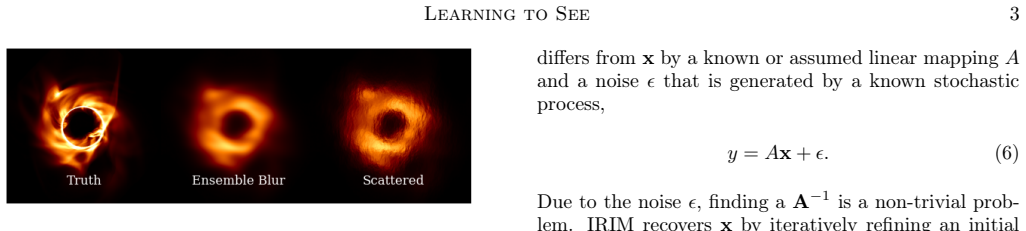
The central claim is that scattering mitigation at resolutions relevant to the EHT is possible without any strong prior on the intrinsic image. The authors demonstrate this by training IRIM on phenomenological images and testing on GRMHD simulations of Sgr A* that were never seen in training. On these test images the Stokes-averaged normalized cross-correlation between the descattered estimate and the truth stays above 0.95 for all angular scales larger than roughly 4 microarcseconds, and the IRIM descattering outperforms simple deblurring with the diffractive kernel at every scale. The conclusion is that the information needed to undo both diffractive and refractive scattering is present in scattered images, so ill-posedness is not an obstacle to practical mitigation.
Load-bearing premise
The model's training and tests assume that the simulated thin-screen scattering with a Kolmogorov ($\alpha = 5/3$) phase structure function and fully sampled images faithfully represents the real EHT measurement process, whereas Sgr A* observations favor an index near 1.38 and real data have sparse coverage and thermal noise.
Editorial extensions
If this is right
- If the result holds, EHT and next-generation arrays can treat scattering as a correctable nuisance rather than a floor on angular resolution, permitting studies of accretion-flow substructure at scales of a few microarcseconds.
- The method's independence from ring priors means it can be applied to extended or asymmetric sources near the galactic center, not just horizon-ring morphology.
- Since the same phase screen corrupts I, Q, U, and V, the model provides a route to high-fidelity polarimetric images of Sgr A* after mitigation.
- The training-on-Gaussians, testing-on-GRMHD generalization suggests that scattering mitigation may transfer to sources whose morphology is poorly known in advance.
- Potential use in future multi-wavelength VLBI campaigns: after mitigation at 1.3 mm, comparisons with 0.87 mm data become cleaner.
Reading between the lines
- A critical robustness check the paper leaves implicit: repeat the training and evaluation with the observed Sgr A* phase-structure index (about 1.38) instead of Kolmogorov $\alpha = 5/3$; the 5 microarcsecond claim currently rests on the Kolmogorov choice.
- Because training uses fully sampled images, real EHT visibilities with sparse $(u,v)$ coverage and thermal noise may degrade the effective resolution; a natural next test is to inject the trained model into the EHT imaging pipeline and compare recovered images against the current deblurring baseline.
- If the descattering generalizes, it could be applied to other strongly scattered Galactic-center sources, and the same IRIM formalism could be reused for chromatic deconvolution in multi-frequency VLBI.
- The paper's success suggests that learned iterative inference with physically motivated forward models may outperform closed-form deconvolution for other stochastic point-spread-function problems, such as atmospheric or ionospheric phase errors.
Editorial analysis
A structured set of objections, weighed in public.
Referee Report
Summary. The paper proposes using an invertible recurrent inference machine (IRIM) to mitigate interstellar scattering of Sgr A* at 1.3 mm. The model is trained on synthetic 'Kolmogorov Gaussian' images with a simulated scattering screen and then evaluated on GRMHD simulation images. The central quantitative claim is that the Stokes-averaged NXCORR between the descattered estimate and the truth exceeds 0.95 for all angular scales down to about 4 microarcseconds, well below the EHT nominal resolution of 24 microarcseconds. The authors conclude that sufficient information exists in scattered images to remove both diffractive and refractive scattering at resolutions relevant for ground-based VLBI.
Significance. If the result held for realistic EHT observations, it would be a valuable advance for high-resolution imaging of Sgr A*. The paper has clear strengths: the GRMHD test set is held out and out-of-distribution relative to the training set, the use of non-birefringence to couple the four Stokes maps is physically motivated, and the quantitative comparison against a deblurring baseline is a useful benchmark. However, the missing interferometric observation operator means the experiments support only an idealized, fully sampled image-domain proof of concept, not the abstract's practical conclusion about EHT resolution. With additional experiments or a more carefully scoped claim, the work would be suitable for publication.
major comments (4)
- [Section 3.2, 4.3, 5] The 4–5 microarcsecond recovery claim is established only on fully sampled, noise-free scattered images. The 'observed' images in Section 3.2 are generated with complete (u,v)-coverage, and Section 4.3 evaluates NXCORR on those fully sampled images. Real EHT data consist of sparse visibilities with thermal noise, and 5 microarcsecond features at 1.3 mm correspond to baselines several times the Earth's diameter, which EHT cannot measure. Section 5 explicitly defers instrument resolution, thermal noise, and imaging specifics. Consequently, the abstract's statement that scattering mitigation is possible 'well below the nominal instrumental resolution of EHT' is not supported by the experiments as presented. The claim should be restricted to the full-information image-domain problem, or an experiment with realistic coverage and noise should be added.
- [Section 2.1, 3.2] The forward model and training data use a Kolmogorov phase structure function with alpha = 5/3, while the paper itself notes that observations of Sgr A* favor alpha near 1.38 (Johnson et al. 2018). Because the model is trained to suppress refractive substructures whose statistics depend on alpha, the reported performance may be specific to alpha = 5/3. No robustness test at alpha = 1.38 is reported. A concrete test would be to generate scattered images with alpha = 1.38 and evaluate the already-trained model, and also to retrain on alpha = 1.38 images, quantifying the change in the NXCORR crossing scale.
- [Section 3.2, Eq. (16)] The training image generation uses I proportional to g exp(n0) and then approximates this by g |n0 + 1|. For a unit-variance n0, exp(n0) is not well approximated by |n0 + 1|; the approximation changes the amplitude distribution and the power spectrum of the simulated intrinsic fluctuations. This makes the exact training distribution unclear and hampers reproducibility. Please either justify the approximation in a valid small-|n0| regime or generate training images as g exp(n0) directly.
- [Section 4.1] The deblurred baseline is computed with a Fourier-domain floor of K_tilde = 0.1 beyond 10 G lambda, whereas the IRIM model is applied to and evaluated at all scales in the fully sampled image. Because the two methods receive different information, the NXCORR gap at small scales partly reflects this asymmetry rather than the intrinsic merits of IRIM. The comparison should be made under the same band limit, for example by applying the 10 G lambda cutoff to both the input and output of IRIM or by evaluating both methods only on angular scales accessible to EHT.
minor comments (6)
- [Section 3.3] The text says 'trained the model over one interaction of this set'; this should be 'one iteration'.
- [Figure 6 caption] The caption contains 'Irim' and mixes 'descattered' and 'deblurred' labels; please correct the spelling and clarify which image corresponds to which method.
- [Abstract] The phrase 'this process both diffractive blurs and adds stochastic refractive substructures that limits' should be 'that limit' for grammatical agreement.
- [Equation (2)] There is a typesetting issue: 'r + r2 F ∇phi(r)' should be 'r + r_F^2 ∇phi(r)'.
- [Section 4.1] The choice of rho = 0.95 as the fidelity threshold is arbitrary; the 4 microarcsecond crossing scale depends on this choice. Reporting the sensitivity of the crossing scale to the threshold would help the reader assess the robustness of the headline number.
- [References] The Porth et al. (2019) reference appears twice; please consolidate.
Circularity Check
No circularity found: the 5 μas result is a held-out metric crossing, not a fitted input or a self-citation chain.
full rationale
The central derivation chain is not circular. The IRIM model is trained on 200,000 Kolmogorov-Gaussian pairs generated with the stochastic-optics module (Sections 3.2–3.3) and evaluated on held-out realizations of the same family plus GRMHD synthetic images that the model never saw (Section 4.3). The headline 4–5 μas figure is an empirically measured crossing of the NXCORR fidelity curve (Section 4.3, Figure 6), not a fitted parameter renamed as a prediction. The metric (Equation 19) compares the estimator to the truth image after Gaussian blur and is independent of the training loss (MSE, Equation 18), so the threshold crossing is not forced by construction. The GRMHD test set is out-of-distribution relative to the training phenomenology (ring morphology, self-consistent turbulence, Stokes correlations), providing external grounding for the capability claim. The paper's residual limitations—full (u,v) coverage, no thermal noise, and Kolmogorov α = 5/3 rather than the observed 1.38—are acknowledged in Section 5 and affect whether the result transfers to real EHT data; they are generalization uncertainties, not circular reductions. The few overlapping-author citations (e.g., Ni et al. 2022 for non-birefringence) are backed by external quantitative support (Johnson et al. 2018, Equation 5) and hence are not load-bearing.
Assumptions & free parameters
free parameters (5)
- NXCORR fidelity threshold =
0.95
- Training-set spectral index =
alpha = 5/3
- Training Gaussian FWHM range =
not stated
- IRIM hyperparameters =
128 channels, dilations 1, 2, 8, 20 inference steps, learning rate 3e-5
- Deblurring baseline length floor =
tilde K at 10 G-lambda set to 0.1
assumptions (6)
- domain assumption Thin-screen scattering model with phase structure function D_phi(r) proportional to |r|^alpha and scattering map I = (K * I)(r + r_F^2 grad phi) (Equation 2).
- domain assumption Kolmogorov spectrum alpha = 5/3 for the scattering screen.
- domain assumption Complete (u,v)-coverage, no thermal noise, no imaging pipeline.
- domain assumption ISM scattering is non-birefringent at 1.3 mm.
- domain assumption IRIM can solve nonlinear inverse problems of the form y = A(x, epsilon).
- domain assumption Diffractive kernel K is exactly known from the phase structure function.
Cite this review
Pith. "Pith review of Learning to See: Applying Inverse Recurrent Inference Machines to See through Refractive Scattering." pith.science (2026). https://pith.science/paper/7SKJ6QB2
@misc{pith2026250114055,
  author       = {Pith},
  title        = {Pith review of: Learning to See: Applying Inverse Recurrent Inference Machines to See through Refractive Scattering},
  year         = {2026},
  howpublished = {\url{https://pith.science/paper/7SKJ6QB2}},
  note         = {Machine review of arXiv:2501.14055}
}
abstract
The Event Horizon Telescope (EHT) has produced horizon-resolving images of Sagittarius A* (Sgr A$^*$). Scattering in the turbulent plasma of the interstellar medium distorts the appearance of Sgr A$^*$ on scales only marginally smaller than the fiducial resolution of EHT. Therefore, this process both diffractive blurs and adds stochastic refractive substructures that limits the practical angular resolution of EHT images of Sgr A$^*$. We utilized a novel recurrent neural network machine learning framework to demonstrate that it is possible to mitigate interstellar scattering at wavelengths of $1.3\,{\rm mm}$ near the galactic center up to structures at the scale of $5\mu{as}$ well below the nominal instrumental resolution of EHT, $24\,\mu{\rm as}$.
Figures


Figures from the paper (5 more)


Reference graph
Works this paper leans on
-
[1]
, " * write output.state after.block = add.period write newline
ENTRY address archivePrefix author booktitle chapter doi edition editor eprint howpublished institution journal key month number organization pages publisher school series title misctitle type volume year version url label extra.label sort.label short.list INTEGERS output.state before.all mid.sentence after.sentence after.block FUNCTION init.state.consts ...
-
[2]
write newline
" write newline "" before.all 'output.state := FUNCTION format.url url empty "" new.block "" url * "" * if FUNCTION format.eprint eprint empty "" archivePrefix empty "" archivePrefix "arXiv" = new.block " " eprint * " " * new.block " " eprint * " " * if if if FUNCTION format.doi doi empty "" " " doi * " " * if FUNCTION format.pid doi empty eprint empty ur...
-
[3]
acknowledgments ... acknowledgments
thebibliography [1] 20pt to REFERENCES 6pt =0pt -12pt 10pt plus 3pt =0pt =0pt =1pt plus 1pt =0pt =0pt -12pt =13pt plus 1pt =20pt =13pt plus 1pt \@M =10000 =-1.0em =0pt =0pt 0pt =0pt =1.0em @enumiv\@empty 10000 10000 `\.\@m \@noitemerr \@latex@warning Empty `thebibliography' environment \@ifnextchar \@reference \@latexerr Missing key on reference command E...
2021
-
[5]
1995, Astrophysical Journal, Part 1 (ISSN 0004-637X), vol
Armstrong, J., Rickett, B., & Spangler, S. 1995, Astrophysical Journal, Part 1 (ISSN 0004-637X), vol. 443, no. 1, p. 209-221, 443, 209
work page 1995
-
[6]
Bower, G. C., Goss, W. M., Falcke, H., Backer, D. C., & Lithwick, Y. 2006, The Astrophysical Journal, 648, L127, 10.1086/508019
doi:10.1086/508019 2006
-
[7]
C., Deller, A., Demorest, P., et al
Bower, G. C., Deller, A., Demorest, P., et al. 2013, The Astrophysical Journal Letters, 780, L2, 10.1088/2041-8205/780/1/L2
-
[8]
Broderick, A. E., Fish, V. L., Doeleman, S. S., & Loeb, A. 2009, The Astrophysical Journal, 697, 45. http://adsabs.harvard.edu/abs/2009ApJ...697...45B
work page 2009
-
[9]
E., Gold, R., Georgiev, B., et al
Broderick, A. E., Gold, R., Georgiev, B., et al. 2022, The Astrophysical Journal Letters, 930, L21, 10.3847/2041-8213/ac6584
Show all 37 references
-
[10]
2015, On learning optimized reaction diffusion processes for effective image restoration
Chen, Y., Yu, W., & Pock, T. 2015, On learning optimized reaction diffusion processes for effective image restoration. 1503.05768
2015 arXiv
-
[11]
2022, The Astrophysical Journal, 926, 108, 10.3847/1538-4357/ac4165
Cho, I., Zhao, G.-Y., Kawashima, T., et al. 2022, The Astrophysical Journal, 926, 108, 10.3847/1538-4357/ac4165
2022 doi
-
[12]
D., Walsh , D., & Booth , R
Davies , R. D., Walsh , D., & Booth , R. S. 1976, , 177, 319, 10.1093/mnras/177.2.319
1976 doi
-
[13]
2019 a , , 875, L2, ( 87 Paper II), 10.3847/2041-8213/ab0c96
Event Horizon Telescope Collaboration , Akiyama , K., Alberdi , A., et al. 2019 a , , 875, L2, ( 87 Paper II), 10.3847/2041-8213/ab0c96
2019 doi
-
[15]
2019 c , , 875, L5, ( 87 Paper V), 10.3847/2041-8213/ab0f43
---. 2019 c , , 875, L5, ( 87 Paper V), 10.3847/2041-8213/ab0f43
2019 doi
-
[17]
2022 b , , 930, L14, 10.3847/2041-8213/ac6429
---. 2022 b , , 930, L14, 10.3847/2041-8213/ac6429
2022 doi
-
[18]
2022 c , , 930, L15, 10.3847/2041-8213/ac667410.3847/2041-8213/ac667210.3847/2041-8213/ac6736
---. 2022 c , , 930, L15, 10.3847/2041-8213/ac667410.3847/2041-8213/ac667210.3847/2041-8213/ac6736
2022
-
[19]
2022 d , , 930, L16, 10.3847/2041-8213/ac6672
---. 2022 d , , 930, L16, 10.3847/2041-8213/ac6672
2022 doi
-
[20]
L., Johnson, M
Fish, V. L., Johnson, M. D., Lu, R.-S., et al. 2014, The Astrophysical Journal, 795, 134, 10.1088/0004-637X/795/2/134
2014 doi
-
[21]
1989, Monthly Notices of the Royal Astronomical Society, 238, 995
Goodman, J., & Narayan, R. 1989, Monthly Notices of the Royal Astronomical Society, 238, 995
1989
-
[22]
2010, in ICML 2010 - Proceedings, 27th International Conference on Machine Learning, ICML 2010 - Proceedings, 27th International Conference on Machine Learning, 399--406
Gregor, K., & LeCun, Y. 2010, in ICML 2010 - Proceedings, 27th International Conference on Machine Learning, ICML 2010 - Proceedings, 27th International Conference on Machine Learning, 399--406
2010
-
[23]
R., Kovalev, Y
Gwinn, C. R., Kovalev, Y. Y., Johnson, M. D., & Soglasnov, V. A. 2014, The Astrophysical Journal Letters, 794, L14, 10.1088/2041-8205/794/1/L14
2014 doi
-
[24]
D., Blackburn, L., et al
Issaoun, S., Johnson, M. D., Blackburn, L., et al. 2021, The Astrophysical Journal, 915, 99, 10.3847/1538-4357/ac00b0
2021 doi
-
[25]
Johnson, M. D. 2016, The Astrophysical Journal, 833, 74, 10.3847/1538-4357/833/1/74
2016 doi
-
[26]
D., & Gwinn, C
Johnson, M. D., & Gwinn, C. R. 2015, The Astrophysical Journal, 805, 180, 10.1088/0004-637x/805/2/180
2015 doi
-
[27]
D., Narayan, R., Psaltis, D., et al
Johnson, M. D., Narayan, R., Psaltis, D., et al. 2018, The Astrophysical Journal, 865, 104, 10.3847/1538-4357/aadcff
2018 doi
-
[28]
1989, Monthly Notices of the Royal Astronomical Society, 238, 963
Narayan, R., & Goodman, J. 1989, Monthly Notices of the Royal Astronomical Society, 238, 963
1989
-
[29]
E., & Gold, R
Ni, C., Broderick, A. E., & Gold, R. 2022, The Astrophysical Journal, 940, 149, 10.3847/1538-4357/ac9b47
2022 doi
-
[31]
2019, , 243, 26, 10.3847/1538-4365/ab29fd
Porth , O., Chatterjee , K., Narayan , R., et al. 2019, , 243, 26, 10.3847/1538-4365/ab29fd
2019 doi
-
[32]
2017, Recurrent Inference Machines for Solving Inverse Problems
Putzky, P., & Welling, M. 2017, Recurrent Inference Machines for Solving Inverse Problems. 1706.04008
2017 arXiv
-
[33]
2019, in Advances in Neural Information Processing Systems 32, ed
---. 2019, in Advances in Neural Information Processing Systems 32, ed. H. Wallach, H. Larochelle, A. Beygelzimer, F. d Alch\' e -Buc, E. Fox, & R. Garnett (Curran Associates, Inc.), 444--454. http://papers.nips.cc/paper/8336-invert-to-learn-to-invert.pdf
2019
-
[34]
1984, Astronomy and Astrophysics (ISSN 0004-6361), vol
Rickett, B., Coles, W., & Bourgois, G. 1984, Astronomy and Astrophysics (ISSN 0004-6361), vol. 134, no. 2, May 1984, p. 390-395., 134, 390
1984
-
[35]
J., Dodson, R., & Asaki, Y
Rioja, M. J., Dodson, R., & Asaki, Y. 2023, Galaxies, 11, 16, 10.3390/galaxies11010016
2023 doi
-
[36]
2015, U-Net: Convolutional Networks for Biomedical Image Segmentation
Ronneberger, O., Fischer, P., & Brox, T. 2015, U-Net: Convolutional Networks for Biomedical Image Segmentation. 1505.04597
2015 arXiv
-
[37]
2019 a , The Astrophysical Journal Letters, 875, L1, 10.3847/2041-8213/ab0ec7
The Event Horizon Telescope Collaboration , Akiyama, K., Alberdi, A., et al. 2019 a , The Astrophysical Journal Letters, 875, L1, 10.3847/2041-8213/ab0ec7
2019 doi
-
[38]
2019 b , The Astrophysical Journal Letters, 875, L4, 10.3847/2041-8213/ab0e85
---. 2019 b , The Astrophysical Journal Letters, 875, L4, 10.3847/2041-8213/ab0e85
2019 doi
-
[39]
2022, The Astrophysical Journal Letters, 930, L12, 10.3847/2041-8213/ac6674
---. 2022, The Astrophysical Journal Letters, 930, L12, 10.3847/2041-8213/ac6674
2022 doi
-
[40]
2016, in Advances in Neural Information Processing Systems, ed
Wang, S., Fidler, S., & Urtasun, R. 2016, in Advances in Neural Information Processing Systems, ed. D. Lee, M. Sugiyama, U. Luxburg, I. Guyon, & R. Garnett, Vol. 29 (Curran Associates, Inc.). https://proceedings.neurips.cc/paper_files/paper/2016/file/f4be00279ee2e0a53eafdaa94a...
2016
-
[41]
2015, in 2015 IEEE International Conference on Computer Vision (ICCV) (IEEE), 10.1109/iccv.2015.179
Zheng, S., Jayasumana, S., Romera-Paredes, B., et al. 2015, in 2015 IEEE International Conference on Computer Vision (ICCV) (IEEE), 10.1109/iccv.2015.179
2015 doi
Reviewed August 10, 2026 · model on record in the stance chip above.
Discussion (0). Continue with ORCID to comment.