REVIEW 2 major objections 6 minor 1 cited by
6G Cellular Networks: Mapping the Landscape for the IMT-2030 Framework
T0 review · 2 major / 6 minor · reviewed 2026-08-10 · deepseek-v4-flash
Pith's one-line read A quantitative map of 6G research, organized by the IMT-2030 framework
desk verdict A useful IMT-2030-oriented map of the 6G literature, but the quantitative distribution rests on an undocumented title-classification step and the reference list has unfinished entries. read the letter →
The pith
A machine-rendered reading of the paper's core claim, the machinery that carries it, and where it could break.
The reading
What carries the argument
The machinery is a thematic classification scheme derived from the IMT-2030 framework and applied to a curated corpus. The authors screen 899 titles from IEEE Xplore, Scopus, research consortia, and standards developing organizations, keeping peer-reviewed journal, magazine, and conference papers with more than 50 citations plus seminal white papers and standardization documents, and assign each title to one of five themes and nine enabler subareas. The resulting percentage distribution (Figure 2, Table II) is what carries the argument: it turns a qualitative survey into a quantitative map of research emphasis.
What would settle it
Re-run the screening on 6G publications from 2023 to 2025 with fewer than 50 citations and compare the theme shares to Figure 2; if the technology-enabler share drops well below 70% or orchestration and security grow substantially, the map is an artifact of the citation threshold. Alternatively, have two independent coders assign the 899 titles to the nine enabler subareas and measure inter-coder agreement on the largest categories.
Extended reading notes
Core claim
The central claim is that a thematic synthesis of highly cited 6G literature, organized by the five IMT-2030-aligned themes (vision; use cases, requirements, and architecture; enabling technologies; vertical applications; research frontier), provides an accurate and useful measure of the field's emphasis. The quantitative anchor is Figure 2 and Table II: within the 628 technology-enabler publications, antennas and meta-surfaces account for 20.22%, heterogeneous network integration 14.49%, AI-based network intelligence 13.54%, and spectrum 13.22%, whereas distributed orchestration (4.78%) and security and privacy (4.46%) are comparatively thin. The paper concludes that enabler research is strongly represented while vertical applications (19.8%) and the research frontier (0.9%) are smaller, and uses that asymmetry to recommend where future standards-informed research attention is needed.
Load-bearing premise
The entire map rests on treating a citation count above 50 as a valid proxy for 'well-established' 6G research, and on the authors' subjective assignment of titles to themes; if that threshold hides recent high-quality work or the assignments are unreliable, the percentage breakdown could shift.
Editorial extensions
If this is right
- Standards bodies can use the map to see which research areas are saturated—antennas, meta-surfaces, network integration, AI, and spectrum—and which are comparatively underexplored, such as orchestration and security.
- The small 0.9% share for the research frontier indicates that most established work is aimed at near-term technology enablers rather than long-range challenges beyond 6G.
- The paper's synthesis of the six IMT-2030 use cases gives stakeholders a common vocabulary for linking use cases to technical requirements and enabling technologies.
- If the map is accurate, funding and standardization effort could be rebalanced toward network orchestration, security and privacy, and vertical applications, which the authors identify as necessary but underweighted.
Reading between the lines
- Because the greater-than-50-citations filter systematically excludes very recent work, the 'underexplored' areas such as orchestration and security may be growing faster than the map shows; a time-bounded rerun would test this.
- The same thematic lens could be applied to patent filings or 3GPP contributions to compare academic research emphasis with industry and standardization effort.
- A natural extension is to weight the screened corpus by recency or venue quality rather than citation count, which would produce a complementary map of emerging rather than established 6G research.
Editorial analysis
A structured set of objections, weighed in public.
Referee Report
Summary. The paper presents a semi-systematic thematic synthesis of 6G literature organized around the IMT-2030 framework. It screens 899 titles published between 2019 and 2025, drawn from IEEE Xplore, Scopus, research consortia, and SDO documents, and classifies them into five thematic dimensions: 6G vision, use cases and requirements, technology enablers, vertical applications, and the research frontier. The quantitative centerpiece is Figure 2 and Table II, which report that 69.9% of screened literature falls under technology enablers, with antennas and meta-surfaces (20.22%), network integration (14.49%), AI (13.54%), and spectrum (13.22%) as the largest subareas, while orchestration (4.78%) and security and privacy (4.46%) are smaller. The paper also summarizes IMT-2030 use cases and technical requirements, outlines architectural trends, discusses vertical sectors, and identifies open research problems.
Significance. If the map is accurate, this is a useful reference for 6G stakeholders because it organizes a large body of literature through the IMT-2030 lens and identifies perceived gaps such as orchestration and security. The paper has concrete strengths: the full list of screened publications is available in an open-access repository [32]; the arithmetic in Figure 2 and Table II is internally consistent, with Table II percentages summing to 100; the methodology and its limitations are explicitly discussed in Section II.A; and the use of primary ITU documents (ITU-R M.2160-0, M.2516-0) grounding the framework is appropriate. However, the quantitative map rests on a single-pass subjective classification that has not been validated for reliability, and the corpus construction has at least one visible inconsistency with the stated citation threshold. The contribution is therefore useful but currently conditional on the reproducibility of the classification.
major comments (2)
- [Section II.A and Table II] The classification of the 899 screened titles into five thematic dimensions and nine research areas is not reproducible as reported. No coding protocol, codebook, decision rules, dual screening, or inter-rater reliability measure is provided, and the paper does not state how titles spanning multiple categories (e.g., a reconfigurable-intelligent-surface paper could plausibly be placed under Antennas, Transmission, or Network Architecture) were assigned to exactly one bucket. The second-decimal percentages in Table II (e.g., 20.22%, 4.78%, 4.46%) imply a precision that is unsupported by a single-pass title-based assignment. Because the central claim of the paper is an accurate quantitative map of 6G research emphasis, and the conclusion that orchestration and security are 'underexplored' depends on these percentages, the authors should either provide a validated classification with inter-rater agreement and a stated coding protocol, or explicitly downgrade the quantitative claims to approximate rankings rather than precise percentages.
- [Section II.A and Table I] The stated inclusion criterion in Section II.A is 'peer-reviewed journals, magazines, and conference proceedings with a minimum citation count of 50,' yet Table I includes [14] as a screened general survey with only 18 citations, marked with an asterisk. If this is a deliberate exception, the rationale is not given; if it is an oversight, the corpus-construction rule is applied inconsistently. Since every percentage in Figure 2 and Table II is computed from this corpus, the inconsistency should be resolved: either exclude [14] from the screened set, or state and justify separate inclusion criteria for low-cited but recent surveys.
minor comments (6)
- [Section VI.A and Section VII] The table cross-references are incorrect: Section VI.A says 'Table VII summarizes applications in the social sector' but the social-sector table is Table IV, and Section VII says 'Table VI summarizes 6G's research frontier' but the research-frontier table is Table VII.
- [Figure 1 and Table II] There are typos in key displays: Figure 1 labels 'Network Intelligente' (should be 'Intelligence'), and Table II has 'Modern modulation and codign techniques' (should be 'coding').
- [Table VII] Table VII contains multiple spelling errors, including 'difsraction' and 'difrraction' for 'diffraction,' 'Matematerials' for 'Metamaterials,' and 'metamateials' for 'metamaterials.'
- [Section III and Figure 3] The text and Figure 3 caption use 'UA Vs' instead of 'UAVs' (e.g., 'LEO satellites, HAPS, and UA Vs' in Section III.A).
- [Reference list] Reference [80] is incomplete, with placeholder author names ('F. Author and S. Author') and volume/page fields 'XX'; this must be replaced with the actual publication data.
- [Reference [63]] Reference [63] is labeled as a TechRxiv preprint despite the methodology stating that only peer-reviewed journals, magazines, and conference proceedings were screened; if this source is included, the methodology should clarify how preprints were handled.
Circularity Check
No significant circularity: the survey's quantitative map is a transparent description of its own explicitly defined corpus, not a prediction derived from a fitted input.
full rationale
This paper is a narrative survey organized around the IMT-2030 framework; it contains no derived equations, no fitted parameters, and no prediction validated against an external outcome. The central quantitative claims (Figure 2 and Table II) are percentages computed from the authors' explicitly stated corpus: English-language peer-reviewed articles from 2019 to 2025 with more than 50 citations, plus seminal white papers and SDO documents. A descriptive statistic of a defined corpus is not circular by construction; it is exactly the survey's data description. The conclusion that areas such as network orchestration and security are 'underexplored' is an inductive generalization from that corpus, and the authors acknowledge the citation-threshold limitation in Section II.A. The two self-citations ([106] on consortium blockchain orchestration and [113] on Koopman-based RL) support peripheral claims about candidate technologies; the thematic map does not rest on these works. The self-maintained dataset [32] is offered as transparency for the screened list, not as evidence for a separately derived result. Methodological concerns about single-pass title classification and inter-rater reliability are validity and reproducibility limitations, not circularity: no step in the paper reduces to its own input or to a self-citation chain.
Assumptions & free parameters
assumptions (4)
- domain assumption "Well-established" is proxied by a citation count above 50.
- domain assumption IEEE Xplore and Scopus index most relevant 6G literature.
- domain assumption IMT-2030 is the appropriate organizing lens for the review.
- ad hoc to paper The authors' thematic classifications of titles are reliable.
Cite this review
Pith. "Pith review of 6G Cellular Networks: Mapping the Landscape for the IMT-2030 Framework." pith.science (2026). https://pith.science/paper/6VLFPUIB
@misc{pith2026250114552,
  author       = {Pith},
  title        = {Pith review of: 6G Cellular Networks: Mapping the Landscape for the IMT-2030 Framework},
  year         = {2026},
  howpublished = {\url{https://pith.science/paper/6VLFPUIB}},
  note         = {Machine review of arXiv:2501.14552}
}
read the original abstract
The IMT-2030 framework provides the vision and conceptual foundation for the next-generation of mobile broadband systems, colloquially known as Sixth-Generation (6G) cellular networks. Academic circles, industry players, and Standard Developing Organizations (SDOs) are already engaged in early standardization discussions for the system, providing key insights for future technical specifications. In this context, a structured thematic synthesis aligned with IMT-2030 is essential to inform the discussions and assist collaboration among 6G stakeholders -- including scholars, professionals, regulators, and SDO officials. This review intends to offer a concise yet informative synthesis of well-established 6G literature, viewed through the IMT-2030 lens, for both specialists and generalists engaged in shaping future standards and advancing 6G research.
Figures


Figures from the paper (5 more)



Forward citations
Cited by 1 Pith paper
-
When 5G MIMO Scaling Breaks: Toward 6G Upper-Mid-Band Extreme MIMO
Scaling 5G MIMO to 256+ ports at 7–8 GHz breaks on common-channel coverage, RF/array power, and CSI overhead; the paper maps a roadmap that decouples radiating elements, RF chains, and acquired channel dimensions.
Reference graph
Works this paper leans on
-
[14]
On challenges of sixth-generation (6g) wireless networks: A comprehensive survey of requirements, applications, and security issues,
M. S. Akbar, Z. Hussain, M. Ikram, Q. Z. Sheng, and S. C. Mukhopad- hyay, “On challenges of sixth-generation (6g) wireless networks: A comprehensive survey of requirements, applications, and security issues,” Journal of Network and Computer Applications , vol. 233, pp. 1–24, 2025
2025
-
[80]
Spectrum man- agement in the 6g era: The role of regulation and spectrum sharing,
M. Matinmikko-Blue, S. Yrj ¨ol¨a, and P. Ahokangas, “Spectrum man- agement in the 6g era: The role of regulation and spectrum sharing,” in 2020 2nd 6G Wireless Summit (6G SUMMIT) , 2020, pp. 1–5
2020
-
[56]
Networking systems of ai: On the convergence of computing and communications,
J. Jiang, F. R. Yu, K. B. Letaief, M. Bennis, and H. Zhang, “Networking systems of ai: On the convergence of computing and communications,” IEEE Journal on Selected Areas in Communications, vol. 41, no. 1, pp. 5–27, 2023
2023
-
[133]
X. Zhang, W. Wang, H. Liu, P. Li, Z. Yang, C. Yu, H. Wei, Y . Zhao, and Z. Liu, “Biocompatible material-based flexible biosensors: From materials design to wearable/implantable devices and integrated sensing systems,” Advanced Functional Materials , vol. 33, no. 5, p. 2210642, 2023
work page 2023
-
[32]
The development of imt towards 2030 and beyond,
“The development of imt towards 2030 and beyond,” Asia-Pacific Telecommunity (APT), APG23-4/INF-32, Tech. Rep., August 2022
2022
-
[1]
6g wireless networks: Vision, requirements, archi- tecture, and key technologies,
Z. Zhang, Y . Xiao, Z. Ma, M. Xiao, Z. Ding, X. Lei, G. K. Karagian- nidis, and P. Fan, “6g wireless networks: Vision, requirements, archi- tecture, and key technologies,” IEEE Vehicular Technology Magazine, vol. 14, no. 3, pp. 28–41, 2019
2019
-
[2]
What should 6g be?
S. Dang, O. Amin, B. Shihada, and M.-S. Alouini, “What should 6g be?” Nature Electronics, vol. 3, pp. 20–29, 2020
2020
-
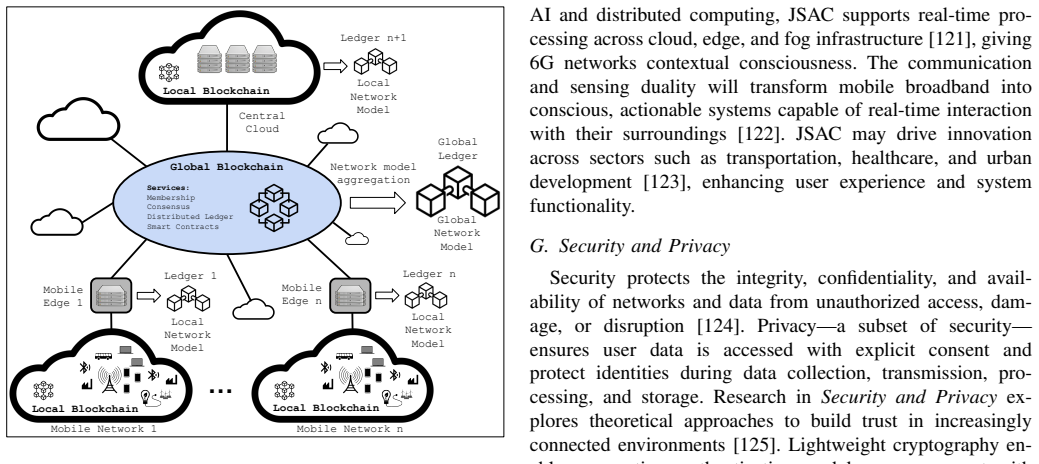
[3]
6g wireless communication systems: Applications, requirements, technolo- gies, challenges, and research directions,
M. Z. Chowdhury, M. Shahjalal, S. Ahmed, and Y . M. Jang, “6g wireless communication systems: Applications, requirements, technolo- gies, challenges, and research directions,” IEEE Open Journal of the Communications Society, vol. 1, pp. 957–975, 2020
2020
Show all 168 references
-
[4]
6g and beyond: The future of wireless communications systems,
I. F. Akyildiz, A. Kak, and S. Nie, “6g and beyond: The future of wireless communications systems,” IEEE Access, vol. 8, pp. 133 995– 134 030, 2020
2020
-
[5]
Communications in the 6g era,
H. Viswanathan and P. E. Mogensen, “Communications in the 6g era,” IEEE Access, vol. 8, pp. 57 063–57 074, 2020
2020
-
[6]
Towards 6g wireless com- munication networks: Vision, enabling technologies, and new paradigm shifts,
X. You, C. Wang, J. Huang, and H. Zhang, “Towards 6g wireless com- munication networks: Vision, enabling technologies, and new paradigm shifts,” Science China Information Sciences , vol. 63, pp. 259 501:1– 259 501:20, 2020
2020
-
[7]
The road towards 6g: A comprehensive survey,
W. Jiang, B. Han, M. A. Habibi, and H. D. Schotten, “The road towards 6g: A comprehensive survey,” IEEE Open Journal of the Communications Society, vol. 2, pp. 334–366, 2021
2021
-
[8]
6g wireless systems: Vision, requirements, challenges, insights, and opportunities,
H. Tataria, M. Shafi, A. F. Molisch, M. Dohler, H. Sj ¨oland, and F. Tufvesson, “6g wireless systems: Vision, requirements, challenges, insights, and opportunities,” Proceedings of the IEEE , vol. 109, no. 7, pp. 1166–1199, 2021
2021
-
[9]
6g networks: Beyond shan- non towards semantic and goal-oriented communications,
E. Calvanese Strinati and S. Barbarossa, “6g networks: Beyond shan- non towards semantic and goal-oriented communications,” Computer Networks, vol. 190, p. 107930, 2021
2021
-
[10]
6g wireless communications networks: A comprehensive survey,
M. Alsabah, M. A. Naser, B. M. Mahmmod, S. H. Abdulhussain, M. R. Eissa, A. Al-Baidhani, N. K. Noordin, S. M. Sait, K. A. Al-Utaibi, and F. Hashim, “6g wireless communications networks: A comprehensive survey,” IEEE Access, vol. 9, pp. 148 191–148 243, 2021
2021
-
[11]
On the road to 6g: Visions, requirements, key technologies, and testbeds,
C.-X. Wang, X. You, X. Gao, X. Zhu, Z. Li, C. Zhang, H. Wang, Y . Huang, Y . Chen, H. Haas, J. S. Thompson, E. G. Larsson, M. D. Renzo, W. Tong, P. Zhu, X. Shen, H. V . Poor, and L. Hanzo, “On the road to 6g: Visions, requirements, key technologies, and testbeds,” IEEE Communi...
2023
-
[12]
6g mobile communication technology: Requirements, targets, applications, challenges, advan- tages, and opportunities,
M. Banafaa, I. Shayea, J. Din, M. Hadri Azmi, A. Alashbi, Y . Ibrahim Daradkeh, and A. Alhammadi, “6g mobile communication technology: Requirements, targets, applications, challenges, advan- tages, and opportunities,” Alexandria Engineering Journal, vol. 64, pp. 245–274, 2023
2023
-
[13]
5g, 6g, and beyond: Recent advances and future challenges,
F. Salahdine, T. Han, and N. Zhang, “5g, 6g, and beyond: Recent advances and future challenges,” International Journal of Wireless and Mobile Computing, vol. 1, no. 1, pp. 1–15, 2023
2023
-
[15]
A vision of 6g wireless systems: Applications, trends, technologies, and open research problems,
W. Saad, M. Bennis, and M. Chen, “A vision of 6g wireless systems: Applications, trends, technologies, and open research problems,” IEEE Network, vol. 34, no. 3, pp. 134–142, 2020
2020
-
[16]
High-capacity mobile telephone system technical report,
Bell Laboratories, “High-capacity mobile telephone system technical report,” AT&T Bell Laboratories, Tech. Rep. FCC Docket 71-xx, Dec. 20 1971, filed with the FCC
1971
-
[17]
Release description; Summary of Rel-18 Work Items,
3GPP, “Release description; Summary of Rel-18 Work Items,” 3GPP, Technical Report TR 21.918, 2023, retrieved from 3GPP Release 18 page. [Online]. Available: https://www.3gpp.org/specifications- technologies/releases/release-18
2023
-
[18]
Release description; Summary of Rel-19 Work Items,
——, “Release description; Summary of Rel-19 Work Items,” 3GPP, Technical Report TR 21.919, 2025, retrieved from 3GPP Release 19 page. [Online]. Available: https://www.3gpp.org/specifications- technologies/releases/release-19
2025
-
[19]
3gpp commits to develop 6g specifications,
3GPP Organizational Partners, “3gpp commits to develop 6g specifications,” Press Release, Dec. 2023, accessed: 2025-06-
2023
-
[20]
Available: https://www.3gpp.org/news-events/3gpp- news/partner-pr-6g
[Online]. Available: https://www.3gpp.org/news-events/3gpp- news/partner-pr-6g
-
[21]
Emerging usage trends of terrestrial imt systems towards 2030 and beyond,
“Emerging usage trends of terrestrial imt systems towards 2030 and beyond,” International Telecommunication Union Radiocommunication Sector (ITU-R), Tech. Rep. ITU-R M.2441-0, August 2018
2018
-
[22]
Future technology trends of terrestrial international mobile telecommunications systems towards 2030 and beyond (imt-2030),
International Telecommunication Union Radiocommunication Sector (ITU-R) Working Party 5D, “Future technology trends of terrestrial international mobile telecommunications systems towards 2030 and beyond (imt-2030),” International Telecommunication Union, ITU-R Report M.2516, Dec. 2022
2022
-
[23]
Framework and overall objectives of the future development of IMT for 2030 and beyond (ITU-R M.2160-0 report),
ITU, “Framework and overall objectives of the future development of IMT for 2030 and beyond (ITU-R M.2160-0 report),” 2023
2023
-
[24]
Browse our technologies,
3GPP, “Browse our technologies,” https://www.3gpp.org/specifications-technologies/browse-our- technologies, 2024, accessed: 2025-06-16
2024
-
[25]
Itu’s imt-2030 vision: Navigating towards 6g in the americas,
5G Americas, “Itu’s imt-2030 vision: Navigating towards 6g in the americas,” 5G Americas, Washington, D.C., White Paper, Aug. 2024
2024
-
[26]
Literature reviews as a research methodology: An overview and guidelines,
H. Snyder, “Literature reviews as a research methodology: An overview and guidelines,” Journal of Business Research , vol. 104, pp. 333–339, 2019
2019
-
[27]
Towards a methodology for developing evidence-informed management knowledge by means of systematic review,
D. Tranfield, D. Denyer, and P. Smart, “Towards a methodology for developing evidence-informed management knowledge by means of systematic review,” British journal of management , vol. 14, no. 3, pp. 207–222, 2003
2003
-
[28]
Conducting a literature review: Challenges and best practices,
J. vom Brocke, A. Simons, B. Niehaves, K. Reimer, R. Plattfaut, and A. Cleven, “Conducting a literature review: Challenges and best practices,” Communications of the Association for Information Systems, vol. 37, 2015
2015
-
[29]
6g flagship – more than wireless,
University of Oulu, 6G Flagship, “6g flagship – more than wireless,” https://www.6gflagship.com/, 2025, accessed June 2025
2025
-
[30]
6g vision, use cases and key societal values,
“6g vision, use cases and key societal values,” Hexa-X Project, Tech. Rep. Deliverable D1.1, January 2021
2021
-
[31]
Itu’s imt-2030 vision: Navigating towards 6g in the americas,
“Itu’s imt-2030 vision: Navigating towards 6g in the americas,” 5G Americas, Tech. Rep., September 2024
2024
-
[33]
6g research literature database,
A. Vera Rivera, “6g research literature database,” https://github.com/angelovrr/6g-literature-database, 2025, accessed: 2025-07-19
2025
-
[34]
A survey of 5g network: Architecture and emerging technologies,
A. Gupta and R. K. Jha, “A survey of 5g network: Architecture and emerging technologies,” IEEE Access, vol. 3, pp. 1206–1232, 2015
2015
-
[35]
5g shortcomings and beyond- 5g/6g requirements,
M. Moussaoui, E. Bertin, and N. Crespi, “5g shortcomings and beyond- 5g/6g requirements,” in 2022 1st International Conference on 6G Networking (6GNet), 2022, pp. 1–8
2022
-
[36]
Millimeter-wave mobile communica- tions for 5g: Challenges and opportunities,
F. Al-Ogaili and R. M. Shubair, “Millimeter-wave mobile communica- tions for 5g: Challenges and opportunities,” in 2016 IEEE International Symposium on Antennas and Propagation (APSURSI), 2016, pp. 1003– 1004
2016
-
[37]
A study on prop- agation models for 60 ghz signals in indoor environments,
L. Carneiro de Souza, C. H. de Souza Lopes, R. de Cassia Carlleti dos Santos, A. Cerqueira Sodr ´e Jr., and L. L. Mendes, “A study on prop- agation models for 60 ghz signals in indoor environments,” Frontiers in Communications and Networks , vol. 2, 2022
2022
-
[38]
Effect of atmospheric absorption on millimetre wave frequencies for 5g cellular networks,
Y . Banday, G. M. Rather, and G. R. Begh, “Effect of atmospheric absorption on millimetre wave frequencies for 5g cellular networks,” IET Communications, vol. 12, no. 18, pp. 2357–2365, 2018
2018
-
[39]
Artificial intelligence in 5g technology: A survey,
M. E. Morocho Cayamcela and W. Lim, “Artificial intelligence in 5g technology: A survey,” in 2018 International Conference on Informa- tion and Communication Technology Convergence (ICTC) , 2018, pp. 860–865
2018
-
[40]
Energy saving technologies and best practices for 5g radio access network,
R. Tan, Y . Shi, Y . Fan, W. Zhu, and T. Wu, “Energy saving technologies and best practices for 5g radio access network,” IEEE Access, vol. 10, pp. 51 747–51 756, 2022
2022
-
[41]
Stephenson, Snow Crash
N. Stephenson, Snow Crash. Bantam Books, 1992
1992
-
[42]
A survey on the metaverse: The state-of-the-art, technologies, applications, and challenges,
H. Wang, H. Ning, Y . Lin, W. Wang, S. Dhelim, F. Farha, J. Ding, and M. Daneshmand, “A survey on the metaverse: The state-of-the-art, technologies, applications, and challenges,” IEEE Internet of Things Journal, vol. 10, no. 16, pp. 14 671–14 688, 2023
2023
-
[43]
Toward 6g non-terrestrial networks,
G. Araniti, A. Iera, S. Pizzi, and F. Rinaldi, “Toward 6g non-terrestrial networks,” IEEE Network, vol. 36, no. 1, pp. 113–120, 2022
2022
-
[44]
Terahertz communications for 6g and beyond wireless networks: Challenges, key advancements, and opportunities,
A. Shafie, N. Yang, C. Han, J. M. Jornet, M. Juntti, and T. Kerner, “Terahertz communications for 6g and beyond wireless networks: Challenges, key advancements, and opportunities,” IEEE Network , vol. 37, no. 3, pp. 162–169, 2023
2023
-
[45]
Terahertz massive mimo with holographic reconfigurable intelligent surfaces,
Z. Wan, Z. Gao, F. Gao, M. D. Renzo, and M. Alouini, “Terahertz massive mimo with holographic reconfigurable intelligent surfaces,” IEEE Transactions on Communications, vol. 69, no. 7, pp. 4732–4750, 2021
2021
-
[46]
The roadmap to 6g: Ai empowered wireless networks,
Y . Chen, M. Wang, M. Elkashlan, J. Li, F. Safar, and K.-K. Wong, “The roadmap to 6g: Ai empowered wireless networks,” IEEE Com- munications Magazine, vol. 58, no. 11, pp. 84–90, 2020
2020
-
[47]
Machine type communications: key drivers and enablers towards the 6g era,
N. H. Mahmood, S. B ¨ocker, I. Moerman, O. A. L ´opez, A. Munari, K. Mikhaylov, F. Clazzer, H. Bartz, O. Park, E. Mercier, S. Saidi, D. M. Osorio, R. J ¨antti, R. Pragada, E. Annanper ¨a, Y . Ma, C. Wietfeld, M. Andraud, G. Liva, Y . Chen, E. Garro, F. Burkhardt, C. Liu, H. Al...
2021
-
[48]
6g digital twin networks: From theory to practice,
X. Lin, L. Kundu, C. Dick, E. Obiodu, T. Mostak, and M. Flaxman, “6g digital twin networks: From theory to practice,” IEEE Communications Magazine, vol. 61, no. 11, pp. 72–78, 2023
2023
-
[49]
Trustworthy ai-generative content in intelligent 6g network: Adversarial, privacy, and fairness,
S. Li, X. Lin, Y . Liu, and J. Li, “Trustworthy ai-generative content in intelligent 6g network: Adversarial, privacy, and fairness,” 2024
2024
-
[50]
Ai and 6g security: Opportunities and challenges,
Y . Siriwardhana, P. Porambage, M. Liyanage, and M. Ylianttila, “Ai and 6g security: Opportunities and challenges,” in 2021 Joint European Conference on Networks and Communications (EuCNC) & 6G Summit. IEEE, 2021, pp. 616–621
2021
-
[51]
Security and privacy for 6g: A survey on prospective tech- nologies and challenges,
A. A. Munir, S. M. A. Kazmi, J. J. P. C. Rodrigues, S. Mumtaz, and M. Imran, “Security and privacy for 6g: A survey on prospective tech- nologies and challenges,” IEEE Communications Surveys & Tutorials , vol. 24, no. 4, pp. 2630–2658, 2022
2022
-
[52]
6g security challenges and potential solutions,
P. Porambage, G. G ¨ur, D. P. M. Osorio, M. Liyanage, and M. Ylianttila, “6g security challenges and potential solutions,” in 2021 Joint Euro- pean Conference on Networks and Communications (EuCNC) & 6G Summit. Porto, Portugal: IEEE, 2021, pp. 622–627
2021
-
[53]
The role of blockchain in 6g: Challenges, opportunities and research directions,
T. Hewa, G. G ¨ur, A. Kalla, M. Ylianttila, A. Bracken, and M. Liyanage, “The role of blockchain in 6g: Challenges, opportunities and research directions,” in 2020 2nd 6G Wireless Summit (6G SUMMIT) , 2020, pp. 1–5
2020
-
[54]
Edge computing for internet of everything: A survey,
X. Kong, Y . Wu, H. Wang, and F. Xia, “Edge computing for internet of everything: A survey,” IEEE Communications Surveys & Tutorials , vol. 24, no. 3, pp. 1625–1650, 2022
2022
-
[55]
A vision on the artificial intelligence for 6g communication,
T. B. Ahammed, R. Patgiri, and S. Nayak, “A vision on the artificial intelligence for 6g communication,” ICT Express , vol. 2, no. 2, pp. 197–210, 2023
2023
-
[57]
A survey on green 6g network: Architecture and technologies,
T. Huang, W. Yang, J. Wu, J. Ma, X. Zhang, and D. Zhang, “A survey on green 6g network: Architecture and technologies,” IEEE Access , vol. 7, pp. 175 758–175 768, 2019
2019
-
[59]
Toward greener 5g and beyond radio access networks ˆaC
R. Zhang, Q. Liu, Y . Wang, L. Zhang, and Y . Zhang, “Toward greener 5g and beyond radio access networks ˆaC”a survey,” IEEE Communications Surveys & Tutorials , vol. 24, no. 2, pp. 980–1010, 2022
2022
-
[60]
Framework and overall objectives of the future development of IMT for 2020 and beyond (ITU-R M.2083-0 report),
ITU, “Framework and overall objectives of the future development of IMT for 2020 and beyond (ITU-R M.2083-0 report),” 2015
2020
-
[61]
Toward immersive communications in 6g,
X. S. Shen, J. Gao, M. Li, C. Zhou, S. Hu, M. He, and W. Zhuang, “Toward immersive communications in 6g,” Frontiers in Computer Science, vol. 4, p. 1068478, 2023
2023
-
[62]
Future (post–covid) digital, smart and sustainable cities in the wake of 6g: Digital twins, immersive realities and new urban economies,
Z. Allam and D. S. Jones, “Future (post–covid) digital, smart and sustainable cities in the wake of 6g: Digital twins, immersive realities and new urban economies,” Land Use Policy , vol. 101, p. 105201, 2021
2021
-
[63]
Urllc in beyond 5g and 6g networks: An in- terference management perspective,
M. U. A. Siddiqui, H. Abumarshoud, L. Bariah, S. Muhaidat, M. A. Imran, and L. Mohjazi, “Urllc in beyond 5g and 6g networks: An in- terference management perspective,” IEEE Access, vol. 11, pp. 54 639– 54 663, 2023
2023
-
[64]
Urllc and embb in 5g industrial iot: A survey,
B. S. Khan, S. Jangsher, A. Ahmed, and A. Al-Dweik, “Urllc and embb in 5g industrial iot: A survey,” IEEE Open Journal of the Communica- tions Society (TechRxiv preprint), 2022, preprint; comprehensive review of URLLC and eMBB in private 5G/B5G IIoT networks
2022
-
[65]
Facilitating urllc in uav-assisted relay systems with multiple-mobile robots for 6g networks: A prospec- tive of agriculture 4.0,
A. Ranjha, G. Kaddoum, and K. Dev, “Facilitating urllc in uav-assisted relay systems with multiple-mobile robots for 6g networks: A prospec- tive of agriculture 4.0,” IEEE Transactions on Industrial Informatics , vol. 18, pp. 4954–4965, 2022
2022
-
[66]
Enabling massive iot toward 6g: A comprehensive survey,
R. K. Yadav, S. Gupta, and M. Khan, “Enabling massive iot toward 6g: A comprehensive survey,” IEEE Communications Surveys and Tutorials, vol. 26, no. 2, pp. 1024–1050, 2024
2024
-
[67]
Vision, requirements, and technology trend of 6g: How to tackle the challenges of system coverage, capacity, user data-rate and move- ment speed,
S. Chen, Y . Liang, S. Sun, S. Kang, W. Cheng, and M. Peng, “Vision, requirements, and technology trend of 6g: How to tackle the challenges of system coverage, capacity, user data-rate and move- ment speed,” IEEE Wireless Communications (also arXiv preprint arXiv:2002.04929), ...
2002 arXiv
-
[68]
Non-terrestrial networks in the 6g era: Challenges and opportunities,
M. Giordani and M. Zorzi, “Non-terrestrial networks in the 6g era: Challenges and opportunities,” IEEE Network , vol. 35, no. 2, pp. 244–251, 2021. [Online]. Available: https://doi.org/10.1109/MNET.011.2000493
2021 doi
-
[69]
Space-air-ground integrated network (sagin) for 6g: Requirements, architecture and challenges,
H. Cui, J. Zhang, Y . Geng, Z. Xiao, T. Sun, N. Zhang, J. Liu, Q. Wu, and X. Cao, “Space-air-ground integrated network (sagin) for 6g: Requirements, architecture and challenges,” China Communications , vol. 19, no. 2, pp. 90–108, 2022
2022
-
[70]
Antenna array enabled space/air/ground communications and networking for 6g,
Z. Xiao, Z. Han, A. Nallanathan, O. A. Dobre, B. Clerckx, J. Choi, C. He, and W. Tong, “Antenna array enabled space/air/ground communications and networking for 6g,” arXiv preprint arXiv:2110.12610 , 2021, preprint. [Online]. Available: https://arxiv.org/abs/2110.12610
2021 arXiv
-
[71]
Edge-Native Intelligence for 6G Communications Driven by Federated Learning: A Survey of Trends and Challenges,
M. Al-Quraan, L. Mohjazi, L. Bariah, A. Centeno, A. Zoha, K. Arshad, K. Assaleh, S. Muhaidat, M. Debbah, and M. A. Imran, “Edge-Native Intelligence for 6G Communications Driven by Federated Learning: A Survey of Trends and Challenges,” IEEE Transactions on Emerging Topics in C...
2023
-
[72]
6g visions: Mobile ultra-broadband, super internet-of-things, and artificial intelligence,
L. Zhang, Y . Liang, and D. Niyato, “6g visions: Mobile ultra-broadband, super internet-of-things, and artificial intelligence,” China Communications, vol. 16, no. 8, pp. 1–14, 2019
2019
-
[73]
Federated learning for 6g: Applications, challenges, and opportunities,
Z. Yang, M. Chen, S. Cui, and K.-K. Wong, “Federated learning for 6g: Applications, challenges, and opportunities,” arXiv preprint arXiv:2101.01338, 2021
2021 arXiv
-
[74]
Explainable artificial intelligence (xai) for 6g: Improving trust between human and machine,
W. Guo, “Explainable artificial intelligence (xai) for 6g: Improving trust between human and machine,” arXiv preprint arXiv:1911.04542 , Nov. 2019. [Online]. Available: https://arxiv.org/abs/1911.04542
1911 arXiv
-
[75]
Survey on intelligence edge computing in 6g: Characteristics, challenges, potential use cases, and market drivers,
A. Al-Ansi, A. M. Al-Ansi, A. Muthanna, I. A. Elgendy, and A. Kouch- eryavy, “Survey on intelligence edge computing in 6g: Characteristics, challenges, potential use cases, and market drivers,” Future Internet , vol. 13, no. 5, p. 118, 2021
2021
-
[76]
Integrated sensing and communications: Toward dual-functional wire- less networks for 6g and beyond,
F. Liu, Y . Cui, C. Masouros, J. Xu, T. X. Han, Y . C. Eldar, and S. Buzzi, “Integrated sensing and communications: Toward dual-functional wire- less networks for 6g and beyond,” IEEE Journal on Selected Areas in Communications, vol. 40, no. 6, pp. 1–1, March 2022
2022
-
[77]
Integrated sensing and communication in 6g: Motivations, use cases, requirements, challenges and future directions,
D. K. P. Tan, J. He, Y . Li, A. Bayesteh, Y . Chen, P. Zhu, and W. Tong, “Integrated sensing and communication in 6g: Motivations, use cases, requirements, challenges and future directions,” in Proceedings of the 1st IEEE International Online Symposium on Joint Communications ...
2021
-
[78]
The integrated sensing and communication revolution for 6g: Vision, techniques, and applications,
N. Gonz ´alez-Prelcic and et al., “The integrated sensing and communication revolution for 6g: Vision, techniques, and applications,” arXiv preprint, vol. 2405.01816, 2024, accessed: 2025-07-16. [Online]. Available: https://arxiv.org/abs/2405.01816
2024 arXiv
-
[79]
The 6g architecture landscape: European perspective,
5GPPP, “The 6g architecture landscape: European perspective,” 2022
2022
-
[81]
The role of millimeter-wave technologies in 5g/6g wireless communications,
F. Author and S. Author, “The role of millimeter-wave technologies in 5g/6g wireless communications,” IEEE Communications Magazine , vol. XX, no. X, pp. XX–XX, 202X
-
[82]
Tera- hertz channel propagation phenomena, measurement techniques and modeling for 6g wireless communication applications: A survey, open challenges and future research directions,
D. Serghiou, M. Khalily, T. W. C. Brown, and R. Tafazolli, “Tera- hertz channel propagation phenomena, measurement techniques and modeling for 6g wireless communication applications: A survey, open challenges and future research directions,” IEEE Communications Surveys & Tutor...
1957
-
[83]
Thz radio com- munication: Link budget analysis toward 6g,
K. Rikkinen, M. E. Leinonen, and A. P ¨arssinen, “Thz radio com- munication: Link budget analysis toward 6g,” IEEE Communications Magazine, vol. 58, no. 11, pp. 22–27, 2020
2020
-
[84]
Visible light communication in 6g: Advances, challenges, and prospects,
N. Chi, Y . Zhou, Y . Wei, and F. Hu, “Visible light communication in 6g: Advances, challenges, and prospects,” IEEE Vehicular Technology Magazine, vol. 15, no. 3, pp. 93–102, 2020
2020
-
[85]
Optical wireless communi- cation: A candidate 6g technology?
S. Arai, M. Kinoshita, and T. Yamazato, “Optical wireless communi- cation: A candidate 6g technology?” IEICE Transactions on Funda- mentals of Electronics, Communications and Computer Sciences , vol. E104.A, no. 1, pp. 227–234, 2021
2021
-
[86]
Issues, challenges, and research trends in spectrum manage- ment: A comprehensive overview and new vision for designing 6g networks,
F. Qamar, M. U. A. Siddiqui, M. H. Hindia, R. Hassan, and Q. N. Nguyen, “Issues, challenges, and research trends in spectrum manage- ment: A comprehensive overview and new vision for designing 6g networks,” Electronics, vol. 9, no. 9, p. 1416, 2020
2020
-
[87]
Spectrum man- agement in the 6g era: The role of regulation and spectrum sharing,
M. Matinmikko-Blue, S. Yrj ¨ol¨a, and P. Ahokangas, “Spectrum man- agement in the 6g era: The role of regulation and spectrum sharing,” in Proceedings of the 2nd 6G Wireless Summit (6G SUMMIT) . Levi, Finland: 6G Wireless Summit, Mar 17–20 2020, pp. 1–5
2020
-
[88]
Spectrum options and allocations for 6g: A regulatory and standardization review,
W. K. Alsaedi, H. Ahmadi, Z. Khan, and D. Grace, “Spectrum options and allocations for 6g: A regulatory and standardization review,” IEEE Open Journal of the Communications Society , vol. 4, pp. 1787–1812, 2023
2023
-
[89]
A road towards 6g communication—a review of 5g antennas, arrays, and wearable devices,
M. Ikram, K. Sultan, M. F. Lateef, and A. S. M. Alqadami, “A road towards 6g communication—a review of 5g antennas, arrays, and wearable devices,” Electronics, vol. 11, no. 1, p. 169, 2022
2022
-
[90]
The review and analysis of antenna for sixth generation (6g) applications,
S. N. Hafizah Sa’don, M. R. Kamarudin, M. H. Dahri, A. Y . I. Ashyap, F. C. Seman, M. I. Abbasi, and Z. Z. Abidin, “The review and analysis of antenna for sixth generation (6g) applications,” in 2020 IEEE International RF and Microwave Conference (RFM) , 2020, pp. 1–5
2020
-
[91]
Ultramassive mimo systems at terahertz bands: Prospects and challenges,
A. Faisal, H. Sarieddeen, H. Dahrouj, T. Y . Al-Naffouri, and M.-S. Alouini, “Ultramassive mimo systems at terahertz bands: Prospects and challenges,” IEEE Vehicular Technology Magazine , vol. 15, no. 4, p. —, 2020
2020
-
[92]
Wireless communications through reconfigurable intelligent surfaces,
E. Basar, M. Di Renzo, J. De Rosny, M. Debbah, M. Alouini, and R. Zhang, “Wireless communications through reconfigurable intelligent surfaces,” IEEE Access, vol. 7, pp. 116 753–116 773, 2019
2019
-
[93]
Reconfigurable intelligent surfaces for 6g systems: Principles, appli- cations, and research directions,
C. Pan, H. Ren, K. Wang, J. F. Kolb, M. Elkashlan, M. Chen, M. D. Renzo, Y . Hao, J. Wang, A. L. Swindlehurst, X. You, and L. Hanzo, “Reconfigurable intelligent surfaces for 6g systems: Principles, appli- cations, and research directions,” 2021
2021
-
[94]
Reconfigurable holographic surfaces for ultra-massive mimo in 6g: Practical design, optimization and implementation,
R. Deng, Y . Zhang, H. Zhang, B. Di, H. Zhang, H. V . Poor, and L. Song, “Reconfigurable holographic surfaces for ultra-massive mimo in 6g: Practical design, optimization and implementation,” IEEE Journal on Selected Areas in Communications, vol. 41, no. 8, pp. 2368–2379, Aug 2023
2023
-
[95]
Survey and performance evaluation of multiple access schemes for next-generation wireless communication systems,
A. F. M. S. Shah, A. N. Qasim, M. A. Karabulut, H. Ilhan, and M. B. Islam, “Survey and performance evaluation of multiple access schemes for next-generation wireless communication systems,” IEEE Access , vol. 9, pp. 113 428–113 442, 2021
2021
-
[96]
6g wireless channel measurements and models: Trends and challenges,
C. Wang, J. Huang, H. Wang, X. Gao, X. You, and Y . Hao, “6g wireless channel measurements and models: Trends and challenges,” IEEE Vehicular Technology Magazine, vol. 15, no. 4, pp. 22–32, 2020
2020
-
[97]
Developing noma to next generation multiple access: Future vision and research opportunities,
Y . Liu, W. Yi, Z. Ding, X. Liu, O. A. Dobre, and N. Al-Dhahir, “Developing noma to next generation multiple access: Future vision and research opportunities,” IEEE Wireless Communications , vol. 29, no. 6, pp. 120–127, 2022
2022
-
[98]
A review of orbital angular momentum vortex waves for the next generation wireless communications,
S. K. Noor, M. N. M. Yasin, A. M. Ismail, M. N. Osman, P. J. Soh, N. Ramli, and A. H. Rambe, “A review of orbital angular momentum vortex waves for the next generation wireless communications,” IEEE Access, vol. 10, pp. 89 465–89 484, 2022
2022
-
[99]
Orthogonal time-frequency space modulation: A promising next-generation waveform,
R. Hadani, A. F. Molisch, C. Monk, M. Tsatsanis, A. Goldsmith, R. Calderbank, and P. Schniter, “Orthogonal time-frequency space modulation: A promising next-generation waveform,” IEEE Wireless Communications, vol. 24, no. 6, pp. 38–46, 2017
2017
-
[100]
Index modulation multiple access for 6g communications: Principles, applications, and challenges,
Y . Liu, M. Xiao, X. Ma, X. Chen, Q. Li, Y . Wu, and F. Gao, “Index modulation multiple access for 6g communications: Principles, applications, and challenges,” IEEE Wireless Communications, vol. 29, no. 4, pp. 64–71, 2022
2022
-
[101]
6g wireless systems: A vision, architectural elements, and future directions,
L. U. Khan, I. Yaqoob, M. Imran, Z. Han, and C. S. Hong, “6g wireless systems: A vision, architectural elements, and future directions,” IEEE Access, vol. 8, pp. 147 029–147 044, 2020. [Online]. Available: https://doi.org/10.1109/ACCESS.2020.3015289
2020
-
[102]
A survey on beyond 5g network with the advent of 6g: Architecture and emerging technologies,
A. Dogra, R. K. Jha, and S. Jain, “A survey on beyond 5g network with the advent of 6g: Architecture and emerging technologies,” IEEE Access , vol. 9, 2021. [Online]. Available: https://doi.org/10.1109/ACCESS.2020.3031234
2021
-
[103]
Holistic network virtualization and pervasive network intelligence for 6g,
X. Shen, J. Gao, W. Wu, M. Li, C. Zhou, and W. Zhuang, “Holistic network virtualization and pervasive network intelligence for 6g,”IEEE Communications Surveys & Tutorials , vol. 24, no. 1, pp. 1–30, 2022
2022
-
[104]
Ai-native network slicing for 6g networks,
W. Wu, C. Zhou, M. Li, H. Wu, H. Zhou, N. Zhang, X. S. Shen, and W. Zhuang, “Ai-native network slicing for 6g networks,”IEEE Wireless Communications, vol. 29, no. 1, pp. 96–103, 2022
2022
-
[105]
Comput- ing power network: The architecture of convergence of computing and networking towards 6g requirement,
X. Tang, C. Cao, Y . Wang, S. Zhang, J. Li, Y . Li, and F. Liu, “Comput- ing power network: The architecture of convergence of computing and networking towards 6g requirement,” China Communications, vol. 18, no. 2, pp. 175–185, 2021
2021
-
[106]
Zero touch management: A survey of network automation solutions for 5g and 6g networks,
J. Coronado, S. Barro, J. Garcia-Reinoso, and A. F. Skarmeta, “Zero touch management: A survey of network automation solutions for 5g and 6g networks,” IEEE Communications Surveys & Tutorials, vol. 24, no. 4, pp. 2535–2566, 2022
2022
-
[107]
Decentralizing trust: Consortium blockchains and hyperledger fabric explained,
A. Vera-Rivera and E. Hossain, “Decentralizing trust: Consortium blockchains and hyperledger fabric explained,” 2025. [Online]. Available: https://arxiv.org/abs/2502.06540
2025 arXiv
-
[108]
Ai-enabled future wireless net- works: Challenges, opportunities, and open issues,
M. Elsayed and M. Erol-Kantarci, “Ai-enabled future wireless net- works: Challenges, opportunities, and open issues,” IEEE Vehicular Technology Magazine, vol. 14, no. 3, pp. 70–77, 2021
2021
-
[109]
The roadmap to 6g: Ai empowered wireless networks,
K. B. Letaief, W. Chen, Y . Shi, J. Zhang, and Y . A. Zhang, “The roadmap to 6g: Ai empowered wireless networks,” IEEE Communica- tions Magazine, vol. 57, no. 8, pp. 84–90, 2019
2019
-
[110]
Machine learning for 6g wireless networks: Carrying forward enhanced bandwidth, massive access, and ultrareliable/low-latency service,
J. Du, C. Jiang, J. Wang, Y . Ren, and M. Debbah, “Machine learning for 6g wireless networks: Carrying forward enhanced bandwidth, massive access, and ultrareliable/low-latency service,” IEEE Vehicular Technology Magazine, vol. 15, no. 4, pp. 122–132, 2020
2020
-
[111]
A tutorial on ultra-reliable and low-latency communications in 6g: Integrating domain knowledge into deep learning,
C. She, C. Sun, Z. Gu, Y . Li, C. Yang, H. V . Poor, and B. Vucetic, “A tutorial on ultra-reliable and low-latency communications in 6g: Integrating domain knowledge into deep learning,” Proceedings of the IEEE, vol. 109, no. 3, pp. 204–246, 2021
2021
-
[112]
Ai-based resource provisioning of ioe services in 6g: A deep reinforcement learning approach,
H. Sami, H. Otrok, J. Bentahar, and A. Mourad, “Ai-based resource provisioning of ioe services in 6g: A deep reinforcement learning approach,” IEEE Transactions on Network and Service Management , vol. 18, no. 4, pp. 3527–3540, 2021
2021
-
[113]
Generative adversarial learning for intelligent trust management in 6g wireless networks,
Y . Liu, Y . Li, S. X. Yang, Y . Lu, T. Guo, and K. Yu, “Generative adversarial learning for intelligent trust management in 6g wireless networks,” IEEE Network, 2022
2022
-
[114]
Koopman- based generalization of deep reinforcement learning with application to wireless communications,
A. Termehchi, E. Hossain, and I. Woungang, “Koopman- based generalization of deep reinforcement learning with application to wireless communications,” 2025. [Online]. Available: https://arxiv.org/abs/2503.02961
2025 arXiv
-
[115]
Artificial- intelligence-enabled air interface for 6g: Solutions, challenges, and standardization impacts,
J. Hoydis, F. Ait Aoudia, A Valcarce, and H. Viswanathan, “Artificial- intelligence-enabled air interface for 6g: Solutions, challenges, and standardization impacts,” arXiv preprint, vol. arXiv:2012.08285, 2020, preprint. [Online]. Available: https://arxiv.org/abs/2012.08285
2012 arXiv
-
[116]
Edge artificial intelligence for 6g: Vision, enabling technologies, and applications,
K. B. Letaief, Y . Shi, J. Lu, and J. Lu, “Edge artificial intelligence for 6g: Vision, enabling technologies, and applications,” IEEE Journal on Selected Areas in Communications , vol. 40, no. 1, pp. 1–, 2022
2022
-
[117]
Toward integrated sensing and communications for 6g: Key enabling technologies, standardization, and challenges,
A. Kaushik, R. Singh, S. Dayarathna, R. Senanayake, M. Di Renzo, M. Dajer, H. Ji, Y . Kim, V . Sciancalepore, A. Zappone, and W. Shin, “Toward integrated sensing and communications for 6g: Key enabling technologies, standardization, and challenges,” IEEE Communications Standar...
2024
-
[118]
Integrated sensing and communications: Toward dual- functional wireless networks for 6g and beyond,
F. Liu, Y . Cui, C. Masouros, J. Xu, T. X. Han, Y . C. Eldar, and S. Buzzi, “Integrated sensing and communications: Toward dual- functional wireless networks for 6g and beyond,” IEEE Journal on Selected Areas in Communications , vol. 40, no. 6, 2022
2022
-
[119]
Sensing as a service in 6g perceptive networks: A unified framework for isac resource allocation,
Y . Dong, Y . Zeng, J. Xu, and K. B. Letaief, “Sensing as a service in 6g perceptive networks: A unified framework for isac resource allocation,” IEEE Transactions on Wireless Communications , vol. 21, no. 12, pp. 10 965–10 979, 2022
2022
-
[120]
An overview on integrated localization and communication towards 6g,
Z. Xiao and Y . Zeng, “An overview on integrated localization and communication towards 6g,” Science China Information Sciences , vol. 65, no. 3, pp. 1–35, 2021
2021
-
[121]
The integrated sensing and communication revolution for 6g: Vision, techniques, and applications,
N. Gonz ´alez-Prelcic, M. F. Keskin, O. Kaltiokallio, M. Valkama, D. Dardari, X. Shen, Y . Shen, M. Bayraktar, and H. Wymeersch, “The integrated sensing and communication revolution for 6g: Vision, techniques, and applications,” Proceedings of the IEEE, vol. 112, no. 7, pp. 67...
2024
-
[122]
Joint communication, sensing, and computation enabled 6g intelligent machine system,
Z. Feng, Z. Wei, X. Chen, H. Yang, Q. Zhang, and P. Zhang, “Joint communication, sensing, and computation enabled 6g intelligent machine system,” IEEE Network, vol. 35, no. 6, pp. 34–42, 2021
2021
-
[123]
Integrated sensing and communication in 6g: Motivations, use cases, requirements, challenges and future directions,
D. K. P. Tan, J. He, Y . Li, A. Bayesteh, Y . Chen, P. Zhu, and W. Tong, “Integrated sensing and communication in 6g: Motivations, use cases, requirements, challenges and future directions,” in Proceedings of the 1st IEEE International Online Symposium on Joint Communications ...
2021
-
[124]
Convergent communication, sensing and localization in 6g systems: An overview of technologies, opportunities and chal- lenges,
C. de Lima, D. Belot, R. A. Berkvens, A. Bourdoux, D. Dardari, M. Guillaud, M. Isomursu, E.-S. Lohan, Y . Miao, A. N. Barreto, M. R. K. Aziz, J. Saloranta, T. Sanguanpuak, H. Sarieddeen, G. Seco- Granados, J. Suutala, T. Svensson, M. Valkama, B. Van Liempd, and H. Wymeersch, “...
2021
-
[125]
The roadmap to 6g security and privacy,
P. Porambage, G. G ¨ur, D. P. M. Osorio, M. Liyanage, A. Gurtov, and M. Ylianttila, “The roadmap to 6g security and privacy,” IEEE Open Journal of the Communications Society , vol. 2, pp. 1094–1122, 2021
2021
-
[126]
Security and privacy for 6g: A survey on prospective technologies and challenges,
V .-L. Nguyen, P.-C. Lin, B.-C. Cheng, R.-H. Hwang, and Y .-D. Lin, “Security and privacy for 6g: A survey on prospective technologies and challenges,” IEEE Communications Surveys & Tutorials , vol. 23, no. 4, pp. 2384–2428, 2021
2021
-
[127]
A survey on the usage of blockchain technology for cyber-threats in the context of industry 4.0,
F. Khan, K. Salah, H. U. Rehman, and R. Jayaraman, “A survey on the usage of blockchain technology for cyber-threats in the context of industry 4.0,” IEEE Access, vol. 9, pp. 37 386–37 400, 2021
2021
-
[128]
Enabling multi-functional 5g and beyond user equipment: A survey and tutorial,
Y . Huo, X. Dong, W. Xu, and M. Yuen, “Enabling multi-functional 5g and beyond user equipment: A survey and tutorial,” IEEE Access, vol. 7, pp. 116 975–117 008, 2019
2019
-
[129]
6g internet of things: A comprehensive survey,
D. C. Nguyen, M. Ding, P. N. Pathirana, A. Seneviratne, J. Li, D. Niyato, O. Dobre, and H. V . Poor, “6g internet of things: A comprehensive survey,” IEEE Internet of Things Journal , vol. 9, no. 1, pp. 359–383, 2022
2022
-
[130]
Zero-energy devices empowered 6g networks: Opportunities, key technologies, and chal- lenges,
S. Naser, L. Bariah, S. Muhaidat, and E. Basar, “Zero-energy devices empowered 6g networks: Opportunities, key technologies, and chal- lenges,” IEEE Internet of Things Magazine , vol. 6, no. 3, pp. 44–50, 2023
2023
-
[131]
High-performance compliant thermoelectric generators with magnetically self-assembled soft heat conductors for self-powered wearable electronics,
B. Lee, H. Cho, K. T. Park, J.-S. Kim, M. Park, H. Kim, Y . Hong, and S. Chung, “High-performance compliant thermoelectric generators with magnetically self-assembled soft heat conductors for self-powered wearable electronics,” Nature Communications, vol. 11, no. 1, p. 5948, 2020
2020
-
[132]
A perspective of tailoring dielectric genes for 2d materials toward advanced electromagnetic functions,
W.-Q. Cao, M. Zhang, and M.-S. Cao, “A perspective of tailoring dielectric genes for 2d materials toward advanced electromagnetic functions,” Advanced Functional Materials, vol. 34, no. 52, p. 2410928, 2024
2024
-
[134]
A survey on green 6g network: Architecture and technologies,
T. Huang, Y . Wu, J. Wu, J. Ma, X. Zhang, and D. Zhang, “A survey on green 6g network: Architecture and technologies,” IEEE Access, vol. 7, pp. 175 758–175 785, 2019
2019
-
[135]
An energy-efficient in-network computing paradigm for 6g,
N. Hu, Z. Tian, X. Du, and M. Guizani, “An energy-efficient in-network computing paradigm for 6g,” IEEE Transactions on Green Communi- cations and Networking , vol. 5, no. 4, pp. 1722–1733, 2021
2021
-
[136]
Net zero coalition: Climate action for a healthy planet,
United Nations, “Net zero coalition: Climate action for a healthy planet,” https://www.un.org/en/climatechange/net-zero-coalition, 2020, accessed: 2025-07-16
2020
-
[137]
Energy self-sustainability in full-spectrum 6g,
J. Hu, Q. Wang, and K. Yang, “Energy self-sustainability in full-spectrum 6g,” IEEE Network , 2020, early access/preprint. [Online]. Available: https://arxiv.org/abs/2005.14430
2020 arXiv
-
[138]
Ai models for green communications towards 6g,
B. Mao, F. Tang, Y . Kawamoto, and N. Kato, “Ai models for green communications towards 6g,” IEEE Communications Surveys and Tutorials, 2021, early access
2021
-
[139]
Toward greener 5g and beyond radio access networks—a survey,
L. M. P. Larsen, H. L. Christiansen, S. Ruepp, and M. S. Berger, “Toward greener 5g and beyond radio access networks—a survey,” IEEE Open Journal of the Communications Society , vol. 4, pp. 768– 797, 2023
2023
-
[140]
Energy self-sustainability in full-spectrum 6g,
J. Hu, Q. Wang, and K. Yang, “Energy self-sustainability in full-spectrum 6g,” IEEE Wireless Communications, vol. 28, no. 1, pp. 104–111, 2021
2021
-
[141]
A review of energy efficiency and power control schemes in ultra-dense cell-free massive mimo systems for sustainable 6g wireless communication,
A. L. Imoize, H. I. Obakhena, F. I. Anyasi, and S. N. Sur, “A review of energy efficiency and power control schemes in ultra-dense cell-free massive mimo systems for sustainable 6g wireless communication,” Sustainability, vol. 14, no. 17, p. 11100, 2022
2022
-
[142]
A key 6g challenge and opportu- nity—connecting the base of the pyramid: A survey on rural connec- tivity,
E. Yaacoub and M.-S. Alouini, “A key 6g challenge and opportu- nity—connecting the base of the pyramid: A survey on rural connec- tivity,” Proceedings of the IEEE , vol. 108, no. 4, pp. 533–582, 2020
2020
-
[143]
6g for bridging the digital divide: Wireless connectivity to remote areas,
A. Chaoub, M. Giordani, B. Lall, V . Bhatia, A. Kliks, L. Mendes, K. Rabie, H. Saarnisaari, A. Singhal, N. Zhang, S. Dixit, and M. Zorzi, “6g for bridging the digital divide: Wireless connectivity to remote areas,” IEEE Wireless Communications , vol. 29, no. 1, pp. 160–168, 2022
2022
-
[144]
Edge intelligence for mission-critical 6g services in space-air-ground integrated networks,
X. Hou, J. Wang, Z. Fang, Y . Ren, K.-C. Chen, and L. Hanzo, “Edge intelligence for mission-critical 6g services in space-air-ground integrated networks,” IEEE Network, vol. 36, no. 2, pp. 181–189, 2022
2022
-
[145]
Society 5.0: Internet as if people mattered,
A. Beniiche, S. Rostami, and M. Maier, “Society 5.0: Internet as if people mattered,” IEEE Wireless Communications , vol. 29, no. 6, pp. 12–18, 2022
2022
-
[146]
A comprehensive survey of enabling and emerging technologies for social distancing—part ii: Emerging technologies and open issues,
C. T. Nguyen, Y . M. Saputra, N. V . Huynh, N.-T. Nguyen, V . K. Tran, B. M. Tuan, D. N. Nguyen, D. T. Hoang, T. X. Vu, E. Dutkiewicz, S. Chatzinotas, and B. Ottersten, “A comprehensive survey of enabling and emerging technologies for social distancing—part ii: Emerging techno...
2020
-
[147]
Future smart cities: Requirements, emerging technologies, ap- plications, challenges, and future aspects,
A. R. Javed, F. Shahzad, S. u. Rehman, Y . B. Zikria, Z. Jalil, and G. Xu, “Future smart cities: Requirements, emerging technologies, ap- plications, challenges, and future aspects,” Cities, vol. 128, p. 103794, 2022
2022
-
[148]
Unpacking the ‘15-minute city’ via 6g, iot, and digital twins: To- wards a new narrative for increasing urban efficiency, resilience, and sustainability,
Z. Allam, S. E. Bibri, D. S. Jones, D. Chabaud, and C. Moreno, “Unpacking the ‘15-minute city’ via 6g, iot, and digital twins: To- wards a new narrative for increasing urban efficiency, resilience, and sustainability,” Sensors, vol. 22, no. 4, p. 1369, 2022
2022
-
[149]
6g—enabling the new smart city: A survey,
M. Murroni, M. Anedda, M. Fadda, and D. D. Giusto, “6g—enabling the new smart city: A survey,” Sensors, vol. 23, no. 17, p. 7528, 2023
2023
-
[150]
6g enabled smart infrastructure for sustainable society: Opportunities, challenges, and research roadmap,
A. L. Imoize, O. Adedeji, A. Oseni, A. A. Atayero, and J. H. Anajemba, “6g enabled smart infrastructure for sustainable society: Opportunities, challenges, and research roadmap,” Sensors, vol. 21, no. 23, p. 7999, 2021
2021
-
[151]
6g communication technology: A vision on intelligent healthcare,
S. Nayak and R. Patgiri, “6g communication technology: A vision on intelligent healthcare,” in Health Informatics: A Computational Perspective in Healthcare , ser. Studies in Computational Intelligence, 2021, vol. 932, pp. 1–18
2021
-
[152]
Intelligent healthcare: Integration of emerging technologies and internet of things for humanity,
C. T. Nguyen, Y . M. Saputra, N. V . Huynh, N.-T. Nguyen, V . K. Tran, B. M. Tuan, D. N. Nguyen, D. T. Hoang, T. X. Vu, E. Dutkiewicz, S. Chatzinotas, and B. Ottersten, “Intelligent healthcare: Integration of emerging technologies and internet of things for humanity,” Sensors,...
2023
-
[153]
Patient-centric hetnets powered by machine learning and big data analytics for 6g networks,
M. S. Hadi, A. Q. Lawey, H. El-Gorashi, Taisir E. and H. Elmirghani, Jaafar M. “Patient-centric hetnets powered by machine learning and big data analytics for 6g networks,” IEEE Access, vol. 8, pp. 85 639– 85 655, 2020
2020
-
[154]
6g cellular networks and connected autonomous vehicles,
J. He, K. Yang, and H.-H. Chen, “6g cellular networks and connected autonomous vehicles,” IEEE Network , vol. 35, no. 4, pp. 255–261, 2021
2021
-
[155]
6g for vehicle-to-everything (v2x) communications: Enabling technologies, challenges, and oppor- tunities,
M. Noor-A-Rahim, Z. Liu, H. Lee, M. O. Khyam, J. He, D. Pesch, K. Moessner, W. Saad, and H. V . Poor, “6g for vehicle-to-everything (v2x) communications: Enabling technologies, challenges, and oppor- tunities,” Proceedings of the IEEE, vol. 110, no. 6, pp. 712–751, 2022
2022
-
[156]
A recent survey on 6g vehicular technology: Applications and challenges,
B. K. Pandey, M. A. Paramashivan, D. Pandey, A. S. George, A. Agar- wal, P. Dadheech, and D. A. Mahajan, “A recent survey on 6g vehicular technology: Applications and challenges,” in 6G Security Education and Multidisciplinary Implementation . IGI Global, 2024
2024
-
[157]
Ai and 6g into the metaverse: Fundamentals, challenges and future research trends,
M. Zawish, F. A. Dharejo, S. A. Khowaja, S. Raza, S. Davy, K. Dev, and P. Bellavista, “Ai and 6g into the metaverse: Fundamentals, challenges and future research trends,” IEEE Open Journal of the Communications Society, vol. 5, pp. 730–778, 2024
2024
-
[158]
The metaverse and beyond: Implementing advanced multiverse realms with smart wearables,
S. Rostami and M. Maier, “The metaverse and beyond: Implementing advanced multiverse realms with smart wearables,” in Proceedings of the IEEE International Conference on Smart Wearables and Virtual Reality (SWVR), 2022, pp. 45–52
2022
-
[159]
Industry 5.0: A survey on enabling technologies and potential applications,
P. K. R. Maddikunta, Q.-V . Pham, D. N. Nguyen, P. N. Pathirana, L. B. Le, T. R. Gadekallu, and M. Liyanage, “Industry 5.0: A survey on enabling technologies and potential applications,” Computer Communications, vol. 189, pp. 115–145, 2022
2022
-
[160]
Future of industry 5.0 in society: Human-centric solutions, challenges and prospective research areas,
A. Adel, “Future of industry 5.0 in society: Human-centric solutions, challenges and prospective research areas,” Journal of Cloud Comput- ing, vol. 11, no. 40, 2022
2022
-
[161]
Industrial revolution 5.0 and the role of cutting edge technologies,
M. Humayun, “Industrial revolution 5.0 and the role of cutting edge technologies,” International Journal of Advanced Computer Science and Applications (IJACSA) , vol. 12, no. 12, 2021
2021
-
[162]
Wireless networked multi- robot systems in smart factories,
J. Chen, W. Lin, L. Huang, and Y . Zhao, “Wireless networked multi- robot systems in smart factories,” Proceedings of the IEEE , vol. 109, no. 4, pp. 610–630, 2021
2021
-
[163]
6g enabled industrial internet of everything: Towards a theoretical framework,
N. K. Padhi and F. Charrua-Santos, “6g enabled industrial internet of everything: Towards a theoretical framework,” Informatics, vol. 8, no. 1, p. 11, 2021
2021
-
[164]
The impact of 6g-iot technologies on the development of agriculture 5.0: A review,
S. Polymeni, S. Plastras, D. N. Skoutas, G. Kormentzas, and C. Skianis, “The impact of 6g-iot technologies on the development of agriculture 5.0: A review,” Electronics, vol. 12, no. 12, p. 2651, 2023
2023
-
[165]
Facilitating urllc in uav- assisted relay systems with multiple-mobile robots for 6g networks: A prospective of agriculture 4.0,
A. Ranjha, G. Kaddoum, and K. Dev, “Facilitating urllc in uav- assisted relay systems with multiple-mobile robots for 6g networks: A prospective of agriculture 4.0,” IEEE Transactions on Industrial Informatics, vol. 18, no. 7, pp. 4954–4965, 2022
2022
-
[166]
Metamaterials could solve one of 6g’s big problems [industry view],
M. Poulakis, “Metamaterials could solve one of 6g’s big problems [industry view],” Proceedings of the IEEE , vol. 110, no. 9, pp. 1151– 1158, 2022
2022
-
[167]
Quantum-enabled 6g wireless networks: Opportunities and challenges,
C. Wang and A. Rahman, “Quantum-enabled 6g wireless networks: Opportunities and challenges,”IEEE Wireless Communications, vol. 29, no. 1, pp. 58–69, 2022
2022
-
[168]
Explainable artificial intelligence for 6g: Improving trust be- tween human and machine,
W. Guo, “Explainable artificial intelligence for 6g: Improving trust be- tween human and machine,” IEEE Communications Magazine, vol. 58, no. 6, pp. 39–45, 2020
2020
-
[169]
Technology trends outlook 2024 report,
Mckensey and Company, “Technology trends outlook 2024 report,” 2024. Ekram Hossain (Fellow, IEEE) is a Professor and the Associate Head (Graduate Studies) of the De- partment of Electrical and Computer Engineering, University of Manitoba, Canada. He is a Member (Class of 2016)...
2024
Reviewed August 10, 2026 · model on record in the stance chip above.
Discussion (0). Continue with ORCID to comment.