REVIEW 3 major objections 5 minor 54 references
Impact of phonon lifetimes on the single-photon indistinguishability in quantum emitters based on 2D materials
T0 review · 3 major / 5 minor · reviewed 2026-08-10 · deepseek-v4-flash
Pith's one-line read Phonon coupling and finite phonon lifetimes cap the Hong-Ou-Mandel indistinguishability of WSe2 quantum emitters near 0.3–0.4 at zero temperature.
desk verdict Careful vNL/IBM study of 2D WSe2 emitter indistinguishability whose central ceiling hinges on a phonon-lifetime model that is physically under-motivated. read the letter →
The pith
A machine-rendered reading of the paper's core claim, the machinery that carries it, and where it could break.
The reading
What carries the argument
The central object is the von Neumann-Lindblad master equation for the coupled QD-cavity-phonon density matrix, expanded in a Fock basis of up to three phonon excitations across a Chebyshev-Gauss grid of 2D LA phonon modes with experimental coupling parameters. Phonon decay enters as a Lindblad term with rate $\Gamma_{\mathrm{phon}} = c_{\mathrm{ac}}/\Lambda$ acting identically on every mode, where $\Lambda$ is the mean free path set by the smallest distance to sample boundaries. This turns the otherwise purely non-Markovian exciton-phonon interaction into a source of pure dephasing, quantified analytically by the augmented independent boson model through the polaron shift $\Delta_{\mathrm{pol}}$, the pure dephasing rate $\gamma_{\mathrm{pure}}$, and the dephasing integral $\Phi(\tau)$. Photon indistinguishability is obtained from two-time correlation functions via the quantum regression formula, with the augmented IBM providing the $g=0$ limit that isolates the phonon contribution.
What would settle it
Measure the Hong-Ou-Mandel visibility of a single WSe2 quantum emitter in a cavity with $Q \approx 5000$ and $\tau_{\mathrm{phon}} \approx 300\,\mathrm{ps}$ at $T\approx 4\,\mathrm{K}$ under resonant excitation: if $I$ exceeds $0.4$, the predicted ceiling is wrong. Alternatively, time-resolved phonon spectroscopy that reveals a broad distribution of mode-dependent decay rates would invalidate the single-rate assumption underlying $\gamma_{\mathrm{pure}}$.
Extended reading notes
Core claim
For a WSe2 quantum emitter embedded in monolayer WSe2, coupled to 2D longitudinal acoustic phonons and a resonant optical cavity at $T=0\,\mathrm{K}$, the single-photon indistinguishability $I$ is strongly reduced compared to 3D systems and saturates at a maximum of $0.3$–$0.4$ under standard excitation conditions. The reduction follows from the 2D phonon density of states, which makes the non-Markovian phonon sideband dephasing more efficient than in bulk GaAs, where near-unity $I$ is obtained. Finite phonon lifetimes, modeled by a mode-independent Lindblad rate $\Gamma_{\mathrm{phon}} = c_{\mathrm{ac}}/\Lambda$ with mean free path $\Lambda$, generate an additional pure dephasing rate $\gamma_{\mathrm{pure}}$ that scales with $1/\tau_{\mathrm{phon}}$; this is the only source of pure dephasing at zero temperature within the model. Cavity enhancement increases $I$ with growing Jaynes-Cummings coupling $g$ and quality factor $Q$, but the curves saturate well below unity, leaving the phonon-induced ceiling as the dominant limitation.
Load-bearing premise
The calculation assumes that every phonon mode decays exponentially at the same rate $\Gamma_{\mathrm{phon}} = c_{\mathrm{ac}}/\Lambda$, with $\Lambda$ set by the distance to the nearest sample boundary, and that this is the only source of pure dephasing at zero temperature.
Editorial extensions
If this is right
- At $T=0\,\mathrm{K}$, the maximum achievable indistinguishability for WSe2 emitters in realistic cavities is $I\approx0.3$–$0.4$; exceeding this requires suppressing phonon coupling or extending the phonon mean free path.
- Larger sample dimensions and cleaner boundaries increase $\tau_{\mathrm{phon}}(\Lambda)$, raising $I$: the paper shows $I$ grows as $\tau_{\mathrm{phon}}$ spans from 10 ps to about 1 ns, approaching the pure non-Markovian limit.
- Cavity engineering cannot fully rescue indistinguishability: although higher $g$ and $Q$ improve $I$, the non-Markovian phonon sideband prevents the simple $\Gamma_{\mathrm{eff}}/(\Gamma_{\mathrm{eff}}+\gamma_{\mathrm{pure}})$ scaling from holding.
- In contrast to bulk GaAs emitters, where near-unity $I$ is achieved, the 2D phonon density of states is the decisive factor separating the two platforms.
- Finite temperature will add phonon-phonon scattering channels and further reduce $I$, making the $T=0$ ceiling an upper bound for practical operation.
Reading between the lines
- A full treatment of quadratic exciton-phonon coupling, which the authors note but do not include, would likely add pure dephasing even at $T=0$ and could push the ceiling below 0.3; this is a testable extension.
- The mode-independent $\Gamma_{\mathrm{phon}}$ assumption could be replaced by mode-dependent decay from boundary roughness or isotope scattering; if phonon modes decay at different rates, the saturation of $I$ with $\Lambda$ would change.
- Mapping $I$ across a single sample should reveal a systematic dependence on the emitter's distance to edges, since $\Lambda$ is set by that distance; this is a direct experimental probe of the paper's mechanism.
- Phonon engineering strategies such as suspending the monolayer or embedding it in a superlattice could extend $\Lambda$ beyond the 1.2 µm studied here and are predicted to lift $I$ above 0.4 even without an ultrahigh-Q cavity.
Signed reviews
Editorial analysis
A structured set of objections, weighed in public.
Referee Report
Summary. This paper develops a fully quantum-mechanical, non-Markovian model of a WSe2 quantum emitter coupled to 2D longitudinal acoustic phonons and a single cavity mode. The central observable is the Hong-Ou-Mandel indistinguishability I of emitted single photons. The authors solve a von Neumann-Lindblad equation in a truncated multiphonon Fock basis, using exciton-phonon coupling parameters from an earlier experimental fit (Ref. [33]), and add a phenomenological phonon decay rate Gamma_phon = c_ac/Lambda (Eq. 10) for every phonon mode, attributed to a boundary-limited phonon mean free path. At T=0 this decay produces a pure dephasing rate gamma_pure (Eq. 18) and an exponential long-time decay of the phonon coherence function f(tau) (Eq. 19). The main reported result is that I is strongly reduced relative to 3D emitters and is capped around 0.3-0.4 for the studied cavity parameters at T=0.
Significance. If the phonon-decay premise were microscopically justified, this would be an important quantitative contribution to the design of 2D-material single-photon sources, identifying sample size and boundary scattering as direct controls on indistinguishability. The paper's strengths are its rigorous non-Markovian formalism, the explicit augmented independent-boson-model benchmark in Appendix D, and the convergence checks on the phonon-mode grid and the phonon-number truncation. The qualitative conclusion that the 2D phonon density of states enhances phonon-induced dephasing compared with 3D hosts is likely robust. However, the central quantitative prediction of a T=0 pure-dephasing ceiling is contingent on an externally imposed and physically disputable dissipation mechanism, so the paper currently establishes a scenario rather than a demonstrated fundamental limit.
major comments (3)
- [Sec. II, Eq. (10); Sec. III, Eqs. (18)-(19)] The central prediction that finite phonon lifetimes create pure dephasing at T=0 and cap I at about 0.3-0.4 is generated entirely by the mode-independent Lindblad amplitude-damping term Gamma_phon = c_ac/Lambda introduced in Eq. (10). The supporting physical picture (a limited phonon mean free path due to the smallest distance to sample surfaces or grain boundaries) does not by itself imply amplitude damping: elastic boundary and grain-boundary scattering conserves phonon number and energy, and the correct finite-size description would be standing-wave normal modes without a Markovian decay channel. If the intended mechanism is escape into a substrate or clamping, the rate is not simply c_ac/Lambda and is generally mode dependent. Because the exponential long-time decay in f(tau) and the resulting ceiling follow from this imposed term, the quantitative claim rests on an unvalidated assumption. The authors should either derive Gamma_phon from a concrete boundary/substrate coupling model (including mode dependence and the conditions for Markovianity) or provide an explicit falsifiable prediction, such as the scaling of the zero-phonon line width with flake size, to test Eq. (10). The manuscript itself acknowledges in Sec. III that a quadratic exciton-phonon coupling term, not included here, would also give T=0 pure dephasing; this makes the model's reliance on the phonon-decay mechanism even more consequential.
- [Sec. IV; Figs. 4 and 6] The statement in the conclusion of a maximum achievable I of 0.3 to 0.4 is not established as a fundamental limit by the presented results. In Fig. 4, I is still rising at the largest calculated Jaynes-Cummings coupling g about 0.12 meV for every Q-factor, with no sign of saturation, and the authors do not explain why larger g is outside the standard excitation conditions. Moreover, Fig. 6 shows that the cavity-free I continues to increase with phonon lifetime beyond the 300 ps maximum used in Fig. 4, reaching about 0.3 at tau_phon approximately 1000 ps; since gamma_pure decreases with increasing tau_phon, the cavity-enhanced I at larger tau_phon would likely exceed the quoted range. To support the claimed maximum, the authors should extend the sweep in g (with a physically motivated upper limit) and in tau_phon (for example, up to 1000 ps), or rephrase the conclusion as an upper envelope for the sampled parameter set rather than a fundamental limitation.
- [Appendix V-B and V-C] Convergence of I with respect to the phonon-number truncation N_ph is not directly demonstrated. The paper checks that the polaron shift converges for N_ph=3 (Fig. S1) and that I converges with respect to the number of discrete modes N (Fig. S2), but it only assumes that I is also converged for N_ph=3. Since I involves two-time correlation functions in which multiphonon sideband contributions can play a role beyond the static polaron shift, a direct convergence check of I (or f(tau)) against N_ph is needed for the numerical values in Figs. 4 and 6.
minor comments (5)
- [Sec. II, Eq. (10)] The sentence 'A lower bound for the phonon lifetime is then given by Eq. (10)' should be clarified; as written, Gamma_phon=c_ac/Lambda is a decay rate, and whether tau_phon=Lambda/c_ac is an upper or lower bound depends on whether additional scattering is included. The intended meaning is presumably a conservative estimate of the shortest lifetime, but this should be stated explicitly.
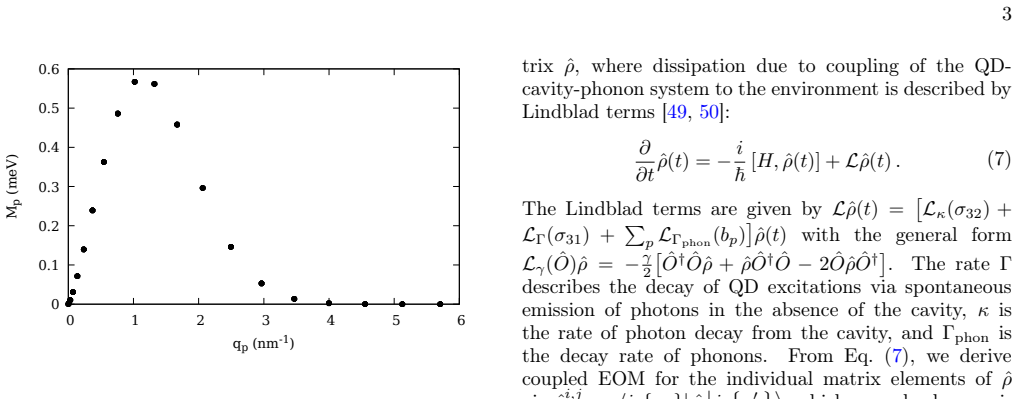
- [Eq. (3)] The prefactor (2 pi Delta_p q_p / A (2 pi)^2)^{1/2} in the definition of M_p is hard to parse. Please verify the units and clarify the origin of the (2 pi)^2 factor.
- [Fig. 4] The Purcell factors are given only for some data points at tau_phon=100 ps, and the text says they 'might be approximately used' for the other panels. Please provide a complete table of the Purcell factors for all computed g and Q values so that the panels can be compared quantitatively.
- [Sec. III] The comparison with 3D systems is qualitative and refers to the bulk GaAs results of Ref. [41]. A side-by-side calculation using the same vNL approach with a 3D phonon density of states would make the dimensionality claim more quantitative.
- [Appendix D, around Eq. (S41)] The assumption that the polaron transformation does not significantly affect the emitter-reservoir coupling is used in the augmented IBM derivation. The good agreement with the full vNL at g=0 justifies it in that limit, but the range of validity for the cavity-modified dynamics should be stated explicitly.
Circularity Check
No significant circularity: the indistinguishability values are computed, not fitted, and the phonon-lifetime mechanism is an external model input rather than a relabeled output.
full rationale
The central claim is a model prediction, not a fit. The paper solves the von Neumann-Lindblad master equation for a QD-cavity-2D-LA-phonon system and evaluates the HOM indistinguishability I from two-time correlation functions via the quantum regression formula. The target quantity I never appears as a fitted parameter or an input constraint; it is an output determined by the chosen rates (Gamma, kappa, g) and phonon parameters. The finite-phonon-lifetime effect enters through the externally imposed Lindblad rate Gamma_phon = c_ac/Lambda (Eq. 10); the pure dephasing rate gamma_pure in Eq. 18 and the long-time decay in f(tau) in Eq. 19 follow from solving the augmented independent boson model rather than being asserted as the conclusion. The exciton-phonon coupling parameters in Table II are imported from a fit to experimental spectra in Ref. [33], which has overlapping authorship, but Ref. [33] does not fit I, and the present calculation is an independent solution of a different observable; this is an inherited-parameter reproducibility concern, not a circular reduction. The physical plausibility of Eq. (10) as the only T = 0 dephasing channel is a legitimate modeling risk, but under the stated assumptions the derivation chain is self-contained and the I ~ 0.3-0.4 ceiling is a consequence of the assumed coupling and decay model, not an equivalence to its inputs.
Assumptions & free parameters
free parameters (9)
- De (electron deformation potential) =
3.82 eV
- Dh (hole deformation potential) =
1.07 eV
- c_ac (longitudinal acoustic sound velocity) =
3.92 nm/ps
- le (electron wavefunction length) =
1.36 nm
- lh (hole wavefunction length) =
1.42 nm
- rho (2D mass density) =
3.69e4 meV ps^2 nm^-4
- tau_phon (phonon lifetime) =
10, 100, 300 ps
- Jaynes-Cummings coupling g =
0 to 0.14 meV (scan)
- cavity quality factor Q =
500, 1500, 5000
assumptions (6)
- standard math Lindblad master equation and quantum regression formula are valid descriptions of the open system dynamics.
- standard math Born-Markov approximation for the system-reservoir interaction is valid.
- domain assumption Exciton-phonon coupling in WSe2 at T=0 is dominated by 2D longitudinal acoustic phonons with linear dispersion.
- ad hoc to paper Phonon decay is a mode-independent Lindblad process at rate Gamma_phon = c_ac / Lambda.
- domain assumption The initial phonon state is vacuum, corresponding to T=0 K.
- ad hoc to paper The polaron transformation does not significantly affect the emitter-reservoir coupling.
Cite this review
Pith. "Pith review of Impact of phonon lifetimes on the single-photon indistinguishability in quantum emitters based on 2D materials." pith.science (2026). https://pith.science/paper/H7AVQXFC
@misc{pith2026250114656,
  author       = {Pith},
  title        = {Pith review of: Impact of phonon lifetimes on the single-photon indistinguishability in quantum emitters based on 2D materials},
  year         = {2026},
  howpublished = {\url{https://pith.science/paper/H7AVQXFC}},
  note         = {Machine review of arXiv:2501.14656}
}
read the original abstract
Localized excitons in two-dimensional (2D) materials are considered as promising sources of single photons on demand. The photon indistinguishability as key figure of merit for quantum information processing is strongly influenced by the coupling of charge excitations to lattice vibrations of the surrounding semiconductor material. Here, we quantify the impact of exciton-acoustic-phonon-interaction and cavity QED effects on photon indistinguishability in a Hong-Ou-Mandel setup by solving fully quantum mechanical equations for the coupled QD-cavity-phonon system including non-Markovian effects. We find a strong reduction of indistinguishability compared to 3D systems due to increased exciton-phonon coupling efficiency. Moreover, we show that the coherence properties of photons are significantly influenced by the finite phonon lifetime in the surrounding material giving rise to pure dephasing. Only if these limitations are overcome, localized excitons in 2D semiconductors can become a new avenue for quantum light sources.
Figures


Figures from the paper (3 more)


Reference graph
Works this paper leans on
-
[33]
V. N. Mitryakhin, A. Steinhoff, J.-C. Drawer, H. Shan, M. Florian, L. Lackner, B. Han, F. Eilenberger, S. A. Tongay, K. Watanabe, T. Taniguchi, C. Antón-Solanas, A. Predojević, C. Gies, M. Esmann, and C. Schnei- der, Engineering the impact of phonon dephasing on the coherence of aWSe2 single-photon source via cavity quantum electrodynamics, Physical Revie...
work page 2024
-
[1]
H. J. Kimble, The quantum internet, Nature453, 1023 (2008), publisher: Nature Publishing Group
work page 2008
-
[2]
I. Aharonovich, D. Englund, and M. Toth, Solid-state single-photon emitters, Nature Photon 10, 631 (2016), publisher: Nature Publishing Group
work page 2016
-
[3]
T. Gao, M. Von Helversen, C. Antón-Solanas, C. Schnei- der, and T. Heindel, Atomically-thin single-photon sources for quantum communication, npj 2D Mater Appl 7, 4 (2023)
work page 2023
-
[4]
T. Flissikowski, A. Betke, I. A. Akimov, and F. Hen- neberger, Two-Photon Coherent Control of a Single Quantum Dot, Phys. Rev. Lett.92, 227401 (2004), pub- lisher: American Physical Society
work page 2004
-
[5]
H. Jayakumar, A. Predojević, T. Huber, T. Kauten, G.S.Solomon,andG.Weihs,DeterministicPhotonPairs and Coherent Optical Control of a Single Quantum Dot, Phys. Rev. Lett.110, 135505 (2013), publisher: Ameri- can Physical Society
work page 2013
-
[6]
X. Ma, X. Yuan, Z. Cao, Z. Zhang, and B. Qi, Quantum random number generation, npj Quantum Information 2, 10.1038/npjqi.2016.21 (2016), institution: Oak Ridge National Laboratory (ORNL), Oak Ridge, TN (United States) Publisher: Nature Partner Journals
-
[7]
J. L. O’Brien, A. Furusawa, and J. Vučković, Photonic quantumtechnologies,NaturePhoton 3,687(2009),pub- lisher: Nature Publishing Group
work page 2009
Show all 54 references
-
[8]
H. Wang, J. Qin, X. Ding, M.-C. Chen, S. Chen, X. You, Y.-M. He, X. Jiang, L. You, Z. Wang, C. Schneider, J. J. Renema, S. Höfling, C.-Y. Lu, and J.-W. Pan, Boson sampling with 20 input photons and a 60-mode inter- ferometer in a 1014-dimensional hilbert space, Physical Review...
2019
-
[9]
N. Lal, S. Mishra, and R. P. Singh, Indistinguishable pho- tons, AVS Quantum Science4, 021701 (2022)
2022
-
[10]
Peyskens, C
F. Peyskens, C. Chakraborty, M. Muneeb, D. Van Thourhout, and D. Englund, Integration of single photon emitters in 2D layered materials with a silicon nitride photonic chip, Nature Communications 10, 4435 (2019), publisher: Nature Publishing Group
2019
-
[11]
C. K. Hong, Z. Y. Ou, and L. Mandel, Measurement of subpicosecond time intervals between two photons by in- terference, Phys. Rev. Lett.59, 2044 (1987), publisher: American Physical Society
1987
-
[12]
Santori, D
C. Santori, D. Fattal, J. Vučković, G. S. Solomon, and Y. Yamamoto, Indistinguishable photons from a single- photon device, Nature 419, 594 (2002), publisher: Na- ture Publishing Group. 8
2002
-
[13]
Wang, Y.-M
H. Wang, Y.-M. He, T.-H. Chung, H. Hu, Y. Yu, S. Chen, X. Ding, M.-C. Chen, J. Qin, X. Yang, R.-Z. Liu, Z.- C. Duan, J.-P. Li, S. Gerhardt, K. Winkler, J. Jurkat, L.-J. Wang, N. Gregersen, Y.-H. Huo, Q. Dai, S. Yu, S. Höfling, C.-Y. Lu, and J.-W. Pan, Towards optimal single-ph...
2019
-
[14]
Komza, P
L. Komza, P. Samutpraphoot, M. Odeh, Y.-L. Tang, M. Mathew, J. Chang, H. Song, M.-K. Kim, Y. Xiong, G. Hautier, and A. Sipahigil, Indistinguishable photons from an artificial atom in silicon photonics, Nature Com- munications 15, 6920 (2024), publisher: Nature Publish- ing Group
2024
-
[15]
Wei, Y.-M
Y.-J. Wei, Y.-M. He, M.-C. Chen, Y.-N. Hu, Y. He, D. Wu, C. Schneider, M. Kamp, S. Höfling, C.-Y. Lu, and J.-W. Pan, Deterministic and Robust Generation of Sin- gle Photons from a Single Quantum Dot with 99.5% In- distinguishability Using Adiabatic Rapid Passage, Nano Lett. 14...
2014
-
[16]
Y. Yu, I. C. Seo, M. Luo, K. Lu, B. Son, J. K. Tan, and D. Nam, Tunable single-photon emitters in 2D materials, Nanophotonics 13, 3615 (2024), publisher: De Gruyter
2024
-
[17]
J. Kern, I. Niehues, P. Tonndorf, R. Schmidt, D. Wigger, R. Schneider, T. Stiehm, S. Michaelis De Vasconcellos, D. E. Reiter, T. Kuhn, and R. Bratschitsch, Nanoscale Positioning of Single-Photon Emitters in Atomically Thin WSe2, Advanced Materials28, 7101 (2016)
2016
-
[18]
Palacios-Berraquero, D
C. Palacios-Berraquero, D. M. Kara, A. R.-P. Mont- blanch, M. Barbone, P. Latawiec, D. Yoon, A. K. Ott, M. Loncar, A. C. Ferrari, and M. Atatüre, Large-scale quantum-emitter arrays in atomically thin semiconduc- tors, Nat Commun8, 15093 (2017)
2017
-
[19]
L. Yu, M. Deng, J. L. Zhang, S. Borghardt, B. Kardy- nal, J. Vučković, and T. F. Heinz, Site-Controlled Quan- tum Emitters in Monolayer MoSe2, Nano Lett.21, 2376 (2021)
2021
-
[20]
Q. Wang, J. Maisch, F. Tang, D. Zhao, S. Yang, R. Joos, S. L. Portalupi, P. Michler, and J. H. Smet, Highly Po- larized Single Photons from Strain-Induced Quasi-1D Lo- calized Excitons in WSe2, Nano Lett.21, 7175 (2021)
2021
-
[21]
Paralikis, C
A. Paralikis, C. Piccinini, A. A. Madigawa, P. Metuh, L. Vannucci, N. Gregersen, and B. Munkhbat, Tailor- ing polarization in WSe2 quantum emitters through de- terministic strain engineering, npj 2D Mater Appl8, 1 (2024), publisher: Nature Publishing Group
2024
-
[22]
L. N. Tripathi, O. Iff, S. Betzold, L. Dusanowski, M. Em- merling, K. Moon, Y. J. Lee, S.-H. Kwon, S. Höfling, andC.Schneider,SpontaneousEmissionEnhancementin Strain-Induced WSe2 Monolayer-Based Quantum Light Sources on Metallic Surfaces, ACS Photonics 5, 1919 (2018)
2018
-
[23]
G. D. Shepard, O. A. Ajayi, X. Li, X.-Y. Zhu, J. Hone, and S. Strauf, Nanobubble induced formation of quan- tum emitters in monolayer semiconductors, 2D Mater.4, 021019 (2017)
2017
-
[24]
Cianci, E
S. Cianci, E. Blundo, F. Tuzi, G. Pettinari, K. Olkowska- Pucko, E. Parmenopoulou, D. B. L. Peeters, A. Miri- ametro, T. Taniguchi, K. Watanabe, A. Babinski, M. R. Molas, M. Felici, and A. Polimeni, Spatially Controlled SinglePhotonEmittersinhBN-CappedWS2Domes,Ad- vanced Optic...
2023
-
[25]
T. P. Darlington, C. Carmesin, M. Florian, E. Yanev, O. Ajayi, J. Ardelean, D. A. Rhodes, A. Ghiotto, A. Krayev, K. Watanabe, T. Taniguchi, J. W. Kysar, A. N. Pasupathy, J. C. Hone, F. Jahnke, N. J. Borys, and P. J. Schuck, Imaging strain-localized excitons in nanoscale bubble...
2020
-
[26]
J. A. Preuss, D. Groll, R. Schmidt, T. Hahn, P. Mach- nikowski, R. Bratschitsch, T. Kuhn, S. M. d. Vasconcel- los, and D. Wigger, Resonant and phonon-assisted ultra- fast coherent control of a single hBN color center, Optica 9, 522 (2022), publisher: Optica Publishing Group
2022
-
[27]
Aharonovich, J.-P
I. Aharonovich, J.-P. Tetienne, and M. Toth, Quantum Emitters in Hexagonal Boron Nitride, Nano Lett. 22, 9227 (2022)
2022
-
[28]
Samaner, S
C. Samaner, S. Pacal, G. Mutlu, K. Uyanik, and S. Ates, Free-Space Quantum Key Distribution with Single Pho- tons from Defects in Hexagonal Boron Nitride, Adv Quantum Tech5, 2200059 (2022)
2022
-
[29]
Kretzschmar, S
T. Kretzschmar, S. Ritter, A. Kumar, T. Vogl, F. Eilen- berger, and F. Schmidt, Quantitative Investigation of Quantum Emitter Yield in Drop-Casted Hexagonal Boron Nitride Nanoflakes, ACS Appl. Opt. Mater. 2, 1427 (2024), publisher: American Chemical Society
2024
-
[30]
Drawer, V
J.-C. Drawer, V. N. Mitryakhin, H. Shan, S. Stephan, M. Gittinger, L. Lackner, B. Han, G. Leibeling, F. Eilenberger, R. Banerjee, S. Tongay, K. Watanabe, T. Taniguchi, C. Lienau, M. Silies, C. Anton-Solanas, M. Esmann, and C. Schneider, Monolayer-based single- photon source in...
2023
-
[31]
Fournier, S
C. Fournier, S. Roux, K. Watanabe, T. Taniguchi, S. Buil, J. Barjon, J.-P. Hermier, and A. Delteil, Two- photon interference from a quantum emitter in hexago- nal boron nitride, Physical Review Applied19, L041003 (2023), publisher: American Physical Society
2023
-
[32]
Vannucci, J
L. Vannucci, J. F. Neto, C. Piccinini, A. Paralikis, N. Gregersen, and B. Munkhbat, Single-photon emitters in WSe2: critical role of phonons on excitation schemes and indistinguishability, Physical Review B109, 245304 (2024), publisher: American Physical Society
2024
-
[34]
Khatri, I
P. Khatri, I. J. Luxmoore, and A. J. Ramsay, Phonon sidebands of color centers in hexagonal boron nitride, Physical Review B100, 125305 (2019), publisher: Amer- ican Physical Society
2019
-
[35]
E. V. Denning, M. Wubs, N. Stenger, J. Mørk, and P. T. Kristensen, Quantum theory of two-dimensional materi- als coupled to electromagnetic resonators, Physical Re- viewB 105,085306(2022),publisher: AmericanPhysical Society
2022
-
[36]
M. K. Svendsen, S. Ali, N. Stenger, K. S. Thygesen, and J. Iles-Smith, Signatures of non-markovianity in cavity QED with color centers in two-dimensional materials, Physical Review Research5, L032037 (2023), publisher: American Physical Society
2023
-
[37]
Piccinini, A
C. Piccinini, A. Paralikis, J. F. Neto, A. A. Madigawa, 9 P. Wyborski, V. Remesh, L. Vannucci, N. Gregersen, and B. Munkhbat, High-purity and stable single-photon emission in bilayer WSe2 via phonon-assisted excitation (2024), arXiv:2406.07097
2024
-
[38]
Grange, G
T. Grange, G. Hornecker, D. Hunger, J.-P. Poizat, J.-M. Gérard, P. Senellart, and A. Auffèves, Cavity- funneled generation of indistinguishable single photons from strongly dissipative quantum emitters, Physical Re- view Letters 114, 193601 (2015), publisher: American Physical Society
2015
-
[39]
Krummheuer, V
B. Krummheuer, V. M. Axt, and T. Kuhn, Theory of pure dephasing and the resulting absorption line shape in semiconductor quantum dots, Physical Review B65, 195313 (2002)
2002
-
[40]
Ferreira Neto, M
J. Ferreira Neto, M. Bundgaard-Nielsen, N. Gregersen, and L. Vannucci, One-dimensional photonic wire as a single-photon source: Implications of cavity QED to a phonon bath of reduced dimensionality, Physical Review B 110, 115308 (2024), publisher: American Physical So- ciety
2024
-
[41]
P. Kaer, P. Lodahl, A.-P. Jauho, and J. Mork, Micro- scopic theory of indistinguishable single-photon emis- sion from a quantum dot coupled to a cavity: The role of non-markovian phonon-induced decoherence, Physical Review B 87, 081308 (2013), publisher: American Phys- ical Society
2013
-
[42]
Hohenester, Quantum control of polaron states in semiconductor quantum dots, Journal of Physics B: Atomic, Molecular and Optical Physics40, S315 (2007)
U. Hohenester, Quantum control of polaron states in semiconductor quantum dots, Journal of Physics B: Atomic, Molecular and Optical Physics40, S315 (2007)
2007
-
[43]
Zimmermann and E
R. Zimmermann and E. Runge, Dephasing in quantum dots via electron-phonon interaction, Proc. 26th ICPS, Edinburgh (2002)
2002
-
[44]
L. C. Flatten, L. Weng, A. Branny, S. Johnson, P. R. Dolan, A. A. Trichet, B. D. Gerardot, and J. M. Smith, Microcavity enhanced single photon emission from two-dimensional WSe2, Appl. Phys. Lett. 112, 10.1063/1.5026779 (2018), arXiv:1807.02778
2018 arXiv
-
[45]
Betzold, M
O.Iff, Q.Buchinger, M.Moczała-Dusanowska, M.Kamp, S. Betzold, M. Davanco, K. Srinivasan, S. Tongay, C. Antón-Solanas, S. Höfling, and C. Schneider, Purcell- Enhanced Single Photon Source Based on a Determinis- tically Placed WSe2Monolayer Quantum Dot in a Circu- lar Bragg Grat...
2021 arXiv
-
[46]
T. T. Tran, D. Wang, Z. Q. Xu, A. Yang, M. Toth, T. W. Odom, and I. Aharonovich, Deterministic Cou- pling of Quantum Emitters in 2D Materials to Plasmonic Nanocavity Arrays, Nano Lett.17, 2634 (2017)
2017
-
[47]
M. A. Sakib, B. Triplett, W. Harris, N. Hus- sain, A. Senichev, M. Momenzadeh, J. Bocanegra, P. Vabishchevich, R. Wu, A. Boltasseva, V. M. Shalaev, and M. R. Shcherbakov, Purcell-Induced Bright Single Photon Emitters in Hexagonal Boron Nitride, Nano Lett. 24, 12390 (2024), arX...
2024 arXiv
-
[48]
Y. Luo, G. D. Shepard, J. V. Ardelean, D. A. Rhodes, B. Kim, K. Barmak, J. C. Hone, and S. Strauf, Deter- ministic coupling of site-controlled quantum emitters in monolayer WSe2 to plasmonic nanocavities, Nat. Nan- otechnol. 13, 1137 (2018)
2018
-
[49]
Lindblad, On the generators of quantum dynamical semigroups, Communications in Mathematical Physics 48, 119 (1976)
G. Lindblad, On the generators of quantum dynamical semigroups, Communications in Mathematical Physics 48, 119 (1976)
1976
-
[50]
Breuer, The Theory of Open Quantum Systems (Oxford University Press, USA, 2007)
H.-P. Breuer, The Theory of Open Quantum Systems (Oxford University Press, USA, 2007)
2007
-
[51]
H. J. Carmichael, Statistical Methods in Quantum Op- tics 1: Master Equations and Fokker-Planck Equations , Theoretical and Mathematical Physics (Springer-Verlag, Berlin Heidelberg, 1999)
1999
-
[52]
T. M. Chang and J. L. Skinner, Non-Markovian popula- tion and phase relaxation and absorption lineshape for a two-levelsystemstronglycoupledtoaharmonicquantum bath, Physica A: Statistical Mechanics and its Applica- tions 193, 483 (1993)
1993
-
[53]
Ortíz, M
O. Ortíz, M. Esmann, and N. D. Lanzillotti-Kimura, Phonon engineering with superlattices: Generalized nanomechanical potentials, Physical Review B 100, 085430 (2019), publisher: American Physical Society
2019
-
[54]
Nq iωq + ¯γq 2 − 1 + Nq iωq − ¯γq 2 # τ + X q M 2 q
G. D. Mahan,Many Particle Physics , 3rd ed. (Springer, 2000). 10 V. APPENDIX A. Numerical Details For the discretization of phonon momentum, we use a Chebyshev-Gauss-type grid, which is dense around zero momentum and coarse for large momentum: qp = p 2N + 1 − 1 2πsin 2π p 2N +...
2000
Reviewed August 10, 2026 · model on record in the stance chip above.
Discussion (0). Continue with ORCID to comment.