REVIEW 2 major objections 6 minor 1 cited by
Radial Uncertainty Product for Spherically Symmetric Potential in Position Space
T0 review · 2 major / 6 minor · reviewed 2026-08-10 · deepseek-v4-flash
Pith's one-line read The radial operators form a canonical pair, and the paper derives exact uncertainty products for hydrogen, the infinite spherical well, and the 3D oscillator, each exceeding ℏ/2 for all bound states.
desk verdict A mostly correct but largely derivative re-derivation of radial uncertainty products for three standard potentials, with an unexamined domain assumption and one unjustified step. read the letter →
The pith
A machine-rendered reading of the paper's core claim, the machinery that carries it, and where it could break.
The reading
What carries the argument
The object carrying the argument is the symmetrized radial momentum operator $p_r=-i\hbar(\partial_r+1/r)$, whose commutator with $r$ is $i\hbar$. The evaluation of the product uses three computational tools: (i) orthogonality, recursion, and derivative identities for associated Laguerre polynomials to obtain $\langle r\rangle$ and $\langle r^2\rangle$; (ii) an energy-based route to $\langle p_r^2\rangle$ that combines the total energy with the centrifugal term $\ell(\ell+1)\hbar^2/r^2$ and the virial theorem, avoiding direct integration by parts; and (iii) for the infinite well, known indefinite integrals of spherical Bessel functions together with their zeros; for the oscillator, the substitution $\eta=\alpha r^2$ that turns the Laguerre weight into the standard linear form.
What would settle it
Compute $\langle p_r^2\rangle$ for the hydrogen 2p state by direct quadrature on the known radial function, $\langle p_r^2\rangle = \hbar^2\int_0^\infty r^2 |(\partial_r+1/r)R_{21}(r)|^2\,dr$, and compare with Eq. (39) for $n=2,\ell=1$; any mismatch beyond round-off would show the derivation of the momentum variance is invalid.
Extended reading notes
Core claim
The central claim is that the radial operators form a canonical pair: $[\,r,p_r\,]=i\hbar$ with $p_r=-i\hbar(\partial_r+1/r)$, so that the Robertson relation gives $\Delta r\,\Delta p_r \ge \hbar/2$ in exactly the Cartesian form. The paper explicitly evaluates the product for three potentials. For hydrogenic atoms (Eq. (41)) the product is $\frac{\hbar}{2n}\sqrt{n^2(n^2+2)-[\ell(\ell+1)]^2}\sqrt{1-\frac{2\ell(\ell+1)}{n(2\ell+1)}}$; for the infinite spherical well the product is expressed via the functions $A(\ell,z_{n\ell})$, $B(\ell,z_{n\ell})$, and $D(\ell,z_{n\ell})$ of the Bessel-function zeros $z_{n\ell}$ (Section IV.D); and for the spherical harmonic oscillator (Eq. (98)) it is $\hbar\sqrt{n+\tfrac32-\widetilde C_{n\ell}^2\widetilde I_1^2}\sqrt{n+\tfrac32-\ell(\ell+1)\widetilde C_{n\ell}\widetilde I_7}$. In all three cases the paper finds $\langle p_r\rangle=0$ and verifies numerically that the product exceeds $\hbar/2$ for every bound state considered.
Load-bearing premise
The load-bearing premise is that $p_r=-i\hbar(\partial_r+1/r)$ is a well-defined self-adjoint observable on the radial half-line, so the Robertson uncertainty relation applies without a separate discussion of boundary conditions at $r=0$.
Editorial extensions
If this is right
- For hydrogenic atoms the radial uncertainty product depends only on $n$, $\ell$, and $\hbar$, not on $Z$ or $a_0$, so the same numerical values apply to H, He$^+$, Li$^{2+}$, and Be$^{3+}$.
- In the infinite spherical well the product is expressed in terms of the zeros $z_{n\ell}$ of spherical Bessel functions, giving values that are essentially exact once those zeros are known.
- For the spherical harmonic oscillator the product involves the dimensionless integrals $\widetilde I_1$ and $\widetilde I_7$; the closed form of $\langle r^2\rangle$ in Eq. (85) follows from the virial theorem and provides a consistency check.
- In all three potentials $\langle p_r\rangle = 0$ for every bound state, so the radial momentum variance is entirely determined by $\langle p_r^2\rangle$, and the uncertainty product simplifies to $\Delta r\sqrt{\langle p_r^2\rangle}$.
Reading between the lines
- The same canonical-pair structure would apply to any spherically symmetric potential in $d$ dimensions by replacing the operator with $p_r=-i\hbar(\partial_r+(d-1)/2r)$, so the method can be extended to systems such as the 3D Morse potential or Woods–Saxon wells without new machinery.
- The paper's silence on the domain of $p_r$ leaves open a genuine functional-analytic gap; if the bound-state radial functions do not lie in a common domain making $p_r$ self-adjoint, the Robertson relation is not automatically justified, and the product could in principle depend on the chosen self-adjoint extension.
- The hydrogenic formula implies a soft bound on how strongly the radial degree of freedom can be squeezed: for fixed $n$, states of maximal $\ell$ come closest to the Heisenberg floor, so angular-momentum-carrying states are the natural candidates for nearly-minimum-uncertainty radial wave packets.
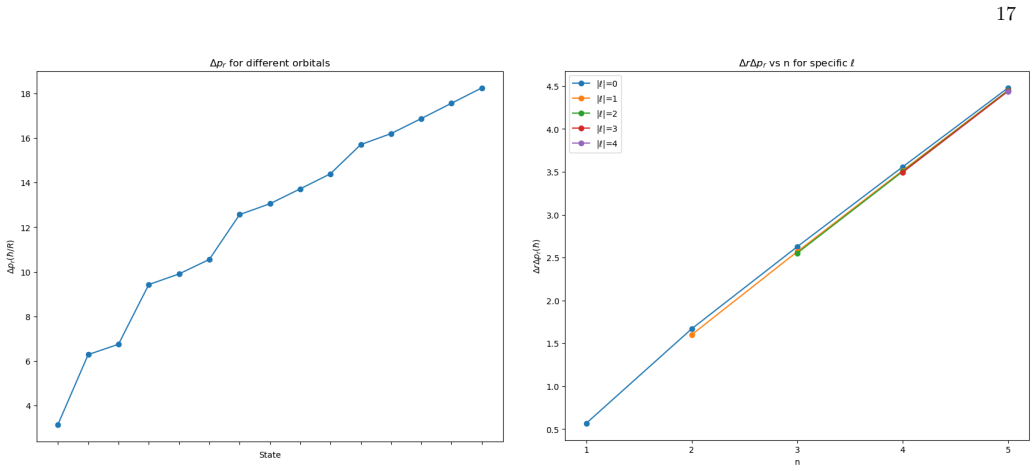
- The ISW product, built from Bessel-function zeros, grows roughly linearly with $n$ for small $\ell$, while the oscillator product grows only slowly, hinting that the degree of radial squeezing differs sharply between hard-wall and harmonic confinement.
Editorial analysis
A structured set of objections, weighed in public.
Referee Report
Summary. The paper derives a radial uncertainty relation Δr Δp_r ≥ ħ/2 from the commutator [r, p_r] = iħ and then computes explicit bound-state formulas for the radial uncertainty product for three spherically symmetric potentials: hydrogenic atoms, the infinite spherical well, and the spherical harmonic oscillator. For each potential the author presents the normalized radial wave functions, expectation values ⟨r⟩ and ⟨r²⟩, the radial momentum expectation ⟨p_r⟩ (shown to vanish), Δp_r, and the resulting product, together with numerical tables and plots. The hydrogen product is given in Eq. (41), the infinite-spherical-well product in Section IV.D, and the oscillator product in Eq. (98).
Significance. If the derivations were complete, the paper would provide a useful catalog of exact radial uncertainty products for standard central potentials, extending the known hydrogen results to the spherical well and harmonic oscillator with explicit hypergeometric expressions. The manuscript has several genuine strengths: the final hydrogen formulas match textbook values (e.g., the 1s ground state gives Δr = √3 a₀/(2Z) and Δp_r = Zħ/a₀), the calculations are largely explicit, and the numerical tables and figures allow spot checking. The author also makes good use of orthogonal-polynomial identities and reports Mathematica integration results, which aids reproducibility. However, the central theoretical framework is not rigorously established in two load-bearing places: the radial momentum operator is not self-adjoint on the stated Hilbert space, and the derivation of Eq. (38) for ⟨1/r²⟩ contains an unjustified step. These gaps do not falsify the final product formulas, which are independently known or verifiable, but they prevent the paper from standing as a rigorous derivation as written.
major comments (2)
- [Section II, Eqs. (4)-(5)] The assertion that [r, p_r] = iħ immediately yields a Heisenberg-type uncertainty relation is not supported because p_r = -iħ(∂_r + 1/r) is not self-adjoint on L²((0,∞), r²dr). The unitary transformation f ↦ r f maps p_r to -iħ d/dr on L²((0,∞), dr), whose deficiency indices are (1,0); consequently p_r has no self-adjoint extension and is not an observable in the standard von Neumann sense. The paper must either justify the uncertainty relation on a common dense domain using the appropriate inequality for symmetric operators, or derive the radial uncertainty bound directly on the eigenstates considered, rather than invoking the Cartesian Robertson argument verbatim.
- [Section III, Eqs. (34)-(38)] The derivation of ⟨1/r²⟩ for hydrogen is flawed. Equation (35) has f² ∂ℓ(f''/f) on the left-hand side, but Eq. (36) drops the f² and integrates ∂ℓ(f''/f) alone. The later assertion that ∫₀^∞ ∂ℓ[f''/f] dr = 0 is asserted without proof and is not evidently true. Since Eq. (38) and hence Δp_r in Eq. (40) and the hydrogen product in Eq. (41) depend on this step, the derivation must be repaired; a standard derivation via Kramers' relation or a direct Feynman-Hellmann argument on the radial equation would suffice. The final hydrogen formula is correct, but the route given is not.
minor comments (6)
- [Section IV.B, Eq. (58)] Equation (58) contains a stray '= 0' inside '⟨ˆr²⟩ = 0 = ...', which makes the equation nonsensical; this appears to be a typo for '⟨ˆr²⟩ = ...'.
- [Table XII] In the n = 6 block, the row labeled '(4,2)' should be labeled '(6,2)', and the entry '64/9455√π' appears to be a typo for '64/945√π'; as printed, the table lists two different values for the same state (6,2) that do not agree.
- [Section III, preceding Eq. (34)] The statement 'For n = n(ℓ) = nr + ℓ + 1, dn/dℓ = 1' should make explicit that the differentiation is at fixed radial quantum number n_r, not at fixed principal n; otherwise the reader cannot follow the derivative of the term Z²/(n²a₀²).
- [Section IV.C, Eq. (87)] In the display for ⟨p_r⟩, the prefactor is written as 2/R after substitution, but an intermediate step contains z-dependent normalization factors involving |j_{ℓ+1}(z_{nℓ})|²; the final conclusion ⟨p_r⟩ = 0 is correct, but the printed algebra skips a cancellation that should be shown.
- [Throughout] There are numerous incomplete sentences and grammatical errors (e.g., 'Lets check whether ˆr and ˆpr commute or not' and 'Now, our aim is to evaluate ⟨ˆr²⟩ = 0'); a careful language edit is needed.
- [References] Reference [13] is an unpublished ResearchGate document marked 'In Progress' and should be replaced by a peer-reviewed source or the needed normalization/orthogonality result should be stated directly; reference [17] contains the placeholder URL 'https://example.com/your-article-link' and must be corrected.
Circularity Check
No significant circularity: all claims are derived from standard wavefunctions, operator identities, and independent integrals.
full rationale
The paper's derivation chain is self-contained and contains no fitted parameter that is subsequently relabeled as a prediction. The radial momentum operator in Eq. (4) is defined by symmetrization, the commutator [r, p_r] = iℏ is then computed explicitly, and the uncertainty relation follows from the standard Robertson theorem applied to that commutator. This is a legitimate derivation step, not a circular one: the uncertainty product is not used to define p_r or to fit any constant. For the hydrogen atom, the expectation values ⟨r⟩ and ⟨r²⟩ are obtained from normalized Laguerre wavefunctions and the orthogonality/recursion relations (13)-(15), while ⟨p_r²⟩ is obtained from the operator identity p² = p_r² + L²/r², the known Coulomb energy, and a Feynman-Hellmann-type differentiation (34)-(38). For the infinite spherical well, the normalized spherical Bessel wavefunction (53), the virial-based energy, and Mathematica-evaluated Bessel integrals (55), (59), and (62) are used; the product is then assembled from these independently computed moments. For the spherical harmonic oscillator, Laguerre integrals and the virial/energy relation (94)-(96) give the moments, again without fitting the final product. There are no self-citations in the paper, and no load-bearing uniqueness or ansatz is imported from the author's prior work. The skeptic's concern that p_r may not be self-adjoint on L²((0,∞), r² dr) is a correctness/rigor issue, not a circularity issue; even if that domain gap invalidates the Robertson-based inequality as stated, it does not make any output equal to an input by construction. Under the hard rules, the absence of a specific input-output identity means the appropriate finding is no circularity, score 0.
Assumptions & free parameters
assumptions (7)
- standard math Robertson-Schrödinger uncertainty relation ΔA ΔB ≥ 1/2 |⟨[A,B]⟩| for observables A,B.
- domain assumption Radial momentum operator p_r = -iℏ(∂/∂r + 1/r) is a symmetric self-adjoint observable on the bound-state wavefunctions.
- standard math Total squared momentum decomposes as p² = p_r² + L²/r².
- standard math Virial theorem: for V ∝ r^n, ⟨T⟩ = (n/2)⟨V⟩.
- standard math Orthogonality and recursion relations for associated Laguerre functions (Eqs. 13-15).
- standard math Zeros z_nℓ of spherical Bessel functions determine ISW energies and the integral ∫ x² j_l² dx = (x³/2)(j_l² - j_{l-1}j_{l+1}).
- domain assumption Symbolic integrals quoted from Mathematica (hypergeometric representations, Bessel squared integrals) are correct.
Cite this review
Pith. "Pith review of Radial Uncertainty Product for Spherically Symmetric Potential in Position Space." pith.science (2026). https://pith.science/paper/MRS5VSSF
@misc{pith2026250114831,
  author       = {Pith},
  title        = {Pith review of: Radial Uncertainty Product for Spherically Symmetric Potential in Position Space},
  year         = {2026},
  howpublished = {\url{https://pith.science/paper/MRS5VSSF}},
  note         = {Machine review of arXiv:2501.14831}
}
read the original abstract
This paper presents a detailed analysis of the radial uncertainty product for quantum systems with spherically symmetric potentials. Using the principles of quantum mechanics, the study derives the radial uncertainty relation analogous to the Cartesian form and investigates its implications for three key spherically symmetric potentials: the Hydrogen atom, the infinite spherical potential well, and the spherical harmonic oscillator, all within the non-relativistic regime. Employing the Schrodinger equation in spherical coordinates, the paper rigorously evaluates the normalized radial wave functions, expectation values, and uncertainties associated with both position and momentum. Analytical derivations and numerical computations highlight the dependence of the uncertainty product on quantum numbers and system-specific parameters.
Figures


Figures from the paper (36 more)




Forward citations
Cited by 1 Pith paper
-
Generalized Radial Uncertainty Product for d-Dimensional Hydrogen Atom
The paper obtains an explicit analytic expression for the radial position-momentum uncertainty product of the d-dimensional hydrogen atom in terms of the quantum numbers n and ℓ and the dimension d.
Reference graph
Works this paper leans on
-
[19]
Bransden and C
B. Bransden and C. Joachain, Introduction to Quantum Mechanics, Wiley, New York, 1989
1989
-
[20]
Abramowitz and I
M. Abramowitz and I. A. Stegun, Handbook of Math- ematical Functions with Formulas, Graphs, and Math- ematical Tables , 9th printing, Dover, New York, 1972. Chapter 22: Orthogonal Polynomials, 771–802
1972
-
[1]
Orthonormal property Z ∞ 0 zae−zLa b (z)La c (z)dz = Γ(a + b + 1) Γ(b + 1) δbc (13) Many authors like Griffiths (Refs. [11]) uses the orthogo- nality property as R ∞ 0 zae−zLa b (z)La c (z)dz = Γ(a+b+1) [Γ(b+1)]3 δbc, but this will not affect in our calculation, we see
-
[2]
Recursive property zLa b (z) = (a + 2b + 1)La b (z) − b + 1 a + b + 1La b+1(z) − (a + b)2La b−1(z) (14)
-
[3]
Derivative property d dz La b (z) = La+1 b (z) = 1 z [bLa b (z) − (b + a)La b−1(z)] (15) Let’s introduce a dimensionless parameter ρ as ρ = 2Z na0 r For that, the radial wave function form looks like Rnℓ(ρ) = Nnℓe− ρ 2 ρℓL2ℓ+1 n−ℓ−1(ρ) (16) Let make normalize. P (r) = r2|R(r)|2 =⇒ P (ρ) = na0 2Z 2 ρ2|Rnℓ(ρ)|2 (17) As r = na0 2Z ρ, then dr = na0 2Z dρ and ...
-
[4]
They are tabulated in Table III
Expectation value of Radial position We have already derived the generalized formula for expectation or average of radial position is given by, ⟨ˆr⟩ = 1 2 a0 Z [3n2 − ℓ(ℓ + 1)] for all principal quantum numbers ( n) and azimuthal quantum numbers ( ℓ). They are tabulated in Table III. If ℓ = 0, then ⟨ˆr⟩ = 1 2 a0 Z 3n2 and for ground state wave function (n...
-
[5]
Uncertainty in Radial position We have already derived the generalized formula for uncertainty of radial position is given by, ∆ˆr = 1 2 a0 Z p n2(n2 + 2) − [ℓ(ℓ + 1)]2 8 FIG. 3. ⟨ˆr⟩ for different orbitals for all principal quantum numbers ( n) and azimuthal quantum numbers ( ℓ). If ℓ = 0, then ∆ˆ r = 1 2 a0 Z p n2(n2 + 2) and for ground state wave funct...
-
[6]
the ratio of uncertainty and expectation of radial FIG
Relative dispersion of Radial position The relative dispersion or coefficient of variation in the measurement of radial position is defined as, σr = ∆ˆr ⟨ˆr⟩ i.e. the ratio of uncertainty and expectation of radial FIG. 5. ∆ˆr vs ℓ for a specific n of H-atom FIG. 6. ∆ˆr for different orbitals position. The relative dispersion is given by σr = p n2(n2 + 2) ...
Show all 32 references
-
[7]
Now it is known that the radial prob- ability current is directly proportional to average radial momentum
Expectation value of Radial momentum By rigorous calculation, it is able to to that ⟨ˆpr⟩ = 0, as shown before. Now it is known that the radial prob- ability current is directly proportional to average radial momentum. The radial probability current density in 3d is given by j...
-
[8]
If ℓ = 0, then ∆ˆpr = Zℏ na0 and for ground state wave function (n = 1, ℓ= 0), it becomes ∆ˆpr = Zℏ a0
Uncertainty in Radial momentum We have already derived the generalized formula for uncertainty of radial momentum is given by, ∆ˆpr = Zℏ na0 s 1 − 2ℓ(ℓ + 1) n(2ℓ + 1) for all principal quantum numbers ( n) and azimuthal quantum numbers ( ℓ). If ℓ = 0, then ∆ˆpr = Zℏ na0 and fo...
-
[9]
They are tabulated in Table IV
Radial uncertainty product We have already derived the generalized formula for radial uncertainty for Hydrogen and Hydrogen-like ions, ∆ˆr∆ˆpr = ℏ 2n p n2(n2 + 2) − [ℓ(ℓ + 1)]2 s 1 − 2ℓ(ℓ + 1) n(2ℓ + 1) Clearly, the radial uncertainty product is independent of Bohr radius and ...
-
[10]
Uncertainties in radial position, momentum and their product FIG
Ground state of Hydrogen atom The radial wave function of Hydrogen atom is given by, Rnℓ(r) = Nnℓe− r na0 2 na0 r ℓ L2ℓ+1 n−ℓ−1 2 na0 r 11 Principal quantum number ( n) Azimuthal quantum number ( ℓ) Orbital Radial solution ( Rnℓ) ∆ˆr( a0 Z ) ∆ˆpr( Zℏ a0 ) ∆ˆr∆ˆpr(ℏ) K-Shell (n...
-
[11]
https://doi.org/10.1142/S0217979222500722
Anzor Khelashvili and Teimuraz Nadareishvili, Gener- alized Heisenberg uncertainty relation in spherical co- ordinates, International Journal of Modern Physics B, 36(15), 2250072 (2022), doi:10.1142/S0217979222500722. https://doi.org/10.1142/S0217979222500722
2022 doi
-
[12]
https://doi.org/ 10.1119/1.3534840
Christian Bracher, Uncertainty relations for angular momentum eigenstates in two and three spatial di- mensions, American Journal of Physics, 79(3), 313– 319 (2011), doi:10.1119/1.3534840. https://doi.org/ 10.1119/1.3534840
2011 doi
-
[13]
Al-Jaber, Uncertainty Relations for Some Cen- tral Potentials in N-Dimensional Space , Applied Math- ematics, 7(6), March 2016, doi:10.4236/am.2016.76047
Sami M. Al-Jaber, Uncertainty Relations for Some Cen- tral Potentials in N-Dimensional Space , Applied Math- ematics, 7(6), March 2016, doi:10.4236/am.2016.76047. https://doi.org/10.4236/am.2016.76047
2016
-
[14]
J. S. Dehesa, Spherical-Symmetry and Spin Effects on the Uncertainty Measures of Multidimensional Quan- tum Systems with Central Potentials , Entropy, 23(5), 607 (2021), doi:10.3390/e23050607. https://doi.org/ 10.3390/e23050607
2021 doi
-
[15]
http://dx.doi.org/ 10.1002/andp.202000335 26
Jun-Li Li and Cong-Feng Qiao, The Generalized Uncer- tainty Principle , Annalen der Physik, 533(1), November 2020, doi:10.1002/andp.202000335. http://dx.doi.org/ 10.1002/andp.202000335 26
2020 doi
-
[16]
Al-Jaber, Hydrogen Atom in N Dimensions , International Journal of Theoretical Physics, 37, 1289– 1298 (1998), doi:10.1023/A:1026679921970
Sami M. Al-Jaber, Hydrogen Atom in N Dimensions , International Journal of Theoretical Physics, 37, 1289– 1298 (1998), doi:10.1023/A:1026679921970. https:// doi.org/10.1023/A:1026679921970
1998 doi
-
[17]
https://arxiv.org/ abs/quant-ph/0009046
Gil Paz, On the connection between the radial mo- mentum operator and the Hamiltonian in n dimen- sions, European Journal of Physics, 22(4), 337 (2001), doi:10.1088/0143-0807/22/4/308. https://arxiv.org/ abs/quant-ph/0009046
2001 arXiv
-
[18]
Supriadi, A
B. Supriadi, A. Harijanto, M. Maulana, Z. R. Ridlo, W. D. Wisesa, and A. Nurdiniaya, The function of the radial wave of a hydrogen atom in the principal quan- tum numbers (n) 4 and 5 , Journal of Physics: Con- ference Series, 1211, 012052 (2019), doi:10.1088/1742- 6596/1211/1/012052
2019 doi
-
[21]
Griffiths and Darrell F
David J. Griffiths and Darrell F. Schroeter, Introduction to Quantum Mechanics , 3rd ed., Cambridge University Press, Cambridge, 2018
2018
-
[22]
Nouredine Zettili, Quantum Mechanics: Concepts and Applications, 2nd ed., Wiley, Hoboken, NJ, 2013
2013
-
[23]
https: //doi.org/10.13140/RG.2.2.18172.44162
Young-Sea Huang, Kung-Te Wu, and Chun-Hsien Wu, The right way to solve the infinite spherical well in quan- tum mechanics, ResearchGate, 2017, In Progress. https: //doi.org/10.13140/RG.2.2.18172.44162
2017
-
[24]
Bloomfield, Stephen H
Jolyon K. Bloomfield, Stephen H. P. Face, and Zander Moss, Indefinite Integrals of Spherical Bessel Functions , arXiv:1703.06428 [math.CA], 2017. https://arxiv.org/ abs/1703.06428
2017 arXiv
-
[25]
Wolfram Research, Integration Solution in Mathematica ,
-
[27]
https://mathworld.wolfram.com/ RegularizedHypergeometricFunction.html
Wolfram Research, Regularized Hypergeometric Function, 2025. https://mathworld.wolfram.com/ RegularizedHypergeometricFunction.html
2025
-
[28]
https://example.com/your-article-link
Adam Badra Cahaya, Radial Wave Function of 2D and 3D Quantum Harmonic Oscillator , AL-FIZIYA JOUR- NAL OF MATERIALS SCIENCE, GEOPHYSICS, IN- STRUMENTATION AND THEORETICAL PHYSICS, 5(2), 2022. https://example.com/your-article-link
2022
-
[29]
https://quantummechanics
UC San Diego, 3D Symmetric Harmonic Oscillator in Spherical Coordinates, n.d. https://quantummechanics. ucsd.edu/ph130a/130_notes/node244.html
-
[30]
Cheng-Deng Kuo, The uncertainties in radial posi- tion and radial momentum of an electron in the non- relativistic hydrogen-like atom, Annals of Physics, 316(2), 431–439 (2005), doi:10.1016/j.aop.2004.09.005
2005 doi
-
[31]
Patil and K.D
S.H. Patil and K.D. Sen, Uncertainty relations for modified isotropic harmonic oscillator and Coulomb po- tentials, Physics Letters A, 362(2-3), 109–114 (2007), doi:10.1016/j.physleta.2007.01.021
2007 doi
-
[32]
Pauling and E.B
L. Pauling and E.B. Wilson Jr., Introduction to Quantum Mechanics With Applications to Chemistry , McGraw- Hill, New York, 1935
1935
-
[2025]
https://www.wolfram.com/mathematica/
Reviewed August 10, 2026 · model on record in the stance chip above.
Discussion (0). Continue with ORCID to comment.