REVIEW 5 major objections 5 minor 36 references
BOLDreams: Dreaming with pruned in-silico fMRI Encoding Models of the Visual Cortex
T0 review · 5 major / 5 minor · reviewed 2026-08-10 · deepseek-v4-flash
Pith's one-line read Across three CNN backbones, cutting the readout to 1-10% of filters per layer leaves fMRI prediction accuracy essentially unchanged.
desk verdict Pruning invariance is real but under-specified: the result needs a random-pruning control and better handling of subject exclusion, but it is a useful incremental contribution. read the letter →
The pith
A machine-rendered reading of the paper's core claim, the machinery that carries it, and where it could break.
The reading
What carries the argument
The central object is the feature-weighted receptive field readout of Equation 1: for each voxel, trainable receptive fields pool feature maps at selected layers, and a weighted sum maps the pooled values to a predicted BOLD response. The pruning mechanism ranks the filters in each layer by the standard deviation of their activations over the training set and keeps only the top p% for the readout. This pairing of a linear readout over a fixed CNN feature hierarchy with variance-based filter selection is what carries the claim that readout width has little effect on accuracy.
What would settle it
Train the same readout at 1% and 10% widths with filters chosen at random instead of by highest activation variance, and compare per-voxel correlations with the variance-ranked versions; if random selection reproduces the full-model accuracy, the invariance is a property of readout redundancy rather than of the BOLD signal's feature content.
Extended reading notes
Core claim
Across all three backbone architectures, voxel-wise correlation between predicted and measured BOLD responses stays essentially flat as the readout is pruned from 100% of the filters per layer down to 1%, and the best overall accuracy is reached by a fine-tuned AlexNet using only 10% of filters per layer. Because the pruning rule keeps the highest-variance filters, the authors conclude that the BOLD signal is well captured by a small set of broadly informative features and does not require the detailed feature repertoire of a large pretrained network. They cast this as a maximally minimal model, M0, with the full model decomposed as M = M0 ⊕ M1, where M1 comprises connections that are compatible with the signal but need external evidence to be justified.
Load-bearing premise
The pruning invariance rests on the assumption that the filters with the largest activation variance across training images are the ones carrying the BOLD-relevant information; if that ranking rule is not the right one, the flat accuracy curve could be an artifact of the pruning procedure rather than a sign that the BOLD signal encodes only a coarse feature scaffold.
Editorial extensions
If this is right
- Pruned models with 1-10% of filters per layer can be used in place of full-width readouts for fMRI prediction with nearly identical voxel-wise accuracy, reducing storage and computation substantially.
- The existence of M0 implies that, at least for the NSD paradigm, the BOLD signal in visual cortex does not require the fine-grained features of large pretrained networks; broad scaffolding features suffice.
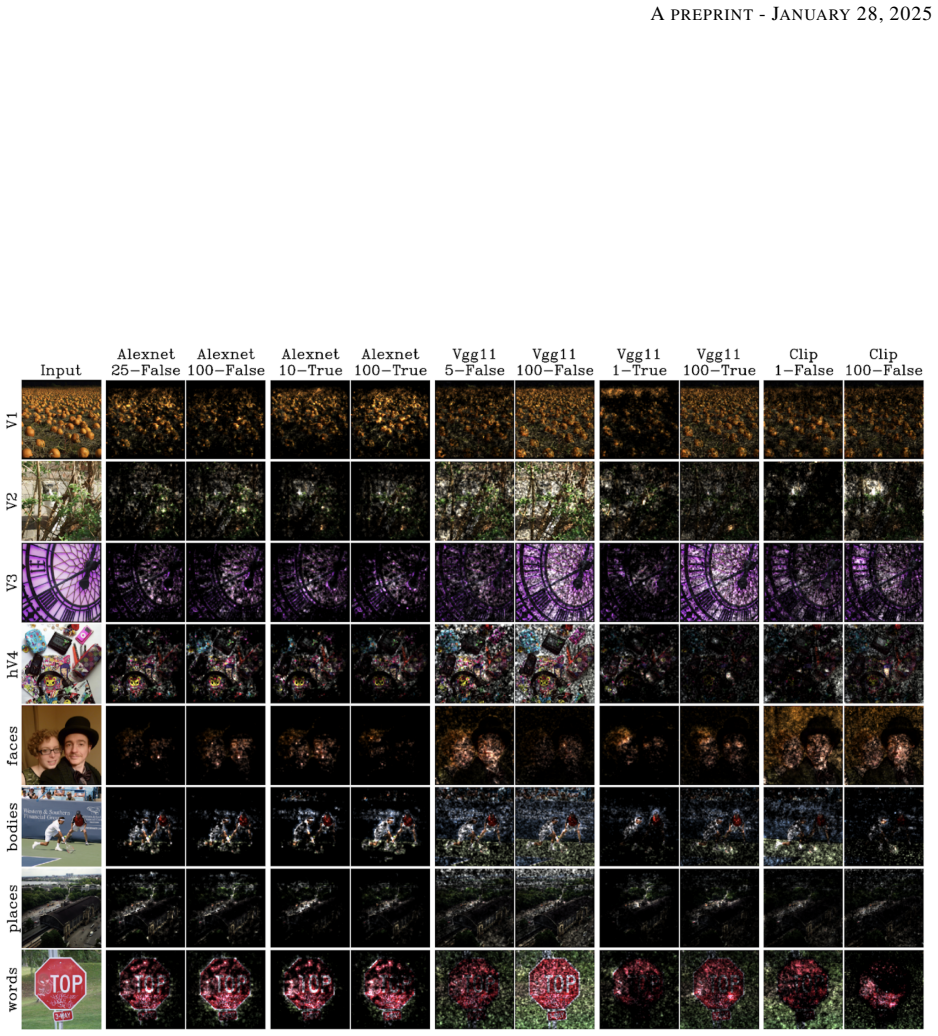
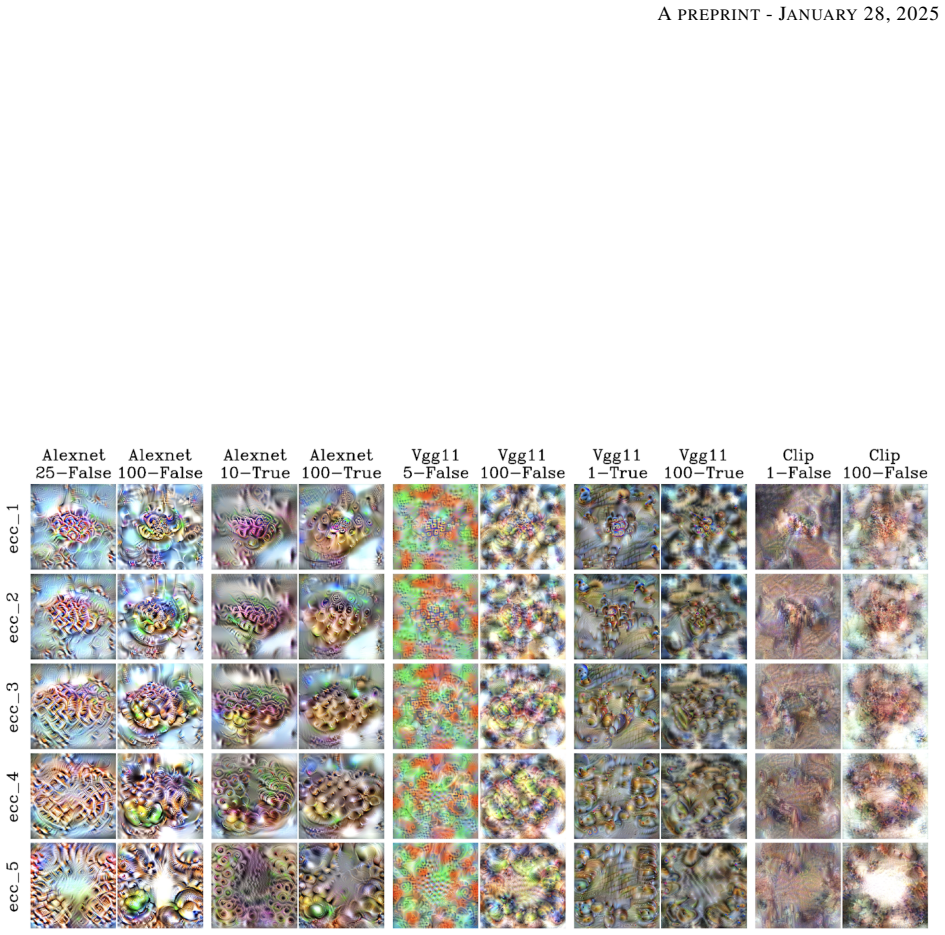
- Because different backbones reach similar accuracy through different learned features, model accuracy alone cannot identify which features the brain actually uses; mechanism-level analyses such as dreams and attention maps are necessary.
- The M0 ⊕ M1 decomposition suggests that additional data modalities, such as electrophysiology or behavior, are needed to constrain the features that are compatible with but not required by the BOLD signal.
Reading between the lines
- Inference: If the variance-ranking result generalizes, a similar pruning sweep on other fMRI encoding datasets and cortical areas should reproduce the flat accuracy curve; that would make aggressive readout pruning a cheap preprocessing step for large-scale encoding studies.
- Inference: The paper's dream images suggest a direct behavioral test: present maximally exciting images from pruned and full models to a new sample of participants; if pruned-model dreams drive BOLD responses as strongly as full-model dreams, the omitted filters are confirmed irrelevant to that signal.
- Inference: The M0 ⊕ M1 decomposition predicts representational degeneracy at the voxel level; two models with disjoint sets of kept filters could still predict the same voxel responses, which could be probed by comparing prediction consistency across random filter subsets.
- Inference: The pruning-by-variance recipe could be carried over to decoding pipelines, where shrinking the feature space before image reconstruction from fMRI might lower computational cost without hurting reconstruction quality.
Editorial analysis
A structured set of objections, weighed in public.
Referee Report
Summary. The paper trains feature-weighted receptive field encoding models on the Natural Scenes Dataset using three pretrained backbones (AlexNet, VGG11, CLIP RN50x4), with and without finetuning, and with readouts pruned by retaining the top p% of filters per layer ranked by activation standard deviation. Voxel-wise correlations are reported as a function of this pruning percentage. The main empirical claim is that reducing the readout to 1–10% of filters per layer has little effect on prediction accuracy, and that a finetuned AlexNet with 10% of filters per layer is the best-performing model, motivating a proposed 'maximally minimal' model M0. The paper also presents 'dreams' (maximally exciting images) and integrated-gradient attention maps as interpretability analyses.
Significance. If the pruning-invariance result is robust, it is an interesting and practically useful finding: it suggests that large pretrained feature spaces are substantially redundant for linear readout to BOLD responses and that much smaller readouts suffice. The released BOLDreams toolkit and the systematic comparison across backbones, finetuning, and readout width are useful contributions. The interpretability analyses (dreams, attention maps, word clouds) provide qualitative illustrations that may generate hypotheses. However, the central pruning claim is currently supported only under a single filter-ranking heuristic, without a control condition, and the statistical and data-handling caveats (exclusion of subject 7, failed RN50x4 finetuning, test-set model selection) need to be addressed before the strength of the claim is established.
major comments (5)
- [§2.2 and Figure 2] The pruning-invariance claim is established only for the standard-deviation filter ranking defined in §2.2; there is no control condition using random filter selection, readout-weight magnitude, or mutual-information-based selection at matched pruning levels. Without such controls, the flat accuracy curves could reflect the informativeness of high-variance filters rather than genuine redundancy in the neural code, and the 'maximally minimal' model M0 is defined relative to a heuristic that is never varied. Please add a random-pruning control and ideally at least one alternative ranking, reporting the variance of performance across randomly sampled filter subsets.
- [§3.1, Figures 2–4] Subject 7 is excluded from the main accuracy and histogram analyses because it 'appears to be an outlier,' but no quantitative criterion or preregistered rule for this exclusion is given. Since all central claims are averaged over subjects, post-hoc exclusion can change the conclusions. Please report results with and without subject 7, justify the exclusion statistically, or treat the exclusion explicitly as a sensitivity analysis.
- [§3.1, Figure 2] The fine-tuned RN50x4 condition is reported as producing zero or NaN correlations and is omitted from all subsequent plots, but no explanation or diagnostic is provided. This leaves the backbone-by-finetuning comparison incomplete: the claim that the finetuned AlexNet is the best-performing model is made without a successful finetuned CLIP comparison. Please document the failure mode (for example, loss divergence or learning-rate sensitivity) or provide a corrected finetuning protocol.
- [§3.1, Figure 4] The 'best percentage parameter' for each model appears to be selected using the same test set on which the final comparisons are made. This is test-set model selection and can optimistically bias the reported differences between models. Please clarify whether a separate validation split or nested cross-validation was used for selecting the percentage parameter, or report the selection results on a validation subset.
- [§3.1 and Discussion] The paper repeatedly states that pruning 'does not significantly reduce' correlation and that differences are 'marginal,' but no statistical test is reported that compares ρ_i with ρ_100 across voxels or subjects. Error bars showing standard error are not a substitute. Please provide paired tests or confidence intervals for the pruning effect, and state whether the invariance claim holds statistically for each backbone and finetuning condition.
minor comments (5)
- [Throughout] There are numerous typographical and naming inconsistencies, for example 'LeCunn' in the introduction, 'Vgg' instead of 'VGG' in several places, and inconsistent hyphenation of 'finetuned' versus 'fine tuned.' These should be corrected.
- [Equation (1)] The notation for layers is inconsistent: the text uses P_l for pixel spaces and then uses script ℓ both for the readout layers and for the pixel-space dimension in Eq. (1). Please unify the notation to avoid ambiguity.
- [§3.2, Figures 5–7] The interpretation of the dreams and word clouds is entirely qualitative and subjective. I do not object to qualitative XAI analysis, but the claims that specific backbones produce 'biologically plausible' or 'relevant' features would be strengthened by a quantitative evaluation, such as a rating study or a similarity metric between dream features and known category-selective responses.
- [Figure 3] The caption states that intensity to the left of the red line means the 100% model performs better. Since the y-axis is the maximum of ρ_i and ρ_100, the relationship between a point's location and the sign of ρ_i − ρ_100 is not immediately clear; a more direct scatter plot of ρ_i versus ρ_100 with a diagonal reference line would be easier to interpret.
- [§4, Discussion of M0] The decomposition M = M0 ⊕ M1 is introduced in prose without a formal definition of the fusion operation or a criterion for when a connection belongs to M1. As a conceptual proposal this is acceptable, but the paper should state explicitly that this is a qualitative framework rather than a construction with algorithmic content.
Circularity Check
No circularity found; the paper's claims are empirical fits evaluated on held-out data, not predictions reduced to their own inputs.
full rationale
The paper's derivation chain is empirical and self-contained. The readout is defined in Eq. 1 as a linear map from CNN features to voxel BOLD; readout weights are trained on NSD training images, and accuracy is measured as correlation with ground-truth BOLD on held-out test images. The pruning-invariance claim is an empirical result obtained with a fixed heuristic (keeping the top p% of filters per layer by training-set activation standard deviation); it is not a quantity derived from that heuristic by construction. The selection of the 'maximally minimal' model M0 is standard test-set model selection, and the paper does not relabel a fitted parameter as a prediction. Dreams/MEIs are by construction inputs that maximize the model's predicted ROI response (Eq. 3), but the paper uses them as illustrative XAI output, explicitly notes their subjectivity, and does not claim they independently confirm the pruning result; external references are cited for physiological relevance. There are no load-bearing self-citations: no reference in the bibliography is authored by the present authors, and the encoding architecture is attributed to external prior work [35]. Concerns such as the unvaried pruning rule or the post-hoc exclusion of subject 7 are robustness or validity limitations, not circularity. The central claims are therefore not equivalent to their inputs by definition, and no circular step can be exhibited.
Assumptions & free parameters
free parameters (4)
- Learning rate and training epochs =
0.0001, 10 epochs
- Percentage of filters per layer =
1, 5, 10, 15, 20, 25, 50, 75, 100
- Readout layer selection =
ReLU layers per block (Table 1)
- Best model per class =
Finetuned AlexNet at 10% filters
assumptions (3)
- domain assumption BOLD betas are a reliable proxy for neural activity and can be linearly read out from CNN features (Equation 1).
- ad hoc to paper Filters with highest standard deviation across the training set are the most informative for predicting BOLD.
- domain assumption Subject 7 is an outlier and can be excluded from most analyses.
invented entities (1)
-
Maximally minimal model M0
Cite this review
Pith. "Pith review of BOLDreams: Dreaming with pruned in-silico fMRI Encoding Models of the Visual Cortex." pith.science (2026). https://pith.science/paper/OTF5T7Z3
@misc{pith2026250114854,
  author       = {Pith},
  title        = {Pith review of: BOLDreams: Dreaming with pruned in-silico fMRI Encoding Models of the Visual Cortex},
  year         = {2026},
  howpublished = {\url{https://pith.science/paper/OTF5T7Z3}},
  note         = {Machine review of arXiv:2501.14854}
}
read the original abstract
In this article we use the Natural Scenes Dataset (NSD) to train a family of feature-weighted receptive field neural encoding models. These models use a pre-trained vision or text backbone and map extracted features to the voxel space via receptive field readouts. We comprehensively assess such models, quantifying performance changes based on using different modalities like text or images, toggling finetuning, using different pre-trained backbones, and changing the width of the readout. We also dissect each model using explainable AI (XAI) techniques, such as feature visualization via input optimization, also referred to as ``dreaming'' in the AI literature, and the integrated gradients approach to calculate implicit attention maps to illustrate which features drive the predicted signal in different brain areas. These XAI tools illustrate biologically plausible features that drive the predicted signal. Traversing the model hyperparameter space reveals the existence of a maximally minimal model, balancing simplicity while maintaining performance.
Figures


Figures from the paper (17 more)




Reference graph
Works this paper leans on
-
[1]
Convolutional Neural Networks Mimic the Hierarchy of Visual Representations in the Human Brain
Pulkit Agrawal et al. “Convolutional Neural Networks Mimic the Hierarchy of Visual Representations in the Human Brain”. en. In: ()
-
[2]
A massive 7T fMRI dataset to bridge cognitive neuroscience and artificial intelligence
Emily J. Allen et al. “A massive 7T fMRI dataset to bridge cognitive neuroscience and artificial intelligence”. en. In: Nature Neuroscience 25.1 (Jan. 2022). Number: 1 Publisher: Nature Publishing Group, pp. 116–126. ISSN : 1546-1726. DOI: 10.1038/s41593-021-00962-x . URL: https://www.nature.com/articles/s41593- 021-00962-x (visited on 12/20/2022)
-
[3]
From voxels to pixels and back: Self-supervision in natural-image reconstruction from fMRI
Roman Beliy et al. “From voxels to pixels and back: Self-supervision in natural-image reconstruction from fMRI”. In: Advances in Neural Information Processing Systems . V ol. 32. Curran Associates, Inc., 2019.URL: https : / / proceedings . neurips . cc / paper / 2019 / hash / 7d2be41b1bde6ff8fe45150c37488ebb - Abstract.html (visited on 12/20/2022)
work page 2019
-
[4]
O’Reilly Media, Inc
Steven Bird, Ewan Klein, and Edward Loper. Natural language processing with Python: analyzing text with the natural language toolkit. " O’Reilly Media, Inc.", 2009
2009
-
[5]
Diffusion Models Beat GANs on Image Synthesis
Prafulla Dhariwal and Alex Nichol. Diffusion Models Beat GANs on Image Synthesis . arXiv:2105.05233 [cs, stat]. June 2021. URL: http://arxiv.org/abs/2105.05233 (visited on 01/04/2024)
arXiv 2021
-
[6]
fMRI Brain Decoding and Its Applications in Brain–Computer Interface: A Survey
Bing Du et al. “fMRI Brain Decoding and Its Applications in Brain–Computer Interface: A Survey”. In: Brain Sciences 12.2 (Feb. 2022), p. 228. ISSN : 2076-3425. DOI: 10.3390/brainsci12020228. URL: https: //www.ncbi.nlm.nih.gov/pmc/articles/PMC8869956/ (visited on 01/04/2024)
-
[7]
Reconstructing Perceived Images From Human Brain Activities With Bayesian Deep Multiview Learning
Changde Du et al. “Reconstructing Perceived Images From Human Brain Activities With Bayesian Deep Multiview Learning”. In: IEEE Transactions on Neural Networks and Learning Systems 30.8 (Aug. 2019). Conference Name: IEEE Transactions on Neural Networks and Learning Systems, pp. 2310–2323. ISSN : 2162-2388. DOI: 10.1109/TNNLS.2018.2882456 . URL: https://ie...
-
[8]
Retinotopic organization in human visual cortex and the spatial precision of functional MRI
Stephen Engel, G.H. Glover, and Brian Wandell. “Retinotopic organization in human visual cortex and the spatial precision of functional MRI”. In: Cerebral cortex (New York, N.Y. : 1991) 7 (Apr. 1997), pp. 181–92. DOI: 10.1093/cercor/7.2.181. 17 A PREPRINT - JANUARY 28, 2025
Show all 36 references
-
[9]
Brown corpus manual, manual of information to accompany a standard corpus of present-day edited American English
W Francis and Henry Kucera. “Brown corpus manual, manual of information to accompany a standard corpus of present-day edited American English”. In: Dept. of Linguistics, Brown Univ., Tech. Rep (1979)
1979
-
[10]
Self-supervised Natural Image Reconstruction and Large-scale Semantic Classification from Brain Activity
Guy Gaziv et al. “Self-supervised Natural Image Reconstruction and Large-scale Semantic Classification from Brain Activity”. en. In: NeuroImage 254 (July 2022), p. 119121. ISSN : 1053-8119. DOI: 10 . 1016 / j . neuroimage . 2022 . 119121. URL: https : / / www . sciencedirect ....
2022
-
[11]
Human brain responses are modulated when exposed to optimized natural images or synthetically generated images
Zijin Gu et al. “Human brain responses are modulated when exposed to optimized natural images or synthetically generated images”. en. In: Communications Biology 6.1 (Oct. 2023). Number: 1 Publisher: Nature Publishing Group, pp. 1–12. ISSN : 2399-3642. DOI: 10.1038/s42003- 023-...
2023 doi
-
[12]
NeuroGen: Activation optimized image synthesis for discovery neuroscience
Zijin Gu et al. “NeuroGen: Activation optimized image synthesis for discovery neuroscience”. In: NeuroImage 247 (Feb. 2022), p. 118812. ISSN : 1053-8119. DOI: 10.1016/j.neuroimage.2021.118812 . URL: https: //www.sciencedirect.com/science/article/pii/S1053811921010831 (visited ...
2022
-
[13]
Deep Neural Networks Reveal a Gradient in the Complexity of Neural Representations across the Ventral Stream
Umut Güçlü and Marcel A. J. van Gerven. “Deep Neural Networks Reveal a Gradient in the Complexity of Neural Representations across the Ventral Stream”. en. In: Journal of Neuroscience 35.27 (July 2015). Publisher: Society for Neuroscience Section: Articles, pp. 10005–10014. IS...
2015 doi
-
[14]
Sequence regularity and geometry of orientation columns in the monkey striate cortex
D. H. Hubel and T. N. Wiesel. “Sequence regularity and geometry of orientation columns in the monkey striate cortex”. eng. In: The Journal of Comparative Neurology 158.3 (Dec. 1974), pp. 267–293. ISSN : 0021-9967. DOI: 10.1002/cne.901580304
1974 doi
-
[15]
Huettel, Allen W
Scott A. Huettel, Allen W. Song, and and Gregory McCarthy. Functional Magnetic Resonance Imaging . Third Edition, Third Edition. Oxford, New York: Oxford University Press, Aug. 2014.ISBN : 978-0-87893-627-4
2014
-
[16]
Neural style transfer: A review
Yongcheng Jing et al. “Neural style transfer: A review”. In:IEEE transactions on visualization and computer graphics 26.11 (2019), pp. 3365–3385
2019
-
[17]
Identifying natural images from human brain activity
Kendrick N. Kay et al. “Identifying natural images from human brain activity”. en. In: Nature 452.7185 (Mar. 2008). Number: 7185 Publisher: Nature Publishing Group, pp. 352–355. ISSN : 1476-4687. DOI: 10.1038/ nature06713. URL: https://www.nature.com/articles/nature06713 (visi...
2008
-
[18]
greentfrapp/lucent
Lim Swee Kiat. greentfrapp/lucent. original-date: 2020-05-09T18:07:01Z. Nov. 2024. URL: https://github. com/greentfrapp/lucent (visited on 11/10/2024)
2020
-
[19]
ImageNet Classification with Deep Convolutional Neural Networks
Alex Krizhevsky, Ilya Sutskever, and Geoffrey E Hinton. “ImageNet Classification with Deep Convolutional Neural Networks”. In:Advances in Neural Information Processing Systems. V ol. 25. Curran Associates, Inc., 2012. URL: https://proceedings.neurips.cc/paper/2012/hash/c399862...
2012
-
[20]
Gradient-Based Learning Applied to Document Recognition
Yann LeCun et al. “Gradient-Based Learning Applied to Document Recognition”. en. In: (1998). 18 A PREPRINT - JANUARY 28, 2025
1998
-
[21]
Feature Visualization
Chris Olah, Alexander Mordvintsev, and Ludwig Schubert. “Feature Visualization”. en. In: Distill 2.11 (Nov. 2017), e7. ISSN : 2476-0757. DOI: 10 . 23915 / distill . 00007. URL: https : / / distill . pub / 2017 / feature-visualization (visited on 12/20/2022)
2017
-
[22]
Natural scene reconstruction from fMRI signals using generative latent diffusion
Furkan Ozcelik and Rufin VanRullen. Natural scene reconstruction from fMRI signals using generative latent diffusion. en. arXiv:2303.05334 [cs, q-bio]. June 2023. URL: http://arxiv.org/abs/2303.05334 (visited on 01/04/2024)
2023 arXiv
-
[23]
Learning transferable visual models from natural language supervision
Alec Radford et al. “Learning transferable visual models from natural language supervision”. In: International conference on machine learning. PMLR. 2021, pp. 8748–8763
2021
-
[24]
Natural Image Reconstruction From fMRI Using Deep Learning: A Survey
Zarina Rakhimberdina et al. “Natural Image Reconstruction From fMRI Using Deep Learning: A Survey”. In: Frontiers in Neuroscience 15 (2021). ISSN : 1662-453X. URL: https://www.frontiersin.org/articles/ 10.3389/fnins.2021.795488 (visited on 01/04/2024)
2021
-
[25]
Generative adversarial networks for reconstructing natural images from brain activity
K. Seeliger et al. “Generative adversarial networks for reconstructing natural images from brain activity”. In: NeuroImage 181 (Nov. 2018), pp. 775–785. ISSN : 1053-8119. DOI: 10.1016/j.neuroimage.2018.07.043. URL: https : / / www . sciencedirect . com / science / article / pi...
2018 doi
-
[26]
Deep image reconstruction from human brain activity
Guohua Shen et al. “Deep image reconstruction from human brain activity”. en. In:PLOS Computational Biology 15.1 (Jan. 2019). Ed. by Jill O’Reilly, e1006633. ISSN : 1553-7358. DOI: 10.1371/journal.pcbi.1006633. URL: https://dx.plos.org/10.1371/journal.pcbi.1006633 (visited on ...
2019 doi
-
[27]
V ery Deep Convolutional Networks for Large-Scale Image Recognition
Karen Simonyan and Andrew Zisserman. V ery Deep Convolutional Networks for Large-Scale Image Recognition. arXiv:1409.1556. Apr. 2015. DOI: 10.48550/arXiv.1409.1556 . URL: http://arxiv.org/abs/1409. 1556 (visited on 11/10/2024)
-
[28]
arXiv:1703.01365 [cs]
Mukund Sundararajan, Ankur Taly, and Qiqi Yan.Axiomatic Attribution for Deep Networks . arXiv:1703.01365 [cs]. June 2017. URL: http://arxiv.org/abs/1703.01365 (visited on 01/05/2024)
2017 arXiv
-
[29]
Yu Takagi and Shinji Nishimoto.High-resolution image reconstruction with latent diffusion models from human brain activity. en. Pages: 2022.11.18.517004 Section: New Results. Mar. 2023. DOI: 10 . 1101 / 2022 . 11 . 18.517004. URL: https://www.biorxiv.org/content/10.1101/2022.1...
2022 doi
-
[30]
Attention is All you Need
Ashish Vaswani et al. “Attention is All you Need”. In: Advances in Neural Information Processing Systems . V ol. 30. Curran Associates, Inc., 2017.URL: https://proceedings.neurips.cc/paper_files/paper/ 2017/hash/3f5ee243547dee91fbd053c1c4a845aa-Abstract.html (visited on 11/10/2024)
2017
-
[31]
Inception loops discover what excites neurons most using deep predictive models
Edgar Y . Walker et al. “Inception loops discover what excites neurons most using deep predictive models”. en. In: Nature Neuroscience 22.12 (Dec. 2019), pp. 2060–2065. ISSN : 1097-6256, 1546-1726. DOI: 10.1038/s41593- 019-0517-x. URL: https://www.nature.com/articles/s41593-01...
2019 doi
-
[32]
Better models of human high-level visual cortex emerge from natural language supervision with a large and diverse dataset
Aria Y . Wang et al. “Better models of human high-level visual cortex emerge from natural language supervision with a large and diverse dataset”. en. In: Nature Machine Intelligence 5.12 (Dec. 2023). Number: 12 Publisher: Nature Publishing Group, pp. 1415–1426. ISSN : 2522-583...
2023 doi
-
[33]
Disentangled Representation Learning
Xin Wang et al. Disentangled Representation Learning . arXiv:2211.11695 [cs]. Aug. 2023. URL: http:// arxiv.org/abs/2211.11695 (visited on 04/02/2024)
2023 arXiv
-
[34]
Generative Adversarial Networks Conditioned on Brain Activity Reconstruct Seen Images
Ghislain St-Yves and Thomas Naselaris. “Generative Adversarial Networks Conditioned on Brain Activity Reconstruct Seen Images”. In: 2018 IEEE International Conference on Systems, Man, and Cybernetics (SMC) . ISSN: 2577-1655. Oct. 2018, pp. 1054–1061. DOI: 10.1109/SMC.2018.0018...
2018
-
[35]
The feature-weighted receptive field: an interpretable encoding model for complex feature spaces
Ghislain St-Yves and Thomas Naselaris. “The feature-weighted receptive field: an interpretable encoding model for complex feature spaces”. en. In: NeuroImage. New advances in encoding and decoding of brain signals 180 (Oct. 2018), pp. 188–202. ISSN : 1053-8119. DOI: 10 . 1016 ...
2018
-
[36]
Brain-optimized deep neural network models of human visual areas learn non-hierarchical representations
Ghislain St-Yves et al. “Brain-optimized deep neural network models of human visual areas learn non-hierarchical representations”. en. In: Nature Communications 14.1 (June 2023). Number: 1 Publisher: Nature Publishing Group, p. 3329. ISSN : 2041-1723. DOI: 10.1038/s41467-023-3...
2023 doi
Reviewed August 10, 2026 · model on record in the stance chip above.
Discussion (0). Continue with ORCID to comment.